数学家传记
艾萨克·牛顿是他那一代最伟大的英国数学家。他为微分和积分学奠定了基础。他在光学和引力方面的研究使他成为世界上最伟大的科学家之一。
艾萨克·牛顿的一生可以分为三个截然不同的时期。第一个是他的少年时代,从1643年到1669年被任命为讲席。第二个时期从1669年到1687年,是他作为剑桥大学卢卡斯讲席教授的高产时期。第三个时期(几乎与前两个时期的总和一样长)看到牛顿在伦敦担任高薪政府官员,对数学研究几乎没有进一步兴趣。
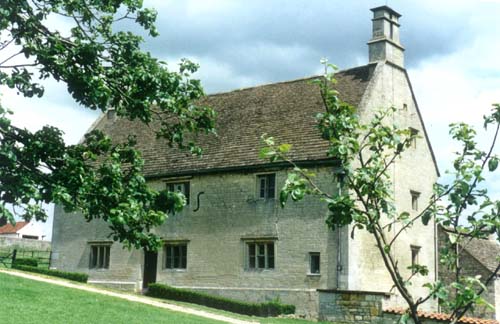
牛顿出生于林肯郡格兰瑟姆附近的伍尔索普庄园。尽管按他出生时使用的历法,他出生于1642年圣诞节,但本传记中我们给出的日期是1643年1月4日,这是“修正”后的格里高利历日期,使其与我们现行的历法一致。(格里高利历直到1752年才在英格兰采用。)牛顿出身于农民家庭,但从未见过他的父亲,其父也叫牛顿,于1642年10月去世,即儿子出生前三个月。尽管牛顿的父亲拥有财产和牲畜,使他相当富有,但他完全没有受过教育,连自己的名字都不会签。
你可以在THIS LINK看到伍尔索普庄园现在的照片。
牛顿的母亲汉娜·艾斯库在牛顿两岁时,改嫁给了附近村庄北威瑟姆的教堂牧师巴纳巴斯·史密斯。这个年幼的孩子随后被留在伍尔索普由祖母玛杰里·艾斯库照顾。基本上被当作孤儿对待,牛顿没有幸福的童年。他的外祖父詹姆斯·艾斯库在牛顿晚年从未被提及,而詹姆斯在男孩十岁时所立的遗嘱中什么也没留给牛顿,这表明两人之间没有感情。毫无疑问,牛顿对母亲和继父巴纳巴斯·史密斯感到非常痛苦。在十九岁检查自己的罪过时,牛顿列出了:-
威胁我的父亲和母亲史密斯,要烧死他们和他们的房子。
继父于1653年去世后,牛顿生活在一个大家庭中,包括他的母亲、祖母、一个同母异父的兄弟和两个同母异父的姐妹。此后不久,牛顿开始就读于格兰瑟姆的自由文法学校。虽然这离他家只有五英里,牛顿寄宿在格兰瑟姆的克拉克家。然而他在学业上似乎没有什么前途。他的学校报告称他“懒惰”和“不专心”。他的母亲此时已是一位拥有相当财富和财产的女士,认为她的长子是管理她的事务和财产的正确人选。牛顿被从学校带走,但很快表明他没有管理财产的天赋或兴趣。
一位叔父,William Ayscough,决定牛顿应该准备进入大学,并说服了他的母亲这是正确的做法,牛顿于1660年获准回到格兰瑟姆的自由文法学校完成他的学校教育。这一次他寄宿在斯托克斯家,斯托克斯是学校的校长,看来,尽管有说法称他先前没有表现出学术前途,牛顿必定已使周围的一些人相信他有学术前途。一些证据表明斯托克斯也说服了牛顿的母亲让他进入大学,因此很可能牛顿在学校的第一个时期表现出的前途比学校报告所显示的要大。另一条证据来自上面提到的牛顿的罪过清单。他把自己的一个罪过列为:-
……把心思放在金钱、学问和享乐上胜过放在你身上……
这告诉我们牛顿必定对学问有热情。
我们不知道牛顿为进入大学准备了什么,但斯托克斯是个能干的人,几乎肯定给牛顿进行了私人辅导和良好的基础训练。没有证据表明他学过任何数学,但我们不能排除斯托克斯向他介绍了欧几里得的Elements,斯托克斯完全有能力教授这本书(尽管下文提到的证据表明牛顿在1663年之前没有读过欧几里得)。关于牛顿在学校表现出的机械才能,轶事层出不穷,还有故事讲述他制作机器模型的技巧,特别是钟表和风车。然而,当传记作者寻找名人的信息时,人们总是倾向于报告他们认为别人期望听到的内容,这些轶事可能只是后来那些认为世界上最著名的科学家在学校就应该具备这些技能的人编造出来的。
牛顿于1661年6月5日进入他叔叔的旧学院——剑桥大学三一学院。他比大多数同学年龄大,但尽管他的母亲经济富裕,他还是以减费生(Sizar)的身份入学。剑桥的工读生是获得学院费用津贴的学生,以换取为其他学生服务。他作为工读生的地位确实有些模糊,因为他似乎与“较好阶层”的学生交往,而不是其他工读生。韦斯特福尔(见[23]或[24])提出,牛顿可能有一位远亲汉弗莱·巴宾顿作为他的赞助人,汉弗莱·巴宾顿是三一学院的会士。这个合理的解释与已知情况很吻合,意味着他的母亲没有像他的一些传记作者声称的那样不必要地让他受苦。
牛顿在剑桥的目标是获得法律学位。剑桥的教学由亚里士多德的哲学主导,但在课程的第三年允许一定的学习自由。牛顿学习了勒内·笛卡儿、皮埃尔·伽桑狄、托马斯·霍布斯的哲学,尤其是罗伯特·波义耳。伽利略的哥白尼天体力学的力学吸引了他,他还研究了约翰内斯·开普勒的Optics。他把自己的想法记录在一本他命名为Quaestiones Quaedam Philosophicae Ⓣ(某些哲学问题)的书中。这是一份引人入胜的记述,说明牛顿的思想在1664年前后已经如何形成。他在正文开头写了一句拉丁文,意思是“柏拉图是我的朋友,亚里士多德是我的朋友,但我最好的朋友是真理”,这表明他从早期就是一个自由思想者。
牛顿是如何接触到当时最先进的数学文本的,则不太清楚。根据亚伯拉罕·棣莫弗,牛顿对数学的兴趣始于1663年秋天,当时他在剑桥的一个集市上买了一本占星术书,发现他无法理解其中的数学。他试图读一本三角学书,发现自己缺乏几何学知识,于是决定读伊萨克·巴罗版的欧几里得的Elements。最初几个结果太容易了,他几乎放弃,但他:-
……当他读到同底且在同二平行线之间的平行四边形相等时,改变了主意。
回到开头,牛顿怀着新的敬意读完了整本书。然后他转向威廉·欧垂的Clavis Mathematica Ⓣ(数学的钥匙)和勒内·笛卡儿的La Géométrie Ⓣ(几何学)。弗朗索瓦·韦达的新代数和解析几何由牛顿从弗兰斯·范斯霍滕版的弗朗索瓦·韦达文集读到,该文集出版于1646年。他在这段时间研究的其他主要数学著作是弗兰斯·范斯霍滕新出版的主要著作Geometria a Renato Des Cartes Ⓣ(勒内·笛卡儿的几何学),该书于1659-1661年分两卷出版。这本书包含了弗兰斯·范斯霍滕的三位弟子德·维特、Johan Hudde和Hendrick van Heuraet的重要附录。牛顿还研究了约翰·沃利斯的Algebra,看来他最初的原创数学工作来自他对这一文本的研究。他读了约翰·沃利斯求与抛物线等面积正方形的方法,以及使用不可分量的双曲线。牛顿对约翰·沃利斯对级数的处理做了笔记,但也设计了自己的定理证明,写道:-
约翰·沃利斯是这样做的,但也可以这样做……
人们很容易认为,牛顿的才华是在1663年伊萨克·巴罗来到剑桥担任卢卡斯讲席、并成为三一学院会士时开始显露的。的确,这一时间与牛顿开始进行深入数学研究的时间相符。然而,看来1663年这个日期只是巧合,直到若干年后,伊萨克·巴罗才在自己的学生中认出了这位数学天才。
尽管有一些证据表明他的进展并不特别好,牛顿还是在1664年4月28日被选为学者,并于1665年4月获得学士学位。看来他的科学天才仍未显现,但当1665年夏天瘟疫使大学关闭,他不得不回到林肯郡时,这种天才突然显现了。在那里,在不到两年的时间里,当牛顿还不到25岁时,他开始了数学、光学、物理学和天文学方面的革命性进展。
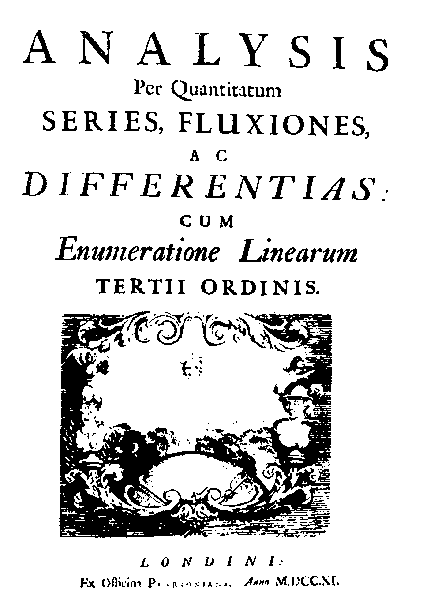
牛顿留在家中时,为微分和积分奠定了基础,比哥特弗里德·威廉·莱布尼茨独立发现它们早了几年。他称之为“流数法”,基于他的关键洞见:函数的积分只是微分的逆过程。牛顿把微分作为基本运算,产生了简单的分析方法,统一了以前为解决看似无关的问题而发展起来的许多独立技巧,例如求面积、切线、曲线长度以及函数的极大值和极小值。牛顿的De Methodis Serierum et Fluxionum Ⓣ(论级数方法与流数)写于1671年,但牛顿未能将其出版,直到1736年约翰·科尔森制作了英文译本才付印。
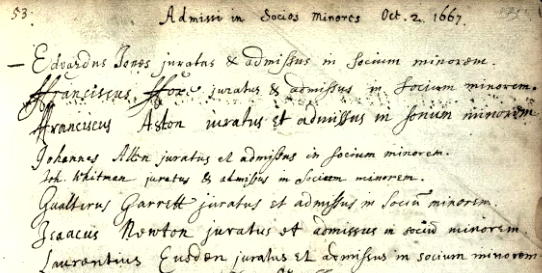
你可以在1667年10月THIS LINK的三一学院入学登记册上看到牛顿的签名。
1667年瘟疫过后剑桥大学重新开放时,牛顿自荐为会士候选人。10月,他当选为三一学院的初级会士,但在获得硕士学位后,他于1668年7月当选为高级会士,这使他得以在会士餐桌用餐。1669年7月,伊萨克·巴罗试图确保牛顿的数学成就为世人所知。他把牛顿的文本De Analysi寄给伦敦的约翰·柯林斯,并写道:
[艾萨克·牛顿]前几天给我带来了一些论文,其中他写下了计算量的大小的各种方法,类似于尼古拉斯·墨卡托先生关于双曲线的方法,但非常普遍;还有解方程的方法;我想这会使你满意;我下次会把它们寄给你。
约翰·柯林斯与当时所有主要数学家都有通信,因此伊萨克·巴罗的举动本应使牛顿迅速得到认可。约翰·柯林斯向皇家学会主席威廉·布朗克展示了牛顿的结果(经作者允许),但此后牛顿要求归还他的手稿。约翰·柯林斯无法给出详细说明,但de Sluze和詹姆斯·格雷果里通过约翰·柯林斯了解到一些牛顿的工作。伊萨克·巴罗于1669年辞去卢卡斯讲席,以献身神学,并推荐由牛顿(当时年仅27岁)接替他的职位。此后不久,牛顿访问伦敦,并两次与约翰·柯林斯会面,但正如他写信给詹姆斯·格雷果里时所说:
……由于与他没有更多交情,我认为不宜催促他交流任何东西。
牛顿担任卢卡斯讲席教授后的第一部著作是关于光学的,这也是他于1670年1月开始的第一次授课课程的主题。他在两个瘟疫年份期间得出结论:白光不是一种简单的实体。自亚里士多德以来的每一位科学家都相信白光是基本的单一实体,但望远镜镜片中的色差使牛顿确信并非如此。当他让一束细阳光通过玻璃棱镜时,牛顿注意到了形成的光谱颜色。
他论证说,白光实际上是许多不同类型的射线的混合物,这些射线以略微不同的角度折射,每种不同类型的射线产生不同的光谱颜色。牛顿被这一推理引向错误的结论:使用折射透镜的望远镜总会遭受色差。因此,他提议并建造了一台反射望远镜。
1672年,牛顿在捐赠了一台反射望远镜后当选为皇家学会会士。同样在1672年,牛顿在Philosophical Transactions of the Royal Society上发表了他的第一篇关于光和颜色的科学论文。这篇论文普遍受到好评,但罗伯特·胡克和克里斯蒂安·惠更斯反对牛顿试图仅通过实验证明光由小粒子的运动而非波组成。他的出版物所受到的接待丝毫没有改善牛顿向世界公布其成果的态度。他总是被拉向两个方向,他的天性中有些东西想要名声和认可,而另一面则害怕批评,避免被批评的最简单方法就是什么都不发表。当然可以说他对批评的反应是不理性的,当然他因自己的观点而公开羞辱罗伯特·胡克的目标是不正常的。然而,也许因为牛顿已经享有很高的声誉,他的微粒说一直统治到19世纪波动说复兴。
1675年,当罗伯特·胡克声称牛顿窃取了他的一些光学成果时,牛顿与罗伯特·胡克的关系进一步恶化。尽管两人通过互致礼貌信件而和解,但牛顿变得内向,远离了他与罗伯特·胡克作为其领袖之一联系在一起的皇家学会。他将光学研究的完整记述的出版推迟到1703年罗伯特·胡克去世之后。牛顿的Opticks于1704年问世。它论述了光和颜色的理论以及
为了解释他的一些观察,他不得不将光的波动理论与他的微粒理论结合使用。
另一次争论,这次是在列日与英国耶稣会士关于他的颜色理论,导致了激烈的信件往来,然后在1678年,牛顿似乎遭受了神经崩溃。他的母亲在次年去世,他进一步退缩到自己的壳中,多年来尽可能少与人交往。
牛顿最伟大的成就是他在物理学和天体力学方面的工作,最终形成了万有引力理论。到1666年,牛顿已经有了他的运动三定律的早期版本。他还发现了给出在圆形路径上匀速运动的物体的离心力的定律。然而,他对圆周运动的力学没有正确的理解。
牛顿在1666年的新想法是设想地球的引力影响月球,抵消其离心力。根据他的离心力定律和约翰内斯·开普勒的行星运动第三定律,牛顿推导出了平方反比定律。
1679年,牛顿与罗伯特·胡克通信,后者曾写信给牛顿声称:-
……吸引力总是与到中心的距离的平方成反比……
M Nauenberg对接下来发生的事件作了叙述:-
在他1679年与罗伯特·胡克通信之后,据牛顿自己说,他找到了一个证明,表明约翰内斯·开普勒的面积定律是向心力作用的结果,他还证明了如果轨道曲线是在中心力作用下的椭圆,那么力对距离的径向依赖关系是平方反比。
这一发现显示了约翰内斯·开普勒第二定律的物理意义。
1684年,爱德蒙·哈雷厌倦了罗伯特·胡克的吹嘘[M Nauenberg]:-
……问牛顿,在平方反比力作用下,物体遵循什么轨道,牛顿立即回答说,那将是一个椭圆。然而,在《论运动》中,他只给出了逆定理的证明,即如果轨道是椭圆,则力是平方反比的。平方反比力意味着conic section轨道的证明,在《原理》第二版和第三版第一编命题13的推论1中有所概述,但在第一版中没有。
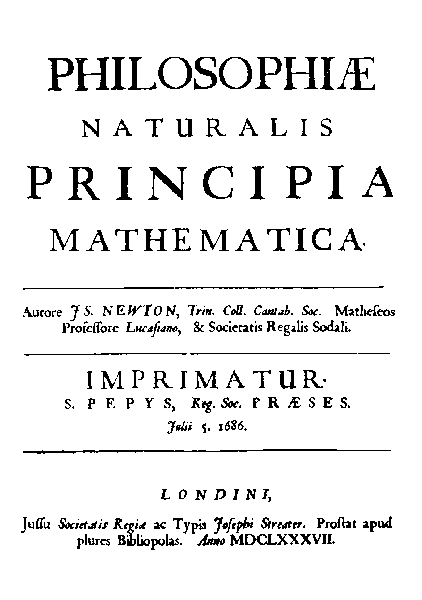
爱德蒙·哈雷说服牛顿全面论述他的新物理学及其在天文学中的应用。一年多以后(1687年),牛顿出版了Philosophiae naturalis principia mathematicaⓉ(自然哲学的数学原理),或者如人们一直所称的Principia。
Principia被公认为有史以来最伟大的科学著作。牛顿分析了物体在阻力和非阻力介质中在向心力作用下的运动。结果被应用于轨道天体、抛射体、摆以及地球附近的自由落体。他进一步证明了行星被一个与距离平方成反比的力吸引向太阳,并推广到所有天体相互吸引。
进一步的推广使牛顿得出了万有引力定律:-
……所有物质都吸引所有其他物质,其力与它们质量的乘积成正比,与它们之间距离的平方成反比。
牛顿解释了广泛先前无关的现象:彗星的偏心轨道、潮汐及其变化、地轴进动,以及月球受太阳引力扰动而产生的运动。这项工作使牛顿成为国际科学研究的领导者。大陆科学家当然不接受超距作用的观念,并继续相信勒内·笛卡儿的涡旋理论,即力通过接触起作用。然而,这并没有阻止对牛顿技术专长的普遍钦佩。
詹姆斯·韦德尔·亚历山大于1685年2月6日成为大不列颠国王。他在1669年皈依罗马天主教会,但当他登基时,他得到了圣公会教徒和天主教徒的大力支持。然而叛乱兴起,詹姆斯将其镇压,但他开始不信任新教徒,并开始任命罗马天主教军官进入军队。他随后更进一步,只任命天主教徒担任法官和国家官员。每当牛津或剑桥的职位空缺时,国王就任命一名罗马天主教徒填补。牛顿是坚定的新教徒,强烈反对他所认为的对剑桥大学的攻击。
当国王试图坚持让一位本笃会修士不经任何考试或宣誓就获得学位时,牛顿写信给副校长:-
要勇敢,要坚定地遵守法律,你就不会失败。
副校长采纳了牛顿的建议,结果被免职。然而牛顿继续为这一案件据理力争,准备文件供大学辩护之用。不过,许多领袖已邀请奥兰治的威廉率军来英格兰击败詹姆斯。威廉于1688年11月登陆,詹姆斯发现新教徒已离开他的军队,便逃往法国。剑桥大学于1689年1月15日选举牛顿——此时他已因坚决捍卫大学而闻名——作为其两名代表之一参加协商议会。该议会宣布詹姆斯已退位,并于1689年2月将王位授予威廉和玛丽。牛顿正处于声望的顶峰——被视为大学的领袖和世界上最杰出的数学家之一。然而,他当选议员这件事可能让他看到,伦敦有一种生活可能比剑桥的学术界对他更有吸引力。
在1693年第二次神经崩溃后,牛顿退出了研究。他的传记作者们讨论过这次崩溃的原因,并提出了许多理论:炼金术实验导致的化学中毒;对研究的挫败感;与法蒂奥·德·杜伊列尔——一位居住在伦敦的瑞士裔数学家——个人友谊的结束;以及由宗教信仰引起的问题。牛顿自己归咎于睡眠不足,但这几乎肯定是疾病的症状而非原因。似乎没有什么理由认为这种病不是抑郁症——一种他一生大部分时间必定遭受的精神疾病,或许因我们刚刚列举的一些事件而加重。
牛顿决定离开剑桥去伦敦担任政府职务,于1696年成为皇家铸币厂监管,1699年成为厂长。然而,直到1701年他才辞去剑桥的职位。作为铸币厂厂长,加上他的地产收入,我们看到牛顿成了一个非常富有的人。对许多人来说,像铸币厂厂长这样的职位只会被视为对其科学成就的奖励。牛顿并不这样看待,他对铸币厂的工作做出了重大贡献。他带领铸币厂度过了重新铸币的困难时期,并特别积极地采取措施防止硬币伪造。
1703年,他当选为皇家学会院长,每年连任直至去世。1705年,他被安妮女王封为爵士,是第一位因工作获此荣誉的科学家。然而,他生命的最后一段并不轻松,在许多方面都充斥着与哥特弗里德·威廉·莱布尼茨关于谁发明了微积分的争论。
鉴于牛顿一生中受到批评时表现出的愤怒,他对哥特弗里德·威廉·莱布尼茨大发非理性脾气并不奇怪。我们已在哥特弗里德·威廉·莱布尼茨的传记中详细描述了这场争论,读者可参阅该文了解详情。也许这里唯一值得提及的是牛顿如何利用他作为皇家学会院长的职位。他以这一身份任命了一个“公正”的委员会来决定是他还是哥特弗里德·威廉·莱布尼茨是微积分的发明者。他撰写了委员会的官方报告(当然不是以他的名义发表),由皇家学会出版,然后他又写了一篇评论(同样匿名),发表在Philosophical Transactions of the Royal Society上。
牛顿的助手威廉·惠斯顿亲眼见过他发怒。他写道:-
牛顿是我所知道的最胆怯、最谨慎、最多疑的性情。
Isaac Newton's life can be divided into three quite distinct periods. The first is his boyhood days from 1643 up to his appointment to a chair in 1669. The second period from 1669 to 1687 was the highly productive period in which he was Lucasian professor at Cambridge. The third period (nearly as long as the other two combined) saw Newton as a highly paid government official in London with little further interest in mathematical research.
Isaac Newton was born in the manor house of Woolsthorpe, near Grantham in Lincolnshire. Although by the calendar in use at the time of his birth he was born on Christmas Day 1642, we give the date of 4 January 1643 in this biography which is the "corrected" Gregorian calendar date bringing it into line with our present calendar. (The Gregorian calendar was not adopted in England until 1752.) Isaac Newton came from a family of farmers but never knew his father, also named Isaac Newton, who died in October 1642, three months before his son was born. Although Isaac's father owned property and animals which made him quite a wealthy man, he was completely uneducated and could not sign his own name.
You can see a picture of Woolsthorpe Manor as it is now at THIS LINK.
Isaac's mother Hannah Ayscough remarried Barnabas Smith the minister of the church at North Witham, a nearby village, when Isaac was two years old. The young child was then left in the care of his grandmother Margery Ayscough at Woolsthorpe. Basically treated as an orphan, Isaac did not have a happy childhood. His grandfather James Ayscough was never mentioned by Isaac in later life and the fact that James left nothing to Isaac in his will, made when the boy was ten years old, suggests that there was no love lost between the two. There is no doubt that Isaac felt very bitter towards his mother and his step-father Barnabas Smith. When examining his sins at age nineteen, Isaac listed:-
Threatening my father and mother Smith to burn them and the house over them.
Upon the death of his stepfather in 1653, Newton lived in an extended family consisting of his mother, his grandmother, one half-brother, and two half-sisters. From shortly after this time Isaac began attending the Free Grammar School in Grantham. Although this was only five miles from his home, Isaac lodged with the Clark family at Grantham. However he seems to have shown little promise in academic work. His school reports described him as 'idle' and 'inattentive'. His mother, by now a lady of reasonable wealth and property, thought that her eldest son was the right person to manage her affairs and her estate. Isaac was taken away from school but soon showed that he had no talent, or interest, in managing an estate.
An uncle, William Ayscough, decided that Isaac should prepare for entering university and, having persuaded his mother that this was the right thing to do, Isaac was allowed to return to the Free Grammar School in Grantham in 1660 to complete his school education. This time he lodged with Stokes, who was the headmaster of the school, and it would appear that, despite suggestions that he had previously shown no academic promise, Isaac must have convinced some of those around him that he had academic promise. Some evidence points to Stokes also persuading Isaac's mother to let him enter university, so it is likely that Isaac had shown more promise in his first spell at the school than the school reports suggest. Another piece of evidence comes from Isaac's list of sins referred to above. He lists one of his sins as:-
... setting my heart on money, learning, and pleasure more than Thee ...
which tells us that Isaac must have had a passion for learning.
We know nothing about what Isaac learnt in preparation for university, but Stokes was an able man and almost certainly gave Isaac private coaching and a good grounding. There is no evidence that he learnt any mathematics, but we cannot rule out Stokes introducing him to Euclid's Elements which he was well capable of teaching (although there is evidence mentioned below that Newton did not read Euclid before 1663). Anecdotes abound about a mechanical ability which Isaac displayed at the school and stories are told of his skill in making models of machines, in particular of clocks and windmills. However, when biographers seek information about famous people there is always a tendency for people to report what they think is expected of them, and these anecdotes may simply be made up later by those who felt that the most famous scientist in the world ought to have had these skills at school.
Newton entered his uncle's old College, Trinity College Cambridge, on 5 June 1661. He was older than most of his fellow students but, despite the fact that his mother was financially well off, he entered as a sizar. A sizar at Cambridge was a student who received an allowance toward college expenses in exchange for acting as a servant to other students. There is certainly some ambiguity in his position as a sizar, for he seems to have associated with "better class" students rather than other sizars. Westfall (see [23] or [24]) has suggested that Newton may have had Humphrey Babington, a distant relative who was a Fellow of Trinity, as his patron. This reasonable explanation would fit well with what is known and mean that his mother did not subject him unnecessarily to hardship as some of his biographers claim.
Newton's aim at Cambridge was a law degree. Instruction at Cambridge was dominated by the philosophy of Aristotle but some freedom of study was allowed in the third year of the course. Newton studied the philosophy of Descartes, Gassendi, Hobbes, and in particular Boyle. The mechanics of the Copernican astronomy of Galileo attracted him and he also studied Kepler's Optics. He recorded his thoughts in a book which he entitled Quaestiones Quaedam Philosophicae Ⓣ. It is a fascinating account of how Newton's ideas were already forming around 1664. He headed the text with a Latin statement meaning "Plato is my friend, Aristotle is my friend, but my best friend is truth" showing himself a free thinker from an early stage.
How Newton was introduced to the most advanced mathematical texts of his day is slightly less clear. According to de Moivre, Newton's interest in mathematics began in the autumn of 1663 when he bought an astrology book at a fair in Cambridge and found that he could not understand the mathematics in it. Attempting to read a trigonometry book, he found that he lacked knowledge of geometry and so decided to read Barrow's edition of Euclid's Elements. The first few results were so easy that he almost gave up but he:-
... changed his mind when he read that parallelograms upon the same base and between the same parallels are equal.
Returning to the beginning, Newton read the whole book with a new respect. He then turned to Oughtred's Clavis Mathematica Ⓣ and Descartes' La Géométrie Ⓣ. The new algebra and analytical geometry of Viète was read by Newton from Frans van Schooten's edition of Viète's collected works published in 1646. Other major works of mathematics which he studied around this time was the newly published major work by van Schooten Geometria a Renato Des Cartes Ⓣ which appeared in two volumes in 1659-1661. The book contained important appendices by three of van Schooten's disciples, Jan de Witt, Johan Hudde, and Hendrick van Heuraet. Newton also studied Wallis's Algebra and it appears that his first original mathematical work came from his study of this text. He read Wallis's method for finding a square of equal area to a parabola and a hyperbola which used indivisibles. Newton made notes on Wallis's treatment of series but also devised his own proofs of the theorems writing:-
Thus Wallis doth it, but it may be done thus ...
It would be easy to think that Newton's talent began to emerge on the arrival of Barrow to the Lucasian chair at Cambridge in 1663 when he became a Fellow at Trinity College. Certainly the date matches the beginnings of Newton's deep mathematical studies. However, it would appear that the 1663 date is merely a coincidence and that it was only some years later that Barrow recognised the mathematical genius among his students.
Despite some evidence that his progress had not been particularly good, Newton was elected a scholar on 28 April 1664 and received his bachelor's degree in April 1665. It would appear that his scientific genius had still not emerged, but it did so suddenly when the plague closed the University in the summer of 1665 and he had to return to Lincolnshire. There, in a period of less than two years, while Newton was still under 25 years old, he began revolutionary advances in mathematics, optics, physics, and astronomy.
While Newton remained at home he laid the foundations for differential and integral calculus, several years before its independent discovery by Leibniz. The 'method of fluxions', as he termed it, was based on his crucial insight that the integration of a function is merely the inverse procedure to differentiating it. Taking differentiation as the basic operation, Newton produced simple analytical methods that unified many separate techniques previously developed to solve apparently unrelated problems such as finding areas, tangents, the lengths of curves and the maxima and minima of functions. Newton's De Methodis Serierum et Fluxionum Ⓣ was written in 1671 but Newton failed to get it published and it did not appear in print until John Colson produced an English translation in 1736.
You can see Newton's signature on the Trinity College admissions book in October 1667 at THIS LINK.
When the University of Cambridge reopened after the plague in 1667, Newton put himself forward as a candidate for a fellowship. In October he was elected to a minor fellowship at Trinity College but, after being awarded his Master's Degree, he was elected to a major fellowship in July 1668 which allowed him to dine at the Fellows' Table. In July 1669 Barrow tried to ensure that Newton's mathematical achievements became known to the world. He sent Newton's text De Analysi to Collins in London writing:-
[Newton] brought me the other day some papers, wherein he set down methods of calculating the dimensions of magnitudes like that of Mr Mercator concerning the hyperbola, but very general; as also of resolving equations; which I suppose will please you; and I shall send you them by the next.
Collins corresponded with all the leading mathematicians of the day so Barrow's action should have led to quick recognition. Collins showed Brouncker, the President of the Royal Society, Newton's results (with the author's permission) but after this Newton requested that his manuscript be returned. Collins could not give a detailed account but de Sluze and Gregory learnt something of Newton's work through Collins. Barrow resigned the Lucasian chair in 1669 to devote himself to divinity, recommending that Newton (still only 27 years old) be appointed in his place. Shortly after this Newton visited London and twice met with Collins but, as he wrote to Gregory:-
... having no more acquaintance with him I did not think it becoming to urge him to communicate anything.
Newton's first work as Lucasian Professor was on optics and this was the topic of his first lecture course begun in January 1670. He had reached the conclusion during the two plague years that white light is not a simple entity. Every scientist since Aristotle had believed that white light was a basic single entity, but the chromatic aberration in a telescope lens convinced Newton otherwise. When he passed a thin beam of sunlight through a glass prism Newton noted the spectrum of colours that was formed.
He argued that white light is really a mixture of many different types of rays which are refracted at slightly different angles, and that each different type of ray produces a different spectral colour. Newton was led by this reasoning to the erroneous conclusion that telescopes using refracting lenses would always suffer chromatic aberration. He therefore proposed and constructed a reflecting telescope.
In 1672 Newton was elected a fellow of the Royal Society after donating a reflecting telescope. Also in 1672 Newton published his first scientific paper on light and colour in the Philosophical Transactions of the Royal Society. The paper was generally well received but Hooke and Huygens objected to Newton's attempt to prove, by experiment alone, that light consists of the motion of small particles rather than waves. The reception that his publication received did nothing to improve Newton's attitude to making his results known to the world. He was always pulled in two directions, there was something in his nature which wanted fame and recognition yet another side of him feared criticism and the easiest way to avoid being criticised was to publish nothing. Certainly one could say that his reaction to criticism was irrational, and certainly his aim to humiliate Hooke in public because of his opinions was abnormal. However, perhaps because of Newton's already high reputation, his corpuscular theory reigned until the wave theory was revived in the 19th century.
Newton's relations with Hooke deteriorated further when, in 1675, Hooke claimed that Newton had stolen some of his optical results. Although the two men made their peace with an exchange of polite letters, Newton turned in on himself and away from the Royal Society which he associated with Hooke as one of its leaders. He delayed the publication of a full account of his optical researches until after the death of Hooke in 1703. Newton's Opticks appeared in 1704. It dealt with the theory of light and colour and with
To explain some of his observations he had to use a wave theory of light in conjunction with his corpuscular theory.
Another argument, this time with the English Jesuits in Liège over his theory of colour, led to a violent exchange of letters, then in 1678 Newton appears to have suffered a nervous breakdown. His mother died in the following year and he withdrew further into his shell, mixing as little as possible with people for a number of years.
Newton's greatest achievement was his work in physics and celestial mechanics, which culminated in the theory of universal gravitation. By 1666 Newton had early versions of his three laws of motion. He had also discovered the law giving the centrifugal force on a body moving uniformly in a circular path. However he did not have a correct understanding of the mechanics of circular motion.
Newton's novel idea of 1666 was to imagine that the Earth's gravity influenced the Moon, counter- balancing its centrifugal force. From his law of centrifugal force and Kepler's third law of planetary motion, Newton deduced the inverse-square law.
In 1679 Newton corresponded with Hooke who had written to Newton claiming:-
... that the Attraction always is in a duplicate proportion to the Distance from the Center Reciprocall ...
M Nauenberg writes an account of the next events:-
After his 1679 correspondence with Hooke, Newton, by his own account, found a proof that Kepler's areal law was a consequence of centripetal forces, and he also showed that if the orbital curve is an ellipse under the action of central forces then the radial dependence of the force is inverse square with the distance from the centre.
This discovery showed the physical significance of Kepler's second law.
In 1684 Halley, tired of Hooke's boasting [M Nauenberg]:-
... asked Newton what orbit a body followed under an inverse square force, and Newton replied immediately that it would be an ellipse. However in 'De Motu..' he only gave a proof of the converse theorem that if the orbit is an ellipse the force is inverse square. The proof that inverse square forces imply conic section orbits is sketched in Cor. 1 to Prop. 13 in Book 1 of the second and third editions of the 'Principia', but not in the first edition.
Halley persuaded Newton to write a full treatment of his new physics and its application to astronomy. Over a year later (1687) Newton published the Philosophiae naturalis principia mathematica Ⓣ or Principia as it is always known.
The Principia is recognised as the greatest scientific book ever written. Newton analysed the motion of bodies in resisting and non-resisting media under the action of centripetal forces. The results were applied to orbiting bodies, projectiles, pendulums, and free-fall near the Earth. He further demonstrated that the planets were attracted toward the Sun by a force varying as the inverse square of the distance and generalised that all heavenly bodies mutually attract one another.
Further generalisation led Newton to the law of universal gravitation:-
... all matter attracts all other matter with a force proportional to the product of their masses and inversely proportional to the square of the distance between them.
Newton explained a wide range of previously unrelated phenomena: the eccentric orbits of comets, the tides and their variations, the precession of the Earth's axis, and motion of the Moon as perturbed by the gravity of the Sun. This work made Newton an international leader in scientific research. The Continental scientists certainly did not accept the idea of action at a distance and continued to believe in Descartes' vortex theory where forces work through contact. However this did not stop the universal admiration for Newton's technical expertise.
James II became king of Great Britain on 6 February 1685. He had become a convert to the Roman Catholic church in 1669 but when he came to the throne he had strong support from Anglicans as well as Catholics. However rebellions arose, which James put down but he began to distrust Protestants and began to appoint Roman Catholic officers to the army. He then went further, appointing only Catholics as judges and officers of state. Whenever a position at Oxford or Cambridge became vacant, the king appointed a Roman Catholic to fill it. Newton was a staunch Protestant and strongly opposed to what he saw as an attack on the University of Cambridge.
When the King tried to insist that a Benedictine monk be given a degree without taking any examinations or swearing the required oaths, Newton wrote to the Vice-Chancellor:-
Be courageous and steady to the Laws and you cannot fail.
The Vice-Chancellor took Newton's advice and was dismissed from his post. However Newton continued to argue the case strongly preparing documents to be used by the University in its defence. However William of Orange had been invited by many leaders to bring an army to England to defeat James. William landed in November 1688 and James, finding that Protestants had left his army, fled to France. The University of Cambridge elected Newton, now famous for his strong defence of the university, as one of their two members to the Convention Parliament on 15 January 1689. This Parliament declared that James had abdicated and in February 1689 offered the crown to William and Mary. Newton was at the height of his standing - seen as a leader of the university and one of the most eminent mathematicians in the world. However, his election to Parliament may have been the event which let him see that there was a life in London which might appeal to him more than the academic world in Cambridge.
After suffering a second nervous breakdown in 1693, Newton retired from research. The reasons for this breakdown have been discussed by his biographers and many theories have been proposed: chemical poisoning as a result of his alchemy experiments; frustration with his researches; the ending of a personal friendship with Fatio de Duillier, a Swiss-born mathematician resident in London; and problems resulting from his religious beliefs. Newton himself blamed lack of sleep but this was almost certainly a symptom of the illness rather than the cause of it. There seems little reason to suppose that the illness was anything other than depression, a mental illness he must have suffered from throughout most of his life, perhaps made worse by some of the events we have just listed.
Newton decided to leave Cambridge to take up a government position in London becoming Warden of the Royal Mint in 1696 and Master in 1699. However, he did not resign his positions at Cambridge until 1701. As Master of the Mint, adding the income from his estates, we see that Newton became a very rich man. For many people a position such as Master of the Mint would have been treated as simply a reward for their scientific achievements. Newton did not treat it as such and he made a strong contribution to the work of the Mint. He led it through the difficult period of recoinage and he was particularly active in measures to prevent counterfeiting of the coinage.
In 1703 he was elected president of the Royal Society and was re-elected each year until his death. He was knighted in 1705 by Queen Anne, the first scientist to be so honoured for his work. However the last portion of his life was not an easy one, dominated in many ways with the controversy with Leibniz over which of them had invented the calculus.
Given the rage that Newton had shown throughout his life when criticised, it is not surprising that he flew into an irrational temper directed against Leibniz. We have given details of this controversy in Leibniz's biography and refer the reader to that article for details. Perhaps all that is worth relating here is how Newton used his position as President of the Royal Society. In this capacity he appointed an "impartial" committee to decide whether he or Leibniz was the inventor of the calculus. He wrote the official report of the committee (although of course it did not appear under his name) which was published by the Royal Society, and he then wrote a review (again anonymously) which appeared in the Philosophical Transactions of the Royal Society.
Newton's assistant Whiston had seen his rage at first hand. He wrote:-
Newton was of the most fearful, cautious and suspicious temper that I ever knew.
正文里的方括号编号指向这里,悬停即可直接看到条目。书目保留原文——译了书名反而查不到文献。
原站列出的延伸阅读与外部数据库,照原样保留,目标多为英文页面。
关于艾萨克·牛顿的其它页面:
关于艾萨克·牛顿的其它网站:
原站的交叉引用。指向本站已镜像专题的留在站内,其余仍指回原站。