数学家传记
威廉·欧垂是一位英国数学家,最为人所知的是发明了一种早期形式的计算尺。他发明了许多新符号,包括用X表示乘法、用::表示比例。
威廉·欧垂的父亲是Rev Benjamin Oughtred,一位写作教师兼伊顿公学的‘注册主任’。我们将欧垂的出生日期定为1574年3月5日,确实大多数传记都以此作为他的出生日期,但实际上这是他受洗的日期。他的实际出生日期未知,但不太可能比受洗日期早几天以上。欧垂作为国王奖学金生就读于伊顿公学,虽然这是一所非常著名的学校,但实际上它是他的本地学校,他父亲任教的学校。欧垂在伊顿由他自己的父亲教授算术。从那里他去了剑桥大学国王学院,于1592年入学。令人惊讶的是,尽管当时伊顿和剑桥都很少教授数学,欧垂却对数学产生了强烈的兴趣。欧垂在剑桥期间自学数学,写道(例如,见[30]):-
……在剑桥大学国王学院……我在通常的学习之外用于数学科学的时间,是我一夜又一夜地从自然睡眠中夺来的,欺骗我的身体,使它习惯于熬夜、寒冷和劳作,而大多数人则在休息。……通过激励、帮助和指导他人,我使许多人热爱并研究这些艺术,不仅在我们自己的学院,也在其他一些学院。
三年后,他成为国王学院的研究员,1596年获得学士学位,1600年获得硕士学位。尽管欧垂在剑桥期间没有发表任何数学著作,但我们知道他确实写了一些作品,这些作品他很久以后才发表。也是在这个时候,他在思考数学仪器的设计,关于这一点他当时也没有发表任何东西,但多年后会发表。
欧垂于1603年被任命为英格兰教会牧师,但他继续在剑桥大学担任研究员,直到1604年成为萨里郡肖尔福德的牧师,这是吉尔福德以南的一个村庄。在那里他遇到了Christsgift Caryll,她是欧垂和Dorothy Caryll的女儿。欧垂 Caryll于1587年5月8日在萨里郡戈德尔明与Dorothy Cowdry结婚。他们的女儿Christsgift于1588年4月21日在戈德尔明受洗,当欧垂遇到Christsgift时,她与父母住在靠近肖尔福德的唐利。欧垂于1607年2月20日在唐利与Christsgift Caryll结婚。他们有十二个孩子,欧垂、Henry、Henry(第一个Henry在婴儿期去世)、Benjamin、Simon、Margaret、Judith、Edward、Elizabeth、Anne、George和弗瑞兹·约翰。他的两个儿子,Benjamin和约翰,与欧垂一样对仪器感兴趣,并成为钟表匠。
1610年,欧垂成为奥尔伯里的教区长,这是沙尔福德以东约5公里的一个村庄。他将在余生中继续担任这一职位,但他与伦敦格雷沙姆学院的同行数学家建立了联系。大约在1633年,欧垂描述了15年前对伦敦的一次访问:-
1618年春,我在伦敦时去格雷沙姆学院拜访我尊敬的朋友亨利·布里格斯先生:他当时介绍我认识了刚被选为那里天文讲师的埃德蒙·冈特先生,那时他正在布鲁克斯博士的房间里。与他谈起他的象限仪时,我给他看了我的水平仪。他非常仔细地观看:并询问其投影和使用方法,常常说这些话,这是一个非常好的。不久之后,他交给亨利·布里格斯先生,将我自己的仪器从一块黄铜切割印刷出来寄给我:后来我得知他将其赠予尊贵的布里奇沃特伯爵,并且在他六年后出版的扇形书中,在其他投影中列出了这个。
欧垂的婚姻使他与某些当地家族有了接触,这些家族影响了他的地位。其中两个家族是Aungier家族和Duncombe家族,两者都与他的妻子家族有远亲关系。Francis Aungier(1558-1632)是朗福德第一男爵,欧垂教他的儿子Gerald Aungier(1596-1655)数学。欧垂当然也是一位拉丁语学者,并且像这一时期的其他人一样,会用拉丁语撰写他的著作。他给George Duncombe(1563-1660)家族的一名成员教拉丁语,George Duncombe是他的教区居民之一。
1620年,欧垂遇到了Marmaduke Neilson船长,他声称发现了一种在海上寻找经度的天文方法。似乎当时人们一致认为Neilson的方法行不通,但几年后,欧垂会更正式地参与评估Neilson的方法。我们将在本传记后面描述这一点。
正是在1628年,欧垂建立了一个重要的联系,这使他得以更多地参与伦敦数学家的活动。托马斯·霍华德,第21代阿伦德尔伯爵,在1625年去世的国王詹姆斯一世统治时期曾是一位重要的朝臣。霍华德当时是国王查理一世的朝臣,1628年他与欧垂联系时担任此职,后者写道,在1628年:-
……阿伦德尔伯爵,我最尊贵的勋爵,在他私下退居到他的宅邸……位于西霍斯利,离我仅四小英里……听说我的情况……便派人召我前去:后来在伦敦又在他的宅邸[阿伦德尔宅,位于河岸街]中为我指定了一个房间。
这为欧垂在伦敦提供了一个对他很重要的基地。Thomas Howard最小的儿子是欧垂 Howard(1614-1680),他后来成为第一代斯塔福德子爵和皇家学会会士。欧垂 Howard是个聪明的男孩,欧垂教他高等数学。为了辅助这一教学,欧垂撰写了一部数学著作,于1631年出版,书名为Clavis Mathematicae Ⓣ(数学之钥)。我们将在下面考察这部重要著作的内容。欧垂接收私人学生,他们来到他在Albury的家中,免费住在那里,同时接受数学指导。然而,在伦敦有一个房间也使他能够在那里授课。他有许多学生,但最著名的是约翰·沃利斯、约翰·佩尔、Seth Ward、克里斯托弗·雷恩和理查德·德拉曼。其中一些他在Albury辅导,一些在伦敦辅导,还有一些或许更恰当地说是追随者,他们通过阅读Clavis Mathematicae Ⓣ(数学之钥)获益良多,也许偶尔与他交谈.。他在伦敦基地的另一个好处是,这使他能够与数学仪器制造者保持密切联系,特别是Elias Allen(1592-1653),他的工坊位于Strand的St Clement Danes教堂旁,靠近Arundel House。一封欧垂写给Allen的信,日期为1638年8月20日,内容如下:-
我在此寄给你(按你在特威克纳姆时的请求)关于制作两把尺的说明。……[我]很乐意在[仪器的两部分]之一完成时见到它:但我至今还未曾见过。
克里斯托弗·布鲁克斯,艾伦的助手之一,成为了欧垂的女婿。他编辑了欧垂的The Solution of All Spherical Triangles by the Planisphere (1651年)。
欧垂在职业生涯早期并未让人制作仪器,他是在剑桥时发明了它们。事实上,他在奥尔伯里的一个学生,欧垂福斯特,在1630年夏天住在欧垂家中,对欧垂的数学仪器印象深刻,以至于他说服欧垂允许他出版欧垂未发表的拉丁文描述的英文译本。该书于1632年在伦敦出版,书名为The Circles of Proportion and the Horizontal Instrument. Both invented, and the uses of both written in Latin by Mr William Oughtred. Translated into English and set forth for the public benefit by William Forster。书中写道:-
由埃利亚斯·艾伦印制,他是这些及所有其他数学仪器的制造者,并在其位于圣克莱门特教堂对面、坦普尔栅门外的店铺出售。
欧垂福斯特在书中写道:-
因为在1630年假期期间,在乡下,在尊敬的、我值得尊敬的朋友和老师欧垂先生的家中……我向他提到了埃德蒙·冈特先生的尺子。[他将其描述为]一个拙劣的发明[并向我展示]他多年来[随身]所拥有的装置。……他打算向我推荐仪器的技巧,但首先他要我在科学方面得到良好的指导。
尽管如我们所见,欧垂从第21代阿伦德尔伯爵托马斯·霍华德的支持中获益,但他仍觉得自己从未从赞助人那里得到应得的奖赏。其他人也认为阿伦德尔在对待欧垂时不够慷慨,后者寻求教会职位。他唯一的收获是奇切斯特大教堂的希思菲尔德受俸牧师职位,这不是由阿伦德尔伯爵授予的,而是由亨利·金主教——一位曾担任奇切斯特主教的英国诗人——授予的。亨利·金主教与乔治·邓科姆有亲属关系,并让他的儿子John King受教于欧垂。
我们上面提到 欧垂 后来会与马默杜克·尼尔森上尉有牵连,这发生在1636年。该年5月22日的一份文件提到了马默杜克·尼尔森上尉关于他在海上寻找经度的天文方法的请愿书。一个由詹姆斯·加洛韦爵士、约翰 塞尔登、Henry Gellibrand 和 欧垂 组成的委员会成立,“以考虑并证明他们是否认为请愿人能够完成其请愿书中提到的具体事项。”委员会的报告没有留存下来,但我们可以肯定委员会没有发现尼尔森的方法可行。
我们对欧垂生平的描述使它看起来是一个忙碌的人生,因为我们必须记住,他的全职职位是Albury的教区长。然而,他本人将自己的生活描述为平静的,很少去伦敦(例如,见[3]或[11]):-
的确,人的生活和心灵无法忍受没有某种消遣的交替,以及从我们各自职业的紧张行动中暂停;每个人都受自己的乐趣所吸引。我的消遣是多样化的研究;每当我被自己职业的劳动所累时,我就通过在人文学习各个不同部分的愉快且超越极乐田野的漫步来缓解那种乏味,而不仅仅是数学。
Aubrey [5]对欧垂的外貌和生活方式给出了有趣的描述:-
他是个小个子,黑头发,黑眼睛(充满精神)。他的头脑总是在运转。他会在灰尘上画线和图表……他常常在床上躺到十一二点,穿着紧身短上衣……学习到深夜,直到11点才上床,身边带着他的火绒盒,在床柱顶上固定着他的墨水瓶。他睡得很少。有时他两三个晚上不睡觉,直到找到所探究的问题才下楼吃饭。
弗洛里安·卡乔里仔细研究了欧垂的著作,并能够对他的数学方法以及数学教学方法获得有用的感受。弗洛里安·卡乔里写道[3]:-
欧垂 是希腊数学家的伟大崇拜者——欧几里得、阿基米德、阿波罗尼奥斯、丢番图。但在阅读他们的文字时,他深切体会到了许多现代读者所感受到的,即几乎完全缺乏数学符号使他们的著作读起来不必要地困难。那些可以压缩成几个精心选择的符号、让眼睛能够一览无余的陈述,却用冗长的句子来表达。……据说在研究古代作者时,欧垂 曾在印刷页面的空白处写下一些定理及其证明,用代数的符号语言表达。
欧垂 最重要的著作 Clavis Mathematicae Ⓣ(数学之钥)(1631)包含了印度-阿拉伯记数法和十进小数的描述,但这部著作的真正优势之一在于它将分数、无理数、小数展开和对数都视为“数”。这与当时其他数学家将这些视为不同概念的做法形成对比。他甚至将负数也视为“数”,尽管他不允许负数作为方程的解。正如 5 所写 [5]:-
……他将数视为连续的,而非离散的,这是对希腊人关注点的偏离。
这部著作包含相当一部分关于代数的内容,尽管这仍然是从几何角度来思考的,正如他拒绝将负数作为方程的解所表明的那样。他在 Clavis Mathematicae Ⓣ(数学之钥)第二版(1647)中写道:-
……这部论著不是以通常的综合方式写成的,也不是用冗长的表达,而是以分析的创新方式,用事物的符号或记号代替词语,对许多人来说似乎非常困难;尽管实际上这只是他们自己的缺乏自信,被这种新奇的表述方式吓到了;而不是事情本身有任何困难。因为这种似是而非的符号方式,既不用大量的词语折磨记忆,也不用比较和归纳事物来加重想象;而是清楚地将每次运算和论证的整个过程呈现在眼前。……现在,我在我的《钥匙》第一版中的范围和意图,以及在这个新版本,或者说重新锻造的版本中,是伸出阿里阿德涅之线,引导这些科学的热爱者穿过这些研究的错综复杂的迷宫,并指导他们更容易、更充分地理解最好和最古老的作者;……使他们不仅学习他们的命题——这是大多数学生所追求的艺术最高点;而且还能看出那些古代贤哲以何等的勤勉,通过什么样的方程、解释、比较、化简和探究的工具,美化、扩展并首先发现了这门最卓越的科学。……最后,通过以问题的方式、以分析的方式构建类似的问题,仿佛它们已经完成,将它们分解为原理,我寻找出实现它们的原因和方法。通过这种实践过程,经过长时间和大量努力,我发现了这条帮助和促进技艺的途径。
他试验了许多新符号,包括用 X 表示乘法,用 :: 表示比例。像 欧垂 的所有著作一样,它非常简洁,只有 88 页。
欧垂在Clavis Mathematicae Ⓣ(数学之钥)中使用了π,但不是用于圆周与直径之比,仅仅用于圆周。其他表示大于和小于的符号被证明难以记住,未被接受,熟悉的>和<几乎同时归功于托马斯·哈里奥特。
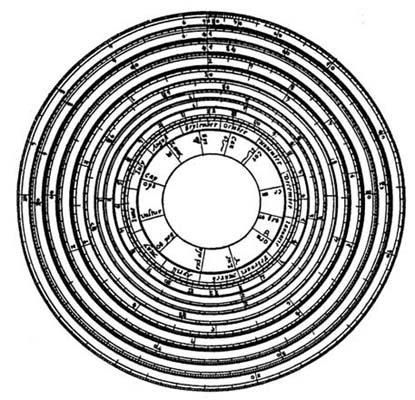
今天看来,欧垂最为人所知的可能是他发明了一种早期形式的计算尺。埃德蒙·冈特(1620年)在一根两英尺长的直尺上绘制了对数刻度。他使用一对分规来加减长度,这些操作等价于乘法和除法。1630年,欧垂发明了圆形计算尺。1632年,他使用了两把埃德蒙·冈特尺,从而可以不用分规。他的描述于1632年发表在Circles of Proportion中,正如我们上面所解释的。它描述了计算尺和日晷。
欧垂的Circle of Proportion的图片在THIS LINK上。
然而,关于圆形计算尺的发明优先权存在争议。理查德·德拉曼 确实在 欧垂 之前发表了圆形计算尺的描述。他的 Grammelogia, or the Mathematicall ring 于1630年出版。很可能两人是独立发明了这一工具。不幸的是,随之而来的是非常激烈的争论,这在一定程度上给 欧垂 晚年的生活蒙上了阴影。争论归结为一个人是否需要理解工具的工作原理才能使用它。Katherine Hill 写道 [20]:-
理查德·德拉曼 提出,教授工具的使用而不解释工具为何如此工作是可以接受的。……在他的《数学仪器与绅士教育》中,[理查德·德拉曼 指出] 仪器是使数学活动对绅士可用的最简单方式,而不必提供“数学理论原理的完整基础”。许多潜在的学生希望将仪器视为“黑箱”,忽略其操作背后的原理。另一方面,欧垂 认为,例如,向不懂对数的人教授比例圆的使用是不恰当的。对他来说,学生在学习仪器的使用之前理解其构造背后的原理至关重要。
正是 欧垂 在 Circles of Proportion 中的以下陈述激怒了 理查德·德拉曼,他认为这是针对他的攻击:-
艺术的真正途径不是通过仪器,而是通过论证:而庸俗教师的本末倒置的做法,是从仪器开始,而不是从科学开始,因此不是培养艺术家,而是使他们的学生只会耍把戏,如同变戏法的人:这是对艺术的蔑视,浪费先前的时间,并将愿意且勤奋的才智出卖给无知和懒惰。仪器的使用确实卓越,如果一个人是艺术家:但若被设置并与艺术对立,则可鄙。
我们注意到,现代形式的计算尺是由法国军官 Amedee Mannheim 于1850年设计的。
欧垂的其他著作有Trigonometria(1657年),这是最早使用简洁符号体系的三角学著作之一,The Solution of All Spherical Triangles by the Planisphere (1651年),通过平面球解决球面三角形,以及一些关于制表和确定太阳位置的更次要的著作,在他去世后作为Opuscula mathematica Ⓣ(数学著作)(1677年)出版。
英国内战(1642-1646)对欧垂来说是一段艰难的时期,他是坚定的保皇派支持者。1646年,他因支持保皇派而被传唤到奥利弗·克伦威尔的没收委员会面前。欧垂 Lilly(1602-1681)是一位议会占星家,他对欧垂的支持是使其免于处罚的一个因素。据信还有其他人也帮助救了他,包括萨里郡地主理查德·昂斯洛爵士,他将1647年出版的Clavis Mathematicae 第二版献给了他。欧垂对1649年1月国王查理一世的处决感到震惊,但据说他在临终时听到查理二世于1660年5月20日抵达伦敦并恢复英国王位的消息时感到欣慰。
欧垂于6月15日下葬,1661年7月24日,他的遗产管理权交给了他的儿子亨利。欧垂拥有一个重要的图书馆,其中一部分归了威廉·琼斯,但今天无法确定哪些书来自欧垂的图书馆。
William Oughtred's father was the Rev Benjamin Oughtred, a writing-master and 'registrar' at Eton College. We have given William's date of birth as 5 March 1574, and indeed most biographies give this as his date of birth, but in fact it is the date that he was baptised. His actual date of birth is unknown but is unlikely to be more than a few days before his date of baptism. William attended Eton School as a King's Scholar, which although a very famous school was in fact his local school, the school were his father taught. William was taught arithmetic at Eton by his own father. From there he went to King's College Cambridge, entering in 1592. It is surprising that although very little mathematics was taught at either Eton or Cambridge at this time, Oughtred became passionately interested. Oughtred was self-taught in mathematics while at Cambridge, writing (see, for example, [30]):-
... in Cambridge in King's College ... ... the time which over and above those usual studies I employed upon the mathematical sciences I redeemed night by night from my natural sleep, defrauding my body, and inuring it to watching, cold, and labour, while most others took their rest. ... by inciting, assisting and instructing others, I brought many into the love and study of those Arts, not only in our own, but in some other Colleges also.
Three years later he became a Fellow of King's College, received his B.A. in 1596 and his M.A. in the year 1600. Although Oughtred did not publish any mathematics during his years at Cambridge, nevertheless we know that he did produce various writings which he published much later. Also at this time he was thinking about the design of mathematical instruments about which again he published nothing at this time but would do so years later.
Oughtred was ordained a Church of England minister in 1603 but he continued as a fellow at Cambridge University until 1604 when he became vicar of Shalford, Surrey, a village south of Gilford. There he met Christsgift Caryll, the daughter of William and Dorothy Caryll. William Caryll had married Dorothy Cowdry on 8 May 1587 at Godalming, Surrey. Their daughter, Christsgift, was baptised at Godalming on 21 April 1588 and, when Oughtred met Christsgift she was living with her parents in Tangley, close to Shalford. Oughtred married Christsgift Caryll at Tangley on 20 February 1607. They had twelve children, William, Henry, Henry (the first Henry died as a baby), Benjamin, Simon, Margaret, Judith, Edward, Elizabeth, Anne, George, and John. Two of his sons, Benjamin and John, shared Oughtred's interest in instruments and became watchmakers.
In 1610, Oughtred became rector of Albury, a village about 5 km east of Shalford. He would continue to keep this position for the rest of his life, but he made contacts with fellow mathematicians at Gresham College in London. Writing in about 1633, Oughtred describes a visit to London 15 years earlier:-
In the Spring 1618 I being at London went to see my honoured friend Master Henry Briggs at Gresham College: who then brought me acquainted with Master Gunter lately chosen Astronomical lecturer there, and was at that time in Doctor Brooks his chamber. With whom falling into speech about his quadrant, I showed him my Horizontal Instrument. He viewed it very heedfully: and questioned about the projecture and use thereof, often saying these words, it is a very good one. And not long after he delivered to Master Briggs to be sent to me mine own Instrument printed off from one cut in brass: which afterwards I understood he presented to the right Honourable the Earl of Bridgewater, and in his book of the sector printed six years after, among other projections he setteth down this.
Oughtred's marriage had brought him into contact with certain local families which influenced his position. Two of these families were the Aungiers and the Duncombes both of which were distantly related to his wife's family. Francis Aungier (1558-1632) was 1st Baron of Longford and Oughtred taught his son, Gerald Aungier (1596-1655), mathematics. Oughtred, of course, was also a Latin scholar and, as others of this period, would write his works in Latin. He taught Latin to a member of the family of George Duncombe (1563-1660), who was one of his parishioners.
In 1620 Oughtred met Captain Marmaduke Neilson who claimed to have found an astronomical method of finding longitude at sea. It seems that at this time it was agreed that Neilson's method would not work but, some years later Oughtred would become more formally involved with assessing Neilson's method. We will describe this later in this biography.
It was in 1628 that Oughtred made an important contact which allowed him to become more involved with the mathematicians working in London. Thomas Howard, 21st Earl of Arundel, had been a leading courtier during the reign of King James I who had died in 1625. Howard was then a courtier for King Charles I, a role he had in 1628 when he made contact with Oughtred who wrote that in 1628:-
... the Earl of Arundel my most honourable Lord in a time of his private retiring to his house ... at West Horsley, four small miles from me ... hearing of me ... was pleased to send for me: and afterward at London to appoint me a chamber in his own house [Arundel House, in the Strand].
This gave Oughtred a base in London which was important to him. Thomas Howard's youngest son was William Howard (1614-1680) who later became 1st Viscount Stafford and an Fellow of the Royal Society. William Howard was a bright boy and Oughtred taught him advanced mathematics. To assist in this teaching, Oughtred composed a work on mathematics which was published in 1631 as Clavis Mathematicae Ⓣ. We will look at the contents of this important work below. Oughtred took private pupils who came to his house in Albury and lived there free of charge while they received mathematical instruction. However, having a room in London allowed him to also give some tuition there. He had many pupils but the most famous were John Wallis, John Pell, Seth Ward, Christopher Wren and Richard Delamain. Some of these he tutored in Albury, some in London, and some could be perhaps better described as followers who had gained much from reading the Clavis Mathematicae Ⓣ and perhaps had an occasional word with him. Another benefit from his London base was that it allowed him to have close contact with makers of mathematical instruments, particularly Elias Allen (1592-1653) who had his workshop beside St Clement Danes Church, the Strand, near Arundel House. A letter from Oughtred to Allen, dated 20 August 1638, reads:-
I have here sent you directions (as you requested me being at Twickenham) about the making of the two rulers. ... [I] would gladly see one of [the two parts of the instrument] when it is finished: which yet I never have done.
Christopher Brookes, one of Allen's assistants, became Oughtred's son-in-law. He edited Oughtred's The Solution of All Spherical Triangles by the Planisphere (1651).
Although Oughtred had not had instruments made early in his career, he had invented them while at Cambridge. In fact one of his pupils at Albury, William Forster, spent the summer of 1630 living in Oughtred's home and was so impressed with Oughtred's mathematical instruments that he persuaded Oughtred to let him publish an English translation of Oughtred's unpublished Latin description. It was published in London in 1632 under the title The Circles of Proportion and the Horizontal Instrument. Both invented, and the uses of both written in Latin by Mr William Oughtred. Translated into English and set forth for the public benefit by William Forster. It states:-
Printed for Elias Allen maker of these and all other Mathematical Instruments and are to be sold at his shop over against St Clements church without Temple Bar.
William Forster writes in the book:-
For being in the time of the vacation 1630, in the country, at the house of the Reverend, and my worthy friend, and Teacher, Mr William Oughtred ... I told him of Mr Gunter's Ruler. [He described it as] a poor invention [and showed me] what devices [he] has had by [him] these many years. ... he meant to commend to me, the skill of Instruments, but first he would have me well instructed in the Sciences.
Although, as we have seen, Oughtred gained from the support of Thomas Howard, 21st Earl of Arundel, nevertheless he felt that he never received the rewards that he deserved from his patron. Others too considered Arundel less than generous in his dealings with Oughtred who looked for church preferments. His one acquisition was the Heathfield prebend at Chichester Cathedral given to him, not by the Earl of Arundel, but by Bishop Henry King an English poet who served as Bishop of Chichester. Bishop Henry King was related to George Duncombe and had his son John King who was tutored by Oughtred.
We mentioned above that Oughtred would become involved with Captain Marmaduke Neilson later and this happened in 1636. A document of 22 May of that year refers to Captain Marmaduke Neilson's petition regarding his astronomical method of finding longitude at sea. A commission composed of Sir James Galloway, John Seldon, Henry Gellibrand and William Oughtred was set up "to consider and certify whether they hold the petitioner able to perform the particulars mentioned in his petition." The commission's report has not survived but we can be certain that the commission did not find Neilson's method workable.
Our description of Oughtred's life makes it appear that it was a busy one for, we must remember, his full-time position was as rector of Albury. He himself, however, described his life as quiet with infrequent trips to London (see, for example, [3] or [11]):-
Indeed the life and mind of man cannot endure without some interchangeableness of recreation, and pauses from the intensive actions of our several callings; and every man is drawn with his own delight. My recreations have been diversity of studies; and as oft as I was toiled with the labour of my own profession, I have allayed that tediousness by walking in the pleasant and more than Elysian fields of the diverse and various parts of humane learning, and not the Mathematics only.
Aubrey [5] gives an interesting description of Oughtred's appearance and lifestyle:-
He was a little man, had black hair, and black eyes (with a great deal of spirit). His head was always working. He would draw lines and diagrams on the dust.... he used to lie a bed till eleven or twelve a clock, with his doublet on ... studied late at night, went not to bed till 11 o'clock, had his tinder box by him, and on top of his bed-staff, he had his ink-horn fixed. He slept but little. Sometimes he went not to bed in two or three nights, and would not come down to meals till he had found out the quaesitum.
Florian Cajori studied Oughtred's writings carefully and was able to gain a useful feeling for both his approach to mathematics and to teaching mathematics. Cajori wrote [3]:-
Oughtred was a great admirer of the Greek mathematicians - Euclid, Archimedes, Apollonius of Perga, Diophantus. But in reading their words he experienced keenly what many modern readers have felt, namely, that the almost total absence of mathematical symbols renders their writings unnecessarily difficult to read. Statements that can be compressed into a few well-chosen symbols which the eye is able to survey as a whole are expressed in long drawn out sentences. ... In studying the ancient authors Oughtred is reported to have written down on the margin of the printed page some of the theorems and their proofs, expressed in the symbolic language of algebra.
Oughtred's most important work, Clavis Mathematicae Ⓣ (1631), included a description of Hindu-Arabic notation and decimal fractions but one of the real strengths of the work is the way that fractions, irrationals, decimal expansions, and logarithms are all treated as "numbers." This was in contrast with other mathematicians at this time who treated these as distinct concepts. He even treats negative numbers as "numbers," although he does not allow these to be the solutions of equations. As Neal writes [5]:-
... he treated numbers as continuous, rather than discrete, which was a movement away from Greek concerns.
The work contains a considerable section on algebra, although this is still thought of geometrically as is shown by his rejection of negative numbers as solutions to equations. He wrote in the second edition (1647) of Clavis Mathematicae Ⓣ that:-
... Which treatise not written in the usual synthetic manner, nor with verbose expressions, but in the inventive way of Analysis, and with symbols or notes of things instead of words, seemed unto many very hard; though indeed it was but their own diffidence, being scared by the newness of the delivery; and not any difficulty in the thing itself. For this specious and symbolical manner, neither racketh the memory with multiplicity of words, nor chargeth the fantasy with comparing and laying things together; but plainly presenteth to the eye the whole course and process of every operation and argumentation. ... Now my scope and intent in the first Edition of that my 'Key' was, and in this New Filing, or rather forging of it, is, to reach out to the ingenious lovers of these Sciences, as it were Ariadne's thread, to guide them through the intricate Labyrinth of these studies, and to direct them for the more easy and full understanding of the best and ancientest Authors; ... That they may not only learn their propositions, which is the highest point of Art that most Students aim at; but also may perceive with what solertiousness, by what engines of equations, interpretations, comparations, reductions, and disquisitions, those ancient Worthies have beautified, enlarged, and first found out this most excellent Science. ... Lastly, by framing like questions problematically, and in a way of Analysis, as if they were already done, resolving them into their principles, I sought out reasons and means whereby they might be effected. And by this course of practice, not without long time, and much industry, I found out this way for the help and facilitation of Art.
He experimented with many new symbols including X for multiplication and :: for proportion. Like all Oughtred's works it was very condensed containing only 88 pages.
Oughtred used π in Clavis Mathematicae Ⓣ but not for the ratio of the circumference to the diameter, merely for the circumference. Other notation for greater than and less than proved hard to remember and was not accepted, the familiar > and < being due to Thomas Harriot at almost the same time.
Today it seems that Oughtred is best known for his invention of an early form of the slide rule. Edmund Gunter (1620) plotted a logarithmic scale along a single straight two foot long ruler. He added and subtracted lengths by using a pair of dividers, operations that were equivalent to multiplying and dividing. In 1630 Oughtred invented a circular slide rule. In 1632 he used two Gunter rulers so that he could do away with the dividers. His description was published in Circles of Proportion in 1632 as we explained above. It describes slide rules and sundials.
A picture of Oughtred's Circle of Proportion is at THIS LINK.
There was a dispute, however, regarding priority over the invention of the circular slide rule. Delamain certainly published a description of a circular slide rule before Oughtred. His Grammelogia, or the Mathematicall ring was published in 1630. It may well be that both invented this instrument independently. Unfortunately a very heated argument ensued and to some extent this formed a cloud over the later years of Oughtred's life. The argument came down to whether one needed to understand how an instrument worked before one could make use of it. Katherine Hill writes [20]:-
Delamain proposed that it was acceptable to teach the use of instruments without explaining why the instruments worked the way they did. ... in his 'Mathematical instruments and the education of gentlemen', [Delamain states] that instruments were the simplest way to make mathematical activity available to gentlemen without having to provide 'a full grounding in the theoretical principles of mathematics'. Many prospective students wished to treat instruments as 'black boxes' and ignore the principles behind their operation. Oughtred, on the other hand, believed, for example, that it was improper to teach the use of the Circles of Proportion to someone who had no understanding of logarithms. For him, it was vital that the student understood the principles behind the instrument's construction before they learned its use.
It was the following statement by Oughtred in Circles of Proportion that upset Delamain who saw it as an attack directed at him:-
That the true way of Art is not by Instruments, but by Demonstration: and that it is a preposterous course of vulgar Teachers, to begin with Instruments, and not with the Sciences, and so instead of Artists, to make their Scholars only doers of tricks, and as it were jugglers: to the despite of Art, loss of previous time, and betraying of willing and industrious wits, unto ignorance, and idleness. That the use of Instruments is indeed excellent, if a man be an Artist: but contemptible, being set and opposed to Art.
We note that the present form of the slide rule was designed in 1850 by a French army officer, Amedee Mannheim.
Oughtred's other works were Trigonometria (1657), one of the first works on trigonometry to use concise symbolism, The Solution of All Spherical Triangles by the Planisphere (1651), solving spherical triangles by the planisphere, and a number of more minor works on watchmaking and methods to determine the position of the sun published posthumously as Opuscula mathematica Ⓣ (1677).
The English Civil War (1642-1646) was a difficult time for Oughtred who was a staunch royalist supporter. In 1646 he was summoned before Oliver Cromwell's sequestration committee because of his royalist support. William Lilly (1602-1681) was a parliamentary astrologer whose support of Oughtred was a factor in having him spared. Others are believed to have also helped save him including Sir Richard Onslow, a Surrey landowner, to whom he dedicated the second edition of the Clavis Mathematicae published in 1647. Oughtred was shocked at execution of King Charles I in January of 1649 but it is said that he rejoiced on his deathbed at the news that Charles II, who reached London on 20 May 1660, had been restored to the English throne.
Oughtred was buried on 15 June and, on 24 July 1661, the administration of his estate was given to his son Henry. Oughtred owned an important library which went in part to William Jones but it is impossible today to identify the books that came from Oughtred's library.
正文里的方括号编号指向这里,悬停即可直接看到条目。书目保留原文——译了书名反而查不到文献。
原站列出的延伸阅读与外部数据库,照原样保留,目标多为英文页面。
关于威廉·欧垂的其它页面:
原站的交叉引用。指向本站已镜像专题的留在站内,其余仍指回原站。