数学家传记
欧几里得是一位希腊数学家,以其几何学著作《几何原本》最为著名。这部著作影响了西方数学的发展达2000多年。
欧几里得是古代最杰出的数学家,以其数学论著The Elements而闻名。The Elements的持久性质必定使欧几里得成为有史以来最重要的数学教师。然而,除了他在埃及的欧几里得任教之外,人们对欧几里得的生平知之甚少。普罗克洛,最后一位重要的希腊哲学家,生活在大约公元450年,写道(见[1]或[9]或许多其他来源):-
比这些[柏拉图的学生]年轻不了多少的是欧几里得,他编纂了《几何原本》,按顺序整理了许多欧多克索斯的定理,完善了许多泰阿泰德的定理,并且将前人仅粗略证明的内容带到了无可辩驳的论证。此人生活在第一位克劳狄乌斯·托勒密的时代;因为紧随第一位托勒密之后的阿基米德提到了欧几里得,而且他们还说托勒密曾问他是否有比《几何原本》更短的学习几何的途径,对此他回答说,几何没有皇家大道。因此,他比柏拉图的圈子年轻,但比埃拉托色尼和阿基米德年长;因为正如埃拉托色尼在某处所说,这些人是同时代人。在他的目标上,他是一位柏拉图主义者,赞同这一哲学,因此他将整个《几何原本》的终点设为所谓柏拉图图形的构造。
某些作者给出了关于欧几里得的其他信息,但被认为不可靠。这种额外信息存在两种不同类型。第一种额外信息是由阿拉伯作者给出的,他们声称欧几里得是Naucrates的儿子,并且他出生在提尔。数学史家认为这完全是虚构的,仅仅是作者们编造出来的。
第二类信息是欧几里得出生在麦加拉。这是由于最早提供这一信息的作者们的错误。事实上,有一位麦加拉的欧几里得,他是一位哲学家,生活在大约比数学家欧几里得早100年的时代。有两位被称为欧几里得的博学之士,这并不像看起来那样纯属巧合。事实上,欧几里得在这一时期是一个非常常见的名字,这是又一个复杂因素,使得发现关于欧几里得的信息变得困难,因为这一时期的文献中提到了许多名叫欧几里得的人。
回到上面给出的普罗克洛的引文,首先要指出的是,所给出的年代没有任何不一致之处。然而,尽管我们不能确切知道阿基米德的著作普罗克洛中指的是对欧几里得的哪一处引用,但在流传给我们的内容中,只有一处提到欧几里得,而这出现在On the sphere and the cylinder中。因此,显而易见的结论是,普罗克洛的论证没有问题,这一点一直被假定,直到Hjelmslev在[48]中提出质疑。他主张,对欧几里得的引用是在较晚阶段被添加到阿基米德的书中的,而且这确实是一个相当令人惊讶的引用。给出这样的引用不是当时的传统,此外,在阿基米德中还有许多其他地方适合引用欧几里得,却没有这样的引用。尽管Hjelmslev声称这段文字是后来添加的,Bulmer-Thomas在[1]中写道:-
尽管不再可能依赖这一引用,但对欧几里得著作的一般考察……仍然表明,他必定是在柏拉图的诸如欧多克索斯这样的学生之后、在阿基米德之前写作的。
关于欧几里得年代确定的进一步讨论,例如见[8]。关于数学家欧几里得的争论远未结束。Itard[11]对此作了最好的总结,他给出了三种可能的假设。
(i) 欧几里得是一位历史人物,他写了Elements以及其他归于他名下的著作。
(ii) 欧几里得是在欧几里得工作的一群数学家的领导者。他们都参与了撰写“欧几里得全集”,甚至在他去世后仍继续以欧几里得的名字写书。
(iii) 欧几里得 并非历史人物。“欧几里得 全集”是由 欧几里得 的一批数学家撰写的,他们从大约早100年生活的麦加拉的欧几里得这位历史人物那里取了欧几里得这个名字。
值得指出的是,Itard 接受了 Hjelmslev 关于有关 欧几里得 的段落是后来添加到 阿基米德 中的说法,他倾向于我们上面列出的三种可能性中的第二种。然而,我们应该对这三种可能性作一些评论,公平地说,它们相当好地概括了当前所有可能的理论。
有一些强有力的证据支持接受(i)。2000多年来,所有人都毫无疑义地接受了它,而且几乎没有证据与这一假说相矛盾。诚然,Elements的某些书之间在风格上存在差异,但许多作者都会改变自己的风格。再者,欧几里得无疑是以先前著作作为Elements的基础,这意味着如果原作者的风格没有留下任何痕迹,那反倒会相当令人惊讶。
即使我们接受(i),也几乎毫无疑问欧几里得在欧几里得建立了一个活跃的数学学派。因此他应该有一些有才能的学生,他们可能帮助撰写了这些书。然而假说(ii)比这走得更远,它暗示不同的书是由不同的数学家撰写的。除了上面提到的风格差异之外,几乎没有直接证据支持这一点。
尽管从表面上看,(iii) 可能似乎是三种推测中最离奇的,然而 尼古拉·布尔巴基 的20世纪例子表明它远非不可能。亨利·嘉当、安德烈·韦伊、让·迪厄多内、谢瓦莱 和 亚历山大·格罗滕迪克 以 尼古拉·布尔巴基 的名义集体写作,而 尼古拉·布尔巴基 的 Eléments de mathématiques 包含30多卷。当然,如果 (iii) 是正确的假设,那么曾在 欧几里得 师从 欧几里得 的学生们的 阿波罗尼奥斯,必定知道并不存在“欧几里得”这个人,但他写道:-
.... 欧几里得 没有对 轨迹 关于三条线和四条线的综合进行研究,而只是研究了其中的偶然部分 ...
当然不能证明 欧几里得 是历史人物,因为有许多类似的关于 尼古拉·布尔巴基 的提及,出自完全清楚 布尔巴基 是虚构的数学家们。然而,组成 布尔巴基 团队的数学家们本身都很有名,这可能是反对假设 (iii) 的最大论据,因为“欧几里得 团队”必须由杰出的数学家组成。那么他们是谁呢?
在本文中,我们将假设假设(i)为真,但由于对欧几里得一无所知,我们必须在对其可能的历史事件作出几点评论后,集中讨论他的著作。欧几里得必定曾在雅典的柏拉图学园学习过,才能了解到他所如此熟悉的欧多克索斯和泰阿泰德的几何学。
欧几里得 的作品都没有序言,至少没有一部流传给我们,因此极不可能曾经存在过任何序言,所以我们无法像对其他一些希腊数学家那样,从他们序言的性质中看出他的任何性格。帕普斯 写道(例如见 [1]),欧几里得 是:-
……对一切能在任何程度上推进数学的人都极为公正、怀有好意,处处小心不冒犯任何人,虽然是一位严谨的学者,却不自夸。
有人声称这些话是加到帕普斯中的,而且这段话(在我们未引用的续文中)的要点确实是对阿波罗尼奥斯进行严厉(几乎可以肯定是不公正的)批评。然而,帕普斯所描绘的欧几里得的形象,确实与他的数学文本所提供的证据相符。斯托拜乌斯[9]还讲述了另一个故事:——
……有一个刚开始跟欧几里得学几何的人,在学了第一个定理之后,问欧几里得:“我学这些东西能得到什么?”欧几里得叫来他的奴隶说:“给他三便士,因为他必须从所学的东西中获利。”
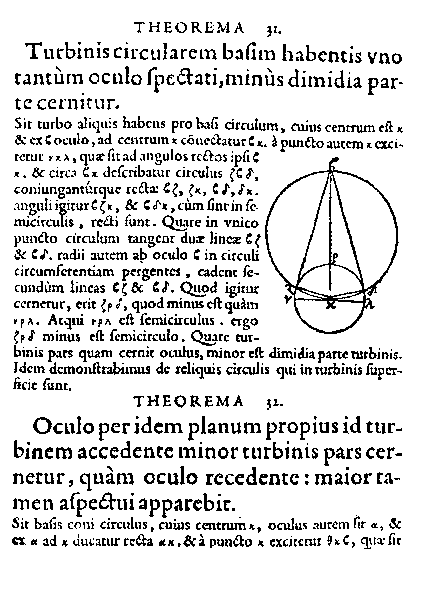
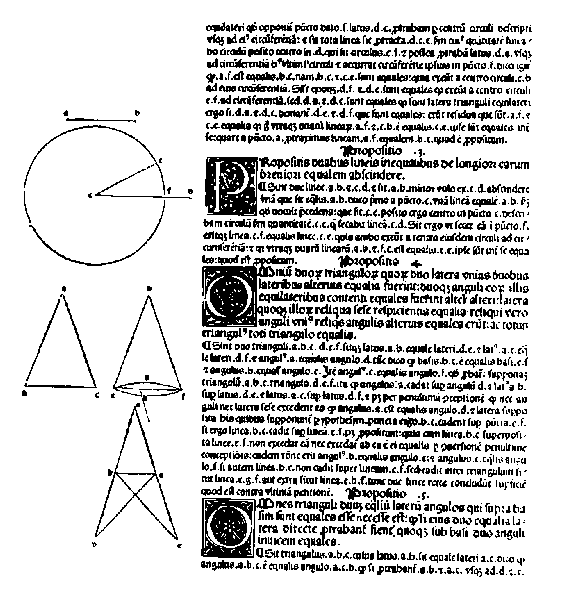
欧几里得最著名的著作是他关于数学的论著The Elements。这本书是一部知识的汇编,在2000年间成为数学教学的中心。The Elements中可能没有哪个结果是由欧几里得首次证明的,但材料的组织及其表述肯定归功于他。事实上,有充分的证据表明欧几里得在撰写Elements时使用了更早的教科书,因为他引入了相当多的定义,而这些定义从未被使用过,例如长方形、菱形和长菱形。
Elements以定义和五条公设开始。前三条公设是作图公设,例如第一条公设断言可以在任意两点之间画一条直线。这些公设还隐含地假定了点、线和圆的存在,然后从这些对象存在这一事实推导出其他几何对象的存在。公设中还有其他未明确说出的假定。例如,假定连接任意两点的直线是唯一的。类似地,第二条和第三条公设分别关于延长直线和画圆,假定了其作图可能性被公设化的那些对象的唯一性。
第四条和第五条公设性质不同。第四条公设断言所有直角都相等。这看起来可能“显而易见”,但它实际上假定了空间是均匀的——我们借此意指一个图形将独立于它在空间中所放置的位置。著名的第五条公设,即平行公设,断言过一点可以画且只能画一条直线平行于给定直线。欧几里得决定将此作为公设,导致了欧几里得几何。直到19世纪,这条公设才被放弃,non-euclidean geometries才得到研究。
还有一些被欧几里得称为“共同概念”的公理。这些不是具体的几何性质,而是使数学能够作为一门演绎科学进行下去的一般假设。例如:——
与同一事物相等的事物彼此相等。
Zeno of Sidon,大约在欧几里得撰写Elements之后250年,似乎首次表明欧几里得的命题并非仅从公设和公理推导而来,而欧几里得确实做出了其他微妙的假设。
Elements分为13卷。第一卷至第六卷讨论平面几何。特别是第一卷和第二卷阐述三角形、平行线、平行四边形、矩形和正方形的基本性质。第三卷研究圆的性质,而第四卷处理关于圆的问题,并被认为主要阐述了毕达哥拉斯追随者的工作。第五卷阐述了欧多克索斯关于比例的工作,应用于可公度的和不可公度量。托马斯·利特尔·希思说[9]:-
希腊数学没有比这一理论更出色的发现了,它为如此多的依赖于比例使用的几何学奠定了坚实的基础。
第六卷考察第五卷结果在平面几何中的应用。
第七卷至第九卷讨论数论。特别是第七卷是数论的独立介绍,并包含求两个数最大公约数的欧几里得算法。第八卷考察geometrical progression中的数,但巴特尔·伦德特·范德瓦尔登在[2]中写道它包含:-
……冗长的表述、不必要的重复,甚至逻辑谬误。显然,欧几里得的阐述仅在他拥有优秀资料的那些部分才出色。
第十卷讨论无理数数的理论,主要是泰阿泰德的工作。欧几里得改变了本卷中若干定理的证明,使它们符合欧多克索斯给出的新比例定义。
第十一卷到第十三卷讨论三维几何。在第十一卷中给出了这三卷共同需要的基本定义。随后定理遵循与第一和第四卷中先前给出的二维类似物相当类似的模式。第十二卷的主要结果是圆彼此之比等于其直径的平方之比,球彼此之比等于其直径的立方之比。这些结果当然归功于欧多克索斯。欧几里得使用欧多克索斯发明的“穷竭法”证明这些定理。Elements以第十三卷结束,该卷讨论五种正多面体的性质,并证明恰好有五种。这一卷似乎主要基于泰阿泰德较早的论著。
欧几里得的Elements以定理陈述和证明的清晰性而著称。这种严格性标准后来成为几个世纪后微积分发明者的目标。正如托马斯·利特尔·希思在[9]中所写:-
这部奇妙的书,尽管有其种种不完美之处——考虑到它出现的年代,这些不完美确实微不足道——现在是而且无疑将永远是有史以来最伟大的数学教科书。……即使在希腊时代,最有成就的数学家也致力于研究它:海伦、帕普斯、波菲利、普罗克洛和西里西亚的辛普利修斯写了注释;亚历山大的席恩欧几里得重新编辑了它,在此处彼处改动语言,主要是为了更清晰和更一致……
Elements如何从欧几里得的时代流传下来是一个引人入胜的故事,Fowler在[7]中对此讲述得很好。他描述了与Elements有关的最早存世材料:-
我们对欧几里得材料的最早一瞥将是一千年中最引人注目的,六块残片陶片包含文字和一个图形……于1906/07年和1907/08年在象岛发现……这些文本很早,尽管仍是在柏拉图去世100多年后(根据古文字学依据,它们被定年为公元前三世纪第三个四分之一);很先进(它们涉及在《几何原本》[第十三卷]……中关于五边形、六边形、十边形和二十面体的结果);而且它们不遵循《几何原本》的文本。……因此它们证明公元前三世纪有人在欧几里得以南500多英里处研究这个困难的材料……这可能是一种理解数学的尝试,而不是奴隶式的抄写……
我们拥有的下一块残片可追溯到公元75-125年,同样似乎是某人试图理解Elements材料的笔记。
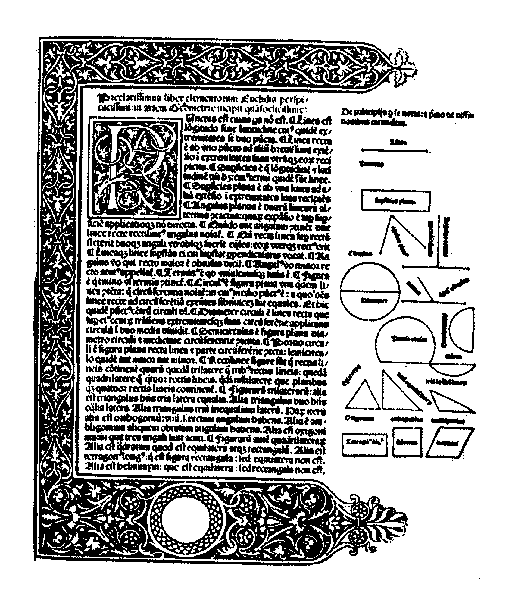
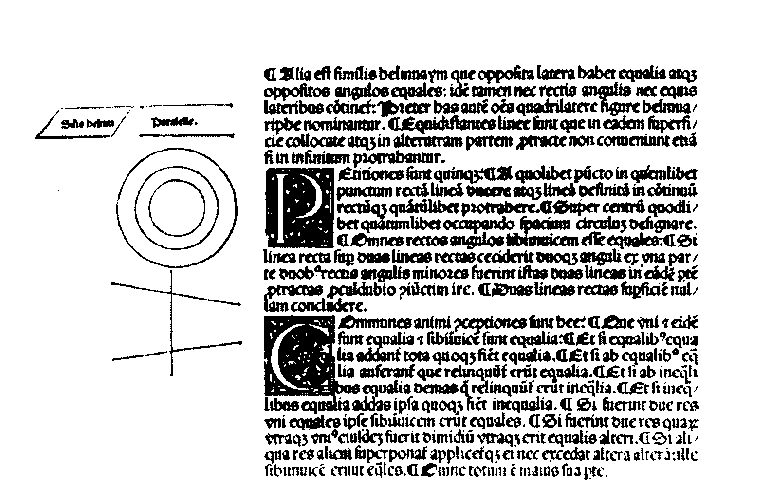
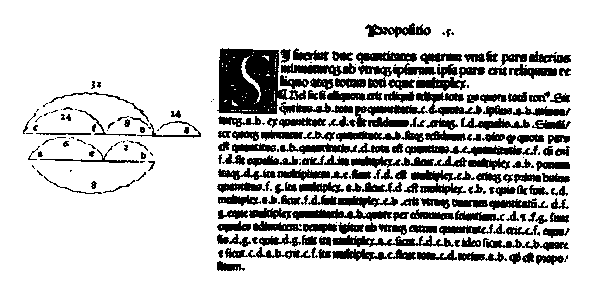
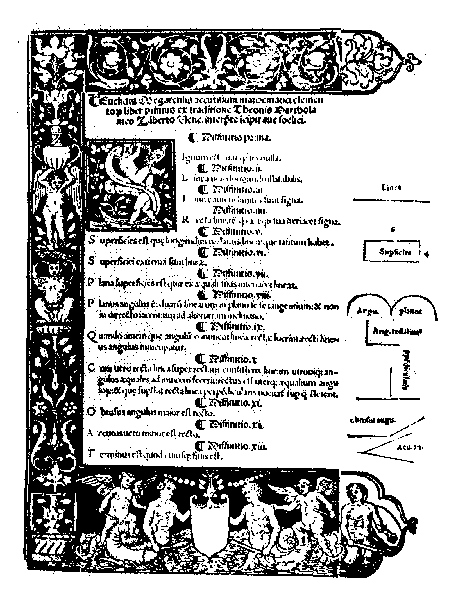
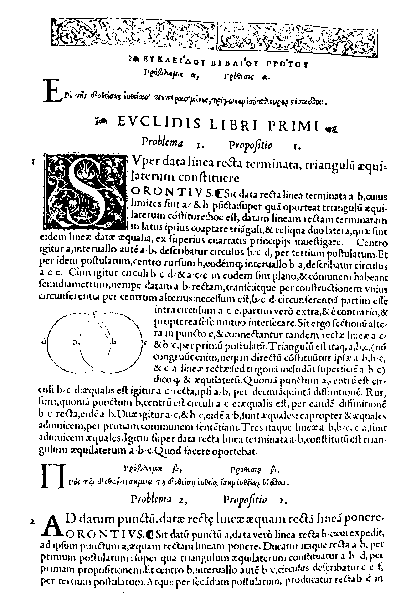
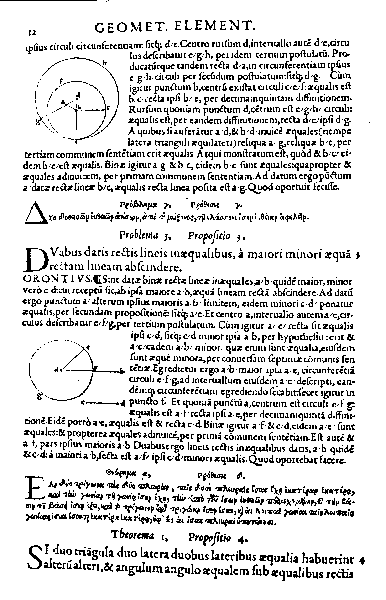
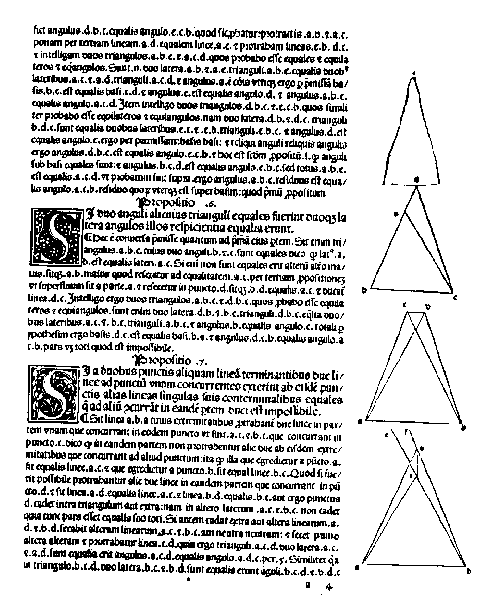
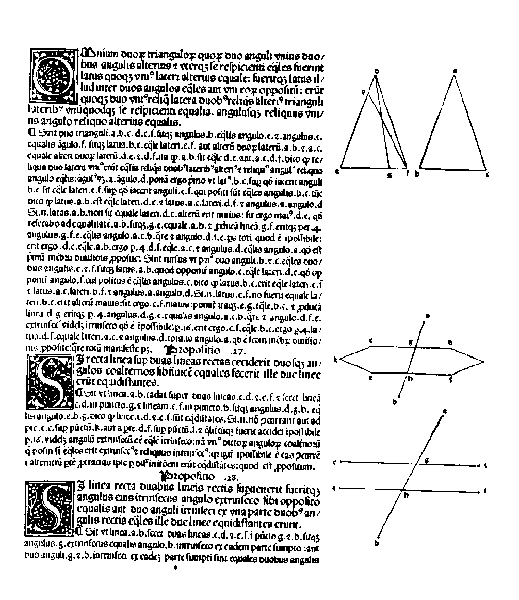
自1482年首次印刷以来,The Elements已出版了超过一千个版本。托马斯·利特尔·希思[9]讨论了许多版本,并描述了多年来文本可能发生的变化。
B L 巴特尔·伦德特·范德瓦尔登 在 [2] 中评估了 Elements 的重要性:-
几乎从成书之时起,直到现在,《几何原本》一直对人类事务产生着持续而重大的影响。至少直到19世纪非欧几何出现之前,它一直是几何推理、定理和方法的主要来源。有时人们说,在西方世界产生的所有书籍中,除了《圣经》之外,《几何原本》可能是被翻译、出版和研究得最多的书。
欧几里得 还写了以下流传下来的书:Data(包含94个命题),考察当给定图形的某些性质时,可以推导出图形的哪些性质;On Divisions 考察将图形分成面积成给定比的两部分的作图;Optics 是第一部希腊透视学著作;以及 Phaenomena,它是数学天文学的入门导论,给出了恒星在特定位置升起和落下的时间的结果。欧几里得 的以下书都已失传:Surface Loci(两卷),Porisms(三卷本著作,根据 帕普斯,包含171个定理和38个引理),圆锥曲线(四卷),Book of Fallacies 和 Elements of Music。Book of Fallacies 由 普罗克洛 [1] 描述如下:-
由于许多事物似乎符合真理并从科学原理中推出,却使人偏离原理并欺骗较为肤浅的人,[欧几里得] 也传下了清晰理解这些事物的方法……他给我们提供这一工具的论著题为《谬误》,按顺序列举各种类型,在每种情况下用各种定理锻炼我们的智力,将真与假并列,并将对错误的反驳与实际例证结合起来。
Elements of Music 是一部被 普罗克洛 归于 欧几里得 的著作。我们有两部流传下来的音乐论著,有些作者将它们归于 欧几里得,但现在认为它们不是 普罗克洛 所提到的那部音乐著作。
欧几里得 可能不是一流数学家,但 The Elements 的持久性质必定使他成为古代或也许是有史以来最重要的数学教师。作为最后的个人附注,让我补充一句,我[EFR]自己在20世纪50年代于学校初次接触数学,用的是 欧几里得 的 Elements 一部分的一个版本,这部著作为数学和证明概念提供了逻辑基础,而这些似乎是当今学校数学所缺乏的。
Euclid of Alexandria is the most prominent mathematician of antiquity best known for his treatise on mathematics The Elements. The long lasting nature of The Elements must make Euclid the leading mathematics teacher of all time. However little is known of Euclid's life except that he taught at Alexandria in Egypt. Proclus, the last major Greek philosopher, who lived around 450 AD wrote (see [1] or [9] or many other sources):-
Not much younger than these [pupils of Plato] is Euclid, who put together the "Elements", arranging in order many of Eudoxus's theorems, perfecting many of Theaetetus's, and also bringing to irrefutable demonstration the things which had been only loosely proved by his predecessors. This man lived in the time of the first Ptolemy; for Archimedes, who followed closely upon the first Ptolemy makes mention of Euclid, and further they say that Ptolemy once asked him if there were a shorted way to study geometry than the Elements, to which he replied that there was no royal road to geometry. He is therefore younger than Plato's circle, but older than Eratosthenes and Archimedes; for these were contemporaries, as Eratosthenes somewhere says. In his aim he was a Platonist, being in sympathy with this philosophy, whence he made the end of the whole "Elements" the construction of the so-called Platonic figures.
There is other information about Euclid given by certain authors but it is not thought to be reliable. Two different types of this extra information exists. The first type of extra information is that given by Arabian authors who state that Euclid was the son of Naucrates and that he was born in Tyre. It is believed by historians of mathematics that this is entirely fictitious and was merely invented by the authors.
The second type of information is that Euclid was born at Megara. This is due to an error on the part of the authors who first gave this information. In fact there was a Euclid of Megara, who was a philosopher who lived about 100 years before the mathematician Euclid of Alexandria. It is not quite the coincidence that it might seem that there were two learned men called Euclid. In fact Euclid was a very common name around this period and this is one further complication that makes it difficult to discover information concerning Euclid of Alexandria since there are references to numerous men called Euclid in the literature of this period.
Returning to the quotation from Proclus given above, the first point to make is that there is nothing inconsistent in the dating given. However, although we do not know for certain exactly what reference to Euclid in Archimedes' work Proclus is referring to, in what has come down to us there is only one reference to Euclid and this occurs in On the sphere and the cylinder. The obvious conclusion, therefore, is that all is well with the argument of Proclus and this was assumed until challenged by Hjelmslev in [48]. He argued that the reference to Euclid was added to Archimedes' book at a later stage, and indeed it is a rather surprising reference. It was not the tradition of the time to give such references, moreover there are many other places in Archimedes where it would be appropriate to refer to Euclid and there is no such reference. Despite Hjelmslev's claims that the passage has been added later, Bulmer-Thomas writes in [1]:-
Although it is no longer possible to rely on this reference, a general consideration of Euclid's works ... still shows that he must have written after such pupils of Plato as Eudoxus and before Archimedes.
For further discussion on dating Euclid, see for example [8]. This is far from an end to the arguments about Euclid the mathematician. The situation is best summed up by Itard [11] who gives three possible hypotheses.
(i) Euclid was an historical character who wrote the Elements and the other works attributed to him.
(ii) Euclid was the leader of a team of mathematicians working at Alexandria. They all contributed to writing the 'complete works of Euclid', even continuing to write books under Euclid's name after his death.
(iii) Euclid was not an historical character. The 'complete works of Euclid' were written by a team of mathematicians at Alexandria who took the name Euclid from the historical character Euclid of Megara who had lived about 100 years earlier.
It is worth remarking that Itard, who accepts Hjelmslev's claims that the passage about Euclid was added to Archimedes, favours the second of the three possibilities that we listed above. We should, however, make some comments on the three possibilities which, it is fair to say, sum up pretty well all possible current theories.
There is some strong evidence to accept (i). It was accepted without question by everyone for over 2000 years and there is little evidence which is inconsistent with this hypothesis. It is true that there are differences in style between some of the books of the Elements yet many authors vary their style. Again the fact that Euclid undoubtedly based the Elements on previous works means that it would be rather remarkable if no trace of the style of the original author remained.
Even if we accept (i) then there is little doubt that Euclid built up a vigorous school of mathematics at Alexandria. He therefore would have had some able pupils who may have helped out in writing the books. However hypothesis (ii) goes much further than this and would suggest that different books were written by different mathematicians. Other than the differences in style referred to above, there is little direct evidence of this.
Although on the face of it (iii) might seem the most fanciful of the three suggestions, nevertheless the 20th century example of Bourbaki shows that it is far from impossible. Henri Cartan, André Weil, Jean Dieudonné, Claude Chevalley and Alexander Grothendieck wrote collectively under the name of Bourbaki and Bourbaki's Eléments de mathématiques contains more than 30 volumes. Of course if (iii) were the correct hypothesis then Apollonius, who studied with the pupils of Euclid in Alexandria, must have known there was no person 'Euclid' but the fact that he wrote:-
.... Euclid did not work out the syntheses of the locus with respect to three and four lines, but only a chance portion of it ...
certainly does not prove that Euclid was an historical character since there are many similar references to Bourbaki by mathematicians who knew perfectly well that Bourbaki was fictitious. Nevertheless the mathematicians who made up the Bourbaki team are all well known in their own right and this may be the greatest argument against hypothesis (iii) in that the 'Euclid team' would have to have consisted of outstanding mathematicians. So who were they?
We shall assume in this article that hypothesis (i) is true but, having no knowledge of Euclid, we must concentrate on his works after making a few comments on possible historical events. Euclid must have studied in Plato's Academy in Athens to have learnt of the geometry of Eudoxus and Theaetetus of which he was so familiar.
None of Euclid's works have a preface, at least none has come down to us so it is highly unlikely that any ever existed, so we cannot see any of his character, as we can of some other Greek mathematicians, from the nature of their prefaces. Pappus writes (see for example [1]) that Euclid was:-
... most fair and well disposed towards all who were able in any measure to advance mathematics, careful in no way to give offence, and although an exact scholar not vaunting himself.
Some claim these words have been added to Pappus, and certainly the point of the passage (in a continuation which we have not quoted) is to speak harshly (and almost certainly unfairly) of Apollonius. The picture of Euclid drawn by Pappus is, however, certainly in line with the evidence from his mathematical texts. Another story told by Stobaeus [9] is the following:-
... someone who had begun to learn geometry with Euclid, when he had learnt the first theorem, asked Euclid "What shall I get by learning these things?" Euclid called his slave and said "Give him threepence since he must make gain out of what he learns".
Euclid's most famous work is his treatise on mathematics The Elements. The book was a compilation of knowledge that became the centre of mathematical teaching for 2000 years. Probably no results in The Elements were first proved by Euclid but the organisation of the material and its exposition are certainly due to him. In fact there is ample evidence that Euclid is using earlier textbooks as he writes the Elements since he introduces quite a number of definitions which are never used such as that of an oblong, a rhombus, and a rhomboid.
The Elements begins with definitions and five postulates. The first three postulates are postulates of construction, for example the first postulate states that it is possible to draw a straight line between any two points. These postulates also implicitly assume the existence of points, lines and circles and then the existence of other geometric objects are deduced from the fact that these exist. There are other assumptions in the postulates which are not explicit. For example it is assumed that there is a unique line joining any two points. Similarly postulates two and three, on producing straight lines and drawing circles, respectively, assume the uniqueness of the objects the possibility of whose construction is being postulated.
The fourth and fifth postulates are of a different nature. Postulate four states that all right angles are equal. This may seem "obvious" but it actually assumes that space in homogeneous - by this we mean that a figure will be independent of the position in space in which it is placed. The famous fifth, or parallel, postulate states that one and only one line can be drawn through a point parallel to a given line. Euclid's decision to make this a postulate led to Euclidean geometry. It was not until the 19th century that this postulate was dropped and non-euclidean geometries were studied.
There are also axioms which Euclid calls 'common notions'. These are not specific geometrical properties but rather general assumptions which allow mathematics to proceed as a deductive science. For example:-
Things which are equal to the same thing are equal to each other.
Zeno of Sidon, about 250 years after Euclid wrote the Elements, seems to have been the first to show that Euclid's propositions were not deduced from the postulates and axioms alone, and Euclid does make other subtle assumptions.
The Elements is divided into 13 books. Books one to six deal with plane geometry. In particular books one and two set out basic properties of triangles, parallels, parallelograms, rectangles and squares. Book three studies properties of the circle while book four deals with problems about circles and is thought largely to set out work of the followers of Pythagoras. Book five lays out the work of Eudoxus on proportion applied to commensurable and incommensurable magnitudes. Heath says [9]:-
Greek mathematics can boast no finer discovery than this theory, which put on a sound footing so much of geometry as depended on the use of proportion.
Book six looks at applications of the results of book five to plane geometry.
Books seven to nine deal with number theory. In particular book seven is a self-contained introduction to number theory and contains the Euclidean algorithm for finding the greatest common divisor of two numbers. Book eight looks at numbers in geometrical progression but van der Waerden writes in [2] that it contains:-
... cumbersome enunciations, needless repetitions, and even logical fallacies. Apparently Euclid's exposition excelled only in those parts in which he had excellent sources at his disposal.
Book ten deals with the theory of irrational numbers and is mainly the work of Theaetetus. Euclid changed the proofs of several theorems in this book so that they fitted the new definition of proportion given by Eudoxus.
Books eleven to thirteen deal with three-dimensional geometry. In book eleven the basic definitions needed for the three books together are given. The theorems then follow a fairly similar pattern to the two-dimensional analogues previously given in books one and four. The main results of book twelve are that circles are to one another as the squares of their diameters and that spheres are to each other as the cubes of their diameters. These results are certainly due to Eudoxus. Euclid proves these theorems using the "method of exhaustion" as invented by Eudoxus. The Elements ends with book thirteen which discusses the properties of the five regular polyhedra and gives a proof that there are precisely five. This book appears to be based largely on an earlier treatise by Theaetetus.
Euclid's Elements is remarkable for the clarity with which the theorems are stated and proved. The standard of rigour was to become a goal for the inventors of the calculus centuries later. As Heath writes in [9]:-
This wonderful book, with all its imperfections, which are indeed slight enough when account is taken of the date it appeared, is and will doubtless remain the greatest mathematical textbook of all time. ... Even in Greek times the most accomplished mathematicians occupied themselves with it: Heron, Pappus, Porphyry, Proclus and Simplicius wrote commentaries; Theon of Alexandria re-edited it, altering the language here and there, mostly with a view to greater clearness and consistency...
It is a fascinating story how the Elements has survived from Euclid's time and this is told well by Fowler in [7]. He describes the earliest material relating to the Elements which has survived:-
Our earliest glimpse of Euclidean material will be the most remarkable for a thousand years, six fragmentary ostraca containing text and a figure ... found on Elephantine Island in 1906/07 and 1907/08... These texts are early, though still more than 100 years after the death of Plato (they are dated on palaeographic grounds to the third quarter of the third century BC); advanced (they deal with the results found in the "Elements" [book thirteen] ... on the pentagon, hexagon, decagon, and icosahedron); and they do not follow the text of the Elements. ... So they give evidence of someone in the third century BC, located more than 500 miles south of Alexandria, working through this difficult material... this may be an attempt to understand the mathematics, and not a slavish copying ...
The next fragment that we have dates from 75 - 125 AD and again appears to be notes by someone trying to understand the material of the Elements.
More than one thousand editions of The Elements have been published since it was first printed in 1482. Heath [9] discusses many of the editions and describes the likely changes to the text over the years.
B L van der Waerden assesses the importance of the Elements in [2]:-
Almost from the time of its writing and lasting almost to the present, the Elements has exerted a continuous and major influence on human affairs. It was the primary source of geometric reasoning, theorems, and methods at least until the advent of non-Euclidean geometry in the 19th century. It is sometimes said that, next to the Bible, the "Elements" may be the most translated, published, and studied of all the books produced in the Western world.
Euclid also wrote the following books which have survived: Data (with 94 propositions), which looks at what properties of figures can be deduced when other properties are given; On Divisions which looks at constructions to divide a figure into two parts with areas of given ratio; Optics which is the first Greek work on perspective; and Phaenomena which is an elementary introduction to mathematical astronomy and gives results on the times stars in certain positions will rise and set. Euclid's following books have all been lost: Surface Loci (two books), Porisms (a three book work with, according to Pappus, 171 theorems and 38 lemmas), Conics (four books), Book of Fallacies and Elements of Music. The Book of Fallacies is described by Proclus [1]:-
Since many things seem to conform with the truth and to follow from scientific principles, but lead astray from the principles and deceive the more superficial, [Euclid] has handed down methods for the clear-sighted understanding of these matters also ... The treatise in which he gave this machinery to us is entitled Fallacies, enumerating in order the various kinds, exercising our intelligence in each case by theorems of all sorts, setting the true side by side with the false, and combining the refutation of the error with practical illustration.
Elements of Music is a work which is attributed to Euclid by Proclus. We have two treatises on music which have survived, and have by some authors attributed to Euclid, but it is now thought that they are not the work on music referred to by Proclus.
Euclid may not have been a first class mathematician but the long lasting nature of The Elements must make him the leading mathematics teacher of antiquity or perhaps of all time. As a final personal note let me add that my [EFR] own introduction to mathematics at school in the 1950s was from an edition of part of Euclid's Elements and the work provided a logical basis for mathematics and the concept of proof which seem to be lacking in school mathematics today.
正文里的方括号编号指向这里,悬停即可直接看到条目。书目保留原文——译了书名反而查不到文献。
原站列出的延伸阅读与外部数据库,照原样保留,目标多为英文页面。
关于欧几里得的其它页面:
关于欧几里得的其它网站:
原站的交叉引用。指向本站已镜像专题的留在站内,其余仍指回原站。