数学家传记
伽利略是一位意大利科学家,他提出了落体的基本定律,并通过仔细测量加以验证。他制造了一架望远镜,用它研究月球陨石坑,发现了四颗绕木星运行的卫星,并支持哥白尼学说。
伽利略的父母是Vincenzo Galilei和Guilia Ammannati。Vincenzo于1520年出生在佛罗伦萨,是一位音乐教师,也是一位出色的鲁特琴演奏者。在威尼斯学习音乐后,他对弦进行了实验以支持他的音乐理论。Guilia出生于佩夏,于1563年与Vincenzo结婚,他们在比萨附近的乡下安了家。伽利略是他们的第一个孩子,早年和家人在比萨度过。
1572年,伽利略八岁时,他家回到佛罗伦萨,即他父亲的家乡。然而,伽利略留在比萨,与Muzio Tedaldi一起生活了两年,后者与伽利略的母亲有姻亲关系。当他十岁时,伽利略离开比萨去佛罗伦萨与家人团聚,在那里由Jacopo Borghini辅导。一旦他到了可以在修道院接受教育的年龄,他的父母就把他送到Vallombrosa的Camaldolese修道院,该修道院位于佛罗伦萨东南33公里处一座壮丽的森林覆盖的山坡上。Camaldolese修会独立于本笃会,大约在1012年从本笃会分裂出来。该修会结合了隐士的独居生活和修士的严格生活,很快年轻的伽利略就发现这种生活很有吸引力。他成为一名见习修士,打算加入修会,但这并不令他父亲满意,因为他已经决定让长子成为一名医生。
Vincenzo让伽利略从Vallombrosa回到佛罗伦萨,并放弃加入Camaldolese修会的想法。然而,他确实继续在佛罗伦萨的一所由Camaldolese修士开办的学校上学。1581年,Vincenzo把伽利略送回比萨,再次与Muzio Tedaldi一起生活,现在是为了在比萨大学注册攻读医学学位。尽管从医的想法似乎从未吸引过伽利略,但他父亲的愿望是相当自然的,因为在上个世纪他的家族中曾有一位杰出的医生。伽利略似乎从未认真对待医学学习,而是参加他真正感兴趣的课程,即数学和自然哲学。他在比萨的数学老师是Filippo Fantoni,他拥有数学讲席。伽利略在暑假回到佛罗伦萨,并在那里继续学习数学。
在1582-83年,Ostilio Ricci,托斯卡纳宫廷的数学家,也是尼科洛·塔尔塔利亚以前的学生,在比萨大学讲授一门关于欧几里得的Elements的课程,伽利略参加了这门课。1583年夏天,伽利略回到佛罗伦萨与家人在一起,Vincenzo鼓励他阅读盖伦以推进他的医学学习。然而伽利略仍然不愿学医,邀请Ricci(他也在佛罗伦萨,托斯卡纳宫廷在那里度过夏秋)到他家见他的父亲。Ricci试图说服Vincenzo允许他的儿子学习数学,因为这是他的兴趣所在。当然Vincenzo不喜欢这个想法并强烈反对,但最终他稍微让步,伽利略得以从尼科洛·塔尔塔利亚所做的意大利语译本中学习欧几里得和阿基米德的著作。当然他仍然正式注册为比萨的医科学生,但最终到1585年,他放弃了这个课程,没有完成学位就离开了。
伽利略开始教数学,首先在佛罗伦萨私下授课,然后在1585-86年间在锡耶纳担任公职。1586年夏天,他在Vallombrosa授课,这一年他写了他的第一本科学著作The little balance [La Balancitta],其中描述了阿基米德用天平求物质比重(即相对密度)的方法。第二年,他前往罗马拜访克里斯托佛·克拉乌,后者是那里罗马学院耶稣会的数学教授。当时耶稣会数学家非常热衷的一个主题是重心,伽利略带去了他在这方面发现的一些结果。尽管给克里斯托佛·克拉乌留下了非常好的印象,伽利略未能获得博洛尼亚大学数学教职。
离开罗马后,伽利略通过通信与克里斯托佛·克拉乌保持联系,Guidobaldo del Monte也是经常通信的人。当然,伽利略所证明并留在罗马的关于固体重心的定理在这些通信中得到了讨论。伽利略很可能还收到了罗马学院所授课程的讲义,因为他抄写了这类材料,这些材料至今仍存。通信大约始于1588年,并持续了许多年。同样在1588年,伽利略收到了一份享有盛誉的邀请,在佛罗伦萨的科学院就但丁Inferno中地狱的尺寸和位置进行讲座。
1589年,Fantoni离开了比萨大学的数学讲席,伽利略被任命填补这一职位(尽管这只是一个名义上的职位,为伽利略提供经济支持)。他不仅得到了克里斯托佛·克拉乌的大力推荐,而且在前一年通过他在佛罗伦萨科学院的讲座赢得了极好的声誉。这位年轻的数学家迅速获得了获得这样一个职位所必需的声誉,但仍有更高的职位可供他追求。伽利略在比萨大学担任这一职位三年,在此期间他写了De Motu,一系列关于运动理论的论文,但他从未发表。很可能他从未发表这些材料是因为他对其不太满意,这是合理的,因为尽管其中包含一些重要的进步,但也包含一些错误的想法。也许De Motu中包含的最重要的新思想是,人们可以通过进行实验来检验理论。特别是,这部作品包含了他的重要观点,即人们可以使用斜面来减缓下落速度,从而检验关于落体的理论。
1591年,Vincenzo Galilei,伽利略的父亲去世,由于伽利略是长子,他必须为家庭的其他成员提供经济支持,特别是要有必要的经济手段为他的两个妹妹提供嫁妆。作为比萨的数学教授薪水不高,所以伽利略寻找一个更有利可图的职位。在Guidobaldo del Monte的大力推荐下,伽利略于1592年被任命为帕多瓦大学(威尼斯共和国大学)的数学教授,薪水是他在比萨时的三倍。1592年12月7日,他发表了他的就职演讲,开始了在这所大学十八年的时期,他后来描述这是他一生中最快乐的岁月。在帕多瓦,他的职责主要是向医学生教授欧几里得的几何学和标准(地心)天文学,这些学生需要了解一些天文学知识,以便在医疗实践中使用占星术。然而,伽利略在1604年关于一颗新星(现在被称为‘约翰内斯·开普勒的超新星’)的出现所作的三次公开演讲中,反对亚里士多德关于天文学和自然哲学的观点。当时的信念是亚里士多德的信念,即天空中的所有变化都必须发生在靠近地球的月球区域,而恒星领域是永久的。伽利略使用视差论证来证明新星不可能靠近地球。在1598年写给约翰内斯·开普勒的一封私人信件中,伽利略曾表示他是哥白尼主义者(相信尼古拉·哥白尼的理论)。然而,直到许多年后,这种信念才公开显现。
在帕多瓦,伽利略与来自威尼斯的Maria Gamba开始了长期关系,但他们没有结婚,也许是因为伽利略觉得自己的经济状况不够好。1600年,他们的第一个孩子Virginia出生,次年第二个女儿Livia出生。1606年,他们的儿子Vincenzo出生。
我们在上面提到了伽利略在De Motu中大约1590年阐述的运动理论中的一个错误。他错误地认为作用在物体上的力是其比重与它所通过的物质的比重之间的相对差异。伽利略在1604年写信给他的朋友Paolo Sarpi,一位优秀的数学家,他是威尼斯政府的顾问,从他的信中可以看出,此时他已经意识到自己的错误。事实上,他在1602年重新开始研究运动理论,并在接下来的两年里,通过研究斜面和摆,他制定了正确的落体定律,并计算出抛射体遵循抛物线路径。然而,这些著名的结果还要再过35年才会发表。
1609年5月,伽利略收到Paolo Sarpi的一封信,信中告诉他一个荷兰人在威尼斯展示了一种窥镜。伽利略于1610年4月在Starry Messenger(Sidereus Nuncius)中写道:——
大约十个月前,一个消息传到我耳中:某个威廉敏娜·弗莱明制造了一种窥镜,借助它,可见物体虽然离观察者的眼睛非常遥远,却能被清晰地看到,仿佛就在近旁。关于这种真正非凡的效果,人们讲述了几次经历,有些人相信,另一些人则否认。几天后,我从巴黎的一位法国人Jacques Badovere那里收到一封信,证实了这个消息,这使我全心全意地投入研究,以找到可能使我发明类似仪器的方法。此后不久我就做到了,我的基础是折射学说。
根据这些报告,并利用他作为数学家和工匠自身的技术技能,伽利略开始制造一系列望远镜,其光学性能比荷兰仪器好得多。他的第一架望远镜是用现成的透镜制成的,放大倍数约为四倍。为了改进这一点,伽利略学会了如何研磨和抛光自己的透镜,到1609年8月,他已有了一架放大倍数约为八到九倍的仪器。伽利略立即看到了他的望远镜(他称之为perspicillum)在海上船只方面的商业和军事应用。他不断向Sarpi通报自己的进展,Sarpi则为威尼斯元老院安排了一次演示。他们印象非常深刻,作为大幅提高其薪水的回报,伽利略将制造望远镜的独家权利授予威尼斯元老院。这对他来说似乎是一个特别好的举动,因为他一定知道这样的权利毫无意义,尤其是因为他始终承认望远镜不是他的发明!
到1609年底,伽利略已把他的望远镜转向夜空,并开始做出非凡的发现。Swerdlow写道(见[16]):——
在大约两个月的时间里,即十二月和一月,他做出的发现比任何人之前或之后做出的都更能改变世界。
他用望远镜做出的天文学发现被写在一本名为Starry Messenger的小书中,该书于1610年5月在威尼斯出版。这部作品引起了轰动。伽利略声称看到了月球上的山脉,证明了银河由微小的恒星组成,并看到了四个围绕木星运行的小天体。为了在佛罗伦萨获得一个职位,他迅速将最后这些天体命名为“美第奇星”。他还送给托斯卡纳大公科西莫·德·美第奇一架精良的望远镜供其本人使用。
威尼斯元老院或许意识到伽利略赋予他们的望远镜制造权毫无价值,于是冻结了他的薪水。然而他成功给科西莫留下了深刻印象,并且在1610年6月,即他那本著名的小书出版仅一个月后,伽利略辞去了帕多瓦的职位,成为比萨大学的首席数学家(无需承担任何教学职责)以及托斯卡纳大公的“数学家与哲学家”。1611年他访问了罗马,在那里被当作头号名人对待;罗马学院举办了一场盛大的晚宴,并发表演讲以表彰伽利略的非凡发现。他还被选为Accademia dei Lincei的成员(实际上是第六位成员),这一荣誉对伽利略尤为重要,从此以后他署名时便自称“伽利略 Linceo”。
在罗马期间以及返回佛罗伦萨之后,伽利略继续用他的望远镜进行观测。早在Starry Messenger中,他就已经给出了木星四颗卫星的粗略周期,但更精确的计算肯定并不容易,因为很难从一次观测中辨认出哪颗卫星是I、哪颗是II、哪颗是III、哪颗是IV。他进行了一长串观测,到1612年得以给出准确的周期。在计算的某一阶段,他变得非常困惑,因为他记录的数据似乎不一致,但他忘了把地球绕太阳的运动考虑进去。
伽利略于1610年7月25日首次将望远镜对准土星,它看起来像三个天体(他的望远镜不够好,无法显示光环,但使它们看起来像行星两侧的瓣状物)。持续的观测确实让伽利略感到困惑,因为当环系统侧对时,土星两侧的天体消失了。同样在1610年,他发现,用望远镜观察时,金星显示出像月球那样的相位,因此它必定绕太阳运行,而不是绕地球运行。这并不能让人在哥白尼体系(其中一切绕太阳运行)和第谷·布拉赫提出的体系(其中除地球(和月球)外的一切绕太阳运行,而太阳又绕地球运行)之间做出决定。事实上,当时大多数天文学家赞成第谷·布拉赫的体系,而且通过实验区分两者超出了当时仪器的能力。然而,伽利略知道他的所有发现都是哥白尼主义的证据,尽管不是证明。事实上,在这方面最重要的是他的落体理论,因为反对运动地球的人认为,如果地球旋转,一个物体从塔上落下,它应该在地球旋转时落在塔的后方。由于实践中没有观察到这一点,这被视为地球静止的有力证据。然而,伽利略已经知道,在旋转的地球上,物体将以观察到的下落方式落下。
伽利略所做的其他观测包括对太阳黑子的观测。他在Discourse on floating bodies中报告了这些,该著作于1612年出版,并在1613年出版的Letters on the sunspots中更完整地报告。次年,他的两个女儿进入了佛罗伦萨郊外的圣马太方济各会修道院,Virginia取名为Maria Celeste修女,Livia取名为Arcangela修女。由于她们是非婚生,伽利略认为她们自己永远不应结婚。尽管伽利略提出了许多革命性的正确理论,但他并非在所有情况下都正确。特别是当1618年出现三颗彗星时,他卷入了一场关于彗星性质的争论。他主张它们靠近地球,是由光学折射引起的。这场不幸争论的一个严重后果是,耶稣会士开始将伽利略视为危险的对手。
尽管私下支持哥白尼主义,伽利略试图通过不公开表态来避免争议。然而,他通过贝内代托·卡斯泰利被卷入了争议,后者于1613年被任命为比萨的数学讲席。贝内代托·卡斯泰利曾是伽利略的学生,他也是尼古拉·哥白尼的支持者。1613年12月,在佛罗伦萨的美第奇宫与托斯卡纳大公科西莫二世及其母亲洛林的克里斯蒂娜大公夫人会面时,贝内代托·卡斯泰利被要求解释哥白尼理论与圣经之间的明显矛盾。贝内代托·卡斯泰利大力捍卫哥白尼立场,事后写信给伽利略,告诉他自己在提出论点方面多么成功。伽利略不太相信贝内代托·卡斯泰利赢得了争论,写信给他Letter to Castelli,论证圣经必须根据科学所证明的真理来解释。伽利略在佛罗伦萨有几个对手,他们确保将一份Letter to Castelli送到罗马的宗教裁判所。然而,在检查其内容后,他们发现几乎没有什么可以反对的。
此时天主教会在处理圣经解释方面最重要的人物是枢机主教罗伯特·贝拉明。此时他似乎认为教会几乎没有理由关注哥白尼理论。争论的焦点是尼古拉·哥白尼只是提出了一个数学理论,使天体位置的计算更简单,还是他提出了一个物理现实。此时贝拉明将该理论视为一个优雅的数学理论,并不威胁关于宇宙结构的既定基督教信仰。
1616年,伽利略写了Letter to the Grand Duchess,猛烈抨击亚里士多德的追随者。在这部作品中,他致信洛林的克里斯蒂娜大公夫人,强烈主张当字面解释会与数学科学所证明的物理世界事实相矛盾时,应对《圣经》作非字面解释。在这部伽利略中,他相当清楚地指出,对他而言,哥白尼理论不仅仅是一种数学计算工具,而是一种物理现实:-
我认为太阳位于天体运行的中心,不改变位置,而地球自转并围绕它运动。此外……我确认这一观点,不仅通过反驳克劳狄乌斯·托勒密和亚里士多德的论据,还通过提出许多支持另一方的论据,特别是某些涉及物理效应的论据,其原因或许无法以任何其他方式确定,以及其他天文学发现;这些发现清楚地驳斥了托勒密体系,并且与这一立场极为吻合,证实了它。
教皇保罗五世命令贝拉尔米内让索引圣部对哥白尼理论做出裁决。宗教裁判所的红衣主教们于1616年2月24日开会,从神学专家那里取证。他们谴责了尼古拉·哥白尼的学说,贝拉尔米内将他们的决定转达给伽利略,而后者并未亲自参与审判。伽利略被禁止持有哥白尼观点,但后来发生的事件使他对宗教裁判所的这一决定不那么在意。最重要的是,马费奥·巴尔贝里尼,一位伽利略的崇拜者,被选为教皇乌尔班八世。这恰好发生在伽利略的书Il saggiatore(《试金者》)即将于1623年由Accademia dei Lincei出版之际,伽利略迅速将这部作品献给新教皇。该作品描述了伽利略的新科学方法,并包含一句关于数学的著名引语:-
哲学写在这部宏大的书——宇宙——之中,它始终展现在我们眼前。但除非一个人首先学会理解其语言并阅读其书写符号,否则无法理解这本书。它用数学语言写成,其符号是三角形、圆形和其他几何图形,没有这些,人类就不可能理解其中的任何一个词;没有这些,人就在黑暗的迷宫中徘徊。
教皇乌尔班八世曾六次邀请伽利略参加教皇接见,并使伽利略相信天主教会不会对哥白尼理论提出异议。因此,伽利略决定发表自己的观点,相信这样做不会招致教会的严重后果。然而,到了他生命的这个阶段,伽利略的健康状况很差,频繁发作严重疾病,因此尽管他在1624年开始撰写他著名的Dialogue,却花了六年时间才完成这部著作。
伽利略在1630年试图从罗马获得出版Dialogue的许可,但这并不容易。最终他从佛罗伦萨而非罗马获得了许可。1632年2月,伽利略出版了Dialogue Concerning the Two Chief Systems of the World - Ptolemaic and Copernican。它采用萨尔维亚蒂和辛普利奇奥之间的对话形式,前者为哥白尼体系辩护,后者是亚里士多德派哲学家。这本书的高潮是萨尔维亚蒂基于伽利略的潮汐理论论证地球运动。伽利略的潮汐理论完全错误,尽管它是在约翰内斯·开普勒已经提出正确解释之后才被提出的。鉴于Dialogue所支持的非凡真理,伽利略认为能最有力地证明尼古拉·哥白尼理论的论点竟然不正确,这实在是不幸。
Dialogue Concerning the Two Chief Systems of the World - Ptolemaic and Copernican出版后不久,宗教裁判所禁止其销售,并命令伽利略到罗马出庭。疾病使他直到1633年才前往罗马。在随后的审判中,对伽利略的指控是他违反了宗教裁判所1616年规定的条件。然而,在审判中出示的是这一决定的另一个版本,而非当时交给伽利略的版本。因此,哥白尼理论的真实性并非问题所在;在审判中,该理论被视为虚假的事实。这当然是合乎逻辑的,因为1616年的判决已宣布它完全虚假。
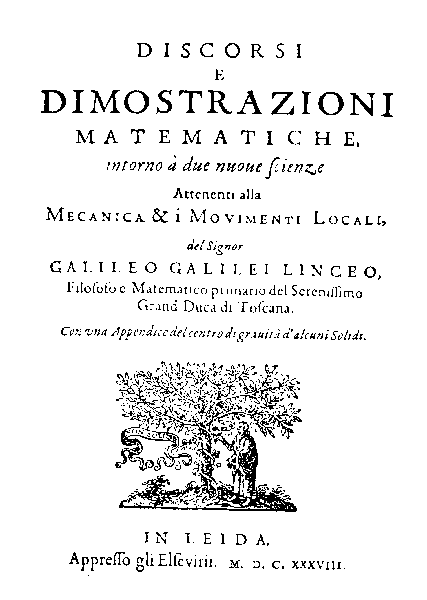
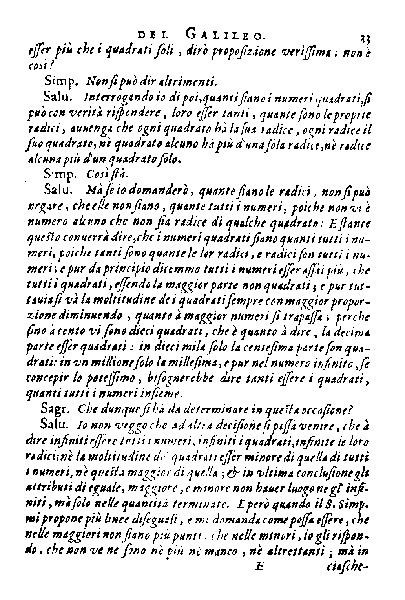
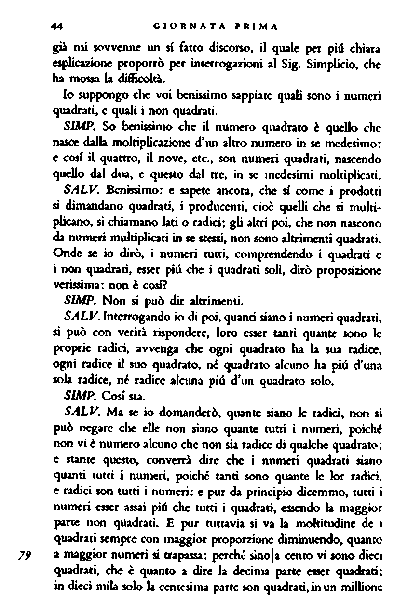
伽利略被判有罪,判处终身监禁,但判决的执行 somewhat 带有同情,实际上相当于软禁而非监禁。他先能与锡耶纳大主教同住,后来回到佛罗伦萨附近阿切特里的家中,但余生必须在宗教裁判所官员的监视下度过。1634年,他的女儿弗吉尼亚,即玛丽亚·切莱斯特修女去世,他遭受了沉重打击。她曾在父亲患病期间给予他巨大支持,伽利略因此心碎,数月无法工作。当他终于重新开始工作时,他开始写Discourses and mathematical demonstrations concerning the two new sciences。
在伽利略完成Discourses之后,它被偷运出意大利,带到荷兰的莱顿,并在那里出版。这是他最严格的数学著作,处理了冲力、矩和重心问题。这部著作的许多内容可以追溯到De Motu中约1590年的未发表思想,以及他在1602-1604年间研究出的改进。在Discourses中,他发展了自己关于斜面的思想,写道:
我假定,同一可动物体在不同倾角的斜面上获得的速度相等,只要这些斜面的高度相等。
然后他描述了一个使用摆的实验来验证他的斜面性质,并利用这些思想给出了关于自由落体物体加速度的定理:
一个物体从静止开始作匀加速运动,通过某段距离所需的时间,等于同一可动物体以先前匀加速运动的最大速度和最终速度的一半作匀速运动通过同一距离所需的时间。
在给出更多这类结果之后,他给出了著名的结果:物体从静止开始作匀加速运动所移动的距离与所用时间的平方成正比。
人们会期望伽利略对摆的理解——他年轻时就已经有了——会引导他设计摆钟。事实上,他似乎只是在生命接近尾声时才想到这种可能性,并在1640年左右确实设计了第一台摆钟。伽利略于1642年初去世,但他的钟设计的重要性肯定被他的儿子文琴佐意识到了,他试图按照伽利略的计划制造一台钟,但失败了。
对于如此伟大的人物来说,因异端邪说被判罪而死是一个悲惨的结局。他的遗嘱表明他希望被埋葬在圣十字大教堂的家族墓穴中,在他父亲旁边,但他的亲属担心——完全正确地——这会招致教会的反对。他的遗体被隐藏起来,直到1737年才由民政当局违背教会中许多人的意愿,安放在教堂中一座精美的坟墓里。1992年10月31日,即伽利略去世350年后,教皇弗瑞兹·约翰保罗二世代表天主教会发表讲话,承认在伽利略的案件中,神学顾问犯了错误。他宣布伽利略案件结案,但他不承认教会因伽利略相信地球绕太阳旋转而以异端罪名定罪是错误的。
Galileo Galilei's parents were Vincenzo Galilei and Guilia Ammannati. Vincenzo, who was born in Florence in 1520, was a teacher of music and a fine lute player. After studying music in Venice he carried out experiments on strings to support his musical theories. Guilia, who was born in Pescia, married Vincenzo in 1563 and they made their home in the countryside near Pisa. Galileo was their first child and spent his early years with his family in Pisa.
In 1572, when Galileo was eight years old, his family returned to Florence, his father's home town. However, Galileo remained in Pisa and lived for two years with Muzio Tedaldi who was related to Galileo's mother by marriage. When he reached the age of ten, Galileo left Pisa to join his family in Florence and there he was tutored by Jacopo Borghini. Once he was old enough to be educated in a monastery, his parents sent him to the Camaldolese Monastery at Vallombrosa which is situated on a magnificent forested hillside 33 km southeast of Florence. The Camaldolese Order was independent of the Benedictine Order, splitting from it in about 1012. The Order combined the solitary life of the hermit with the strict life of the monk and soon the young Galileo found this life an attractive one. He became a novice, intending to join the Order, but this did not please his father who had already decided that his eldest son should become a medical doctor.
Vincenzo had Galileo return from Vallombrosa to Florence and give up the idea of joining the Camaldolese order. He did continue his schooling in Florence, however, in a school run by the Camaldolese monks. In 1581 Vincenzo sent Galileo back to Pisa to live again with Muzio Tedaldi and now to enrol for a medical degree at the University of Pisa. Although the idea of a medical career never seems to have appealed to Galileo, his father's wish was a fairly natural one since there had been a distinguished physician in his family in the previous century. Galileo never seems to have taken medical studies seriously, attending courses on his real interests which were in mathematics and natural philosophy. His mathematics teacher at Pisa was Filippo Fantoni, who held the chair of mathematics. Galileo returned to Florence for the summer vacations and there continued to study mathematics.
In the year 1582-83 Ostilio Ricci, who was the mathematician of the Tuscan Court and a former pupil of Tartaglia, taught a course on Euclid's Elements at the University of Pisa which Galileo attended. During the summer of 1583 Galileo was back in Florence with his family and Vincenzo encouraged him to read Galen to further his medical studies. However Galileo, still reluctant to study medicine, invited Ricci (also in Florence where the Tuscan court spent the summer and autumn) to his home to meet his father. Ricci tried to persuade Vincenzo to allow his son to study mathematics since this was where his interests lay. Certainly Vincenzo did not like the idea and resisted strongly but eventually he gave way a little and Galileo was able to study the works of Euclid and Archimedes from the Italian translations which Tartaglia had made. Of course he was still officially enrolled as a medical student at Pisa but eventually, by 1585, he gave up this course and left without completing his degree.
Galileo began teaching mathematics, first privately in Florence and then during 1585-86 at Siena where he held a public appointment. During the summer of 1586 he taught at Vallombrosa, and in this year he wrote his first scientific book The little balance [La Balancitta] which described Archimedes' method of finding the specific gravities (that is the relative densities) of substances using a balance. In the following year he travelled to Rome to visit Clavius who was professor of mathematics at the Jesuit Collegio Romano there. A topic which was very popular with the Jesuit mathematicians at this time was centres of gravity and Galileo brought with him some results which he had discovered on this topic. Despite making a very favourable impression on Clavius, Galileo failed to gain an appointment to teach mathematics at the University of Bologna.
After leaving Rome Galileo remained in contact with Clavius by correspondence and Guidobaldo del Monte was also a regular correspondent. Certainly the theorems which Galileo had proved on the centres of gravity of solids, and left in Rome, were discussed in this correspondence. It is also likely that Galileo received lecture notes from courses which had been given at the Collegio Romano, for he made copies of such material which still survive today. The correspondence began around 1588 and continued for many years. Also in 1588 Galileo received a prestigious invitation to lecture on the dimensions and location of hell in Dante's Inferno at the Academy in Florence.
Fantoni left the chair of mathematics at the University of Pisa in 1589 and Galileo was appointed to fill the post (although this was only a nominal position to provide financial support for Galileo). Not only did he receive strong recommendations from Clavius, but he also had acquired an excellent reputation through his lectures at the Florence Academy in the previous year. The young mathematician had rapidly acquired the reputation that was necessary to gain such a position, but there were still higher positions at which he might aim. Galileo spent three years holding this post at the university of Pisa and during this time he wrote De Motu a series of essays on the theory of motion which he never published. It is likely that he never published this material because he was less than satisfied with it, and this is fair for despite containing some important steps forward, it also contained some incorrect ideas. Perhaps the most important new ideas which De Motu contains is that one can test theories by conducting experiments. In particular the work contains his important idea that one could test theories about falling bodies using an inclined plane to slow down the rate of descent.
In 1591 Vincenzo Galilei, Galileo's father, died and since Galileo was the eldest son he had to provide financial support for the rest of the family and in particular have the necessary financial means to provide dowries for his two younger sisters. Being professor of mathematics at Pisa was not well paid, so Galileo looked for a more lucrative post. With strong recommendations from Guidobaldo del Monte, Galileo was appointed professor of mathematics at the University of Padua (the university of the Republic of Venice) in 1592 at a salary of three times what he had received at Pisa. On 7 December 1592 he gave his inaugural lecture and began a period of eighteen years at the university, years which he later described as the happiest of his life. At Padua his duties were mainly to teach Euclid's geometry and standard (geocentric) astronomy to medical students, who would need to know some astronomy in order to make use of astrology in their medical practice. However, Galileo argued against Aristotle's view of astronomy and natural philosophy in three public lectures he gave in connection with the appearance of a New Star (now known as 'Kepler's supernova') in 1604. The belief at this time was that of Aristotle, namely that all changes in the heavens had to occur in the lunar region close to the Earth, the realm of the fixed stars being permanent. Galileo used parallax arguments to prove that the New Star could not be close to the Earth. In a personal letter written to Kepler in 1598, Galileo had stated that he was a Copernican (believer in the theories of Copernicus). However, no public sign of this belief was to appear until many years later.
At Padua, Galileo began a long term relationship with Maria Gamba, who was from Venice, but they did not marry perhaps because Galileo felt his financial situation was not good enough. In 1600 their first child Virginia was born, followed by a second daughter Livia in the following year. In 1606 their son Vincenzo was born.
We mentioned above an error in Galileo's theory of motion as he set it out in De Motu around 1590. He was quite mistaken in his belief that the force acting on a body was the relative difference between its specific gravity and that of the substance through which it moved. Galileo wrote to his friend Paolo Sarpi, a fine mathematician who was consultor to the Venetian government, in 1604 and it is clear from his letter that by this time he had realised his mistake. In fact he had returned to work on the theory of motion in 1602 and over the following two years, through his study of inclined planes and the pendulum, he had formulated the correct law of falling bodies and had worked out that a projectile follows a parabolic path. However, these famous results would not be published for another 35 years.
In May 1609, Galileo received a letter from Paolo Sarpi telling him about a spyglass that a Dutchman had shown in Venice. Galileo wrote in the Starry Messenger (Sidereus Nuncius) in April 1610:-
About ten months ago a report reached my ears that a certain Fleming had constructed a spyglass by means of which visible objects, though very distant from the eye of the observer, were distinctly seen as if nearby. Of this truly remarkable effect several experiences were related, to which some persons believed while other denied them. A few days later the report was confirmed by a letter I received from a Frenchman in Paris, Jacques Badovere, which caused me to apply myself wholeheartedly to investigate means by which I might arrive at the invention of a similar instrument. This I did soon afterwards, my basis being the doctrine of refraction.
From these reports, and using his own technical skills as a mathematician and as a craftsman, Galileo began to make a series of telescopes whose optical performance was much better than that of the Dutch instrument. His first telescope was made from available lenses and gave a magnification of about four times. To improve on this Galileo learned how to grind and polish his own lenses and by August 1609 he had an instrument with a magnification of around eight or nine. Galileo immediately saw the commercial and military applications of his telescope (which he called a perspicillum) for ships at sea. He kept Sarpi informed of his progress and Sarpi arranged a demonstration for the Venetian Senate. They were very impressed and, in return for a large increase in his salary, Galileo gave the sole rights for the manufacture of telescopes to the Venetian Senate. It seems a particularly good move on his part since he must have known that such rights were meaningless, particularly since he always acknowledged that the telescope was not his invention!
By the end of 1609 Galileo had turned his telescope on the night sky and began to make remarkable discoveries. Swerdlow writes (see [16]):-
In about two months, December and January, he made more discoveries that changed the world than anyone has ever made before or since.
The astronomical discoveries he made with his telescopes were described in a short book called the Starry Messenger published in Venice in May 1610. This work caused a sensation. Galileo claimed to have seen mountains on the Moon, to have proved the Milky Way was made up of tiny stars, and to have seen four small bodies orbiting Jupiter. These last, with an eye to getting a position in Florence, he quickly named 'the Medicean stars'. He had also sent Cosimo de Medici, the Grand Duke of Tuscany, an excellent telescope for himself.
The Venetian Senate, perhaps realising that the rights to manufacture telescopes that Galileo had given them were worthless, froze his salary. However he had succeeded in impressing Cosimo and, in June 1610, only a month after his famous little book was published, Galileo resigned his post at Padua and became Chief Mathematician at the University of Pisa (without any teaching duties) and 'Mathematician and Philosopher' to the Grand Duke of Tuscany. In 1611 he visited Rome where he was treated as a leading celebrity; the Collegio Romano put on a grand dinner with speeches to honour Galileo's remarkable discoveries. He was also made a member of the Accademia dei Lincei (in fact the sixth member) and this was an honour which was especially important to Galileo who signed himself 'Galileo Galilei Linceo' from this time on.
While in Rome, and after his return to Florence, Galileo continued to make observations with his telescope. Already in the Starry Messenger he had given rough periods of the four moons of Jupiter, but more precise calculations were certainly not easy since it was difficult to identify from an observation which moon was I, which was II, which III, and which IV. He made a long series of observations and was able to give accurate periods by 1612. At one stage in the calculations he became very puzzled since the data he had recorded seemed inconsistent, but he had forgotten to take into account the motion of the Earth round the sun.
Galileo first turned his telescope on Saturn on 25 July 1610 and it appeared as three bodies (his telescope was not good enough to show the rings but made them appear as lobes on either side of the planet). Continued observations were puzzling indeed to Galileo as the bodies on either side of Saturn vanished when the ring system was edge on. Also in 1610 he discovered that, when seen in the telescope, the planet Venus showed phases like those of the Moon, and therefore must orbit the Sun not the Earth. This did not enable one to decide between the Copernican system, in which everything goes round the Sun, and that proposed by Tycho Brahe in which everything but the Earth (and Moon) goes round the Sun which in turn goes round the Earth. Most astronomers of the time in fact favoured Brahe's system and indeed distinguishing between the two by experiment was beyond the instruments of the day. However, Galileo knew that all his discoveries were evidence for Copernicanism, although not a proof. In fact it was his theory of falling bodies which was the most significant in this respect, for opponents of a moving Earth argued that if the Earth rotated and a body was dropped from a tower it should fall behind the tower as the Earth rotated while it fell. Since this was not observed in practice this was taken as strong evidence that the Earth was stationary. However Galileo already knew that a body would fall in the observed manner on a rotating Earth.
Other observations made by Galileo included the observation of sunspots. He reported these in Discourse on floating bodies which he published in 1612 and more fully in Letters on the sunspots which appeared in 1613. In the following year his two daughters entered the Franciscan Convent of St Matthew outside Florence, Virginia taking the name Sister Maria Celeste and Livia the name Sister Arcangela. Since they had been born outside of marriage, Galileo believed that they themselves should never marry. Although Galileo put forward many revolutionary correct theories, he was not correct in all cases. In particular when three comets appeared in 1618 he became involved in a controversy regarding the nature of comets. He argued that they were close to the Earth and caused by optical refraction. A serious consequence of this unfortunate argument was that the Jesuits began to see Galileo as a dangerous opponent.
Despite his private support for Copernicanism, Galileo tried to avoid controversy by not making public statements on the issue. However he was drawn into the controversy through Castelli who had been appointed to the chair of mathematics in Pisa in 1613. Castelli had been a student of Galileo's and he was also a supporter of Copernicus. At a meeting in the Medici palace in Florence in December 1613 with the Grand Duke Cosimo II and his mother the Grand Duchess Christina of Lorraine, Castelli was asked to explain the apparent contradictions between the Copernican theory and Holy Scripture. Castelli defended the Copernican position vigorously and wrote to Galileo afterwards telling him how successful he had been in putting the arguments. Galileo, less convinced that Castelli had won the argument, wrote Letter to Castelli to him arguing that the Bible had to be interpreted in the light of what science had shown to be true. Galileo had several opponents in Florence and they made sure that a copy of the Letter to Castelli was sent to the Inquisition in Rome. However, after examining its contents they found little to which they could object.
The Catholic Church's most important figure at this time in dealing with interpretations of the Holy Scripture was Cardinal Robert Bellarmine. He seems at this time to have seen little reason for the Church to be concerned regarding the Copernican theory. The point at issue was whether Copernicus had simply put forward a mathematical theory which enabled the calculation of the positions of the heavenly bodies to be made more simply or whether he was proposing a physical reality. At this time Bellarmine viewed the theory as an elegant mathematical one which did not threaten the established Christian belief regarding the structure of the universe.
In 1616 Galileo wrote the Letter to the Grand Duchess which vigorously attacked the followers of Aristotle. In this work, which he addressed to the Grand Duchess Christina of Lorraine, he argued strongly for a non-literal interpretation of Holy Scripture when the literal interpretation would contradict facts about the physical world proved by mathematical science. In this Galileo stated quite clearly that for him the Copernican theory is not just a mathematical calculating tool, but is a physical reality:-
I hold that the Sun is located at the centre of the revolutions of the heavenly orbs and does not change place, and that the Earth rotates on itself and moves around it. Moreover ... I confirm this view not only by refuting Ptolemy's and Aristotle's arguments, but also by producing many for the other side, especially some pertaining to physical effects whose causes perhaps cannot be determined in any other way, and other astronomical discoveries; these discoveries clearly confute the Ptolemaic system, and they agree admirably with this other position and confirm it.
Pope Paul V ordered Bellarmine to have the Sacred Congregation of the Index decide on the Copernican theory. The cardinals of the Inquisition met on 24 February 1616 and took evidence from theological experts. They condemned the teachings of Copernicus, and Bellarmine conveyed their decision to Galileo who had not been personally involved in the trial. Galileo was forbidden to hold Copernican views but later events made him less concerned about this decision of the Inquisition. Most importantly Maffeo Barberini, who was an admirer of Galileo, was elected as Pope Urban VIII. This happened just as Galileo's book Il saggiatore (The Assayer) was about to be published by the Accademia dei Lincei in 1623 and Galileo was quick to dedicate this work to the new Pope. The work described Galileo's new scientific method and contains a famous quote regarding mathematics:-
Philosophy is written in this grand book, the universe, which stands continually open to our gaze. But the book cannot be understood unless one first learns to comprehend the language and read the characters in which it is written. It is written in the language of mathematics, and its characters are triangles, circles, and other geometric figures without which it is humanly impossible to understand a single word of it; without these one is wandering in a dark labyrinth.
Pope Urban VIII invited Galileo to papal audiences on six occasions and led Galileo to believe that the Catholic Church would not make an issue of the Copernican theory. Galileo, therefore, decided to publish his views believing that he could do so without serious consequences from the Church. However by this stage in his life Galileo's health was poor with frequent bouts of severe illness and so even though he began to write his famous Dialogue in 1624 it took him six years to complete the work.
Galileo attempted to obtain permission from Rome to publish the Dialogue in 1630 but this did not prove easy. Eventually he received permission from Florence, and not Rome. In February 1632 Galileo published Dialogue Concerning the Two Chief Systems of the World - Ptolemaic and Copernican. It takes the form of a dialogue between Salviati, who argues for the Copernican system, and Simplicio who is an Aristotelian philosopher. The climax of the book is an argument by Salviati that the Earth moves which was based on Galileo's theory of the tides. Galileo's theory of the tides was entirely false despite being postulated after Kepler had already put forward the correct explanation. It was unfortunate, given the remarkable truths the Dialogue supported, that the argument which Galileo thought to give the strongest proof of Copernicus's theory should be incorrect.
Shortly after publication of Dialogue Concerning the Two Chief Systems of the World - Ptolemaic and Copernican the Inquisition banned its sale and ordered Galileo to appear in Rome before them. Illness prevented him from travelling to Rome until 1633. Galileo's accusation at the trial which followed was that he had breached the conditions laid down by the Inquisition in 1616. However a different version of this decision was produced at the trial rather than the one Galileo had been given at the time. The truth of the Copernican theory was not an issue therefore; it was taken as a fact at the trial that this theory was false. This was logical, of course, since the judgement of 1616 had declared it totally false.
Found guilty, Galileo was condemned to lifelong imprisonment, but the sentence was carried out somewhat sympathetically and it amounted to house arrest rather than a prison sentence. He was able to live first with the Archbishop of Siena, then later to return to his home in Arcetri, near Florence, but had to spend the rest of his life watched over by officers from the Inquisition. In 1634 he suffered a severe blow when his daughter Virginia, Sister Maria Celeste, died. She had been a great support to her father through his illnesses and Galileo was shattered and could not work for many months. When he did manage to restart work, he began to write Discourses and mathematical demonstrations concerning the two new sciences.
After Galileo had completed work on the Discourses it was smuggled out of Italy, and taken to Leyden in Holland where it was published. It was his most rigorous mathematical work which treated problems on impetus, moments, and centres of gravity. Much of this work went back to the unpublished ideas in De Motu from around 1590 and the improvements which he had worked out during 1602-1604. In the Discourses he developed his ideas of the inclined plane writing:-
I assume that the speed acquired by the same movable object over different inclinations of the plane are equal whenever the heights of those planes are equal.
He then described an experiment using a pendulum to verify his property of inclined planes and used these ideas to give a theorem on acceleration of bodies in free fall:-
The time in which a certain distance is traversed by an object moving under uniform acceleration from rest is equal to the time in which the same distance would be traversed by the same movable object moving at a uniform speed of one half the maximum and final speed of the previous uniformly accelerated motion.
After giving further results of this type he gives his famous result that the distance that a body moves from rest under uniform acceleration is proportional to the square of the time taken.
One would expect that Galileo's understanding of the pendulum, which he had since he was a young man, would have led him to design a pendulum clock. In fact he only seems to have thought of this possibility near the end of his life and around 1640 he did design the first pendulum clock. Galileo died in early 1642 but the significance of his clock design was certainly realised by his son Vincenzo who tried to make a clock to Galileo's plan, but failed.
It was a sad end for so great a man to die condemned of heresy. His will indicated that he wished to be buried beside his father in the family tomb in the Basilica of Santa Croce but his relatives feared, quite rightly, that this would provoke opposition from the Church. His body was concealed and only placed in a fine tomb in the church in 1737 by the civil authorities against the wishes of many in the Church. On 31 October 1992, 350 years after Galileo's death, Pope John Paul II gave an address on behalf of the Catholic Church in which he admitted that errors had been made by the theological advisors in the case of Galileo. He declared the Galileo case closed, but he did not admit that the Church was wrong to convict Galileo on a charge of heresy because of his belief that the Earth rotates round the sun.
正文里的方括号编号指向这里,悬停即可直接看到条目。书目保留原文——译了书名反而查不到文献。
原站列出的延伸阅读与外部数据库,照原样保留,目标多为英文页面。
关于伽利略的其它页面:
关于伽利略的其它网站:
原站的交叉引用。指向本站已镜像专题的留在站内,其余仍指回原站。