数学家传记
约翰·沃利斯是一位英国数学家,他在博纳文图拉·卡瓦列里的不可分方法基础上设计了一种插值法。利用约翰内斯·开普勒的连续性概念,他发现了求积分的方法。
约翰·沃利斯的父亲是沃利斯牧师,他于1602年成为阿什福德的牧师。他是一位在该地区广受尊敬的人。沃利斯牧师于1612年与Joanna 西德尼·查普曼结婚,后者是他的第二任妻子,弗瑞兹·约翰是他们五个孩子中的第三个。当年轻的约翰大约六岁时,他的父亲去世了。
约翰在阿什福德上学,但该地区爆发瘟疫,促使他的母亲决定让他搬走为妙。1625年,他去了肯特郡滕特登的詹姆斯·莫瓦特文法学校,在那里他首次展现出作为学者的巨大潜力。沃利斯在自传中写道[28]:-
从小我就一直热衷于不仅靠死记硬背来学习,还要了解所学之物的根据或理由;既充实我的记忆,也启发我的判断。
1630年,他年仅13岁,就认为自己已准备好上大学[28]:-
我已像某些被送到那里的人一样,为上大学做好了准备。
然而,他在1631至1632年间就读于埃塞克斯郡费尔斯特德的马丁·霍尔比奇学校,在那里他精通了拉丁语、希腊语和希伯来语。他还在该校学习了逻辑学,但当时最好的学校并不认为数学重要,因此沃利斯在学校并未接触该学科。正是在1631年圣诞节假期期间,沃利斯首次接触数学,当时他的哥哥教他算术规则。沃利斯发现数学[28]:-
……非常适合我的性情,以至于我从那时起就从事它,不是作为正式的学习,而是作为闲暇时令人愉快的消遣……
他读的数学书籍都是偶然遇到的:-
因为没有人指导我该读什么书,或该寻找什么,或该按什么方法进行。因为数学,在当时我们这里,几乎不被视为学术研究,而更像是机械性的——如商人、贸易商、海员、木匠、土地测量员等的事务。
从费尔斯特德的学校,他去了剑桥大学伊曼纽尔学院,大约在1632年圣诞节入学。他攻读了标准的文学学士学位,并且由于当时剑桥没有人能指导他的数学学习,他学习了一系列科目,如伦理学、形而上学、地理学、天文学、医学和解剖学。尽管从未打算从事医学职业,他还是在公开辩论中为他的老师弗朗西斯·格利森的革命性血液循环理论辩护,成为第一个这样做的人。
1637年,沃利斯获得学士学位,并继续学习,于1640年获得硕士学位。同年,他被温彻斯特主教任命为牧师,并被任命为约克郡巴特沃思的理查德·达利爵士的随行牧师。1642年至1644年间,他在埃塞克斯郡的赫丁厄姆和伦敦担任随行牧师。正是在这段时间,塑造沃利斯未来的两个事件中的第一个发生了:-
……一天晚餐时,有人送来一封关于1642年12月27日奇切斯特被攻占的密码信,沃利斯在两小时内成功破译。这一壮举使他发迹。他成为当时几乎无人知晓的密码学艺术的高手,并为议会党一方效力。
这是保皇党人与议会党人之间内战的时代,沃利斯运用他的密码学技能为议会党人破译保皇党人的信息。由于他为议会党人效力,1643年他被授予伦敦芬丘奇街圣加百列教堂的负责权。同年,他的母亲去世,这使沃利斯因继承肯特郡的一大片地产而成为有独立收入的人。
1644年,沃利斯成为威斯敏斯特神职人员的秘书,并因此获得剑桥大学王后学院的会士职位。他在那里对神学的研究没有持续多久,因为他于1645年3月14日与苏珊娜·格莱德结婚,因此不再能保有会士职位(会士不得结婚)。他回到伦敦,开始每周与一群对自然和实验科学感兴趣的科学家会面。这个热情的团体最终将成为伦敦的皇家学会,但即使在这个早期阶段,他们也制定了严格的规则。沃利斯写道:-
[我们]每周在某个固定时间会面(有时在戈达德博士的住所,有时在附近伍德街的米特雷酒馆),违反者受一定处罚,并每周缴纳实验费用,我们之间商定了某些规则。在那里,为了避免被引向其他话题以及出于其他一些原因,我们禁止一切关于神学、国家事务和新闻的讨论(除了与我们哲学事业相关的),将我们自己局限于哲学探究及相关主题;如医学、解剖学、几何学、天文学、航海学、静力学、力学和自然实验。
在这段文字中,我们稍微现代化了沃利斯的英语,使其更易于理解。
我们在上文谈到了塑造沃利斯未来的两件事,第一件是密码学。第二件与皇家学会的初创密切相关,几乎可以肯定源于那些聚会,那就是他在1647年读了威廉·欧垂的Clavis Mathematicae。他学生时代对数学的热爱从未有机会蓬勃发展,如今迅速迸发出来。他在自传中写道,他几周内就掌握了威廉·欧垂的书,并进而做出了自己的数学工作。
沃利斯写了一本书Treatise of Angular Sections,这本书四十年未出版。他还发现了求解四次方程的方法,这些方法与托马斯·哈里奥特所发现的方法相似,但沃利斯声称这些发现是他自己做出的,直到后来才知道托马斯·哈里奥特的贡献。
1649年,他由克伦威尔任命为牛津的萨维尔几何学讲席,主要是因为他支持议会派。当然,该讲席的前任Peter Turner因保皇派观点而被解职。克伦威尔高度评价沃利斯,不仅因为他的政治观点,还因为他的学术成就。沃利斯担任萨维尔讲席超过50年,直到去世,即使他是因为错误的原因被任命的,他也绝对配得上这个讲席。
这并不是沃利斯在牛津担任的唯一职位。1657年,他被任命为大学档案保管员。关于他当选这一职位存在相当大的争议。奥布里在他的Lives of Eminent Men:-中写道
1657年,他(以不正当手段)使自己被选为牛津大学的档案保管员……现在,萨维里讲席教授还兼任其他职位,这直接违反了亨利亨利·萨维尔爵士的章程,再没有比这更严重的了,如果他这样做,他就是直接作伪证。然而,这位博士仍被允许保留另一个职位。
沃利斯的对手认为,他之所以成为大学档案保管员,是因为他支持克伦威尔。即使情况如此,与萨维里讲席一样,沃利斯极其出色地履行了职责,完全配得上这个职位。
沃利斯是议会派,他确实公开反对处决查理一世,并在1648年签署了一份反对处决的文件。这是出于善意,因为尽管沃利斯有时利用他无可置疑的政治技巧来获得他想要的东西,但从未有任何迹象表明他不是一个诚实的人。然而,沃利斯通过签署反对国王处决的请愿书而获益,因为在1660年君主制恢复、查理二世登基时,沃利斯在萨维尔讲席的任命得到了国王的确认。查理二世走得更远,他任命沃利斯为皇家牧师,并在1661年提名他为修订祈祷书而设立的委员会成员。
沃利斯对微积分的起源做出了重大贡献,是艾萨克·牛顿之前最有影响力的英国数学家。他研究了约翰内斯·开普勒、博纳文图拉·卡瓦列里、罗贝瓦尔、埃万杰利斯塔·托里拆利和勒内·笛卡儿的著作,然后引入了超越这些作者的微积分思想。
沃利斯最著名的著作是Arithmetica infinitorum,于1656年出版。在这部著作中,沃利斯建立了公式
直到向他证明该公式能给出π的数值正确近似值,克里斯蒂安·惠更斯才肯相信。沃利斯在试图计算从0到1的积分、进而求单位半径圆的面积时发现了这一结果。他在博纳文图拉·卡瓦列里的不可分法基础上,解决了对的整数幂积分的问题,但无法处理分数幂,于是使用了插值法,这个词是他在此著作中引入的。他的插值法使用了约翰内斯·开普勒的连续性概念,并借此发现了计算积分的方法,这些方法后来被艾萨克·牛顿用于其关于二项式定理的工作。艾萨克·牛顿写道:——
大约在我数学研究的初期,当我们著名的同胞沃利斯博士的著作一落到我手中,通过考虑级数,他通过内插法展示了圆和双曲线的面积……
在其Tract on Conic Sections(1655)中,沃利斯将用平面截圆锥所得的截面曲线描述为代数坐标的性质:——
……没有圆锥的那些纠缠。
在引言中他宣称它是31:-
……把抛物线看作圆锥被平行于母线的平面所截的截面,并不比把圆看作圆锥被平行于底面的平面所截的截面,甚至把三角形看作过顶点的平面更为必要。
沃利斯以勒内·笛卡儿的风格发展了分析方法,并且是第一位使用这些新技巧的英国数学家。这项工作也因首次使用符号∞而闻名,该符号由沃利斯选定,用来表示一条可以被无限多次描出的曲线。他在几个月后出版的更具影响力的著作Arithmetica infinitorum中再次使用了这个符号。
沃利斯 也是一位重要的早期数学史家,在他的 Treatise on Algebra 中,他提供了大量有价值的历史材料。然而,这部于 1685 年问世的著作最重要的特点是,它以清晰的阐述将 托马斯·哈里奥特 的工作带给数学家,这是第一次由真正理解其贡献意义的人来呈现。
在 Treatise on Algebra 中,沃利斯 接受了负根和复根。他证明 恰好有三个根,且它们都是实根。他还批评了 勒内·笛卡儿 的符号法则,相当正确地指出,通过观察确定正根数和负根数的法则,仅当方程的所有根都是实根时才有效。这部著作中一个极具争议的部分是,沃利斯 声称 勒内·笛卡儿 的代数学知识直接来自 托马斯·哈里奥特。该书一出版,沃利斯 就因这些主张而受到批评,但这一主题至今仍令数学史家感兴趣。沃利斯 在这一主题上提出的主张从未被证明为假并令所有人完全满意。只是有一点暗示,他的主张可能有些道理,这使得讨论得以继续。
沃利斯 通过整理一些古希腊文本,如 克劳狄乌斯·托勒密 的 Harmonics、阿里斯塔克斯 的 On the magnitudes and distances of the sun and moon 和 阿基米德 的 Sand-reckoner,对数学史做出了其他贡献。
他的非数学著作包括许多宗教著作、一本关于词源学和语法的书 Grammatica linguae Anglicanae(牛津,1653 年)以及一本逻辑学书 Institutio logicae(牛津,1687 年)。
沃利斯卷入了一场与托马斯·霍布斯的激烈争论,后者虽然是一位优秀的学者,但作为数学家远不及沃利斯的水平。1655年,托马斯·霍布斯声称发现了一种化圆为方的方法。沃利斯当时正在印刷他那本包含其方法的书Arithmetica infinitorum,他驳斥了托马斯·霍布斯的主张。托马斯·霍布斯回应道:-
……无礼、伤人、粗鄙的语言……
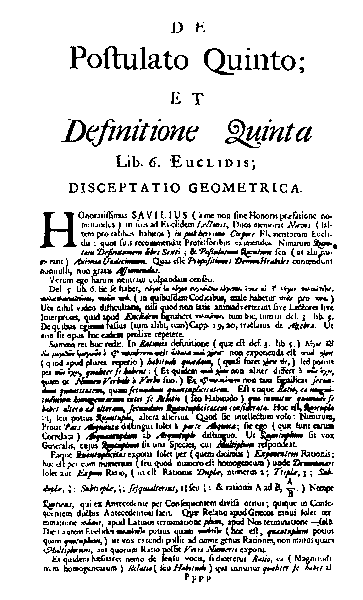
沃利斯用小册子Six lessons to the Professors of Mathematics at the Institute of Sir Henry Savile。沃利斯用小册子Due Correction for Mr Hobbes, or School Discipline for not saying his Lessons Aright作了答复,对此托马斯·霍布斯写了小册子The Marks of the Absurd Geometry, Rural Language etc. of Doctor Wallis。
在争论似乎已经结束了一段时间之后,托马斯·霍布斯以一部新著作重新挑起了争论。他在序言中写道:——
在那些和我一样就这些事情写过一些东西的人当中,要么只有我是疯子,要么只有我不是疯子。没有第三种选择可以成立,除非(也许在某些人看来可能如此)我们都是疯子。
沃利斯回复道:-
如果他是疯子,他不太可能被理性说服;另一方面,如果我们疯了,我们就无法尝试这样做。
争论持续了20多年,范围扩大到包括罗伯特·波义耳,直到托马斯·霍布斯去世才结束。
沃利斯数学才能的一个方面尚未提及,即他进行心算的非凡能力。他睡眠很差,常常躺在床上醒着时进行心算。一天夜里,他在头脑中计算了一个53位数的平方根。到了早上,他完全凭记忆口述出了这个数的27位平方根。这一壮举理所当然地被认为是非凡的,Royal Society的秘书Oldenburg派了一位同事去调查沃利斯是如何做到的。这件事被认为足够重要,值得在1685年的Philosophical Transactions of the Royal Society中讨论。
Hearne在1885年写到沃利斯时,对他作了如下描述:——
……他是一位具有最令人钦佩的优秀才能和极大勤奋的人,因此在一些年里,他因在数学上的深厚造诣而声名卓著,被理所当然地认为是当时从事这一职业的人中最伟大的人物。他还是一位优秀的神学家,并且在希腊语和拉丁语方面绝非平庸的批评家。
John Wallis's father was the Reverend John Wallis who had become a minister in Ashford in 1602. He was a highly respected man known widely in the area. The Reverend Wallis married Joanna Chapman, who was his second wife, in 1612 and John was the third of their five children. When young John was about six years old his father died.
John went to school in Ashford but an outbreak of the plague in the area led to his mother to decide that it would be best for him to move away. He went to James Movat's grammar school in Tenterden, Kent, in 1625 where he first showed his great potential as a scholar. Writing in his autobiography, Wallis comments [28]:-
It was always my affection, even from a child, not only to learn by rote, but to know the grounds or reasons of what I learnt; to inform my judgement as well as to furnish my memory.
In 1630, still only 13 years of age, he considered himself ready for university [28]:-
I was as ripe for university as some that have been sent thither.
However he spent 1631-32 at Martin Holbeach's school in Felsted, Essex, where he became proficient in Latin, Greek and Hebrew. He also studied logic at this school but mathematics was not considered important in the best schools of the time, so Wallis did not come in contact with that topic at school. It was during the 1631 Christmas holidays that Wallis first came in contact with mathematics when his brother taught him the rules of arithmetic. Wallis found that mathematics [28]:-
... suited my humour so well that I did thenceforth prosecute it, not as a formal study, but as a pleasing diversion at spare hours ...
The mathematics books he read were those he came on by chance:-
For I had none to direct me what books to read, or what to seek, or in what method to proceed. For mathematics, at that time with us, were scarce looked on as academical studies, but rather mechanical - as the business of traders, merchants, seamen, carpenters, surveyors of lands and the like.
From school in Felsted he went to Emmanual College Cambridge, entering around Christmas 1632. He took the standard bachelor of arts degree and, since nobody at Cambridge at this time could direct his mathematical studies, he took a range of topics such as ethics, metaphysics, geography, astronomy, medicine and anatomy. Although never intending to follow a career in medicine, he defended his teacher Francis Glisson's revolutionary theory of the circulation of the blood in a public debate, being the first person to do so.
In 1637 Wallis received his BA and continued his studies receiving his Master's Degree in 1640. In the same year he was ordained by the bishop of Winchester and appointed chaplain to Sir Richard Darley at Butterworth in Yorkshire. Between 1642 and 1644 he was chaplain at Hedingham, Essex and in London. It was during this time that the first of two events which shaped Wallis's future took place:-
... one evening at supper, a letter in cipher was brought in, relating to the capture of Chichester on 27 December 1642, which Wallis in two hours succeeded in deciphering. The feat made his fortune. He became an adept in the cryptologic art, until then almost unknown, and exercised it on behalf of the parliamentary party.
This was the time of the Civil War between the Royalists and Parliamentarians and Wallis used his skills in cryptography in decoding Royalist messages for the Parliamentarians. Because of his efforts on behalf of the Parliamentarians he was given charge of the church of St Gabriel in Fenchurch Street, London in 1643. In this same year his mother died and this left Wallis as a man of independent means since he inherited a major estate in Kent.
In 1644 Wallis became secretary to the clergy at Westminster and through this he was given a fellowship at Queen's College, Cambridge. His study of divinity there did not last long since he married Susanna Glyde on 14 March 1645, so was no longer able to hold the fellowship (fellows could not be married). He returned to London where he began to meet weekly with a group of scientists interested in natural and experimental science. This enthusiastic group would eventually become the Royal Society of London, but even at this early stage they evolved strict rules. Wallis wrote:-
[We] met weekly, (sometimes at Dr Goddard's lodgings, sometimes at the Mitre in Wood Street near-by) at a certain hour, under a certain penalty, and a weekly contribution for the charge of experiments, with certain rules agreed among us. There, to avoid being diverted to other discourses and for some other reasons, we barred all discussion of Divinity, of State Affairs, and of news (other than what concerned our business of philosophy) confining ourselves to philosophical inquiries, and related topics; as medicine, anatomy, geometry, astronomy, navigation, statics, mechanics, and natural experiments.
In this passage we have modernised Wallis's English a little to make it more easily understood.
We talked above about two events which shaped Wallis's future, the first being cryptography. The second, closely associated with the beginnings of the Royal Society and almost certainly arising from those meetings, was that he read Oughtred's Clavis Mathematicae in 1647. Quickly his love of mathematics, which he had as a student but which had never found the opportunity to flourish, now came pouring out. He writes in his autobiography that he mastered Oughtred's book in a couple of weeks and went on to produce mathematics of his own.
Wallis wrote a book Treatise of Angular Sections which remained unpublished for forty years. He also discovered methods of solving equations of degree four which were similar to those which Harriot had found but Wallis claimed that he made the discoveries himself, not being aware of Harriot's contributions until later.
He was appointed to the Savilian Chair of geometry at Oxford in 1649 by Cromwell mainly because of his support for the Parliamentarians. Certainly the previous holder of the chair, Peter Turner, was dismissed for his Royalist views. Cromwell held Wallis in high regard, not just for his political views but also for his scholarship. Wallis held the Savilian Chair for over 50 years until his death and, even if he was appointed for the wrong reasons, he most certainly deserved to hold the chair.
This was not the only position which Wallis would hold at Oxford. In 1657 he was appointed as keeper of the University archives. There was considerable controversy over his election to this post. Aubrey wrote in his Lives of Eminent Men:-
In 1657 he got himself chosen (by unjust means) to the Custos Archivorum of the University of Oxford ... Now, for the Savilian Professor to hold another place besides, is so downright against Sir Henry Savile's Statutes that nothing can be imagined more, and if he does he is downright perjured. Yet the Dr is allowed to keep the other place still.
Certainly Wallis's opponents believed that he became keeper of the University archives because of his support for Cromwell. Even if this were the case, as with the Savilian Chair, Wallis carried out his duties extremely well and fully deserved the post.
Although Wallis was a Parliamentarian he certainly spoke out against the execution of Charles I and, in 1648, had signed a document opposing the execution. This was done in good faith for although Wallis used his undoubted political skills to gain what wanted at times, there was never any suggestion that he was anything other than an honest man. Wallis, however, gained by signing the petition against the King's execution for, in 1660 when the monarchy was restored and Charles II came to the throne, Wallis had his appointment in the Savilian Chair confirmed by the King. Charles II went even further for he appointed Wallis as a royal chaplain and, in 1661, nominated him as a member of a committee set up to revise the prayer book.
Wallis contributed substantially to the origins of calculus and was the most influential English mathematician before Newton. He studied the works of Kepler, Cavalieri, Roberval, Torricelli and Descartes, and then introduced ideas of the calculus going beyond that of these authors.
Wallis's most famous work was Arithmetica infinitorum which he published in 1656. In this work Wallis established the formula
which Huygens refused to believe until he was shown that it led to numerically correct approximations to π. Wallis discovered this result when he was attempting to compute the integral of from 0 to 1 and hence to find the area of a circle of unit radius. He solved the problem of integrating for integer powers of , building on Cavalieri's method of indivisibles, but, unable to deal with fractional powers, he used interpolation, a word which he introduced in this work. His interpolation used Kepler's concept of continuity, and with it he discovered methods to evaluate integrals which were later used by Newton in his work on the binomial theorem. Newton wrote:-
About the beginning of my mathematical studies, as soon as the works of our celebrated countryman, Dr Wallis, fell into my hands, by considering the Series, by the Intercalation of which, he exhibits the Area of the Circle and the Hyperbola....
In his Tract on Conic Sections (1655) Wallis described the curves that are obtained as cross sections by cutting a cone with a plane as properties of algebraic coordinates:-
... without the embranglings of the cone.
In the Introduction he declared that it was [31]:-
... no more necessary ... to regard the parabola as a section of a cone by a plane parallel to a generator than to regard a circle as a section of a cone by a plane parallel to the base, or even a triangle as a plane through the vertex.
Wallis developed methods in the style of Descartes analytical treatment and he was the first English mathematician to use these new techniques. This work is also famed for the first use of the symbol ∞ which was chosen by Wallis to represent a curve which one could traced out infinitely many times. He used the symbol again in the more influential work Arithmetica infinitorum which was published a few months later.
Wallis was also an important early historian of mathematics and in his Treatise on Algebra he gives a wealth of valuable historical material. However the most important feature of this work, which appeared in 1685, is that it brought to mathematicians the work of Harriot in a clear exposition, presented for the first time by someone who really understood the significance of his contributions.
In Treatise on Algebra Wallis accepts negative roots and complex roots. He shows that has exactly three roots and that they are all real. He also criticises Descartes' Rule of Signs stating, quite correctly, that the rule which determines the number of positive and the number of negative roots by inspection, is only valid if all the roots of the equation are real. One highly controversial section in this work is one in which Wallis claims that Descartes' knowledge of algebra was gained directly from Harriot. Wallis received criticism for these claims immediately the book was published, but the subject is still of interest to historians of mathematics today. The claims made by Wallis on this topic have never been shown false to everyone's complete satisfaction. There is just a hint that there could be some truth in his claims which keeps the discussion alive.
Wallis made other contributions to the history of mathematics by restoring some ancient Greek texts such as Ptolemy's Harmonics, Aristarchus's On the magnitudes and distances of the sun and moon and Archimedes' Sand-reckoner.
His non-mathematical works include many religious works, a book on etymology and grammar Grammatica linguae Anglicanae (Oxford, 1653) and a logic book Institutio logicae (Oxford, 1687).
Wallis became involved in a bitter dispute with Hobbes, who although a fine scholar, was far below Wallis's class as a mathematician. In 1655 Hobbes claimed to have discovered a method to square the circle. Wallis's book Arithmetica infinitorum with his methods was in press at the time and he refuted Hobbes claims. Hobbes replied to the:-
... insolent, injurious, clownish language ...
of Wallis with the pamphlet Six lessons to the Professors of Mathematics at the Institute of Sir Henry Savile. Wallis replied with the pamphlet Due Correction for Mr Hobbes, or School Discipline for not saying his Lessons Aright to which Hobbes wrote the pamphlet The Marks of the Absurd Geometry, Rural Language etc. of Doctor Wallis.
After a period when the controversy seemed to have ended, Hobbes open up the argument again with a new work. In the Preface he wrote:-
Of those who with me have written something about these matters, either I alone am mad, or I alone am not mad. No third option can be maintained, unless (as perchance it may seem to some) was are all mad.
Wallis replied:-
If he is mad, he is not likely to be convinced by reason; on the other hand, if we be mad, we are in no position to attempt it.
The dispute continued for over 20 years, becoming extended to include Boyle, and ending only with Hobbes's death.
One aspect of Wallis's mathematical skills has not yet been mentioned, namely his great ability to do mental calculations. He slept badly and often did mental calculations as he lay awake in his bed. One night he calculated the square root of a number with 53 digits in his head. In the morning he dictated the 27 digit square root of the number, still entirely from memory. It was a feat which was rightly considered remarkable, and Oldenburg, the Secretary of the Royal Society, sent a colleague to investigate how Wallis did it. It was considered important enough to merit discussion in the Philosophical Transactions of the Royal Society of 1685.
Hearne, writing of Wallis in 1885, described him as follows:-
... he was a man of most admirable fine parts, and great industry, whereby in some years he became so noted for his profound skill in mathematics that he was deservedly accounted the greatest person in that profession of any in his time. He was withal a good divine, and no mean critic in the Greek and Latin tongues.
正文里的方括号编号指向这里,悬停即可直接看到条目。书目保留原文——译了书名反而查不到文献。
原站列出的延伸阅读与外部数据库,照原样保留,目标多为英文页面。
关于约翰·沃利斯的其它页面:
原站的交叉引用。指向本站已镜像专题的留在站内,其余仍指回原站。