数学家传记
詹姆斯·格雷果里是一位苏格兰科学家,也是圣安德鲁斯的第一位钦定数学教授,他描述了第一台实用反射望远镜。他致力于使用无限收敛级数来求圆和双曲线的面积。
詹姆斯·格雷果里出生于德鲁莫克牧师住宅。这是迪河畔的一个小教区,位于阿伯丁以西约十五公里处。他的父亲是John Gregory,母亲是Janet 奥斯卡·安德尔森。John Gregory曾在阿伯丁的马歇尔学院学习,随后前往圣安德鲁斯大学的圣玛丽学院学习神学,之后一生都在德鲁莫克教区度过。Turnbull写道[20]:-
[John Gregory]是一个有勇气和远见的人,但并未以杰出的智力天赋而著称……
格雷果里似乎是通过母系家族继承了他的天才。Janet 安德尔森的兄弟Alexander Anderson是弗朗索瓦·韦达的学生。他曾担任弗朗索瓦·韦达的编辑,并将弗朗索瓦·韦达的思想完全融入他在巴黎的教学中。格雷果里是他父母三个孩子中最小的。他有两个哥哥Alexander(长子)和弗洛伦斯·南丁格尔·大卫,格雷果里和大卫之间相差十岁。
格雷果里 首先从母亲那里学习数学,母亲教他几何。他的父亲 John Gregory 于 1651 年去世,当时 格雷果里 十三岁,在这个阶段,格雷果里 的教育由他的哥哥 大卫 接管,当时他大约 23 岁。格雷果里 得到了 欧几里得 的 Elements 来学习,他发现这相当容易。他上了文法学校,然后进入大学,在阿伯丁的 Marischal 学院学习。
格雷果里年轻时健康状况不佳。他患了约十八个月的间日热,这是一种大约每72小时复发的发热。然而,一旦他摆脱了这个问题,他的健康状况就很好,几年后他写道,间日热(例如见[20]):-
……是一种我有幸熟悉的疾病,因为自那以后我从未有过丝毫不适;然而我从前却是体质柔弱多病的。
格雷果里开始研究光学和望远镜的构造。在其兄弟大卫的鼓励下,他就此主题写了一本书Optica Promota。在序言中他写道:-
受某种青春热情的驱使,并因椭圆不等式的发明而备受鼓舞,我投身于这些光学思辨之中,其中首要的是对望远镜的论证。
读者可能不理解格雷果里提到的“椭圆不等式”,这实际上指的是约翰内斯·开普勒的发现。格雷果里在Optica Promota中描述了第一台实用的反射望远镜,现称为格雷戈里望远镜。
这本书以5个公设和37个定义开始。然后他给出了59个关于光的反射和折射的定理。接着是关于数学天文学的命题,讨论了视差、凌日和椭圆轨道。接下来格雷果里详细描述了他发明反射望远镜的细节。一个主凹抛物面镜将光汇聚到凹椭球镜的一个focus。从其表面反射的光线汇聚到椭球镜的第二个焦点,该焦点位于主镜后面。主镜上有一个中心孔,光通过该孔,并由目镜透镜聚焦。因此,格雷戈里望远镜的镜筒比两个反射镜的焦距之和短。他的新颖想法是在望远镜中同时使用反射镜和透镜。他表明,这种组合比仅使用反射镜或仅使用透镜的望远镜更有效。
这本书只是对望远镜的理论描述,因为在这个阶段还没有制造出望远镜。格雷果里在书中[21]指出:-
……关于他在透镜和反射镜制作技术方面缺乏技巧……
1663年,格雷果里前往伦敦。在那里他遇到了约翰·柯林斯,并开始了终生的友谊。格雷果里的目标之一是让Optica Promota出版,他实现了这一目标。他的另一个目标是找到一个能按照他书中所述设计制造望远镜的人。约翰·柯林斯建议他向一位名叫Reive的著名光学仪器制造者寻求帮助,后者应格雷果里的请求,尝试制造一个抛物面镜。他的尝试未能使格雷果里满意,后者决定放弃让Reive制造该仪器的想法。然而,罗伯特·胡克得知了Reive制造抛物面镜的失败尝试,这将在约十年后导致第一台格雷戈里望远镜的成功制造。
格雷果里还遇到了皇家学会的主席Robert Moray,Moray试图安排格雷果里和克里斯蒂安·惠更斯在巴黎会面。然而,克里斯蒂安·惠更斯不在巴黎,会面没有实现。Moray将在稍后对格雷果里的职业生涯发挥重要作用。
1664年,格雷果里前往意大利。他在旅途中访问了佛兰德斯、罗马和巴黎,但大部分时间是在帕多瓦大学度过的,在那里他致力于使用无穷收敛级数来求圆和双曲线的面积。在帕多瓦,他与斯特凡诺‧德力‧安杰利密切合作,后者的[20]:-
……教学深刻影响了格雷果里,特别是提供了微积分的两把钥匙,切线方法(微分)和求积方法(积分)。
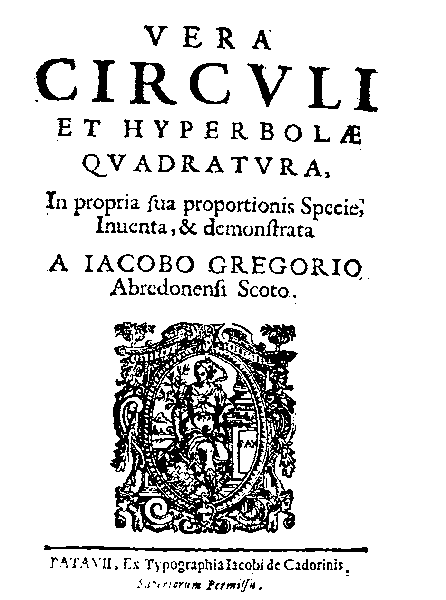
格雷果里得以住在哲学教授Caddenhead教授的家中,后者是斯格特的会士。格雷果里在帕多瓦期间出版的两部著作是1667年出版的Vera circuli et hyperbolae quadratura和1668年他意大利之行即将结束时出版的Geometriae pars universalis。
关于Vera circuli et hyperbolae quadratura,马克斯·登和恩斯特·黑林格在[5]中写道:-
在这部著作中,格雷果里为当时正在形成的无穷小几何学奠定了精确的基础。值得注意的是,几十年后,当分析处于革命性发展状态时,精确性的标准比格雷果里低得多,而且一般来说,在艾萨克·牛顿和哥特弗里德·威廉·莱布尼茨(例如克里斯蒂安·惠更斯、皮耶特罗·曼戈里、伊萨克·巴罗)的发现之前写作的作者们也是如此。
我们正在讨论的这部著作性质颇为不同。一方面,他获取灵感的来源对我们来说完全未知。另一方面,我们在这里发现了一种奇特的混合:既有影响深远的想法,也有精确的方法、不完整的推导,甚至还有错误的结论。
这部著作实际上试图证明π和e是超越数,但格雷果里的论证包含一个微妙的错误。然而,这绝不应减损这部著作的光辉以及它所包含的惊人思想集合,例如:收敛性、函数性、代数函数、超越函数、迭代等等。
在离开帕多瓦之前,格雷果里发表了Geometriae pars universalis,它实际上就是[13]:-
……首次尝试撰写一部系统性的教科书,论述我们今天所称的微积分。
这本书包含了已知最早的证明,即切线方法(用我们现代术语说就是微分)是求积方法(用我们现代术语说就是积分)的逆运算。格雷果里展示了如何通过变量替换来变换一个积分,并引入了思想,而这是艾萨克·牛顿流数术的基础。或许值得稍微谈一谈格雷果里的工作与艾萨克·牛顿的工作之间的关系。到格雷果里发表这部著作时,艾萨克·牛顿已经形成了他的微积分思想,因此很可能没有受到格雷果里的影响。另一方面,艾萨克·牛顿尚未发表他的任何想法,因此这些想法肯定不可能影响格雷果里。本质上,艾萨克·牛顿和格雷果里是在同一时期研究出微积分的基本思想的,当然,其他数学家也是如此。
大约在1668年复活节前后,格雷果里从意大利返回伦敦。他曾将一本Vera circuli et hyperbolae quadratura寄给克里斯蒂安·惠更斯,并附上一封说明信,表示他多么期待听到克里斯蒂安·惠更斯对此的专家意见。克里斯蒂安·惠更斯没有回复,但在1668年7月发表了一篇对该工作的评论。在评论中,他提出了一些反对意见,并声称其中一些结果是他最先证明的。一方面,格雷果里在伦敦度过的夏季几个月颇有收获,尤其是通过他与约翰·柯林斯的友谊。那是一段数学迅速发展的时期,格雷果里发现,约翰·柯林斯凭借其对最新进展的了解,对他极有帮助。另一方面,他对克里斯蒂安·惠更斯的评论感到不安,他认为这些评论暗示克里斯蒂安·惠更斯在指责他未经致谢就窃取了自己的结果。
这两位伟大的数学家竟然陷入争论,确实很不幸,尽管话虽如此,值得注意的是,在当时争论很常见,尤其是关于优先权的争论。以今天对所涉数学的理解来回顾这场争论,我们可以说,克里斯蒂安·惠更斯暗示格雷果里窃取了他的成果,这当然是不公平的。格雷果里独立证明了这些结果,而克里斯蒂安·惠更斯本应意识到格雷果里不可能知道它们。然而,克里斯蒂安·惠更斯对格雷果里证明的主要数学反对意见是有道理的。尽管这部文本以及[16]中有出色的工作,Scriba展示了格雷果里距离作出进一步重大发现有多么接近。他写道[16]:-
显然格雷果里无法预见他构造中隐藏的后果。但他对它们将引向何处有一种准确无误的直觉……
这场争论还有另一个不幸的后果,即格雷果里变得不那么热衷于公布他做出数学发现的方法,因此,直到20世纪30年代Turnbull在圣安德鲁斯的图书馆里查阅格雷果里的论文时,格雷果里发现的全部辉煌才为人所知。
我们现在可以确定,在1668年夏天,格雷果里已经完全熟悉sin、cos和tan的级数展开。他还确立了
这解决了航海表编制中一个长期存在的问题。他发表Exercitationes Geometricae作为对克里斯蒂安·惠更斯的反击。尽管他在这篇小论著中没有公开自己的方法,但他讨论了包括各种级数展开、对数函数的积分以及其他相关思想在内的主题。
同样在1668年夏天他在伦敦期间,格雷果里参加了皇家学会的会议,并于当年6月11日被选为学会会士。他向学会提交了关于各种主题的多篇论文,包括天文学、引力和力学。我们已经提到,Robert Moray是皇家学会的成员,格雷果里与他关系友好。Moray是斯格特会士,也是圣安德鲁斯的毕业生。几乎可以肯定,正是通过Moray,查理二世被说服在圣安德鲁斯设立钦定数学讲席,主要是为了让格雷果里有一个可以继续其杰出数学研究的职位。
格雷果里于1668年末抵达圣安德鲁斯。与其他教授不同,他并未隶属于任何学院,而是被安排在大学图书馆的上厅作为工作场所。这是唯一不属于任何学院的大学建筑,因此是这位无归属教授唯一可能的工作地点。格雷果里发现圣安德鲁斯持古典观念,最新的数学工作完全不为人知。1669年,抵达圣安德鲁斯后不久,格雷果里与寡妇玛丽·詹姆森结婚。他们育有两个女儿和一个儿子。格雷果里去世后,她第三次结婚。
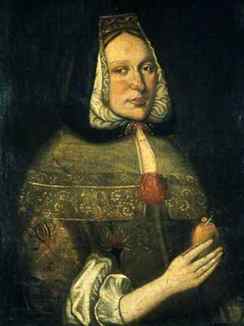
玛丽·詹姆森的父亲乔治·詹姆森是一位杰出的苏格兰肖像画家。你可以在THIS LINK看到他为她画的肖像。
在圣安德鲁斯期间,格雷果里每周作两次公开讲座,但反响不佳:——
……我常常被极大的无礼所困扰:这里的所有人都对这些事情一无所知,令人惊叹。
格雷果里在担任钦定讲席的六年间,完成了许多重要的数学和天文学工作。他通过与约翰·柯林斯通信来了解当前的研究进展。格雷果里保存了约翰·柯林斯的所有信件,并在约翰·柯林斯来信的背面写下了自己的笔记。这些至今仍保存在圣安德鲁斯大学图书馆中,生动地记录了他那个时代最杰出的数学家之一是如何做出发现的。
约翰·柯林斯将伊萨克·巴罗的书寄给格雷果里,收到后不到一个月,格雷果里就在扩展其中的思想,并将具有重大意义的结果寄给约翰·柯林斯。1671年2月,他发现了泰勒级数(直到1715年才由布鲁克·泰勒发表),该定理包含在1671年2月15日寄给约翰·柯林斯的一封信中。格雷果里在发现这一结果时所做的笔记仍然存在,写在一封1671年1月30日爱丁堡书商寄给格雷果里的信的背面。约翰·柯林斯回信说艾萨克·牛顿发现了类似的结果,格雷果里决定等到艾萨克·牛顿发表后再印刷。他仍然对与克里斯蒂安·惠更斯的争执感到不快,当然也不希望卷入与艾萨克·牛顿的类似争执。
一根海鸟的羽毛使格雷果里在圣安德鲁斯工作期间又做出了一项具有根本重要性的科学发现。这根羽毛成了第一个衍射光栅,但格雷果里对艾萨克·牛顿的尊重再次阻止了他在这项工作上走得更远。他写道:-
让阳光通过一个小孔射入暗室,在小孔处放一根羽毛(为此目的,越精致、越白越好),它便会在对面的白墙或纸上投射出若干小圆圈和椭圆形(如果我没弄错的话),其中一个是略白的(即正对太阳的中间那个),其余则各自带有颜色。我很想听听艾萨克·牛顿先生对此的看法。
图书馆的楼上房间朝南视野开阔,是格雷果里架设望远镜的绝佳位置。格雷果里把他的摆钟挂在同一扇窗户旁的墙上。这座钟由伦敦的Joseph Knibb制作,购于1673年。克里斯蒂安·惠更斯于1656年为摆钟的想法申请了专利,他阐述摆的理论的著作于1673年出版,正是格雷果里购买他的钟的那一年。
1674年,格雷果里与巴黎的同事合作,对一次月食进行同步观测,他首次能够计算出经度。然而,他已经开始着手建造天文台。1673年,大学允许格雷果里为天文台购买仪器,但告诉他必须提出申请并组织募捐以筹集建造天文台的资金。格雷果里回到阿伯丁,在教堂门外募捐,为建造天文台筹集资金。1673年7月19日,格雷果里写信给皇家天文学家约翰·佛兰斯蒂德,寻求建议。随后他前往英格兰购买仪器。
格雷果里于1674年离开圣安德鲁斯前往爱丁堡。他离开的原因再次描绘出一幅对这位杰出数学家怀有偏见的可悲图景。就任爱丁堡讲席后,格雷果里写道:-
我羞于回答,圣安德鲁斯天文台的事务状况如此糟糕,其原因在于大学的管理者们对数学产生了偏见,因为他们的一些学生发现自己的课程和口授内容与他们所学的数学相抵触,便嘲笑他们的老师,并公开嘲弄其中一些人。此后,各学院的仆役接到命令,不得在我的观测时侍候我:我的薪水也被扣留,最显赫的学生被强行阻止来见我,违背他们本人和父母的意愿,管理者们劝说他们,说他们的头脑承受不了。
格雷果里成为那里第一位数学讲席教授。然而,他担任该讲席的时间并不长,因为他在就职后几乎整整一年便去世了。在这一年里,他仍在天文学和数学研究方面非常活跃。在后一领域,他对用代数方法解五次方程的问题产生了兴趣,并在丢番图问题上有了一些有趣的发现。他的去世很突然。一天晚上,他正用望远镜向学生展示木星的卫星,这时他中风并失明。几天后他便去世了,年仅36岁。D. T. 怀特塞德在[1]中写道:-
尽管格雷果里才华横溢,未来成就可期,但他未能活到做出本可让他声名远扬的重大发现。当他通过约翰·柯林斯得知艾萨克·牛顿在微积分和无穷级数方面的进展时,他不愿发表自己的“几何与分析中的若干普遍方法”,为此在身后付出了沉重代价……
我们在本文中提到了许多归功于格雷果里的卓越思想。然而,我们现在总结这些贡献及其他贡献,希望尽管他不愿发表自己的方法,他的非凡贡献确实能得到更广泛的理解:格雷果里早在1670年就独立于艾萨克·牛顿发现了插值公式和一般二项式定理;他比布鲁克·泰勒早四十多年发现了布鲁克·泰勒级数;他解决了约翰内斯·开普勒的著名问题,即如何用一条通过直径上给定点的直线按给定比例分割半圆(他的方法是将布鲁克·泰勒级数应用于一般摆线);他给出了最早的收敛比较判别法例子之一,本质上给出了奥古斯丁·路易·柯西的比值判别法,并包含对余项的理解;他给出了一个积分定义,其一般性与波恩哈德·黎曼所给出的本质上一样;他对微分方程所有解(包括奇解)的理解令人印象深刻;他似乎是第一个试图证明π和不是代数方程解的人;他知道如何用系数表示代数方程根的次幂之和;而他在给约翰·柯林斯的最后一封信中的一句话表明,他已开始意识到次数大于四的代数方程不能用根式求解。
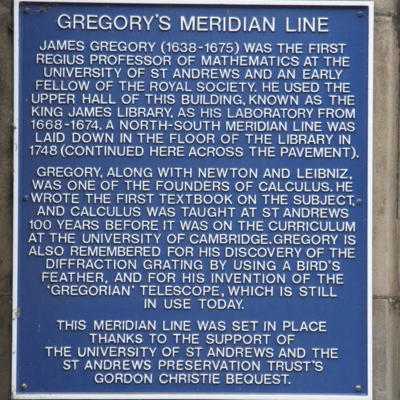
一块纪念格雷果里的牌匾被安放在圣安德鲁斯曾容纳他天文台的建筑墙上。
你可以在THIS LINK看到它。
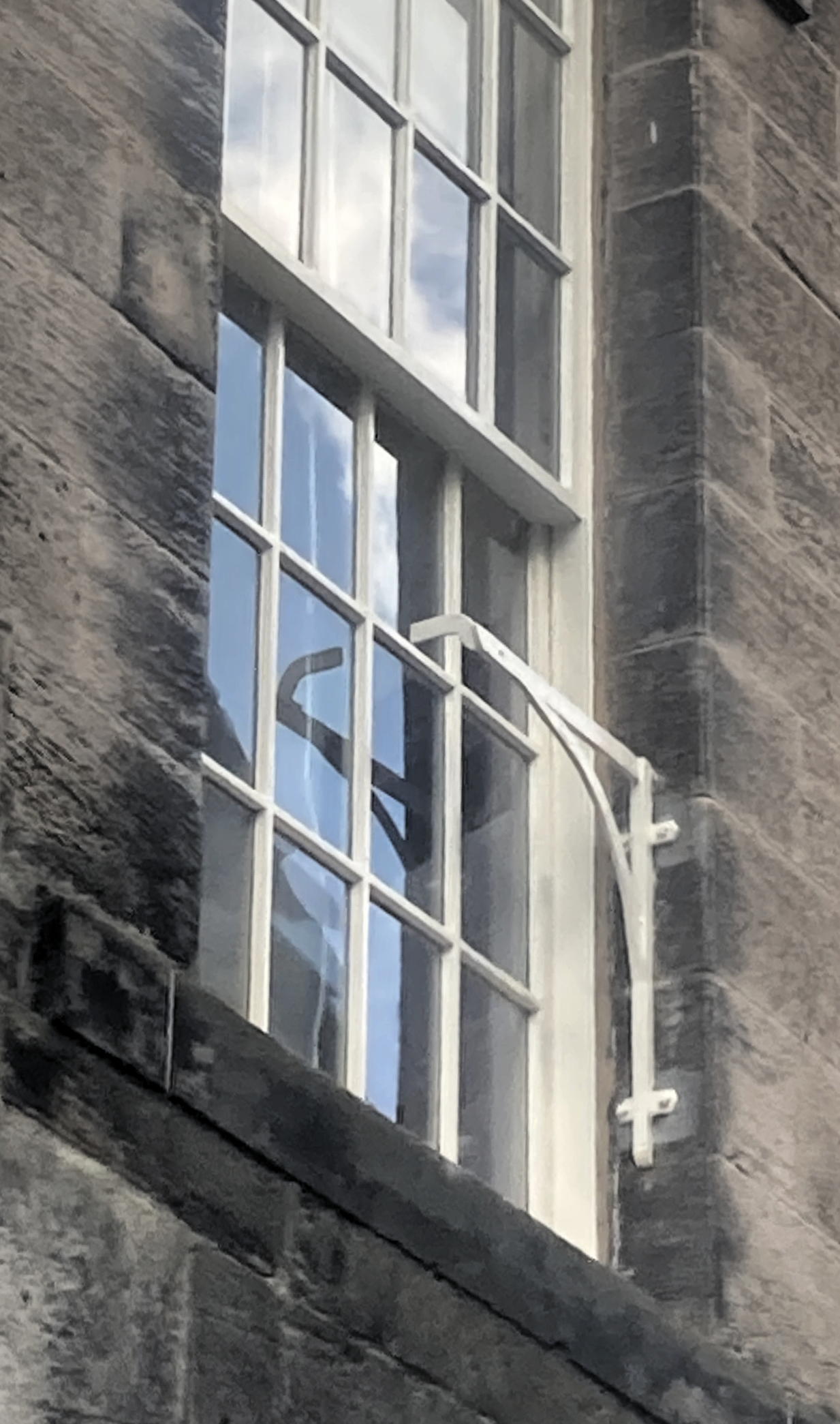
格雷果里用来安装望远镜的支架仍在他天文台的窗外。
你可以在THIS LINK看到它。
James Gregory was born in the Manse of Drumoak. This is a small parish on the river Dee, about fifteen kilometres west of Aberdeen. His father was John Gregory and his mother was Janet Anderson. John Gregory had studied at Marischal College in Aberdeen, then gone on to study theology at St Mary's College in the University of St Andrews before spending his life in the parish of Drumoak. Turnbull writes [20]:-
[John Gregory] was a man of courage and foresight but was not conspicuous for outstanding intellectual gifts ...
James seems to have inherited his genius through his mother's side of the family. Janet Anderson's brother, Alexander Anderson, was a pupil of Viète. He acted as an editor for Viète and fully incorporated Viète's ideas into his own teaching in Paris. James was the youngest of his parents three children. He had two older brothers Alexander (the eldest) and David, and there was an age gap of ten years between James and David.
James learnt mathematics first from his mother who taught him geometry. His father John Gregory died in 1651 when James was thirteen and at this stage James's education was taken over by his brother David who was about 23 at the time. James was given Euclid's Elements to study and he found this quite an easy task. He attended Grammar School and then proceeded to university, studying at Marischal College in Aberdeen.
Gregory's health was poor in his youth. He suffered for about eighteen months from the quartan fever which is a fever which recurs at approximately 72-hour intervals. Once he had shaken off this problem his health was good, however, and he wrote some years later that the quartan fever (see for example [20]):-
... is a disease I am happily acquainted with, for since that time I never had the least indisposition; nevertheless that I was of a tender and sickly constitution formerly.
Gregory began to study optics and the construction of telescopes. Encouraged by his brother David, he wrote a book on the topic Optica Promota. In the preface he writes:-
Moved by a certain youthful ardour and emboldened by the invention of the elliptic inequality, I have girded myself with these optical speculations, chief among which is the demonstration of the telescope.
The reader may not understand Gregory's reference to "the elliptic inequality" which in fact refers to Kepler's discoveries. Gregory, in Optica Promota, describes the first practical reflecting telescope now called the Gregorian telescope.
The book begins with 5 postulates and 37 definitions. He then gives 59 theorems on reflection and refraction of light. There follows propositions on mathematical astronomy discussing parallax, transits and elliptical orbits. Next Gregory gives details of his invention of a reflecting telescope. A primary concave parabolic mirror converges the light to one focus of a concave ellipsoidal mirror. Reflection of light rays from its surface converge to the ellipsoid's second focus which is behind the main mirror. There is a central hole in the main mirror through which the light passes and is brought to a focus by an eyepiece lens. The tube of the Gregorian telescope is thus shorter than the sum of the focal lengths of the two mirrors. His novel idea was to use both mirrors and lenses in his telescope. He showed that the combination would work more effectively than a telescope which used only mirrors or used only lenses.
The book was only a theoretical description of the telescope for at this stage one had not been constructed. Gregory remarks in the book [21]:-
... on his lack of skill in the technique of lens and mirror making ...
In 1663 Gregory went to London. There he met Collins and a lifelong friendship began. One of Gregory's aims was to have Optica Promota published and he achieved this. His other aim was to find someone who could construct a telescope to the design set out in his book. Collins advised him to seek the help of a leading optician by the name of Reive who, at Gregory's request, tried to construct a parabolic mirror. His attempt did not satisfy Gregory who decided to give up the idea of having Reive construct the instrument. However, Hooke learnt of Reive's failed attempt at making the parabolic mirror and this would lead to a successful construction of the first Gregorian telescope around ten years later.
In London Gregory also met Robert Moray, president of the Royal Society, and Moray attempted to arrange a meeting between Gregory and Huygens in Paris. However, Huygens was not in Paris and the meeting did not materialise. Moray was to play a major role in Gregory's career somewhat later.
In 1664 Gregory went to Italy. He visited Flanders, Rome and Paris on his journey but spent most time at the University of Padua where he worked on using infinite convergent series to find the areas of the circle and hyperbola. At Padua he worked closely with Angeli whose [20]:-
... teaching profoundly influenced Gregory, particularly in providing the twin keys to the calculus, the method of tangents (differentiation) and of quadratures (integration).
In Padua Gregory was able to live in the house of the Professor of Philosophy who was Professor Caddenhead, a fellow Scot. Two works which were published by Gregory while he was in Padua are Vera circuli et hyperbolae quadratura published in 1667 and Geometriae pars universalis published right at the end of his Italian visit in 1668.
Of Vera circuli et hyperbolae quadratura Dehn and Hellinger write in [5]:-
In this work Gregory lays down exact foundations for the infinitesimal geometry then coming into existence. It is remarkable that some decades later, at the time when analysis was in a state of revolutionary development, exactness was at a much lower standard than with Gregory, and generally with the authors writing before the discoveries of Newton and Leibniz (e.g. Huygens, Mengoli, Barrow).
The work we are dealing with is of quite a different character. On the one hand, the source from which he is getting his inspiration is quite unknown to us. On the other hand we find here a singular mixture of far-reaching ideas, exact methods, incomplete deductions, and even false conclusions.
The work was really trying to prove that π and e are transcendental but Gregory's arguments contain a subtle error. However, this should not in any way detract from the brilliance of the work and the amazing collection of ideas which it contains such as: convergence, functionality, algebraic functions, transcendental functions, iterations etc.
Before he left Padua Gregory published Geometriae pars universalis which is really [13]:-
... the first attempt to write a systematic text-book on what we should call the calculus.
This book contained the first known proof that the method of tangents (differentiation in our modern terminology) was inverse to the method of quadratures (integration in our modern terminology). Gregory shows how to transform an integral by a change of variable and introduces the idea which is the basis of Newton's fluxions. Perhaps it is worth saying a little about how Gregory's work relates to that of Newton. By the time that Gregory published this work Newton had formed his ideas of the calculus so probably had not been influenced by Gregory. On the other hand Newton had not said anything of his ideas and so certainly these ideas could not have influenced Gregory. Essentially Newton and Gregory were working out the basic ideas of the calculus at the same time, as, of course, were other mathematicians.
Gregory returned to London from Italy at about Easter 1668. He had sent a copy of Vera circuli et hyperbolae quadratura to Huygens and written a covering letter saying how he was looking forward to hearing the expert opinions of Huygens on it. Huygens did not reply but published a review of the work in July 1668. In the review he raised some objections and also claimed that he had been the first to prove some of the results. On the one hand the summer months that Gregory spent in London were profitable, particularly through his friendship with Collins. It was a time of rapid mathematical development and Gregory found that Collins, with his up-to-date knowledge of developments, was most helpful to him. On the other hand he was upset by Huygens' comments which he took to imply that Huygens was accusing him of stealing his results without acknowledgement.
It was indeed unfortunate that these two great mathematicians should enter into a dispute, although having said that it is worth noting that disputes were common at this time, particularly regarding priority. Looking at the dispute with the hindsight of today's understanding of the mathematics involved we can say that Huygens was certainly unfair in suggesting that Gregory had stolen his results. Gregory had proved them independently and Huygens should have realised that Gregory could not have known of them. However, Huygens' main mathematical objection to Gregory's proof is a valid one. Despite there is brilliant work in this text and in [16] Scriba shows how close Gregory was to making further major discoveries. He writes [16]:-
Clearly [Gregory] could not see the consequences that lay concealed in his construction. But he had an unerring sense of where they would lead ...
The dispute had another unfortunate consequence, namely that Gregory became much less keen to announce the methods by which he made his mathematical discoveries and, as a consequence, it was not until Turnbull examined Gregory's papers in the library in St Andrews in the 1930s that the full brilliance of Gregory's discoveries became known.
We can now be certain that during the summer of 1668 Gregory was completely familiar with the series expansions of sin, cos and tan. He also established that
which solved a long standing problem in the construction of nautical tables. He published the Exercitationes Geometricae as a counterattack on Huygens. Although he did not disclose his methods in the small treatise he discussed topics including various series expansions, the integral of the logarithmic function, and other related ideas.
Also during his time in London in the summer of 1668 Gregory attended meetings of the Royal Society and he was elected a fellow of the Society on 11 June of that year. He presented various papers to the Society on a variety of topics including astronomy, gravitation and mechanics. We have already mentioned that Robert Moray was a member of the Royal Society with whom Gregory was friendly. Moray was a fellow Scot and a graduate of St Andrews. It is almost certain that it was through Moray that Charles II was persuaded to create the Regius Chair of Mathematics in St Andrews, principally to allow Gregory a position in which he could continue his outstanding mathematical research.
Gregory arrived in St Andrews late in 1668. He was not attached to a College, as were the other professors, but given the Upper Hall of the university library as his place of work. It was the only university building which was not part of a college so was the only possible place for an unattached professor. Gregory found that St Andrews was of classical outlook where the latest mathematical work was totally unknown. In 1669, not long after arriving in St Andrews, Gregory married Mary Jamesone who was a widow. They had two daughters and one son. After Gregory's death she married for a third time.
Mary Jamesone's father George Jamesone was a distinguished Scottish portrait painter. You can his painting of her at THIS LINK.
While in St Andrews Gregory gave two public lecture each week which were not well received:-
... I am often troubled with great impertinences: all persons here being ignorant of these things to admiration.
However Gregory was to carry out much important mathematical and astronomical work during his six years in the Regius chair. He kept in touch with current research by corresponding with Collins. Gregory preserved all Collins's letters, writing notes of his own on the backs of Collins's letters. These are still preserved in the St Andrews University library and provide a vivid record of how one of the foremost mathematicians of his day made his discoveries.
Collins sent Barrow's book to Gregory and, within a month of receiving it, Gregory was extending the ideas in it and sending Collins results of major importance. In February 1671 he discovered Taylor series (not published by Taylor until 1715), and the theorem is contained in a letter sent to Collins on 15 February 1671. The notes Gregory made in discovering this result still exist written on the back of a letter sent to Gregory on 30 January 1671 by an Edinburgh bookseller. Collins wrote back to say that Newton had found a similar result and Gregory decided to wait until Newton had published before he went into print. He still felt badly about his dispute with Huygens and he certainly did not wish to become embroiled in a similar dispute with Newton.
The feather of a sea bird was to allow Gregory to make another fundamentally important scientific discovery while he worked in St Andrews. The feather became the first diffraction grating but again Gregory's respect for Newton prevented him going further with this work. He wrote:-
Let in the sun's rays by a small hole to a darkened house, and at the hole place a feather (the more delicate and white the better for this purpose), and it shall direct to a white wall or paper opposite to it a number of small circles and ovals (if I mistake them not) whereof one is somewhat white (to wit, the middle which is opposite the sun) and all the rest severally coloured. I would gladly hear Mr Newton's thoughts of it.
The Upper Room of the library had an unbroken view to the south and was an excellent site for Gregory to set up his telescope. Gregory hung his pendulum clock on the wall beside the same window. The clock, made by Joseph Knibb of London, was purchased in 1673. Huygens patented the idea of a pendulum clock in 1656 and his work describing the theory of the pendulum was published in 1673, the year Gregory purchased his clock.
In 1674 Gregory cooperated with colleagues in Paris to make simultaneous observations of an eclipse of the moon and he was able to work out the longitude for the first time. However he had already begun work on an observatory. In 1673 the university allowed Gregory to purchase instruments for the observatory, but told him he would have to make applications and organise collections for funds to build the observatory. Gregory went home to Aberdeen and took a collection outside the church doors for money to build his observatory. On 19 July 1673 Gregory wrote to Flamsteed, the Astronomer Royal, asking for advice. He then travelled to England to purchase instruments.
Gregory left St Andrews for Edinburgh in 1674. His reasons for leaving again paint a sorry picture of prejudice against the brilliant mathematician. Writing after taking up his Edinburgh chair Gregory said:-
I was ashamed to answer, the affairs of the Observatory of St Andrews were in such a bad condition, the reason of which was, a prejudice the masters of the University did take at the mathematics, because some of their scholars, finding their courses and dictats opposed by what they had studied in the mathematics, did mock at their masters, and deride some of them publicly. After this, the servants of the colleges got orders not to wait on me at my observations: my salary was also kept back from me, and scholars of most eminent rank were violently kept from me, contrary to their own and their parents wills, the masters persuading them that their brains were not able to endure it.
In Edinburgh Gregory became the first person to hold the Chair of Mathematics there. He was not to hold the chair for long, however, for he died almost exactly one year after taking up the post. It was a year in which he was still very active in research in both astronomy and mathematics. On the latter topic he had become interested in the problem of solving quintic equations algebraically and made some interesting discoveries on Diophantine problems. His death came suddenly. One night he was showing the moons of Jupiter to his students with his telescope when he suffered a stroke and became blind. He died a few days later at the young age of 36. Whiteside writes in [1]:-
For all his talent and promise of future achievement, Gregory did not live long enough to make the major discovery which would have gained him popular fame. For his reluctance to publish his "several universal methods in geometry and analysis" when he heard through Collins of Newton's own advances in calculus and infinite series, he postumously paid a heavy price ...
We have mentioned in this article many of the brilliant ideas which are due to Gregory. However, we now summarise these and other contributions in the hope that, despite his reluctance to publish his methods, his remarkable contributions might indeed be more widely understood: Gregory anticipated Newton in discovering both the interpolation formula and the general binomial theorem as early as 1670; he discovered Taylor series more than 40 years before Taylor; he solved Kepler's famous problem of how to divide a semicircle by a straight line through a given point of the diameter in a given ratio (his method was to apply Taylor series to the general cycloid); he gives one of the earliest examples of a comparison test for convergence, essentially giving Cauchy's ratio test, together with an understanding of the remainder; he gave a definition of the integral which is essentially as general as that given by Riemann; his understanding of all solutions to a differential equation, including singular solutions, is impressive; he appears to be the first to attempt to prove that π and are not the solution of algebraic equations; he knew how to express the sum of the th powers of the roots of an algebraic equation in terms of the coefficients; and a remark in his last letter to Collins suggests that he had begun to realise that algebraic equations of degree greater than four could not be solved by radicals.
A plaque honouring Gregory has been placed on the wall of the building which housed his observatory in St Andrews.
You can see it at THIS LINK.
The bracket that Gregory used to mount his telescope is still ouside the window of his observatory.
You can see it at THIS LINK.
正文里的方括号编号指向这里,悬停即可直接看到条目。书目保留原文——译了书名反而查不到文献。
原站列出的延伸阅读与外部数据库,照原样保留,目标多为英文页面。
关于詹姆斯·格雷果里的其它页面:
关于詹姆斯·格雷果里的其它网站:
原站的交叉引用。指向本站已镜像专题的留在站内,其余仍指回原站。