数学家传记
弗朗索瓦·韦达是一位法国业余数学家和天文学家,他在其著作《分析术引论》中引入了第一个系统的代数符号。他还参与了密码破译。
弗朗索瓦·韦达的父亲是艾蒂安韦达,法国西部丰特奈勒孔特的一名律师,该地距沿海城镇拉罗谢尔以东约50公里。韦达的母亲是玛格丽特·杜邦。他在丰特奈勒孔特上学,然后搬到丰特奈勒孔特以东约80公里的普瓦捷,在普瓦捷大学接受教育。鉴于他父亲的职业,韦达在大学学习法律并不令人意外。1560年获得法律学位毕业后,韦达进入法律行业,但他只在这条路上继续了四年,便决定改变职业。
1564年,韦达在Antoinette d'Aubeterre的服务中获得了职位。他受雇监督Antoinette的女儿Catherine的教育,她后来成为帕尔特奈的Catherine(帕尔特奈大约位于丰特奈勒孔特和普瓦捷之间)。Catherine的父亲于1566年去世,Antoinette d'Aubeterre带着女儿搬到拉罗谢尔。韦达与他的雇主和她的女儿一起搬到了拉罗谢尔。
这是法国政治和宗教极度动荡的时期。查理九世于1560年成为法国国王,不久之后,在1562年,法国宗教战争爆发。说这些战争是新教徒与罗马天主教徒之间的战争,是过于简单化了,但各派别之间的战斗断断续续地持续到几乎本世纪末。1570年,韦达离开拉罗谢尔,搬到巴黎。尽管他从未被聘为专业科学家或数学家,韦达已经在研究数学和天文学课题,他第一部出版的数学著作于1571年在巴黎问世。当韦达在巴黎时,查理九世于1572年8月23日授权屠杀胡格诺派教徒,这是一个日益强大的法国新教徒群体。这对韦达来说必定是极其艰难的时期,因为尽管他没有积极参与新教事业,他本人就是胡格诺派教徒。查理在此事件后没有活很久,这场屠杀显然在他余生中一直困扰着他。然而,1573年10月24日,查理任命韦达为布列塔尼的政府官员,驻地在雷恩。
韦达搬到雷恩,就任那里的参事职位。他留在雷恩直到1580年3月返回巴黎。查理九世已于1574年5月30日去世,查理死后,亨利三世成为国王。亨利在1576年对新教胡格诺派作出让步,罗马天主教徒组建了神圣联盟,通过军事行动来维护自身利益。在这种紧张气氛中,亨利三世于1580年3月25日任命韦达为皇家枢密参事,他隶属于巴黎的议会。
1584年,亨利三世的兄弟去世,新教徒纳瓦拉的亨利成为王位继承人,神圣联盟因此得到加强。由于担心新教徒可能在法国获得控制权,神圣联盟更加积极地投入罗马天主教事业。宫廷中包含有不同政治目标的派别,1584年,韦达作为已知胡格诺派教徒的职位变得无法维持,他被政敌逐出宫廷。离开巴黎后,韦达前往博瓦尔叙尔梅尔,位于他家乡丰特奈勒孔特西北约130公里的海岸上。在博瓦尔叙尔梅尔度过的五年里,韦达得以完全投身于数学研究。在许多方面,韦达的敌人帮了数学一个忙,因为正是在这段没有正式职务的时期,韦达最重要的数学工作得以完成。
1587年,纳瓦拉的亨利击败了亨利三世的军队。1588年5月12日,神圣联盟据点巴黎的人民起义,迫使国王逃往沙特尔。在这个阶段,亨利三世召见韦达,并于1589年4月将他带回现在设在图尔的议会。亨利三世与纳瓦拉的亨利和解(因为联合力量对他们双方都有利),他们一起在1589年试图夺回巴黎。然而,亨利三世于同年8月1日被一名雅各宾派修士刺杀。
西班牙的腓力二世是罗马天主教反宗教改革的拥护者,他通过向法国提供资金和军队来支持神圣联盟。亨利三世被谋杀后,腓力为其女儿伊莎贝拉·克拉拉·欧亨尼亚声称法国王位。1589年10月28日写给腓力的一封用密码写成的信落入了纳瓦拉的亨利手中,后者即将成为下一任国王亨利四世。
亨利三世遇刺后,韦达为亨利四世效力。此时他的处境更为稳固,作为一名新教徒支持一位新教国王。韦达此时无疑已因其数学才能而闻名,作为亨利四世最忠诚的支持者之一,亨利自然求助于韦达来破译发送给他的敌人西班牙的腓力二世的密信。韦达花了一些时间才破解这一复杂的密码。起初他只能破译部分信息,并将部分内容转交给亨利四世,但最终韦达于1590年3月15日将完全破译的信息送交给他。然而[2]:-
……当腓力假设密码无法被破解,却发现法国人已知晓他的军事计划时,他向教皇抱怨说有人对他的国家使用了黑魔法。
韦达从来不是职业数学家,但他确实讲授数学。例如,1592年他在图尔讲学,讨论了当时关于仅用尺规解决circle could be squared、angle trisected和cube doubled问题的最新主张。他在这些讲座中表明,当年早些时候发表的“证明”是错误的。
1592年,亨利四世并未控制巴黎,他仍然遭到法国神圣联盟的反对,而神圣联盟得到了西班牙的支持。1593年7月,亨利重新皈依罗马天主教,这或许出于政治而非宗教原因。韦达效仿他的国王,也皈依了罗马天主教。亨利的皈依无疑卓有成效,因为对他的抵抗减弱了,他于1594年3月22日攻占巴黎。1595年1月,亨利对西班牙的腓力二世宣战,并继续消灭神圣联盟及其西班牙盟友的抵抗。
在上一段提到的时期,韦达再次通过解决一个数学问题挽救了国王。1593年,阿德里安·范·罗门提出了一个涉及求解45次方程的问题。荷兰大使向亨利四世评论法国数学家素质低下,说没有法国人能解决阿德里安·范·罗门的问题。亨利把这个问题交给韦达,他通过意识到存在一个潜在的三角关系而解决了它。由此,韦达和阿德里安·范·罗门之间建立了友谊。韦达向阿德里安·范·罗门提出了画一个圆与3个给定圆相切的问题(阿波罗尼奥斯问题),阿德里安·范·罗门用双曲线解决了它,并于1596年发表了结果。韦达本人于1595年发表了他对阿德里安·范·罗门问题的解答,在引言中[1]说道:-
我,并不自称是数学家,但每当有闲暇时,就喜欢数学研究……
韦达继续在巴黎为亨利四世服务,直到1597年他回到家乡丰特奈勒孔特。两年后他回到巴黎,再次为亨利四世服务,但他在1602年12月14日被亨利解职。他几乎正好一年后去世。
韦达的一些早期工作旨在撰写一部关于数学天文学的重要著作Ad harmonicon coeleste。这是一部从未出版的著作,但有四份手稿留存下来,其中一份是亲笔手稿,它们被Libri重新发现。这些手稿的内容在[22]中有描述,其中指出韦达纯粹对克劳狄乌斯·托勒密和尼古拉·哥白尼行星理论的几何感兴趣,并未考虑这些理论是否代表实际物理实在的问题。也许相当令人惊讶的是,韦达得出结论,认为尼古拉·哥白尼的理论在几何上不成立。
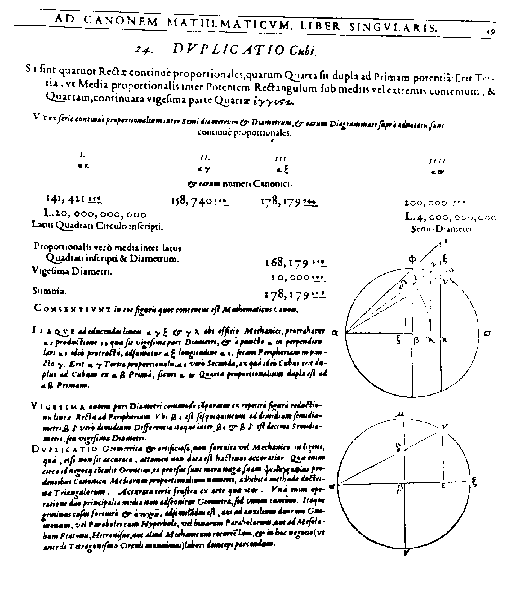
尽管Ad harmonicon coeleste从未出版,韦达确实在1571年开始出版Canon Mathematicus,其意图是作为天文学论著的数学导论。Canon Mathematicus涵盖三角学;它包含三角函数表,还给出了表构造背后的数学,并详细说明了如何求解平面和球面三角形。有趣的是,在Canon Mathematicus的第二部分,韦达[1]:-
……写小数分数时,小数部分用比整数部分更小的字体印刷,并用竖线与后者分开。
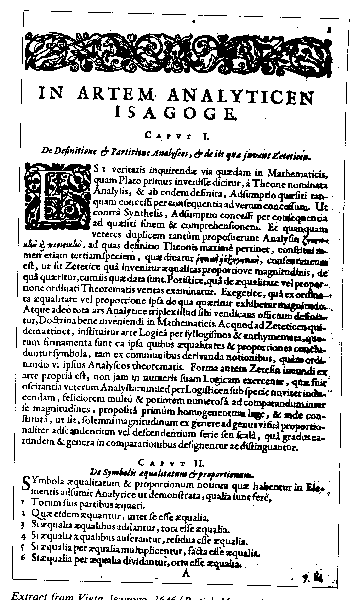
韦达在其1591年于图尔出版的著作In artem analyticam isagoge中引入了第一个系统的代数符号。这部作品的标题可能看起来令人费解,因为它意为“分析术引论”,这很难让人听起来像是一本代数书。然而,韦达并不喜欢阿拉伯数学,而是将他的工作建立在意大利数学家如吉罗拉莫·卡尔达诺以及古希腊数学家的著作之上。然而,人们不得不说,如果韦达对阿拉伯数学有更好的理解,他可能会发现他提出的许多想法早已为早期的阿拉伯数学家所知。
在其论著In artem analyticam isagoge中,韦达展示了符号的价值,引入字母来表示未知量。他建议使用字母作为量的符号,包括已知量和未知量。他用元音表示未知量,用辅音表示已知量。字母表中靠近开头的字母表示已知量、靠近末尾的字母表示未知量的约定,后来由勒内·笛卡儿在La Gèometrie中引入。这一约定今天仍在使用,人们往往没有意识到正在使用一种约定。(如果我要求解,没有人会问:“我求解方程是针对哪个量?”)
韦达在方程理论方面做出了许多改进。然而,如果我们要严格准确地说,他并没有求解方程本身,而是求解比例问题,他非常明确地指出这与求解方程是同一回事。然而,他受到维度齐性条件的限制。问题在于,如果我们要求解,那么我们要求解的是一个在几何上毫无意义的问题。因为是一个立方体,而是一条线,显然将一个三维对象与一个一维对象相加是毫无意义的。因此,韦达寻找诸如这样的方程的解,按照他的约定,其中是未知量,和是已知量。这里的维度是“正确的”,每一项都是3维的。韦达在In artem analyticam isagoge中写道(见[7]或[3]):-
关于等式或比例的第一条也是永恒的法则是:齐性量必须与齐性量相比较,因为它是由齐性量构想出来的,所以被称为齐性量法则。
他提出了求解二次、三次和四次方程的方法。他知道方程的正根与未知量各次幂的系数之间的联系。也许值得注意的是,“系数”这个词实际上归功于韦达。当韦达像他在De numerosa potestatum中那样应用数值方法求解方程时,他给出的方法与早期阿拉伯数学家给出的方法相似。例如,他的方法在论文[11]和[19]中与萨拉夫·丁·图西的方法进行了比较。在前者中,作者认为尽管这些方法乍看之下似乎相似,但存在许多重要差异。他推断韦达的工作并非基于萨拉夫·丁·图西的工作。然而,在[19]中,Rashed认为萨拉夫·丁·图西和韦达的方法确实非常接近。
韦达还写了关于三角学和几何学的书,如Supplementum geometriae(1593年)。他在此书中给出了倍立方体和三等分角的几何解法。
1593年,韦达出版了第二本书,这本书在许多方面受到他前一年在Tours的讲座课程的启发(我们上面提到过),考察了诸如倍立方体、三等分角以及在阿基米德螺线上任意点作切线等各种问题。此外,在这本书中,他使用边的多边形将π计算到10位小数。他还将π表示为无穷乘积,据目前所知,这是π最早的无穷表示。
最后,我们应该提到,韦达常被称为“代数之父”。正如[9]的作者所论证的,一方面,这对许多先于韦达的优秀代数学家不公平。另一方面,这对韦达也不公平,因为他的贡献具有更广泛的数学重要性。
了解韦达的想法在多大程度上受到托马斯·哈里奥特想法的影响也会很有趣。在[3]中引用了H Stevens于1900年写的一本关于托马斯·哈里奥特的书中的一段话:-
……看来托马斯·哈里奥特的分析或代数体系是基于他的朋友和通信者韦达的体系,正如韦达的体系公开基于古人的体系一样。……托马斯·哈里奥特和他的朋友们给予了这位杰出的法国数学家充分的赞誉。
虽然这似乎清楚地表明了托马斯·哈里奥特对韦达的依赖,但人们不得不说,两人给出了非常相似的解方程algebraically的方法,然而托马斯·哈里奥特显示出比韦达更深刻的理解。我[EFR]觉得必须允许思想双向流动的可能性,并且韦达的代数必定受益于他与托马斯·哈里奥特的通信。
François Viète's father was Étienne Viète, a lawyer in Fontenay-le-Comte in western France about 50 km east of the coastal town of La Rochelle. François' mother was Marguerite Dupont. He attended school in Fontenay-le-Comte and then moved to Poitiers, about 80 km east of Fontenay-le-Comte, where he was educated at the University of Poitiers. Given the occupation of his father, it is not surprising that Viète studied law at university. After graduating with a law degree in 1560, Viète entered the legal profession but he only continued on this path for four years before deciding to change his career.
In 1564 Viète took a position in the service of Antoinette d'Aubeterre. He was employed to supervise the education of Antoinette's daughter Catherine, who would later become Catherine of Parthenay (Parthenay is about half-way between Fontenay-le-Comte and Poitiers). Catherine's father died in 1566 and Antoinette d'Aubeterre moved with her daughter to La Rochelle. Viète moved to La Rochelle with his employer and her daughter.
This was a period of great political and religious unrest in France. Charles IX had become king of France in 1560 and shortly after, in 1562, the French Wars of Religion began. It is a gross over-simplification to say that these wars were between Protestants and Roman Catholics but fighting between the various factions would continue on and off until almost the end of the century. In 1570 Viète left La Rochelle and moved to Paris. Although he was never employed as a professional scientist or mathematician, Viète was already working on topics in mathematics and astronomy and his first published mathematical work appeared in Paris in 1571. While Viète was in Paris, Charles IX authorised the massacre of the Huguenots, who were an increasingly powerful group of French Protestants, on 23 August 1572. This must have been an extremely difficult time for Viète for, although not active in the Protestant cause, he was a Huguenot himself. Charles did not live very long after this event, the massacre apparently haunting him for the rest of his life. However, on 24 October 1573 Charles appointed Viète to the government of Brittany which was based at Rennes.
Viète moved to Rennes to take up his position of counsellor there. He remained at Rennes until March 1580 when he returned to Paris. Charles IX had died on 30 May 1574 and, on Charles' death Henry III became king. Henry made concessions to the Protestant Huguenots in 1576 and the Roman Catholics formed the Holy League to look after their own interests by military actions. In this tense atmosphere Viète was appointed by Henry III as royal privy counsellor on 25 March 1580, and he was attached to the parliament in Paris.
In 1584 the Holy League was strengthened when Henry III's brother died and the Protestant Henry of Navarre became heir to the throne. Fearing that the Protestants might gain control in France, the Holy League fought more vigorously for the Roman Catholic cause. The royal court contained factions with different political aims and in 1584 Viète's position as a known Huguenot became untenable and he was banished by his political enemies from the court. Leaving Paris, Viète went to Beauvoir-sur-Mer, on the coast about 130 km northwest of his home town of Fontenay-le-Comte. During the five years that he spent at Beauvoir-sur-Mer, Viète was able to devote himself entirely to his mathematical studies. In many ways Viète's enemies did mathematics a favour, for it was during this period without formal duties that Viète's most important mathematics was done.
In 1587 Henry of Navarre defeated the army of Henry III. A rising of the people of Paris, a Holy League stronghold, on 12 May 1588, caused the king to flee to Chartres. At this stage Henry III sent for Viète and, in April 1589, brought him back into his parliament which was now set up at Tours. Henry III was reconciled with Henry of Navarre (since it suited them to combine forces) and together they tried to retake Paris in 1589. Henry III was, however, assassinated by a Jacobin friar on 1 August of that year.
Philip II of Spain, a champion of the Roman Catholic Counter-Reformation, supported the Holy League by sending money and troops to France. After the murder of Henry III, Philip claimed the throne of France for his daughter, Isabella Clara Eugenia. A letter to Philip dated 28 October 1589 written in code fell into the hands of Henry of Navarre who was to become the next king, Henry IV.
Following the assassination of Henry III, Viète worked for Henry IV. He was now in a sounder position, as a Protestant supporter of a Protestant King. Viète was certainly well known for his mathematical abilities by this time and, as one of the Henry IV's most loyal supporters, it was natural for Henry to turn to Viète to decode messages being sent to his enemy Philip II of Spain. It took Viète some time to crack the complicated code. At first he was only able to decode parts of the message and forwarded parts to Henry IV, but eventually Viète sent him the fully decoded message on 15 March 1590. However [2]:-
... when Philip, assuming that the cipher could not be broken, discovered that the French were aware of his military plans, he complained to the Pope that black magic was being employed against his country.
Although Viète was never a professional mathematician, he did lecture on mathematics. For instance in 1592 he lectured at Tours and discussed recent claims that the circle could be squared, an angle trisected, and the cube doubled using only ruler and compass. He showed in these lectures that the "proofs" which had been published earlier in the year were fallacious.
In 1592 Henry IV did not control Paris, and he was still opposed by the Holy League in France who were supported by Spain. Henry converted back to Roman Catholicism in July 1593, perhaps for political rather than religious reasons. Viète followed the example of his king and also converted to Roman Catholicism. Henry's conversion was certainly effective, for resistance against him lessened and he took Paris on 22 March 1594. Henry declared war on Philip II of Spain in January 1595 and continued to wipe out resistance by the League and its Spanish allies.
During the period referred to in the previous paragraph, Viète had again come to the King's rescue by solving a mathematical problem. In 1593 Roomen had proposed a problem which involved solving an equation of degree 45. The ambassador from the Netherlands made comments to Henry IV on the poor quality of French mathematicians saying that no Frenchman could solve Roomen's problem. Henry put the problem to Viète who solved it by realising that there was an underlying trigonometric relation. As a result of this a friendship grew up between Viète and Roomen. Viète proposed the problem of drawing a circle to touch 3 given circles to Roomen (the Apollonian Problem) and Roomen solved it using hyperbolas, publishing the result in 1596. Viète himself, published his answer to Roomen's problem in 1595, stating in the introduction [1]:-
I, who do not profess to be a mathematician, but who, whenever there is leisure, delight in mathematical studies ...
Viète continued to serve Henry IV in Paris until 1597 when he went back to his home town of Fontenay-le-Comte. Two years later he was back in Paris, again in the service of Henry IV, but he was dismissed by Henry on 14 December 1602. He died almost exactly one year later.
Some of Viète's first work was directed towards the production of a major work on mathematical astronomy Ad harmonicon coeleste. It was a work which was never published but four manuscripts, one of them an autograph, have survived and were rediscovered by Libri. The contents of these manuscripts are described in [22] where it is stated that Viète was interested purely in the geometry of the planetary theories of both Ptolemy and Copernicus, and did not consider the question of whether the theories represented the actual physical reality. Perhaps rather surprisingly Viète came to the conclusion that Copernicus's theory was not valid geometrically.
Although the Ad harmonicon coeleste was never published, Viète did begin publishing the Canon Mathematicus in 1571 which was intended as a mathematical introduction to the astronomy treatise. The Canon Mathematicus covers trigonometry; it contains trigonometric tables, it also gives the mathematics behind the construction of the tables, and it details how to solve both plane and spherical triangles. It is interesting that in the second part of the Canon Mathematicus Viète [1]:-
... wrote decimal fractions with the fractional part printed in smaller type than the integral and separated from the latter by a vertical line.
Viète introduced the first systematic algebraic notation in his book In artem analyticam isagoge published at Tours in 1591. The title of the work may seem puzzling, for it means "Introduction to the analytic art" which hardly makes it sound like an algebra book. However, Viète did not find Arabic mathematics to his liking and based his work on the Italian mathematicians such as Cardan, and the work of ancient Greek mathematicians. One would have to say, however, that had Viète had a better understanding of Arabic mathematics he might have discovered that many of the ideas he produced were already known to earlier Arabic mathematicians.
In his treatise In artem analyticam isagoge Viète demonstrated the value of symbols introducing letters to represent unknowns. He suggested using letters as symbols for quantities, both known and unknown. He used vowels for the unknowns and consonants for known quantities. The convention where letters near the beginning of the alphabet represent known quantities while letters near the end represent unknown quantities was introduced later by Descartes in La Gèometrie. This convention is used today, often without people realising that a convention is being used at all. (If I asked for a solution to nobody asks: "For which quantity do I solve the equation ?")
Viète made many improvements in the theory of equations. However, if we are to be strictly accurate we should say that he did not solve equations as such but rather he solved problems of proportionals which he states quite explicitly is the same thing as solving equations. However, he was restricted by a condition of homogeneity of dimension. The problem is that if we ask for a solution of then we ask for the solution to a problem which does not make sense geometrically. For is a cube while is a line and clearly it makes no sense to add a three dimensional object to a one dimensional object. Viète therefore looked for solutions of equations such as where, using his convention, was unknown and and were knowns. The dimensions here are "correct" each term being of dimension 3. Viète wrote in the In artem analyticam isagoge (see [7] or [3]):-
The first and permanent law of equalities or proportions which, because it is conceived from homogeneous quantities is called the law of homogeneous quantities, is this: homogeneous quantities must be compared with homogeneous quantities.
He presented methods for solving equations of second, third and fourth degree. He knew the connection between the positive roots of equations and the coefficients of the different powers of the unknown quantity. Perhaps it is worth noting that the word "coefficient" is actually due to Viète. When Viète applied numerical methods to solve equations as he did in De numerosa potestatum he gave methods which were similar to those given by earlier Arabic mathematicians. For example his methods are compared with those of Sharaf al-Din al-Tusi in the paper [11] and [19]. In the first the author argues that although the methods appear to be similar at first sight, there are many important differences. He deduces that the work of Viète is not based on that of Sharaf al-Din al-Tusi. In [19], however, Rashed argues that the methods of Sharaf al-Din al-Tusi and of Viète are very close indeed.
Viète also wrote books on trigonometry and geometry such as Supplementum geometriae (1593). He gave geometrical solutions to doubling a cube and trisecting an angle in this book.
In 1593 Viète published a second book, which in many ways was motivated by his lecture course at Tours in the previous year (which we mentioned above), examining various problems such as doubling the cube, trisecting an angle and the construction the tangent at any point on an Archimedian spiral. Also, in this book, he calculated π to 10 places using a polygon of sides. He also represented π as an infinite product which, as far as is known, is the earliest infinite representation of π.
Finally we should mention that Viète is often called "the father of algebra". As the author of [9] argues this, on the one hand, is unfair on the many fine algebraists who preceded Viète. On the other hand it is unfair to Viète since his contributions were of much wider mathematical importance.
It would also be interesting to know how much Viète's ideas were influenced by those of Harriot. In [3] a quotation from a book about Harriot written in 1900 by H Stevens is given:-
... it appears that Harriot's system of analytics or algebra was based on that of his friend and correspondent François Viète as Viète's was avowedly based on that of the ancients. ... Full credit was given by Harriot and his friends to the distinguished French mathematician.
Although this seems to make Harriot's dependence on Viète clear, one would have to say that the two men give very similar approaches to solving equations algebraically, yet Harriot shows deeper understanding than does Viète. I [EFR] feel that one must allow the possibility that ideas flowed in both directions and that Viète's algebra must have benefited from his correspondence with Harriot.
正文里的方括号编号指向这里,悬停即可直接看到条目。书目保留原文——译了书名反而查不到文献。
原站列出的延伸阅读与外部数据库,照原样保留,目标多为英文页面。
关于弗朗索瓦·韦达的其它页面:
原站的交叉引用。指向本站已镜像专题的留在站内,其余仍指回原站。