数学家传记
克里斯蒂安·惠更斯是一位荷兰数学家,他为第一台摆钟申请了专利,这大大提高了时间测量的精度。他奠定了力学的基础,还从事天文学和概率论的研究。
克里斯蒂安·惠更斯出身于一个重要的荷兰家庭。他的父亲Constantin Huygens曾学习自然哲学,是一名外交官。正是通过他,惠更斯得以进入当时顶尖的科学圈子。特别是康斯坦丁在英国有许多联系人,并定期与马兰·梅森通信,还是勒内·笛卡儿的朋友。
惠更斯在家中由私人教师辅导直到16岁,学习了几何、制作机械模型以及弹鲁特琴等社交技能。他的数学教育显然受到勒内·笛卡儿的影响,后者偶尔拜访惠更斯家,并对年轻的惠更斯的数学进步表现出极大的兴趣。
惠更斯从1645年到1647年在莱顿大学学习法律和数学。他在莱顿期间,弗兰斯·范斯霍滕辅导他数学。从1647年到1649年,他继续学习法律和数学,但此时是在布雷达的奥兰治学院。尽管约翰·佩尔大约在这个时候是布雷达的一名教师,但他似乎与惠更斯接触甚少。通过他父亲与马兰·梅森的联系,惠更斯与马兰·梅森之间的通信大约在这个时候开始了。马兰·梅森向惠更斯提出挑战,要求解决若干问题,包括两端悬挂的绳索的形状。尽管他未能解决这个问题,但他确实解决了相关的如何将重物挂在绳索上使其呈抛物线形状悬挂的问题。
1649年,惠更斯作为外交团队的一员前往丹麦,并希望继续前往斯德哥尔摩拜访勒内·笛卡儿,但天气不允许他进行这次旅行。在访问丹麦之后,他又访问了欧洲其他地方,包括罗马。
惠更斯在1651年和1654年的首批出版物探讨了数学问题。1651年的出版物CyclometriaeⓉ(《圆的度量》)展示了格雷瓜尔·德·圣樊尚所提出方法的谬误,后者曾声称已squared the circle。惠更斯1654年的著作De Circuli Magnitudine InventaⓉ(《求圆的大小》)是关于类似主题的一部更重要的作品。
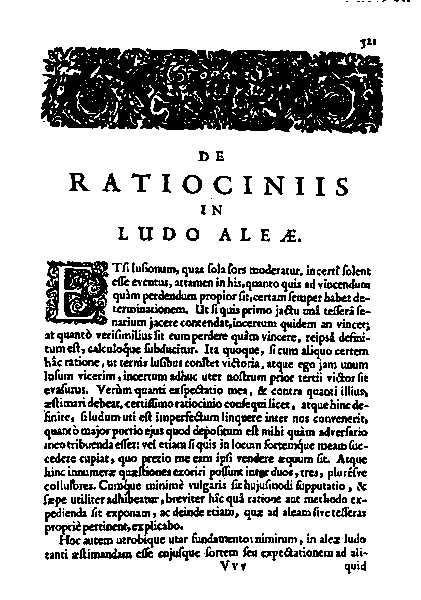
惠更斯很快将注意力转向透镜研磨和望远镜制造。大约在1654年,他设计了一种新的更好的研磨和抛光透镜的方法。使用他自己的一块透镜,惠更斯于1655年发现了土星的第一颗卫星。同年,他首次访问巴黎。他将自己的发现告知了巴黎的数学家,包括伊斯梅尔·布里阿德,而惠更斯则得知了布莱兹·帕斯卡与皮埃尔·德·费马之间通信中进行的关于probability的工作。回到荷兰后,惠更斯写了一部关于概率演算的小著作De Ratiociniis in Ludo Aleae,这是该主题的第一部印刷作品。
第二年,他发现了土星环的真实形状。然而其他人有不同的理论,包括罗贝瓦尔和伊斯梅尔·布里阿德。伊斯梅尔·布里阿德未能探测到土星的卫星泰坦,因此惠更斯意识到他使用的望远镜较差。到1656年,惠更斯能够向伊斯梅尔·布里阿德确认他的环理论,结果被报告给巴黎小组。在Systema Saturnium(1659年)中,惠更斯解释了环的相位和形状变化。一些人,包括耶稣会士Fabri,不仅攻击惠更斯的理论,还攻击他的观测。然而到1665年,甚至Fabri也被说服接受惠更斯的环理论,因为改进的望远镜证实了他的观测。
天文学工作需要对时间的精确计量,这促使惠更斯着手解决这个问题。1656年,他为第一台摆钟申请了专利,这大大提高了时间测量的精度。他在摆方面的研究与他在摆线方面所做的其他数学工作有关,这是由布莱兹·帕斯卡的挑战引起的。惠更斯认为,在大弧中摆动的摆在海上有用,因此他发明了摆线摆。他建造了几台摆钟以确定海上经度,这些钟在1662年和1686年进行了海上试验。在Horologium Oscillatorium sive de motu pendulorum(1673年)中,他描述了摆运动的理论。他还推导出了匀速圆周运动的离心力定律。由于这一点,惠更斯、罗伯特·胡克、爱德蒙·哈雷和克里斯托弗·雷恩提出了万有引力的平方反比定律。
惠更斯于1660年回到巴黎,并参加了那里各种科学学会的会议。他在给兄弟的一封信中写道:-
……每周二[在蒙莫尔家]都有一个聚会,二三十位杰出人士聚在一起。我从不缺席……我也偶尔去罗奥先生家,他阐述勒内·笛卡儿先生的哲学,并对其做非常精细的实验,推理得当。
在这些学会中,他遇到了许多数学家,包括罗贝瓦尔、皮埃尔·德·卡克维、布莱兹·帕斯卡、Pierre Petit、吉拉尔·笛沙格和索比埃尔。在布莱兹·帕斯卡于1660年12月拜访他之后,惠更斯写道
……我们谈论了炮筒中稀薄水的力量以及飞行,我给他看了我的望远镜……
1661年,惠更斯访问了伦敦,特别是为了进一步了解当时在格雷沙姆学院新成立的皇家学会聚会。他对约翰·沃利斯以及他会见的其他英国科学家印象深刻,从那时起,他继续与这个团体保持联系。他向英国科学家展示了他的望远镜,这些望远镜被证明优于英国使用的望远镜。约克公爵和公爵夫人前来通过惠更斯的望远镜观察月球和土星。在伦敦期间,惠更斯看到了罗伯特·波义耳的真空泵,他对此印象深刻。回到海牙后,他亲自进行了许多罗伯特·波义耳的实验。惠更斯于1663年当选为伦敦皇家学会会士。
此时,惠更斯为他的摆钟设计申请了专利,心中想着解决经度问题。1665年,他得知皇家学会正在研究其他形式的钟,特别是罗伯特·胡克正在试验一种弹簧调节的钟。惠更斯写信给罗伯特·胡克,怀疑这种方法,他认为这种方法会受到温度变化的过度影响。尽管如此,惠更斯确实开始试验由弹簧调节的钟,但它们的精度比他的摆钟差。
惠更斯于1666年接受了科尔贝尔的邀请,成为Académie Royale des Sciences的一部分。他当年抵达巴黎,发现学会尚未组织起来。在与罗贝瓦尔、皮埃尔·德·卡克维、阿德里安·奥祖、福兰尼可、奥祖和比奥在科尔贝尔的图书馆举行会议后,Society搬到了国王图书馆,惠更斯在那里居住。他担任了该小组的领导,很大程度上基于他对皇家学会在英格兰运作方式的了解。
惠更斯关于弹性体碰撞的工作显示了勒内·笛卡儿碰撞定律的错误,他关于这个主题的论文于1668年寄给了皇家学会。Royal Society提出了一个关于碰撞的问题,惠更斯通过实验证明,两个物体碰撞前在固定方向上的动量等于碰撞后在该方向上的动量。约翰·沃利斯和克里斯托弗·雷恩也回答了这个。问题。
圆周运动是惠更斯此时着手的一个课题,但他也继续思考勒内·笛卡儿基于涡旋的引力理论。他此时似乎已表现出对勒内·笛卡儿理论的不满迹象,但他在1669年仍就这一课题向Académie作了报告,尽管在他报告之后,罗贝瓦尔和Mariotte强烈且正确地反对勒内·笛卡儿的理论,这可能影响了惠更斯。
从青年时代起,惠更斯的健康就从未强健过,1670年他患了重病,结果他离开巴黎前往荷兰。在离开巴黎之前,他相信自己已接近死亡,便要求将他未发表的力学论文寄给皇家学会。英国大使的秘书被召来,描述了惠更斯的理由:-
……他谈到了英格兰的皇家学会,他说那是基督教世界中最精选的才俊的集会……他说他选择将这些小小的劳动成果……交到他们手中,而不是其他任何人。……他说他确实预见到这个科学院的解体,因为它掺杂着嫉妒的色彩,因为它建立在利益的假设之上,因为它完全取决于一位王子的脾性和一位大臣的恩宠……
到1671年,惠更斯回到了巴黎。然而在1672年,路易十四入侵低地国家,惠更斯发现自己处于极其困难的境地:在法国与自己的祖国交战时,他却在巴黎担任重要职位。那个时代的科学家们认为自己超越于政治战争之上,惠更斯在朋友们的大力支持下,得以继续他的工作。
1672年,惠更斯和哥特弗里德·威廉·莱布尼茨在巴黎相遇,此后哥特弗里德·威廉·莱布尼茨经常造访Académie。事实上,哥特弗里德·威廉·莱布尼茨在很大程度上要归功于惠更斯,他从后者那里学到了许多数学。同年,惠更斯得知了艾萨克·牛顿在望远镜和光方面的工作。他相当错误地批评了艾萨克·牛顿的光理论,特别是他的颜色理论。他自己的著作Horologium Oscillatorium sive de motu pendulorumⓉ(摆钟与摆的运动)于1673年问世,表明惠更斯已经远远摆脱了勒内·笛卡儿的影响。
Horologium OscillatoriumⓉ(摆钟与摆的运动)包含关于摆的工作。在其中,惠更斯证明了摆线是等时曲线,这是一个重要的理论结果,但对摆的实际应用甚少。他还解决了复摆问题。然而,其中远不止关于摆的工作。惠更斯描述了物体在真空中的下降,无论是垂直下降还是沿曲线下降。他定义了曲线的evolutes和involutes,并在给出一些基本性质之后,求出了摆线和抛物线的渐屈线。惠更斯在这部著作中首次尝试研究物体而非质点的动力学。
德尼·帕潘大约在这段时间担任惠更斯的助手,在他离开去与罗伯特·波义耳共事之后,埃伦弗里德·瓦尔特·冯·切恩豪斯加入了惠更斯。1676年又一次患病使惠更斯再次回到海牙。他在那里待了两年,尤其研究了拉斯穆·巴多林在冰洲石晶体中发现的双折射。他还研究了光速,他相信光速是有限的,并很高兴听到Rømer的实验,该实验通过观测木星的卫星给出了光速的近似值。
到1678年,惠更斯已经回到巴黎。那一年,他的Traité de la lumiereⓉ(《论光》)问世,在其中惠更斯主张光的波动说。惠更斯指出,一个膨胀的光球的行为就好像波前上的每一点都是具有相同频率和相位的新辐射源。然而,他的健康状况变得更加不可靠,1679年他病倒了,1681年再次病倒,那时他最后一次回到海牙。菲利普·德拉伊尔一直反对Académie中的外国人,他向惠更斯致以最良好的祝愿,但他显然希望他不要回来,以便他自己可能获得他的职位。
经度问题一直是惠更斯一生继续研究钟表的一个持续动因。在他恢复健康后,他又在1682年研究一种新的航海钟,由于荷兰东印度公司表现出兴趣,他努力研究这些钟表。科尔贝尔于1683年去世,没有他的赞助人的支持,回到巴黎似乎是不可能的。他的父亲于1687年去世,享年91岁,次年他的兄弟前往英格兰。惠更斯怀念身边有可以讨论科学话题的人。1689年他来到英格兰。
惠更斯在皇家学会会见了艾萨克·牛顿、罗伯特·波义耳和其他人。惠更斯与艾萨克·牛顿之间进行了什么讨论不得而知,但我们确实知道惠更斯非常钦佩艾萨克·牛顿,但同时又相信万有引力理论,他说
在我看来是荒谬的。
当然,从某种意义上说惠更斯是对的,当两个相距遥远的物体之间什么都没有时,人们怎么能相信它们会相互吸引呢,艾萨克·牛顿的理论中没有任何东西能解释一个物体怎么可能甚至知道另一个物体的存在。后来在写到艾萨克·牛顿和Principia时,惠更斯写道:-
我高度评价他的理解和敏锐,但我认为在这部著作的大部分内容中,它们被用在了不当之处,作者在那里研究的是些用处不大的东西,或者是在不可信的吸引原理上构建理论。
他带着对在荷兰科学孤立处境的深深悲伤离开了。
在他生命的最后几年,惠更斯撰写了最早关于外星生命的讨论之一,在他死后出版为CosmotheorosⓉ(宇宙理论)(1698年)。他继续致力于改进透镜、弹簧调节钟和新的摆钟。
惠更斯在Lettre touchant le cycle harmoniqueⓉ(关于和谐周期的信)中描述了31音平均律。这间接导致了本世纪荷兰31音音乐的传统。
在1687年写给埃伦弗里德·瓦尔特·冯·切恩豪斯的一封信中,惠更斯解释了他自己的方法:-
……起初会遇到很大的困难,只有从实验出发……然后构想某些假说……才能克服这些困难。但即便如此,仍有大量艰苦的工作要做,人们不仅需要极大的洞察力,还常常需要一定程度的运气。
惠更斯的科学成就在[4]中被总结如下:-
……惠更斯是十七世纪最伟大的机械论者。他把伽利略对现象的数学处理与勒内·笛卡儿关于自然终极设计的构想结合起来。他起初是一位热忱的笛卡尔主义者,试图纠正该体系中较为明显的错误,最终却成为它最尖锐的批评者之一。……质量、重量、动量、力和功这些概念,最终在惠更斯对碰撞现象、向心力以及人们最早研究的动力系统——复摆——的处理中得到了澄清。
Christiaan Huygens came from an important Dutch family. His father Constantin Huygens had studied natural philosophy and was a diplomat. It was through him that Christiaan was to gain access to the top scientific circles of the times. In particular Constantin had many contacts in England and corresponded regularly with Mersenne and was a friend of Descartes.
Tutored at home by private teachers until he was 16 years old, Christiaan learned geometry, how to make mechanical models and social skills such as playing the lute. His mathematical education was clearly influenced by Descartes who was an occasional visitor at the Huygens' home and took a great interest in the mathematical progress of the young Christiaan.
Christiaan Huygens studied law and mathematics at the University of Leiden from 1645 until 1647. Van Schooten tutored him in mathematics while he was in Leiden. From 1647 until 1649 he continued to study law and mathematics but now at the College of Orange at Breda. Although John Pell was a teacher at Breda about this time, he seems to have had little contact with Huygens. Through his father's contact with Mersenne, a correspondence between Huygens and Mersenne began around this time. Mersenne challenged Huygens to solve a number of problems including the shape of the rope supported from its ends. Although he failed at this problem he did solve the related problem of how to hang weights on the rope so that it hung in a parabolic shape.
In 1649 Huygens went to Denmark as part of a diplomatic team and hoped to continue to Stockholm to visit Descartes but the weather did not allow him to make this journey. He followed the visit to Denmark with others around Europe including Rome.
Huygens's first publications in 1651 and 1654 considered mathematical problems. The 1651 publication Cyclometriae Ⓣ showed the fallacy in methods proposed by Gregory of Saint-Vincent, who had claimed to have squared the circle. Huygens' 1654 work De Circuli Magnitudine Inventa Ⓣ was a more major work on similar topics.
Huygens soon turned his attention to lens grinding and telescope construction. Around 1654 he devised a new and better way of grinding and polishing lenses. Using one of his own lenses, Huygens detected, in 1655, the first moon of Saturn. In this same year he made his first visit to Paris. He informed the mathematicians in Paris including Boulliau of his discovery and in turn Huygens learnt of the work on probability carried out in a correspondence between Pascal and Fermat. On his return to Holland Huygens wrote a small work De Ratiociniis in Ludo Aleae on the calculus of probabilities, the first printed work on the subject.
The following year he discovered the true shape of the rings of Saturn. However others had different theories including Roberval and Boulliau. Boulliau had failed to detect Saturn's moon Titan so Huygens realised that he was using an inferior telescope. By 1656 Huygens was able to confirm his ring theory to Boulliau and the results were reported to the Paris group. In Systema Saturnium (1659), Huygens explained the phases and changes in the shape of the ring. Some, including the Jesuit Fabri, attacked not only Huygens theories but also his observations. However by 1665 even Fabri was persuaded to accept Huygens' ring theory as improving telescopes confirmed his observations.
Work in astronomy required accurate timekeeping and this prompted Huygens to tackle this problem. In 1656 he patented the first pendulum clock, which greatly increased the accuracy of time measurement. His work on the pendulum was related to other mathematical work which he had been doing on the cycloid as a result of the challenge by Pascal. Huygens believed that a pendulum swinging in a large are would be more useful at sea and he invented the cycloidal pendulum with this in mind. He built several pendulum clocks to determine longitude at sea and they underwent sea trials in 1662 and again in 1686. In the Horologium Oscillatorium sive de motu pendulorum (1673) he described the theory of pendulum motion. He also derived the law of centrifugal force for uniform circular motion. As a result of this Huygens, Hooke, Halley and Wren formulated the inverse-square law of gravitational attraction.
Huygens returned to Paris in 1660 and went to meetings of various scientific societies there. He wrote, in a letter to his brother:-
... there is a meeting every Tuesday [at Montmor's house] where twenty or thirty illustrious men are found together. I never fail to go ... I have also been occasionally to the house of M Rohault, who expounds the philosophy of M Descartes and does very fine experiments with good reasoning on them.
At these societies he met many mathematicians including Roberval, Carcavi, Pascal, Pierre Petit, Desargues and Sorbière. After Pascal visited him in December 1660 Huygens wrote
... we talked of the force of water rarefied in cannons and of flying, I showed him my telescopes...
In 1661 Huygens visited London, particularly to find out more about the newly forming Royal Society meeting at that time in Gresham College. He was greatly impressed with Wallis and the other English scientists whom he met and, from this time on, he was to continue his contacts with this group. He showed his telescopes to the English scientists and they proved superior to those in use in England. The Duke and Duchess of York came to observe the Moon and Saturn through Huygens' telescope. While in London Huygens saw Boyle's vacuum pump and he was impressed. After his return to the Hague he carried out a number of Boyle's experiments for himself. Huygens was elected to the Royal Society of London in 1663.
At this time Huygens patented his design of pendulum clock with the solution of the longitude problem in mind. In 1665 he learnt that the Royal Society was investigating other forms of clock, in particular Hooke was experimenting with a spring regulated clock. Huygens wrote to Hooke doubting this approach which he felt would be unduly affected by temperature changes. Despite this Huygens did begin to experiment with clocks regulated by springs, but their accuracy was poorer than his pendulum clocks.
Huygens accepted an invitation from Colbert in 1666 to become part of the Académie Royale des Sciences. He arrived in Paris that year to discover that the Society was not yet organised. After meetings were held with Roberval, Carcavi, Auzout, Frenicle de Bessy, Auzout and Buot in Colbert's library the Society moved to the Bibliothèque du Roi where Huygens took up residence. He assumed leadership of the group basing much on his knowledge of the way the Royal Society operated in England.
Huygens' work on the collision of elastic bodies showed the error Descartes' laws of impact and his memoir on the topic was sent to the Royal Society in 1668. The Royal Society had posed a question on impact and Huygens proved by experiment that the momentum in a fixed direction before the collision of two bodies is equal to the momentum in that direction after the collision. Wallis and Wren also answered this question.
Circular motion was a topic which Huygens took up at this time but he also continued to think about Descartes' theory of gravity based on vortices. He seems to have shown signs of being unhappy with Descartes' theory around this time but he still addressed the Académie on this topic in 1669 although after his address Roberval and Mariotte argued strongly, and correctly, against Descartes' theory and this may have influenced Huygens.
From his youth Huygens' health had never been robust and in 1670 he had a serious illness which resulted in him leaving Paris for Holland. Before he left Paris, believing himself to be close to death he asked that his unpublished papers on mechanics be sent to the Royal Society. The secretary to the English ambassador was called and described Huygens' reasons:-
... he fell into a discourse concerning the Royal Society in England which he said was an assembly of the choicest wits in Christendom ... he said he chose to deposit those little labours ... in their hands sooner than any else. ... he said he did foresee the dissolution of this Academy because it was mixed with tinctures of envy because it was supported upon suppositions of profit because it wholly depended upon the humour of a prince and the favour of a minister...
By 1671 Huygens returned to Paris. However in 1672 Louis XIV invaded the Low Countries and Huygens found himself in the extremely difficult position of being in an important position in Paris at a time France was at war with his own country. Scientists of this era felt themselves above political wars and Huygens was able, with much support from his friends, to continue his work.
In 1672 Huygens and Leibniz met in Paris and thereafter Leibniz was a frequent visitor to the Académie. In fact Leibniz owes much to Huygens from whom he learnt much of his mathematics. In this same year Huygens learnt of Newton's work on the telescope and on light. He, quite wrongly, criticised Newton's theory of light, in particular his theory of colour. His own work, Horologium Oscillatorium sive de motu pendulorum Ⓣ appeared in 1673 and showed that Huygens had moved far from Descartes' influence.
Horologium Oscillatorium Ⓣ contains work on the pendulum. In it Huygens proves that the cycloid is tautochronous, an important theoretical result but one which had little practical application to the pendulum. He also solves the problem of the compound pendulum. However there is much more than work on pendulums. Huygens describes the descent of bodies in a vacuum, either vertically or along curves. He defines evolutes and involutes of curves and, after giving some elementary properties, finds the evolutes of the cycloid and of the parabola. Huygens attempts for the first time in this work to study the dynamics of bodies rather than particles.
Papin worked as an assistant to Huygens around this time and after he left to work with Boyle, Huygens was joined by Tschirnhaus. Another bout of illness in 1676 saw Huygens return to the Hague again. He spent two years there, in particular studying the double refraction Bartholin had discovered in Iceland spar crystal. He also worked on the velocity of light which he believed was finite and was pleased to hear of Rømer's experiments which gave an approximate velocity for light determined by observing Jupiter's moons.
By 1678 Huygens had returned to Paris. In that year his Traité de la lumiere Ⓣ appeared, in it Huygens argued in favour of a wave theory of light. Huygens stated that an expanding sphere of light behaves as if each point on the wave front were a new source of radiation of the same frequency and phase. However his health became even more unreliable and he became ill in 1679 and then again in 1681 when he returned to the Hague for the last time. La Hire, who had always argued against foreigners in the Académie, sent his best wishes to Huygens but he clearly hoped that he would not return so that he might himself might acquire his position.
The longitude problem had remained a constant cause for Huygens to continue work on clocks all his life. Again after his health returned he worked on a new marine clock during 1682 and, with the Dutch East India Company showing interest, he worked hard on the clocks. Colbert died in 1683 and a return to Paris without the support of his patron seemed impossible. His father died in 1687, having reached 91 years of age, and the following year his brother left for England. Huygens missed having people around him with whom he could discuss scientific topics. In 1689 he came to England.
In England Huygens met Newton, Boyle and others in the Royal Society. It is not known what discussions went on between Huygens and Newton but we do know that Huygens had a great admiration for Newton but at the same time did not believe the theory of universal gravitation which he said
appears to me absurd.
In some sense of course Huygens was right, how can one believe that two distant masses attract one another when there is nothing between them, nothing in Newton's theory explains how one mass can possible even know the other mass is there. Writing about Newton and the Principia some time later Huygens wrote:-
I esteem his understanding and subtlety highly, but I consider that they have been put to ill use in the greater part of this work, where the author studies things of little use or when he builds on the improbable principle of attraction.
He departed with much sadness at the thoughts of his scientific isolation in Holland.
In the final years of his life Huygens composed one of the earliest discussions of extraterrestrial life, published after his death as the Cosmotheoros Ⓣ (1698). He continued to work on improving lenses and on a spring regulated clock and on new pendulum clocks.
Huygens described the 31-tone equal temperament in Lettre touchant le cycle harmonique Ⓣ. This has led indirectly to a tradition of 31-tone music in the Netherlands in this century.
In a letter to Tschirnhaus written in 1687, Huygens explained his own approach:-
.. great difficulties are felt at first and these cannot be overcome except by starting from experiments ... and then be conceiving certain hypotheses ... But even so, very much hard work remains to be done and one needs not only great perspicacity but often a degree of good fortune.
Huygens scientific achievements are summed up in [4] as follows:-
... Huygens was the greatest mechanist of the seventeenth century. He combined Galileo's mathematical treatment of phenomena with Descartes' vision of the ultimate design of nature. Beginning as an ardent Cartesian who sought to correct the more glaring errors of the system, he ended up as one of its sharpest critics. ... the ideas of mass, weight, momentum, force, and work were finally clarified in Huygens' treatment of the phenomena of impact, centripetal force and the first dynamical system ever studied - the compound pendulum.
正文里的方括号编号指向这里,悬停即可直接看到条目。书目保留原文——译了书名反而查不到文献。
原站列出的延伸阅读与外部数据库,照原样保留,目标多为英文页面。
关于克里斯蒂安·惠更斯的其它页面:
关于克里斯蒂安·惠更斯的其它网站:
原站的交叉引用。指向本站已镜像专题的留在站内,其余仍指回原站。