数学家传记
莱昂哈德·欧拉是一位瑞士数学家,对包括解析几何、三角学、几何学、微积分和数论在内的广泛数学和物理学领域做出了巨大贡献。
莱昂哈德·欧拉的父亲是Paul Euler。Paul Euler曾在巴塞尔大学学习神学,并在那里听过雅各布·伯努利的讲座。事实上,Paul Euler和约翰·伯努利在巴塞尔读本科时都住在雅各布·伯努利的房子里。Paul Euler成为新教牧师,并娶了另一位新教牧师的女儿Margaret Brucker。他们的儿子欧拉出生在巴塞尔,但在他一岁时全家搬到了Riehen,伦纳德正是在离巴塞尔不远的Riehen长大的。正如我们已经提到的,Paul Euler受过一些数学训练,能够教他的儿子初等数学以及其他科目。
欧拉被送到巴塞尔上学,在此期间他与外祖母住在一起。据各方面说法,这所学校相当差,欧拉从学校根本没学到任何数学。然而他对数学的兴趣肯定是由他父亲的教学激发的,他自学数学文本并上了一些私人课程。欧拉的父亲希望儿子跟随自己进入教会,便送他到巴塞尔大学为牧职作准备。他于1720年进入该大学,时年14岁,先接受通识教育,然后再进行更高级的学习。约翰·伯努利很快在欧拉自己安排的私人辅导中发现了欧拉在数学上的巨大潜力。欧拉在其未出版的自传性著作中给出的自述,见1,如下:-
……我很快就找到了一个机会,被引荐给一位著名的教授约翰·伯努利。……的确,他非常忙,因此断然拒绝给我单独授课;但他给了我更有价值的建议:让我自己开始阅读更难的数学书籍,并尽可能勤奋地研读它们;如果我遇到某些障碍或困难,我被允许在每个星期天下午随时去拜访他,他会亲切地向我解释一切我不懂的地方……
1723年,欧拉在比较和对照了勒内·笛卡儿和艾萨克·牛顿的哲学思想后,完成了他的哲学硕士学位。1723年秋,他遵从父亲的意愿开始学习神学,但是,尽管他一生都将是一位虔诚的基督徒,他却无法在神学、希腊语和希伯来语的研究中找到他在数学中感受到的那种热情。在约翰·伯努利的劝说下,欧拉获得了父亲的同意,转学数学。欧拉的父亲在本科时代曾是约翰·伯努利的朋友,这一事实无疑使劝说工作容易得多。
欧拉于1726年在巴塞尔大学完成学业。他在巴塞尔期间研读了许多数学著作,Calinger[24]重建了欧拉在约翰·伯努利建议下阅读的许多著作。它们包括皮埃尔·伐里农、勒内·笛卡儿、艾萨克·牛顿、伽利略、弗兰斯·范斯霍滕、雅各布·伯努利、雅各布·赫尔曼、布鲁克·泰勒和约翰·沃利斯的著作。到1726年,欧拉已经有一篇论文付印,是一篇关于阻力介质中等时曲线的短文。1727年,他发表了另一篇关于互反轨迹的文章,并提交了一篇参赛作品,参加巴黎科学院1727年关于船上桅杆最佳布置的大奖赛。
1727年的奖项授予了皮埃尔·布格,一位与船舶有关的数学专家,但欧拉的论文为他赢得了第二名,这对这位年轻毕业生来说是一项出色的成就。然而,欧拉现在必须为自己找到一个学术职位,当尼古拉·伯努利二世于1726年7月在圣彼得堡去世,在那里造成一个空缺时,欧拉被提供了这个职位,这将涉及他教授数学和力学在生理学中的应用。他在1726年11月接受了这个职位,但表示他不想在次年春天之前前往俄罗斯。他有两个推迟的理由。他想要时间研究与他的新职位相关的课题,但他也有机会获得巴塞尔大学的一个职位,因为那里的物理学教授去世了。欧拉写了一篇关于声学的文章,这篇文章后来成为经典,以争取被选上这个职位,但他没有被选中进入抽签决定谁将填补这个讲席的最终决策阶段。几乎可以肯定,他的年轻(当时他19岁)对他不利。然而Calinger [24] 提出:-
这个决定最终使欧拉受益,因为它迫使他从一个小共和国搬到一个更适合他辉煌的研究和技术工作的环境。
一旦他知道自己不会被任命为物理学讲席,欧拉于1727年4月5日离开了巴塞尔。他乘船沿莱茵河而下,乘邮政马车穿越德意志各邦,然后从吕贝克乘船,于1727年5月17日抵达圣彼得堡。他是在圣彼得堡科学院由彼得大帝的妻子叶卡捷琳娜一世创立两年后加入该院的。通过丹尼尔·伯努利和雅各布·赫尔曼的请求,欧拉被任命到科学院的数学-物理部,而不是他最初被提供的生理学职位。在圣彼得堡,欧拉有许多同事,为他提供了特殊的环境 [1]:-
在其他任何地方,他都不可能被这样一群杰出的科学家所包围,包括分析学家、几何学家雅各布·赫尔曼,一位亲戚;丹尼尔·伯努利,欧拉不仅与他有私人友谊,而且在应用数学领域有共同兴趣;多才多艺的学者克里斯蒂安·哥德巴赫,欧拉与他讨论了许多分析和数论问题;从事三角学的F Maier;以及天文学家和地理学家J-N Delisle。
欧拉 从 1727 年到 1730 年在俄罗斯海军中担任医疗中尉。在圣彼得堡,他与 丹尼尔·伯努利 住在一起,后者在俄罗斯已经感到不快,曾请求 欧拉 从瑞士给他带茶、咖啡、白兰地和其他美味。欧拉 于 1730 年成为科学院物理学教授,由于这使他成为科学院的正式成员,他得以放弃俄罗斯海军的职位。
丹尼尔·伯努利持有科学院的高级数学讲席,但当他于1733年离开圣彼得堡返回巴塞尔时,是欧拉被任命为这个高级数学讲席。这次任命带来的经济改善使欧拉得以结婚,他于1734年1月7日结婚,娶了Katharina Gsell,一位来自圣彼得堡文理中学的画家的女儿。Katharina,像欧拉一样,来自一个瑞士家庭。他们总共有13个孩子,尽管只有五个在婴儿期存活下来。欧拉声称,他在抱着婴儿、其他孩子在他脚边玩耍时做出了一些他最伟大的数学发现。
我们将在本文后面考察 欧拉 的数学成就,但在现阶段值得总结 欧拉 在其职业生涯这一阶段的工作。这在 [24] 中如下所述:-
……1730 年后,他执行了涉及制图学、科学教育、磁学、消防车、机械和造船的国家项目。……他的研究计划的核心此时已经确立:数论;包括其新兴分支的无穷分析,微分方程 和 变分法;以及理性力学。他认为这三个领域紧密相连。数论研究对微积分的基础至关重要,而 特殊函数 和微分方程对理性力学必不可少,后者提供了具体问题。
许多文章的发表以及他的著作 Mechanica(1736-37)首次以数学分析的形式广泛呈现了牛顿动力学,使 欧拉 开始了重大数学工作。
欧拉 的健康问题始于 1735 年,当时他患了严重的热病,几乎丧命。然而,他在康复之前一直向巴塞尔的父母和伯努利家族成员隐瞒这一消息。在其自传性著作中,欧拉 说他的视力问题始于 1738 年,是由于制图工作过度劳累所致,并且到 1740 年他已经 [24]:-
……失去了一只眼睛,[另一只]目前可能处于同样的危险之中。
然而,欧拉在24中认为,欧拉的视力问题几乎可以肯定开始得更早,而1735年的严重发烧是眼疲劳的症状。他还认为,1753年的一幅欧拉肖像表明,到那时他的左眼视力仍然良好,而右眼视力不佳但并未完全失明。欧拉认为,欧拉的左眼失明是由于后来的白内障,而非眼疲劳。
到1740年,欧拉已享有极高的声誉,曾在1738年和1740年获得巴黎科学院的大奖。两次他都是与他人共享一等奖。欧拉的声誉为他带来了前往柏林的邀请,但起初他更愿意留在圣彼得堡。然而,俄罗斯的政治动荡使外国人的处境特别困难,促使欧拉改变了主意。接受了一份更优厚的邀请后,欧拉应腓特烈大帝之邀前往柏林,那里计划成立一个科学院以取代科学学会。他于1741年6月19日离开圣彼得堡,7月25日抵达柏林。在给一位朋友的信中,欧拉写道:-
我可以做我想做的事[在我的研究中]……国王称我为他的教授,我认为我是世界上最幸福的人。
即使在柏林,欧拉仍继续从俄罗斯领取部分薪水。作为报酬,他为圣彼得堡科学院购买书籍和仪器,继续为他们撰写科学报告,并教育年轻的俄罗斯人。
皮埃尔·莫佩尔蒂在1744年柏林科学院成立时担任院长,欧拉任数学主任。他在皮埃尔·莫佩尔蒂缺席时代表其履职,两人成为挚友。欧拉为科学院[1]承担了令人难以置信的大量工作:-
……他监督天文台和植物园;选拔人员;管理各种财务事务;特别是管理各种历法和地理地图的出版,其销售是科学院的收入来源。国王还交给欧拉一些实际问题,例如1749年校正菲诺运河水平的项目……当时他还监督无忧宫(皇家夏宫)液压系统的泵和管道工作。
这绝不是他职责的极限。他在科学院的委员会中任职,负责图书馆和科学出版物。他还担任政府关于国家彩票、保险、年金和养老金以及火炮的顾问。除此之外,他在这段时期的科学产出是惊人的。
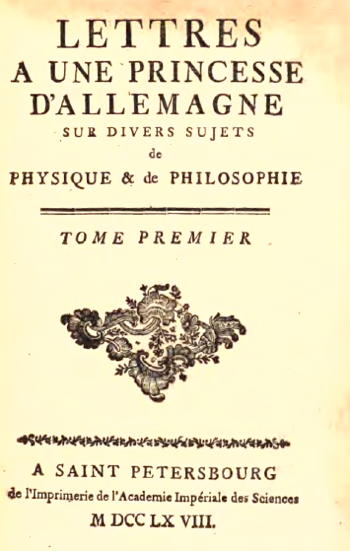
在柏林度过的二十五年间,欧拉撰写了约380篇文章。他写了关于变分法、行星轨道计算、火炮和弹道学(扩展了本杰明·罗宾斯的书)、分析、造船和航海、月球运动、微分方程讲义以及一部通俗科学出版物Letters to a Princess of Germany(3卷,1768-72年)的书籍。
参见THIS LINK。
1759年皮埃尔·莫佩尔蒂去世,欧拉接任了柏林科学院的领导职务,尽管没有院长头衔。国王总揽大权,尽管早期颇受恩宠,欧拉此时与腓特烈关系不佳。曾在科学问题上与让·勒朗·达朗贝尔争论过的欧拉,在1763年腓特烈向让·勒朗·达朗贝尔提供科学院院长职位时感到不安。然而让·勒朗·达朗贝尔拒绝迁往柏林,但腓特烈对科学院运作的持续干预使欧拉决定离开的时机已到。
1766年欧拉返回圣彼得堡,腓特烈对他的离去极为愤怒。回到俄罗斯后不久,欧拉在一场病后几乎完全失明。1771年,他的家被大火烧毁,他仅能救出自己和数学手稿。火灾后不久,仍在1771年,一次白内障手术使他的视力恢复了几天,但欧拉似乎未能对自己采取必要的照料,他完全失明了。由于他非凡的记忆力,他能够继续从事光学、代数和月球运动的工作。令人惊讶的是,回到圣彼得堡后(当时欧拉59岁),尽管完全失明,他仍完成了几乎一半的全部作品。
欧拉当然不是在没有帮助的情况下达到这一非凡产出水平的。他得到了儿子们的帮助,Johann Albrecht Euler于1766年被任命为圣彼得堡科学院的物理学讲席(1769年成为其秘书),以及Christoph Euler,后者从事军事生涯。欧拉还得到了科学院另外两名成员W L Krafft和A J 安德斯·约翰·莱克塞尔的帮助,以及年轻数学家尼古拉斯·福斯,他于1772年从瑞士被邀请到科学院。尼古拉斯·福斯,是欧拉的孙女婿,于1776年成为他的助手。A.П. 尤什克维奇在[1]中写道:-
.. 协助欧拉的科学家们不仅仅是秘书;他与他们讨论作品的总体方案,他们发展他的想法,计算表格,有时还汇编例子。
例如,欧拉将他在1772年出版的关于月球运动的775页著作归功于Albrecht、Krafft和安德斯·约翰·莱克塞尔的帮助。尼古拉斯·福斯帮助欧拉在大约七年的时间里准备了超过250篇文章以供出版,在此期间他担任欧拉的助手,包括一部关于保险的重要著作,于1776年出版。
他还写了一篇欧拉的颂词,你可以在THIS LINK看到。
A.П. 尤什克维奇在[1]中描述了欧拉去世的那一天:-
1783年9月18日,欧拉像往常一样度过了半天。他给一个孙子上了一堂数学课,用粉笔在两块黑板上做了一些关于气球运动的计算;然后与安德斯·约翰·莱克塞尔和尼古拉斯·福斯讨论了最近发现的天王星。下午五点左右,他突发脑溢血,只说了句“我要死了”便失去了意识。他在晚上十一点左右去世。
1783年他去世后,St Petersburg Academy继续出版欧拉未发表的作品近50年。
欧拉在数学方面的工作如此浩瀚,这样一篇文章只能对它作非常肤浅的叙述。他是有史以来最多产的数学作家。他在现代解析几何和三角学的研究中取得了巨大进展,在那里他第一个把sin、cos等视为函数,而不是像克劳狄乌斯·托勒密那样视为弦。
他对几何、微积分和数论做出了决定性和形成性的贡献。他把哥特弗里德·威廉·莱布尼茨的微分学和艾萨克·牛顿的流数法整合进数学分析。他引入了beta和伽马函数,以及用于微分方程的积分因子。他研究了连续介质力学、与亚历克西斯·克劳德·克莱罗一起的月球理论、三体问题、弹性、声学、光的波动说、水力学和音乐。他奠定了分析力学的基础,尤其是在他的Theory of the Motions of Rigid Bodies(1765)中。
我们归功于欧拉的记号有:函数的记号(1734),自然对数底的记号(1727),-1的平方根的记号(1777),π的记号,求和的记号(1755),有限差的记号和以及许多其他记号。
让我们更详细地考察欧拉的一些工作。首先,他在数论方面的工作似乎受到克里斯蒂安·哥德巴赫的激发,但最初可能来自伯努利家族对该主题的兴趣。克里斯蒂安·哥德巴赫在1729年问欧拉,他是否知道皮埃尔·德·费马的猜想:如果是2的幂,那么数总是prime。欧拉对 = 1、2、4、8和16验证了这一点,并且最迟在1732年证明了下一个情形能被641整除,因此不是素数。欧拉还研究了皮埃尔·德·费马的其他未证明结果,并在这样做时引入了欧拉 phi函数,即满足且 互素到的整数的个数。他在1749年证明了皮埃尔·德·费马的另一个断言,即如果和互素,那么没有形如的除数。
也许在欧拉年轻时给他带来最大名声的成果是他解决了所谓的巴塞尔问题。这个问题是求无穷级数的和的封闭形式,这个问题曾难倒了许多顶尖数学家,包括雅各布·伯努利、约翰·伯努利和丹尼尔·伯努利。这个问题也曾被哥特弗里德·威廉·莱布尼茨、斯特林、亚伯拉罕·棣莫弗等人研究但未成功。欧拉在1735年证明了,但他进一步证明了更多,即和。1737年,他证明了ζ函数与素数级数的联系,给出了著名的关系式
这里求和是对所有自然数,而乘积是对所有素数。
欧拉在无穷级数方面的其他工作包括在1735年引入了他著名的欧拉常数γ,他证明了它是
当趋于无穷大时。他将常数γ计算到了16位小数。欧拉还研究了Fourier series,并在1744年首次用这样的级数表示一个代数函数,当时他给出了结果
在给克里斯蒂安·哥德巴赫的一封信中。像欧拉的大部分工作一样,这些结果在发表之前有相当长的时间延迟;这个结果直到1755年才发表。
欧拉在1736年6月8日写信给斯特林,告诉他关于幂的倒数求和、调和级数和欧拉常数以及其他关于级数的结果。他特别写道[60]:-
关于收敛极慢的级数的求和,在过去一年里,我在我们科学院讲授了一种特殊方法,用这种方法,我以很小的努力足够精确地给出了许多级数的和。
接着他描述了现在所谓的欧拉-科林·麦克劳林求和公式。两年后,斯特林回复告诉欧拉,科林·麦克劳林:-
...将出版一本关于流数的书。...他有两个通过项的导数来求级数和定理,其中一个正是你寄给我的那个结果。
欧拉回复道:-
...我非常不希望从著名的科林·麦克劳林先生的名声中减损任何东西,因为他很可能在我之前就得到了同样的求和级数定理,因此理应被称为其第一个发现者。因为我大约四年前发现了那个定理,当时我也向我们的科学院更详细地描述了它的证明和应用。
欧拉的一些数论结果已在上文提及。欧拉在数论方面的进一步重要结果包括他对情形的费马大定理的证明。也许比这里的结果更重要的是,他引入了一个涉及形如的数的证明,其中整数和。尽管他的方法存在问题,但这最终导致了恩斯特·爱德华·库默尔关于Fermats Last Theorem的主要工作,并引入了环的概念。
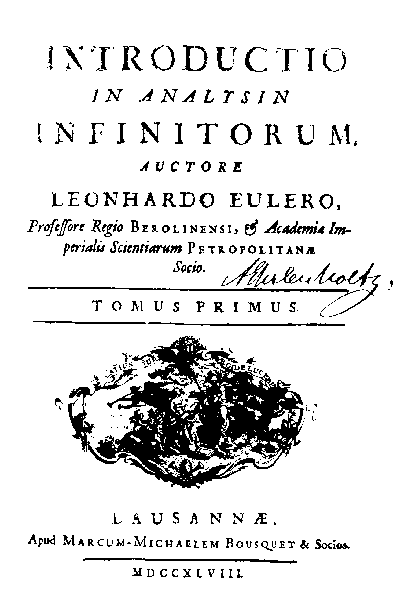
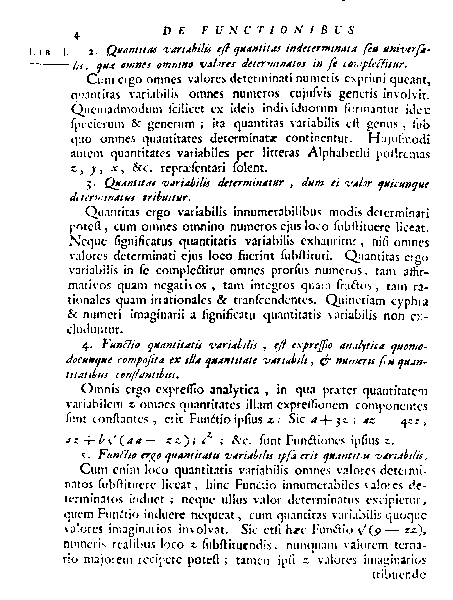
人们可以说数学分析始于欧拉。1748年,在Introductio in analysin infinitorum中,欧拉在定义函数时使约翰·伯努利的思想更加精确,并指出数学分析是研究函数的。这部著作将微积分建立在初等函数理论之上,而不是像以前那样建立在几何曲线之上。同样在这部著作中,欧拉给出了公式
。
在Introductio in analysin infinitorum中,欧拉处理了只取正值的变量的对数,尽管他在1727年已经发现了公式
。他在1751年发表了他关于复数对数的完整理论。
复变量的解析函数被欧拉在多个不同背景下研究过,包括正交轨迹和制图学的研究。他在1777年发现了奥古斯丁·路易·柯西-波恩哈德·黎曼方程,尽管让·勒朗·达朗贝尔在1752年研究流体动力学时已经发现了它们。
1755年,欧拉发表了Institutiones calculi differentialis,该书以有限差分微积分的研究开篇。这部著作深入考察了微分在代换下的表现。
在Institutiones calculi integralis(1768—70)中,欧拉深入考察了可用初等函数表示的积分。他还研究了他在1729年首次引入的贝塔函数与伽马函数。阿德里安-马里·勒让德分别称它们为“第一类和第二类欧拉积分”,而雅可·比内和卡尔·弗里德里希·高斯则分别给它们取名为贝塔函数和伽马函数。除了研究二重积分,欧拉在这部著作中还考虑了ordinary和偏微分方程。
变分法是欧拉做出基础性发现的另一个领域。他1740年发表的著作Methodus inveniendi lineas curvas Ⓣ(一种关于曲线的方法)……开始了对变分法的恰当研究。在[12]中指出,康斯坦丁·卡拉西奥多里认为这是:-
……有史以来写得最优美的数学著作之一。
数学物理中的问题使欧拉对微分方程进行了广泛研究。他考虑了常系数线性方程、变系数二阶微分方程、微分方程的幂级数解、常数变易法、积分因子、近似解法以及许多其他方法。在研究振动膜时,欧拉导出了弗里德里希·威廉·贝塞尔方程,他通过引入Bessel functions求解了该方程。
欧拉对微分几何做出了重大贡献,研究了曲面理论和曲面的曲率。欧拉在这一领域许多未发表的结果被卡尔·弗里德里希·高斯重新发现。其他几何研究引导他得出拓扑学中的基本思想,例如多面体的欧拉示性数。
1736年,欧拉出版了Mechanica,它在力学方面取得了重大进展。正如A.П. 尤什克维奇在[1]中所写:-
与前辈相比,欧拉在力学研究中的显著特点是系统而成功地应用了分析。此前,力学方法大多是综合的和几何的;它们要求对各个问题采取过于个别化的处理方式。欧拉是第一个认识到将统一的分析方法引入力学的重要性的人,从而使力学问题能够以清晰而直接的方式得到解决。
在Mechanica中,欧拉考虑了质点既在真空中又在阻力介质中的运动。他分析了质点在中心力作用下的运动,还考虑了质点在曲面上的运动。在后一主题中,他必须解决微分几何和测地线的各种问题。
Mechanica之后是理性力学中的另一部重要著作,这次是欧拉关于海军科学的两卷本著作。它在[24]中被描述为:-
在理论力学和应用力学两方面都很杰出,它涉及欧拉对船舶推进问题的深入研究。它应用变分原理来确定最优船舶设计,并首次建立了流体静力学原理……欧拉在这里还开始发展刚体运动学和动力学,部分引入了刚体运动的微分方程。
当然,流体静力学自阿基米德以来就有人研究,但欧拉给出了一个决定性的版本。
1765年,欧拉发表了另一部关于力学的重大著作Theoria motus corporum solidorumⓉ(《固体运动理论》),其中他将固体的运动分解为直线运动和旋转运动。他考虑了欧拉角,并研究了由岁差问题所激发的旋转问题。
欧拉在流体力学方面的工作也相当卓越。他在18世纪50年代发表了许多重要著作,为该主题建立了主要公式:连续性方程、皮埃尔·西蒙·拉普拉斯速度势方程,以及描述无粘性不可压缩流体运动的欧拉方程。1752年,他写道:-
无论伯努利先生、亚历克西斯·克劳德·克莱罗和让·勒朗·达朗贝尔关于流体的研究多么高深,它们都如此自然地从我那两个一般公式中流出,以至于人们不能不充分赞叹他们深刻思考与我推导出这两个方程所依据的简单原理之间的这种一致……
欧拉在许多其他领域也贡献了知识,并且在所有这些领域中,他都运用了自己的数学知识和技能。他在天文学方面做了重要工作,包括[1]:-
……通过少量观测确定彗星和行星的轨道、计算太阳视差的方法、折射理论、对彗星物理性质的考虑,……他最杰出的著作,为他赢得了巴黎Académie des Sciences的许多奖项,涉及天体力学,这尤其吸引了当时的科学家。
事实上,欧拉的月球理论被托比亚斯·梅耶用于编制他的月球表。1765年,托比亚斯·梅耶的遗孀从英国获得了3000英镑,因为这些表对确定经度问题作出了贡献,而欧拉则因他对这项工作的理论贡献从英国政府获得了300英镑。
欧拉还发表了关于音乐理论的著作,特别是他在1739年出版了Tentamen novae theoriae musicaeⓉ(一种新的音乐理论),在其中他试图使音乐:-
……成为数学的一部分,并从正确的原理出发,以有序的方式推导出一切能使音调的协调与混合令人愉悦的内容。
然而,根据[8],这部作品:-
……对音乐家来说数学太深奥,对数学家来说又太音乐化。
制图学是欧拉涉足的另一个领域,1735年他被任命为圣彼得堡科学院地理部门的主任。他的具体任务是帮助Delisle准备一幅整个俄罗斯帝国的地图。Russian Atlas是这次合作的成果,于1745年问世,由20幅地图组成。到出版时已在柏林的欧拉自豪地指出,这项工作使俄罗斯人在制图艺术上远远领先于德国人。
Leonhard Euler's father was Paul Euler. Paul Euler had studied theology at the University of Basel and had attended Jacob Bernoulli's lectures there. In fact Paul Euler and Johann Bernoulli had both lived in Jacob Bernoulli's house while undergraduates at Basel. Paul Euler became a Protestant minister and married Margaret Brucker, the daughter of another Protestant minister. Their son Leonhard Euler was born in Basel, but the family moved to Riehen when he was one year old and it was in Riehen, not far from Basel, that Leonard was brought up. Paul Euler had, as we have mentioned, some mathematical training and he was able to teach his son elementary mathematics along with other subjects.
Leonhard was sent to school in Basel and during this time he lived with his grandmother on his mother's side. This school was a rather poor one, by all accounts, and Euler learnt no mathematics at all from the school. However his interest in mathematics had certainly been sparked by his father's teaching, and he read mathematics texts on his own and took some private lessons. Euler's father wanted his son to follow him into the church and sent him to the University of Basel to prepare for the ministry. He entered the University in 1720, at the age of 14, first to obtain a general education before going on to more advanced studies. Johann Bernoulli soon discovered Euler's great potential for mathematics in private tuition that Euler himself engineered. Euler's own account given in his unpublished autobiographical writings, see [1], is as follows:-
... I soon found an opportunity to be introduced to a famous professor Johann Bernoulli. ... True, he was very busy and so refused flatly to give me private lessons; but he gave me much more valuable advice to start reading more difficult mathematical books on my own and to study them as diligently as I could; if I came across some obstacle or difficulty, I was given permission to visit him freely every Sunday afternoon and he kindly explained to me everything I could not understand ...
In 1723 Euler completed his Master's degree in philosophy having compared and contrasted the philosophical ideas of Descartes and Newton. He began his study of theology in the autumn of 1723, following his father's wishes, but, although he was to be a devout Christian all his life, he could not find the enthusiasm for the study of theology, Greek and Hebrew that he found in mathematics. Euler obtained his father's consent to change to mathematics after Johann Bernoulli had used his persuasion. The fact that Euler's father had been a friend of Johann Bernoulli's in their undergraduate days undoubtedly made the task of persuasion much easier.
Euler completed his studies at the University of Basel in 1726. He had studied many mathematical works during his time in Basel, and Calinger [24] has reconstructed many of the works that Euler read with the advice of Johann Bernoulli. They include works by Varignon, Descartes, Newton, Galileo, van Schooten, Jacob Bernoulli, Hermann, Taylor and Wallis. By 1726 Euler had already a paper in print, a short article on isochronous curves in a resisting medium. In 1727 he published another article on reciprocal trajectories and submitted an entry for the 1727 Grand Prize of the Paris Academy on the best arrangement of masts on a ship.
The Prize of 1727 went to Bouguer, an expert on mathematics relating to ships, but Euler's essay won him second place which was a fine achievement for the young graduate. However, Euler now had to find himself an academic appointment and when Nicolaus(II) Bernoulli died in St Petersburg in July 1726 creating a vacancy there, Euler was offered the post which would involve him in teaching applications of mathematics and mechanics to physiology. He accepted the post in November 1726 but stated that he did not want to travel to Russia until the spring of the following year. He had two reasons to delay. He wanted time to study the topics relating to his new post but also he had a chance of a post at the University of Basel since the professor of physics there had died. Euler wrote an article on acoustics, which went on to become a classic, in his bid for selection to the post but he was not chosen to go forward to the stage where lots were drawn to make the final decision on who would fill the chair. Almost certainly his youth (he was 19 at the time) was against him. However Calinger [24] suggests:-
This decision ultimately benefited Euler, because it forced him to move from a small republic into a setting more adequate for his brilliant research and technological work.
As soon as he knew he would not be appointed to the chair of physics, Euler left Basel on 5 April 1727. He travelled down the Rhine by boat, crossed the German states by post wagon, then by boat from Lübeck arriving in St Petersburg on 17 May 1727. He had joined the St Petersburg Academy of Sciences two years after it had been founded by Catherine I the wife of Peter the Great. Through the requests of Daniel Bernoulli and Jakob Hermann, Euler was appointed to the mathematical-physical division of the Academy rather than to the physiology post he had originally been offered. At St Petersburg Euler had many colleagues who would provide an exceptional environment for him [1]:-
Nowhere else could he have been surrounded by such a group of eminent scientists, including the analyst, geometer Jakob Hermann, a relative; Daniel Bernoulli, with whom Euler was connected not only by personal friendship but also by common interests in the field of applied mathematics; the versatile scholar Christian Goldbach, with whom Euler discussed numerous problems of analysis and the theory of numbers; F Maier, working in trigonometry; and the astronomer and geographer J-N Delisle.
Euler served as a medical lieutenant in the Russian navy from 1727 to 1730. In St Petersburg he lived with Daniel Bernoulli who, already unhappy in Russia, had requested that Euler bring him tea, coffee, brandy and other delicacies from Switzerland. Euler became professor of physics at the Academy in 1730 and, since this allowed him to become a full member of the Academy, he was able to give up his Russian navy post.
Daniel Bernoulli held the senior chair in mathematics at the Academy but when he left St Petersburg to return to Basel in 1733 it was Euler who was appointed to this senior chair of mathematics. The financial improvement which came from this appointment allowed Euler to marry which he did on 7 January 1734, marrying Katharina Gsell, the daughter of a painter from the St Petersburg Gymnasium. Katharina, like Euler, was from a Swiss family. They had 13 children altogether although only five survived their infancy. Euler claimed that he made some of his greatest mathematical discoveries while holding a baby in his arms with other children playing round his feet.
We will examine Euler's mathematical achievements later in this article but at this stage it is worth summarising Euler's work in this period of his career. This is done in [24] as follows:-
... after 1730 he carried out state projects dealing with cartography, science education, magnetism, fire engines, machines, and ship building. ... The core of his research program was now set in place: number theory; infinitary analysis including its emerging branches, differential equations and the calculus of variations; and rational mechanics. He viewed these three fields as intimately interconnected. Studies of number theory were vital to the foundations of calculus, and special functions and differential equations were essential to rational mechanics, which supplied concrete problems.
The publication of many articles and his book Mechanica (1736-37), which extensively presented Newtonian dynamics in the form of mathematical analysis for the first time, started Euler on the way to major mathematical work.
Euler's health problems began in 1735 when he had a severe fever and almost lost his life. However, he kept this news from his parents and members of the Bernoulli family back in Basel until he had recovered. In his autobiographical writings Euler says that his eyesight problems began in 1738 with overstrain due to his cartographic work and that by 1740 he had [24]:-
... lost an eye and [the other] currently may be in the same danger.
However, Calinger in [24] argues that Euler's eyesight problems almost certainly started earlier and that the severe fever of 1735 was a symptom of the eyestrain. He also argues that a portrait of Euler from 1753 suggests that by that stage the sight of his left eye was still good while that of his right eye was poor but not completely blind. Calinger suggests that Euler's left eye became blind from a later cataract rather than eyestrain.
By 1740 Euler had a very high reputation, having won the Grand Prize of the Paris Academy in 1738 and 1740. On both occasions he shared the first prize with others. Euler's reputation was to bring an offer to go to Berlin, but at first he preferred to remain in St Petersburg. However political turmoil in Russia made the position of foreigners particularly difficult and contributed to Euler changing his mind. Accepting an improved offer Euler, at the invitation of Frederick the Great, went to Berlin where an Academy of Science was planned to replace the Society of Sciences. He left St Petersburg on 19 June 1741, arriving in Berlin on 25 July. In a letter to a friend Euler wrote:-
I can do just what I wish [in my research] ... The king calls me his professor, and I think I am the happiest man in the world.
Even while in Berlin Euler continued to receive part of his salary from Russia. For this remuneration he bought books and instruments for the St Petersburg Academy, he continued to write scientific reports for them, and he educated young Russians.
Maupertuis was the president of the Berlin Academy when it was founded in 1744 with Euler as director of mathematics. He deputised for Maupertuis in his absence and the two became great friends. Euler undertook an unbelievable amount of work for the Academy [1]:-
... he supervised the observatory and the botanical gardens; selected the personnel; oversaw various financial matters; and, in particular, managed the publication of various calendars and geographical maps, the sale of which was a source of income for the Academy. The king also charged Euler with practical problems, such as the project in 1749 of correcting the level of the Finow Canal ... At that time he also supervised the work on pumps and pipes of the hydraulic system at Sans Souci, the royal summer residence.
This was not the limit of his duties by any means. He served on the committee of the Academy dealing with the library and of scientific publications. He served as an advisor to the government on state lotteries, insurance, annuities and pensions and artillery. On top of this his scientific output during this period was phenomenal.
During the twenty-five years spent in Berlin, Euler wrote around 380 articles. He wrote books on the calculus of variations; on the calculation of planetary orbits; on artillery and ballistics (extending the book by Robins); on analysis; on shipbuilding and navigation; on the motion of the moon; lectures on the differential calculus; and a popular scientific publication Letters to a Princess of Germany (3 vols., 1768-72).
See THIS LINK.
In 1759 Maupertuis died and Euler assumed the leadership of the Berlin Academy, although not the title of President. The king was in overall charge and Euler was not now on good terms with Frederick despite the early good favour. Euler, who had argued with d'Alembert on scientific matters, was disturbed when Frederick offered d'Alembert the presidency of the Academy in 1763. However d'Alembert refused to move to Berlin but Frederick's continued interference with the running of the Academy made Euler decide that the time had come to leave.
In 1766 Euler returned to St Petersburg and Frederick was greatly angered at his departure. Soon after his return to Russia, Euler became almost entirely blind after an illness. In 1771 his home was destroyed by fire and he was able to save only himself and his mathematical manuscripts. A cataract operation shortly after the fire, still in 1771, restored his sight for a few days but Euler seems to have failed to take the necessary care of himself and he became totally blind. Because of his remarkable memory he was able to continue with his work on optics, algebra, and lunar motion. Amazingly after his return to St Petersburg (when Euler was 59) he produced almost half his total works despite the total blindness.
Euler of course did not achieve this remarkable level of output without help. He was helped by his sons, Johann Albrecht Euler who was appointed to the chair of physics at the Academy in St Petersburg in 1766 (becoming its secretary in 1769) and Christoph Euler who had a military career. Euler was also helped by two other members of the Academy, W L Krafft and A J Lexell, and the young mathematician N Fuss who was invited to the Academy from Switzerland in 1772. Fuss, who was Euler's grandson-in-law, became his assistant in 1776. Yushkevich writes in [1]:-
.. the scientists assisting Euler were not mere secretaries; he discussed the general scheme of the works with them, and they developed his ideas, calculating tables, and sometimes compiled examples.
For example Euler credits Albrecht, Krafft and Lexell for their help with his 775 page work on the motion of the moon, published in 1772. Fuss helped Euler prepare over 250 articles for publication over a period on about seven years in which he acted as Euler's assistant, including an important work on insurance which was published in 1776.
He also wrote a eulogy of Euler, which you can see at THIS LINK.
Yushkevich describes the day of Euler's death in [1]:-
On 18 September 1783 Euler spent the first half of the day as usual. He gave a mathematics lesson to one of his grandchildren, did some calculations with chalk on two boards on the motion of balloons; then discussed with Lexell and Fuss the recently discovered planet Uranus. About five o'clock in the afternoon he suffered a brain haemorrhage and uttered only "I am dying" before he lost consciousness. He died about eleven o'clock in the evening.
After his death in 1783 the St Petersburg Academy continued to publish Euler's unpublished work for nearly 50 more years.
Euler's work in mathematics is so vast that an article of this nature cannot but give a very superficial account of it. He was the most prolific writer of mathematics of all time. He made large bounds forward in the study of modern analytic geometry and trigonometry where he was the first to consider sin, cos etc. as functions rather than as chords as Ptolemy had done.
He made decisive and formative contributions to geometry, calculus and number theory. He integrated Leibniz's differential calculus and Newton's method of fluxions into mathematical analysis. He introduced beta and gamma functions, and integrating factors for differential equations. He studied continuum mechanics, lunar theory with Clairaut, the three body problem, elasticity, acoustics, the wave theory of light, hydraulics, and music. He laid the foundation of analytical mechanics, especially in his Theory of the Motions of Rigid Bodies (1765).
We owe to Euler the notation for a function (1734), for the base of natural logs (1727), for the square root of -1 (1777), for pi, for summation (1755), the notation for finite differences and and many others.
Let us examine in a little more detail some of Euler's work. Firstly his work in number theory seems to have been stimulated by Goldbach but probably originally came from the interest that the Bernoullis had in that topic. Goldbach asked Euler, in 1729, if he knew of Fermat's conjecture that the numbers were always prime if is a power of 2. Euler verified this for = 1, 2, 4, 8 and 16 and, by 1732 at the latest, showed that the next case is divisible by 641 and so is not prime. Euler also studied other unproved results of Fermat and in so doing introduced the Euler phi function , the number of integers with and coprime to . He proved another of Fermat's assertions, namely that if and are coprime then has no divisor of the form , in 1749.
Perhaps the result that brought Euler the most fame in his young days was his solution of what had become known as the Basel problem. This was to find a closed form for the sum of the infinite series , a problem which had defeated many of the top mathematicians including Jacob Bernoulli, Johann Bernoulli and Daniel Bernoulli. The problem had also been studied unsuccessfully by Leibniz, Stirling, de Moivre and others. Euler showed in 1735 that but he went on to prove much more, namely that and . In 1737 he proved the connection of the zeta function with the series of prime numbers giving the famous relation
Here the sum is over all natural numbers while the product is over all prime numbers.
By 1739 Euler had found the rational coefficients in in terms of the Bernoulli numbers.
Other work done by Euler on infinite series included the introduction of his famous Euler's constant γ, in 1735, which he showed to be the limit of
as tends to infinity. He calculated the constant γ to 16 decimal places. Euler also studied Fourier series and in 1744 he was the first to express an algebraic function by such a series when he gave the result
in a letter to Goldbach. Like most of Euler's work there was a fair time delay before the results were published; this result was not published until 1755.
Euler wrote to James Stirling on 8 June 1736 telling him about his results on summing reciprocals of powers, the harmonic series and Euler's constant and other results on series. In particular he wrote [60]:-
Concerning the summation of very slowly converging series, in the past year I have lectured to our Academy on a special method of which I have given the sums of very many series sufficiently accurately and with very little effort.
He then goes on to describe what is now called the Euler-Maclaurin summation formula. Two years later Stirling replied telling Euler that Maclaurin:-
... will be publishing a book on fluxions. ... he has two theorems for summing series by means of derivatives of the terms, one of which is the self-same result that you sent me.
Euler replied:-
... I have very little desire for anything to be detracted from the fame of the celebrated Mr Maclaurin since he probably came upon the same theorem for summing series before me, and consequently deserves to be named as its first discoverer. For I found that theorem about four years ago, at which time I also described its proof and application in greater detail to our Academy.
Some of Euler's number theory results have been mentioned above. Further important results in number theory by Euler included his proof of Fermat's Last Theorem for the case of . Perhaps more significant than the result here was the fact that he introduced a proof involving numbers of the form for integers and . Although there were problems with his approach this eventually led to Kummer's major work on Fermats Last Theorem and to the introduction of the concept of a ring.
One could claim that mathematical analysis began with Euler. In 1748 in Introductio in analysin infinitorum Euler made ideas of Johann Bernoulli more precise in defining a function, and he stated that mathematical analysis was the study of functions. This work bases the calculus on the theory of elementary functions rather than on geometric curves, as had been done previously. Also in this work Euler gave the formula
.
In Introductio in analysin infinitorum Euler dealt with logarithms of a variable taking only positive values although he had discovered the formula
in 1727. He published his full theory of logarithms of complex numbers in 1751.
Analytic functions of a complex variable were investigated by Euler in a number of different contexts, including the study of orthogonal trajectories and cartography. He discovered the Cauchy-Riemann equations in 1777, although d'Alembert had discovered them in 1752 while investigating hydrodynamics.
In 1755 Euler published Institutiones calculi differentialis which begins with a study of the calculus of finite differences. The work makes a thorough investigation of how differentiation behaves under substitutions.
In Institutiones calculi integralis (1768-70) Euler made a thorough investigation of integrals which can be expressed in terms of elementary functions. He also studied beta and gamma functions, which he had introduced first in 1729. Legendre called these 'Eulerian integrals of the first and second kind' respectively while they were given the names beta function and gamma function by Binet and Gauss respectively. As well as investigating double integrals, Euler considered ordinary and partial differential equations in this work.
The calculus of variations is another area in which Euler made fundamental discoveries. His work Methodus inveniendi lineas curvas Ⓣ... published in 1740 began the proper study of the calculus of variations. In [12] it is noted that Carathéodory considered this as:-
... one of the most beautiful mathematical works ever written.
Problems in mathematical physics had led Euler to a wide study of differential equations. He considered linear equations with constant coefficients, second order differential equations with variable coefficients, power series solutions of differential equations, a method of variation of constants, integrating factors, a method of approximating solutions, and many others. When considering vibrating membranes, Euler was led to the Bessel equation which he solved by introducing Bessel functions.
Euler made substantial contributions to differential geometry, investigating the theory of surfaces and curvature of surfaces. Many unpublished results by Euler in this area were rediscovered by Gauss. Other geometric investigations led him to fundamental ideas in topology such as the Euler characteristic of a polyhedron.
In 1736 Euler published Mechanica which provided a major advance in mechanics. As Yushkevich writes in [1]:-
The distinguishing feature of Euler's investigations in mechanics as compared to those of his predecessors is the systematic and successful application of analysis. Previously the methods of mechanics had been mostly synthetic and geometrical; they demanded too individual an approach to separate problems. Euler was the first to appreciate the importance of introducing uniform analytic methods into mechanics, thus enabling its problems to be solved in a clear and direct way.
In Mechanica Euler considered the motion of a point mass both in a vacuum and in a resisting medium. He analysed the motion of a point mass under a central force and also considered the motion of a point mass on a surface. In this latter topic he had to solve various problems of differential geometry and geodesics.
Mechanica was followed by another important work in rational mechanics, this time Euler's two volume work on naval science. It is described in [24] as:-
Outstanding in both theoretical and applied mechanics, it addresses Euler's intense occupation with the problem of ship propulsion. It applies variational principles to determine the optimal ship design and first established the principles of hydrostatics ... Euler here also begins developing the kinematics and dynamics of rigid bodies, introducing in part the differential equations for their motion.
Of course hydrostatics had been studied since Archimedes, but Euler gave a definitive version.
In 1765 Euler published another major work on mechanics Theoria motus corporum solidorum Ⓣ in which he decomposed the motion of a solid into a rectilinear motion and a rotational motion. He considered the Euler angles and studied rotational problems which were motivated by the problem of the precession of the equinoxes.
Euler's work on fluid mechanics is also quite remarkable. He published a number of major pieces of work through the 1750s setting up the main formulae for the topic, the continuity equation, the Laplace velocity potential equation, and the Euler equations for the motion of an inviscid incompressible fluid. In 1752 he wrote:-
However sublime are the researches on fluids which we owe to Messrs Bernoulli, Clairaut and d'Alembert, they flow so naturally from my two general formulae that one cannot sufficiently admire this accord of their profound meditations with the simplicity of the principles from which I have drawn my two equations ...
Euler contributed to knowledge in many other areas, and in all of them he employed his mathematical knowledge and skill. He did important work in astronomy including [1]:-
... determination of the orbits of comets and planets by a few observations, methods of calculation of the parallax of the sun, the theory of refraction, consideration of the physical nature of comets, .... His most outstanding works, for which he won many prizes from the Paris Académie des Sciences, are concerned with celestial mechanics, which especially attracted scientists at that time.
In fact Euler's lunar theory was used by Tobias Mayer in constructing his tables of the moon. In 1765 Mayer's widow received £3000 from Britain for the contribution the tables made to the problem of the determination of the longitude, while Euler received £300 from the British government for his theoretical contribution to the work.
Euler also published on the theory of music, in particular he published Tentamen novae theoriae musicae Ⓣ in 1739 in which he tried to make music:-
... part of mathematics and deduce in an orderly manner, from correct principles, everything which can make a fitting together and mingling of tones pleasing.
However, according to [8] the work was:-
... for musicians too advanced in its mathematics and for mathematicians too musical.
Cartography was another area that Euler became involved in when he was appointed director of the St Petersburg Academy's geography section in 1735. He had the specific task of helping Delisle prepare a map of the whole of the Russian Empire. The Russian Atlas was the result of this collaboration and it appeared in 1745, consisting of 20 maps. Euler, in Berlin by the time of its publication, proudly remarked that this work put the Russians well ahead of the Germans in the art of cartography.
正文里的方括号编号指向这里,悬停即可直接看到条目。书目保留原文——译了书名反而查不到文献。
原站列出的延伸阅读与外部数据库,照原样保留,目标多为英文页面。
关于莱昂哈德·欧拉的其它页面:
关于莱昂哈德·欧拉的其它网站:
原站的交叉引用。指向本站已镜像专题的留在站内,其余仍指回原站。