数学家传记
雅各布·伯努利是一位瑞士数学家,他是第一个使用积分这一术语的人。他研究了悬链线,即悬挂弦的曲线。他是极坐标的早期使用者,并发现了等时曲线。
雅各布·伯努利的父亲尼古拉·伯努利一世(1623-1708)继承了其父在巴塞尔创立的香料生意,该生意最初设在阿姆斯特丹,后来迁至巴塞尔。这个家族原籍比利时,是为躲避荷兰西班牙统治者的迫害而逃亡的难民。西班牙国王腓力于1567年派遣阿尔巴公爵率大军前往尼德兰,惩罚反对西班牙统治的人,强制推行罗马天主教,并重建腓力的权威。阿尔巴设立了“除暴委员会”,这是一个法庭,判处了超过12000人有罪,但大多数人,如信奉新教的雅各布·伯努利家族,都逃离了该国。
雅各布·伯努利是巴塞尔的重要公民,担任市议会议员和地方法官。雅各布·伯努利的母亲也出身于巴塞尔一个重要的银行家和地方议员家族。雅各布·伯努利是约翰·伯努利的兄弟,也是丹尼尔·伯努利的叔父。他迫于父母压力学习哲学和神学,对此极为不满,他于1671年在巴塞尔大学获得哲学硕士学位,1676年获得神学执业资格。
在雅各布·伯努利攻读大学学位期间,他违背父母意愿学习数学和天文学。值得一提的是,这是雅各布·伯努利家族许多成员的典型模式,他们不顾从事其他领域职业的压力而研究数学。然而雅各布·伯努利是第一个走上这条路的人,所以对他来说情况颇为不同,因为在雅各布·伯努利之前家族中并无数学传统。家族后来的成员必定深受研究数学和数学物理这一传统的影响。
1676年,在取得神学学位后,雅各布·伯努利移居日内瓦,在那里担任家庭教师。随后他前往法国,花了两年时间跟随勒内·笛卡儿的追随者学习,当时这些追随者由尼古拉斯‧马勒伯朗士领导。1681年,雅各布·伯努利前往荷兰,在那里他遇到了许多数学家,包括Hudde。他继续与欧洲顶尖的数学家和科学家一起学习,前往英国,在那里他会见了罗伯特·波义耳和罗伯特·胡克等人。此时他对天文学深感兴趣,并完成了一部著作,提出了一种不正确的彗星理论。由于他的旅行,雅各布·伯努利开始与许多数学家通信,这种通信持续了多年。
雅各布·伯努利回到瑞士,从1683年起在巴塞尔大学讲授力学,就固体和液体力学做了一系列重要讲座。由于他的学位是神学,他转向教会本是很自然的,但尽管有人向他提供教会的职位,他还是拒绝了。雅各布·伯努利真正热爱的是数学和理论物理,他讲授和研究的正是这些课题。在此期间,他研读了当时的主要数学著作,包括勒内·笛卡儿的Géométrie和弗兰斯·范斯霍滕在拉丁文版中增补的材料。雅各布·伯努利还研读了约翰·沃利斯和伊萨克·巴罗的著作,并通过这些对无穷小几何学产生了兴趣。雅各布·伯努利开始在Acta Eruditorum杂志上发表文章,该杂志于1682年在莱比锡创办。
1684年,雅各布·伯努利与Judith Stupanus结婚。他们有两个孩子,一个儿子取了祖父的名字Nicolaus,还有一个女儿。与雅各布·伯努利家族的许多成员不同,这些孩子后来没有成为数学家或物理学家。
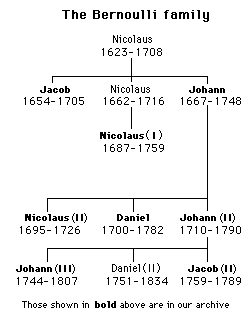
你可以在THIS LINK看到雅各布·伯努利的家谱。
关于雅各布·伯努利数学研究的最重要事件之一,发生在他的弟弟约翰·伯努利开始研究数学课题之时。约翰·伯努利被父亲要求学医,但他在学医期间请哥哥雅各布·伯努利教他数学。雅各布·伯努利于1687年被任命为巴塞尔数学教授,两兄弟开始研究哥特弗里德·威廉·莱布尼茨在1684年发表于Nova Methodus pro Maximis et Minimis, itemque Tangentibus……并刊于Acta Eruditorum的微分学论文中所阐述的微积分。他们还研读了埃伦弗里德·瓦尔特·冯·切恩豪斯的出版物。必须理解,哥特弗里德·威廉·莱布尼茨关于微积分的出版物对当时的数学家来说极为晦涩,而伯努利兄弟是最早试图理解和应用哥特弗里德·威廉·莱布尼茨理论的人。
尽管雅各布·伯努利和约翰·伯努利都研究过类似的问题,但他们的关系很快就从合作者变成了竞争对手。约翰·伯努利的吹嘘是雅各布·伯努利攻击他的第一个原因,雅各布·伯努利写道,约翰·伯努利是他的学生,其唯一成就就是重复老师教给他的东西。当然,这是一个极不公平的说法。雅各布·伯努利继续以可耻和没有必要的方式在印刷品中攻击他的兄弟,特别是在1697年之后。然而,他并没有将公开批评仅限于他的兄弟。他批评巴塞尔大学当局,并且再次非常公开地发表批评性言论,正如人们所预料的那样,这让他在大学里处境艰难。雅各布·伯努利可能觉得约翰·伯努利是两人中更强大的数学家,这让他感到受伤,因为雅各布·伯努利的性格意味着他总是需要感到自己受到各方的赞扬。Hofmann在[1]中写道:-
敏感、易怒、对批评的共同热情以及对认可的过度需求使兄弟俩疏远,其中雅各布·伯努利的智力较慢但更深刻。
正如这段引文所暗示的,兄弟俩在争吵中同样有错。约翰·伯努利本希望得到雅各布·伯努利所拥有的巴塞尔大学数学讲席,他当然对1695年不得不搬到荷兰感到不满。这是1697年关系彻底破裂的另一个因素。
当然,兄弟之间关于谁能获得最大认可的争执,从某种意义上说是特别愚蠢的,因为两人都对数学做出了极其重要的贡献。这种竞争是激励他们取得更大成就,还是如果他们继续最初的合作可能会取得更多成果,这无法断言。我们现在将考察雅各布·伯努利在哥特弗里德·威廉·莱布尼茨关于微积分的工作之后数学发展的一个重要阶段所做出的一些主要贡献。
雅各布·伯努利的第一批重要贡献是1685年出版的一本关于逻辑与代数平行关系的小册子,1685年关于probability的工作,以及1687年关于几何学的工作。他的几何学结果给出了一种用两条垂直线将任意三角形分成四个相等部分的构造。
到1689年,他已发表了关于无穷级数的重要工作,并发表了概率论中的大数定律。将概率解释为相对频率是说,如果一个实验重复大量次数,那么一个事件发生的相对频率等于该事件的概率。大数定律是对这一结果的数学解释。雅各布·伯努利在1682年至1704年间发表了五篇关于无穷级数的论著。其中前两篇包含许多结果,例如发散这一基本结果,雅各布·伯努利认为这些是新结果,但实际上皮耶特罗·曼戈里在40年前就已证明。雅各布·伯努利无法找到的闭形式,但他确实证明了它收敛到一个小于2的有限极限。莱昂哈德·欧拉是1737年第一个求出这个级数之和的人。雅各布·伯努利还研究了由考察复利而引出的指数级数。
1690年5月,在Acta Eruditorum上发表的一篇论文中,雅各布·伯努利表明确定等时线的问题等价于求解一个一阶非线性微分方程。等时线,或恒定下降曲线,是粒子在重力作用下从任何点下降到最低点所需时间完全相同的曲线,无论起点如何。克里斯蒂安·惠更斯在1687年和哥特弗里德·威廉·莱布尼茨在1689年研究过它。在找到微分方程后,雅各布·伯努利用我们现在称为分离变量的方法求解了它。雅各布·伯努利1690年的论文对微积分的历史很重要,因为integral一词首次以其积分含义出现。1696年,雅各布·伯努利求解了该方程,现在称为“雅各布·伯努利方程”,
Hofmann将他工作的这一部分描述为:-
……证明了雅各布·伯努利对无穷小数学的旧有以及当代贡献的细致和批判性工作,以及他在处理特殊相关问题,甚至是力学-动力学性质的问题时的毅力和分析能力。
雅各布·伯努利还发现了一种确定曲线evolutes的一般方法,即将其作为其曲率圆的包络。他还研究了焦散曲线,特别是大约在1692年研究了抛物线、对数螺线和外摆线的相关曲线。雅各布·伯努利的伯努利双纽线最早由雅各布·伯努利于1694年构想出来。1695年,他研究了吊桥问题,该问题寻求所需的曲线,使得沿缆绳滑动的重物始终保持吊桥平衡。
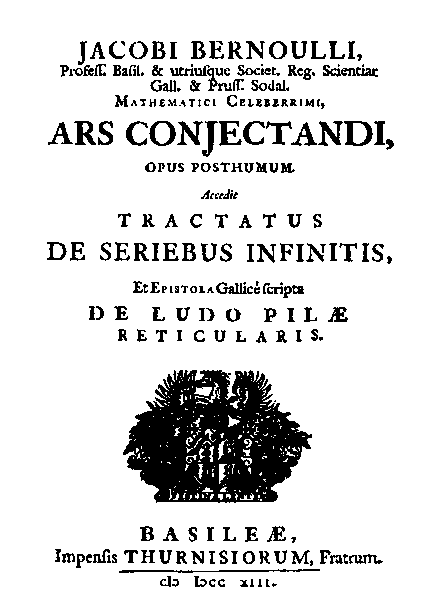
雅各布·伯努利最具原创性的著作是Ars Conjectandi,于1713年在巴塞尔出版,即他去世八年后。该著作在他去世时尚未完成,但它在概率论中仍具有极其重要的意义。在书中,雅各布·伯努利评述了其他人在概率方面的工作,特别是van 弗兰斯·范斯霍滕、哥特弗里德·威廉·莱布尼茨和Prestet的工作。伯努利数出现在书中关于指数级数的讨论中。书中给出了许多关于在各种机会游戏中预期能赢多少的例子。关于概率究竟是什么,有一些有趣的想法[1]:-
……概率作为可度量的确定性程度;必然性与偶然性;道德期望与数学期望;先验概率与后验概率;当玩家按技巧划分时的获胜期望;对所有可用论据的考量、其估值及其可计算评估;大数定律……
在[1]中,Hofmann对雅各布·伯努利的贡献总结如下:-
雅各布·伯努利极大地推进了代数、无穷小微积分、变分法、力学、级数论和概率论。他任性、固执、好斗、报复心强,深受自卑感困扰,却又坚信自己的能力。具有这些特征,他必然与他那性格相似的兄弟发生冲突。尽管如此,他对后者产生了最持久的影响。
雅各布·伯努利是高等分析形式方法最重要的推动者之一。在他的表述和表达方法中,很少见到机敏和优雅,但有着最大限度的诚实。
雅各布·伯努利继续在巴塞尔担任数学讲席,直到1705年去世,讲席由他的兄弟约翰接任。雅各布·伯努利一直觉得对数螺线的性质几乎具有魔力,他要求将一条对数螺线刻在他的墓碑上,并附上拉丁文铭文Eadem Mutata Resurgo,意为“我将再生,虽已改变”。
参见THIS LINK。
Jacob Bernoulli's father, Nicolaus Bernoulli (1623-1708) inherited the spice business in Basel that had been set up by his own father, first in Amsterdam and then in Basel. The family, of Belgium origin, were refugees fleeing from persecution by the Spanish rulers of the Netherlands. Philip, the King of Spain, had sent the Duke of Alba to the Netherlands in 1567 with a large army to punish those opposed to Spanish rule, to enforce adherence to Roman Catholicism, and to re-establish Philip's authority. Alba set up the Council of Troubles which was a court that condemned over 12000 people but most, like the Bernoulli family who were of the Protestant faith, fled the country.
Nicolaus Bernoulli was an important citizen of Basel, being a member of the town council and a magistrate. Jacob Bernoulli's mother also came from an important Basel family of bankers and local councillors. Jacob Bernoulli was the brother of Johann Bernoulli and the uncle of Daniel Bernoulli. He was compelled to study philosophy and theology by his parents, which he greatly resented, and he graduated from the University of Basel with a master's degree in philosophy in 1671 and a licentiate in theology in 1676.
During the time that Jacob Bernoulli was taking his university degrees he was studying mathematics and astronomy against the wishes of his parents. It is worth remarking that this was a typical pattern for many of the Bernoulli family who made a study of mathematics despite pressure to make a career in other areas. However Jacob Bernoulli was the first to go down this road so for him it was rather different in that there was no tradition of mathematics in the family before Jacob Bernoulli. Later members of the family must have been much influenced by the tradition of studying mathematics and mathematical physics.
In 1676, after taking his theology degree, Bernoulli moved to Geneva where he worked as a tutor. He then travelled to France spending two years studying with the followers of Descartes who were led at this time by Malebranche. In 1681 Bernoulli travelled to the Netherlands where he met many mathematicians including Hudde. Continuing his studies with the leading mathematicians and scientists of Europe he went to England where, among others, he met Boyle and Hooke. At this time he was deeply interested in astronomy and produced a work giving an incorrect theory of comets. As a result of his travels, Bernoulli began a correspondence with many mathematicians which he carried on over many years.
Jacob Bernoulli returned to Switzerland and taught mechanics at the University in Basel from 1683, giving a series of important lectures on the mechanics of solids and liquids. Since his degree was in theology it would have been natural for him to turn to the Church, but although he was offered an appointment in the Church he turned it down. Bernoulli's real love was for mathematics and theoretical physics and it was in these topics that he taught and researched. During this period he studied the leading mathematical works of his time including Descartes' Géométrie and van Schooten's additional material in the Latin edition. Jacob Bernoulli also studied the work of Wallis and Barrow and through these he became interested in infinitesimal geometry. Jacob began publishing in the journal Acta Eruditorum which was established in Leipzig in 1682.
In 1684 Jacob Bernoulli married Judith Stupanus. They were to have two children, a son who was given his grandfather's name of Nicolaus and a daughter. These children, unlike many members of the Bernoulli family, did not go on to become mathematicians or physicists.
You can see the Bernoulli family tree at THIS LINK.
One of the most significant events concerning the mathematical studies of Jacob Bernoulli occurred when his younger brother, Johann Bernoulli, began to work on mathematical topics. Johann was told by his father to study medicine but while he was studying that topic he asked his brother Jacob to teach him mathematics. Jacob Bernoulli was appointed professor of mathematics in Basel in 1687 and the two brothers began to study the calculus as presented by Leibniz in his 1684 paper on the differential calculus in Nova Methodus pro Maximis et Minimis, itemque Tangentibus... published in Acta Eruditorum. They also studied the publications of von Tschirnhaus. It must be understood that Leibniz's publications on the calculus were very obscure to mathematicians of that time and the Bernoullis were the first to try to understand and apply Leibniz's theories.
Although Jacob and Johann both worked on similar problems their relationship was soon to change from one of collaborators to one of rivals. Johann Bernoulli's boasts were the first cause of Jacob's attacks on him and Jacob wrote that Johann was his pupil whose only achievements were to repeat what his teacher had taught him. Of course this was a grossly unfair statement. Jacob continued to attack his brother in print in a disgraceful and unnecessary fashion, particularly after 1697. However he did not reserve public criticism for his brother. He was critical of the university authorities at Basel and again he was very public in making critical statements that, as one would expect, left him in a difficult situation at the university. Jacob probably felt that Johann was the more powerful mathematician of the two and, this hurt since Jacob's nature meant that he always had to feel that he was winning praise from all sides. Hofmann writes in [1]:-
Sensitivity, irritability, a mutual passion for criticism, and an exaggerated need for recognition alienated the brothers, of whom Jacob had the slower but deeper intellect.
As suggested by this quote the brothers were equally at fault in their quarrel. Johann would have liked the chair of mathematics at Basel which Jacob held and he certainly resented having to move to Holland in 1695. This was another factor in the complete breakdown of relations in 1697.
Of course the dispute between the brothers over who could obtain the greatest recognition was a particularly stupid one in the sense that both made contributions to mathematics of the very greatest importance. Whether the rivalry spurred them on to greater things or whether they might have achieved more had they continued their initial collaboration, it is impossible to say. We shall now examine some of the major contributions made by Jacob Bernoulli at an important stage in the development of mathematics following Leibniz's work on the calculus.
Jacob Bernoulli's first important contributions were a pamphlet on the parallels of logic and algebra published in 1685, work on probability in 1685 and geometry in 1687. His geometry result gave a construction to divide any triangle into four equal parts with two perpendicular lines.
By 1689 he had published important work on infinite series and published his law of large numbers in probability theory. The interpretation of probability as relative-frequency says that if an experiment is repeated a large number of times then the relative frequency with which an event occurs equals the probability of the event. The law of large numbers is a mathematical interpretation of this result. Jacob Bernoulli published five treatises on infinite series between 1682 and 1704. The first two of these contained many results, such as fundamental result that diverges, which Bernoulli believed were new but they had actually been proved by Mengoli 40 years earlier. Bernoulli could not find a closed form for but he did show that it converged to a finite limit less than 2. Euler was the first to find the sum of this series in 1737. Bernoulli also studied the exponential series which came out of examining compound interest.
In May 1690 in a paper published in Acta Eruditorum, Jacob Bernoulli showed that the problem of determining the isochrone is equivalent to solving a first-order nonlinear differential equation. The isochrone, or curve of constant descent, is the curve along which a particle will descend under gravity from any point to the bottom in exactly the same time, no matter what the starting point. It had been studied by Huygens in 1687 and Leibniz in 1689. After finding the differential equation, Bernoulli then solved it by what we now call separation of variables. Jacob Bernoulli's paper of 1690 is important for the history of calculus, since the term integral appears for the first time with its integration meaning. In 1696 Bernoulli solved the equation, now called "the Bernoulli equation",
and Hofmann describes this part of his work as:-
... proof of Bernoulli's careful and critical work on older as well as on contemporary contributions to infinitesimal mathematics and of his perseverance and analytical ability in dealing with special pertinent problems, even those of a mechanical-dynamic nature.
Jacob Bernoulli also discovered a general method to determine evolutes of a curve as the envelope of its circles of curvature. He also investigated caustic curves and in particular he studied these associated curves of the parabola, the logarithmic spiral and epicycloids around 1692. The lemniscate of Bernoulli was first conceived by Jacob Bernoulli in 1694. In 1695 he investigated the drawbridge problem which seeks the curve required so that a weight sliding along the cable always keeps the drawbridge balanced.
Jacob Bernoulli's most original work was Ars Conjectandi published in Basel in 1713, eight years after his death. The work was incomplete at the time of his death but it is still a work of the greatest significance in the theory of probability. In the book Bernoulli reviewed work of others on probability, in particular work by van Schooten, Leibniz, and Prestet. The Bernoulli numbers appear in the book in a discussion of the exponential series. Many examples are given on how much one would expect to win playing various game of chance. There are interesting thoughts on what probability really is [1]:-
... probability as a measurable degree of certainty; necessity and chance; moral versus mathematical expectation; a priori an a posteriori probability; expectation of winning when players are divided according to dexterity; regard of all available arguments, their valuation, and their calculable evaluation; law of large numbers ...
In [1] Hofmann sums up Jacob Bernoulli's contributions as follows:-
Bernoulli greatly advanced algebra, the infinitesimal calculus, the calculus of variations, mechanics, the theory of series, and the theory of probability. He was self-willed, obstinate, aggressive, vindictive, beset by feelings of inferiority, and yet firmly convinced of his own abilities. With these characteristics, he necessarily had to collide with his similarly disposed brother. He nevertheless exerted the most lasting influence on the latter.
Bernoulli was one of the most significant promoters of the formal methods of higher analysis. Astuteness and elegance are seldom found in his method of presentation and expression, but there is a maximum of integrity.
Jacob Bernoulli continued to hold the chair of mathematics at Basel until his death in 1705 when the chair was filled by his brother Johann. Jacob had always found the properties of the logarithmic spiral to be almost magical and he had requested that it be carved on his tombstone with the Latin inscription Eadem Mutata Resurgo meaning "I shall arise the same though changed".
See THIS LINK.
正文里的方括号编号指向这里,悬停即可直接看到条目。书目保留原文——译了书名反而查不到文献。
原站列出的延伸阅读与外部数据库,照原样保留,目标多为英文页面。
关于雅各布·伯努利的其它页面:
关于雅各布·伯努利的其它网站:
原站的交叉引用。指向本站已镜像专题的留在站内,其余仍指回原站。