数学家传记
皮埃尔·德·费马是一位法国律师和政府官员,最为人铭记的是他在数论方面的工作;特别是关于皮埃尔·德·费马大定理。他在微积分的基础方面也很重要。
皮埃尔·德·费马的父亲是一位富有的皮革商人,也是博蒙-德-洛马涅的第二执政官。关于费马的出生日期如上所述存在一些争议[14],因为他可能有一个哥哥(也被命名为费马)但早逝。费马有一个兄弟和两个姐妹,几乎可以肯定是在他出生的城镇长大的。尽管关于他的学校教育证据很少,但一定是在当地的方济各会修道院。
他在图卢兹大学学习,随后于17世纪20年代后半期迁往波尔多。在波尔多,他开始了最初认真的数学研究,并于1629年将他复原的阿波罗尼奥斯的Plane loci交给当地的一位数学家。可以肯定的是,他在波尔多与让·博格朗有联系,在此期间他完成了关于极大值和极小值的重要工作,并将其交给了Étienne d'Espagnet,后者显然与费马有着共同的数学兴趣。
费马去了奥尔良,在奥尔良大学学习法律。他获得了民法学位,并购买了图卢兹议会参事的职位。因此到1631年,费马已是图卢兹的律师和政府官员,由于他此时所持有的职位,他有权将自己的名字从费马改为费马。
在他余下的生活中,他住在图卢兹,但除了在那里工作外,他还在他的家乡博蒙德洛马涅和附近的卡斯特尔镇工作。从1631年5月14日被任命起,费马在议会下院工作,但在1638年1月16日,他被任命到更高的议院,然后在1652年,他被提升到刑事法院的最高级别。进一步的晋升似乎表明他在职业中相当迅速地崛起,但晋升主要基于资历,而瘟疫在1650年代初袭击了该地区,这意味着许多年长的人死亡。费马本人也被瘟疫击倒,在1653年,他的死亡被错误报道,然后更正:-
我早些时候告知过你费马的死讯。他还活着,我们不再为他的健康担忧,尽管不久前我们还把他列在死者之中。
以下这份呈报给当时法国首脑柯尔贝尔的报告,听起来有几分真实:-
费马学识渊博,与各地学者都有联系。但他相当心不在焉,叙述事例不佳,且思路混乱。
当然,费马全神贯注于数学。他迁往图卢兹后仍与让·博格朗保持着数学上的友谊,但在那里他又结识了一位新的数学朋友皮埃尔·德·卡克维。费马因公务结识了皮埃尔·德·卡克维,因为两人都是图卢兹的参事,但他们都热爱数学,费马还向皮埃尔·德·卡克维讲述了自己的数学发现。
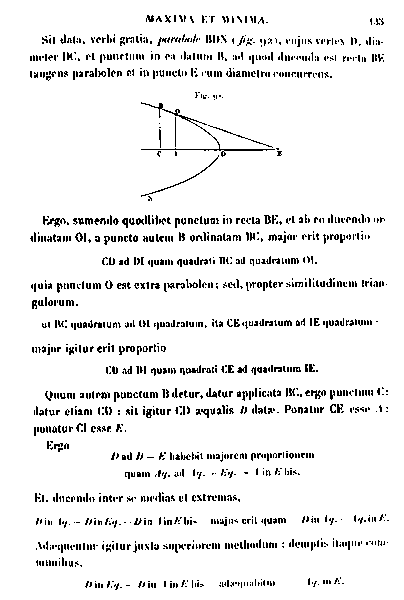
1636年,皮埃尔·德·卡克维前往巴黎担任皇家图书馆员,并与马兰·梅森及其圈子建立了联系。马兰·梅森被皮埃尔·德·卡克维对费马关于落体发现的描述所吸引,于是写信给费马。费马于1636年4月26日回信,除了告诉马兰·梅森他认为伽利略在描述自由落体时所犯的错误外,还向马兰·梅森讲述了自己关于螺线的工作以及他对阿波罗尼奥斯的Plane loci的复原。他关于螺线的工作源于对自由落体轨迹的思考,他运用了从阿基米德的著作On spirals推广而来的方法来计算螺线下方的面积。此外,费马还写道:-
我还为各种问题——既有数值的也有几何的——找到了多种分析,这些问题的求解靠弗朗索瓦·韦达的分析是不够的。只要你愿意,我随时可以与你分享这一切,而且毫无野心,在这方面我比世上任何人都更超脱、更远离野心。
有点讽刺的是,他与费马和科学界的初次接触是通过他对自由落体的研究实现的,因为费马对数学的物理应用兴趣不大。即使在他关于自由落体的结果中,他也更感兴趣于证明几何定理,而不是它们与现实世界的关系。然而,这第一封信确实包含了两个关于最大值的问题,费马要求马兰·梅森转交给巴黎的数学家们,这将成为费马信件的典型风格,他会挑战他人找出他已经获得的结果。
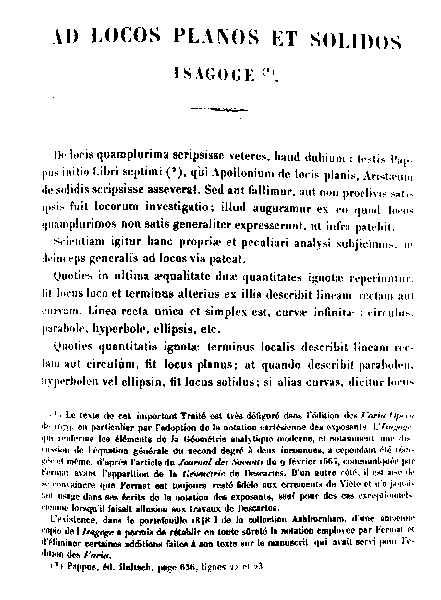
罗贝瓦尔和马兰·梅森发现,费马在这第一封信以及随后信件中的问题极其困难,通常无法用当时的技术解决。他们请他公开自己的方法,费马便将Method for determining Maxima and Minima and 切线 to Curved Lines、他复原的阿波罗尼奥斯的Plane loci文本以及他处理几何的代数方法Introduction to Plane and Solid Loci寄给了巴黎的数学家们。
他作为世界顶尖数学家之一的声誉很快到来,但试图发表其著作的努力大多失败了,主要是因为费马从未真正想把他的工作整理成精炼的形式。然而,他的一些方法还是发表了,例如皮埃尔·埃里戈纳在其主要著作Cursus mathematicusⓉ(《数学教程》)中附加了一份包含费马极大极小方法的补编。费马与其他数学家之间日益扩大的通信并未获得普遍赞誉。福兰尼可对费马的问题感到恼火,因为在他看来这些问题无法解决。他愤怒地写信给费马,但尽管费马在回信中给出了更多细节,福兰尼可仍觉得费马几乎是在戏弄他。
费马很快与一位比福兰尼可更重要的数学家陷入了争论。在收到让·博格朗寄来的勒内·笛卡儿的La Dioptrique Ⓣ(光学)副本后,费马对它不太在意,因为他正忙于与罗贝瓦尔和埃蒂安·帕斯卡尔关于积分方法以及用它们寻找重心的通信。马兰·梅森要求他对La Dioptrique Ⓣ(光学)发表意见,费马这样做了,将其描述为
在阴影中摸索。
他声称勒内·笛卡儿没有正确推导出他的折射定律,因为它已隐含在他的假设中。说勒内·笛卡儿不高兴是轻描淡写。勒内·笛卡儿很快找到了更生气的理由,因为他认为费马关于最大值、最小值和切线的工作降低了他自己作品La Géométrie的重要性,而勒内·笛卡儿最为自豪,并试图表明只有他的Discours de la méthode Ⓣ(方法论)才能给出。
勒内·笛卡儿攻击了费马的最大值、最小值和切线方法。罗贝瓦尔和埃蒂安·帕斯卡尔卷入了争论,最终吉拉尔·笛沙格也卷入其中,勒内·笛卡儿要求他担任裁判。费马被证明是正确的,最终勒内·笛卡儿承认了这一点,写道:-
……看到你用于寻找曲线切线的最后方法,我只能这样回复:它非常好,如果你一开始就以这种方式解释它,我根本不会反对它。
这是否结束了这件事并提高了费马的地位?完全没有,因为勒内·笛卡儿试图损害费马的声誉。例如,尽管他写信给费马赞扬他在确定摆线切线方面的工作(这确实是正确的),但勒内·笛卡儿写信给马兰·梅森声称这是不正确的,并说费马作为数学家和思想家是不合格的。勒内·笛卡儿很重要且受人尊敬,因此能够严重损害费马的声誉。
1643年至1654年期间,费马与巴黎的科学同行失去了联系。这有多方面的原因。首先,工作压力使他无法在数学上投入太多时间。其次,法国发生了投石党运动(Fronde)内战,从1648年起图卢兹受到很大影响。最后,1651年的瘟疫必然对图卢兹的生活产生了重大影响,当然也对费马本人产生了近乎致命的后果。然而正是在这段时间里,费马研究了数论。
费马最为人所知的是他在数论方面的工作,特别是费马大定理。这个定理指出
对于和,当时,没有非零整数解。费马在克劳德-加斯帕·巴歇·德·梅齐里亚克翻译的丢番图的Arithmetica的页边空白处写道
我发现了一个真正非凡的证明,但这个页边空白太小,写不下。
这些页边笔记直到费马的儿子皮埃尔·萨米埃尔于1670年出版了克劳德-加斯帕·巴歇·德·梅齐里亚克翻译的丢番图的Arithmetica并附有他父亲的笔记后才为人所知。
现在人们认为费马的“证明”是错误的,尽管不可能完全确定。费马断言的真实性于1993年6月由英国数学家安德鲁·怀尔斯证明,但当1993年晚些时候出现问题后,安德鲁·怀尔斯撤回了拥有证明的声明。1994年11月,安德鲁·怀尔斯再次声称拥有正确的证明,该证明现已被接受。
在300年间证明该定理的失败尝试导致了交换环论的发现以及大量其他数学发现。
费马与巴黎数学家的通信在1654年重新开始,当时布莱兹·帕斯卡,即埃蒂安·帕斯卡尔的儿子,写信给他,要求确认他关于probability的想法。布莱兹·帕斯卡通过他的父亲(三年前去世)知道了费马,并且非常清楚费马杰出的数学能力。他们简短的通信建立了概率论,因此他们现在被视为该学科的联合创始人。然而,费马感到孤立,仍然想采用他旧式的挑战数学家的风格,试图将话题从概率转向数论。布莱兹·帕斯卡不感兴趣,但费马没有意识到这一点,写信给皮埃尔·德·卡克维说:-
我很高兴能持有与M 布莱兹·帕斯卡一致的观点,因为我对他的天才怀有无限的敬意……你们两人可以着手进行那项出版工作,我同意由你们做主,你们可以澄清或补充任何看起来过于简略的内容,并解除我因职责所限而无法承担的重负。
然而布莱兹·帕斯卡肯定不会编辑费马的著作,在短暂地渴望出版费马的著作之后,他又放弃了这一想法。不过,他在挑战问题方面比以往走得更远:-
图卢兹议会国王顾问费马先生向法国、英国、荷兰以及全欧洲的数学家提出的两个数学问题,被宣称为不可解。
他的问题并未引起太大兴趣,因为大多数数学家似乎认为数论不是一个重要课题。然而,这两个问题中的第二个,即对于非平方数的,求的所有解,被约翰·沃利斯和威廉·布朗克解决了,他们在求解过程中发展了连分数。威廉·布朗克给出了有理的解,这引发了争论。福兰尼可也许是当时唯一真正对数论感兴趣的数学家,但他没有足够的数学才能来做出重大贡献。
费马提出了更多问题,即两个立方数之和不能是一个立方数(这是费马最后定理的一个特例,可能表明此时费马意识到他对一般结果的证明是错误的),恰好有两个整数解,以及方程只有一个整数解。他直接向英国人提出问题。每个人都未能看出费马一直希望他的具体问题能引导他们发现,就像他所做的那样,更深层的理论结果。
大约在这个时候,勒内·笛卡儿的一个学生正在收集他的通信以供出版,他转向费马寻求帮助,处理费马 - 勒内·笛卡儿的通信。这导致费马重新审视他20年前使用的论证,并再次审视他对勒内·笛卡儿光学的反对意见。特别是,他一直对勒内·笛卡儿关于光折射的描述不满,现在他确定了一个原理,该原理实际上产生了威理博·斯涅尔和勒内·笛卡儿提出的折射正弦定律。然而,费马现在从他提出的一个基本性质推导出了它,即光总是沿着最短可能的路径传播。费马的原理,现在是光学最基本的性质之一,当时并未得到数学家的青睐。
1656年,费马开始与克里斯蒂安·惠更斯通信。这源于克里斯蒂安·惠更斯对概率的兴趣,通信很快被费马操纵到数论话题上。克里斯蒂安·惠更斯对这个话题不感兴趣,但费马努力尝试,并在New Account of Discoveries in the Science of Numbers年通过皮埃尔·德·卡克维于1659年发送给克里斯蒂安·惠更斯,他透露了比向其他人更多的自己的方法。
费马描述了他的无穷递降法,并举例说明如何用它来证明每个形如的prime都可以写成两个平方数之和。假设某个形如的数不能写成两个平方数之和。那么存在一个更小的形如的数不能写成两个平方数之和。继续论证将导致矛盾。费马在这封信中未能解释的是,如何从较大的数构造出较小的数。人们假设费马确实知道如何迈出这一步,但他再次未能披露方法,使数学家失去了兴趣。直到莱昂哈德·欧拉着手这些问题,缺失的步骤才被填补。
费马在[9]中被描述为
他隐秘而沉默寡言,不喜欢谈论自己,也不愿过多透露自己的想法。……然而,他的思想无论多么独创或新颖,都是在那个[1600 - 1650]时代和那个[法国]地点所限定的可能性范围内运作的。
Carl B 卡尔·本杰明·波耶在[2]中写道:-
对费马在分析方面工作重要性的认可来得很迟,部分原因是他坚持使用弗朗索瓦·韦达所创制的数学符号体系,而这些记号因勒内·笛卡儿的“Géométrie”已在很大程度上被废弃。这种笨拙记号所造成的障碍在费马最喜爱的研究领域数论中影响较小,但不幸的是,在这里他找不到分享其热情的通信者。
Pierre Fermat's father was a wealthy leather merchant and second consul of Beaumont- de- Lomagne. There is some dispute [14] about the date of Pierre's birth as given above, since it is possible that he had an elder brother (who had also been given the name Pierre) but who died young. Pierre had a brother and two sisters and was almost certainly brought up in the town of his birth. Although there is little evidence concerning his school education it must have been at the local Franciscan monastery.
He attended the University of Toulouse before moving to Bordeaux in the second half of the 1620s. In Bordeaux he began his first serious mathematical researches and in 1629 he gave a copy of his restoration of Apollonius's Plane loci to one of the mathematicians there. Certainly in Bordeaux he was in contact with Beaugrand and during this time he produced important work on maxima and minima which he gave to Étienne d'Espagnet who clearly shared mathematical interests with Fermat.
From Bordeaux Fermat went to Orléans where he studied law at the University. He received a degree in civil law and he purchased the offices of councillor at the parliament in Toulouse. So by 1631 Fermat was a lawyer and government official in Toulouse and because of the office he now held he became entitled to change his name from Pierre Fermat to Pierre de Fermat.
For the remainder of his life he lived in Toulouse but as well as working there he also worked in his home town of Beaumont-de-Lomagne and a nearby town of Castres. From his appointment on 14 May 1631 Fermat worked in the lower chamber of the parliament but on 16 January 1638 he was appointed to a higher chamber, then in 1652 he was promoted to the highest level at the criminal court. Still further promotions seem to indicate a fairly meteoric rise through the profession but promotion was done mostly on seniority and the plague struck the region in the early 1650s meaning that many of the older men died. Fermat himself was struck down by the plague and in 1653 his death was wrongly reported, then corrected:-
I informed you earlier of the death of Fermat. He is alive, and we no longer fear for his health, even though we had counted him among the dead a short time ago.
The following report, made to Colbert the leading figure in France at the time, has a ring of truth:-
Fermat, a man of great erudition, has contact with men of learning everywhere. But he is rather preoccupied, he does not report cases well and is confused.
Of course Fermat was preoccupied with mathematics. He kept his mathematical friendship with Beaugrand after he moved to Toulouse but there he gained a new mathematical friend in Carcavi. Fermat met Carcavi in a professional capacity since both were councillors in Toulouse but they both shared a love of mathematics and Fermat told Carcavi about his mathematical discoveries.
In 1636 Carcavi went to Paris as royal librarian and made contact with Mersenne and his group. Mersenne's interest was aroused by Carcavi's descriptions of Fermat's discoveries on falling bodies, and he wrote to Fermat. Fermat replied on 26 April 1636 and, in addition to telling Mersenne about errors which he believed that Galileo had made in his description of free fall, he also told Mersenne about his work on spirals and his restoration of Apollonius's Plane loci. His work on spirals had been motivated by considering the path of free falling bodies and he had used methods generalised from Archimedes' work On spirals to compute areas under the spirals. In addition Fermat wrote:-
I have also found many sorts of analyses for diverse problems, numerical as well as geometrical, for the solution of which Viète's analysis could not have sufficed. I will share all of this with you whenever you wish and do so without any ambition, from which I am more exempt and more distant than any man in the world.
It is somewhat ironical that this initial contact with Fermat and the scientific community came through his study of free fall since Fermat had little interest in physical applications of mathematics. Even with his results on free fall he was much more interested in proving geometrical theorems than in their relation to the real world. This first letter did however contain two problems on maxima which Fermat asked Mersenne to pass on to the Paris mathematicians and this was to be the typical style of Fermat's letters, he would challenge others to find results which he had already obtained.
Roberval and Mersenne found that Fermat's problems in this first, and subsequent, letters were extremely difficult and usually not soluble using current techniques. They asked him to divulge his methods and Fermat sent Method for determining Maxima and Minima and Tangents to Curved Lines, his restored text of Apollonius's Plane loci and his algebraic approach to geometry Introduction to Plane and Solid Loci to the Paris mathematicians.
His reputation as one of the leading mathematicians in the world came quickly but attempts to get his work published failed mainly because Fermat never really wanted to put his work into a polished form. However some of his methods were published, for example Hérigone added a supplement containing Fermat's methods of maxima and minima to his major work Cursus mathematicus Ⓣ. The widening correspondence between Fermat and other mathematicians did not find universal praise. Frenicle de Bessy became annoyed at Fermat's problems which to him were impossible. He wrote angrily to Fermat but although Fermat gave more details in his reply, Frenicle de Bessy felt that Fermat was almost teasing him.
However Fermat soon became engaged in a controversy with a more major mathematician than Frenicle de Bessy. Having been sent a copy of Descartes' La Dioptrique Ⓣ by Beaugrand, Fermat paid it little attention since he was in the middle of a correspondence with Roberval and Étienne Pascal over methods of integration and using them to find centres of gravity. Mersenne asked him to give an opinion on La Dioptrique Ⓣ which Fermat did, describing it as
groping about in the shadows.
He claimed that Descartes had not correctly deduced his law of refraction since it was inherent in his assumptions. To say that Descartes was not pleased is an understatement. Descartes soon found reason to feel even more angry since he viewed Fermat's work on maxima, minima and tangents as reducing the importance of his own work La Géométrie which Descartes was most proud of and which he sought to show that his Discours de la méthode Ⓣ alone could give.
Descartes attacked Fermat's method of maxima, minima and tangents. Roberval and Étienne Pascal became involved in the argument and eventually so did Desargues who Descartes asked to act as a referee. Fermat proved correct and eventually Descartes admitted this writing:-
... seeing the last method that you use for finding tangents to curved lines, I can reply to it in no other way than to say that it is very good and that, if you had explained it in this manner at the outset, I would have not contradicted it at all.
Did this end the matter and increase Fermat's standing? Not at all since Descartes tried to damage Fermat's reputation. For example, although he wrote to Fermat praising his work on determining the tangent to a cycloid (which is indeed correct), Descartes wrote to Mersenne claiming that it was incorrect and saying that Fermat was inadequate as a mathematician and a thinker. Descartes was important and respected and thus was able to severely damage Fermat's reputation.
The period from 1643 to 1654 was one when Fermat was out of touch with his scientific colleagues in Paris. There are a number of reasons for this. Firstly pressure of work kept him from devoting so much time to mathematics. Secondly the Fronde, a civil war in France, took place and from 1648 Toulouse was greatly affected. Finally there was the plague of 1651 which must have had great consequences both on life in Toulouse and of course its near fatal consequences on Fermat himself. However it was during this time that Fermat worked on number theory.
Fermat is best remembered for this work in number theory, in particular for Fermat's Last Theorem. This theorem states that
has no non-zero integer solutions for and when . Fermat wrote, in the margin of Bachet's translation of Diophantus's Arithmetica
I have discovered a truly remarkable proof which this margin is too small to contain.
These marginal notes only became known after Fermat's son Samuel published an edition of Bachet's translation of Diophantus's Arithmetica with his father's notes in 1670.
It is now believed that Fermat's 'proof' was wrong although it is impossible to be completely certain. The truth of Fermat's assertion was proved in June 1993 by the British mathematician Andrew Wiles, but Wiles withdrew the claim to have a proof when problems emerged later in 1993. In November 1994 Wiles again claimed to have a correct proof which has now been accepted.
Unsuccessful attempts to prove the theorem over a 300 year period led to the discovery of commutative ring theory and a wealth of other mathematical discoveries.
Fermat's correspondence with the Paris mathematicians restarted in 1654 when Blaise Pascal, Étienne Pascal's son, wrote to him to ask for confirmation about his ideas on probability. Blaise Pascal knew of Fermat through his father, who had died three years before, and was well aware of Fermat's outstanding mathematical abilities. Their short correspondence set up the theory of probability and from this they are now regarded as joint founders of the subject. Fermat however, feeling his isolation and still wanting to adopt his old style of challenging mathematicians, tried to change the topic from probability to number theory. Pascal was not interested but Fermat, not realising this, wrote to Carcavi saying:-
I am delighted to have had opinions conforming to those of M Pascal, for I have infinite esteem for his genius... the two of you may undertake that publication, of which I consent to your being the masters, you may clarify or supplement whatever seems too concise and relieve me of a burden that my duties prevent me from taking on.
However Pascal was certainly not going to edit Fermat's work and after this flash of desire to have his work published Fermat again gave up the idea. He went further than ever with his challenge problems however:-
Two mathematical problems posed as insoluble to French, English, Dutch and all mathematicians of Europe by Monsieur de Fermat, Councillor of the King in the Parliament of Toulouse.
His problems did not prompt too much interest as most mathematicians seemed to think that number theory was not an important topic. The second of the two problems, namely to find all solutions of for not a square, was however solved by Wallis and Brouncker and they developed continued fractions in their solution. Brouncker produced rational solutions which led to arguments. Frenicle de Bessy was perhaps the only mathematician at that time who was really interested in number theory but he did not have sufficient mathematical talents to allow him to make a significant contribution.
Fermat posed further problems, namely that the sum of two cubes cannot be a cube (a special case of Fermat's Last Theorem which may indicate that by this time Fermat realised that his proof of the general result was incorrect), that there are exactly two integer solutions of and that the equation has only one integer solution. He posed problems directly to the English. Everyone failed to see that Fermat had been hoping his specific problems would lead them to discover, as he had done, deeper theoretical results.
Around this time one of Descartes' students was collecting his correspondence for publication and he turned to Fermat for help with the Fermat - Descartes correspondence. This led Fermat to look again at the arguments he had used 20 years before and he looked again at his objections to Descartes' optics. In particular he had been unhappy with Descartes' description of refraction of light and he now settled on a principle which did in fact yield the sine law of refraction that Snell and Descartes had proposed. However Fermat had now deduced it from a fundamental property that he proposed, namely that light always follows the shortest possible path. Fermat's principle, now one of the most basic properties of optics, did not find favour with mathematicians at the time.
In 1656 Fermat had started a correspondence with Huygens. This grew out of Huygens interest in probability and the correspondence was soon manipulated by Fermat onto topics of number theory. This topic did not interest Huygens but Fermat tried hard and in New Account of Discoveries in the Science of Numbers sent to Huygens via Carcavi in 1659, he revealed more of his methods than he had done to others.
Fermat described his method of infinite descent and gave an example on how it could be used to prove that every prime of the form could be written as the sum of two squares. For suppose some number of the form could not be written as the sum of two squares. Then there is a smaller number of the form which cannot be written as the sum of two squares. Continuing the argument will lead to a contradiction. What Fermat failed to explain in this letter is how the smaller number is constructed from the larger. One assumes that Fermat did know how to make this step but again his failure to disclose the method made mathematicians lose interest. It was not until Euler took up these problems that the missing steps were filled in.
Fermat is described in [9] as
Secretive and taciturn, he did not like to talk about himself and was loath to reveal too much about his thinking. ... His thought, however original or novel, operated within a range of possibilities limited by that [1600 - 1650] time and that [France] place.
Carl B Boyer, writing in [2], says:-
Recognition of the significance of Fermat's work in analysis was tardy, in part because he adhered to the system of mathematical symbols devised by François Viète, notations that Descartes' "Géométrie" had rendered largely obsolete. The handicap imposed by the awkward notations operated less severely in Fermat's favourite field of study, the theory of numbers, but here, unfortunately, he found no correspondent to share his enthusiasm.
正文里的方括号编号指向这里,悬停即可直接看到条目。书目保留原文——译了书名反而查不到文献。
原站列出的延伸阅读与外部数据库,照原样保留,目标多为英文页面。
关于皮埃尔·德·费马的其它页面:
关于皮埃尔·德·费马的其它网站:
原站的交叉引用。指向本站已镜像专题的留在站内,其余仍指回原站。