数学家传记
科林·麦克劳林是一位苏格兰数学家,他发表了艾萨克·牛顿方法的第一个系统阐述,写作目的是回应乔治·伯克利对微积分缺乏严格基础的攻击。
科林·麦克劳林出生于基尔莫丹,他的父亲John Maclaurin是该教区的牧师。这个村庄(1904年人口387人)位于鲁埃尔河畔,教堂在格伦达鲁尔。
你可以在THIS LINK上了解更多关于基尔莫丹教堂的信息。
John Maclaurin比一般教区牧师更像一位学者,因为他曾将《诗篇》翻译成盖尔语。他有三个儿子。长子弗瑞兹·约翰继承父业,成为牧师;他是一位热心公益、学识渊博的人,并与美国形而上学家乔纳森·爱德华兹有通信往来。次子丹尼尔早年展现出非凡的天赋,但英年早逝。麦克劳林是最小的儿子。他的父亲在麦克劳林六周大时去世。麦克劳林的母亲继承了阿盖尔郡的一处小地产,麦克劳林就是在这处地产上度过了早年时光。他的母亲希望麦克劳林和他的兄弟约翰能接受良好的教育,于是全家搬到邓巴顿,孩子们在那里上学。
1707年,麦克劳林九岁时,他的母亲去世了,因此抚养麦克劳林和他的兄弟约翰的任务落到了他们的叔叔Daniel Maclaurin身上,后者是费恩湖基尔芬南的牧师。
你可以在THIS LINK上了解更多关于基尔芬南教堂的信息。
麦克劳林 在1709年十一岁时成为格拉斯哥大学的学生。他是大约400名学生中的一员。这个年龄开始大学教育似乎令人难以置信,但在当时并不像今天这样令人惊讶。基本上,当时的苏格兰学校和大学争夺最优秀的学生,而不是像今天这样,大学教育被视为学校教育的延续。
当然,麦克劳林 的才能在格拉斯哥大学很快就开始显现。他第一次接触高等数学是在进入大学一年后,当时他在一个朋友的房间里发现了一本 欧几里得 的 Elements。这是当时数学学习的标准教材,但 麦克劳林 自学了它,迅速掌握了 Elements 十三卷中的前六卷。在格拉斯哥,麦克劳林 接触到了 罗伯特·西姆松,他是那里的数学教授。罗伯特·西姆松 对古希腊几何特别感兴趣,他对这一主题的热情影响了年轻学生 麦克劳林。Tweddle 在 [23] 中考察了 罗伯特·西姆松 和 麦克劳林 在 conic sections 上的通信,这是在 麦克劳林 在格拉斯哥的学生时代25年后。
14岁时,麦克劳林 在学习了拉丁语、希腊语、逻辑学、道德哲学、自然哲学和数学后获得了文学硕士学位。虽然名义上是硕士学位,但这相当于学士学位的第一学位,但古老的苏格兰大学(包括圣安德鲁斯,我[EFR]自己的大学)仍然保留文学硕士学位作为文科的第一学位。然而,麦克劳林 必须为获得这个学位在公开考试中辩护一篇论文(今天不是这样),他选择了 On the power of gravity 作为他的主题。这篇论文发展了 艾萨克·牛顿 的理论,是由一个14岁的男孩写的,当时这样的先进思想只有少数领先的数学家才熟悉。
获得硕士学位后,麦克劳林在格拉斯哥大学又留了一年学习神学。他原本打算进入长老会,但[7]:-
……对当时潜入教会中的纷争感到厌恶……
他决定放弃这一职业。
1714年离开格拉斯哥后,麦克劳林 回到基尔芬南的牧师住宅与他的叔叔同住。这些对 麦克劳林 来说是快乐的岁月,他努力学习,在附近的山丘和山脉中散步以消遣。他笔记本中未完成的片段揭示了他天性的敏感性,他有时会爆发出对景色之美及其创造者完美的诗意狂想。他显然在数学上达到了非常高的标准,因为在1717年8月,他年仅19岁就被任命为阿伯丁大学马里沙尔学院的数学教授。这次任命是在十天的考试后寻找最佳候选人,很明显,尽管还有另一位杰出的候选人,麦克劳林 对高级主题的知识最多。
你可以在 THIS LINK 看到考试的报道,你可以在 THIS LINK 看到马里沙尔学院的图片。
麦克劳林曾两次前往伦敦,第一次是在1719年。麦克劳林已经表明自己是艾萨克·牛顿的数学和物理思想的非常坚定的拥护者,因此他们在麦克劳林访问伦敦期间会面是很自然的。令人惊讶的是,艾萨克·牛顿的一些传记作者,例如A Rupert Hall在其1992年的传记中,竟然宣称麦克劳林和艾萨克·牛顿从未见过面。麦克劳林在给他的一封信中写到这次伦敦之行(例如见[3]中的第117封信)时说道:-
我受到了[Royal Society成员]最殷勤的接待,尤其是伟大的艾萨克·牛顿,我经常与他在一起。
麦克劳林从皇家学会得到的不仅仅是殷勤接待,因为他在这次伦敦之行期间被选为皇家学会的会士。
在麦克劳林的职业生涯中,有一件相当奇怪的事发生在他担任阿伯丁大学数学讲席期间。波尔沃思勋爵是国王乔治二世的外交代理人。当时,上层人物的儿子们为了完成教育,通常会去欧洲进行壮游。波尔沃思邀请麦克劳林陪同他的儿子乔治·休姆(或霍姆)(1704 - 1724)进行这样的壮游,而麦克劳林接受了这个旅行并会见法国数学家的机会,这并不太令人惊讶。令人惊讶的是,他似乎没有向阿伯丁大学当局寻求必要的许可,尽管他似乎找到了人代他授课。Turnbull在[5]中写道:-
……人们不禁想知道,他在马歇尔学院那些无人指导的课程发生了什么。他是否把它们全忘了;他是否对所有的召回呼吁充耳不闻;他身上是否有某种东西,类似于艾萨克·牛顿那种难以接近的孤高,在精神创造的时刻将他与同伴和职责隔绝开来。
这不是一次短暂的旅行,因为麦克劳林与波尔沃思的儿子一起旅行了两年。这段经历以悲剧告终,因为他们在访问蒙彼利埃时,波尔沃思的儿子生病并去世了。麦克劳林回到阿伯丁后发现,大学对他两年未履行职责极为不满。当然,麦克劳林在外出期间并非无所事事,因为他在法国期间,因关于物体碰撞的研究而获得了Académie des Sciences颁发的大奖。
尽管被阿伯丁大学恢复讲席,麦克劳林仍在爱丁堡大学寻求职位。詹姆斯·格雷果里,不是那位同名的著名数学家,而是不太知名的格雷果里(1666 - 1742),他是大卫·格雷戈里的兄弟,担任爱丁堡大学数学讲席,但已病重无法工作。爱丁堡大学试图任命一人与格雷果里共同担任教授,并于1725年8月21日,艾萨克·牛顿写信给麦克劳林,表示支持推荐他担任该职位(见[1],或[7],或[3]的第122封信):-
听说你有望与格雷果里先生共同担任爱丁堡大学数学教授,我非常高兴,不仅因为你是我的朋友,主要因为你的能力,你既熟悉数学的进步,也熟悉这些科学的先前状态。我衷心祝愿你成功,并将非常高兴听到你当选的消息。
1725年11月,艾萨克·牛顿写信给爱丁堡市长John Campbell,支持麦克劳林的任命(见[1],或[7]):-
得知麦克劳林先生在你们中间享有盛誉,我很高兴,因为我认为他完全配得上:为了向你们表明我并非在奉承他,同时也为了鼓励他接受协助Gregory先生并最终接替其职位的位置,我愿意(若你们允许)在他等待Gregory先生职位空缺期间,每年出资二十英镑作为他的生活补贴,前提是我能活到那时。
没有证据表明爱丁堡方面接受了艾萨克·牛顿提出的为麦克劳林的薪水出资的提议。麦克劳林于1725年11月3日开始在爱丁堡大学任职。他成为一名受欢迎的教师,班级学生超过100人,但直到1742年,即他去世前四年,他才领到全额薪水。苏格兰教会领袖Alexander Carlyle(1722 - 1805)在其自传中写道:-
麦克劳林当时是一位备受喜爱的教授,这并不奇怪,因为他是我所听过的那门抽象科学中最清晰、最令人愉快的讲师。他使数学成为一门时髦的学问……
麦克劳林将在爱丁堡度过余下的职业生涯。1733年7月8日,他与Anne Stewart结婚,她是苏格兰副检察长的女儿。他们将有七个孩子,但正如当时常见的那样,并非所有孩子都活到成年。在七个孩子中,有两个男孩和三个女孩比他活得长。结婚后不久,麦克劳林致力于将爱丁堡医学协会扩展为一个更广泛的协会,以涵盖其他学科。麦克劳林本人担任这个扩展后协会的两名秘书之一,在每月会议上,他经常宣读自己的一篇论文或一位外国科学家的来信,内容涉及当前某个话题的最新进展。这个协会在麦克劳林去世后,将成为爱丁堡皇家学会。
麦克劳林在几何学方面做了显著的工作,特别是研究高次平面曲线。事实上,他的第一部重要著作是Geometria Organica; Sive Descriptio Linearum Curvarum UniversalisⓉ(有机几何,附通用线性曲线的描述),于1720年他在阿伯丁大学时出版。1740年,他获得了巴黎Académie des Sciences颁发的二等奖,这次是关于潮汐的研究De Causa Physica Fluxus et Reflexus MarisⓉ(海洋潮汐的物理学)。他使用艾萨克·牛顿的引力理论来表明,一个被足够深的海洋覆盖的光滑球体,在单个变形体的潮汐力作用下,是一个长球体,其长轴指向变形体。这个奖项与麦克劳林、莱昂哈德·欧拉和丹尼尔·伯努利共同获得,将麦克劳林与他那个时代的两位顶级数学家并列。
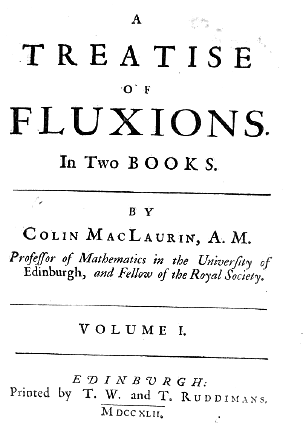
1742年,麦克劳林出版了他的两卷本Treatise of fluxions,这是对艾萨克·牛顿方法的首次系统阐述,写作目的是回应乔治·伯克利对微积分缺乏严格基础的攻击。麦克劳林在导言中写道(例如见[1]):-
[乔治·伯克利]将流数法描述为建立在错误推理之上,充满神秘。他的反对意见似乎是由于这种方法的基本原理通常被描述得过于简洁,而它们被一位像他这样有能力的人如此误解,在我看来足以证明需要对该方法的基础作出更充分的说明。
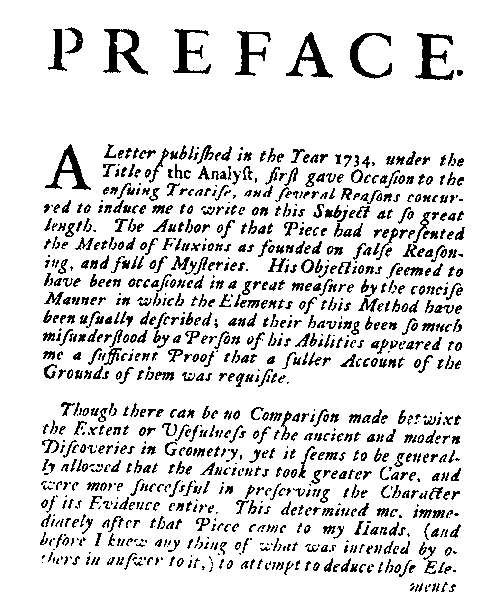
你可以在THIS LINK看到Treatise of fluxions的序言。
Treatise of fluxions是一部763页的重要著作,受到读者的高度赞扬,但通常被描述为影响不大。然而,文章[10]令人信服地论证了麦克劳林对大陆数学家的影响被低估了。格拉比纳给出了麦克劳林论文的五个影响领域:他对微积分基本定理的处理;他在极大值和极小值方面的工作;椭球体的吸引;elliptic integrals;以及莱昂哈德·欧拉-麦克劳林求和公式。
麦克劳林求助于古希腊人的几何方法以及阿基米德的穷竭法,试图为艾萨克·牛顿的微积分奠定严格的基础。正是在Treatise of fluxions中,麦克劳林使用了如今以他命名的泰勒级数的特殊情形,而他今天无疑最为人所铭记的也正是这一点。麦克劳林级数并非独立于布鲁克·泰勒更一般结果而发现的,因为麦克劳林承认了布鲁克·泰勒的贡献。麦克劳林给出的另一个重要结果——既未以他命名,也未以任何其他数学家命名——是关于无穷级数收敛性的重要积分判别法。Treatise of fluxions并不仅仅是一部旨在为微积分奠定严格基础的作品,因为麦克劳林在其中给出了微积分的许多应用。例如,他研究两个旋转椭球体的相互吸引,作为他所给出方法的一个应用。
麦克劳林还撰写了其他主题,包括1737年太阳的日环食以及蜜蜂蜂窝的结构。他还是精算学研究的创始人之一,并投稿于[5]:-
他为保险协会奠定了可靠的精算基础,该协会自此一直帮助苏格兰牧师和教授的遗孀及子女。
麦克劳林于1743年5月23日写信给苏格兰教会大会主持人罗伯特·华莱士牧师:-
既然您乐意在大会委员会上提及我对为牧师遗孀提供年金及为其子女设立基金的方案的意见,因此我认为有责任再次仔细复核那些计算,并将结果完整呈交给您,以避免任何类型的错误。
麦克劳林确实因若干结果与其他数学家卷入了争议。其中两起有详细记载,一起是与William Braikenridge的争议(参见本档案中Braikenridge的传记,以及[16]),争论的焦点是以下结果:-
如果一个多边形的边通过固定点,且除一个顶点外的所有顶点都位于固定直线上,那么剩下的顶点描绘出一条圆锥曲线或一条直线。
在[17]中描述了麦克劳林与George Campbell之间关于复根的争论。同样,麦克劳林称之为“一场不愉快的争论”的论战,是关于优先权的。另见[27]。
然而,我们不仅应当评论麦克劳林的数学研究,还应当评论他作为教师的品质。他在爱丁堡大学的教学受到了相当多的赞扬[7]:-
……他如此急切地希望学生进步,以至于无论何时,如果他们似乎没有完全理解他的意思,或者如果在考查他们时,他发现他们不能轻易证明他所提供的命题,他往往宁愿怀疑自己的解释晦涩,而不是怀疑他们缺乏天赋或注意力,因此他会用另一种方法重新进行证明,试图通过从不同角度展示它,使他们对其有更好的理解。
麦克劳林在1745年詹姆斯党叛乱期间为保卫爱丁堡发挥了积极作用。当詹姆斯党军队于1745年9月向爱丁堡进军时,麦克劳林不知疲倦地努力准备该城的防御。他描述了这些事件(例如见[3]的第100封信):-
城墙的看护被交托给我,我在上级的无限阻挠下日夜操劳。当有人许诺给我数百名工人时,我几乎连几十名都得不到。此事每天都有抱怨,许诺会予以纠正,但直到最后两天才得到纠正,而那时已经太晚了。
詹姆斯党军队于1745年9月15日抵达爱丁堡,谈判失败后,城门被打开。城堡坚守。麦克劳林逃往英格兰,在纽卡斯尔时,他收到约克大主教的邀请,请他去约克做客。在那里他:-
……作为一个在如此境况下离开自己的国家、把家人留在身后的人来说,他过了一段尽可能快乐的日子。
当詹姆斯党军队从爱丁堡向南进军时,麦克劳林于1745年11月返回该城。然而,他因准备爱丁堡防御的劳累、往返约克的艰难旅程、冬季寒冷的天气以及从马上摔下而身体虚弱。1745年12月26日,他写道:-
自12月3日以来,我[一直]没有[出门]。我的病似乎很危险,医生称之为11月14、15和16日旅行中严寒导致的腰部[肾脏]阻塞。我的胃部有肿胀。
他于次年死于爱丁堡,葬于灰衣修士教堂,其坟墓至今仍可在西南角看到。
许多人写到麦克劳林的非凡善良。他被描述为[7]:-
……和蔼可亲……
据说他给予学生的帮助:——
……从未缺乏;除了上课时间外,任何人求见都不会被拒绝。
他的友谊受到极高的珍视:——
他的相识和友谊……为各阶层的才俊所围绕;他们因喜爱与他为伴,占去了他大量时间,甚至在他的乡间隐居处也让他无法自主支配时间。
麦克劳林的Treatise on algebra于1748年出版,即他去世两年后。另一部著作Account of Sir Isaac Newton's discoveries在他去世时尚未完成,但于1750年出版。
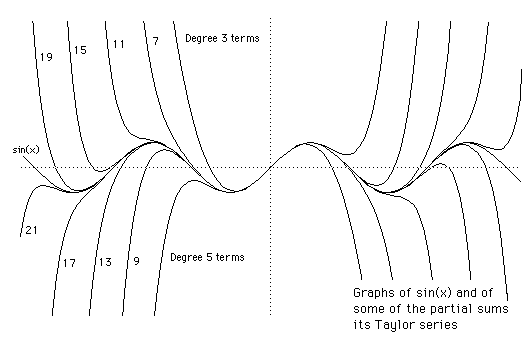
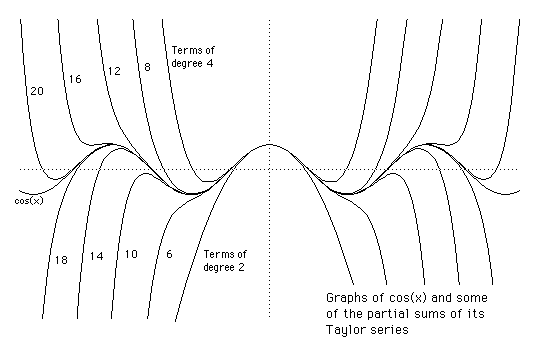
如上所述,麦克劳林最为人所知的是麦克劳林级数,它是布鲁克·泰勒级数的一个特例。他还因欧拉-麦克劳林求和公式以及麦克劳林-奥古斯丁·路易·柯西收敛积分判别法而被人铭记,该判别法由麦克劳林在奥古斯丁·路易·柯西出生前50年发现。麦克劳林是第一个发现曲线交点上的加布里尔·克拉默悖论的人。
他的一篇论文直到1996年Grabiner发表[11]时才得以出版。在这项工作中,麦克劳林考虑了一个几何问题:求由圆锥曲线生成的旋转体截锥的体积,与一个圆柱的体积之差,该圆柱的高与截锥相同,其直径等于截锥在其高度中点处的直径。
Colin Maclaurin was born in Kilmodan where his father, John Maclaurin, was the minister of the parish. The village (population 387 in 1904) is on the river Ruel and the church is at Glendaruel.
You can see more about Kilmodan Church at THIS LINK.
John Maclaurin was more of a scholar than one would expect of a parish minister, for he had translated the Psalms into Gaelic. He had three sons. John, the eldest, following in his father's steps, became a minister; he was a public spirited man of profound learning, and corresponded with Jonathan Edwards, the American metaphysician. The second son, Daniel, died young after having given signs of extraordinary genius. Colin was the youngest. His father died when Colin was six weeks old. Colin Maclaurin's mother inherited a small estate in Argyllshire and it was on the estate that Colin spent the early years of his life. His mother wanted a good education for Colin and his brother John, so the family moved to Dumbarton where the boys attended school.
In 1707, when Colin was nine years old, his mother died so the task of bringing up Colin and his brother John fell to their uncle Daniel Maclaurin who was the minister at Kilfinan on Loch Fyne.
You can see more about Kilfinan Church at THIS LINK.
Colin became a student at the University of Glasgow in 1709 at the age of eleven years. He was one of around 400 students. This may seem an unbelievable age for someone to begin their university education, but it was not so amazing at this time as it would be today. Basically Scottish schools and universities competed for the best pupils at that time, rather than a university education being seen as following a school education as is the norm today.
Certainly Maclaurin's abilities soon began to show at Glasgow University. His first encounter with advanced mathematics came one year after he entered university, when he found a copy of Euclid's Elements in one of his friend's rooms. This was the standard text for mathematical study at this time, but Maclaurin studied it on his own, quickly mastering the first six of the thirteen books of the Elements. At Glasgow Maclaurin came into contact with Robert Simson who was the Professor of Mathematics there. Simson was particularly interested in the geometry of ancient Greece and his enthusiasm for the topic was to influence the young student Maclaurin. Tweddle in [23] looks at the correspondence between Simson and Maclaurin on conic sections 25 years after Maclaurin's student days at Glasgow.
At the age of 14 Maclaurin was awarded the degree of M.A. after studying Latin, Greek, Logic, Moral Philosophy, Natural Philosophy and Mathematics. Although a master's degree in name, this was a first degree equivalent to a B.A. but the ancient Scottish universities (including St Andrews, my [EFR] own university) still retain the degree of M.A. as the first degree in Arts. However, Maclaurin had to defend a thesis in a public examination for the award of this degree (which is not the case today), and he chose On the power of gravity as his topic. The thesis, which developed Newton's theories, was written by a 14 year old boy at a time when such advanced ideas would only be familiar to a small number of the leading mathematicians.
After graduating with the degree of M.A., Maclaurin remained at the University of Glasgow for a further year to study divinity. It had been his intention to enter the Presbyterian Church but [7]:-
... becoming disgusted at the dissensions that had at that time crept into the church ...
he decided against that career.
After leaving Glasgow in 1714, Maclaurin returned to live with his uncle in the manse at Kilfinan. These were happy years for Maclaurin who studied hard and walked in the nearby hills and mountains for recreation. Unfinished scraps in his notebooks reveal the sensitivity of his nature as he would sometimes break out into poetic rhapsody on the beauties of the scene and the perfections of its Author. He clearly attained a very high standard in mathematics for, in August 1717, he was appointed professor of mathematics at Marischal College in the University of Aberdeen at the age of only 19. The appointment followed ten days of examinations to find the best candidate and it is clear that, despite there being another outstanding candidate, Maclaurin had the most knowledge of advanced topics.
You can see a report of the examinations at THIS LINK and you can see a picture of Marischal College at THIS LINK.
Maclaurin was to make two journeys to London, and the first of these he made in 1719. Maclaurin had already shown himself a very strong advocate of the mathematical and physical ideas of Newton, so it was natural that they should meet during Maclaurin's visit to London. It is surprising that some of Newton's biographers, for example A Rupert Hall in his 1992 biography, should declare that Maclaurin and Newton never met. Maclaurin writing of this visit to London in one of his letters (see for example letter 117 in [3]) states:-
I received the greatest civility from [members of the Royal Society] and particularly from the great Sir Isaac Newton with whom I was very often.
Maclaurin received more than civility from the Royal Society, for he was elected a Fellow of the Royal Society during this visit to London.
A rather strange event in Maclaurin's career took place during the time he held the chair of mathematics at Aberdeen. Lord Polwarth was a diplomatic agent of King George II. At this time it was customary for the sons of the top people to make a grand tour of Europe as part of finishing their education. Polwarth invited Maclaurin to accompany his son George Hume (or Home) (1704 - 1724) on such a grand tour and, it is not too surprising that Maclaurin accepted this chance to travel and meet with French mathematicians. What is surprising is that he does not appear to have sought the necessary permission of the university authorities in Aberdeen, although he does appear to have found someone to do his teaching. Turnbull writes however in [5]:-
... one wonders what was happening to his unshepherded classes in Marischal College. Had he forgotten all about them; did he turn a deaf ear to all calls to return; was there something in him, akin to the impenetrable aloofness of Newton, which shut him off from his fellows and his duties at times of mental creativity.
It was not a short tour, for Maclaurin spent two years travelling with Polwarth's son . It was an episode which was to end tragically, for while they were visiting Montpellier, Polwarth's son became ill and died. Maclaurin returned to Aberdeen to discover that the University was most certainly highly displeased that he had not been undertaking his duties for two years. It was certainly not the case that Maclaurin had been idle during his time away, for, while in France, he had been awarded a Grand Prize by the Académie des Sciences for his work on the impact of bodies.
Despite being reinstated to his chair by the University of Aberdeen, Maclaurin sought a position in the University of Edinburgh. James Gregory, not the famous mathematician of that name but rather the lesser known James Gregory (1666 - 1742) who was a brother of David Gregory, held the chair of mathematics at Edinburgh but had become too ill to carry out the work. The University of Edinburgh sought to appoint someone to a joint professorship with James Gregory and, on 21 August 1725, Newton wrote to Maclaurin offering his support in recommending him for appointment to the post (see [1], or [7] or letter 122 of [3]):-
I am very glad to hear that you have the prospect of being joined with Mr James Gregory in the Professorship of Mathematics at Edinburgh, not only because you are my friend, but principally because of your abilities, you being acquainted as well with the improvements of Mathematics as with the former state of those sciences. I heartily wish you good success, and shall be very glad to hear of your being elected.
In November 1725 Newton wrote to John Campbell, the lord provost of Edinburgh, supporting Maclaurin's appointment (see [1], or [7]):-
I am glad to understand that Mr Maclaurin is in good repute amongst you, for I think he deserves it very well: And to satisfy you that I do not flatter him, and also to encourage him to accept the place of assisting Mr Gregory, in order to succeed him, I am ready (if you will please give me leave) to contribute twenty pounds per annum towards a provision for him till Mr Gregory's place becomes void, if I live so long.
There is no evidence to suggest that Edinburgh took Newton up on his offer to contribute to Maclaurin's salary. Maclaurin began his appointment to the University of Edinburgh on 3 November 1725. He became a popular teacher with a class of over 100 students, though he did not receive a full salary until 1742, four years before his death. The Church of Scotland leader Alexander Carlyle (1722 - 1805) wrote in his autobiography:-
Maclaurin was at this time a favourite professor, and no wonder, as he was the clearest and most agreeable lecturer on that abstract science that ever I heard. He made mathematics a fashionable study ...
Maclaurin was to spend the rest of his career in Edinburgh. On 8th July 1733 he married Anne Stewart, who was the daughter of the Solicitor General for Scotland. They were to have seven children but, as was common at that time, not all reached adulthood. Of the seven children, two boys and three girls survived him. Not long after his marriage, Maclaurin worked to expand the Medical Society of Edinburgh into a wider society to include other branches of learning. Maclaurin himself acted as one of the two secretaries of this expanded Society and at the monthly meetings he often read a paper of his own or a letter from a foreign scientist on the latest developments in some topic of current interest. This Society would, after Maclaurin's death, become the Royal Society of Edinburgh.
Maclaurin did notable work in geometry, particularly studying higher plane curves. In fact his first important work was Geometria Organica; Sive Descriptio Linearum Curvarum Universalis Ⓣ published in 1720 while he was at the University of Aberdeen. In 1740 he was awarded a second prize from the Académie des Sciences in Paris, this time for a study of the tides De Causa Physica Fluxus et Reflexus Maris Ⓣ. He used Newton's theory of gravity to show that a smooth sphere covered by a sufficiently deep ocean under the tidal force of a single deforming body is a prolate spheroid with major axis directed toward the deforming body. This prize was jointly awarded to Maclaurin, Euler and Daniel Bernoulli, bracketing Maclaurin with the top two mathematicians of his day.
In 1742 Maclaurin published his 2 volume Treatise of fluxions, the first systematic exposition of Newton's methods written as a reply to Berkeley's attack on the calculus for its lack of rigorous foundations. Maclaurin wrote in the introduction (see for example [1]):-
[Berkeley] represented the method of fluxions as founded on false reasoning, and full of mysteries. His objections seemed to have been occasioned by the concise manner in which the elements of this method have been usually described, and their having been so much misunderstood by a person of his abilities appeared to me to be sufficient proof that a fuller account of the grounds of this was required.
You can see the Preface to Treatise of fluxions at THIS LINK.
The Treatise of fluxions is a major work of 763 pages, much praised by those who read it but usually described as having little influence. The article [10], however, argues convincingly that Maclaurin's influence on the Continentals has been underrated. Grabiner gives five areas of influence of Maclaurin's treatise: his treatment of the fundamental theorem of the calculus; his work on maxima and minima; the attraction of ellipsoids; elliptic integrals; and the Euler-Maclaurin summation formula.
Maclaurin appealed to the geometrical methods of the ancient Greeks and to Archimedes' method of exhaustion in attempting to put Newton's calculus on a rigorous footing. It is in the Treatise of fluxions that Maclaurin uses the special case of Taylor series now named after him and for which he is undoubtedly best remembered today. The Maclaurin series was not an idea discovered independently of the more general result of Taylor for Maclaurin acknowledges Taylor's contribution. Another important result given by Maclaurin, which has not been named after him or any other mathematician, is the important integral test for the convergence of an infinite series. The Treatise of fluxions is not simply a work designed to put the calculus on a rigorous basis, for Maclaurin gave many applications of calculus in the work. For example he investigates the mutual attraction of two ellipsoids of revolution as an application of the methods he gives.
Other topics which Maclaurin wrote on were the annular eclipse of the sun in 1737 and the structure of bees' honeycombs. He also contributed to actuarial studies as one of the founders of the topic and [5]:-
He laid sound actuarial foundations for the insurance society that has ever since helped the widows and children of Scottish ministers and professors.
Maclaurin wrote to the Reverend Robert Wallace, Moderator of the General Assembly of the Church of Scotland on May 23, 1743:-
As you was pleased to mention my opinion concerning the scheme for providing an annuity to ministers widows and a stock for their children, in the committee of the general Assembly, I therefore thought it my duty to go over those computations again with care and lay the result fully before you to prevent mistakes of any kind.
Maclaurin did become involved in controversy with other mathematicians over a number of results. Two are well documented, one being with William Braikenridge (see our biography of Braikenridge in this archive, and also [16]) on the argument over the result:-
... if the sides of a polygon pass through fixed points and all but one of the vertices lie on fixed lines, then the remaining vertices describe a conic section or a straight line.
In [17] the controversy between Maclaurin and George Campbell over complex roots is described. Again the argument, which Maclaurin calls "a disagreeable dispute", was about priority. See also [27].
We should not only comment on Maclaurin's mathematical research, however, but also on his qualities as a teacher. His teaching at the University of Edinburgh came in for considerable praise [7]:-
... such was his anxiety for the improvement of his scholars that if at any time they seemed not fully to comprehend his meaning, or if, upon examining them, he found they could not readily demonstrate the propositions from which he had provided, he was apt rather to suspect his own explanation to have been obscure, than their want of genius or attention, and therefore would resume the demonstration in some other method, to try if, by exposing it in a different light, he would give then a better view of it.
Maclaurin played an active role in the defence of Edinburgh during the Jacobite rebellion of 1745. As the Jacobite army marched towards Edinburgh in September 1745, Maclaurin worked endlessly in attempting to prepare the defences of the city. He described the events (see for example letter 100 of [3]):-
The care of the walls was recommended to me, in which I laboured night and day under infinite discouragements from superior powers. When I was promised hundreds of workers I could hardly get dozens. This was daily complained of, redress was promised but till the last two days no redress was made, and then it was too late.
The Jacobite army reached Edinburgh on 15 September 1745 and, after negotiations had failed, the gates of the city were opened. The castle held out. Maclaurin fled to England and while in Newcastle he received an invitation from the Archbishop of York to be his guest in York. There he:-
... lived for some time as happy as was possible for a man who had left his country in such a situation and his family in it behind him.
When the Jacobite army marched south from Edinburgh, Maclaurin returned to the city in November 1745. However, he was weakened by his exertions in preparing the defences of Edinburgh, by the difficult journeys to and from York, by the cold winter weather, and by a fall from his horse. On 26 December 1745 he wrote:-
I have not been [out] since December 3. My illness seemed dangerous, the physicians call it an obstruction in the reins [kidneys] from the severe cold in travelling November 14, 15 and 16. I had a swelling about my stomach.
He died the following year in Edinburgh and was buried in Greyfriars Church where his grave can still be seen at the south-west corner.
Many wrote of Maclaurin's outstanding kindness. He was described as [7]:-
... kindly and approachable ...
and it was said that the help he gave to his students:-
... was never wanting; nor was admittance refused to any except in his teaching hours.
His friendship was exceedingly highly valued:-
His acquaintance and friendship were ... centred by the ingenious of all ranks; who by their fondness for his company, took up a great deal of his time, and left him not master of it, even in his country retreat.
Maclaurin's Treatise on algebra was published in 1748, two years after his death. Another work Account of Sir Isaac Newton's discoveries was left incomplete on his death but was published in 1750.
As mentioned above, Maclaurin is best known for the Maclaurin Series, which is a special case of the Taylor series. He is also remembered for the Euler-Maclaurin Summation Formula and for the Maclaurin-Cauchy Integral Test for Convergence which Maclaurin discovered 50 years before Cauchy was born. Maclaurin was the first to discover Cramer's Paradox on the intersection of curves.
One of his papers remained unpublished until 1996 when Grabiner published [11]. In this work Maclaurin considers the geometric problem of finding the difference between the volume of the frustum of a solid of revolution which is generated by a conic section and the volume of the cylinder of the same height as the frustum having diameter equal to that of the frustum at the midpoint of its height.
正文里的方括号编号指向这里,悬停即可直接看到条目。书目保留原文——译了书名反而查不到文献。
原站列出的延伸阅读与外部数据库,照原样保留,目标多为英文页面。
关于科林·麦克劳林的其它页面:
原站的交叉引用。指向本站已镜像专题的留在站内,其余仍指回原站。