数学家传记
阿德里安-马里·勒让德在椭圆积分方面的主要工作为数学物理提供了基本的分析工具。他给出了π是无理数的简单证明,以及π²是无理数的第一个证明。
阿德里安-马里·勒让德或许会不喜欢这篇文章包含他生平的细节,因为西莫恩·德尼·泊松在12中这样写到:-
我们的同事常常表示,希望人们在谈到他时,只谈他的著作,因为事实上,这些著作就是他的全部生命。
鉴于勒让德的这些观点,关于他早年生活的细节很少,这并不令人意外。我们按照1和2中的记载,将他的出生地写为巴黎,但有一些证据表明他出生在图卢兹,全家在他很小的时候搬到了巴黎。他无疑出身于富裕家庭,并在巴黎的马扎林学院接受了数学和物理方面的顶级教育。
1770年,18岁的 勒让德 在马扎林学院进行了数学和物理的学位论文答辩,但这并不像今天听起来那么了不起,因为这更像是一个研究计划,而不是一篇完成的学位论文。在论文中,他列出了他将要研究的文献以及他打算证明的结果。由于无需为谋生而工作,勒让德 住在巴黎,专注于研究。
从1775年到1780年,他在皮埃尔·西蒙·拉普拉斯任教,任职于军事学院,他的任命是根据让·勒朗·达朗贝尔的建议作出的。随后他决定参加柏林科学院于1782年设立的关于抛射体的奖金竞赛。实际任务如下所述:-
确定炮弹和炸弹所描述的曲线,考虑空气阻力;给出获得对应于不同初速度和不同投射角的射程的规则。
他的论文Recherches sur la trajectoire des projectiles dans les milieux résistantsⓉ(关于抛射体在阻力介质中的轨迹的研究)赢得了奖金,并开启了勒让德的研究生涯。1782年,约瑟夫·拉格朗日是柏林科学院数学主任,这引起了勒让德对他的注意。他写信给皮埃尔·西蒙·拉普拉斯,询问更多关于这位获奖年轻数学家的信息。
勒让德接下来研究了椭球体的吸引力。他证明了科林·麦克劳林的一个结果,即位于两个共焦椭球体主轴上的外部点所受的吸引力与它们的质量成正比。随后,他引入了我们今天称之为勒让德函数的概念,并利用幂级数来确定椭球体在任何外部点的吸引力。勒让德于1783年1月将他的结果提交给巴黎的Académie des Sciences,这些结果在3月提交给Académie的报告中得到了皮埃尔·西蒙·拉普拉斯的高度赞扬。几天后,即3月30日,勒让德被任命为Académie des Sciences的助理,填补了当年早些时候皮埃尔·西蒙·拉普拉斯从助理晋升为副研究员后留下的空缺。
在接下来的几年里,勒让德在多个领域发表了著作。特别是,他发表了关于天体力学的论文,如1784年的Recherches sur la figure des planètes Ⓣ(关于行星形状的研究),其中包含勒让德多项式;数论,例如1785年的Recherches d'analyse indéterminée Ⓣ(关于不定分析的研究);以及椭圆函数理论,1786年发表了关于椭圆弧积分的论文。
1785年关于数论的论文包含了许多重要结果,例如二次互反律的剩余律,以及首项为互素、公差为primes的每个等差数列都包含无穷多个卡尔·弗里德里希·高斯的结果。当然,今天我们将二次互反律归功于等差数列,将关于等差数列中素数的定理归功于约翰·彼得·古斯塔夫·勒热纳·狄利克雷。这是公平的,因为勒让德对二次互反律的证明并不令人满意,而他对等差数列中素数的定理没有提供证明。然而,这两个结果非常重要,勒让德在这些方面的工作应受到赞誉,尽管他并不是第一个陈述二次互反律的人,因为它出现在莱昂哈德·欧拉1751年和1783年的工作中(见[15])。
勒让德在Académie des Sciences的职业生涯进展顺利。他于1785年成为副研究员,然后在1787年成为团队的一员,该团队的任务是与伦敦格林威治皇家天文台合作,进行涉及巴黎和格林威治天文台之间三角测量的地球测量。这项工作使他在1787年当选为伦敦皇家学会会士,并促成了一部重要出版物Mémoire sur les opérations trigonométriques dont les résultats dépendent de la figure de la terre,其中包含勒让德关于球面三角的定理。
1791年5月13日,勒让德成为Académie des Sciences委员会成员,任务是标准化度量衡。该委员会致力于公制系统,并进行了必要的天文观测和三角测量,以计算米的长度。此时,勒让德也在撰写他的主要著作Eléments de géométrie,这是由尼古拉·德·孔多塞鼓励他写的。然而,Académie des Sciences因1793年的革命而关闭,勒让德遇到了特殊困难,因为他失去了为他提供舒适收入的资本。他后来写信给卡尔·古斯塔夫·雅各布·雅可比,解释了他在此期间的个人情况(见[1]):-
在一场摧毁了我微薄财富的血腥革命之后,我结婚了;我们遇到了很大的问题和一些非常困难的时刻,但我的妻子坚定地帮助我一点一点地整理我的事务,并给了我必要的宁静,以便我进行惯常的工作和撰写新作品,这些作品稳步增加了我的声誉。
在勒让德曾任职的十进制系统委员会的工作之后,de Prony于1792年开始了一项重大任务,即制作对数和三角表,即地籍册。勒让德和de Prony与拉扎尔·卡诺和其他数学家一起领导了该项目的数学部分。他们有70到80名助手,这项工作持续了数年,于1801年完成。
1794年,勒让德出版了Eléments de géométrieⓉ(《几何原本》),该书在大约100年间一直是该主题的主要基础教材。这部著作在[2]中有描述:-
在其《原本》中,勒让德对欧几里得《原本》中的许多命题进行了大幅重新编排和简化,以编写出一部更有效的教科书。勒让德的著作取代了欧几里得的《原本》,成为欧洲大部分地区的教科书,并在随后的译本中成为美国和美国的教科书,并成为后来几何教科书的原型。在《原本》中,勒让德给出了π是无理数的简单证明,以及是无理数的第一个证明,并猜想π不是任何具有有理的系数的有限次代数方程的根。
1795年,Académie des Sciences重新开放为国家科学与艺术学院,从那时起直到1806年,它都在卢浮宫开会。学院的每个学部有六个席位,勒让德是数学部六个席位之一。1803年,拿破仑重组了学院,创建了几何学部,勒让德被安排到这个学部。
勒让德于1806年出版了一本关于确定彗星轨道的书。他在书中写道:-
我认为,在彗星问题中,更好的做法是从观测的直接数据出发,并尽一切可能简化用于确定轨道要素的公式和方程。
他的方法涉及在相等时间间隔进行的三次观测,他假设彗星沿抛物线路径运动,因此最终得到的方程数多于未知数。他将自己的方法应用于两颗彗星的已知数据。在附录中,勒让德给出了拟合现有数据曲线的最小二乘法。然而,卡尔·弗里德里希·高斯于1809年发表了他版本的最小二乘法,虽然承认它出现在勒让德的书中,卡尔·弗里德里希·高斯仍然声称自己拥有优先权。这极大地伤害了勒让德,他多年来一直为争取自己的优先权得到承认而斗争。
1808年,勒让德出版了他的Théorie des nombresⓉ(数论)第二版,该版对1798年的第一版做了相当大的改进。例如,卡尔·弗里德里希·高斯在1801年证明了二次互反律,此前他对勒让德1785年的证明和勒让德在1798年Théorie des nombresⓉ(数论)第一版中大为改进的证明提出了批评。卡尔·弗里德里希·高斯是正确的,但人们可以理解,勒让德发现这样一个年轻人攻击他结果的严密性,必定感到多么受伤。当然,卡尔·弗里德里希·高斯并未声明他是在改进勒让德的结果,而是声称这个结果属于他自己,因为他的证明是第一个完全严密的证明。勒让德后来写道(见[20]):-
这种过度的无礼令人难以置信,尤其在一个有足够个人功绩、无需窃取他人发现的人身上。
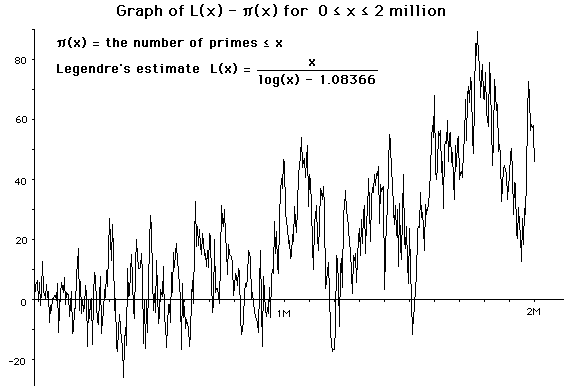
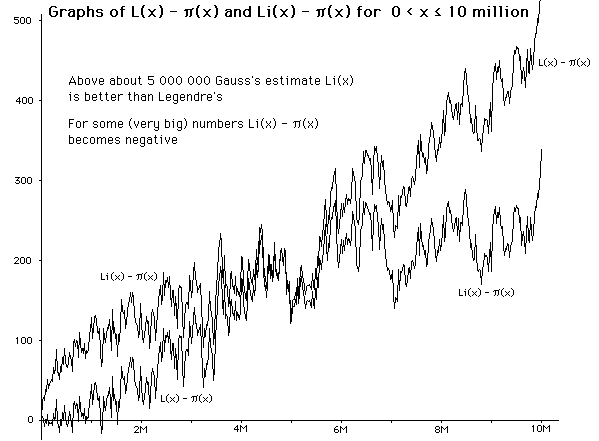
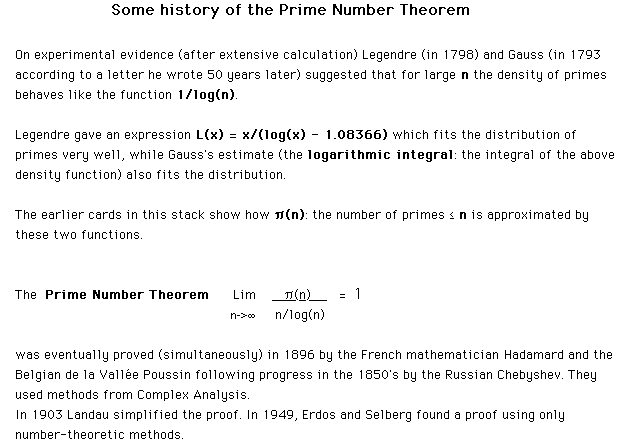
值得称赞的是,勒让德在1808年版的Théorie des nombresⓉ(数论)中使用了卡尔·弗里德里希·高斯对二次互反律的证明,并给予了卡尔·弗里德里希·高斯应有的认可。1808年版的Théorie des nombresⓉ(数论)还包含了勒让德对的估计,即不超过的素数个数为。同样,卡尔·弗里德里希·高斯会声称他在勒让德之前就得到了素数渐近分布的定律,但肯定是最先由勒让德将这些想法引起数学家们注意的。
关于勒让德对的估计的更多信息见THIS LINK。
你可以在THIS LINK看到勒让德估计误差的图表,并在THIS LINK看到勒让德的估计与高斯估计的比较。
勒让德关于椭圆函数的主要著作Exercices du Calcul IntégralⓉ(积分学练习)于1811年、1817年和1819年分三卷出版。在第一卷中,勒让德介绍了椭圆积分的基本性质,以及beta和伽马函数的基本性质。第二卷中出现了更多关于贝塔函数和伽马函数的结果,以及他的结果在力学、地球自转、椭球吸引和其他问题中的应用。第三卷主要致力于椭圆积分表。
1824年11月,他决定重印一个新版本,但到1825年9月他对这项工作并不满意,于是开始出版他的新著作Traité des Fonctions ElliptiquesⓉ(椭圆函数论),同样分三卷,分别于1825年、1826年和1830年出版。这部新著作涵盖了与原著相似的材料,但材料被完全重新组织。然而,尽管勒让德在椭圆函数上花费了40年,他从未获得卡尔·古斯塔夫·雅各布·雅可比和尼尔斯·阿贝尔的洞察力,而这两位数学家的独立工作几乎使勒让德的新三卷著作一出版就过时了。
勒让德证明平行公设的尝试持续了30多年。然而,正如[1]中所述,他的尝试:-
……全都失败了,因为归根结底,他总是依赖于从欧几里得观点来看是“显然”的命题。
1832年(鲍耶发表其关于non-euclidean geometry的著作的那一年),勒让德在写作中确认了他对欧几里得空间的绝对信念:-
尽管如此,可以肯定的是,三角形三个角之和的定理应被视为那些无法争辩的基本真理之一,并且是数学确定性的持久范例。
1824年,勒让德拒绝投票支持政府提名的国家研究院候选人。尼尔斯·阿贝尔在1826年10月写道:-
勒让德是一位极其和蔼可亲的人,但不幸的是,他像石头一样古老。
由于勒让德在1824年拒绝投票支持政府候选人,他的养老金被停止,他在贫困中去世。
Adrien-Marie Legendre would perhaps have disliked the fact that this article contains details of his life for Poisson wrote of him in [12]:-
Our colleague has often expressed the desire that, in speaking of him, it would only be the matter of his works, which are, in fact, his entire life.
It is not surprising that, given these views of Legendre, there are few details of his early life. We have given his place of birth as Paris, as given in [1] and [2], but there is some evidence to suggest that he was born in Toulouse and the family moved to Paris when he was very young. He certainly came from a wealthy family and he was given a top quality education in mathematics and physics at the Collège Mazarin in Paris.
In 1770, at the age of 18, Legendre defended his thesis in mathematics and physics at the Collège Mazarin but this was not quite as grand an achievement as it sounds to us today, for this consisted more of a plan of research rather than a completed thesis. In the thesis he listed the literature that he would study and the results that he would be aiming to prove. With no need for employment to support himself, Legendre lived in Paris and concentrated on research.
From 1775 to 1780 he taught with Laplace at École Militaire where his appointment was made on the advice of d'Alembert. He then decided to enter for the 1782 prize on projectiles offered by the Berlin Academy. The actual task was stated as follows:-
Determine the curve described by cannonballs and bombs, taking into consideration the resistance of the air; give rules for obtaining the ranges corresponding to different initial velocities and to different angles of projection.
His essay Recherches sur la trajectoire des projectiles dans les milieux résistants Ⓣ won the prize and launched Legendre on his research career. In 1782 Lagrange was Director of Mathematics at the Academy in Berlin and this brought Legendre to his attention. He wrote to Laplace asking for more information about the prize winning young mathematician.
Legendre next studied the attraction of ellipsoids. He gave a proof of a result due to Maclaurin, that the attractions at an external point lying on the principal axis of two confocal ellipsoids was proportional to their masses. He then introduced what we call today the Legendre functions and used these to determine, using power series, the attraction of an ellipsoid at any exterior point. Legendre submitted his results to the Académie des Sciences in Paris in January 1783 and these were highly praised by Laplace in his report delivered to the Académie in March. Within a few days, on 30 March, Legendre was appointed an adjoint in the Académie des Sciences filling the place which had become vacant when Laplace was promoted from adjoint to associé earlier that year.
Over the next few years Legendre published work in a number of areas. In particular he published on celestial mechanics with papers such as Recherches sur la figure des planètes Ⓣ in 1784 which contains the Legendre polynomials; number theory with, for example, Recherches d'analyse indéterminée Ⓣ in 1785; and the theory of elliptic functions with papers on integrations by elliptic arcs in 1786.
The 1785 paper on number theory contains a number of important results such as the law of quadratic reciprocity for residues and the results that every arithmetic series with the first term coprime to the common difference contains an infinite number of primes. Of course today we attribute the law of quadratic reciprocity to Gauss and the theorem concerning primes in an arithmetic progression to Dirichlet. This is fair since Legendre's proof of quadratic reciprocity was unsatisfactory, while he offered no proof of the theorem on primes in an arithmetic progression. However, these two results are of great importance and credit should go to Legendre for his work on them, although he was not the first to state the law of quadratic reciprocity since it occurs in Euler's work of 1751 and also of 1783 (see [15]).
Legendre's career in the Académie des Sciences progressed in a satisfactory manner. He became an associé in 1785 and then in 1787 he was a member of the team whose task it was to work with the Royal Observatory at Greenwich in London on measurements of the Earth involving a triangulation survey between the Paris and Greenwich observatories. This work resulted in his election to the Royal Society of London in 1787 and also to an important publication Mémoire sur les opérations trigonométriques dont les résultats dépendent de la figure de la terre which contains Legendre's theorem on spherical triangles.
On 13 May 1791 Legendre became a member of the committee of the Académie des Sciences with the task to standardise weights and measures. The committee worked on the metric system and undertook the necessary astronomical observations and triangulations necessary to compute the length of the metre. At this time Legendre was also working on his major text Eléments de géométrie which he had been encouraged to write by Condorcet. However the Académie des Sciences was closed due to the Revolution in 1793 and Legendre had special difficulties since he lost the capital which provided him with a comfortable income. He later wrote to Jacobi explaining his personal circumstances around this time (see [1]):-
I married following a bloody revolution that had destroyed my small fortune; we had great problems and some very difficult moments, but my wife staunchly helped me to put my affairs in order little by little and gave me the tranquillity necessary for my customary work and for writing new works which have steadily increased my reputation.
Following the work of the committee on the decimal system on which Legendre had served, de Prony in 1792 began a major task of producing logarithmic and trigonometric tables, the Cadastre. Legendre and de Prony headed the mathematical section of this project along with Carnot and other mathematicians. They had between 70 to 80 assistants and the work was undertaken over a period of years, being completed in 1801.
In 1794 Legendre published Eléments de géométrie Ⓣ which was the leading elementary text on the topic for around 100 years. The work is described in [2]:-
In his "Eléments" Legendre greatly rearranged and simplified many of the propositions from Euclid's "Elements" to create a more effective textbook. Legendre's work replaced Euclid's "Elements" as a textbook in most of Europe and, in succeeding translations, in the United States and became the prototype of later geometry texts. In "Eléments" Legendre gave a simple proof that π is irrational, as well as the first proof that is irrational, and conjectured that π is not the root of any algebraic equation of finite degree with rational coefficients.
In 1795 the Académie des Sciences was reopened as the Institut National des Sciences et des Arts and from then until 1806 it met in the Louvre. Each section of the Institut contained six places, and Legendre was one of the six in the mathematics section. In 1803 Napoleon reorganised the Institut and a geometry section was created and Legendre was put into this section.
Legendre published a book on determining the orbits of comets in 1806. In this he wrote:-
I have thought that what there was better to do in the problem of comets was to start out from the immediate data of observation, and to use all means to simplify as much as possible the formulas and the equations which serve to determine the elements of the orbit.
His method involved three observations taken at equal intervals and he assumed that the comet followed a parabolic path so that he ended up with more equations than there were unknowns. He applied his methods to the data known for two comets. In an appendix Legendre gave the least squares method of fitting a curve to the data available. However, Gauss published his version of the least squares method in 1809 and, while acknowledging that it appeared in Legendre's book, Gauss still claimed priority for himself. This greatly hurt Legendre who fought for many years to have his priority recognised.
In 1808 Legendre published a second edition of his Théorie des nombres Ⓣ which was a considerable improvement on the first edition of 1798. For example Gauss had proved the law of quadratic reciprocity in 1801 after making critical remarks about Legendre's proof of 1785 and Legendre's much improved proof of 1798 in the first edition of Théorie des nombres Ⓣ. Gauss was correct, but one could understand how hurtful Legendre must have found an attack on the rigour of his results by such a young man. Of course Gauss did not state that he was improving Legendre's result but rather claimed the result for himself since his was the first completely rigorous proof. Legendre later wrote (see [20]):-
This excessive impudence is unbelievable in a man who has sufficient personal merit not to have need of appropriating the discoveries of others.
To his credit Legendre used Gauss's proof of quadratic reciprocity in the 1808 edition of Théorie des nombres Ⓣ giving proper credit to Gauss. The 1808 edition of Théorie des nombres Ⓣ also contained Legendre's estimate for the number of primes ≤ of . Again Gauss would claim that he had obtained the law for the asymptotic distribution of primes before Legendre, but certainly it was Legendre who first brought these ideas to the attention of mathematicians.
More information about Legendre's estimate for is at THIS LINK.
You can see a graph of the eror in Legendre's estimate at THIS LINK and a comparison of Legendre's estimate to that of Gauss at THIS LINK.
Legendre's major work on elliptic functions in Exercices du Calcul Intégral Ⓣ appeared in three volumes in 1811, 1817, and 1819. In the first volume Legendre introduced basic properties of elliptic integrals and also of beta and gamma functions. More results on beta and gamma functions appeared in the second volume together with applications of his results to mechanics, the rotation of the Earth, the attraction of ellipsoids and other problems. The third volume was largely devoted to tables of elliptic integrals.
In November 1824 he decided to reprint a new edition but he was not happy with this work by September 1825 publication began of his new work Traité des Fonctions Elliptiques Ⓣ again in three volumes of 1825, 1826, and 1830. This new work covered similar material to the original but the material was completely reorganised. However, despite spending 40 years working on elliptic functions, Legendre never gained the insight of Jacobi and Abel and the independent work of these two mathematicians was making Legendre's new three volume work obsolete almost as soon as it was published.
Legendre's attempt to prove the parallel postulate extended over 30 years. However as stated in [1] his attempts:-
... all failed because he always relied, in the last analysis, on propositions that were "evident" from the Euclidean point of view.
In 1832 (the year Bolyai published his work on non-euclidean geometry) Legendre confirmed his absolute belief in Euclidean space when he wrote:-
It is nevertheless certain that the theorem on the sum of the three angles of the triangle should be considered one of those fundamental truths that are impossible to contest and that are an enduring example of mathematical certitude.
In 1824 Legendre refused to vote for the government's candidate for the Institut National. Abel wrote in October 1826:-
Legendre is an extremely amiable man, but unfortunately as old as the stones.
As a result of Legendre's refusal to vote for the government's candidate in 1824 his pension was stopped and he died in poverty.
正文里的方括号编号指向这里,悬停即可直接看到条目。书目保留原文——译了书名反而查不到文献。
原站列出的延伸阅读与外部数据库,照原样保留,目标多为英文页面。
关于阿德里安-马里·勒让德的其它页面:
原站的交叉引用。指向本站已镜像专题的留在站内,其余仍指回原站。