数学家传记
约翰·伯努利是一位瑞士数学家,他研究了光的反射和折射、曲线族的正交轨线、用级数求面积的求积以及最速降线。
约翰·伯努利是尼古劳斯和Margaretha Bernoulli的第十个孩子。他是雅各布·伯努利的兄弟,但约翰·伯努利比他的哥哥雅各布小十二岁,这意味着当约翰·伯努利还是个孩子时,雅各布已经是个年轻人了。
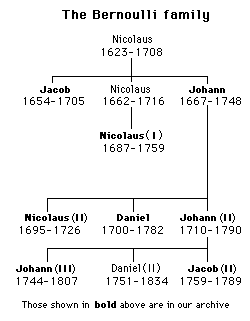
你可以在THIS LINK看到约翰·伯努利的家谱。
这两兄弟对彼此的数学发展产生了重要影响,尤其真实的是,在早年,约翰·伯努利必定深受影响,因为他看到雅各布不顾父母的反对,朝着数学事业迈进。至于他童年的教育,约翰·伯努利在自传中写道,他的父母:-
在道德和宗教两方面都不遗余力、不惜花费地给我以适当的教育。
这种宗教就是加尔文宗信仰,它曾迫使他的祖父母为躲避宗教迫害而从安特卫普逃出。
尼古劳斯和Margaretha Bernoulli试图让约翰·伯努利走上经商之路,但尽管父亲大力推动,约翰·伯努利似乎完全不适合将来经商。约翰·伯努利的父亲本打算让他接管家族的香料生意,1682年,当他15岁时,约翰·伯努利在香料贸易中工作了一年,但他不喜欢这份工作,做得也不好。约翰·伯努利的父亲在1683年非常不情愿地同意约翰·伯努利进入巴塞尔大学。约翰·伯努利要在大学学习的科目是医学,尽管约翰·伯努利家族许多成员喜欢数学和数学物理,最终却都学了这门学科。
在巴塞尔大学,约翰·伯努利修读医学课程,但他跟哥哥雅各布学习数学。当约翰·伯努利进入巴塞尔大学时,雅各布正在那里讲授实验物理,很快就清楚的是,约翰·伯努利的大部分时间都用来跟哥哥雅各布学习哥特弗里德·威廉·莱布尼茨关于微积分的论文。在一起学习两年后,约翰·伯努利在数学技能上已与哥哥不相上下。
约翰·伯努利的第一篇出版物是1690年关于发酵过程的,当然不是一个数学主题,但1691年约翰·伯努利去了日内瓦,在那里讲授微分。从日内瓦,约翰·伯努利前往巴黎,在那里他遇到了尼古拉斯‧马勒伯朗士圈子里的数学家,当时法国数学的中心就在那里。在那里约翰·伯努利遇到了洛必达,他们进行了深入的数学交谈。与如今通常所说的相反,洛必达是一位优秀的数学家,也许是当时巴黎最好的数学家,尽管他还不能完全与约翰·伯努利相提并论。
洛必达 欣喜地发现 约翰·伯努利 理解了 哥特弗里德·威廉·莱布尼茨 刚刚发表的新微积分方法,便请 约翰·伯努利 教他这些方法。这位 约翰·伯努利 同意了,课程既在巴黎教授,也在 洛必达 位于乌克的乡间别墅进行。约翰·伯努利 因这些课程从 洛必达 那里获得了丰厚的报酬,这些课程确实价值不菲,因为几乎没有其他人能够讲授它们。约翰·伯努利 回到巴塞尔后,仍通过通信继续他的微积分课程,这对 洛必达 来说并不便宜,他为这些指导付给 约翰·伯努利 半个教授的薪水。然而,这确实保证了 洛必达 在数学史上的地位,因为他出版了第一本微积分著作 Analyse des infiniment petits pour l'intelligence des lignes courbes Ⓣ(《用于理解曲线的无穷小分析》)(1696),该书基于 约翰·伯努利 寄给他的课程内容。
正如人们所料,这部著作没有承认它是以他的讲义为基础,这使约翰·伯努利大为不快。该书的序言只包含这样的说明:——
然后我要感谢约翰·伯努利先生们的许多高明想法;尤其是小约翰·伯努利先生,他现在是格罗宁根的教授。
著名的洛必达法则载于这部微积分书中,因此它是约翰·伯努利的一项成果。事实上,直到1922年,当约翰·伯努利的侄子尼古拉·伯努利一世所抄录的约翰·伯努利课程的一份抄本在巴塞尔被发现时,才获得这部著作出自约翰·伯努利的证据。约翰·伯努利的课程与洛必达的书几乎完全相同,但值得指出的是,洛必达改正了许多错误,例如约翰·伯努利误以为的积分是有限的。1704年洛必达去世后,约翰·伯努利强烈抗议说,他才是洛必达的微积分书的作者。看来洛必达付给约翰·伯努利的丰厚报酬附有条件,使他不能早些说出真相。然而,在1922年发现的证据出现之前,很少有人相信约翰·伯努利。
让我们回到对约翰·伯努利在巴黎时期的叙述。1692年,在巴黎期间,他遇到了皮埃尔·伐里农,这促成了深厚的友谊,并且皮埃尔·伐里农在他们多年通信中从约翰·伯努利那里学到了许多关于微积分应用的知识。约翰·伯努利还开始与哥特弗里德·威廉·莱布尼茨通信,这被证明非常富有成果。事实上,这成为哥特弗里德·威廉·莱布尼茨所进行的最重要的通信。对约翰·伯努利来说,这是一个数学成就相当丰硕的时期。尽管他正在撰写医学博士学位论文,但他正在产出大量数学主题的论文并发表,还有包含在他通信中的重要成果。
约翰·伯努利 已经解决了他兄弟在 1691 年提出的 悬链线 问题。他在其兄弟提出该问题的同一年就解决了它,这是他不依赖兄弟独立产生的第一个重要数学成果,尽管它使用了雅各布在提出问题时给出的想法。在这个阶段,约翰·伯努利 和雅各布在一种相当友好的竞争中相互学习了很多,几年后这种竞争会演变成公开的敌意。例如,他们在 1692-93 年间合作研究焦散曲线,尽管他们没有联合发表这项工作。即使在这个阶段,竞争也过于激烈,不允许联合发表,而且尽管他们在相似的主题上工作,他们在任何时候都不会联合发表作品。
我们在上面提到,约翰·伯努利 的学位论文是关于医学主题的,但实际上它是关于数学在医学中的应用,具体是关于肌肉运动,并于 1694 年提交。然而,约翰·伯努利 并不希望从事医学职业,但由于雅各布占据了这一职位,他在巴塞尔获得数学讲席的前景渺茫。
一连串的数学思想继续从 约翰·伯努利 那里流出。1694 年,他考虑了函数 ,还利用分部积分法研究了级数。对 约翰·伯努利 来说,积分仅仅被视为微分的逆运算,通过这种方法,他在积分 微分方程 方面取得了巨大成功。他求和级数,并利用三角函数和双曲函数所满足的微分方程发现了它们的加法定理。这一对数学的杰出贡献在 1695 年得到了回报,当时他收到了两个讲席邀请。他被邀请担任哈勒的讲席和格罗宁根的数学讲席。后一个讲席是在 克里斯蒂安·惠更斯 的建议下提供给 约翰·伯努利 的,约翰·伯努利 非常高兴地接受了这个职位,尤其是因为他现在与他的兄弟雅各布地位平等,而雅各布正迅速变得极其嫉妒 约翰·伯努利 的进步。然而,过错并不全在雅各布一方,约翰·伯努利 对关系的恶化同样负有责任。有趣的是,约翰·伯努利 被任命为数学讲席,但他的任命信提到了他的医学技能,并为他提供了在格罗宁根期间行医的机会。
约翰·伯努利 娶了德罗西娅·法尔克纳,当全家于 1695 年 9 月 1 日启程前往荷兰时,他们的第一个孩子已经七个月大了。这第一个孩子是 尼古拉·伯努利二世,他也成为了一名数学家。也许这是一个好时机来指出,约翰·伯努利 的另外两个孩子后来也成为了数学家,丹尼尔·伯努利,他在全家在格罗宁根期间出生,以及 约翰·伯努利二世。
约翰·伯努利 的妻子和岳父都对搬到格罗宁根感到不满,尤其是因为带着年幼的婴儿,旅途如此艰难。9 月 1 日出发后,他们不得不穿过军队交战的地区,然后乘船沿莱茵河而下,最后乘马车和另一艘船到达目的地。他们于 10 月 22 日抵达,开始了在格罗宁根的十年,这十年充满了困难。约翰·伯努利 卷入了一些宗教争端,他的第二个孩子是一个女儿,生于 1697 年,只活了六周,而他病得非常严重,以至于有报道说他死了。
在一次争论中,他被指控否认肉身的复活,这一指控基于他所持的医学观点。在1702年的第二次争论中,约翰·伯努利被格罗宁根大学的一名学生Petrus Venhuysen指控,此人出版了一本小册子,基本上是指控约翰·伯努利追随勒内·笛卡儿的哲学。这本小册子还指控他反对加尔文宗信仰,剥夺信徒在基督受难中的安慰。约翰·伯努利给大学校监们写了一封长达十二页的答复,此信至今尚存[16]:——
……如果⟦N1⟧不是最差的学生之一,一个十足的无知者,不被任何有学问的人所知、所敬、所信,我本不会如此介意,而他当然没有资格去玷污一个诚实人的名声,更不用说一位闻名于整个学术界的教授了……
……我一生都公开信奉我改革宗基督教的信仰,我现在仍然如此……他却想让我被当作一个非正统的信徒,一个十足的异端;的确,他极其邪恶地试图使我成为世人所憎恶的对象,并使我遭受当权者和普通民众的报复……
这并不是约翰·伯努利在格罗宁根期间唯一的争论。他在教学中引入了物理实验,但⟦N2⟧在16中写道,这些实验:-
……对笛卡尔派科学家和加尔文主义者来说都令人反感。笛卡尔派自然强调“理性”,并认为……感官知觉的世界次要;加尔文主义者则试图通过一丝不苟地分析自然现象来揣摩上帝的根本计划。仅对这些自然现象的解释就会与两者都不相容。
在格罗宁根担任讲席期间,约翰·伯努利与他的兄弟展开竞争,这场竞争逐渐变成一场有趣的数学较量,但不幸也是一场苦涩的个人争斗。约翰·伯努利于1696年6月提出了最速降线问题,并挑战他人来解答。哥特弗里德·威廉·莱布尼茨说服他给出更长的期限,以便外国数学家也有机会解答该问题。共获得了五个解答,除约翰·伯努利外,雅各布·伯努利和哥特弗里德·威廉·莱布尼茨也都解答了该问题。摆线的解答并未被伽利略找到,他此前给出了一个错误的解答。雅各布不甘被兄弟胜过,于是提出了isoperimetric problem,即最小化曲线所围面积的问题。
约翰·伯努利对这个问题的解答不如雅各布的令人满意,但当约翰·伯努利在1718年读了布鲁克·泰勒的一部著作后重新回到这个问题时,他给出了一个优雅的解答,这将成为变分法的基础。
1705年,格罗宁根的约翰·伯努利一家收到一封信,说约翰·伯努利的岳父正思念他的女儿和外孙们,且已时日无多。他们决定返回巴塞尔,同行的还有尼古拉·伯努利一世,即他的侄子,他一直在格罗宁根随叔父学习数学。他们在雅各布去世两天后离开格罗宁根,但当然,他们当时并不知道他已死于肺结核,他们是在旅途中才得知他的死讯。因此,约翰·伯努利返回巴塞尔时并非期望获得数学讲席,而是回来填补希腊语讲席。当然,他兄弟的去世将导致计划的改变。
然而,在到达巴塞尔之前,约翰·伯努利受到乌得勒支大学一个讲席邀请的诱惑。乌得勒支大学的负责人如此渴望约翰·伯努利来那里,以至于在约翰·伯努利一家于法兰克福赶上他们后,他便出发追赶。他试图说服约翰·伯努利去乌得勒支,但约翰·伯努利决心返回巴塞尔。
回到巴塞尔后,约翰·伯努利努力确保自己继承他兄弟的讲席,很快他就被任命到雅各布的数学讲席。值得一提的是,约翰·伯努利的岳父又活了三年,在此期间他非常高兴女儿和外孙们回到巴塞尔。约翰·伯努利还拒绝了其他邀请,如莱顿、乌得勒支的第二次邀请,以及1717年邀请他返回格罗宁根的优厚条件。
1713年,约翰·伯努利卷入了艾萨克·牛顿-哥特弗里德·威廉·莱布尼茨之争。他强烈支持哥特弗里德·威廉·莱布尼茨,并通过展示他的微积分在解决某些艾萨克·牛顿未能用其方法解决的问题上的威力,为论战增添了分量。尽管约翰·伯努利在支持哥特弗里德·威廉·莱布尼茨更优越的微积分方法方面基本上是正确的,但他也支持勒内·笛卡儿的涡旋理论而非艾萨克·牛顿的引力理论,而在这里他肯定是不正确的。他的支持实际上推迟了艾萨克·牛顿的物理学在欧洲大陆被接受。
约翰·伯努利 在力学方面也做出了重要贡献,他在动能方面的工作,毫不奇怪,是数学家们争论多年的另一个话题。他的著作 Hydraulica Ⓣ(水力学)是他嫉妒本性的另一个标志。这部著作标注的日期是1732年,但这是不正确的,是 约翰·伯努利 试图获得优先于他自己儿子丹尼尔的优先权。丹尼尔·伯努利 于1734年完成了他最重要的著作 Hydrodynamica Ⓣ(流体动力学),并于1738年出版,大约与 约翰·伯努利 出版 Hydraulica 同时。这不是一个孤立的事件,正如他曾与自己的兄弟竞争一样,他现在又与自己的儿子竞争。正如对历史记录的研究证明了 约翰·伯努利 声称是 洛必达 的微积分教科书的作者是合理的,它也表明他声称在儿子写出 Hydrodynamica 之前已经出版了 Hydraulica 是虚假的。
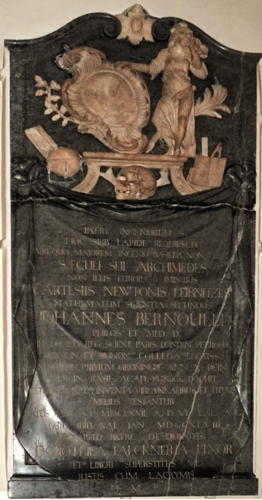
约翰·伯努利生前就享有盛名。他当选为巴黎、柏林、伦敦、圣彼得堡和博洛尼亚科学院的会士。他被称为“他那个时代的阿基米德”,这确实铭刻在他的墓碑上。
参见THIS LINK。
Johann Bernoulli was the tenth child of Nicolaus and Margaretha Bernoulli. He was the brother of Jacob Bernoulli but Johann was twelve years younger than his brother Jacob which meant that Jacob was already a young man while Johann was still a child.
You can see the Bernoulli family tree at THIS LINK.
The two brothers were to have an important influence on each others mathematical development and it was particularly true that in his early years Johann must have been greatly influenced by seeing Jacob head towards a mathematical career despite the objections of his parents. As to his education as a child, Johann wrote in his autobiography that his parents:-
... spared no trouble or expense to give me a proper education in both morals and religion.
This religion was the Calvinist faith which had forced his grandparents to flee from Antwerp to avoid religious persecution.
Nicolaus and Margaretha Bernoulli tried to set Johann on the road to a business career but, despite his father's strong pushing, Johann seemed to be totally unsuited to a future in business. Johann's father had intended him to take over the family spice business and in 1682, when he was 15 years old, Johann worked in the spice trade for a year but, not liking the work, he did not do well. It was with great reluctance that Johann's father agreed in 1683 to Johann entering the University of Basel. The subject that Johann Bernoulli was to study at university was medicine, a topic that many members of the Bernoulli family ended up studying despite their liking for mathematics and mathematical physics.
At Basel University Johann took courses in medicine but he studied mathematics with his brother Jacob. Jacob was lecturing on experimental physics at the University of Basel when Johann entered the university and it soon became clear that Johann's time was mostly devoted to studying Leibniz's papers on the calculus with his brother Jacob. After two years of studying together Johann became the equal of his brother in mathematical skill.
Johann's first publication was on the process of fermentation in 1690, certainly not a mathematical topic but in 1691 Johann went to Geneva where he lectured on the differential calculus. From Geneva, Johann made his way to Paris and there he met mathematicians in Malebranche's circle, where the focus of French mathematics was at that time. There Johann met de l'Hôpital and they engaged in deep mathematical conversations. Contrary to what is commonly said these days, de l'Hôpital was a fine mathematician, perhaps the best mathematician in Paris at that time, although he was not quite in the same class as Johann Bernoulli.
De l'Hôpital was delighted to discover that Johann Bernoulli understood the new calculus methods that Leibniz had just published and he asked Johann to teach him these methods. This Johann agreed to do and the lessons were taught both in Paris and also at de l'Hôpital's country house at Oucques. Bernoulli received generous payment from de l'Hôpital for these lessons, and indeed they were worth a lot for few other people would have been able to have given them. After Bernoulli returned to Basel he still continued his calculus lessons by correspondence, and this did not come cheap for de l'Hôpital who paid Bernoulli half a professor's salary for the instruction. However it did assure de l'Hôpital of a place in the history of mathematics since he published the first calculus book Analyse des infiniment petits pour l'intelligence des lignes courbes Ⓣ (1696) which was based on the lessons that Johann Bernoulli sent to him.
As one would expect, it upset Johann Bernoulli greatly that this work did not acknowledge the fact that it was based on his lectures. The preface of the book contains only the statement:-
And then I am obliged to the gentlemen Bernoulli for their many bright ideas; particularly to the younger Mr Bernoulli who is now a professor in Groningen.
The well known de l'Hôpital's rule is contained in this calculus book and it is therefore a result of Johann Bernoulli. In fact proof that the work was due to Bernoulli was not obtained until 1922 when a copy of Johann Bernoulli's course made by his nephew Nicolaus(I) Bernoulli was found in Basel. Bernoulli's course is virtually identical with de l'Hôpital's book but it is worth pointing out that de l'Hôpital had corrected a number of errors such as Bernoulli's mistaken belief that the integral of is finite. After de l'Hôpital's death in 1704 Bernoulli protested strongly that he was the author of de l'Hôpital's calculus book. It appears that the handsome payment de l'Hôpital made to Bernoulli carried with it conditions which prevented him speaking out earlier. However, few believed Johann Bernoulli until the proofs discovered in 1922.
Let us return to an account of Bernoulli's time in Paris. In 1692, while in Paris, he met Varignon and this resulted in a strong friendship and also Varignon learned much about applications of the calculus from Johann Bernoulli over the many years which they corresponded. Johann Bernoulli also began a correspondence with Leibniz which was to prove very fruitful. In fact this turned out to be the most major correspondence which Leibniz carried out. This was a period of considerable mathematical achievement for Johann Bernoulli. Although he was working on his doctoral dissertation in medicine he was producing numerous papers on mathematical topics which he was publishing and also important results which were contained in his correspondence.
Johann Bernoulli had already solved the problem of the catenary which had been posed by his brother in 1691. He had solved this in the same year that his brother posed the problem and it was his first important mathematical result produced independently of his brother, although it used ideas that Jacob had given when he posed the problem. At this stage Johann and Jacob were learning much from each other in a reasonably friendly rivalry which, a few years later, would descend into open hostility. For example they worked together on caustic curves during 1692-93 although they did not publish the work jointly. Even at this stage the rivalry was too severe to allow joint publications and they would never publish joint work at any time despite working on similar topics.
We mentioned above that Johann's doctoral dissertation was on a topic in medicine, but it was really on an application of mathematics to medicine, being on muscular movement, and it was submitted in 1694. Johann did not wish to follow a career in medicine however, but there were little prospects of a chair at Basel in mathematics since Jacob filled this post.
A stream of mathematical ideas continued to flow from Johann Bernoulli. In 1694 he considered the function and he also investigated series using the method of integration by parts. Integration to Bernoulli was simply viewed as the inverse operation to differentiation and with this approach he had great success in integrating differential equations. He summed series, and discovered addition theorems for trigonometric and hyperbolic functions using the differential equations they satisfy. This outstanding contribution to mathematics reaped its reward in 1695 when he received two offers of chairs. He was offered a chair at Halle and the chair of mathematics at Groningen. This latter chair was offered to Johann Bernoulli on the advice of Huygens and it was this post which Johann accepted with great pleasure, not least because he now had equal status to his brother Jacob who was rapidly becoming extremely jealous of Johann's progress. The fault was not all on Jacob's side however, and Johann was equally to blame for the deteriorating relations. It is interesting to note that Johann was appointed to the chair of mathematics but his letter of appointment mentions his medical skills and offered him the chance to practise medicine while in Groningen.
Johann Bernoulli had married Drothea Falkner and their first child was seven months old when the family departed for Holland on 1 September 1695. This first child was Nicolaus(II) Bernoulli who also went on to become a mathematician. Perhaps this is a good time to note that two other of Johann's children went on to become mathematicians, Daniel Bernoulli, who was born while the family was in Groningen, and Johann(II) Bernoulli.
Neither Bernoulli's wife nor his father-in-law had been happy about the move to Groningen especially since the journey was such a difficult one with a young baby. After setting out on 1 September they had to cross a region where armies were fighting, then travel down the Rhine by boat, finally taking a carriage and another boat to their destination. They arrived on 22 October to begin ten years in Groningen which were to be filled with difficulties. Johann was involved in a number of religious disputes, his second child was a daughter who was born in 1697 and only lived for six weeks, and he suffered so severe an illness that he was reported to have died.
In one dispute he was accused of denying the resurrection of the body, a charge based on medical opinions he held. In a second dispute in 1702 Bernoulli was accused by a student at the University of Groningen, Petrus Venhuysen, who published a pamphlet which basically accused Bernoulli of following Descartes' philosophy. The pamphlet also accused him of opposing the Calvinist faith and depriving believers of their comfort in Christ's passion. Bernoulli wrote a long twelve page reply to the Governors of the University, which still exists [16]:-
... I would not have minded so much if [Venhuysen] had not been one of the worst students, an utter ignoramus, not known, respected, or believed by any man of learning, and he is certainly not in a position to blacken an honest man's name, let alone a professor known throughout the learned world...
... all my life I have professed my Reformed Christian belief, which I still do... he would have me pass for an unorthodox believer, a very heretic; indeed very wickedly he seeks to make me an abomination to the world, and to expose me to the vengeance of both the powers that be and the common people...
This was not Johann's only dispute while in Groningen. He introduced physics experiments in his teaching, but Sierksma writes in [16] that these:-
... were objectionable to scientists of the Cartesian persuasion and Calvinists alike. The Cartesians naturally highlighted 'reason' and held the view that... the world of sensory perception is of minor importance; the Calvinists attempted to fathom God's underlying plan by scrupulously analysing natural phenomenon. Interpretations of these natural phenomenon alone would be incompatible with either.
While he held the chair in Groningen, Johann Bernoulli competed with his brother in what was becoming an interesting mathematical tussle but an unfortunately bitter personal battle. Johann proposed the problem of the brachristochrone in June 1696 and challenged others to solve it. Leibniz persuaded him to give a longer time so that foreign mathematicians would also have a chance to solve the problem. Five solutions were obtained, Jacob Bernoulli and Leibniz both solving the problem in addition to Johann Bernoulli. The solution of the cycloid had not been found by Galileo who had earlier given an incorrect solution. Not to be outdone by his brother Jacob then proposed the isoperimetric problem, minimising the area enclosed by a curve.
Johann's solution to this problem was less satisfactory than that of Jacob but, when Johann returned to the problem in 1718 having read a work by Taylor, he produced an elegant solution which was to form a foundation for the calculus of variations.
In 1705 the Bernoulli family in Groningen received a letter saying that Johann's father-in-law was pining for his daughter and grandchildren and did not have long to live. They decided to return to Basel along with Nicolaus(I) Bernoulli, his nephew, who had been studying mathematics in Groningen with his uncle. They left Groningen two days after Jacob's death but, of course, they were not aware that he had died of tuberculosis then, and they only learnt of his death while they were on their journey. Hence Johann was not returning to Basel expecting the chair of mathematics, rather he was returning to fill the chair of Greek. Of course the death of his brother was to lead to a change of plan.
Before reaching Basel, however, Johann was tempted by an offer of a chair at the University of Utrecht. The head of the University of Utrecht was so keen to have Bernoulli come there that he set out after the Bernoulli's catching up with them in Frankfurt. He tried to persuade Johann to go to Utrecht but Bernoulli was set on returning to Basel.
On his return to Basel Johann worked hard to ensure that he succeeded to his brother's chair and soon he was appointed to Jacob's chair of mathematics. It is worth remarking that Bernoulli's father-in-law lived for three years in which he greatly enjoyed having his daughter and grandchildren back in Basel. There were other offers that Johann turned down, such as Leiden, a second offer from Utrecht and a generous offer for him to return to Groningen in 1717.
In 1713 Johann became involved in the Newton-Leibniz controversy. He strongly supported Leibniz and added weight to the argument by showing the power of his calculus in solving certain problems which Newton had failed to solve with his methods. Although Bernoulli was essentially correct in his support of the superior calculus methods of Leibniz, he also supported Descartes' vortex theory over Newton's theory of gravitation and here he was certainly incorrect. His support in fact delayed acceptance of Newton's physics on the Continent.
Bernoulli also made important contributions to mechanics with his work on kinetic energy, which, not surprisingly, was another topic on which mathematicians argued over for many years. His work Hydraulica Ⓣ is another sign of his jealous nature. The work is dated 1732 but this is incorrect and was an attempt by Johann to obtain priority over his own son Daniel. Daniel Bernoulli completed his most important work Hydrodynamica Ⓣ in 1734 and published it in 1738 at about the same time as Johann published Hydraulica. This was not an isolated incident, and as he had competed with his brother, he now competed with his own son. As a study of the historical records has justified Johann's claims to be the author of de l'Hôpital's calculus book, so it has shown that his claims to have published Hydraulica before his son wrote Hydrodynamica are false.
Johann Bernoulli attained great fame in his lifetime. He was elected a fellow of the academies of Paris, Berlin, London, St Petersburg and Bologna. He was known as the "Archimedes of his age" and this is indeed inscribed on his tombstone.
See THIS LINK.
正文里的方括号编号指向这里,悬停即可直接看到条目。书目保留原文——译了书名反而查不到文献。
原站列出的延伸阅读与外部数据库,照原样保留,目标多为英文页面。
原站的交叉引用。指向本站已镜像专题的留在站内,其余仍指回原站。