数学家传记
波恩哈德·黎曼关于空间几何的思想对现代理论物理学的发展产生了深远影响。他通过定义我们现在所称的波恩哈德·黎曼积分,阐明了积分的概念。
波恩哈德·黎曼的父亲弗里德里希黎曼是一位路德会牧师。Friedrich Riemann在中年时与夏洛特·埃贝尔结婚。黎曼是他们的六个孩子中的第二个,两个男孩和四个女孩。Friedrich Riemann担任他孩子的老师,他教黎曼直到他十岁。这时,一位来自当地学校名叫舒尔茨的老师协助了黎曼的教育。
1840年,黎曼直接进入汉诺威的中学三年级。在中学期间,他与祖母住在一起,但在1842年,他的祖母去世,黎曼搬到吕讷堡的约翰纽姆文理中学。黎曼似乎是一个好但不出色的学生,在希伯来语和神学等古典科目上努力学习。他对数学表现出特别的兴趣,中学校长允许黎曼从他自己的图书馆学习数学文本。有一次,他借给黎曼阿德里安-马里·勒让德关于数论的书,黎曼在六天内读完了这本900页的书。
1846年春天,黎曼进入哥廷根大学就读。他的父亲曾鼓励他学习神学,因此他进入了神学院。然而,他旁听了一些数学讲座,并询问父亲是否可以转到哲学院,以便学习数学。黎曼一直与家人非常亲近,没有父亲的许可,他绝不会改变专业。不过,父亲同意了,于是黎曼跟随莫里茨·亚伯拉罕·斯特恩和卡尔·弗里德里希·高斯学习数学课程。
人们可能认为黎曼正好处在在哥廷根学习数学的合适位置,但此时哥廷根大学在数学方面相当糟糕。卡尔·弗里德里希·高斯确实给黎曼讲课,但他只讲授初等课程,没有证据表明此时他认识到了黎曼的天才。然而,斯特恩确实意识到他有一个非凡的学生,后来描述此时的黎曼时说,他:-
……已经像金丝雀一样歌唱了。
黎曼于1847年春天从哥廷根迁往柏林大学,师从雅各布·施泰纳、卡尔·古斯塔夫·雅各布·雅可比、约翰·彼得·古斯塔夫·勒热纳·狄利克雷和费迪南·艾森斯坦。这对黎曼来说是一段重要的时期。他从费迪南·艾森斯坦那里学到了很多,并讨论了在椭圆函数理论中使用复变量的问题。然而,此时对黎曼影响最大的人是约翰·彼得·古斯塔夫·勒热纳·狄利克雷。菲利克斯·克莱因在[4]中写道:-
黎曼与约翰·彼得·古斯塔夫·勒热纳·狄利克雷因思想方式相似而产生的强烈内在共鸣而紧密相连。约翰·彼得·古斯塔夫·勒热纳·狄利克雷喜欢在直观的基础上把事物弄清楚;与此同时,他会对基础问题给出敏锐、逻辑的分析,并尽可能避免冗长的计算。他的方式适合黎曼,后者采纳了这种方式,并按照约翰·彼得·古斯塔夫·勒热纳·狄利克雷的方法工作。
黎曼的工作始终建立在直观推理的基础上,这种推理略低于使结论严密无懈可击所需的严格性。然而,他的著作中所包含的卓越思想之所以更加清晰,是因为他的工作没有过度充斥冗长的计算。正是在柏林大学期间,黎曼发展出了他的复变量一般理论,这一理论构成了他一些最重要工作的基础。
1849年,他回到哥廷根,他的博士学位论文由卡尔·弗里德里希·高斯指导,于1851年提交。然而,当时对黎曼产生强烈影响的不仅仅是卡尔·弗里德里希·高斯。在黎曼于柏林期间,威廉·韦伯已从莱比锡回到哥廷根担任物理学讲席,而黎曼做了他18个月的助手。此外,利斯廷于1849年被任命为哥廷根的物理学教授。通过威廉·韦伯和利斯廷,黎曼获得了深厚的理论物理学背景,并从利斯廷那里获得了拓扑学中的重要思想,这些思想影响了他开创性的研究。
黎曼的学位论文研究了复变量理论,特别是我们现在所称的黎曼曲面。因此,它将拓扑学方法引入了复函数理论。这项工作建立在奥古斯丁·路易·柯西多年来建立的复变量理论基础之上,也建立在维克托·皮瑟的分支点思想之上。然而,黎曼的学位论文是一项极其原创的工作,它考察了解析函数的几何性质、共形映射以及曲面的连通性。
在证明其学位论文黎曼中的一些结果时,他使用了一个变分原理,后来他将其称为约翰·彼得·古斯塔夫·勒热纳·狄利克雷原理,因为他是在柏林从约翰·彼得·古斯塔夫·勒热纳·狄利克雷的讲座中学到的。然而,约翰·彼得·古斯塔夫·勒热纳·狄利克雷原理并非起源于约翰·彼得·古斯塔夫·勒热纳·狄利克雷,因为卡尔·弗里德里希·高斯、乔治·格林和开尔文都曾使用过它。黎曼的学位论文是博士论文中出现的最卓越的原创性工作之一,于1851年12月16日接受审查。在关于该论文的报告中,卡尔·弗里德里希·高斯将黎曼描述为具有:-
……一种辉煌而富有成果的原创性。
在卡尔·弗里德里希·高斯的推荐下,黎曼被任命到哥廷根的一个职位,他为获得教授资格论文(Habilitation)而努力,这个学位将使他能够成为讲师。他花了三十个月的时间撰写他的特许任教资格学位论文,内容是关于函数可由三角级数表示的问题。他给出了一个函数具有积分的条件,即我们现在所称的黎曼可积性条件。在论文的第二部分,他考察了用以下话语描述的问题:-
虽然前面的论文已经表明,如果一个函数具有某种性质,那么它可以由一个Fourier series表示,我们提出相反的问题:如果一个函数可以由一个三角级数表示,那么关于它的行为我们能说些什么。
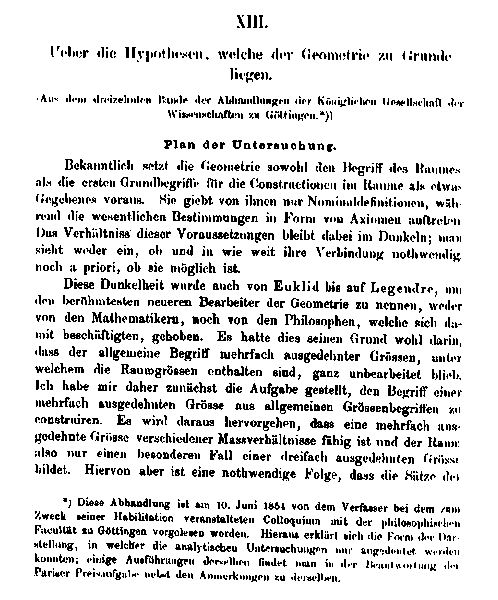
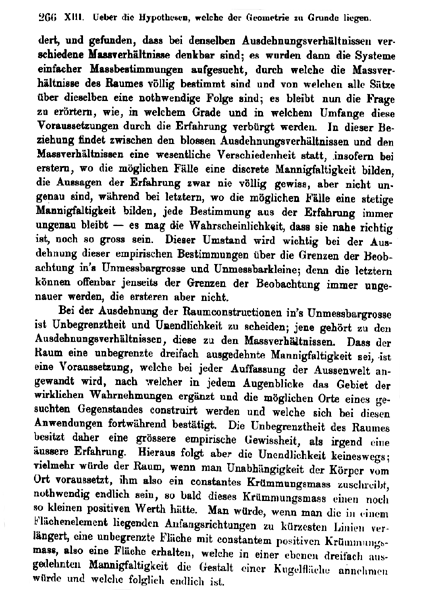
为了完成他的特许任教资格,黎曼必须做一次演讲。他准备了三场演讲,两场关于电学,一场关于几何学。卡尔·弗里德里希·高斯必须从这三场中选择一场让黎曼来宣讲,而出乎黎曼的意料,卡尔·弗里德里希·高斯选择了关于几何学的那场演讲。黎曼的演讲Über die Hypothesen welche der Geometrie zu Grunde liegenⓉ(《论几何学基础中的假设》),于1854年6月10日宣讲,成为数学的经典。
黎曼的演讲分为两部分。在第一部分,他提出了如何定义一个维空间的问题,并最终给出了我们今天称之为黎曼空间的定义。汉斯·弗洛伊登萨在[1]中写道:-
它具有最短线,现在称为测地线,类似于普通的直线。事实上,在测地坐标系中,作为一阶近似,这样的度量是平坦欧几里得的,就像曲面在忽略高阶项时看起来像它的切线平面一样。生活在曲面上的生物可能会发现他们世界的曲率,并根据观察到的与毕达哥拉斯定理的偏差,在任意点计算它。
事实上,黎曼演讲这一部分的要点是曲率张量的定义。黎曼演讲的第二部分提出了关于几何学与我们生活的世界之间关系的深刻问题。他问实空间的维数是多少,以及什么几何学描述了实空间。这场演讲远远超前于它的时代,无法被当时大多数科学家所欣赏。莫纳斯提尔斯基在[6]中写道:-
在黎曼的听众中,只有卡尔·弗里德里希·高斯能够领会黎曼思想的深度。……这次讲座超出了他的所有期望,令他大为惊讶。回到系务会议后,他怀着极大的赞赏和罕见的热情,向Wilhelm 威廉·韦伯谈起黎曼所呈现的思想的深度。
直到六十年后才被完全理解。汉斯·弗洛伊登萨在[1]中写道:-
广义相对论出色地证明了他的工作。在从黎曼的演讲发展出来的数学工具中,阿尔伯特·爱因斯坦找到了适合他的物理思想、他的宇宙论和宇宙起源论的框架:而黎曼演讲的精神正是物理学所需要的:由数据确定的度量结构。
因此,这项杰出的工作使黎曼有资格开始讲课。然而[6]:-
不久之前,在九月,他在哥廷根科学研究者与医师协会的一次会议上宣读了一篇报告《论静电分布定律》。在给父亲的一封信中,黎曼除其他事情外还回忆道,“我在一次科学会议上发言这一事实对我的讲课有帮助”。十月,他开始着手准备关于偏微分方程的讲座。黎曼写给深爱的父亲的信中充满了关于他所遇到困难的回忆。尽管只有八名学生听讲,黎曼却完全快乐。他逐渐克服了天生的羞怯,与听众建立了融洽的关系。
1855年,卡尔·弗里德里希·高斯在哥廷根的讲席由约翰·彼得·古斯塔夫·勒热纳·狄利克雷接任。此时有人试图为黎曼争取一个个人讲席,但未能成功。然而两年后,他被任命为教授,同年,即1857年,他的另一部杰作出版了。论文Theory of abelian functions是多年工作的成果,包含在他1855-56年给三个人讲授的一门课程中。这三人之一是理查德·戴德金,他得以在黎曼早逝后通过出版这些材料而使黎曼讲座的美妙之处流传下来。
阿贝尔函数论文接着他的学位论文的工作继续展开,进一步发展了黎曼曲面及其拓扑性质的思想。他把多值函数视为特殊黎曼曲面上的单值函数,并解决了尼尔斯·阿贝尔和卡尔·古斯塔夫·雅各布·雅可比曾对椭圆积分解决的一般反演问题。然而黎曼并不是唯一研究这类思想的数学家。菲利克斯·克莱因在[4]中写道:-
……当卡尔·魏尔斯特拉斯于1857年向柏林科学院提交关于一般阿贝尔函数的第一份处理时,黎曼关于同一主题的论文出现在奥古斯都·利奥波德·克雷勒的杂志第54卷上。它包含如此多意想不到的新概念,以至于卡尔·魏尔斯特拉斯撤回了他的论文,事实上此后不再发表。
黎曼在其学位论文中使用过的约翰·彼得·古斯塔夫·勒热纳·狄利克雷原理,被他再次用于这篇1857年论文的结果。然而,卡尔·魏尔斯特拉斯表明约翰·彼得·古斯塔夫·勒热纳·狄利克雷原理存在一个问题。菲利克斯·克莱因写道[4]:-
大多数数学家背离了黎曼……黎曼有着相当不同的看法。他完全承认卡尔·魏尔斯特拉斯批评的公正与正确,但他说,正如⟦N3⟧曾告诉我的那样,他求助于约翰·彼得·古斯塔夫·勒热纳·狄利克雷原理只是把它当作手边方便的工具,而他的存在性定理仍然正确。
我们在本文末尾回到这一点,以说明黎曼工作中使用约翰·彼得·古斯塔夫·勒热纳·狄利克雷原理的问题是如何得到解决的。
1858年,恩里科·贝蒂、Casorati和弗朗切斯科·布廖斯基访问了哥廷根,黎曼与他们讨论了他的拓扑学思想。这给黎曼带来了特别的乐趣,也许恩里科·贝蒂尤其从与黎曼的接触中受益。当黎曼于1863年在意大利访问恩里科·贝蒂时,这些接触得以更新。在[16]中,重印了恩里科·贝蒂的两封信,展示了他从黎曼那里学到的拓扑思想。
1859年约翰·彼得·古斯塔夫·勒热纳·狄利克雷去世,黎曼于7月30日被任命为哥廷根大学数学讲席。几天后,他当选为柏林科学院会士。他是由三位柏林数学家恩斯特·爱德华·库默尔、卡尔·威廉·博尔夏特和卡尔·魏尔斯特拉斯提名的。他们的提名书写道[6]:-
在他最近的工作[阿贝尔函数理论]出现之前,黎曼对数学家们来说几乎不为人知。这一情况多少为我们需要更详细地考察他的工作作为我们论述的基础提供了理由。我们认为有责任提请科学院注意我们的同事,我们推荐他并非作为一个带来巨大希望的年轻才俊,而是作为我们科学领域中一位完全成熟且独立的研究者,他在很大程度上推动了该领域的进展。
一位新当选的柏林科学院成员必须报告其最近的研究,黎曼提交了一份关于On the number of primes less than a given magnitude的报告,这是他的另一部伟大杰作,将以极其重要的方式改变数学研究的方向。在其中,黎曼考察了ζ函数
这已经被莱昂哈德·欧拉考虑过。这里求和是对所有自然数,而乘积是对所有素数。黎曼考虑了一个与莱昂哈德·欧拉所考虑的问题非常不同的问题,因为他将zeta函数视为复函数而非实函数。除少数平凡例外,的根都位于0和1之间。在论文中,他指出zeta函数有无穷多个非平凡根,并且它们似乎都可能具有实部。这就是著名的黎曼假设,它至今仍是数学中最重要的未解决问题之一。
黎曼研究了zeta函数级数表示的收敛性,并发现了zeta函数的一个函数方程。该论文的主要目的是给出小于给定数的素数数量的估计。黎曼获得的许多结果后来由雅克·阿达马和de la 夏尔-让·德拉瓦莱·普桑证明。
1862年6月,黎曼与Elise 海里格·冯·科赫结婚,后者是他妹妹的朋友。他们有一个女儿。结婚那年秋天,黎曼得了重感冒,后来转为肺结核。他一生从未有过好身体,事实上他严重的健康问题很可能远早于这次感冒。实际上,他的母亲在黎曼20岁时去世,而他的兄弟和三个姐妹都英年早逝。黎曼试图通过前往气候更温暖的意大利来对抗疾病。
1862-63年的冬天是在西西里度过的,随后他游历意大利,与恩里科·贝蒂及其他曾访问哥廷根的意大利数学家共度时光。他于1863年6月返回哥廷根,但健康状况很快恶化,于是再次回到意大利。在1864年8月至1865年10月间在意大利北部度过之后,黎曼返回哥廷根度过1865-66年的冬天,然后于1866年6月16日回到马焦雷湖畔的塞拉斯卡。理查德·戴德金在[3]中写道:-
他的体力迅速衰退,他自己也感到末日将至。但即便如此,在去世前一天,他安坐在一棵无花果树下,灵魂因壮丽的景色而充满喜悦,他仍在从事最后的工作,不幸的是,这项工作未能完成。
最后,让我们回到卡尔·魏尔斯特拉斯对黎曼使用约翰·彼得·古斯塔夫·勒热纳·狄利克雷原理的批评。卡尔·魏尔斯特拉斯已经表明,约翰·彼得·古斯塔夫·勒热纳·狄利克雷原理并不保证存在一个极小化函数。这产生了使人们怀疑黎曼方法的效果。汉斯·弗洛伊登萨在[1]中写道:-
所有人都使用了黎曼的材料,但他的方法却被完全忽视了。……在本世纪余下的时间里,黎曼的结果产生了巨大的影响:他的思维方式却影响甚微。
卡尔·魏尔斯特拉斯坚信黎曼的结果,尽管他自己发现了约翰·彼得·古斯塔夫·勒热纳·狄利克雷原理的问题。他让他的学生雅各布·赫尔曼 赫尔曼·阿曼杜斯·施瓦茨尝试寻找黎曼存在性定理的其他证明,这些证明不使用约翰·彼得·古斯塔夫·勒热纳·狄利克雷原理。他在1869-70年间成功做到了这一点。然而,菲利克斯·克莱因对黎曼的几何方法着迷,他在1892年写了一本书,给出了他对黎曼工作的版本,但写作风格非常符合黎曼的精神。汉斯·弗洛伊登萨在[1]中写道:-
这是一本美丽的书,了解它是如何被接受的会很有趣。可能许多人因其缺乏严格性而感到不满:菲利克斯·克莱因太像黎曼,无法说服那些不相信后者的人。
1901年,大卫·希尔伯特通过给出使黎曼的证明严格化所需的约翰·彼得·古斯塔夫·勒热纳·狄利克雷原理的正确形式,修补了黎曼的方法。然而,寻找严格证明并没有浪费时间,因为阿尔弗雷德·克莱布什、保罗·哥尔丹、Brill和马克斯·诺特在试图证明黎曼的结果时发现了许多重要的代数思想。Monastyrsky在[6]中写道:-
在十九世纪数学史上,很难再回忆起另一个为严格证明而奋斗却带来如此丰硕成果的例子。
Bernhard Riemann's father, Friedrich Bernhard Riemann, was a Lutheran minister. Friedrich Riemann married Charlotte Ebell when he was in his middle age. Bernhard was the second of their six children, two boys and four girls. Friedrich Riemann acted as teacher to his children and he taught Bernhard until he was ten years old. At this time a teacher from a local school named Schulz assisted in Bernhard's education.
In 1840 Bernhard entered directly into the third class at the Lyceum in Hannover. While at the Lyceum he lived with his grandmother but, in 1842, his grandmother died and Bernhard moved to the Johanneum Gymnasium in Lüneburg. Bernhard seems to have been a good, but not outstanding, pupil who worked hard at the classical subjects such as Hebrew and theology. He showed a particular interest in mathematics and the director of the Gymnasium allowed Bernhard to study mathematics texts from his own library. On one occasion he lent Bernhard Legendre's book on the theory of numbers and Bernhard read the 900 page book in six days.
In the spring of 1846 Riemann enrolled at the University of Göttingen. His father had encouraged him to study theology and so he entered the theology faculty. However he attended some mathematics lectures and asked his father if he could transfer to the faculty of philosophy so that he could study mathematics. Riemann was always very close to his family and he would never have changed courses without his father's permission. This was granted, however, and Riemann then took courses in mathematics from Moritz Stern and Gauss.
It may be thought that Riemann was in just the right place to study mathematics at Göttingen, but at this time the University of Göttingen was a rather poor place for mathematics. Gauss did lecture to Riemann but he was only giving elementary courses and there is no evidence that at this time he recognised Riemann's genius. Stern, however, certainly did realise that he had a remarkable student and later described Riemann at this time saying that he:-
... already sang like a canary.
Riemann moved from Göttingen to Berlin University in the spring of 1847 to study under Steiner, Jacobi, Dirichlet and Eisenstein. This was an important time for Riemann. He learnt much from Eisenstein and discussed using complex variables in elliptic function theory. The main person to influence Riemann at this time, however, was Dirichlet. Klein writes in [4]:-
Riemann was bound to Dirichlet by the strong inner sympathy of a like mode of thought. Dirichlet loved to make things clear to himself in an intuitive substrate; along with this he would give acute, logical analyses of foundational questions and would avoid long computations as much as possible. His manner suited Riemann, who adopted it and worked according to Dirichlet's methods.
Riemann's work always was based on intuitive reasoning which fell a little below the rigour required to make the conclusions watertight. However, the brilliant ideas which his works contain are so much clearer because his work is not overly filled with lengthy computations. It was during his time at the University of Berlin that Riemann worked out his general theory of complex variables that formed the basis of some of his most important work.
In 1849 he returned to Göttingen and his Ph.D. thesis, supervised by Gauss, was submitted in 1851. However it was not only Gauss who strongly influenced Riemann at this time. Weber had returned to a chair of physics at Göttingen from Leipzig during the time that Riemann was in Berlin, and Riemann was his assistant for 18 months. Also Listing had been appointed as a professor of physics in Göttingen in 1849. Through Weber and Listing, Riemann gained a strong background in theoretical physics and, from Listing, important ideas in topology which were to influence his ground breaking research.
Riemann's thesis studied the theory of complex variables and, in particular, what we now call Riemann surfaces. It therefore introduced topological methods into complex function theory. The work builds on Cauchy's foundations of the theory of complex variables built up over many years and also on Puiseux's ideas of branch points. However, Riemann's thesis is a strikingly original piece of work which examined geometric properties of analytic functions, conformal mappings and the connectivity of surfaces.
In proving some of the results in his thesis Riemann used a variational principle which he was later to call the Dirichlet Principle since he had learnt it from Dirichlet's lectures in Berlin. The Dirichlet Principle did not originate with Dirichlet, however, as Gauss, Green and Thomson had all made use if it. Riemann's thesis, one of the most remarkable pieces of original work to appear in a doctoral thesis, was examined on 16 December 1851. In his report on the thesis Gauss described Riemann as having:-
... a gloriously fertile originality.
On Gauss's recommendation Riemann was appointed to a post in Göttingen and he worked for his Habilitation, the degree which would allow him to become a lecturer. He spent thirty months working on his Habilitation dissertation which was on the representability of functions by trigonometric series. He gave the conditions of a function to have an integral, what we now call the condition of Riemann integrability. In the second part of the dissertation he examined the problem which he described in these words:-
While preceding papers have shown that if a function possesses such and such a property, then it can be represented by a Fourier series, we pose the reverse question: if a function can be represented by a trigonometric series, what can one say about its behaviour.
To complete his Habilitation Riemann had to give a lecture. He prepared three lectures, two on electricity and one on geometry. Gauss had to choose one of the three for Riemann to deliver and, against Riemann's expectations, Gauss chose the lecture on geometry. Riemann's lecture Über die Hypothesen welche der Geometrie zu Grunde liegen Ⓣ, delivered on 10 June 1854, became a classic of mathematics.
There were two parts to Riemann's lecture. In the first part he posed the problem of how to define an -dimensional space and ended up giving a definition of what today we call a Riemannian space. Freudenthal writes in [1]:-
It possesses shortest lines, now called geodesics, which resemble ordinary straight lines. In fact, at first approximation in a geodesic coordinate system such a metric is flat Euclidean, in the same way that a curved surface up to higher-order terms looks like its tangent plane. Beings living on the surface may discover the curvature of their world and compute it at any point as a consequence of observed deviations from Pythagoras's theorem.
In fact the main point of this part of Riemann's lecture was the definition of the curvature tensor. The second part of Riemann's lecture posed deep questions about the relationship of geometry to the world we live in. He asked what the dimension of real space was and what geometry described real space. The lecture was too far ahead of its time to be appreciated by most scientists of that time. Monastyrsky writes in [6]:-
Among Riemann's audience, only Gauss was able to appreciate the depth of Riemann's thoughts. ... The lecture exceeded all his expectations and greatly surprised him. Returning to the faculty meeting, he spoke with the greatest praise and rare enthusiasm to Wilhelm Weber about the depth of the thoughts that Riemann had presented.
It was not fully understood until sixty years later. Freudenthal writes in [1]:-
The general theory of relativity splendidly justified his work. In the mathematical apparatus developed from Riemann's address, Einstein found the frame to fit his physical ideas, his cosmology, and cosmogony: and the spirit of Riemann's address was just what physics needed: the metric structure determined by data.
So this brilliant work entitled Riemann to begin to lecture. However [6]:-
Not long before, in September, he read a report "On the Laws of the Distribution of Static Electricity" at a session of the Göttingen Society of Scientific researchers and Physicians. In a letter to his father, Riemann recalled, among other things, "the fact that I spoke at a scientific meeting was useful for my lectures". In October he set to work on his lectures on partial differential equations. Riemann's letters to his dearly-loved father were full of recollections about the difficulties he encountered. Although only eight students attended the lectures, Riemann was completely happy. Gradually he overcame his natural shyness and established a rapport with his audience.
Gauss's chair at Göttingen was filled by Dirichlet in 1855. At this time there was an attempt to get Riemann a personal chair but this failed. Two years later, however, he was appointed as professor and in the same year, 1857, another of his masterpieces was published. The paper Theory of abelian functions was the result of work carried out over several years and contained in a lecture course he gave to three people in 1855-56. One of the three was Dedekind who was able to make the beauty of Riemann's lectures available by publishing the material after Riemann's early death.
The abelian functions paper continued where his doctoral dissertation had left off and developed further the idea of Riemann surfaces and their topological properties. He examined multi-valued functions as single valued over a special Riemann surface and solved general inversion problems which had been solved for elliptic integrals by Abel and Jacobi. However Riemann was not the only mathematician working on such ideas. Klein writes in [4]:-
... when Weierstrass submitted a first treatment of general abelian functions to the Berlin Academy in 1857, Riemann's paper on the same theme appeared in Crelle's Journal, Volume 54. It contained so many unexpected, new concepts that Weierstrass withdrew his paper and in fact published no more.
The Dirichlet Principle which Riemann had used in his doctoral thesis was used by him again for the results of this 1857 paper. Weierstrass, however, showed that there was a problem with the Dirichlet Principle. Klein writes [4]:-
The majority of mathematicians turned away from Riemann ... Riemann had quite a different opinion. He fully recognised the justice and correctness of Weierstrass's critique, but he said, as Weierstrass once told me, that he appealed to Dirichlet's Principle only as a convenient tool that was right at hand, and that his existence theorems are still correct.
We return at the end of this article to indicate how the problem of the use of Dirichlet's Principle in Riemann's work was sorted out.
In 1858 Betti, Casorati and Brioschi visited Göttingen and Riemann discussed with them his ideas in topology. This gave Riemann particular pleasure and perhaps Betti in particular profited from his contacts with Riemann. These contacts were renewed when Riemann visited Betti in Italy in 1863. In [16] two letter from Betti, showing the topological ideas that he learnt from Riemann, are reproduced.
In 1859 Dirichlet died and Riemann was appointed to the chair of mathematics at Göttingen on 30 July. A few days later he was elected to the Berlin Academy of Sciences. He had been proposed by three of the Berlin mathematicians, Kummer, Borchardt and Weierstrass. Their proposal read [6]:-
Prior to the appearance of his most recent work [Theory of abelian functions], Riemann was almost unknown to mathematicians. This circumstance excuses somewhat the necessity of a more detailed examination of his works as a basis of our presentation. We considered it our duty to turn the attention of the Academy to our colleague whom we recommend not as a young talent which gives great hope, but rather as a fully mature and independent investigator in our area of science, whose progress he in significant measure has promoted.
A newly elected member of the Berlin Academy of Sciences had to report on their most recent research and Riemann sent a report on On the number of primes less than a given magnitude another of his great masterpieces which were to change the direction of mathematical research in a most significant way. In it Riemann examined the zeta function
which had already been considered by Euler. Here the sum is over all natural numbers while the product is over all prime numbers. Riemann considered a very different question to the one Euler had considered, for he looked at the zeta function as a complex function rather than a real one. Except for a few trivial exceptions, the roots of all lie between 0 and 1. In the paper he stated that the zeta function had infinitely many nontrivial roots and that it seemed probable that they all have real part . This is the famous Riemann hypothesis which remains today one of the most important of the unsolved problems of mathematics.
Riemann studied the convergence of the series representation of the zeta function and found a functional equation for the zeta function. The main purpose of the paper was to give estimates for the number of primes less than a given number. Many of the results which Riemann obtained were later proved by Hadamard and de la Vallée Poussin.
In June 1862 Riemann married Elise Koch who was a friend of his sister. They had one daughter. In the autumn of the year of his marriage Riemann caught a heavy cold which turned to tuberculosis. He had never had good health all his life and in fact his serious heath problems probably go back much further than this cold he caught. In fact his mother had died when Riemann was 20 while his brother and three sisters all died young. Riemann tried to fight the illness by going to the warmer climate of Italy.
The winter of 1862-63 was spent in Sicily and he then travelled through Italy, spending time with Betti and other Italian mathematicians who had visited Göttingen. He returned to Göttingen in June 1863 but his health soon deteriorated and once again he returned to Italy. Having spent from August 1864 to October 1865 in northern Italy, Riemann returned to Göttingen for the winter of 1865-66, then returned to Selasca on the shores of Lake Maggiore on 16 June 1866. Dedekind writes in [3]:-
His strength declined rapidly, and he himself felt that his end was near. But still, the day before his death, resting under a fig tree, his soul filled with joy at the glorious landscape, he worked on his final work which unfortunately, was left unfinished.
Finally let us return to Weierstrass's criticism of Riemann's use of the Dirichlet's Principle. Weierstrass had shown that a minimising function was not guaranteed by the Dirichlet Principle. This had the effect of making people doubt Riemann's methods. Freudenthal writes in [1]:-
All used Riemann's material but his method was entirely neglected. ... During the rest of the century Riemann's results exerted a tremendous influence: his way of thinking but little.
Weierstrass firmly believed Riemann's results, despite his own discovery of the problem with the Dirichlet Principle. He asked his student Hermann Schwarz to try to find other proofs of Riemann's existence theorems which did not use the Dirichlet Principle. He managed to do this during 1869-70. Klein, however, was fascinated by Riemann's geometric approach and he wrote a book in 1892 giving his version of Riemann's work yet written very much in the spirit of Riemann. Freudenthal writes in [1]:-
It is a beautiful book, and it would be interesting to know how it was received. Probably many took offence at its lack of rigour: Klein was too much in Riemann's image to be convincing to people who would not believe the latter.
In 1901 Hilbert mended Riemann's approach by giving the correct form of Dirichlet's Principle needed to make Riemann's proofs rigorous. The search for a rigorous proof had not been a waste of time, however, since many important algebraic ideas were discovered by Clebsch, Gordan, Brill and Max Noether while they tried to prove Riemann's results. Monastyrsky writes in [6]:-
It is difficult to recall another example in the history of nineteenth-century mathematics when a struggle for a rigorous proof led to such productive results.
正文里的方括号编号指向这里,悬停即可直接看到条目。书目保留原文——译了书名反而查不到文献。
原站列出的延伸阅读与外部数据库,照原样保留,目标多为英文页面。
关于波恩哈德·黎曼的其它页面:
关于波恩哈德·黎曼的其它网站:
原站的交叉引用。指向本站已镜像专题的留在站内,其余仍指回原站。