数学家传记
卡尔·弗里德里希·高斯在数学和物理学的众多领域都有研究,包括数论、分析、微分几何、大地测量学、磁学、天文学和光学。他的工作在许多领域产生了巨大影响。
七岁时,卡尔·弗里德里希·高斯 开始上小学,他的潜力几乎立刻就被注意到。他的老师 Büttner 和他的助手 马丁·巴特尔斯 惊讶地看到,高斯 通过发现这个和是50对数字、每对之和为101,立刻求出了从1到100的整数和。
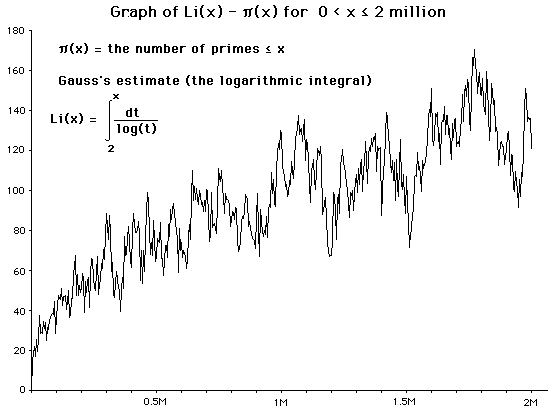
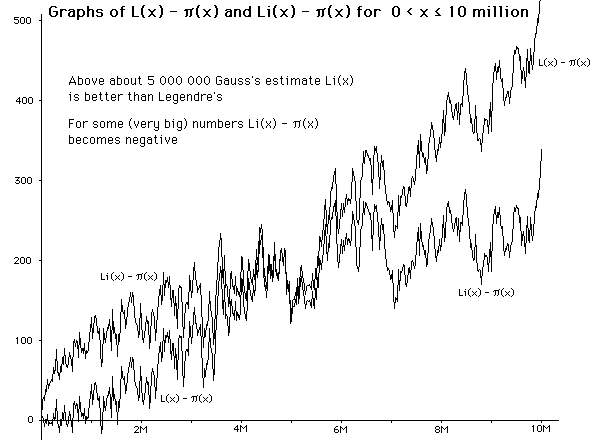
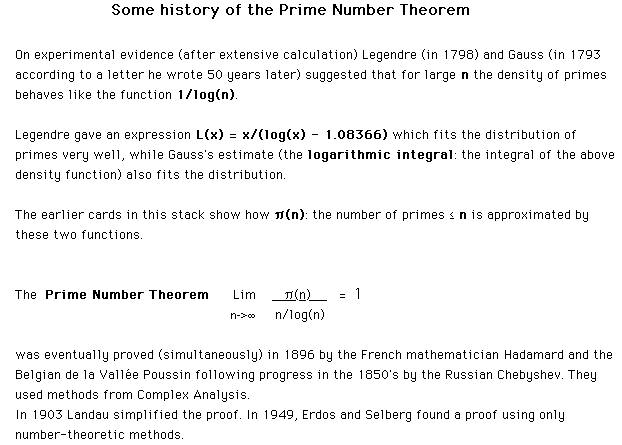
1788年,高斯 在 Büttner 和 马丁·巴特尔斯 的帮助下开始在 文理中学 接受教育,在那里他学习了高地德语和拉丁语。在收到不伦瑞克-沃尔芬比特尔公爵的助学金后,高斯 于1792年进入不伦瑞克卡罗琳学院。在该学院,高斯 独立发现了波得定则、二项式定理 和算术-几何平均,以及 二次互反律 定律和 素数定理。
1795年,高斯 离开不伦瑞克,前往哥廷根大学学习。高斯 在那里的老师是 亚伯拉罕·哥特黑尔弗·凯斯特纳,高斯 常常嘲笑他。他在学生中唯一已知的朋友是 鲍耶·法卡斯。他们于1799年相识,并相互通信多年。
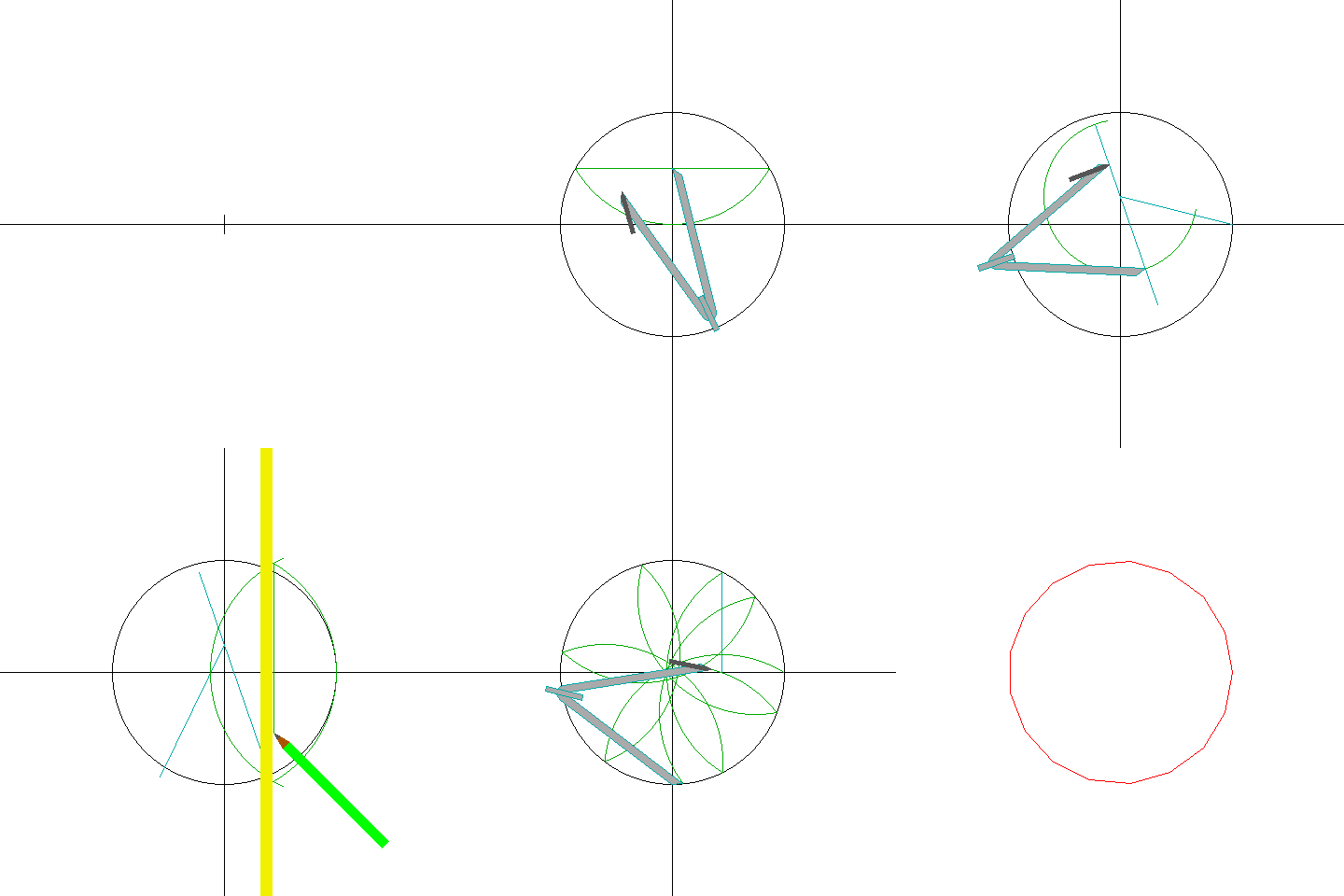
高斯 于1798年离开哥廷根,没有文凭,但到这时他已经做出了自己最重要的发现之一——用 ruler and compasses 构造正17边形。这是自希腊数学时代以来这一领域最重大的进展,并作为 高斯 的著名著作 Disquisitiones Arithmeticae Ⓣ(算术研究)的第七节发表。
高斯回到不伦瑞克,并于1799年在那里获得学位。不伦瑞克公爵同意继续支付高斯的津贴后,他要求高斯向赫尔姆施泰特大学提交一篇博士学位论文。他已经认识约翰·弗里德里希·普法夫,后者被选为他的导师。高斯的学位论文讨论的是代数基本定理。
有了津贴的支持,高斯不需要找工作,因此全身心投入研究。他于1801年夏天出版了Disquisitiones ArithmeticaeⓉ(算术研究)一书。全书共七节,除上面提到的最后一节外,其余各节都致力于数论。
1801年6月,高斯两三年前结识的天文学家Zach发表了谷神星的轨道位置,这是一颗新的“小行星”,由意大利天文学家G Piazzi于1801年1月1日发现。不幸的是,Piazzi只观测到其轨道的9度,它就消失在太阳后面了。Zach发表了几项关于其位置的预测,其中包括高斯的一项,与其他预测大相径庭。当Zach于1801年12月7日重新发现谷神星时,它几乎正好位于高斯预测的位置。尽管他当时没有公开自己的方法,但高斯使用了最小二乘近似法。
1802年6月,高斯拜访了Olbers,后者于当年3月发现了智神星,高斯研究了它的轨道。Olbers请求让高斯担任哥廷根拟建新天文台的台长,但没有采取任何行动。高斯开始与弗里德里希·威廉·贝塞尔通信,直到1825年才与他见面,并与索菲·热尔曼通信。
高斯于1805年10月9日与Johanna Ostoff结婚。尽管他第一次拥有了幸福的个人生活,但他的恩人不伦瑞克公爵在为普鲁士军队作战时阵亡。1807年,高斯离开不伦瑞克,就任哥廷根天文台台长。
高斯 于1807年末抵达哥廷根。1808年他的父亲去世,一年后 高斯 的妻子约翰娜在生下他们的第二个儿子后去世,这个儿子不久后也随她而去。高斯 悲痛欲绝,写信给奥尔伯斯,请求让他寄住几周,
在你的友谊怀抱中重新积聚力量——这力量是为了一个只有属于我的三个年幼孩子才有价值的人生。
高斯第二年再婚,娶了约翰娜最好的朋友明娜,尽管他们有了三个孩子,这桩婚姻对高斯来说似乎是一桩权宜之计。
高斯的工作似乎从未因他个人的悲剧而受到影响。他于1809年出版了他的第二本书Theoria motus corporum coelestium in sectionibus conicis Solem ambientium Ⓣ(《论围绕太阳沿圆锥曲线运动的天体的运动理论》),这是一部关于天体运动的两卷本重要论著。在第一卷中,他讨论了微分方程、conic sections和椭圆轨道,而在第二卷,即该著作的主要部分中,他展示了如何估计并进而改进对行星轨道的估计。高斯对理论天文学的贡献在1817年之后停止了,尽管他继续从事观测直到70岁。
高斯的大部分时间都花在了一座新天文台上,该天文台于1816年完工,但他仍然抽出时间研究其他课题。这一时期的出版物包括Disquisitiones generales circa seriem infinitam Ⓣ(《关于无穷级数的一般研究》),这是对级数的严格处理并引入了超几何函数,Methodus nova integralium valores per approximationem inveniendi Ⓣ(《论求积分值的一种新方法》),这是一篇关于近似积分的实用论文,Bestimmung der Genauigkeit der Beobachtungen Ⓣ(《确定观测的精度》),一篇关于统计估计量的讨论,以及Theoria attractionis corporum sphaeroidicorum ellipticorum homogeneorum methodus nova tractata Ⓣ(《论椭球体均匀部分吸引的一种新方法理论》)。后一著作受到大地测量问题的启发,主要涉及potential theory。事实上,在19世纪20年代,高斯发现自己对大地测量学越来越感兴趣。
高斯在1818年被要求对汉诺威州进行大地测量,以便与现有的丹麦三角网连接。高斯欣然接受并亲自负责这项测量,白天进行测量,晚上进行归算,利用他非凡的计算能力。他定期写信给Schumacher、Olbers和弗里德里希·威廉·贝塞尔,报告他的进展并讨论问题。
由于这项测量,高斯发明了回照器,它通过使用镜子设计和小型望远镜反射太阳光线来工作。然而,测量中使用了不准确的基线和不令人满意的三角网。高斯常常想,如果他从事其他职业是否会更好,但他在1820年至1830年间发表了70多篇论文。
1822年,高斯凭借Theoria attractionis Ⓣ(《吸引理论》)……以及将一个曲面映射到另一个曲面以使两个are similar in their smallest parts的想法赢得了哥本哈根大学奖。这篇论文于1825年发表,并导致了很久以后Untersuchungen über Gegenstände der Höheren Geodäsie Ⓣ(《高等大地测量学研究》)(1843年和1846年)的出版。论文Theoria combinationis observationum erroribus minimis obnoxiae Ⓣ(《论观测组合中的误差理论》)(1823年)及其补编(1828年)致力于数学统计学,特别是最小二乘法。
从1800年代初起,高斯就对non-Euclidean geometry可能存在的问题产生了兴趣。他与鲍耶·法卡斯详细讨论了这个话题,并在与Gerling和Schumacher的通信中也有所涉及。在1816年的一篇书评中,他讨论了从其他欧几里得公理推导出平行公理的证明,暗示他相信非欧几何的存在,尽管他的表述相当含糊。
……徒劳地试图用一堆站不住脚的伪证明来掩盖那个无法填补的缺口。
高斯向Schumacher倾诉,告诉他如果公开承认自己相信这样一种几何的存在,他的声誉将会受损。
1831年,鲍耶·法卡斯把他儿子鲍耶关于这个主题的著作寄给了高斯。高斯回复道
赞扬它就等于赞扬我自己。
又过了十年,当他得知罗巴切夫斯基在这一主题上的工作时,他赞扬其“真正的几何”特性,而在1846年给Schumacher的一封信中,他声称自己
54年来一直持有相同的信念
这表明他自15岁起就知道非欧几何的存在(这似乎不太可能)。
高斯对微分几何有浓厚的兴趣,并就此主题发表了许多论文。Disquisitiones generales circa superficies curva Ⓣ(曲面的一般研究)(1828年)是他在这一领域最著名的著作。事实上,这篇论文源于他对测地线的兴趣,但它包含了诸如高斯曲率这样的几何思想。该论文还包括高斯著名的theorema egregium Ⓣ(重要定理):-
如果中的一个区域可以展开(即等距映射)到的另一个区域,则对应点处的高斯曲率值相同。
1817-1832年这段时期对高斯来说特别痛苦。1817年他接来生病的母亲,她一直住到1839年去世,同时他正与妻子及其家人争论是否应该去柏林。他收到了柏林大学的职位邀请,Minna和她的家人都渴望搬去那里。然而,高斯从不喜欢变动,决定留在哥廷根。1831年,高斯的第二任妻子在长期患病后去世。
1831年,威廉·韦伯作为物理学教授抵达哥廷根,填补了托比亚斯·梅耶的讲席。高斯自1828年起就认识威廉·韦伯,并支持他的任命。高斯在1831年之前从事物理学研究,发表了Über ein neues allgemeines Grundgesetz der Mechanik Ⓣ(论力学的一个新的普遍基本定律),其中包含最小约束原理,以及Principia generalia theoriae figurae fluidorum in statu aequilibrii Ⓣ(平衡状态下流体形状理论的一般原理),讨论了吸引力。这些论文基于高斯的势理论,这在他物理学工作中证明极为重要。他后来逐渐相信他的势理论和最小二乘法为科学与自然之间提供了至关重要的联系。
1832年,高斯和威廉·韦伯开始研究地磁理论,此前Alexander von Humboldt试图获得高斯的帮助,以建立一个环绕地球的磁观测点网格。高斯对这一前景感到兴奋,到1840年,他已经写了三篇关于该主题的重要论文:Intensitas vis magneticae terrestris ad mensuram absolutam revocata Ⓣ(地磁力绝对强度的重新测量)(1832)、Allgemeine Theorie des Erdmagnetismus Ⓣ(地磁通论)(1839)和Allgemeine Lehrsätze in Beziehung auf die im verkehrten Verhältnisse des Quadrats der Entfernung wirkenden Anziehungs- und Abstossungskräfte Ⓣ(关于在反常情况下吸引和排斥距离平方作用的一般定理)(1840)。这些论文都涉及当时关于地磁的理论,包括西莫恩·德尼·泊松的思想、磁力的绝对度量和地磁的经验定义。约翰·彼得·古斯塔夫·勒热纳·狄利克雷的原理被提及但未加证明。
Allgemeine Theorie Ⓣ(通论)...表明地球上只能有两个磁极,并进而证明了一个重要定理,该定理涉及确定磁力水平分量的强度以及倾角。高斯使用皮埃尔·西蒙·拉普拉斯方程来辅助他的计算,并最终指定了磁南极的位置。
Humboldt设计了一个观测磁偏角的日历。然而,一旦高斯的新磁观测台(1833年完工——不含任何磁性金属)建成,他便着手改变Humboldt的许多程序,这让Humboldt很不高兴。然而,高斯的改变以更少的努力获得了更准确的结果。
高斯和威廉·韦伯在共处的六年中取得了很大成就。他们发现了古斯塔夫·基尔霍夫定律,还制造了一台原始的电报装置,可以在5000英尺的距离上发送信息。然而,这对高斯来说只是一种愉快的消遣。他更感兴趣的是建立一个全球磁观测点网络的任务。这项工作产生了许多具体成果。Magnetischer VereinⓉ(磁学会)及其期刊得以创立,地磁图集得以出版,而高斯和威廉·韦伯发表他们成果的自己的期刊则从1836年办到1841年。
1837年,威廉·韦伯因卷入一场政治争端而被迫离开哥廷根,从这时起,高斯的活动逐渐减少。他仍然写信回应同行科学家的发现,通常说这些方法他多年前就已知道,但从未觉得有必要发表。有时他似乎对其他数学家的进展极为高兴,尤其是费迪南·艾森斯坦和罗巴切夫斯基的进展。
高斯从1845年到1851年忙于更新哥廷根大学的寡妇基金。这项工作使他在财务事务上获得了实际经验,他随后通过对私人公司发行的债券进行精明投资而发了财。
高斯最后的两名博士生是莫里兹·贝内迪克特·康托尔和理查德·戴德金。理查德·戴德金对他的导师作了精彩的描述:-
……他通常以舒适的姿态坐着,低头向下,微微驼背,双手交叠放在膝上。他讲话相当自由,非常清晰、简单而平实:但当他想要强调一个新观点时……他会抬起头,转向坐在旁边的人之一,用他那双美丽、锐利的蓝眼睛在强调讲话期间注视着他。……如果他从前面的原理讲解转入数学公式的推导,他就会站起来,以庄重而非常挺拔的姿态,用他特有的漂亮笔迹在黑板上书写:他总是通过节约和刻意的安排,成功地在相当小的空间内完成。对于数值例子,他特别重视其仔细完成,会随身携带写有所需数据的小纸条。
高斯于1849年作了金禧演讲,距Helmstedt大学授予他文凭已五十年。这恰如其分地是他1799年学位论文的一个变体。数学界只有卡尔·古斯塔夫·雅各布·雅可比和约翰·彼得·古斯塔夫·勒热纳·狄利克雷出席,但高斯收到了许多信息和荣誉。
从1850年起,高斯的工作再次几乎全是实用性质的,尽管他确实批准了波恩哈德·黎曼的博士学位论文并听取了他的试用讲座。他已知的最后一次科学交流是与Gerling。他在1854年讨论了一种改进的莱昂·傅科摆。他还得以出席汉诺威与哥廷根之间新铁路连接的开通仪式,但这证明是他最后一次外出。他的健康缓慢恶化,高斯于1855年2月23日清晨在睡梦中去世。
At the age of seven, Carl Friedrich Gauss started elementary school, and his potential was noticed almost immediately. His teacher, Büttner, and his assistant, Martin Bartels, were amazed when Gauss summed the integers from 1 to 100 instantly by spotting that the sum was 50 pairs of numbers each pair summing to 101.
In 1788 Gauss began his education at the Gymnasium with the help of Büttner and Bartels, where he learnt High German and Latin. After receiving a stipend from the Duke of Brunswick- Wolfenbüttel, Gauss entered Brunswick Collegium Carolinum in 1792. At the academy Gauss independently discovered Bode's law, the binomial theorem and the arithmetic- geometric mean, as well as the law of quadratic reciprocity and the prime number theorem.
In 1795 Gauss left Brunswick to study at Göttingen University. Gauss's teacher there was Kästner, whom Gauss often ridiculed. His only known friend amongst the students was Farkas Bolyai. They met in 1799 and corresponded with each other for many years.
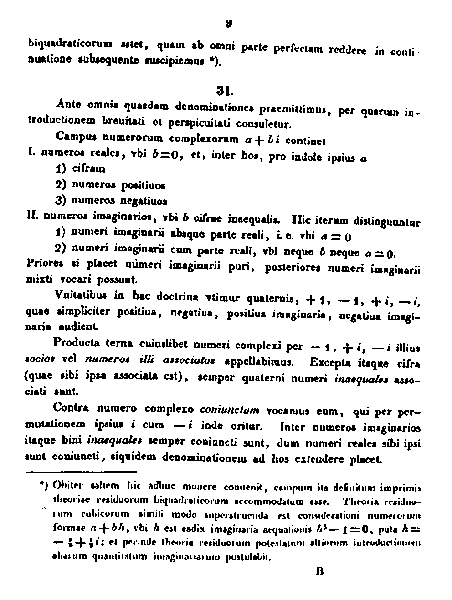
Gauss left Göttingen in 1798 without a diploma, but by this time he had made one of his most important discoveries - the construction of a regular 17-gon by ruler and compasses This was the most major advance in this field since the time of Greek mathematics and was published as Section VII of Gauss's famous work, Disquisitiones Arithmeticae Ⓣ.
Gauss returned to Brunswick where he received a degree in 1799. After the Duke of Brunswick had agreed to continue Gauss's stipend, he requested that Gauss submit a doctoral dissertation to the University of Helmstedt. He already knew Pfaff, who was chosen to be his advisor. Gauss's dissertation was a discussion of the fundamental theorem of algebra.
With his stipend to support him, Gauss did not need to find a job so devoted himself to research. He published the book Disquisitiones Arithmeticae Ⓣ in the summer of 1801. There were seven sections, all but the last section, referred to above, being devoted to number theory.
In June 1801, Zach, an astronomer whom Gauss had come to know two or three years previously, published the orbital positions of Ceres, a new "small planet" which was discovered by G Piazzi, an Italian astronomer on 1 January, 1801. Unfortunately, Piazzi had only been able to observe 9 degrees of its orbit before it disappeared behind the Sun. Zach published several predictions of its position, including one by Gauss which differed greatly from the others. When Ceres was rediscovered by Zach on 7 December 1801 it was almost exactly where Gauss had predicted. Although he did not disclose his methods at the time, Gauss had used his least squares approximation method.
In June 1802 Gauss visited Olbers who had discovered Pallas in March of that year and Gauss investigated its orbit. Olbers requested that Gauss be made director of the proposed new observatory in Göttingen, but no action was taken. Gauss began corresponding with Bessel, whom he did not meet until 1825, and with Sophie Germain.
Gauss married Johanna Ostoff on 9 October, 1805. Despite having a happy personal life for the first time, his benefactor, the Duke of Brunswick, was killed fighting for the Prussian army. In 1807 Gauss left Brunswick to take up the position of director of the Göttingen observatory.
Gauss arrived in Göttingen in late 1807. In 1808 his father died, and a year later Gauss's wife Johanna died after giving birth to their second son, who was to die soon after her. Gauss was shattered and wrote to Olbers asking him to give him a home for a few weeks,
to gather new strength in the arms of your friendship - strength for a life which is only valuable because it belongs to my three small children.
Gauss was married for a second time the next year, to Minna the best friend of Johanna, and although they had three children, this marriage seemed to be one of convenience for Gauss.
Gauss's work never seemed to suffer from his personal tragedy. He published his second book, Theoria motus corporum coelestium in sectionibus conicis Solem ambientium Ⓣ, in 1809, a major two volume treatise on the motion of celestial bodies. In the first volume he discussed differential equations, conic sections and elliptic orbits, while in the second volume, the main part of the work, he showed how to estimate and then to refine the estimation of a planet's orbit. Gauss's contributions to theoretical astronomy stopped after 1817, although he went on making observations until the age of 70.
Much of Gauss's time was spent on a new observatory, completed in 1816, but he still found the time to work on other subjects. His publications during this time include Disquisitiones generales circa seriem infinitam Ⓣ, a rigorous treatment of series and an introduction of the hypergeometric function, Methodus nova integralium valores per approximationem inveniendi Ⓣ, a practical essay on approximate integration, Bestimmung der Genauigkeit der Beobachtungen Ⓣ, a discussion of statistical estimators, and Theoria attractionis corporum sphaeroidicorum ellipticorum homogeneorum methodus nova tractata Ⓣ. The latter work was inspired by geodesic problems and was principally concerned with potential theory. In fact, Gauss found himself more and more interested in geodesy in the 1820s.
Gauss had been asked in 1818 to carry out a geodesic survey of the state of Hanover to link up with the existing Danish grid. Gauss was pleased to accept and took personal charge of the survey, making measurements during the day and reducing them at night, using his extraordinary mental capacity for calculations. He regularly wrote to Schumacher, Olbers and Bessel, reporting on his progress and discussing problems.
Because of the survey, Gauss invented the heliotrope which worked by reflecting the Sun's rays using a design of mirrors and a small telescope. However, inaccurate base lines were used for the survey and an unsatisfactory network of triangles. Gauss often wondered if he would have been better advised to have pursued some other occupation but he published over 70 papers between 1820 and 1830.
In 1822 Gauss won the Copenhagen University Prize with Theoria attractionis Ⓣ... together with the idea of mapping one surface onto another so that the two are similar in their smallest parts. This paper was published in 1825 and led to the much later publication of Untersuchungen über Gegenstände der Höheren Geodäsie Ⓣ (1843 and 1846). The paper Theoria combinationis observationum erroribus minimis obnoxiae Ⓣ (1823), with its supplement (1828), was devoted to mathematical statistics, in particular to the least squares method.
From the early 1800s Gauss had an interest in the question of the possible existence of a non-Euclidean geometry. He discussed this topic at length with Farkas Bolyai and in his correspondence with Gerling and Schumacher. In a book review in 1816 he discussed proofs which deduced the axiom of parallels from the other Euclidean axioms, suggesting that he believed in the existence of non-Euclidean geometry, although he was rather vague.
... the vain effort to conceal with an untenable tissue of pseudo proofs the gap which one cannot fill out.
Gauss confided in Schumacher, telling him that he believed his reputation would suffer if he admitted in public that he believed in the existence of such a geometry.
In 1831 Farkas Bolyai sent to Gauss his son János Bolyai's work on the subject. Gauss replied
to praise it would mean to praise myself .
Again, a decade later, when he was informed of Lobachevsky's work on the subject, he praised its "genuinely geometric" character, while in a letter to Schumacher in 1846, states that he
had the same convictions for 54 years
indicating that he had known of the existence of a non-Euclidean geometry since he was 15 years of age (this seems unlikely).
Gauss had a major interest in differential geometry, and published many papers on the subject. Disquisitiones generales circa superficies curva Ⓣ (1828) was his most renowned work in this field. In fact, this paper rose from his geodesic interests, but it contained such geometrical ideas as Gaussian curvature. The paper also includes Gauss's famous theorema egregium Ⓣ :-
If an area in can be developed (i.e. mapped isometrically) into another area of , the values of the Gaussian curvatures are identical in corresponding points.
The period 1817-1832 was a particularly distressing time for Gauss. He took in his sick mother in 1817, who stayed until her death in 1839, while he was arguing with his wife and her family about whether they should go to Berlin. He had been offered a position at Berlin University and Minna and her family were keen to move there. Gauss, however, never liked change and decided to stay in Göttingen. In 1831 Gauss's second wife died after a long illness.
In 1831, Wilhelm Weber arrived in Göttingen as physics professor filling Tobias Mayer's chair. Gauss had known Weber since 1828 and supported his appointment. Gauss had worked on physics before 1831, publishing Über ein neues allgemeines Grundgesetz der Mechanik Ⓣ, which contained the principle of least constraint, and Principia generalia theoriae figurae fluidorum in statu aequilibrii Ⓣ which discussed forces of attraction. These papers were based on Gauss's potential theory, which proved of great importance in his work on physics. He later came to believe his potential theory and his method of least squares provided vital links between science and nature.
In 1832, Gauss and Weber began investigating the theory of terrestrial magnetism after Alexander von Humboldt attempted to obtain Gauss's assistance in making a grid of magnetic observation points around the Earth. Gauss was excited by this prospect and by 1840 he had written three important papers on the subject: Intensitas vis magneticae terrestris ad mensuram absolutam revocata Ⓣ (1832), Allgemeine Theorie des Erdmagnetismus Ⓣ (1839) and Allgemeine Lehrsätze in Beziehung auf die im verkehrten Verhältnisse des Quadrats der Entfernung wirkenden Anziehungs- und Abstossungskräfte Ⓣ (1840). These papers all dealt with the current theories on terrestrial magnetism, including Poisson's ideas, absolute measure for magnetic force and an empirical definition of terrestrial magnetism. Dirichlet's principle was mentioned without proof.
Allgemeine Theorie Ⓣ... showed that there can only be two poles in the globe and went on to prove an important theorem, which concerned the determination of the intensity of the horizontal component of the magnetic force along with the angle of inclination. Gauss used the Laplace equation to aid him with his calculations, and ended up specifying a location for the magnetic South pole.
Humboldt had devised a calendar for observations of magnetic declination. However, once Gauss's new magnetic observatory (completed in 1833 - free of all magnetic metals) had been built, he proceeded to alter many of Humboldt's procedures, not pleasing Humboldt greatly. However, Gauss's changes obtained more accurate results with less effort.
Gauss and Weber achieved much in their six years together. They discovered Kirchhoff's laws, as well as building a primitive telegraph device which could send messages over a distance of 5000 ft. However, this was just an enjoyable pastime for Gauss. He was more interested in the task of establishing a world-wide net of magnetic observation points. This occupation produced many concrete results. The Magnetischer Verein Ⓣ and its journal were founded, and the atlas of geomagnetism was published, while Gauss and Weber's own journal in which their results were published ran from 1836 to 1841.
In 1837, Weber was forced to leave Göttingen when he became involved in a political dispute and, from this time, Gauss's activity gradually decreased. He still produced letters in response to fellow scientists' discoveries usually remarking that he had known the methods for years but had never felt the need to publish. Sometimes he seemed extremely pleased with advances made by other mathematicians, particularly that of Eisenstein and of Lobachevsky.
Gauss spent the years from 1845 to 1851 updating the Göttingen University widow's fund. This work gave him practical experience in financial matters, and he went on to make his fortune through shrewd investments in bonds issued by private companies.
Two of Gauss's last doctoral students were Moritz Cantor and Dedekind. Dedekind wrote a fine description of his supervisor:-
... usually he sat in a comfortable attitude, looking down, slightly stooped, with hands folded above his lap. He spoke quite freely, very clearly, simply and plainly: but when he wanted to emphasise a new viewpoint ... then he lifted his head, turned to one of those sitting next to him, and gazed at him with his beautiful, penetrating blue eyes during the emphatic speech. ... If he proceeded from an explanation of principles to the development of mathematical formulas, then he got up, and in a stately very upright posture he wrote on a blackboard beside him in his peculiarly beautiful handwriting: he always succeeded through economy and deliberate arrangement in making do with a rather small space. For numerical examples, on whose careful completion he placed special value, he brought along the requisite data on little slips of paper.
Gauss presented his golden jubilee lecture in 1849, fifty years after his diploma had been granted by Helmstedt University. It was appropriately a variation on his dissertation of 1799. From the mathematical community only Jacobi and Dirichlet were present, but Gauss received many messages and honours.
From 1850 onwards Gauss's work was again nearly all of a practical nature although he did approve Riemann's doctoral thesis and heard his probationary lecture. His last known scientific exchange was with Gerling. He discussed a modified Foucault pendulum in 1854. He was also able to attend the opening of the new railway link between Hanover and Göttingen, but this proved to be his last outing. His health deteriorated slowly, and Gauss died in his sleep early in the morning of 23 February, 1855.
正文里的方括号编号指向这里,悬停即可直接看到条目。书目保留原文——译了书名反而查不到文献。
原站列出的延伸阅读与外部数据库,照原样保留,目标多为英文页面。
关于卡尔·弗里德里希·高斯的其它页面:
关于卡尔·弗里德里希·高斯的其它网站:
原站的交叉引用。指向本站已镜像专题的留在站内,其余仍指回原站。