数学家传记
丹尼尔·伯努利是瑞士数学家族中出生于荷兰的成员。他最重要的工作考虑了流体流动、压力、密度和速度的基本性质,并给出了丹尼尔·伯努利原理。
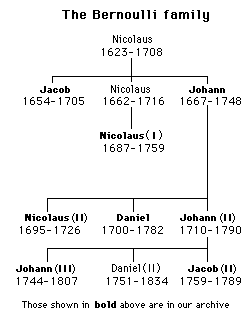
丹尼尔·伯努利是约翰·伯努利的儿子。他出生在格罗宁根,当时他的父亲在那里担任数学讲席。他的哥哥是尼古拉·伯努利二世,他的叔叔是雅各布·伯努利,因此他出生在一个顶尖数学家的家庭,但也是一个存在不幸的竞争、嫉妒和怨恨的家庭。
你可以在THIS LINK看到丹尼尔·伯努利的家谱。
当丹尼尔·伯努利五岁时,全家回到了他们的故乡巴塞尔,丹尼尔·伯努利的父亲填补了他叔叔雅各布·伯努利去世后空出的数学讲席。当丹尼尔·伯努利五岁时,他的弟弟约翰·伯努利二世出生了。三个儿子后来都学习数学,但这并不是约翰·伯努利为丹尼尔·伯努利规划的道路。
约翰·伯努利的父亲曾试图强迫约翰从事商业生涯,他强烈抵制。相当奇怪的是,约翰·伯努利现在对自己的儿子丹尼尔·伯努利也尝试了完全相同的做法。然而,丹尼尔·伯努利首先在13岁时被送到巴塞尔大学学习哲学和逻辑。他在1715年通过了学士学位考试,并在1716年获得了硕士学位。丹尼尔·伯努利像他的父亲一样,真正想学习数学,在巴塞尔学习哲学期间,他从父亲和哥哥尼古拉·伯努利二世那里学习微积分的方法。
约翰决心让丹尼尔·伯努利成为一名商人,他试图让他去做学徒。然而丹尼尔·伯努利像他自己的父亲一样强烈反对,约翰很快让步了,但 certainly 不至于让丹尼尔·伯努利学习数学。约翰宣称数学赚不到钱,所以他把丹尼尔·伯努利送回巴塞尔大学学习医学。丹尼尔·伯努利这样做了,1718年在海德堡、1719年在斯特拉斯堡学习医学。他于1720年回到巴塞尔完成医学博士学位。
到这个阶段,约翰·伯努利准备在儿子学习医学的同时教他更多数学,丹尼尔·伯努利学习了父亲的动能理论。他从父亲那里学到的能量守恒知识应用于他的医学研究,丹尼尔·伯努利写了他的博士论文,主题是呼吸力学。所以像他的父亲一样,丹尼尔·伯努利将数学物理应用于医学,以获得他的医学博士学位。
丹尼尔·伯努利想像他父亲一样开始学术生涯,所以他申请了巴塞尔的两个讲席。他对解剖学和植物学讲席的申请通过抽签决定,他在这场机会游戏中运气不佳。丹尼尔·伯努利申请的巴塞尔下一个空缺讲席是逻辑学讲席,但最终通过抽签选择的机会游戏再次对他不利。由于未能获得学术职位,丹尼尔·伯努利前往威尼斯学习实用医学。
在威尼斯,丹尼尔·伯努利病得很重,因此无法实现前往帕多瓦继续医学研究的打算。然而,在威尼斯期间,他从事数学研究,他的第一部数学著作于1724年出版,当时在克里斯蒂安·哥德巴赫的协助下,Mathematical exercises得以出版。这部著作由四个独立部分组成,是他在威尼斯期间感兴趣的四个主题。
第一部分描述了法罗牌戏,除了表明丹尼尔·伯努利此时正在学习probability的著作外,并不重要。第二部分讨论水从容器孔中流出的问题,并讨论了艾萨克·牛顿的理论(这些理论是错误的)。丹尼尔·伯努利此时尚未解决压力问题,但这项工作再次表明他的兴趣正朝这个方向转移。他关于血液流动和血压的医学工作也使他对方体流动产生了兴趣。Mathematical exercises的第三部分是关于雅各布·黎卡提微分方程的,而最后一部分是关于由两段圆弧所围图形的一个几何问题。
在威尼斯期间,丹尼尔·伯努利还设计了一种用于海上的沙漏,使得即使船在汹涌的海面上摇晃,沙子的细流也能保持恒定。他将关于此的工作提交给了巴黎科学院,并在1725年,也就是他从意大利返回巴塞尔的那一年,得知自己赢得了巴黎科学院的奖金。丹尼尔·伯努利也通过他的著作Mathematical exercises获得了声誉,凭借这一点,他被邀请担任圣彼得堡的数学讲席。他的兄弟尼古拉·伯努利二世也被授予圣彼得堡的数学讲席,因此1725年末,两兄弟前往圣彼得堡。
在他们就任圣彼得堡的职位后八个月内,丹尼尔·伯努利的兄弟因发烧去世。丹尼尔·伯努利被留下,因失去兄弟而极为悲伤,也对严酷的气候非常不满。他想回到巴塞尔,并写信给父亲,告诉他自己在圣彼得堡多么不快乐。约翰·伯努利得以安排他最优秀的学生之一莱昂哈德·欧拉前往圣彼得堡与丹尼尔·伯努利一起工作。莱昂哈德·欧拉于1727年到达,这段在圣彼得堡的时期,直到丹尼尔·伯努利于1733年离开,将是他最多产的时期。
丹尼尔·伯努利在圣彼得堡研究的课题之一是振动系统。正如1在[1]中所写:-
从1728年起,丹尼尔·伯努利和莱昂哈德·欧拉主导了柔性和弹性体的力学研究,那一年他们推导出了这些物体的平衡曲线。……丹尼尔·伯努利确定了完全柔性的线在受到一个分量垂直于曲线、另一个分量平行于给定方向的力作用时所呈现的形状。就这样,他一举推导出了这类曲线的整个系列,如幕曲线、帆曲线、悬链线……
在圣彼得堡期间,他做出了他最著名的发现之一,即定义了系统的简单节点和振荡频率。他证明了乐器弦的运动由无穷多个谐振动叠加在弦上组成。
丹尼尔·伯努利在圣彼得堡期间产生的第二部重要著作是关于概率和政治经济学的。丹尼尔·伯努利假设一个人财富增加所带来的道德价值与该财富量成反比。然后,他将概率赋予一个人赚钱的各种手段,并推导出道德期望增加的期望值。丹尼尔·伯努利将他的一些推论应用于保险。
毫无疑问,丹尼尔·伯努利在圣彼得堡期间最重要的著作是他在流体动力学方面的工作。甚至这个术语本身就源于他题为Hydrodynamica的著作的标题,而且在他离开圣彼得堡之前,丹尼尔·伯努利将这本书的草稿留给了印刷商。然而,这部著作直到1738年才出版,尽管他在1734年至1738年间对其作了相当大的修改,但他更多改变的是表述方式而非实质内容。
这部著作首次对水从容器孔中流出作了正确的分析。这基于他在1720年与父亲一起研究过的能量守恒原理。丹尼尔·伯努利还讨论了水泵和其他提水机械。一个引人注目的发现在Hydrodynamica第10章中出现,其中丹尼尔·伯努利讨论了气体动理论的基础。他能够给出气体理论的基本定律,并且给出了(尽管不是全部细节)一个世纪后由Van der Waals发现的状态方程。
尽管与莱昂哈德·欧拉共事有明显的科学优势,丹尼尔·伯努利在圣彼得堡并不快乐。到1731年,他已在申请巴塞尔的职位,但概率似乎对他不利,他在该职位的投票中落选。该职位既不是数学也不是物理方面的,但丹尼尔·伯努利宁愿回到巴塞尔讲授植物学,也不愿留在圣彼得堡。此时他的弟弟Johann (II) Bernoulli也和他一起在圣彼得堡,他们于1733年离开圣彼得堡,在1734年返回巴塞尔之前访问了但泽、汉堡、荷兰和巴黎。
丹尼尔·伯努利为巴黎科学院1734年的大奖提交了一篇参赛作品,将他的一些思想应用于天文学。这带来了不幸的后果,因为丹尼尔·伯努利的父亲约翰·伯努利也参加了该奖项的角逐,他们的参赛作品被宣布共同获得大奖。这次巴黎科学院奖项事件的结果对丹尼尔·伯努利产生了不幸的后果。他的父亲想到儿子被评得与自己同等而勃然大怒,这导致两人关系破裂。结果是丹尼尔·伯努利发现自己回到了巴塞尔,却被禁止进入父亲的房子。无论这使丹尼尔·伯努利对数学变得不那么感兴趣,还是因为他的学术职位并非数学职位这一事实,可以肯定的是,丹尼尔·伯努利再也没有恢复他在圣彼得堡时表现出的数学研究活力。
尽管丹尼尔·伯努利已经离开圣彼得堡,他立即开始与莱昂哈德·欧拉通信,两人交换了许多关于振动系统的想法。莱昂哈德·欧拉运用他高超的分析技巧,将丹尼尔·伯努利的许多物理洞见转化为严格的数学形式。丹尼尔·伯努利继续打磨他的杰作Hydrodynamica以供出版,并增加了一章,论述流体射流的反作用力和水流对斜面的作用力。在这一章,即第13章中,他还讨论了在船舶推进方面的应用。
巴黎科学院1737年的奖项也有航海主题,即船锚的最佳形状,丹尼尔·伯努利再次共同获得该奖项,这次是与Poleni共同获奖。Hydrodynamica于1738年出版,但在次年约翰·伯努利出版了Hydraulica,该书主要基于他儿子的工作,但Johann试图通过将他书上的出版日期提前到1732年(而非其真实日期,很可能为1739年)来使丹尼尔·伯努利的Hydrodynamica看起来是基于Hydraulica的。这是Johann的一次可耻企图,既想为自己并未做的工作获取荣誉,同时又想贬低自己的儿子,显示出他们之间的恶感已达到何等深度。
可以公平地说,没有证据表明丹尼尔·伯努利对与他父亲关系的破裂有任何责任。相反,有证据表明他试图通过诸如在Hydrodynamica的卷首自称“丹尼尔·伯努利,约翰之子”这样的行为来修复关系。另一个表明丹尼尔·伯努利不像约翰·伯努利和雅各布·伯努利那样嫉妒自己家族成员的迹象是,他确实与他的弟弟约翰·伯努利二世合作发表了成果。
植物学讲座并不是丹尼尔·伯努利想要的,1743年情况有所好转,他得以将这些换成生理学讲座。然而,1750年,他被任命为物理学讲席,并在巴塞尔教授物理学长达26年,直到1776年。他讲授了一些出色的物理学讲座,并在讲座期间进行实验。基于实验证据,他能够推测出某些定律,这些定律直到许多年后才得到验证。其中包括夏尔·奥古斯丁·德·库仑的静电学定律。
在回到巴塞尔的这些年里,丹尼尔·伯努利 确实还做出了其他出色的科学工作。他总共 10 次赢得 巴黎科学院 的大奖,涉及天文学和航海主题。他于 1740 年(与 莱昂哈德·欧拉 共同)因关于 艾萨克·牛顿 潮汐理论的工作获奖;1743 年和 1746 年因关于磁性的论文获奖;1747 年因一种在海上确定时间的方法获奖;1751 年因一篇关于洋流的论文获奖;1753 年因力对船舶的影响获奖;1757 年因关于减少船舶在公海上纵摇和颠簸的建议获奖。
丹尼尔·伯努利工作中另一个在数学物理发展中证明重要的方面,是他接受了许多艾萨克·牛顿的理论,并将这些理论与来自更强大的哥特弗里德·威廉·莱布尼茨微积分的工具结合使用。丹尼尔·伯努利研究力学,再次使用了能量守恒原理,这给出了艾萨克·牛顿基本方程的一个积分。他还使用艾萨克·牛顿的方法研究了物体在阻力介质中的运动。
他还继续在振荡理论方面做出优秀的工作,并在一篇论文中对风琴管中空气的振荡作了精彩的论述。他的长处和短处由Straub在1中总结如下:-
丹尼尔·伯努利活跃而富有想象力的头脑处理了最多样化的科学领域。然而,如此广泛的兴趣常常使他无法将某些项目进行到底。特别不幸的是,他未能跟上从偏微分方程引入数学物理开始的数学的迅速发展。尽管如此,他通过自己在流体动力学方面的工作和发现、对气体动理论的预见、计算资产增值的新方法,以及证明乐器中弦的最常见运动由无穷多个谐振动的叠加组成,确保了自己在科学史上的永久地位……
丹尼尔·伯努利生前备受尊崇。他当选为他那个时代大多数主要科学学会的成员,包括博洛尼亚、St Petersburg、Berlin、Paris、London、伯尔尼、Turin、苏黎世和曼海姆的学会。
Daniel Bernoulli was the son of Johann Bernoulli. He was born in Groningen while his father held the chair of mathematics there. His older brother was Nicolaus (II) Bernoulli and his uncle was Jacob Bernoulli so he was born into a family of leading mathematicians but also into a family where there was unfortunate rivalry, jealousy and bitterness.
You can see the Bernoulli family tree at THIS LINK.
When Daniel was five years old the family returned to their native city of Basel where Daniel's father filled the chair of mathematics left vacant on the death of his uncle Jacob Bernoulli. When Daniel was five years old his younger brother Johann (II) Bernoulli was born. All three sons would go on to study mathematics but this was not the course that Johann Bernoulli planned for Daniel.
Johann Bernoulli's father had tried to force Johann into a business career and he had resisted strongly. Rather strangely Johann Bernoulli now tried exactly the same with his own son Daniel. First however Daniel was sent to Basel University at the age of 13 to study philosophy and logic. He obtained his baccalaureate examinations in 1715 and went on to obtain his master's degree in 1716. Daniel, like his father, really wanted to study mathematics and during the time he studied philosophy at Basel, he was learning the methods of the calculus from his father and his older brother Nicolaus (II) Bernoulli.
Johann was determined that Daniel should become a merchant and he tried to place him in an apprenticeship. However Daniel was as strongly opposed to this as his own father had been and soon Johann relented but certainly not as far as to let Daniel study mathematics. Johann declared that there was no money in mathematics and so he sent Daniel back to Basel University to study medicine. This Daniel did spending time studying medicine at Heidelberg in 1718 and Strasbourg in 1719. He returned to Basel in 1720 to complete his doctorate in medicine.
By this stage Johann Bernoulli was prepared to teach his son more mathematics while he studied medicine and Daniel studied his father's theories of kinetic energy. What he learned on the conservation of energy from his father he applied to his medical studies and Daniel wrote his doctoral dissertation on the mechanics of breathing. So like his father Daniel had applied mathematical physics to medicine in order to obtain his medical doctorate.
Daniel wanted to embark on an academic career like his father so he applied for two chairs at Basel. His application for the chair of anatomy and botany was decided by drawing of lots and he was unlucky in this game of chance. The next chair to fall vacant at Basel that Daniel applied for was the chair of logic, but again the game of chance of the final selection by drawing of lots went against him. Having failed to obtain an academic post, Daniel went to Venice to study practical medicine.
In Venice Daniel was severely ill and so was unable to carry out his intention of travelling to Padua to further his medical studies. However, while in Venice he worked on mathematics and his first mathematical work was published in 1724 when, with Goldbach's assistance, Mathematical exercises was published. This consisted of four separate parts being four topics that had attracted his interest while in Venice.
The first part described the game of faro and is of little importance other than showing that Daniel was learning about probability at this time. The second part was on the flow of water from a hole in a container and discussed Newton's theories (which were incorrect). Daniel had not solved the problem of pressure by this time but again the work shows that his interest was moving in this direction. His medical work on the flow of blood and blood pressure also gave him an interest in fluid flow. The third part of Mathematical exercises was on the Riccati differential equation while the final part was on a geometry question concerning figures bounded by two arcs of a circle.
While in Venice, Daniel had also designed an hour glass to be used at sea so that the trickle of sand was constant even when the ship was rolling in heavy seas. He submitted his work on this to the Paris Academy and in 1725, the year he returned from Italy to Basel, he learnt that he had won the prize of the Paris Academy. Daniel had also attained fame through his work Mathematical exercises and on the strength of this he was invited to take up the chair of mathematics at St Petersburg. His brother Nicolaus (II) Bernoulli was also offered a chair of mathematics at St Petersburg so in late 1725 the two brothers travelled to St Petersburg.
Within eight months of their taking up the appointments in St Petersburg Daniel's brother died of fever. Daniel was left, greatly saddened at the loss of his brother and also very unhappy with the harsh climate. He thought of returning to Basel and wrote to his father telling him how unhappy he was in St Petersburg. Johann Bernoulli was able to arrange for one of his best pupils, Leonard Euler, to go to St Petersburg to work with Daniel. Euler arrived in 1727 and this period in St Petersburg, which Daniel left in 1733, was to be his most productive time.
One of the topics which Daniel studied in St Petersburg was that of vibrating systems. As Straub writes in [1]:-
From 1728, Bernoulli and Euler dominated the mechanics of flexible and elastic bodies, in that year deriving the equilibrium curves for these bodies. ... Bernoulli determined the shape that a perfectly flexible thread assumes when acted upon by forces of which one component is vertical to the curve and the other is parallel to a given direction. Thus, in one stroke he derived the entire series of such curves as the velaria, lintearia, catenaria...
While in St Petersburg he made one of his most famous discoveries when he defined the simple nodes and the frequencies of oscillation of a system. He showed that the movements of strings of musical instruments are composed of an infinite number of harmonic vibrations all superimposed on the string.
A second important work which Daniel produced while in St Petersburg was one on probability and political economy. Daniel makes the assumption that the moral value of the increase in a person's wealth is inversely proportional to the amount of that wealth. He then assigns probabilities to the various means that a person has to make money and deduces an expectation of increase in moral expectation. Daniel applied some of his deductions to insurance.
Undoubtedly the most important work which Daniel Bernoulli did while in St Petersburg was his work on hydrodynamics. Even the term itself is based on the title of the work which he produced called Hydrodynamica and, before he left St Petersburg, Daniel left a draft copy of the book with a printer. However the work was not published until 1738 and although he revised it considerably between 1734 and 1738, it is more the presentation that he changed rather then the substance.
This work contains for the first time the correct analysis of water flowing from a hole in a container. This was based on the principle of conservation of energy which he had studied with his father in 1720. Daniel also discussed pumps and other machines to raise water. One remarkable discovery appears in Chapter 10 of Hydrodynamica where Daniel discussed the basis for the kinetic theory of gases. He was able to give the basic laws for the theory of gases and gave, although not in full detail, the equation of state discovered by Van der Waals a century later.
Daniel Bernoulli was not happy in St Petersburg, despite the obvious scientific advantage of working with Euler. By 1731 he was applying for posts in Basel but probability seemed to work against him and he would lose out in the ballot for the post. The post was neither one in mathematics nor physics but Daniel preferred to return to Basel and give lectures on botany rather than remain in St Petersburg. By this time his younger brother Johann (II) Bernoulli was also with him in St Petersburg and they left St Petersburg in 1733, making visits to Danzig, Hamburg, Holland and Paris before returning to Basel in 1734.
Daniel Bernoulli submitted an entry for the Grand Prize of the Paris Academy for 1734 giving an application of his ideas to astronomy. This had unfortunate consequences since Daniel's father, Johann Bernoulli, also entered for the prize and their entries were declared joint winners of the Grand Prize. The result of this episode of the prize of the Paris Academy had unhappy consequences for Daniel. His father was furious to think that his son had been rated as his equal and this resulted in a breakdown in relationships between the two. The outcome was that Daniel found himself back in Basel but banned from his father's house. Whether this caused Daniel to become less interested in mathematics or whether it was the fact that his academic position was a non mathematical one, certainly Daniel never regained the vigour for mathematical research that he showed in St Petersburg.
Although Daniel had left St Petersburg, he began an immediate correspondence with Euler and the two exchanged many ideas on vibrating systems. Euler used his great analytic skills to put many of Daniel's physical insights into a rigorous mathematical form. Daniel continued to work on polishing his masterpiece Hydrodynamica for publication and added a chapter on the force of reaction of a jet of fluid and the force of a jet of water on an inclined plane. In this chapter, Chapter 13, he also discussed applications to the propulsion of ships.
The 1737 prize of the Paris Academy also had a nautical theme, the best shape for a ship's anchor, and Daniel Bernoulli was again the joint winner of this prize, this time jointly with Poleni. Hydrodynamica was published in 1738 but, in the following year Johann Bernoulli published Hydraulica which is largely based on his son's work but Johann tried to make it look as if Daniel had based Hydrodynamica on Hydraulica by predating the date of publication on his book to 1732 instead of its real date which is probably 1739. This was a disgraceful attempt by Johann to gain credit for work which was not his and at the same time to discredit his own son and shows the depths to which the bad feeling between them had reached.
It is fair to say that there is no evidence that Daniel was in any way to blame for the breakdown of relationships with his father. Rather the reverse since there is evidence that he tried to mend the relationship with such acts as describing himself on the frontispiece of Hydrodynamica as 'Daniel Bernoulli, son of Johann'. Another sign that Daniel was not jealous of members of his own family in the way the Johann Bernoulli and Jacob Bernoulli had been is the fact that he did produce joint work with his younger brother Johann (II) Bernoulli.
Botany lectures were not what Daniel wanted and things became better for him in 1743 when he was able to exchange these for physiology lectures. In 1750, however, he was appointed to the chair of physics and taught physics at Basel for 26 years until 1776. He gave some remarkable physics lectures with experiments performed during the lectures. Based on experimental evidence he was able to conjecture certain laws which were not verified until many years later. Among these was Coulomb's law in electrostatics.
Daniel Bernoulli did produce other excellent scientific work during these many years back in Basel. In total he won the Grand Prize of the Paris Academy 10 times, for topics in astronomy and nautical topics. He won in 1740 (jointly with Euler) for work on Newton's theory of the tides; in 1743 and 1746 for essays on magnetism; in 1747 for a method to determine time at sea; in 1751 for an essay on ocean currents; in 1753 for the effects of forces on ships; and in 1757 for proposals to reduce the pitching and tossing of a ship in high seas.
Another important aspect of Daniel Bernoulli's work that proved important in the development of mathematical physics was his acceptance of many of Newton's theories and his use of these together with the tolls coming from the more powerful calculus of Leibniz. Daniel worked on mechanics and again used the principle of conservation of energy which gave an integral of Newton's basic equations. He also studied the movement of bodies in a resisting medium using Newton's methods.
He also continued to produce good work on the theory of oscillations and in a paper he gave a beautiful account of the oscillation of air in organ pipes. His strengths and weaknesses are summed up by Straub in [1]:-
Bernoulli's active and imaginative mind dealt with the most varied scientific areas. Such wide interests, however, often prevented him from carrying some of his projects to completion. It is especially unfortunate that he could not follow the rapid growth of mathematics that began with the introduction of partial differential equations into mathematical physics. Nevertheless he assured himself a permanent place in the history of science through his work and discoveries in hydrodynamics, his anticipation of the kinetic theory of gases, a novel method for calculating the value of an increase in assets, and the demonstration that the most common movement of a string in a musical instrument is composed of the superposition of an infinite number of harmonic vibrations...
Daniel Bernoulli was much honoured in his own lifetime. He was elected to most of the leading scientific societies of his day including those in Bologna, St Petersburg, Berlin, Paris, London, Bern, Turin, Zürich and Mannheim.
正文里的方括号编号指向这里,悬停即可直接看到条目。书目保留原文——译了书名反而查不到文献。
原站列出的延伸阅读与外部数据库,照原样保留,目标多为英文页面。
关于丹尼尔·伯努利的其它页面:
原站的交叉引用。指向本站已镜像专题的留在站内,其余仍指回原站。