数学家传记
皮埃尔·西蒙·拉普拉斯证明了太阳系的稳定性。在分析中,皮埃尔·西蒙·拉普拉斯引入了势函数和皮埃尔·西蒙·拉普拉斯系数。他还将数学概率论置于坚实的基础上。
皮埃尔·西蒙·拉普拉斯的父亲Pierre Laplace,在苹果酒贸易中相当富裕。拉普拉斯的母亲玛丽-安妮·索雄,来自一个相当富裕的农民家庭,在图尔热维尔拥有土地。许多关于拉普拉斯的记述说他的家庭是“贫穷的农民”或“农民佃户”,但这些说法似乎相当不准确,尽管除了一个被认为是中学数学教师的叔叔外,几乎没有学术成就的证据。这在[1]中是这样表述的:-
除了对有教养的外省资产阶级和小乡绅所能期望的之外,这个家族中几乎没有智力出众的记录。
拉普拉斯在7岁至16岁期间,作为走读生就读于博蒙昂诺日的本笃会小修道院学校。他的父亲期望他在教会中谋得职业,而事实上,小修道院学校的学生通常的去向要么是教会,要么是军队。16岁时,拉普拉斯进入卡昂大学。由于他仍打算进入教会,便注册学习神学。然而,在卡昂大学的两年间,拉普拉斯发现了自己的数学才能和对这门学科的热爱。这主要归功于卡昂的两位数学教师C Gadbled和P Le Canu,关于他们除了认识到拉普拉斯巨大的数学潜力之外,所知甚少。
一旦知道数学将成为自己的专业,拉普拉斯没有取得学位就离开了卡昂,前往巴黎。他带上了他在卡昂的老师Le Canu写给让·勒朗·达朗贝尔的一封介绍信。尽管拉普拉斯到达巴黎时只有19岁,他很快给让·勒朗·达朗贝尔留下了深刻印象。让·勒朗·达朗贝尔不仅开始指导拉普拉斯的数学研究,还试图为他找到一个职位,以挣得足够的钱在巴黎维持生活。为这样一位才华横溢的年轻人找到职位并不困难,拉普拉斯很快被任命为军事学校的数学教授。Gillespie在[1]中写道:-
向出身良好、成绩平平、对科目并无投入的青少年士官生传授几何、三角、初等分析和静力学,提供的激励甚少,但这个职位确实使拉普拉斯得以留在巴黎。
他开始源源不断地写出非凡的数学论文,第一篇于1770年3月28日提交给巴黎的Académie des Sciences。这第一篇论文,向学会宣读但未发表,是关于曲线的极大值和极小值,他在其中改进了约瑟夫·拉格朗日给出的方法。他的下一篇提交给科学院的论文紧随其后,1770年7月18日,他宣读了一篇关于差分方程的论文。
拉普拉斯第一篇即将付印的论文是关于积分学的,他将其翻译成拉丁文,并于1771年在莱比锡的Nova acta eruditorum中发表。六年后,拉普拉斯重新发表了改进版,为1771年的论文道歉,并将其中包含的错误归咎于印刷商。拉普拉斯还将关于极大值和极小值的论文翻译成拉丁文,并于1774年在Nova acta eruditorum中发表。同样在1771年,拉普拉斯将另一篇论文Recherches sur le calcul intégral aux différences infiniment petites, et aux différences finiesⓉ(关于无穷小差和有限差的计算研究)寄给Mélanges de Turin。这篇论文包含的方程,拉普拉斯声称在力学和物理天文学中很重要。
1771年标志着拉普拉斯首次尝试当选Académie des Sciences,但亚历山大-泰奥菲勒·范德蒙德更受青睐。拉普拉斯在1772年再次尝试入选,但这次Cousin当选。尽管只有23岁(而Cousin 33岁),拉普拉斯对被一个明显远逊于他的数学家取代感到非常愤怒。让·勒朗·达朗贝尔也一定感到失望,因为在1773年1月1日,他写信给约瑟夫·拉格朗日——Berlin Academy of Science的数学主任,询问是否有可能让拉普拉斯当选柏林科学院,并在柏林为拉普拉斯找到一个职位。
在约瑟夫·拉格朗日能够对让·勒朗·达朗贝尔的请求采取行动之前,拉普拉斯又有了一个进入Paris Académie的机会。1773年3月31日,他当选为Académie des Sciences的助理。到他当选时,他在不到三年内向Académie宣读了13篇论文。尼古拉·德·孔多塞——Académie的常务秘书——对如此多高质量、涵盖广泛主题的论文发表了评论。
我们已经提到了拉普拉斯的一些早期工作。他不仅对差分方程和微分方程做出了重大贡献,还研究了对数学天文学和theory of probability的应用,这两个主要主题将贯穿他的一生。他在当选科学院之前对数学天文学的工作包括行星轨道倾角的工作、行星如何受到其卫星扰动的研究,以及在1771年11月27日向Académie宣读的一篇论文中,他研究了行星的运动,这将是后来关于太阳系稳定性杰作的第一步。
拉普拉斯的声誉在1770年代稳步上升。正是在这一时期,他[1]:-
……确立了他的风格、声誉、哲学立场、某些数学技巧,以及在概率和天体力学这两个领域中的研究纲领,此后他一生都在数学上致力于这两个领域。
18世纪80年代是拉普拉斯产出大量深刻成果的时期,这些成果使他成为世界上最重要、最有影响力的科学家之一。然而,这并非是在与同事保持良好关系的情况下取得的。尽管让·勒朗·达朗贝尔曾自豪地把拉普拉斯视为自己的门生,但他肯定开始感到拉普拉斯正迅速使他自己一生中的许多工作变得过时,这丝毫没有改善两人的关系。拉普拉斯试图通过强调让·勒朗·达朗贝尔工作的重要性来减轻让·勒朗·达朗贝尔的痛苦,因为他无疑对让·勒朗·达朗贝尔所给予的帮助和支持心怀好感。
看来拉普拉斯对自己的能力和成就并不谦虚,而且他很可能没有意识到自己的态度对同事造成的影响。安德斯·约翰·莱克塞尔于1780—81年在巴黎访问了Académie des Sciences,并报告说拉普拉斯广泛让人知道他认为自己是法国最好的数学家。拉普拉斯确实如此这一事实,对他同事所受的刺激也只能稍有缓解!拉普拉斯对各门科学都有广博的知识,并在Académie中主导一切讨论。正如安德斯·约翰·莱克塞尔所写:
……在科学院中,他想对一切事情发号施令。
正是在安德斯·约翰·莱克塞尔逗留巴黎期间,拉普拉斯涉足了一个新的科学领域[2]:
拉普拉斯和化学家路易·安托万拉瓦锡于1780年将定量方法应用于生命系统与非生命系统的比较,借助他们发明的一种冰量热器,表明呼吸是一种燃烧形式。
拉普拉斯很快又回到了对数学天文学的研究,他与拉瓦锡的这项工作标志着拉普拉斯第三个重要研究领域的开端,即他在物理学方面的工作,特别是他职业生涯后期所研究的热理论。
1784年,拉普拉斯被任命为皇家炮兵团的考官,并在1785年以此身份考核并通过了16岁的拿破仑·波拿巴。事实上,这个职位使拉普拉斯需要撰写大量关于他所考核的学员的报告,但回报是他为法国政府部长和其他有权势的人所熟知。
拉普拉斯在Académie des Sciences的许多委员会中任职,例如约瑟夫·拉格朗日在1782年写信给他,说他的Traité de mécanique analytique工作已接近完成,并成立了一个由皮埃尔·西蒙·拉普拉斯、Cousin、阿德里安-马里·勒让德和尼古拉·德·孔多塞组成的Académie des Sciences委员会来决定出版事宜。拉普拉斯还任职于一个为调查巴黎最大医院而设立的委员会,他运用自己在概率方面的专长,将该医院的死亡率与法国其他地方及其他地区的医院死亡率进行比较。
拉普拉斯于1785年被提升到Académie des Sciences的一个高级职位。两年后,约瑟夫·拉格朗日离开柏林,加入拉普拉斯,成为巴黎Académie des Sciences的成员。于是两位伟大的数学天才在巴黎走到了一起,尽管他们之间存在竞争,但每人都从对方涌现出的思想中受益匪浅。拉普拉斯于1788年5月15日结婚。他的妻子玛丽-夏洛特·德·库尔蒂·德·罗芒热比39岁的拉普拉斯年轻20岁。他们有两个孩子,儿子夏尔-埃米尔生于1789年,后来走上了军事生涯。
1790年5月,拉普拉斯被任命为Académie des Sciences委员会的成员,负责统一度量衡。该委员会致力于公制,并主张采用十进制。1793年,恐怖统治开始,Académie des Sciences与其他学术团体一起于8月8日被取缔。度量衡委员会是唯一被允许继续存在的,但很快拉普拉斯与拉瓦锡、让-夏尔·德博尔达、夏尔·奥古斯丁·德·库仑、Brisson和让·巴蒂斯特·约瑟夫·德朗布尔一起被逐出委员会,因为委员会的所有成员都必须具备:-
……他们的共和美德和对国王的仇恨。
在1793年恐怖统治之前,拉普拉斯与妻子和两个孩子离开巴黎,住在巴黎东南50公里处。直到1794年7月之后,他才回到巴黎。尽管拉普拉斯设法避免了大革命期间一些同事的命运,例如拉瓦锡在1794年5月被送上断头台,当时拉普拉斯不在巴黎,但他确实经历了一些困难时期。他与约瑟夫·拉格朗日和拉朗德一起,就大革命的新历法接受了咨询。拉普拉斯深知所提议的方案并不真正可行,因为所提议的一年的长度与天文数据不符。然而,他足够明智,没有试图用科学事实来推翻政治教条。他也遵从了关于将角度按公制细分为100个分度的决定,或许还更为乐意。
1795年,师范学校成立,旨在培训学校教师,拉普拉斯在那里授课,包括1795年讲授的一门概率课程。师范学校只存在了四个月,因为1200名正在接受培训以成为学校教师的学生发现教学水平远远超出了他们的能力。这完全可以理解。后来,拉普拉斯将他在师范学校的课程讲义整理成Essai philosophique sur les probabilités,于1814年出版。对Essai的一篇评论指出:-
……在关于概率论原理的一般性介绍之后,人们会发现对大量应用的讨论,包括机会游戏、自然哲学、道德科学、证词、司法判决和死亡率等方面的应用。
1795年,Académie des Sciences作为国家科学与艺术研究院重新开放。同样在1795年,经度局成立,约瑟夫·拉格朗日和拉普拉斯是其创始成员中的数学家,而拉普拉斯后来领导了经度局和巴黎天文台。然而,尽管有些人认为他在这些职位上做得很好,另一些人则批评他过于理论化。让·巴蒂斯特·约瑟夫·德朗布尔几年后写道:-
……绝不应该让一位几何学家领导天文台;他会忽视所有观测,除了那些他的公式所需的观测。
让·巴蒂斯特·约瑟夫·德朗布尔还就拉普拉斯对经度局的领导写道:-
人们可以责备[拉普拉斯]这样一个事实:在经度局存在20多年里,它没有确定过一颗恒星的位置,也没有着手编制哪怕最小的星表。
拉普拉斯于1796年在Exposition du systeme du monde Ⓣ(《宇宙体系解说》)中提出了他著名的星云假说,该假说认为太阳系起源于一大片扁平、缓慢旋转的白炽气体云的收缩和冷却。Exposition由五卷组成:第一卷论述天体的视运动、海洋的运动以及大气折射;第二卷论述天体的真实运动;第三卷论述力和动量;第四卷论述万有引力理论,并包括对海洋运动和地球形状的说明;最后一卷给出了天文学的历史叙述,并包括他著名的星云假说。拉普拉斯在Exposition中如下陈述了他的科学哲学:-
如果人仅限于收集事实,科学就只是一种贫瘠的命名法,他也就永远不会知道自然的伟大定律。正是在将现象相互比较、力求把握它们之间的关系时,他才被引导去发现这些定律……
鉴于现代关于彗星撞击地球的理论,看到拉普拉斯对此 remarkably modern 的观点特别有趣:-
……地球与彗星碰撞的小概率在历经多个世纪的累加后可能变得非常大。很容易想象这种撞击对地球的影响。自转轴和自转运动发生了变化,海洋放弃了它们原来的位置……大量的人和动物在这场普遍的大洪水中溺亡,或被施加于地球的剧烈震颤所毁灭。
Exposition du systeme du monde Ⓣ(《宇宙体系论述》)是作为拉普拉斯最重要著作Traité de Mécanique Céleste Ⓣ(《天体力学论》)的非数学导论而写的,后者的第一卷三年后出版。拉普拉斯已经发现了行星平均运动的不变性。1786年,他证明了行星轨道的偏心率和相互倾角始终很小、恒定且能自我校正。这些以及他早期的许多其他成果构成了他伟大著作Traité de Mécanique Céleste Ⓣ(《天体力学论》)的基础,该书分5卷出版,前两卷于1799年问世。
Mécanique Céleste Ⓣ(《天体力学论》)的第一卷分为两篇,第一篇论述固体和流体的平衡与运动的一般定律,第二篇论述万有引力定律以及太阳系中各物体重心的运动。这里主要的数学方法是建立微分方程并求解以描述由此产生的运动。第二卷讨论应用于行星研究的力学。在其中,拉普拉斯包含了对地球形状的研究,其中包括对从几次不同探险获得的数据的讨论,而拉普拉斯将他的误差理论应用于这些结果。拉普拉斯在此研究的另一个主题是潮汐理论,但乔治·比德尔·艾里在近50年后给出自己的结果时写道:-
以拉普拉斯给出该理论的同样形式来提供这一理论将是无用的;因为《天体力学》中包含潮汐理论的那部分也许总体上比任何其他部分都更为晦涩……
在Mécanique Céleste Ⓣ(《天体力学论》)中出现了拉普拉斯方程,但尽管我们现在以拉普拉斯命名这个方程,它实际上在拉普拉斯时代之前就已为人所知。阿德里安-马里·勒让德函数也出现在这里,并多年来被称为拉普拉斯系数。Mécanique Céleste Ⓣ(《天体力学论》)并未将许多思想归功于他人的工作,但拉普拉斯深受约瑟夫·拉格朗日和阿德里安-马里·勒让德的影响,并使用了他们发展出的方法,却很少提及这些思想的创始者。
拉普拉斯曾是元老院成员,后任元老院议长,并于1805年获得荣誉军团勋章。然而拿破仑在圣赫勒拿岛撰写的回忆录中说,他在1799年将拉普拉斯从内政部长的职位上撤职,仅六周之后:-
……因为他把无穷小的精神带进了政府。
拉普拉斯于1806年成为帝国伯爵,波旁王朝复辟后,他于1817年被封为侯爵。
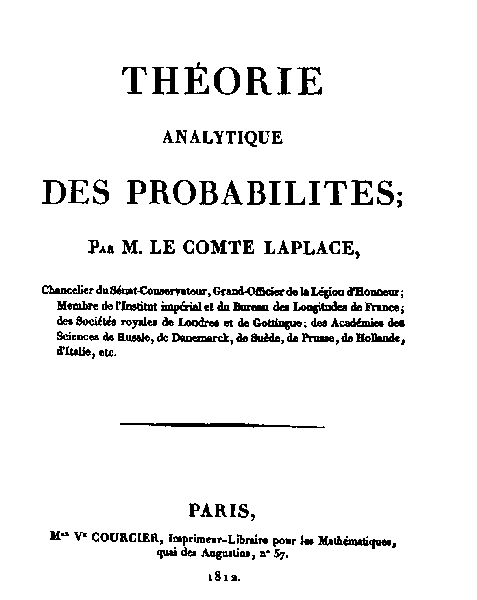
拉普拉斯 的 Théorie Analytique des Probabilités Ⓣ(《概率的分析理论》)第一版于1812年出版。这第一版献给拿破仑大帝,但出于显而易见的原因,在后来的版本中删去了献词!这部著作由两册组成,两年后的第二版使材料增加了约30%。
第一册研究生成函数以及概率论中出现的各种表达式的近似。第二册包含 拉普拉斯 对概率的定义、托马斯·贝叶斯 法则(多年后由 儒勒·昂利·庞加莱 如此命名),以及关于道德期望和数学期望的评论。该书接着讨论了当复合事件的简单分量的概率已知时求复合事件概率的方法,然后讨论了最小二乘法、布丰 的针问题以及逆概率。书中给出了对死亡率、预期寿命和婚姻持续时间的应用,最后 拉普拉斯 考察了法律事务中的道德期望和概率。
Théorie Analytique des Probabilités Ⓣ(《概率的分析理论》)的 later 版本还包含补篇,考虑概率在以下方面的应用:观测中的误差;木星、土星和天王星质量的确定;测量中的三角测量方法;以及大地测量学问题,特别是法国子午线的确定。这项工作大部分由 拉普拉斯 在1817年至1819年间完成,并出现在1820年版的 Théorie Analytique Ⓣ(《分析理论》)中。一个不那么令人印象深刻的第四补篇,回到生成函数这一最初主题,随1825年版出现。这最后的补篇由 拉普拉斯 提交给研究院,他当时已76岁,并由他的儿子提交。
我们上面简要提到了拉普拉斯在1780年关于物理学的第一部著作,这不在他贡献巨大的力学领域之内。大约在1804年,拉普拉斯似乎发展出了一种对物理学的研究方法,这种方法在此后若干年中极具影响力。这一点最好由拉普拉斯本人来解释:-
……我试图确立,自然现象最终可以归结为分子与分子之间的超距作用,并且对这些作用的考虑必须作为这些现象的数学理论的基础。
这种物理学方法试图从分子之间局部作用的力来解释一切,他已经在1805年出版的Mécanique CélesteⓉ(天体力学)第四卷中使用了这种方法。这一卷基于这种新的物理学哲学,包含了对压力和密度、天文折射、气压以及引力传递的研究。值得指出的是,这是一种新方法,不是因为分子理论是新的,而是因为它被应用于比以往任何理论都广泛得多的问题范围,而且正如拉普拉斯的典型风格,它比以往任何理论都更加数学化。
拉普拉斯渴望在物理学中发挥主导作用,这使他在1805年左右成为阿格伊学会的创始成员。他与化学家贝托莱一起,在他们位于巴黎南郊阿格伊的家中建立了这个学会。属于这个活跃科学家团体的数学家包括让-巴蒂斯特·毕奥和西莫恩·德尼·泊松。该团体强烈主张以数学方法研究科学,其中拉普拉斯发挥了主导作用。这标志着拉普拉斯影响力的顶峰,他也在研究院中占据主导地位,并对巴黎综合理工学院以及学生在那里学习的课程产生了强大影响。
在Mécanique CélesteⓉ(天体力学)第四卷出版后,拉普拉斯继续将他的物理学思想应用于其他问题,如毛细作用(1806-07)、双折射(1809)、声速(1816)、热理论,特别是冷却地球的形状和自转(1817-1820),以及弹性流体(1821)。然而在此期间,他在法国科学中的主导地位终结了,其他持有不同物理理论的人开始变得重要起来。
阿格伊学会在几年高度活跃之后,开始变得不那么活跃,大约在1812年会议变得不那么规律。次年会议完全停止。曾是学会坚定成员的弗朗索瓦·阿拉戈,在1815年左右开始支持奥古斯丁·菲涅耳提出的光的波动说,这与拉普拉斯所支持并发展的微粒说直接对立。拉普拉斯的许多其他物理理论受到攻击,例如他的热质说与亚历克西·泰雷兹·珀蒂和约瑟夫·傅里叶的工作不一致。然而,拉普拉斯并不承认他的物理理论有误,仍然相信热和光的流体,在70多岁时还撰写关于这些主题的论文。
在他的影响力下降之时,个人悲剧袭击了拉普拉斯。他唯一的女儿索菲-苏珊娜嫁给了波尔特侯爵,于1813年死于分娩。然而孩子活了下来,拉普拉斯的后代正是通过她延续的。拉普拉斯的儿子夏尔-埃米尔活到85岁,但没有子女。
拉普拉斯总是随着当时政治事件的变化而改变自己的观点,调整自己的意见以适应这一时期典型的频繁政治变动。这种行为方式增添了他在1790年代和1800年代的成功,但对他与同事的个人关系肯定毫无帮助,同事们认为他的观点变化仅仅是为了赢得青睐。1814年,拉普拉斯支持波旁王朝复辟,并在元老院投票反对拿破仑。次年的百日王朝令他难堪,他方便地在这个关键时期离开了巴黎。此后他仍然是波旁王朝的支持者,在政界变得不受欢迎。当他在1826年拒绝签署法国科学院支持新闻自由的文书时,他失去了在政界仅存的朋友。
1827年3月5日星期一早晨,拉普拉斯去世。很少有事件会让科学院取消会议,但那天他们取消了,以表示对这位有史以来最伟大科学家之一的敬意。令人惊讶的是,没有迅速决定填补他去世后留下的空缺,French Academy of Sciences在1827年10月决定再过6个月才填补空缺,但当时并未任命,又过了几个月,Puissant才被选为拉普拉斯的继任者。
Pierre-Simon Laplace's father, Pierre Laplace, was comfortably well off in the cider trade. Laplace's mother, Marie-Anne Sochon, came from a fairly prosperous farming family who owned land at Tourgéville. Many accounts of Laplace say his family were 'poor farming people' or 'peasant farmers' but these seem to be rather inaccurate although there is little evidence of academic achievement except for an uncle who is thought to have been a secondary school teacher of mathematics. This is stated in [1] in these terms:-
There is little record of intellectual distinction in the family beyond what was to be expected of the cultivated provincial bourgeoisie and the minor gentry.
Laplace attended a Benedictine priory school in Beaumont-en-Auge, as a day pupil, between the ages of 7 and 16. His father expected him to make a career in the Church and indeed either the Church or the army were the usual destinations of pupils at the priory school. At the age of 16 Laplace entered Caen University. As he was still intending to enter the Church, he enrolled to study theology. However, during his two years at the University of Caen, Laplace discovered his mathematical talents and his love of the subject. Credit for this must go largely to two teachers of mathematics at Caen, C Gadbled and P Le Canu of whom little is known except that they realised Laplace's great mathematical potential.
Once he knew that mathematics was to be his subject, Laplace left Caen without taking his degree, and went to Paris. He took with him a letter of introduction to d'Alembert from Le Canu, his teacher at Caen. Although Laplace was only 19 years old when he arrived in Paris he quickly impressed d'Alembert. Not only did d'Alembert begin to direct Laplace's mathematical studies, he also tried to find him a position to earn enough money to support himself in Paris. Finding a position for such a talented young man did not prove hard, and Laplace was soon appointed as professor of mathematics at the École Militaire. Gillespie writes in [1]:-
Imparting geometry, trigonometry, elementary analysis, and statics to adolescent cadets of good family, average attainment, and no commitment to the subjects afforded little stimulus, but the post did permit Laplace to stay in Paris.
He began producing a steady stream of remarkable mathematical papers, the first presented to the Académie des Sciences in Paris on 28 March 1770. This first paper, read to the Society but not published, was on maxima and minima of curves where he improved on methods given by Lagrange. His next paper for the Academy followed soon afterwards, and on 18 July 1770 he read a paper on difference equations.
Laplace's first paper which was to appear in print was one on the integral calculus which he translated into Latin and published at Leipzig in the Nova acta eruditorum in 1771. Six years later Laplace republished an improved version, apologising for the 1771 paper and blaming errors contained in it on the printer. Laplace also translated the paper on maxima and minima into Latin and published it in the Nova acta eruditorum in 1774. Also in 1771 Laplace sent another paper Recherches sur le calcul intégral aux différences infiniment petites, et aux différences finies Ⓣ to the Mélanges de Turin. This paper contained equations which Laplace stated were important in mechanics and physical astronomy.
The year 1771 marks Laplace's first attempt to gain election to the Académie des Sciences but Vandermonde was preferred. Laplace tried to gain admission again in 1772 but this time Cousin was elected. Despite being only 23 (and Cousin 33) Laplace felt very angry at being passed over in favour of a mathematician who was so clearly markedly inferior to him. D'Alembert also must have been disappointed for, on 1 January 1773, he wrote to Lagrange, the Director of Mathematics at the Berlin Academy of Science, asking him whether it might be possible to have Laplace elected to the Berlin Academy and for a position to be found for Laplace in Berlin.
Before Lagrange could act on d'Alembert's request, another chance for Laplace to gain admission to the Paris Académie arose. On 31 March 1773 he was elected an adjoint in the Académie des Sciences. By the time of his election he had read 13 papers to the Académie in less than three years. Condorcet, who was permanent secretary to the Académie, remarked on this great number of quality papers on a wide range of topics.
We have already mentioned some of Laplace's early work. Not only had he made major contributions to difference equations and differential equations but he had examined applications to mathematical astronomy and to the theory of probability, two major topics which he would work on throughout his life. His work on mathematical astronomy before his election to the Academy included work on the inclination of planetary orbits, a study of how planets were perturbed by their moons, and in a paper read to the Académie on 27 November 1771 he made a study of the motions of the planets which would be the first step towards his later masterpiece on the stability of the solar system.
Laplace's reputation steadily increased during the 1770s. It was the period in which he [1]:-
... established his style, reputation, philosophical position, certain mathematical techniques, and a programme of research in two areas, probability and celestial mechanics, in which he worked mathematically for the rest of his life.
The 1780s were the period in which Laplace produced the depth of results which have made him one of the most important and influential scientists that the world has seen. It was not achieved, however, with good relationships with his colleagues. Although d'Alembert had been proud to have considered Laplace as his protégé, he certainly began to feel that Laplace was rapidly making much of his own life's work obsolete and this did nothing to improve relations. Laplace tried to ease the pain for d'Alembert by stressing the importance of d'Alembert's work since he undoubtedly felt well disposed towards d'Alembert for the help and support he had given.
It does appear that Laplace was not modest about his abilities and achievements, and he probably failed to recognise the effect of his attitude on his colleagues. Lexell visited the Académie des Sciences in Paris in 1780-81 and reported that Laplace let it be known widely that he considered himself the best mathematician in France. The effect on his colleagues would have been only mildly eased by the fact that Laplace was right! Laplace had a wide knowledge of all sciences and dominated all discussions in the Académie. As Lexell wrote:-
... in the Academy he wanted to pronounce on everything.
It was while Lexell was in Paris that Laplace made an excursion into a new area of science [2]:-
Applying quantitative methods to a comparison of living and nonliving systems, Laplace and the chemist Antoine Lavoisier in 1780, with the aid of an ice calorimeter that they had invented, showed respiration to be a form of combustion.
Although Laplace soon returned to his study of mathematical astronomy, this work with Lavoisier marked the beginning of a third important area of research for Laplace, namely his work in physics particularly on the theory of heat which he worked on towards the end of his career.
In 1784 Laplace was appointed as examiner at the Royal Artillery Corps, and in this role in 1785, he examined and passed the 16 year old Napoleon Bonaparte. In fact this position gave Laplace much work in writing reports on the cadets that he examined but the rewards were that he became well known to the ministers of the government and others in positions of power in France.
Laplace served on many of the committees of the Académie des Sciences, for example Lagrange wrote to him in 1782 saying that work on his Traité de mécanique analytique was almost complete and a committee of the Académie des Sciences comprising of Laplace, Cousin, Legendre and Condorcet was set up to decide on publication. Laplace served on a committee set up to investigate the largest hospital in Paris and he used his expertise in probability to compare mortality rates at the hospital with those of other hospitals in France and elsewhere.
Laplace was promoted to a senior position in the Académie des Sciences in 1785. Two years later Lagrange left Berlin to join Laplace as a member of the Académie des Sciences in Paris. Thus the two great mathematical geniuses came together in Paris and, despite a rivalry between them, each was to benefit greatly from the ideas flowing from the other. Laplace married on 15 May 1788. His wife, Marie-Charlotte de Courty de Romanges, was 20 years younger than the 39 year old Laplace. They had two children, their son Charles-Émile who was born in 1789 went on to a military career.
Laplace was made a member of the committee of the Académie des Sciences to standardise weights and measures in May 1790. This committee worked on the metric system and advocated a decimal base. In 1793 the Reign of Terror commenced and the Académie des Sciences, along with the other learned societies, was suppressed on 8 August. The weights and measures commission was the only one allowed to continue but soon Laplace, together with Lavoisier, Borda, Coulomb, Brisson and Delambre were thrown off the commission since all those on the committee had to be worthy:-
... by their Republican virtues and hatred of kings.
Before the 1793 Reign of Terror Laplace together with his wife and two children left Paris and lived 50 km southeast of Paris. He did not return to Paris until after July 1794. Although Laplace managed to avoid the fate of some of his colleagues during the Revolution, such as Lavoisier who was guillotined in May 1794 while Laplace was out of Paris, he did have some difficult times. He was consulted, together with Lagrange and Laland, over the new calendar for the Revolution. Laplace knew well that the proposed scheme did not really work because the length of the proposed year did not fit with the astronomical data. However he was wise enough not to try to overrule political dogma with scientific facts. He also conformed, perhaps more happily, to the decisions regarding the metric division of angles into 100 subdivisions.
In 1795 the École Normale was founded with the aim of training school teachers and Laplace taught courses there including one on probability which he gave in 1795. The École Normale survived for only four months for the 1200 pupils, who were training to become school teachers, found the level of teaching well beyond them. This is entirely understandable. Later Laplace wrote up the lectures of his course at the École Normale as Essai philosophique sur les probabilités published in 1814. A review of the Essai states:-
... after a general introduction concerning the principles of probability theory, one finds a discussion of a host of applications, including those to games of chance, natural philosophy, the moral sciences, testimony, judicial decisions and mortality.
In 1795 the Académie des Sciences was reopened as the Institut National des Sciences et des Arts. Also in 1795 the Bureau des Longitudes was founded with Lagrange and Laplace as the mathematicians among its founding members and Laplace went on to lead the Bureau and the Paris Observatory. However although some considered he did a fine job in these posts others criticised him for being too theoretical. Delambre wrote some years later:-
... never should one put a geometer at the head of an observatory; he will neglect all the observations except those needed for his formulas.
Delambre also wrote concerning Laplace's leadership of the Bureau des Longitudes:-
One can reproach [Laplace] with the fact that in more than 20 years of existence the Bureau des Longitudes has not determined the position of a single star, or undertaken the preparation of the smallest catalogue.
Laplace presented his famous nebular hypothesis in 1796 in Exposition du systeme du monde Ⓣ, which viewed the solar system as originating from the contracting and cooling of a large, flattened, and slowly rotating cloud of incandescent gas. The Exposition consisted of five books: the first was on the apparent motions of the celestial bodies, the motion of the sea, and also atmospheric refraction; the second was on the actual motion of the celestial bodies; the third was on force and momentum; the fourth was on the theory of universal gravitation and included an account of the motion of the sea and the shape of the Earth; the final book gave an historical account of astronomy and included his famous nebular hypothesis. Laplace states his philosophy of science in the Exposition as follows:-
If man were restricted to collecting facts the sciences were only a sterile nomenclature and he would never have known the great laws of nature. It is in comparing the phenomena with each other, in seeking to grasp their relationships, that he is led to discover these laws...
In view of modern theories of impacts of comets on the Earth it is particularly interesting to see Laplace's remarkably modern view of this:-
... the small probability of collision of the Earth and a comet can become very great in adding over a long sequence of centuries. It is easy to picture the effects of this impact on the Earth. The axis and the motion of rotation have changed, the seas abandoning their old position..., a large part of men and animals drowned in this universal deluge, or destroyed by the violent tremor imparted to the terrestrial globe.
Exposition du systeme du monde Ⓣ was written as a non-mathematical introduction to Laplace's most important work Traité de Mécanique Céleste Ⓣ whose first volume appeared three years later. Laplace had already discovered the invariability of planetary mean motions. In 1786 he had proved that the eccentricities and inclinations of planetary orbits to each other always remain small, constant, and self-correcting. These and many other of his earlier results formed the basis for his great work the Traité de Mécanique Céleste Ⓣ published in 5 volumes, the first two in 1799.
The first volume of the Mécanique Céleste Ⓣ is divided into two books, the first on general laws of equilibrium and motion of solids and also fluids, while the second book is on the law of universal gravitation and the motions of the centres of gravity of the bodies in the solar system. The main mathematical approach here is the setting up of differential equations and solving them to describe the resulting motions. The second volume deals with mechanics applied to a study of the planets. In it Laplace included a study of the shape of the Earth which included a discussion of data obtained from several different expeditions, and Laplace applied his theory of errors to the results. Another topic studied here by Laplace was the theory of the tides but Airy, giving his own results nearly 50 years later, wrote:-
It would be useless to offer this theory in the same shape in which Laplace has given it; for that part of the Mécanique Céleste which contains the theory of tides is perhaps on the whole more obscure than any other part...
In the Mécanique Céleste Ⓣ Laplace's equation appears but although we now name this equation after Laplace, it was in fact known before the time of Laplace. The Legendre functions also appear here and were known for many years as the Laplace coefficients. The Mécanique Céleste Ⓣ does not attribute many of the ideas to the work of others but Laplace was heavily influenced by Lagrange and by Legendre and used methods which they had developed with few references to the originators of the ideas.
Under Napoleon Laplace was a member, then chancellor, of the Senate, and received the Legion of Honour in 1805. However Napoleon, in his memoirs written on St Hélène, says he removed Laplace from the office of Minister of the Interior, which he held in 1799, after only six weeks:-
... because he brought the spirit of the infinitely small into the government.
Laplace became Count of the Empire in 1806 and he was named a marquis in 1817 after the restoration of the Bourbons.
The first edition of Laplace's Théorie Analytique des Probabilités Ⓣ was published in 1812. This first edition was dedicated to Napoleon-le-Grand but, for obvious reason, the dedication was removed in later editions! The work consisted of two books and a second edition two years later saw an increase in the material by about an extra 30 per cent.
The first book studies generating functions and also approximations to various expressions occurring in probability theory. The second book contains Laplace's definition of probability, Bayes rule (so named by Poincaré many years later), and remarks on moral and mathematical expectation. The book continues with methods of finding probabilities of compound events when the probabilities of their simple components are known, then a discussion of the method of least squares, Buffon's needle problem, and inverse probability. Applications to mortality, life expectancy and the length of marriages are given and finally Laplace looks at moral expectation and probability in legal matters.
Later editions of the Théorie Analytique des Probabilités Ⓣ also contains supplements which consider applications of probability to: errors in observations; the determination of the masses of Jupiter, Saturn and Uranus; triangulation methods in surveying; and problems of geodesy in particular the determination of the meridian of France. Much of this work was done by Laplace between 1817 and 1819 and appears in the 1820 edition of the Théorie Analytique Ⓣ. A rather less impressive fourth supplement, which returns to the first topic of generating functions, appeared with the 1825 edition. This final supplement was presented to the Institute by Laplace, who was 76 years old by this time, and by his son.
We mentioned briefly above Laplace's first work on physics in 1780 which was outside the area of mechanics in which he contributed so much. Around 1804 Laplace seems to have developed an approach to physics which would be highly influential for some years. This is best explained by Laplace himself:-
... I have sought to establish that the phenomena of nature can be reduced in the last analysis to actions at a distance between molecule and molecule, and that the consideration of these actions must serve as the basis of the mathematical theory of these phenomena.
This approach to physics, attempting to explain everything from the forces acting locally between molecules, already was used by him in the fourth volume of the Mécanique Céleste Ⓣ which appeared in 1805. This volume contains a study of pressure and density, astronomical refraction, barometric pressure and the transmission of gravity based on this new philosophy of physics. It is worth remarking that it was a new approach, not because theories of molecules were new, but rather because it was applied to a much wider range of problems than any previous theory and, typically of Laplace, it was much more mathematical than any previous theories.
Laplace's desire to take a leading role in physics led him to become a founder member of the Société d'Arcueil in around 1805. Together with the chemist Berthollet, he set up the Society which operated out of their homes in Arcueil which was south of Paris. Among the mathematicians who were members of this active group of scientists were Biot and Poisson. The group strongly advocated a mathematical approach to science with Laplace playing the leading role. This marks the height of Laplace's influence, dominant also in the Institute and having a powerful influence on the École Polytechnique and the courses that the students studied there.
After the publication of the fourth volume of the Mécanique Céleste Ⓣ, Laplace continued to apply his ideas of physics to other problems such as capillary action (1806-07), double refraction (1809), the velocity of sound (1816), the theory of heat, in particular the shape and rotation of the cooling Earth (1817-1820), and elastic fluids (1821). However during this period his dominant position in French science came to an end and others with different physical theories began to grow in importance.
The Société d'Arcueil, after a few years of high activity, began to become less active with the meetings becoming less regular around 1812. The meetings ended completely the following year. Arago, who had been a staunch member of the Society, began to favour the wave theory of light as proposed by Fresnel around 1815 which was directly opposed to the corpuscular theory which Laplace supported and developed. Many of Laplace's other physical theories were attacked, for instance his caloric theory of heat was at odds with the work of Petit and of Fourier. However, Laplace did not concede that his physical theories were wrong and kept his belief in fluids of heat and light, writing papers on these topics when over 70 years of age.
At the time that his influence was decreasing, personal tragedy struck Laplace. His only daughter, Sophie-Suzanne, had married the Marquis de Portes and she died in childbirth in 1813. The child, however, survived and it is through her that there are descendants of Laplace. Laplace's son, Charles-Émile, lived to the age of 85 but had no children.
Laplace had always changed his views with the changing political events of the time, modifying his opinions to fit in with the frequent political changes which were typical of this period. This way of behaving added to his success in the 1790s and 1800s but certainly did nothing for his personal relations with his colleagues who saw his changes of views as merely attempts to win favour. In 1814 Laplace supported the restoration of the Bourbon monarchy and cast his vote in the Senate against Napoleon. The Hundred Days were an embarrassment to him the following year and he conveniently left Paris for the critical period. After this he remained a supporter of the Bourbon monarchy and became unpopular in political circles. When he refused to sign the document of the French Academy of Sciences supporting freedom of the press in 1826, he lost the remaining friends he had in politics.
On the morning of Monday 5 March 1827 Laplace died. Few events would cause the Academy to cancel a meeting but they did on that day as a mark of respect for one of the greatest scientists of all time. Surprisingly there was no quick decision to fill the place left vacant on his death and the decision of the French Academy of Sciences in October 1827 not to fill the vacant place for another 6 months did not result in an appointment at that stage, some further months elapsing before Puissant was elected as Laplace's successor.
正文里的方括号编号指向这里,悬停即可直接看到条目。书目保留原文——译了书名反而查不到文献。
原站列出的延伸阅读与外部数据库,照原样保留,目标多为英文页面。
关于皮埃尔·西蒙·拉普拉斯的其它页面:
原站的交叉引用。指向本站已镜像专题的留在站内,其余仍指回原站。