数学家传记
亚历克西斯·克劳德·克莱罗是一位法国数学家,他致力于证实艾萨克·牛顿-克里斯蒂安·惠更斯关于地球在两极扁平的信念。
亚历克西斯·克劳德·克莱罗的父亲Jean-Baptiste Clairaut在巴黎教授数学,并因当选柏林科学院而展示了他的才能。克莱罗的母亲凯瑟琳·佩蒂有二十个孩子,但只有克莱罗活到成年。
克莱罗在家教育儿子,并设定了令人难以置信的高标准。克莱罗在学习阅读时使用了欧几里得的Elements,到九岁时他已经掌握了吉斯内出色的数学教科书Application de l'algèbre à la géométrieⓉ(代数在几何中的应用),这本书很好地介绍了微分和积分以及解析几何。第二年,克莱罗继续学习洛必达的著作,特别是他著名的教科书Analyse des infiniment petits pour l'intelligence des lignes courbesⓉ(用于理解曲线的无穷小分析)。
很少有人能在13岁时向科学院宣读自己的第一篇论文,但这是克莱罗在1726年令人难以置信的成就,当时他向巴黎科学院宣读了他的论文Quatre problèmes sur de nouvelles courbesⓉ(关于新曲线的四个问题)。尽管我们已经注意到克莱罗是他父母二十个孩子中唯一活到成年的,但他确实有一个弟弟,在1730年14岁时向科学院宣读了一篇数学论文。这个弟弟于1732年去世,年仅16岁。
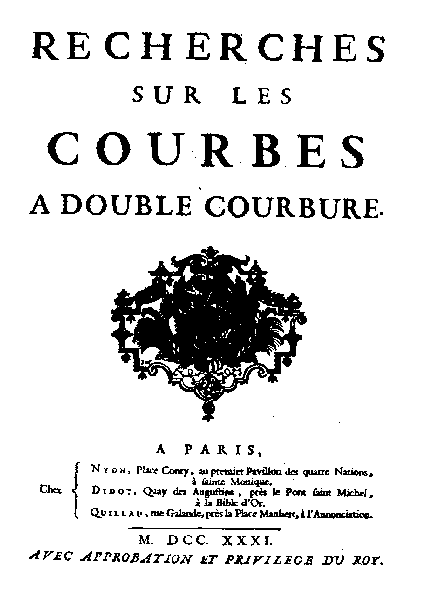
克莱罗开始研究双曲率曲线,并于1729年完成。由于这项工作,他于1729年9月4日被提名为巴黎科学院的成员,但国王直到1731年才确认他的当选。1731年7月,克莱罗成为有史以来当选巴黎科学院的最年轻的人。在那里,他加入了一个由皮埃尔·莫佩尔蒂领导的小组,该小组支持艾萨克·牛顿的自然哲学。皮埃尔·莫佩尔蒂比克莱罗大15岁,但尽管如此,他在33岁时也是科学院的年轻成员。
克莱罗成为皮埃尔·莫佩尔蒂、伏尔泰和du 沙特莱侯爵夫人的密友。这远不止是个人友谊,因为他与皮埃尔·莫佩尔蒂和du 沙特莱侯爵夫人都做了重要的工作。他帮助Marquise du 沙特莱侯爵夫人将艾萨克·牛顿的Principia翻译成法语,这个项目在1745年之前开始,一直持续到1756年该书的一部分出版。除了du 沙特莱侯爵夫人翻译的艾萨克·牛顿之外,克莱罗自己的许多理论也被添加到书中。
1734年,克莱罗与皮埃尔·莫佩尔蒂一起访问了巴塞尔,与约翰·伯努利一起学习了几个月。在巴塞尔期间,克莱罗与约翰·萨穆埃尔·柯尼希成为朋友,并且多年来,两人通过通信继续了有益的科学合作。
克莱罗在1733年至1743年期间发表了一些重要工作。他在1733年写了论文Sur quelques questions de maximis et minimis Ⓣ(关于极大和极小的一些问题),关于变分法,以约翰·伯努利的风格写成,同年,他发表了关于旋转二次曲面的测地线的文章,再次研究了约翰·伯努利曾贡献过的主题。第二年,克莱罗研究了现在称为“克莱罗微分方程”的微分方程,并给出了方程的一般积分之外的奇异解。在1739年和1740年,他发表了关于积分学的进一步工作,证明了积分因子的存在,用于求解一阶微分方程(这也是约翰·伯努利、Reyneau和莱昂哈德·欧拉感兴趣的主题)。1742年,克莱罗发表了一部关于动力学的重要著作,但在第二年,他将注意力转向了他最为人所知的主题。他开始对解决几年前一次探险的实际结果所引出的理论问题感兴趣。
从1736年4月20日到1737年8月20日,克莱罗参加了由皮埃尔·莫佩尔蒂领导的拉普兰探险,以测量一度经线。这次探险由巴黎科学院组织,仍在继续乔凡尼·多美尼科·卡西尼启动的计划,以验证艾萨克·牛顿关于地球是扁球体的理论证明。除了皮埃尔·莫佩尔蒂和克莱罗之外,该小组还包括其他年轻科学家,如Lemonnier、夏尔·艾蒂安·路易·加缪和安德斯·摄尔修斯。这个非常成功的团队并非没有批评者[1]:-
这个热情的团队迅速而精确地完成了任务,在一种青春欢乐的气氛中,有些人为此责备他们。
1743年,克莱罗出版了Théorie de la figure de la Terre Ⓣ(地球形状理论),证实了艾萨克·牛顿-克里斯蒂安·惠更斯关于地球在两极扁平的信念。这本书是一项理论研究,旨在支持拉普兰探险所收集的关于地球形状的实验数据。这本书在为流体静力学研究奠定基础方面很重要。它建立在艾萨克·牛顿和克里斯蒂安·惠更斯的基础上,他们提出了地球是扁球体的理论,也建立在科林·麦克劳林关于潮汐的工作上,该工作发展了流体静力学的一些背景结果。
在完成关于Théorie de la figure de la Terre Ⓣ(地球形状理论)的工作后,克莱罗于1745年开始研究三体问题,特别是月球轨道问题。他从工作中得出的第一个结论是,艾萨克·牛顿的引力理论不正确,平方反比定律不成立。在这一点上,克莱罗得到了莱昂哈德·欧拉的支持,后者在得知克莱罗的结论后,于1747年9月30日写信给他:-
克莱罗在莱昂哈德·欧拉的支持下更加自信,于1747年11月15日向巴黎科学院宣布平方反比定律是错误的。相当引人注目的是,就在克莱罗做出宣布之前,让·勒朗·达朗贝尔向科学院提交了一篇论文,表明他的计算与Clairaut的计算一致。克莱罗建议在中添加一项,而莱昂哈德·欧拉(或许相当明智地)同意克莱罗在他之前就发现了平方反比定律中的错误。
当然,当时并非所有数学家都相信艾萨克·牛顿的理论,有些人仍然相信勒内·笛卡儿的涡旋理论。宣布艾萨克·牛顿的定律不正确使许多勒内·笛卡儿的支持者欣喜若狂,甚至莱昂哈德·欧拉也回到了勒内·笛卡儿的观点。一些人攻击克莱罗的声明,例如布丰,他使用了基于平方反比定律简单性的形而上学论证。
然而,到1748年春天,克莱罗意识到月球远地点观测运动与理论预测之间的差异是由于所做近似产生的误差,而不是由于万有引力的平方反比定律。克莱罗于1749年5月17日向科学院宣布,他的理论现在与平方反比定律一致。随后他有一段时间乐于看着让·勒朗·达朗贝尔和莱昂哈德·欧拉努力重复他的计算。克莱罗写信给他的朋友加布里尔·克拉默[14]:-
……让·勒朗·达朗贝尔和莱昂哈德·欧拉对我导向新结果的策略毫无察觉。后者两次写信告诉我,他为找到与我相同的东西做了徒劳的努力,并恳求我告诉他我是如何得到这些结果的。我或多或少告诉了他这是怎么回事……
莱昂哈德·欧拉仍然觉得他没有正确理解克莱罗做了什么,所以他试图引诱他将其好好写出来,让圣彼得堡科学院将月球远地点问题设为1752年的悬赏题目。确实他的计策奏效了,克莱罗提交了一篇论文,让莱昂哈德·欧拉完全理解了克莱罗的方法。莱昂哈德·欧拉远远超出了界限,但显示出他对自己未能解决这个问题有多么沮丧,他写信给克莱罗说他的结果是:-
……数学史上最重要、最深刻的发现。
克莱罗于1752年出版了Théorie de la luneⓉ(月球理论),这部著作连同两年后出版的月球表,完成了他在这个特定问题上的工作。
克莱罗决定应用他对三体问题的知识来计算爱德蒙·哈雷彗星的轨道,从而预测其回归的确切日期。这需要比月球问题更精确得多的近似。他计算出爱德蒙·哈雷彗星在1759年回归近日点(离太阳最近的点)的时间,误差在一个月以内。他于1758年11月14日向巴黎科学院宣布了他的结果,即近日点将发生在1759年4月15日,而实际的近日点日期是3月13日。当彗星出现时,仅比预测日期早一个月,克莱罗获得了极大的公众赞誉。有人建议将彗星以克莱罗重新命名,克莱罗被称为“新的泰勒斯”。
克莱罗在提交给圣彼得堡科学院的1762年获奖论文中使用了不同的方法,改进了他的结果。他在这项工作中能够获得3月30日的日期,考虑到考虑木星和土星摄动问题的复杂性,这是非常好的。
在关于彗星工作的这件事上,克莱罗与让·勒朗·达朗贝尔之间产生了争执。尽管两人直到约1747年都还算友好地互为竞争对手,但此后关系恶化。当克莱罗为让·勒朗·达朗贝尔包含月表的书撰写书评时,正如Hankins所写[4]:-
他并未公开敌视,而是以一种大师指导能干学生的居高临下口吻;他称赞让·勒朗·达朗贝尔高超的分析技巧,但说他的表没什么用——至少与克莱罗自己的表相比是这样。
在抨击那些像让·勒朗·达朗贝尔一样专注于理论而忽视实验的人时,克莱罗写道:-
为了避免精细的实验或漫长乏味的计算,为了代之以麻烦较少的分析方法,他们常常提出自然界中并不存在的假设;他们追求与目标无关的理论,而只要在实施一种极其简单的方法时稍加坚持,就必定能达到目标。
当让·勒朗·达朗贝尔抨击克莱罗对三体问题的解答过于基于观测,而不像他自己的工作那样基于理论结果时,克莱罗在他们一生中最激烈的争执中猛烈攻击让·勒朗·达朗贝尔。很难判断这两位伟大的数学家谁是对的,但克莱罗显然在当时赢得了公开争论,尤其是因为在出色预测了爱德蒙·哈雷彗星回归日期之后,他的声望极高。
我们还应该提到克莱罗做出重要贡献的另一个主题,即光行差。从拉普兰探险队进行观测时起,他就必须对这个主题有透彻的理解。他在关于行星和彗星的工作中也必须利用光行差的修正。他特别感兴趣的是通过使用由两种不同玻璃制成的透镜来改进望远镜设计的想法。克莱罗就这个主题写了一些重要的回忆录,研究理论并进行光学实验。这项工作在他去世时仍未完成。
克莱罗在数学内部广泛的问题上都有研究。一本几何书Elements de géometrieⓉ(几何原理)于1741年出版,一本代数书Elements d'algèbreⓉ(代数原理)于1749年出版。在Elements de géometrieⓉ(几何原理)的序言中,克莱罗给出了他写这本书的目的:-
我打算回到可能催生几何学的源头;我试图用一种足够自然的方法来发展其原理,使人可以假定它与几何学最初发明者的方法相同,只求避免他们可能不得不走的任何错误步骤……
这本代数书是一部更具学术性的著作,将该主题推进到四次方程的求解。他极为成功地试图说明为什么引入代数符号是必要且不可避免的。这本书在法国学校中作为教材使用了许多年。
克莱罗 在短暂患病后于 52 岁去世。他正处于权力的巅峰,并因被选入当时的主要科学院而获得荣誉。他曾被选入 伦敦皇家学会、Academy of Berlin、Academy of St Petersburg 以及博洛尼亚和乌普萨拉科学院。
Alexis Clairaut's father, Jean-Baptiste Clairaut, taught mathematics in Paris and showed his quality by being elected to the Berlin Academy. Alexis's mother, Catherine Petit, had twenty children although only Alexis survived to adulthood.
Jean-Baptiste Clairaut educated his son at home and set unbelievably high standards. Alexis used Euclid's Elements while learning to read and by the age of nine he had mastered the excellent mathematics textbook of Guisnée Application de l'algèbre à la géométrie Ⓣ which provided a good introduction to the differential and integral calculus as well as analytical geometry. In the following year, Clairaut went on to study de L'Hôpital's books, in particular his famous text Analyse des infiniment petits pour l'intelligence des lignes courbes Ⓣ.
Few people have read their first paper to an academy at the age of 13, but this was the incredible achievement of Clairaut's in 1726 when he read his paper Quatre problèmes sur de nouvelles courbes Ⓣ to the Paris Academy. Although we have already noted that Clairaut was the only one of twenty children of his parents to reach adulthood, he did have a younger brother who, at the age of 14, read a mathematics paper to the Academy in 1730. This younger brother died in 1732 at the age of 16.
Clairaut began to undertake research on double curvature curves which he completed in 1729. As a result of this work he was proposed for membership of the Paris Academy on 4 September 1729 but the king did not confirm his election until 1731. In July 1731 Clairaut became the youngest person ever elected to the Paris Academy of Sciences. There he joined a small group, led by Pierre Louis Maupertuis, who supported the natural philosophy of Newton. Maupertuis was 15 years older than Clairaut but despite this, at the age of 33, he was also a young member of the Academy.
Clairaut became close friends of Maupertuis, Voltaire, and du Châtelet. This was much more than a personal friendship since he did important work with both Maupertuis and du Châtelet. He helped the Marquise du Châtelet translate Newton's Principia into French, a project which began before 1745 and continued until part of the book was published in 1756. Many of Clairaut's own theories were added to the book, in addition to the translation of Newton by du Châtelet.
Together with Maupertuis, Clairaut visited Basel in 1734 to spend a few months studying with Johann Bernoulli. While in Basel, Clairaut became friends with Samuel König and, for many years, the two continued a useful scientific collaboration by correspondence.
Clairaut published some important work during the period 1733 to 1743. He wrote the paper Sur quelques questions de maximis et minimis Ⓣ in 1733 on the calculus of variations, written in the style of Johann Bernoulli and, in the same year, he published on the geodesics of quadrics of rotation again studying a topic to which Johann Bernoulli had contributed. The following year Clairaut studied the differential equations now known as 'Clairaut's differential equations' and gave a singular solution in addition to the general integral of the equations. In 1739 and 1740 he published further work on the integral calculus, proving the existence of integrating factors for solving first order differential equations (a topic which also interested Johann Bernoulli, Reyneau and Euler). In 1742 Clairaut published an important work on dynamics but, in the following year, he turned his attention to the topic for which he is best known. He became interested in solving theoretical questions which followed on from the practical results of an expedition some years earlier.
From 20 April 1736 to 20 August 1737 Clairaut had taken part in an expedition to Lapland, led by Maupertuis, to measure a degree of longitude. The expedition was organised by the Paris Academy of Sciences, still continuing the programme started by Cassini, to verify Newton's theoretical proof that the Earth is an oblate spheroid. In addition to Maupertuis and Clairaut, the group contained other young scientists such as Lemonnier, Camus and Celsius. The highly successful team were not without their critics [1]:-
This enthusiastic group accomplished its mission quickly and precisely, in an atmosphere of youthful gaiety for which some reproached them.
In 1743 Clairaut published Théorie de la figure de la Terre Ⓣ confirming the Newton-Huygens belief that the Earth was flattened at the poles. The book was a theoretical study to support the experimental data on the shape of the Earth which the expedition to Lapland had gathered. The book was an important one in laying the foundations for the study of hydrostatics. It built on foundations due to Newton and Huygens who had put forward the theory that the Earth was an oblate spheroid, and also on Maclaurin's work on tides which developed some background results in hydrostatics.
After his work on Théorie de la figure de la Terre Ⓣ Clairaut began to work on the three-body problem in 1745, in particular on the problem of the moon's orbit. The first conclusions that he drew from his work was that Newton's theory of gravity was incorrect and that the inverse square law did not hold. In this Clairaut had the support of Euler who, after learning of Clairaut's conclusions, wrote to him on 30 September 1747:-
I am able to give several proof that the forces which act on the moon do not exactly follow the rule of Newton, and the one you draw from the movement of the apogee is the most striking...
Clairaut, more confident with Euler's support, announced to the Paris Academy on 15 November 1747 that the inverse square law was false. Rather remarkably, just before Clairaut made his announcement, d'Alembert deposited a paper with the Academy which showed that his calculations agreed with those of Clairaut. Clairaut suggested that a term in needed to be added and Euler (perhaps rather wisely) agreed that Clairaut had found the error in the inverse square law before he had.
Of course, not all mathematicians at this time believed Newton's theory, some still believing in Descartes' vortex theories. The announcement that Newton's law was incorrect made many of Descartes' supporters overjoyed and even Euler returned to Descartes' views. Some attacked Clairaut's announcement, for example Buffon who used a metaphysical argument based on the simplicity of the inverse square law.
However, by the spring of 1748, Clairaut realised that the difference between the observed motion of the moon's apogee and the one predicted by the theory was due to errors coming from the approximations that were being made rather than from the inverse square law of gravitational attraction. Clairaut announced to the Academy on 17 May 1749 that his theory was now in agreement with the inverse square law. He then had a period of enjoying watching d'Alembert and Euler struggle to repeat his calculations. Clairaut wrote to his friend Gabriel Cramer [14]:-
... d'Alembert and Euler had no inkling of the stratagem that led me to my new results. The latter twice wrote to tell me that he had made fruitless efforts to find the same thing as I, and that he begged me to tell him how I arrived at them. I told him, more or less, what it was all about...
Euler still felt he did not properly understand what Clairaut had done so he tried to tempt him to write it up properly by having the St Petersburg Academy set the problem of the moon's apogee as the prize topic for 1752. Indeed his ploy worked and Clairaut submitted an essay which let Euler fully understand Clairaut's method. Euler, going well beyond the mark but showing how frustrated he had been not solving the problem himself, wrote to Clairaut that his results were:-
... the most important and profound discovery that has ever been made in mathematics.
Clairaut published Théorie de la lune Ⓣ in 1752 and this work, together with his lunar tables published two years later, completed his work on this particular problem.
Clairaut decided to apply his knowledge of the three-body problem to compute the orbit of Halley's comet and so predict the exact date of its return. This required much more accurate approximations than had the problem of the moon. He calculated to within a month the return in 1759 of Halley's comet to its perihelion (closest point to the Sun). He announced his result, that the perihelion would occur on 15 April 1759, to the Paris Academy on 14 November 1758, while the actual date of perihelion turned out to be 13 March. When the comet appeared, only one month before the predicted date, Clairaut was given great public acclaim. There was a suggestion that the comet be renamed after Clairaut, and Clairaut was called the 'new Thales'.
Clairaut improved his results when he used a different method in his prize winning paper submitted to the St Petersburg Academy for the 1762 prize. He was able to obtain the date of 30 March in this work which, given the complexity of the problem of taking the perturbations of Jupiter and Saturn into account, is remarkably good.
A dispute arose between Clairaut and d'Alembert regarding this work on comets. Although the two had been reasonably friendly rivals up to about 1747, after that relations deteriorated. When Clairaut wrote a review of d'Alembert's book containing lunar tables then, as Hankins writes [4]:-
He was not openly hostile, but adopted the condescending tone of a master instructing an able student; he praised d'Alembert's great analytical skill, but said his tables were of little use - at least compared to Clairaut's own tables.
In an attack on those who, like d'Alembert, concentrated on theory and neglected experiment, Clairaut wrote:-
In order to avoid delicate experiments or long tedious calculations, in order to substitute analytical methods which cost them less trouble, they often make hypotheses which have no place in nature; they pursue theories that are foreign to their object, whereas a little constancy in the execution of a perfectly simple method would have surely brought them to their goal.
When d'Alembert attacked Clairaut's solution of the three-body problem as being too much based on observation and not, like his own work, based on theoretical results, Clairaut strongly attacked d'Alembert in the most bitter dispute of their lives. It is hard to judge which of the two great mathematicians was right, but Clairaut clearly won the public argument at the time, not least because his standing was so high after the remarkable prediction of the date of the return of Halley's comet.
We should also mention another topic to which Clairaut made important contributions, namely to the aberration of light. He had to have a thorough understanding of this topic from the time of the observations made by the Lapland expedition. He also had to make use of corrections due to aberration in his work on the planets and comets. He was particularly interested in the ideas of improving telescope design by using lenses made up of two different types of glass. Clairaut wrote some important memoirs on the topic, studying the theory as well as conducting optical experiments. This work was still incomplete at the time of his death.
Clairaut worked on a wide range of problems within mathematics. A geometry book Elements de géometrie Ⓣ was published in 1741 and a book on algebra Elements d'algèbre Ⓣ was published in 1749. In the preface to Elements de géometrie Ⓣ Clairaut gives his aims in writing the book:-
I intended to go back to what might have given rise to geometry; and I attempted to develop its principles by a method natural enough so that one might assume it to be the same as that of geometry's first inventors, attempting only to avoid any false steps that they might have had to take...
The algebra book was an even more scholarly work and took the subject up to the solution of equations of degree four. He tried, with great success, to show why the introduction of algebraic notation was necessary and inevitable. The book was used for teaching in French schools for many years.
Clairaut died at the age of 52 after a brief illness. He was at the height of his powers and he had been honoured by being elected to the leading academies of the day. He had been elected to the Royal Society of London, the Academy of Berlin, the Academy of St Petersburg and the Academies of Bologna and Uppsala.
正文里的方括号编号指向这里,悬停即可直接看到条目。书目保留原文——译了书名反而查不到文献。
原站列出的延伸阅读与外部数据库,照原样保留,目标多为英文页面。
原站的交叉引用。指向本站已镜像专题的留在站内,其余仍指回原站。