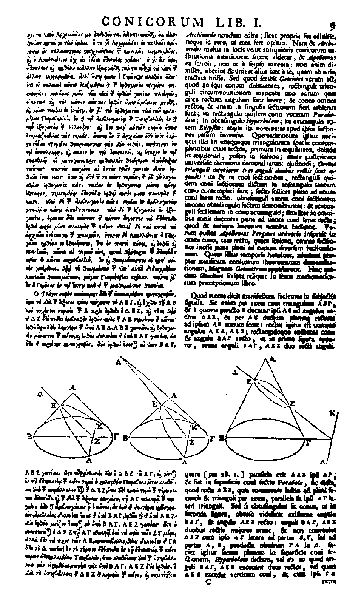
数学家传记
阿波罗尼奥斯是一位希腊数学家,被称为“伟大的几何学家”。他的著作对数学的发展产生了非常大的影响,他的著名著作《圆锥曲线》引入了抛物线、椭圆和双曲线这些术语。
阿波罗尼奥斯被称为“伟大的几何学家”。人们对他的生平所知甚少,但他的著作对数学的发展产生了非常大的影响,特别是他著名的著作圆锥曲线引入了我们今天熟悉的术语,如抛物线、椭圆和双曲线。
阿波罗尼奥斯不应与其他名叫阿波罗尼奥斯的希腊学者混淆,因为这是一个常见的名字。在[1]中给出了其他名叫阿波罗尼奥斯的人的详细信息:罗得岛的阿波罗尼奥斯,生于约公元前295年,希腊诗人和语法学家,埃拉托色尼的老师卡利马科斯的学生;特拉勒斯的安提莫斯的阿波罗尼奥斯,公元前2世纪,希腊雕塑家;雅典的阿波罗尼奥斯,公元前1世纪,雕塑家;提亚纳的阿波罗尼奥斯,公元1世纪,毕达哥拉斯所创立团体的成员;阿波罗尼奥斯 Dyscolus,公元2世纪,希腊语法学家,据称是系统语法研究的创始人;以及提尔的阿波罗尼奥斯,他是一个文学人物。
数学家阿波罗尼奥斯出生于阿波罗尼奥斯,潘菲利亚,今天被称为穆尔蒂纳或穆尔塔纳,现在位于土耳其安塔利亚。阿波罗尼奥斯在当时是一个文化中心,是自然女神阿耳忒弥斯女王的崇拜地。年轻时,阿波罗尼奥斯去了亚历山大,在那里师从欧几里得的追随者,后来在那里任教。阿波罗尼奥斯访问了帕加马,那里建造了类似于亚历山大的大学和图书馆。帕加马,今天是土耳其伊兹密尔省的贝尔加马镇,是密西亚的一座古希腊城市。它位于距爱琴海25公里处,在凯库斯河(今天称为巴克尔河)宽阔山谷北侧的一座小山上。
当阿波罗尼奥斯在帕加马时,他遇到了帕加马的欧德摩斯(不要与写History of Geometry的罗得岛的罗德岛的欧德摩斯混淆),还遇到了阿塔罗斯,许多人认为他一定是帕加马的阿塔罗斯一世国王。在Conics第二版的前言中,阿波罗尼奥斯致意欧德摩斯(见[4]或[7]):-
如果你身体健康,其他事情也如你所愿,那就好;我这边也还算过得去。在帕加马与你相处期间,我注意到你渴望了解我在圆锥曲线方面的工作。
关于阿波罗尼奥斯生平的唯一其他信息见于Conics各卷的前言。我们得知他有一个儿子,也叫阿波罗尼奥斯,事实上他的儿子将Conics第二卷的第二版从亚历山大里亚带给了在帕加马的欧德摩斯。我们还从这本书的前言中得知,阿波罗尼奥斯在以弗所时将几何学家菲洛尼德斯介绍给了欧德摩斯。
关于阿波罗尼奥斯所写的书,我们的了解要好一些。Conics写成八卷,但只有前四卷以希腊文保存下来。然而,在阿拉伯文中,Conics八卷中的前七卷保存了下来。
首先我们应当注意,对阿波罗尼奥斯来说,圆锥曲线按定义是平面与圆锥面相交所形成的曲线。阿波罗尼奥斯在其前言中解释了他如何撰写其著名著作Conics(见[4]或[7]):-
……应几何学家瑙克拉特斯的请求,我着手研究这个课题,当时他来到亚历山大里亚并住在我处,当我用八卷完成它后,我立刻交给了他,过于匆忙,因为他即将启航;因此它们没有经过彻底修订,事实上我只是想到什么就写下了什么,把修订推迟到最后。
Conics的第1卷和第2卷以初稿的形式开始流传,事实上有些证据表明,流传下来的一些译本来自这些初稿。阿波罗尼奥斯写道(见[4]或[7]):-
……碰巧的是,在我遇到过的人当中,有些人也在第一、二卷尚未校正之前就拿到了它们……
Conics 由 8 卷组成。第 1 至第 4 卷构成对圆锥曲线基本性质的初等导引。这些卷中的大多数结果已为 欧几里得、大阿里斯泰俄斯 等人所知,但其中一些,用 阿波罗尼奥斯 自己的话说:-
……比他人的著作中更为充分和一般地加以展开。
在第一卷中,研究了圆锥曲线的直径与 切线 所满足的关系;而在第二卷中,阿波罗尼奥斯 考察了双曲线与其 asymptotes 的关系,并且还研究了如何作给定圆锥曲线的切线。然而,这些卷中也有新的结果,尤其是在第三卷中。阿波罗尼奥斯 关于第三卷写道(见 [4] 或 [7]):-
……这些定理中最多、最漂亮的都是新的,正是它们的发现使我意识到,欧几里得 并未完成关于三条和四条直线的 轨迹 的综合作图,而只是其中偶然的一部分,而且并不成功;因为若无我所发现的那些附加定理的帮助,所说的综合作图就不可能完成。
第五至第七卷极具独创性。在这些卷中,阿波罗尼奥斯 讨论了圆锥曲线的 正规,并说明从一个点可以作出多少条。他给出了确定曲率中心的命题,这些命题直接导向 渐屈线 的笛卡尔方程。托马斯·利特尔·希思 写道,第五卷 [7]:-
……是现存各卷中最杰出的一卷。它讨论圆锥曲线的法线,将其视为从特定点向曲线所引的最大与最小直线。其中包含一系列命题,尽管以最纯粹几何方法推演,实际上直接导向三种圆锥曲线各自渐屈线的确定;也就是说,渐屈线的笛卡尔方程可以容易地从阿波罗尼奥斯所得结果推导出来。毫无疑问,这一卷几乎完全是原创的,是名副其实的几何杰作。
通过阅读托马斯·利特尔·希思给出的命题,可以很容易看出阿波罗尼奥斯的Conics之美,见[4]或[7]。然而,托马斯·利特尔·希思在[7]中解释了原文阅读起来有多么困难:——
……这部论著是一部伟大的经典,理应比现在更为人所知。妨碍人们阅读其原文形式的,是论述篇幅巨大(它包含387个独立命题),部分原因是希腊人习惯于将一般命题的特殊情形与命题本身分开证明,但更多是由于用一般术语(没有用字母表示特定点的帮助)表述复杂命题时的笨重,以及欧几里得形式的繁复,而阿波罗尼奥斯自始至终都遵循这种形式。
帕普斯给出了一些线索,说明阿波罗尼奥斯另外六部著作的内容。这些著作是Cutting of a ratio(两卷)、Cutting an area(两卷)、On determinate section(两卷)、Tangencies(两卷)、Plane loci(两卷)和On verging constructions(两卷)。Cutting of a ratio以阿拉伯文存世,10世纪目录学家Ibn al-Nadim告诉我们,另有三部著作被译成阿拉伯文,但这些都没有留存下来。
为了说明阿波罗尼奥斯在几何作图上比欧几里得的Elements走了多远,我们考虑已知包含在Tangencies中的结果。在Elements第III卷中,欧几里得展示了如何作过三个给定点的圆。他还展示了如何作与三条给定直线相切的圆。在Tangencies中,阿波罗尼奥斯展示了如何构造与三个给定圆相切的圆。更一般地,他展示了如何构造与任意三个对象相切的圆,其中对象是点、直线或圆。
见THIS LINK。
在[14]中,Hogendijk报告说,阿波罗尼奥斯的两部此前被认为未被译成阿拉伯文的著作,实际上为10世纪的穆斯林几何学家所知。这些著作是Plane loci和On verging constructions。在[14]中,描述了这些著作中此前不知道已由阿波罗尼奥斯证明的一些结果。
从其他来源还有对阿波罗尼奥斯更多著作的提及,这些著作都没有留存下来。Hypsicles提到阿波罗尼奥斯的一部著作,比较同一球面上的一个正十二面体和一个二十面体内接,它像Conics一样有两个版本。Marinus在为欧几里得的Data撰写注释时,提到阿波罗尼奥斯的一部通论性著作,其中讨论了数学的基础,例如公理和定义的含义。阿波罗尼奥斯还写了一部关于圆柱螺线的著作,以及另一部关于无理数数的著作,后者被普罗克洛提及。阿什凯隆的欧托基奥斯提到阿波罗尼奥斯的一部书Quick delivery,其中他得到了一个比Hypsicles所知更好的π近似值。
阿基米德已知。在On the Burning Mirror中阿波罗尼奥斯表明平行光线经球面镜不会聚焦(如先前所认为的那样),并讨论了抛物面镜的焦点性质。
阿波罗尼奥斯也是希腊数学天文学的重要奠基人,该学科用几何模型来解释行星理论。克劳狄乌斯·托勒密在其著作Syntaxis中说,阿波罗尼奥斯引入了eccentric和epicyclic运动的体系,以解释行星在天空中呈现的运动。严格说来这并不正确,因为本轮理论肯定早于阿波罗尼奥斯。尽管如此,阿波罗尼奥斯确实做出了重大贡献,尤其是运用了他高超的几何技巧。特别是,他研究了行星看起来静止的点,即顺行变为逆行或反之的点。
阿波罗尼奥斯还运用他的圆锥曲线知识,将之应用于实际问题。他发明了半圆日晷,这是一种把时线画在圆锥曲线表面上的日晷,精度更高。
Apollonius of Perga was known as 'The Great Geometer'. Little is known of his life but his works have had a very great influence on the development of mathematics, in particular his famous book Conics introduced terms which are familiar to us today such as parabola, ellipse and hyperbola.
Apollonius of Perga should not be confused with other Greek scholars called Apollonius, for it was a common name. In [1] details of others with the name of Apollonius are given: Apollonius of Rhodes, born about 295 BC, a Greek poet and grammarian, a pupil of Callimachus who was a teacher of Eratosthenes; Apollonius of Tralles, 2nd century BC, a Greek sculptor; Apollonius the Athenian, 1st century BC, a sculptor; Apollonius of Tyana, 1st century AD, a member of the society founded by Pythagoras; Apollonius Dyscolus, 2nd century AD, a Greek grammarian who was reputedly the founder of the systematic study of grammar; and Apollonius of Tyre who is a literary character.
The mathematician Apollonius was born in Perga, Pamphylia which today is known as Murtina, or Murtana and is now in Antalya, Turkey. Perga was a centre of culture at this time and it was the place of worship of Queen Artemis, a nature goddess. When he was a young man Apollonius went to Alexandria where he studied under the followers of Euclid and later he taught there. Apollonius visited Pergamum where a university and library similar to Alexandria had been built. Pergamum, today the town of Bergama in the province of Izmir in Turkey, was an ancient Greek city in Mysia. It was situated 25 km from the Aegean Sea on a hill on the northern side of the wide valley of the Caicus River (called the Bakir river today).
While Apollonius was at Pergamum he met Eudemus of Pergamum (not to be confused with Eudemus of Rhodes who wrote the History of Geometry) and also Attalus, who many think must be King Attalus I of Pergamum. In the preface to the second edition of Conics Apollonius addressed Eudemus (see [4] or [7]):-
If you are in good health and things are in other respects as you wish, it is well; with me too things are moderately well. During the time I spent with you at Pergamum I observed your eagerness to become aquatinted with my work in conics.
The only other pieces of information about Apollonius's life is to be found in the prefaces of various books of Conics. We learn that he had a son, also called Apollonius, and in fact his son took the second edition of book two of Conics from Alexandria to Eudemus in Pergamum. We also learn from the preface to this book that Apollonius introduced the geometer Philonides to Eudemus while they were at Ephesus.
We are in a somewhat better state of knowledge concerning the books which Apollonius wrote. Conics was written in eight books but only the first four have survived in Greek. In Arabic, however, the first seven of the eight books of Conics survive.
First we should note that conic sections to Apollonius are by definition the curves formed when a plane intersects the surface of a cone. Apollonius explains in his preface how he came to write his famous work Conics (see [4] or [7]):-
... I undertook the investigation of this subject at the request of Naucrates the geometer, at the time when he came to Alexandria and stayed with me, and, when I had worked it out in eight books, I gave them to him at once, too hurriedly, because he was on the point of sailing; they had therefore not been thoroughly revised, indeed I had put down everything just as it occurred to me, postponing revision until the end.
Books 1 and 2 of the Conics began to circulate in the form of their first draft, in fact there is some evidence that certain translations which have come down to us have come from these first drafts. Apollonius writes (see [4] or [7]):-
... it happened that some persons also, among those who I have met, have got the first and second books before they were corrected....
Conics consisted of 8 books. Books one to four form an elementary introduction to the basic properties of conics. Most of the results in these books were known to Euclid, Aristaeus and others but some are, in Apollonius's own words:-
... worked out more fully and generally than in the writings of others.
In book one the relations satisfied by the diameters and tangents of conics are studied while in book two Apollonius investigates how hyperbolas are related to their asymptotes, and he also studies how to draw tangents to given conics. There are, however, new results in these books in particular in book three. Apollonius writes of book three (see [4] or [7]):-
... the most and prettiest of these theorems are new, and it was their discovery which made me aware that Euclid did not work out the syntheses of the locus with respect to three and four lines, but only a chance portion of it, and that not successfully; for it was not possible for the said synthesis to be completed without the aid of the additional theorems discovered by me.
Books five to seven are highly original. In these Apollonius discusses normals to conics and shows how many can be drawn from a point. He gives propositions determining the centre of curvature which lead immediately to the Cartesian equation of the evolute. Heath writes that book five [7]:-
... is the most remarkable of the extant Books. It deals with normals to conics regarded as maximum and minimum straight lines drawn from particular points to the curve. Included in it are a series of propositions which, though worked out by the purest geometrical methods, actually lead immediately to the determination of the evolute of each of the three conics; that is to say, the Cartesian equations of the evolutes can be easily deduced from the results obtained by Apollonius. There can be no doubt that the Book is almost wholly original, and it is a veritable geometrical tour de force.
The beauty of Apollonius's Conics can readily be seen by reading the propositions as given by Heath, see [4] or [7]. However, Heath explains in [7] how difficult the original text is to read:-
... the treatise is a great classic which deserves to be more known than it is. What militates against its being read in its original form is the great extent of the exposition (it contains 387 separate propositions), due partly to the Greek habit of proving particular cases of a general proposition separately from the proposition itself, but more to the cumbersomeness of the enunciations of complicated propositions in general terms (without the help of letters to denote particular points) and to the elaborateness of the Euclidean form, to which Apollonius adheres throughout.
Pappus gives some indications of the contents of six other works by Apollonius. These are Cutting of a ratio (in two books), Cutting an area (in two books), On determinate section (in two books), Tangencies (in two books), Plane loci (in two books), and On verging constructions (in two books). Cutting of a ratio survives in Arabic and we are told by the 10th century bibliographer Ibn al-Nadim that three other works were translated into Arabic but none of these survives.
To illustrate how far Apollonius had taken geometric constructions beyond that of Euclid's Elements we consider results which are known to have been contained in Tangencies. In the Elements Book III Euclid shows how to draw a circle through three given points. He also shows how to draw a tangent to three given lines. In Tangencies Apollonius shows how to construct the circle which is tangent to three given circles. More generally he shows how to construct the circle which is tangent to any three objects, where the objects are points or lines or circles.
See THIS LINK.
In [14] Hogendijk reports that two works of Apollonius, not previously thought to have been translated into Arabic, were in fact known to Muslim geometers of the 10th century. These are the works Plane loci and On verging constructions. In [14] some results from these works which were not previously known to have been proved by Apollonius are described.
From other sources there are references to still further books by Apollonius, none of which have survived. Hypsicles refers to a work by Apollonius comparing a dodecahedron and an icosahedron inscribed in the same sphere, which like Conics appeared in two editions. Marinus, writing a commentary on Euclid's Data, refers to a general work by Apollonius in which the foundations of mathematics such as the meaning of axioms and definitions are discussed. Apollonius also wrote a work on the cylindrical helix and another on irrational numbers which is mentioned by Proclus. Eutocius refers to a book Quick delivery by Apollonius in which he obtained an approximation for π better than the
known to Archimedes. In On the Burning Mirror Apollonius showed that parallel rays of light are not brought to a focus by a spherical mirror (as had been previously thought) and discussed the focal properties of a parabolic mirror.
Apollonius was also an important founder of Greek mathematical astronomy, which used geometrical models to explain planetary theory. Ptolemy in his book Syntaxis says Apollonius introduced systems of eccentric and epicyclic motion to explain the apparent motion of the planets across the sky. This is not strictly true since the theory of epicycles certainly predates Apollonius. Nevertheless, Apollonius did make substantial contributions particularly using his great geometric skills. In particular, he made a study of the points where a planet appears stationary, namely the points where the forward motion changes to a retrograde motion or the converse.
There were also applications made by Apollonius, using his knowledge of conics, to practical problems. He developed the hemicyclium, a sundial which has the hour lines drawn on the surface of a conic section giving greater accuracy.
正文里的方括号编号指向这里,悬停即可直接看到条目。书目保留原文——译了书名反而查不到文献。
原站列出的延伸阅读与外部数据库,照原样保留,目标多为英文页面。
关于阿波罗尼奥斯的其它页面:
原站的交叉引用。指向本站已镜像专题的留在站内,其余仍指回原站。