数学家传记
帕普斯是最后一位伟大的希腊几何学家,他的一个定理被引用为现代射影几何学的基础。他撰写了关于欧几里得的《几何原本》和克劳狄乌斯·托勒密的《天文学大成》的评注。
帕普斯是最后一位伟大的希腊几何学家,他的一个定理被引用为现代射影几何的基础。
我们对帕普斯的生平几乎一无所知。文献中出现了一两处关于帕普斯生卒日期的说法,这些说法必定有误。Suda Lexicon(一部10世纪希腊词典编纂者的著作)中有一处提到,帕普斯与亚历山大的席恩帕普斯是同时代人(例如见[1]):-
帕普斯,帕普斯,哲学家,大约生活在大阿里斯泰俄斯皇帝狄奥多西[公元379年-公元395年]时期,当时亚历山大的席恩这位哲学家也正活跃,他撰写了克劳狄乌斯·托勒密的《准则》。
这似乎很有说服力,但有一份由亚历山大的席恩帕普斯编写的年表,在抄写时,在戴克里先(公元284年—305年在位)的名字旁边插入了“当时写作的帕普斯”。类似的插入给出了克劳狄乌斯·托勒密、喜帕恰斯和其他数学天文学家的年代。
显然这两者不可能都正确,而Suda已知的不准确性使历史学家倾向于接受帕普斯的年代为公元284年—305年期间写作,正如亚历山大的席恩的年表中插入的内容所暗示的那样。托马斯·利特尔·希思在[4]中完全确信地说[4]:-
帕普斯生活在公元三世纪末。
然而,我们现在知道上述两个来源都是错误的,因为Rome(见[6])表明,可以从帕普斯对AlmagestⓉ的评注(主要论题:来自阿拉伯语“al-majisti”——希腊语“Mathematike Syntaxis”的阿拉伯语翻译,后来译为拉丁语“Magna Syntaxis”)中推断出,他观测到了帕普斯发生在320年10月18日的日食。这明确确定了帕普斯对克劳狄乌斯·托勒密的AlmagestⓉ的评注的年代为320年(主要论题:来自阿拉伯语“al-majisti”——希腊语“Mathematike Syntaxis”的阿拉伯语翻译,后来译为拉丁语“Magna Syntaxis”)。
除了这个确切的日期之外,我们对帕普斯所知甚少。他出生并似乎一生都生活在帕普斯。我们知道他将著作献给Hermodorus、Pandrosion和Megethion,但除了知道Hermodorus是帕普斯的儿子之外,我们对这些人没有更多的了解。同样,帕普斯提到一位也是哲学家的朋友,名叫Hierius,但除了知道他鼓励帕普斯研究某些数学问题之外,我们对他也没有其他了解。最后,普罗克洛著作中提到帕普斯,说他在帕普斯领导一所学校。
帕普斯在几何学方面的主要著作是Synagoge或Mathematical Collection,这是一部八卷本的数学文集,被认为写于约340年(尽管一些历史学家认为帕普斯在公元325年完成了这部著作)。托马斯·利特尔·希思在[4]中这样描述Mathematical Collection:-
显然,写作目的是复兴古典希腊几何学,它几乎涵盖了整个领域。然而,它是一部希腊几何学的手册或指南,而不是百科全书;也就是说,它 intended 与原著(如果尚存)一起阅读,而不是使原著可以被弃置不用。
很可能这部著作最初并非作为单一论著写成,而是作为一系列讨论不同主题的书卷写成。每卷都有自己的导言,并且常常包含关于该主题的宝贵历史记述,尤其是在这类记述不易从其他来源获得的情况下。
第一卷涵盖算术(已佚失),而第二卷部分佚失,但剩余部分涉及阿波罗尼奥斯处理大数的方法。该方法将数表示为万的幂,即10000的幂。
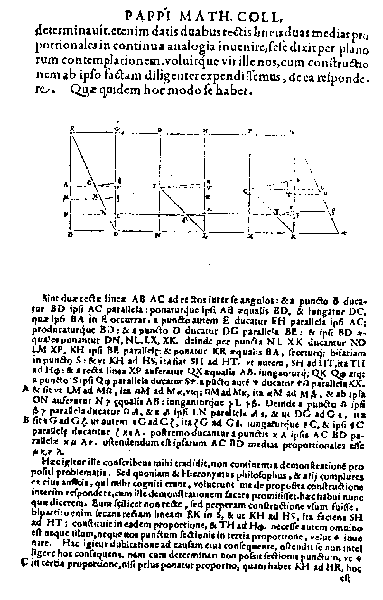
第三卷被帕普斯分为四个部分。第一部分探讨在两条给定直线之间求两个比例中项的问题。第二部分给出了算术平均、几何平均和调和平均的构造。第三部分描述了一组几何悖论,帕普斯说这些取自Erycinus的一部著作。除了这部分所包含的内容之外,我们对Erycinus或其著作一无所知。最后一部分展示了五个正多面体如何各自内接于一个球中。[9]的作者讨论了帕普斯在第三卷中关于在一个圆中展示两条线段的算术平均、几何平均和调和平均的问题上所制造的混乱。
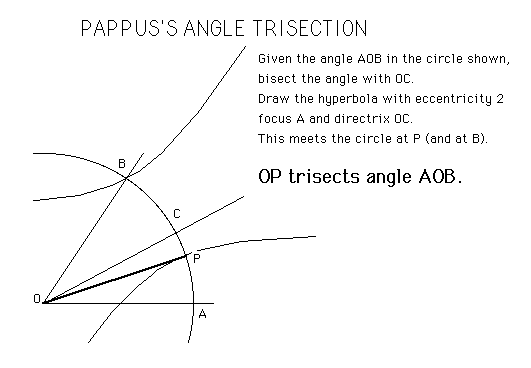
第四卷包含曲线的性质,包括阿基米德的螺线和希庇亚的割圆曲线,并包含他的trisection方法。帕普斯介绍了他将考虑的各种类型的曲线:-
我们说,几何学中有三类问题,即所谓的“平面”、“立体”和“线性”问题。那些可以用直线和圆解决的问题被恰当地称为“平面”问题,因为解决这类问题所用的线起源于平面。那些通过使用一个或多个圆锥截线解决的问题被称为“立体”问题。因为在作图中必须使用立体图形的表面,也就是说,圆锥。剩下第三类,即所谓的“线性”问题。因为在这些情况下的作图需要已经提到的曲线之外的曲线,这些曲线具有更变化多端和牵强的起源,并来自更不规则的曲面和复杂的运动。属于这种性质的是在所谓的“曲面轨迹”中发现的曲线以及许多其他更复杂的曲线……。这些曲线有许多奇妙的性质。较近的作者确实认为其中一些值得更广泛地处理,其中一条曲线被Menelaus称为“悖论曲线”。同类型的其他曲线有螺线、割圆曲线、蚌线和蔓叶线。
帕普斯通过描述蜜蜂如何建造蜂巢来介绍第五卷的一些思想。他结束了对蜂巢的讨论,并如下介绍其工作的目标(例如见[3]或[4]):-
那么,蜜蜂只知道这个对它们有用的事实,即六边形大于正方形和三角形,并且在建造每个图形时消耗相同材料的情况下能容纳更多蜂蜜。但我们,自称比蜜蜂拥有更多智慧,将研究一个更广泛的问题,即,在所有具有相等周长的等边等角平面图形中,角数更多的总是更大,而其中最大的是周长与它们相等的圆。
同样在第五卷中,帕普斯讨论了阿基米德发现的十三种半正多面体。他比较了具有相等周长的图形的面积和具有相等表面积的立体的体积,证明了Zenodorus的一个结果,即球体的体积大于任何具有相等表面积的规则立体。他还证明了相关结果:对于两个具有相等表面积的规则立体,面数更多的具有更大的体积。
第六卷和第七卷考虑了其他作者的书(比提尼亚的狄奥多西、奥托里库斯、阿里斯塔克斯、欧几里得、阿波罗尼奥斯、大阿里斯泰俄斯和埃拉托色尼)。第六卷涉及天文学书籍,这些书籍被收集到Little Astronomy中,与克劳狄乌斯·托勒密的AlmagestⓉ(主要论题:来自阿拉伯语“al-majisti”——希腊语“Mathematike Syntaxis”的阿拉伯语翻译,后来翻译成拉丁语为“Magna Syntaxis”)或Greater Astronomy相对。除了回顾这些作品外,帕普斯还指出了以某种方式进入文本的错误。
在第七卷中,帕普斯 论述了 Treasury of Analysis(例如参见 [3]):-
所谓的“分析宝库”,我亲爱的 Hermodorus,简而言之,是一种特殊的学说体系,供那些在学完通常的初等内容之后,希望获得能力去解决向他们提出的涉及曲线的问题的人使用,并且仅为此目的它才是有用的。它是三个人的工作:欧几里得 是《原本》的作者,阿波罗尼奥斯 是 阿波罗尼奥斯 的,以及老 大阿里斯泰俄斯,并且它通过分析和综合的方法进行。
帕普斯 接着解释了分析和综合的不同方法 [3]:-
……在分析中,我们假设所寻求的东西已经完成,并探究它是由什么产生的,然后又探究后者的先行原因,如此继续,直到通过回溯我们的步骤,我们碰到某个已经知道或被视为第一原理的东西……但在综合中,以相反的方式进行,我们假设在分析中最后达到的东西已经完成,并把以前是先行项的东西按自然顺序排列为后承项,将它们彼此连接起来,我们最终达到所寻求之物的构造……
文章 [13] 是对分析和综合的广泛讨论,以 帕普斯 的这部著作为出发点。
正是在第七卷中出现了帕普斯问题。见THIS LINK。这个问题对几何学的发展产生了重大影响。它被勒内·笛卡儿和艾萨克·牛顿讨论过,现在被称为保罗·古尔丁定理的内容由帕普斯在Mathematical Collection的第七卷中证明。关于保罗·古尔丁在1640年发表他的工作时是否知道帕普斯的结果的讨论,见[7]。
在第八卷中,帕普斯 论述了力学。我们引用 帕普斯 本人对该主题的描述(例如参见 [3]):-
亲爱的赫尔莫多鲁斯,力学这门科学在实际生活中有许多重要用途,被哲学家们认为值得最高度的重视,并被数学家们热切地研究,因为它在处理宇宙物质元素的本性方面几乎占据首位。因为它一般地处理物体围绕其重心的稳定性和运动,以及它们在空间中的运动,不仅探究那些因其本性而运动的物体的原因,而且强行将其他物体从其自身位置以违反其本性的运动转移;并且它通过使用适合主题的定理来设法做到这一点。
整个著作并没有显示出大量的独创性,但它确实表明帕普斯对一系列数学主题有深刻的理解,并且他掌握了所有可用的主要数学技术。他写作良好,显示出思想的极大清晰性,而Mathematical Collection在希腊几何学研究中是一部具有非常重大历史意义的著作。
在帕普斯对克劳狄乌斯·托勒密的AlmagestⓉ(主要论题:来自阿拉伯语“al-majisti”——希腊语“Mathematike Syntaxis”的阿拉伯语翻译,后来翻译成拉丁语为“Magna Syntaxis”)的评注中,只有关于第5卷和第6卷的部分幸存下来。我们不能确定帕普斯写了一部扩展到全部13卷的评注,但他很可能这样做了。当然,有证据表明他的评注涵盖了第1、3和4卷,因为痕迹存在或被其他评注者引用在AlmagestⓉ(主要论题:来自阿拉伯语“al-majisti”——希腊语“Mathematike Syntaxis”的阿拉伯语翻译,后来翻译成拉丁语为“Magna Syntaxis”)上。这部评注似乎比帕普斯的几何著作质量差得多。奥托·纽格包尔[5]写道:-
.. 这些学校论文的沉闷和浮夸是再明显不过的。当克劳狄乌斯·托勒密在关于太阳、月亮和阴影的视直径的章节中仅仅评论说,所讨论的切线锥体在great circles中以可忽略的误差接触球体时,那么帕普斯引用欧几里得的“光学”来表明接触圆的直径小于球体,只是为了添加一个冗长的论证来证明在克劳狄乌斯·托勒密的构造中所犯的错误仍然是可忽略的。或者,当克劳狄乌斯·托勒密说某种现象不可能发生,无论是对于同一气候带还是对于不同的地理纬度,帕普斯觉得有必要通过“要么在气候带3,要么在4,要么在任何其他气候带”来解释“同一气候带”,并通过引用“罗马或帕普斯”来说明“不同”。
奥托·纽格包尔还指出,除了这些无意义的评论之外,还有帕普斯的评论是完全不正确的。如果有人认为Mathematical Collection的质量和对克劳狄乌斯·托勒密的AlmagestⓉ(主要论题:来自阿拉伯语“al-majisti”——希腊语“Mathematike Syntaxis”的阿拉伯语翻译,后来翻译成拉丁语为“Magna Syntaxis”)的评注质量如此不同,以至于帕普斯可能没有写这两者,那么这被他在这Mathematical Collection中做出的引用所排除(例如见[1]):-
... 正如阿基米德所展示的,并且正如我们在[“Almagest”]第一本书的评注中通过我们自己的一个定理所证明的。
当然,帕普斯写的不是“Almagest”,而是该著作的希腊文标题。
帕普斯所写的其他评注中包括对欧几里得的Elements的评注。普罗克洛在其对Elements的评注中三次提到帕普斯的评注,阿什凯隆的欧托基奥斯也提到了帕普斯的评注。帕普斯的评注有一部分可能以阿拉伯语译本的形式存在,即对Elements第X卷的评注。然而,该评注在风格上与Mathematical Collection的评注非常不同,如果作者确实是帕普斯,那么这篇评注未能展现出他在其著作其他部分所表现出的理解深度。
Marinus声称帕普斯还撰写了关于欧几里得的Data的评注,但该评注没有留存下来。帕普斯写过关于Geography的内容,这一点在Suda中有记载,而一部声称由五世纪的霍列的摩西所写的著作似乎主要基于帕普斯的Geography。摩西写道(例如见[1]):-
因此,我们将在帕普斯的《地理学》之后开始,他遵循了克劳狄乌斯克劳狄乌斯·托勒密的圆形地图或专用地图。
这部著作中另一处提到帕普斯的地方写道:-
在一般性地谈论了地理学之后,我们现在将根据帕普斯开始解释各个国家。
可能由帕普斯撰写的其他著作包括一部关于音乐的著作和一部关于流体静力学的著作。确实,有一种测量液体的仪器被归功于他。
Pappus of Alexandria is the last of the great Greek geometers and one of his theorems is cited as the basis of modern projective geometry.
Our knowledge of Pappus's life is almost nil. There appear in the literature one or two references to dates for Pappus's life which must be wrong. There is a reference in the Suda Lexicon (a work of a 10th century Greek lexicographer) which states that Pappus was a contemporary of Theon of Alexandria (see for example [1]):-
Pappus, of Alexandria, philosopher, lived about the time of the Emperor Theodosius the Elder [379 AD - 395 AD], when Theon the Philosopher, who wrote the Canon of Ptolemy, also flourished.
This would seem convincing but there is a chronological table by Theon of Alexandria which, when being copied, has had inserted next to the name of Diocletian (who ruled 284 AD - 305 AD) "at that time wrote Pappus". Similar insertions give the dates for Ptolemy, Hipparchus and other mathematical astronomers.
Clearly both of these cannot be correct, and the known inaccuracy of the Suda led historians to favour dates for Pappus which would have him writing in the period 284 AD - 305 AD, as suggested by the insertion into Theon's chronological table. Heath in [4] is completely convinced saying that [4]:-
Pappus lived at the end of the third century AD.
However, we now know that both the above sources are wrong, for Rome (see [6]) showed that it can be deduced from Pappus's commentary on the Almagest Ⓣ that he observed the eclipse of the sun in Alexandria which took place on the 18th October 320. This fixes clearly the date of 320 for Pappus's commentary on Ptolemy's Almagest Ⓣ.
Other than this accurate date we know little else about Pappus. He was born and appears to have lived in Alexandria all his life. We know that he dedicated works to Hermodorus, Pandrosion and Megethion but other than knowing that Hermodorus was Pappus's son, we have no further knowledge of these men. Again Pappus refers to a friend who was also a philosopher, named Hierius, but other than knowing that he encouraged Pappus to study certain mathematical problems, we know nothing else about him either. Finally a reference to Pappus in Proclus's writings says that he headed a school in Alexandria.
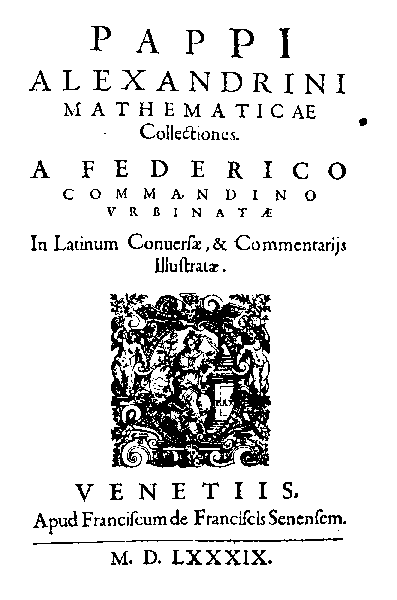
Pappus's major work in geometry is Synagoge or the Mathematical Collection which is a collection of mathematical writings in eight books thought to have been written in around 340 (although some historians believe that Pappus had completed the work by 325 AD). Heath in [4] describes the Mathematical Collection as follows:-
Obviously written with the object of reviving the classical Greek geometry, it covers practically the whole field. It is, however, a handbook or guide to Greek geometry rather than an encyclopaedia; it was intended, that is, to be read with the original works (where still extant) rather than to enable them to be dispensed with.
It seems likely that this work was not originally written as a single treatise but rather was written as a series of books dealing with different topics. Each book has its own introduction and often a valuable historical account of the topic, particularly in the case where such an account is not readily available from other sources.
Book I covered arithmetic (and is lost) while Book II is partly lost but the remaining part deals with Apollonius's method for dealing with large numbers. The method expresses numbers as powers of a myriad, that is as powers of 10000.
Book III is divided by Pappus into four parts. The first part looks at the problem of finding two mean proportionals between two given straight lines. The second part gives a construction of the arithmetic, geometric and harmonic means. The third part describes a collection of geometrical paradoxes which Pappus says are taken from a work by Erycinus. Other than what is included in this part, we know nothing of Erycinus or his work. The final part shows how each of the five regular polyhedra can be inscribed in a sphere. The authors of [9] discuss the muddle Pappus made in Book III of the problem of displaying the arithmetic, geometric and harmonic means of two segments in one circle.
Book IV contains properties of curves including the spiral of Archimedes and the quadratrix of Hippias and includes his trisection methods. Pappus introduces the various types of curves that he will consider:-
There are, we say, three types of problem in geometry, the so-called 'plane', 'solid', and 'linear' problems. Those that can be solved with straight line and circle are properly called 'plane' problems, for the lines by which such problems are solved have their origin in a plane. Those problems that are solved by the use of one or more sections of the cone are called 'solid' problems. For it is necessary in the construction to use surfaces of solid figures, that is to say, cones. There remain the third type, the so-called 'linear' problem. For the construction in these cases curves other than those already mentioned are required, curves having a more varied and forced origin and arising from more irregular surfaces and from complex motions. Of this character are the curves discovered in the so-called 'surface loci' and numerous others even more involved ... . These curves have many wonderful properties. More recent writers have indeed considered some of them worthy of more extended treatment, and one of the curves is called 'the paradoxical curve' by Menelaus. Other curves of the same type are spirals, quadratrices, cochloids, and cissoids.
Pappus introduces some of the ideas of Book V by describing how bees construct honeycombs. He concludes his discussion of honeycombs and introduces the aims of his work as follows (see for example [3] or [4]):-
Bees, then, know just this fact which is useful to them, that the hexagon is greater than the square and the triangle and will hold more honey for the same expenditure of material in constructing each. But we, claiming a greater share in wisdom than the bees, will investigate a somewhat wider problem, namely that, of all equilateral and equiangular plane figures having an equal perimeter, that which has the greater number of angles is always the greater, and the greatest of then all is the circle having its perimeter equal to them.
Also in Book V Pappus discusses the thirteen semiregular solids discovered by Archimedes. He compares the areas of figures with equal perimeters and volumes of solids with equal surface areas, proving a result due to Zenodorus that the sphere has greater volume than any regular solid with equal surface area. He also proves the related result that, for two regular solids with equal surface area, the one with the greater number of faces has the greater volume.
Books VI and VII consider books of other authors (Theodosius, Autolycus, Aristarchus, Euclid, Apollonius, Aristaeus and Eratosthenes). Book VI deals with the books on astronomy which were collected into the Little Astronomy so-called in contrast to Ptolemy's Almagest Ⓣ or Greater Astronomy. As well as reviewing these works, Pappus points out errors which have somehow entered the texts.
In Book VII Pappus writes about the Treasury of Analysis (see for example [3]):-
The so-called "Treasury of Analysis", my dear Hermodorus, is, in short, a special body of doctrine furnished for the use of those who, after going through the usual elements, wish to obtain power to solve problems set to then involving curves, and for this purpose only is it useful. It is the work of three men, Euclid the writer of the "Elements", Apollonius of Perga and Aristaeus the elder, and proceeds by the method of analysis and synthesis.
Pappus then goes on to explain the different approaches of analysis and synthesis [3]:-
... in analysis we suppose that which is sought to be already done, and inquire what it is from which this comes about, and again what is the antecedent cause of the latter, and so on until, by retracing our steps, we light upon something already known or ranking as a first principle... But in synthesis, proceeding in the opposite way, we suppose to be already done that which was last reached in analysis, and arranging in their natural order as consequents what were formerly antecedents and linking them one with another, we finally arrive at the construction of what was sought...
The article [13] is a wide ranging discussion of analysis and synthesis, taking this work by Pappus as a starting point.
It is in Book VII that the Pappus problem appears. See THIS LINK. This problem had a major impact on the development of geometry. It was discussed by Descartes and Newton and what is now known as Guldin's theorem is was proved by Pappus in Book VII of the Mathematical Collection. See [7] for a discussion of whether Guldin knew of Pappus's result when he published his work in 1640.
In Book VIII Pappus deals with mechanics. We quote Pappus's own description of the subject (see for example [3]):-
The science of mechanics, my dear Hermodorus, has many important uses in practical life, and is held by philosophers to be worthy of the highest esteem, and is zealously studied by mathematicians, because it takes almost first place in dealing with the nature of the material elements of the universe. for it deals generally with the stability and movement of bodies about their centres of gravity, and their motions in space, inquiring not only into the causes of those that move in virtue of their nature, but forcibly transferring others from their own places in a motion contrary to their nature; and it contrives to do this by using theorems appropriate to the subject matter.
The whole work does not show a great deal of originality but it does show that Pappus has a deep understanding of a whole range of mathematical topics and that he had mastered all the major available mathematical techniques. He writes well, shows great clarity of thought and the Mathematical Collection is a work of very great historical importance in the study of Greek geometry.
Of Pappus's commentary on Ptolemy's Almagest Ⓣ only the part on Books 5 and 6 has survived. We cannot be certain that Pappus wrote a commentary which extended to the whole 13 books, but it seems highly probable that he did. Certainly there is evidence that his commentary covered Books 1, 3 and 4 since traces exist or are quoted by other commentators on the Almagest Ⓣ. This commentary seems to be of much poorer quality to Pappus's geometrical work. Neugebauer [5] writes:-
.. the dullness and pomposity of these school treatises is only too evident. When Ptolemy in the chapter on the apparent diameter of the sun, moon and shadow simply remarks that the tangential cones in question contact the spheres within a negligible error in great circles, then Pappus refers to Euclid's "Optics" to show that the circle of contact has a smaller diameter than the sphere, only to add a lengthy argument to demonstrate that the error committed in Ptolemy's construction is nevertheless negligible. Or, when Ptolemy says that some phenomenon cannot take place, neither for the same clima nor for different geographical latitudes, Pappus feels obliged to explain "same clima" by "either in clima 3, or in 4, or in any other clima", and to illustrate "different" by referring to "Rome or Alexandria".
Neugebauer also points out that, in addition to these pointless comments, there are also comments by Pappus which are simply incorrect. In case it might be thought that the quality of the Mathematical Collection and the commentary on Ptolemy's Almagest Ⓣ as of such different quality that Pappus may not have written both, then this is ruled out by his references which he makes in the Mathematical Collection (see for example [1]):-
... as Archimedes showed, and as is proved by us in the commentary on the first book of the ["Almagest"] by a theorem of our own.
Of course Pappus did not write "Almagest" but the Greek title of the work.
Other commentaries which Pappus wrote include one on Euclid's Elements. Proclus, in his own commentary on the Elements refers three times to Pappus's commentary and Eutocius also refers to Pappus's commentary. Part of Pappus's commentary may exist in an Arabic translation, namely that on Book X of the Elements. However, the commentary is very different in style to that of the Mathematical Collection and if indeed Pappus is the author it is a commentary which fails to show the depth of understanding that he shows in other parts of his work.
Marinus claims that Pappus also wrote a commentary on Euclid's Data of which nothing has survived. That Pappus wrote on Geography is stated in the Suda and a work which claims to be written by Moses of Khoren in the fifth century seems to be largely based on Pappus's Geography. Moses writes (see for example [1]):-
We shall begin therefore after the Geography of Pappus of Alexandria, who followed the circle or special map of Claudius Ptolemy.
Another reference to Pappus in this work states:-
Having spoken of geography in general, we shall now begin to explain each of the countries according to Pappus of Alexandria.
Other works which could have been written by Pappus include one on music and one on hydrostatics. Certainly an instrument to measure liquids is attributed to him.
正文里的方括号编号指向这里,悬停即可直接看到条目。书目保留原文——译了书名反而查不到文献。
原站列出的延伸阅读与外部数据库,照原样保留,目标多为英文页面。
关于帕普斯的其它页面:
原站的交叉引用。指向本站已镜像专题的留在站内,其余仍指回原站。