数学家传记
毕达哥拉斯是一位希腊哲学家,在数学、天文学和音乐理论方面做出了重要发展。现在被称为毕达哥拉斯定理的定理在1000年前就为巴比伦人所知,但他可能是第一个证明它的人。
毕达哥拉斯常被描述为第一位纯粹数学家。他在数学发展中是极其重要的人物,然而我们对他的数学成就所知相对甚少。与许多后来的希腊数学家不同——至少我们还拥有他们写的一些书——我们对毕达哥拉斯的著作一无所知。他所领导的团体半宗教半科学,遵循保密准则,这无疑意味着今天毕达哥拉斯是一个神秘人物。
我们确实从早期传记中获得了毕达哥拉斯生平的细节,这些传记使用了重要的原始资料,但其作者却赋予他神圣的力量,并且其目的是把他呈现为一个神一般的人物。下面我们呈现的是试图汇集最可靠的资料,以重构毕达哥拉斯生平的叙述。关于他生平的主要事件有相当一致的意见,但大多数日期存在争议,不同学者给出的日期相差20年。一些历史学家把所有这些信息仅仅当作传说,但即使读者这样看待它,作为如此早期的记录,它也具有历史重要性。
毕达哥拉斯的父亲是Mnesarchus([12]和[13]),母亲是Pythais[8],她是土生土长的毕达哥拉斯人。Mnesarchus是一位来自提尔的商人,有一个故事([12]和[13])说,他在一次饥荒时把谷物运到毕达哥拉斯,作为感激的标志被授予毕达哥拉斯公民身份。毕达哥拉斯童年早期在毕达哥拉斯度过,但随父亲广泛旅行。有记载说Mnesarchus带着毕达哥拉斯回到提尔,他在那里受教于迦勒底人和叙利亚的博学之士。看来他还曾随父亲访问意大利。
关于毕达哥拉斯的童年,人们所知甚少。除了对毕达哥拉斯大腿上一块醒目胎记的描述之外,所有关于他外貌的记述都可能是虚构的。他很可能有两个兄弟,尽管有些资料说他曾有三个。他肯定受过良好的教育,学习弹奏里拉琴,学习诗歌并背诵荷马。在他的老师中,有三位哲学家在毕达哥拉斯年轻时对他产生了影响。其中最重要的一位是Pherekydes,许多人将他描述为毕达哥拉斯的老师。
另外两位影响毕达哥拉斯并向他介绍数学思想的哲学家是泰勒斯和他的学生阿那克西曼德,他们都住在米利都。在[8]中说,毕达哥拉斯在18到20岁之间时在米利都拜访了泰勒斯。此时泰勒斯已是一位老人,尽管他给毕达哥拉斯留下了深刻印象,但他可能没有教给他很多。然而,他确实促进了毕达哥拉斯对数学和天文学的兴趣,并建议他前往埃及学习更多这些学科。泰勒斯的学生阿那克西曼德在米利都讲学,毕达哥拉斯参加了这些讲座。阿那克西曼德肯定对几何学和宇宙论感兴趣,他的许多思想影响了毕达哥拉斯自己的观点。
大约在公元前535年,毕达哥拉斯去了埃及。这发生在暴君Polycrates夺取城市毕达哥拉斯控制权几年后。有一些证据表明,毕达哥拉斯和Polycrates起初关系友好,据称[5]毕达哥拉斯带着Polycrates写的介绍信去了埃及。事实上,Polycrates与埃及结盟,因此当时毕达哥拉斯与埃及之间有着紧密的联系。关于毕达哥拉斯在埃及期间的记载表明,他参观了许多神庙,并与祭司们进行了许多讨论。根据波菲利([12]和[13]),毕达哥拉斯被拒绝进入所有神庙,除了Diospolis的那座,在那里他在完成入会所需的仪式后被接纳为祭司。
不难将毕达哥拉斯的许多信仰——他后来强加于他在意大利建立的社会——与他在埃及遇到的习俗联系起来。例如,埃及祭司的保密性、他们拒绝吃豆子、他们拒绝穿甚至由动物皮制成的衣服,以及他们对纯洁的追求,都是毕达哥拉斯后来采纳的习俗。波菲利在[12]和[13]中说,毕达哥拉斯从埃及人那里学习了几何学,但他很可能已经熟悉几何学,肯定是在接受了泰勒斯和阿那克西曼德的教导之后。
公元前525年,波斯国王冈比西斯二世入侵埃及。波利克拉特斯放弃与埃及的联盟,派出40艘船加入波斯舰队对抗埃及人。冈比西斯在尼罗河三角洲赢得佩鲁西姆战役并占领赫利奥波利斯和孟菲斯后,埃及的抵抗崩溃。毕达哥拉斯被俘并被带到巴比伦。扬布利科斯写道,毕达哥拉斯(见[8]):-
……被冈比西斯的追随者作为战俘押送。在那里期间,他乐于与麻葛交往……并接受了他们的神圣仪式教导,了解到一种非常神秘的对诸神的崇拜。他还在巴比伦人教授的算术、音乐和其他数学科学方面达到了完美的顶峰……
大约公元前520年,毕达哥拉斯离开巴比伦,返回毕达哥拉斯。波利克拉特斯大约在公元前522年被杀,冈比西斯于公元前522年夏天去世,或是自杀,或是意外所致。这些统治者的死亡可能是毕达哥拉斯返回毕达哥拉斯的一个因素,但没有任何地方解释毕达哥拉斯是如何获得自由的。波利克拉特斯死后,波斯的 Darius 控制了毕达哥拉斯,而在毕达哥拉斯返回时,他本应控制该岛。这与波菲利和第欧根尼·拉尔修的记载相冲突,他们称毕达哥拉斯返回那里时,波利克拉特斯仍控制着毕达哥拉斯。
毕达哥拉斯返回毕达哥拉斯后不久前往克里特,研究那里的法律体系。回到毕达哥拉斯后,他创办了一所学校,被称为半圆。Iamblichus [8]在公元三世纪写道:-
……他在城邦[毕达哥拉斯]中组建了一所学校,即毕达哥拉斯的“半圆”,即使今天也以此名闻名,萨摩斯人在那里举行政治会议。他们这样做是因为他们认为应该在这个由将所有这些问题视为己任的人所创立的地方讨论关于善、正义和权宜的问题。在城外,他把一个洞穴作为自己哲学教学的私人场所,在那里度过大部分夜晚和白天,研究数学的用途……
毕达哥拉斯于约公元前518年(有人说要早得多)离开毕达哥拉斯前往意大利南部。Iamblichus [8]给出了他离开的一些理由。首先,他评论了萨摩斯人对他的教学方法的反应:-
……他试图运用他那象征性的教学方法,这种方法在各方面都与他在埃及学到的课程相似。萨摩斯人并不太热衷于此法,对他态度粗鲁且失当。
根据Iamblichus的说法,这在一定程度上被用作毕达哥拉斯离开毕达哥拉斯的借口:-
……毕达哥拉斯被同胞拖入各种外交使命,被迫参与公共事务。……他知道之前所有的哲学家都在异国他乡终其一生,因此决定逃避一切政治责任,据某些资料称,他借口萨摩斯人蔑视他的教学方法。
毕达哥拉斯在克罗顿(今意大利南部靴跟东侧的克罗托内)创立了一所哲学与宗教学校,拥有众多追随者。毕达哥拉斯是该团体的领袖,其核心圈子内的追随者被称为mathematikoi。mathematikoi永久地与该团体生活在一起,没有个人财产,并且是素食者。他们由毕达哥拉斯亲自教导,遵守严格的规定。毕达哥拉斯所持的信念是[2]:-
(1) 在最深层次上,实在本质上是数学的,
(2) 哲学可用于精神净化,
(3) 灵魂可上升而与神合一,
(4) 某些符号具有神秘意义,并且
(5) 该教团的所有弟兄都应遵守严格的忠诚与保密。
男性和女性都被允许成为该学派的成员,事实上后来有几位毕达哥拉斯学派的女性成为了著名的哲学家。学派的外围成员被称为“听讲者”,他们住在自己的家中,只在白天来到学派。他们被允许拥有自己的财产,也不被要求素食。
毕达哥拉斯的实际工作无人知晓。他的学派实行保密和公社制,使得难以区分毕达哥拉斯的工作与其追随者的工作。当然,他的学派对数学做出了杰出贡献,并且可以相当确定毕达哥拉斯的一些数学贡献。首先我们应该明确毕达哥拉斯和mathematikoi在何种意义上研究数学。他们并不像现代大学或其他机构中的数学研究小组那样行事。没有供他们解决的“开放问题”,他们也丝毫不感兴趣于试图表述或解决数学问题。
毕达哥拉斯对数学原理、数的概念、三角形或其他数学图形的概念以及证明的抽象理念感兴趣。正如Brumbaugh在[3]中所写:-
对于我们今天这些已经熟悉纯数学抽象和概括这一心智活动的人来说,很难体会到这一毕达哥拉斯学派贡献的独创性。
事实上,今天我们已经在数学上变得如此精深,以至于我们甚至无法认识到2是一个抽象的量。从2艘船+2艘船=4艘船,到抽象结果2+2=4,这是一个非凡的飞跃,后者不仅适用于船,还适用于笔、人、房屋等等。还有另一步,就是认识到2这个抽象概念本身就是一个事物,在某种意义上与一艘船或一座房屋一样真实。
毕达哥拉斯相信所有关系都可以归结为数的关系。正如亚里士多德所写:-
毕达哥拉斯学派……在数学研究中成长起来,认为事物就是数……并且整个宇宙是一个音阶和一个数。
这一推广源于毕达哥拉斯在音乐、数学和天文学中的观察。毕达哥拉斯注意到,当弦长的比值为整数时,振动的弦会产生和谐的音调,并且这些比值可以推广到其他乐器。事实上,毕达哥拉斯对音乐的数学理论做出了显著贡献。他是一位优秀的音乐家,会弹奏里拉琴,并利用音乐作为帮助病人的手段。
毕达哥拉斯研究了今天数学家所熟悉的数的性质,如偶数和奇数、三角数、完全数等。然而对毕达哥拉斯来说,数具有我们今天几乎不认为是数学的个性[3]:-
每个数都有自己的个性——男性或女性、完美或不完美、美丽或丑陋。现代数学有意消除了这种感觉,但我们仍然在小说和诗歌中找到它的余韵。十是最好的数:它本身包含了前四个整数——一、二、三和四[1 + 2 + 3 + 4 = 10]——这些用点表示法写出来形成一个完美的三角形。
当然,今天我们特别记得毕达哥拉斯是因为他著名的几何定理。尽管这个定理,现在称为毕达哥拉斯定理,在1000年前就为巴比伦人所知,但他可能是第一个证明它的人。普罗克洛,最后一位主要的希腊哲学家,生活在大约公元450年,写道(见[7]):-
在[泰勒斯等]之后,毕达哥拉斯将几何研究转变为一种自由教育,从头审视这门科学的原则,并以非物质和理智的方式探究定理:正是他发现了无理数的理论和宇宙图形的构造。
再次,普罗克洛在写到几何时说:-
我效仿毕达哥拉斯学派,他们甚至有一句惯用语来表达我的意思:“一个图形和一个平台,而不是一个图形和六便士”,他们借此暗示,值得研究的几何学是那种在每一个新定理处都搭建起一个可供攀升的平台,并将灵魂提升到高处,而不是让它下降到可感事物之中,从而屈从于这凡人生活的共同需求的几何学。
托马斯·利特尔·希思 [7] 给出了一份归于 毕达哥拉斯,或者更一般地说归于毕达哥拉斯学派的定理列表。
(i) 三角形内角和等于两个直角。毕达哥拉斯学派也知道这一推广:一个具有 条边的多边形,其内角和为 个直角,外角和等于四个直角。
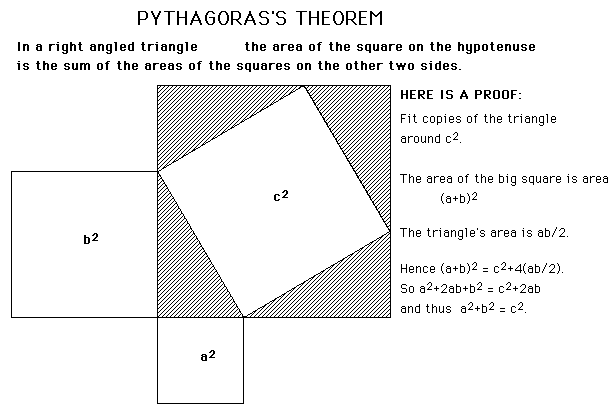
(ii) 毕达哥拉斯定理——对于直角三角形,斜边上的正方形等于另外两边上的正方形之和。这里我们应当注意,对毕达哥拉斯来说,斜边上的正方形肯定不会被认为是某个数乘以自身,而应被视为在该边上构造的几何正方形。说两个正方形之和等于第三个正方形,意思是这两个正方形可以被切割并重新拼合,形成一个与第三个正方形全等的正方形。
(iii) 构造给定面积的图形与几何代数。例如,他们用几何方法解诸如的方程。
(iv) 无理数的发现。这无疑被归功于毕达哥拉斯学派,但似乎不太可能归功于毕达哥拉斯本人。这与毕达哥拉斯的哲学——万物皆数——相悖,因为他所说的数是指两个整数的比。然而,由于他相信万物皆数,一个自然的任务就是试图证明等腰直角三角形的斜边长度对应一个数。
(v) 五种正多面体。人们认为毕达哥拉斯本人知道如何构造前三种,但他不太可能知道如何构造另外两种。
(vi) 在天文学中,毕达哥拉斯 教导说地球是宇宙中心的一个球体。他还认识到月球的轨道与地球赤道倾斜,并且他是最早意识到作为昏星的维纳斯与作为晨星的维纳斯是同一颗行星的人之一。
然而,毕达哥拉斯 首先是一位哲学家。除了上述关于数、几何学和天文学的信念之外,他还持有 [2]:-
……以下哲学和伦理教导:……世界结构动力学依赖于对立面或成对相反者的相互作用;将灵魂视为一种自我运动的数,经历一种转世,或在不同物种中连续转生,直到最终净化(特别是通过伦理严格的毕达哥拉斯学派的理智生活);以及理解……所有存在对象从根本上由形式而非物质实体构成。进一步的毕达哥拉斯学说……将大脑认定为灵魂的 轨迹;并规定了某些秘密的崇拜实践。
在他们的伦理实践中,毕达哥拉斯学派以相互友爱、无私和诚实而闻名。
尽管毕达哥拉斯希望远离政治,但他在克罗顿的社团并未不受政治事件的影响。毕达哥拉斯于公元前513年前往提洛岛照顾他垂死的老教师Pherekydes。他在那里待了几个月,直到他的朋友兼老师去世,然后返回克罗顿。公元前510年,克罗顿攻击并击败了邻邦锡巴里斯,确实有一些迹象表明毕达哥拉斯卷入了这场争端。然后在公元前508年左右,克罗顿的毕达哥拉斯社团遭到来自克罗顿本身的贵族Cylon的攻击。毕达哥拉斯逃到Metapontium,大多数作者说他死在那里,有些人声称他因社团遭到攻击而自杀。Iamblichus在8中引用了事件的一个版本:-
Cylon是克罗顿人,出身、名声和财富都是主要公民,但除此之外是一个难以相处、暴力、令人不安且具有暴君倾向的人,他热切希望参与毕达哥拉斯的生活方式。他接近当时已年老的毕达哥拉斯,但因刚才描述的性格缺陷而被拒绝。当此事发生时,Cylon和他的朋友们发誓要对毕达哥拉斯及其追随者进行猛烈攻击。因此,一种强烈的侵略热情促使Cylon及其追随者迫害毕达哥拉斯学派,直至最后一人。由于这个原因,毕达哥拉斯前往Metapontium,据说在那里结束了他的生命。
这似乎被大多数人接受,但Iamblichus本人不接受这个版本,并认为Cylon的攻击是小事,毕达哥拉斯返回了克罗顿。当然,毕达哥拉斯社团在此后繁荣了许多年,并从克罗顿传播到许多其他意大利城市。Gorman [6]认为这是相信毕达哥拉斯返回克罗顿的有力理由,并引用了其他证据,如广泛报道的毕达哥拉斯去世时年龄约100岁,以及许多来源说毕达哥拉斯教过Empedokles,从而声称他一定在公元前480年之后还活了很久。
关于毕达哥拉斯死亡的时间和地点,证据不明确。当然,毕达哥拉斯社团在公元前500年后迅速扩张,变得具有政治性质,也分裂成若干派系。公元前460年,该社团[2]:-
……遭到暴力镇压。其聚会场所到处被洗劫和焚毁;特别提到克罗顿的“米洛之家”,在那里有五六十名毕达哥拉斯学派成员遭到突袭并被杀害。幸存者逃往底比斯和其他地方避难。
Pythagoras of Samos is often described as the first pure mathematician. He is an extremely important figure in the development of mathematics yet we know relatively little about his mathematical achievements. Unlike many later Greek mathematicians, where at least we have some of the books which they wrote, we have nothing of Pythagoras's writings. The society which he led, half religious and half scientific, followed a code of secrecy which certainly means that today Pythagoras is a mysterious figure.
We do have details of Pythagoras's life from early biographies which use important original sources yet are written by authors who attribute divine powers to him, and whose aim was to present him as a god-like figure. What we present below is an attempt to collect together the most reliable sources to reconstruct an account of Pythagoras's life. There is fairly good agreement on the main events of his life but most of the dates are disputed with different scholars giving dates which differ by 20 years. Some historians treat all this information as merely legends but, even if the reader treats it in this way, being such an early record it is of historical importance.
Pythagoras's father was Mnesarchus ([12] and [13]), while his mother was Pythais [8] and she was a native of Samos. Mnesarchus was a merchant who came from Tyre, and there is a story ([12] and [13]) that he brought corn to Samos at a time of famine and was granted citizenship of Samos as a mark of gratitude. As a child Pythagoras spent his early years in Samos but travelled widely with his father. There are accounts of Mnesarchus returning to Tyre with Pythagoras and that he was taught there by the Chaldaeans and the learned men of Syria. It seems that he also visited Italy with his father.
Little is known of Pythagoras's childhood. All accounts of his physical appearance are likely to be fictitious except the description of a striking birthmark which Pythagoras had on his thigh. It is probable that he had two brothers although some sources say that he had three. Certainly he was well educated, learning to play the lyre, learning poetry and to recite Homer. There were, among his teachers, three philosophers who were to influence Pythagoras while he was a young man. One of the most important was Pherekydes who many describe as the teacher of Pythagoras.
The other two philosophers who were to influence Pythagoras, and to introduce him to mathematical ideas, were Thales and his pupil Anaximander who both lived on Miletus. In [8] it is said that Pythagoras visited Thales in Miletus when he was between 18 and 20 years old. By this time Thales was an old man and, although he created a strong impression on Pythagoras, he probably did not teach him a great deal. However he did contribute to Pythagoras's interest in mathematics and astronomy, and advised him to travel to Egypt to learn more of these subjects. Thales's pupil, Anaximander, lectured on Miletus and Pythagoras attended these lectures. Anaximander certainly was interested in geometry and cosmology and many of his ideas would influence Pythagoras's own views.
In about 535 BC Pythagoras went to Egypt. This happened a few years after the tyrant Polycrates seized control of the city of Samos. There is some evidence to suggest that Pythagoras and Polycrates were friendly at first and it is claimed [5] that Pythagoras went to Egypt with a letter of introduction written by Polycrates. In fact Polycrates had an alliance with Egypt and there were therefore strong links between Samos and Egypt at this time. The accounts of Pythagoras's time in Egypt suggest that he visited many of the temples and took part in many discussions with the priests. According to Porphyry ([12] and [13]) Pythagoras was refused admission to all the temples except the one at Diospolis where he was accepted into the priesthood after completing the rites necessary for admission.
It is not difficult to relate many of Pythagoras's beliefs, ones he would later impose on the society that he set up in Italy, to the customs that he came across in Egypt. For example the secrecy of the Egyptian priests, their refusal to eat beans, their refusal to wear even cloths made from animal skins, and their striving for purity were all customs that Pythagoras would later adopt. Porphyry in [12] and [13] says that Pythagoras learnt geometry from the Egyptians but it is likely that he was already acquainted with geometry, certainly after teachings from Thales and Anaximander.
In 525 BC Cambyses II, the king of Persia, invaded Egypt. Polycrates abandoned his alliance with Egypt and sent 40 ships to join the Persian fleet against the Egyptians. After Cambyses had won the Battle of Pelusium in the Nile Delta and had captured Heliopolis and Memphis, Egyptian resistance collapsed. Pythagoras was taken prisoner and taken to Babylon. Iamblichus writes that Pythagoras (see [8]):-
... was transported by the followers of Cambyses as a prisoner of war. Whilst he was there he gladly associated with the Magoi ... and was instructed in their sacred rites and learnt about a very mystical worship of the gods. He also reached the acme of perfection in arithmetic and music and the other mathematical sciences taught by the Babylonians...
In about 520 BC Pythagoras left Babylon and returned to Samos. Polycrates had been killed in about 522 BC and Cambyses died in the summer of 522 BC, either by committing suicide or as the result of an accident. The deaths of these rulers may have been a factor in Pythagoras's return to Samos but it is nowhere explained how Pythagoras obtained his freedom. Darius of Persia had taken control of Samos after Polycrates' death and he would have controlled the island on Pythagoras's return. This conflicts with the accounts of Porphyry and Diogenes Laertius who state that Polycrates was still in control of Samos when Pythagoras returned there.
Pythagoras made a journey to Crete shortly after his return to Samos to study the system of laws there. Back in Samos he founded a school which was called the semicircle. Iamblichus [8] writes in the third century AD that:-
... he formed a school in the city [of Samos], the 'semicircle' of Pythagoras, which is known by that name even today, in which the Samians hold political meetings. They do this because they think one should discuss questions about goodness, justice and expediency in this place which was founded by the man who made all these subjects his business. Outside the city he made a cave the private site of his own philosophical teaching, spending most of the night and daytime there and doing research into the uses of mathematics...
Pythagoras left Samos and went to southern Italy in about 518 BC (some say much earlier). Iamblichus [8] gives some reasons for him leaving. First he comments on the Samian response to his teaching methods:-
... he tried to use his symbolic method of teaching which was similar in all respects to the lessons he had learnt in Egypt. The Samians were not very keen on this method and treated him in a rude and improper manner.
This was, according to Iamblichus, used in part as an excuse for Pythagoras to leave Samos:-
... Pythagoras was dragged into all sorts of diplomatic missions by his fellow citizens and forced to participate in public affairs. ... He knew that all the philosophers before him had ended their days on foreign soil so he decided to escape all political responsibility, alleging as his excuse, according to some sources, the contempt the Samians had for his teaching method.
Pythagoras founded a philosophical and religious school in Croton (now Crotone, on the east of the heel of southern Italy) that had many followers. Pythagoras was the head of the society with an inner circle of followers known as mathematikoi. The mathematikoi lived permanently with the Society, had no personal possessions and were vegetarians. They were taught by Pythagoras himself and obeyed strict rules. The beliefs that Pythagoras held were [2]:-
(1) that at its deepest level, reality is mathematical in nature,
(2) that philosophy can be used for spiritual purification,
(3) that the soul can rise to union with the divine,
(4) that certain symbols have a mystical significance, and
(5) that all brothers of the order should observe strict loyalty and secrecy.
Both men and women were permitted to become members of the Society, in fact several later women Pythagoreans became famous philosophers. The outer circle of the Society were known as the akousmatics and they lived in their own houses, only coming to the Society during the day. They were allowed their own possessions and were not required to be vegetarians.
Of Pythagoras's actual work nothing is known. His school practised secrecy and communalism making it hard to distinguish between the work of Pythagoras and that of his followers. Certainly his school made outstanding contributions to mathematics, and it is possible to be fairly certain about some of Pythagoras's mathematical contributions. First we should be clear in what sense Pythagoras and the mathematikoi were studying mathematics. They were not acting as a mathematics research group does in a modern university or other institution. There were no 'open problems' for them to solve, and they were not in any sense interested in trying to formulate or solve mathematical problems.
Rather Pythagoras was interested in the principles of mathematics, the concept of number, the concept of a triangle or other mathematical figure and the abstract idea of a proof. As Brumbaugh writes in [3]:-
It is hard for us today, familiar as we are with pure mathematical abstraction and with the mental act of generalisation, to appreciate the originality of this Pythagorean contribution.
In fact today we have become so mathematically sophisticated that we fail even to recognise 2 as an abstract quantity. There is a remarkable step from 2 ships + 2 ships = 4 ships, to the abstract result 2 + 2 = 4, which applies not only to ships but to pens, people, houses etc. There is another step to see that the abstract notion of 2 is itself a thing, in some sense every bit as real as a ship or a house.
Pythagoras believed that all relations could be reduced to number relations. As Aristotle wrote:-
The Pythagorean ... having been brought up in the study of mathematics, thought that things are numbers ... and that the whole cosmos is a scale and a number.
This generalisation stemmed from Pythagoras's observations in music, mathematics and astronomy. Pythagoras noticed that vibrating strings produce harmonious tones when the ratios of the lengths of the strings are whole numbers, and that these ratios could be extended to other instruments. In fact Pythagoras made remarkable contributions to the mathematical theory of music. He was a fine musician, playing the lyre, and he used music as a means to help those who were ill.
Pythagoras studied properties of numbers which would be familiar to mathematicians today, such as even and odd numbers, triangular numbers, perfect numbers etc. However to Pythagoras numbers had personalities which we hardly recognise as mathematics today [3]:-
Each number had its own personality - masculine or feminine, perfect or incomplete, beautiful or ugly. This feeling modern mathematics has deliberately eliminated, but we still find overtones of it in fiction and poetry. Ten was the very best number: it contained in itself the first four integers - one, two, three, and four [1 + 2 + 3 + 4 = 10] - and these written in dot notation formed a perfect triangle.
Of course today we particularly remember Pythagoras for his famous geometry theorem. Although the theorem, now known as Pythagoras's theorem, was known to the Babylonians 1000 years earlier he may have been the first to prove it. Proclus, the last major Greek philosopher, who lived around 450 AD wrote (see [7]):-
After [Thales, etc.] Pythagoras transformed the study of geometry into a liberal education, examining the principles of the science from the beginning and probing the theorems in an immaterial and intellectual manner: he it was who discovered the theory of irrational and the construction of the cosmic figures.
Again Proclus, writing of geometry, said:-
I emulate the Pythagoreans who even had a conventional phrase to express what I mean "a figure and a platform, not a figure and a sixpence", by which they implied that the geometry which is deserving of study is that which, at each new theorem, sets up a platform to ascend by, and lifts the soul on high instead of allowing it to go down among the sensible objects and so become subservient to the common needs of this mortal life.
Heath [7] gives a list of theorems attributed to Pythagoras, or rather more generally to the Pythagoreans.
(i) The sum of the angles of a triangle is equal to two right angles. Also the Pythagoreans knew the generalisation which states that a polygon with sides has sum of interior angles right angles and sum of exterior angles equal to four right angles.
(ii) The theorem of Pythagoras - for a right angled triangle the square on the hypotenuse is equal to the sum of the squares on the other two sides. We should note here that to Pythagoras the square on the hypotenuse would certainly not be thought of as a number multiplied by itself, but rather as a geometrical square constructed on the side. To say that the sum of two squares is equal to a third square meant that the two squares could be cut up and reassembled to form a square identical to the third square.
(iii) Constructing figures of a given area and geometrical algebra. For example they solved equations such as by geometrical means.
(iv) The discovery of irrationals. This is certainly attributed to the Pythagoreans but it does seem unlikely to have been due to Pythagoras himself. This went against Pythagoras's philosophy the all things are numbers, since by a number he meant the ratio of two whole numbers. However, because of his belief that all things are numbers it would be a natural task to try to prove that the hypotenuse of an isosceles right angled triangle had a length corresponding to a number.
(v) The five regular solids. It is thought that Pythagoras himself knew how to construct the first three but it is unlikely that he would have known how to construct the other two.
(vi) In astronomy Pythagoras taught that the Earth was a sphere at the centre of the Universe. He also recognised that the orbit of the Moon was inclined to the equator of the Earth and he was one of the first to realise that Venus as an evening star was the same planet as Venus as a morning star.
Primarily, however, Pythagoras was a philosopher. In addition to his beliefs about numbers, geometry and astronomy described above, he held [2]:-
... the following philosophical and ethical teachings: ... the dependence of the dynamics of world structure on the interaction of contraries, or pairs of opposites; the viewing of the soul as a self-moving number experiencing a form of metempsychosis, or successive reincarnation in different species until its eventual purification (particularly through the intellectual life of the ethically rigorous Pythagoreans); and the understanding ...that all existing objects were fundamentally composed of form and not of material substance. Further Pythagorean doctrine ... identified the brain as the locus of the soul; and prescribed certain secret cultic practices.
In [3] their practical ethics are also described:-
In their ethical practices, the Pythagorean were famous for their mutual friendship, unselfishness, and honesty.
Pythagoras's Society at Croton was not unaffected by political events despite his desire to stay out of politics. Pythagoras went to Delos in 513 BC to nurse his old teacher Pherekydes who was dying. He remained there for a few months until the death of his friend and teacher and then returned to Croton. In 510 BC Croton attacked and defeated its neighbour Sybaris and there is certainly some suggestions that Pythagoras became involved in the dispute. Then in around 508 BC the Pythagorean Society at Croton was attacked by Cylon, a noble from Croton itself. Pythagoras escaped to Metapontium and the most authors say he died there, some claiming that he committed suicide because of the attack on his Society. Iamblichus in [8] quotes one version of events:-
Cylon, a Crotoniate and leading citizen by birth, fame and riches, but otherwise a difficult, violent, disturbing and tyrannically disposed man, eagerly desired to participate in the Pythagorean way of life. He approached Pythagoras, then an old man, but was rejected because of the character defects just described. When this happened Cylon and his friends vowed to make a strong attack on Pythagoras and his followers. Thus a powerfully aggressive zeal activated Cylon and his followers to persecute the Pythagoreans to the very last man. Because of this Pythagoras left for Metapontium and there is said to have ended his days.
This seems accepted by most but Iamblichus himself does not accept this version and argues that the attack by Cylon was a minor affair and that Pythagoras returned to Croton. Certainly the Pythagorean Society thrived for many years after this and spread from Croton to many other Italian cities. Gorman [6] argues that this is a strong reason to believe that Pythagoras returned to Croton and quotes other evidence such as the widely reported age of Pythagoras as around 100 at the time of his death and the fact that many sources say that Pythagoras taught Empedokles to claim that he must have lived well after 480 BC.
The evidence is unclear as to when and where the death of Pythagoras occurred. Certainly the Pythagorean Society expanded rapidly after 500 BC, became political in nature and also spilt into a number of factions. In 460 BC the Society [2]:-
... was violently suppressed. Its meeting houses were everywhere sacked and burned; mention is made in particular of "the house of Milo" in Croton, where 50 or 60 Pythagoreans were surprised and slain. Those who survived took refuge at Thebes and other places.
正文里的方括号编号指向这里,悬停即可直接看到条目。书目保留原文——译了书名反而查不到文献。
原站列出的延伸阅读与外部数据库,照原样保留,目标多为英文页面。
关于毕达哥拉斯的其它页面:
原站的交叉引用。指向本站已镜像专题的留在站内,其余仍指回原站。