数学家传记
约瑟夫·拉格朗日是一位意大利出生的法国数学家,在分析、数论以及分析力学和天体力学等所有领域都有卓越成就。
约瑟夫·拉格朗日通常被认为是法国数学家,但意大利百科全书[40]称他为意大利数学家。他们这一说法当然有一定依据,因为拉格朗日出生于都灵,并以Giuseppe Lodovico Lagrangia之名受洗。拉格朗日的父亲是Giuseppe Francesco Lodovico Lagrangia,曾任都灵公共工程与防御工事办公室的财务主管,而他的母亲Teresa Grosso是来自都灵附近Cambiano的一位医生的独生女。拉格朗日是他们11个孩子中的长子,但只有两个孩子活到成年。
都灵曾是萨伏依公国的首都,但在1720年成为撒丁王国的首都,那是在拉格朗日出生前十六年。拉格朗日的家族在父系方面有法国渊源,他的曾祖父是一位法国骑兵上尉,离开法国为萨伏依公爵效力。拉格朗日始终倾向于自己的法国血统,因为年轻时他会署名Lodovico LaGrange或Luigi Lagrange,使用其姓氏的法语形式。
尽管拉格朗日的父亲在撒丁国王的麾下担任着相当重要的职务,但家境并不富裕,因为拉格朗日的父亲在几次失败的金融投机中损失了大笔钱财。父亲为拉格朗日规划了一条律师的职业道路,而拉格朗日似乎也心甘情愿地接受了这一安排。他在都灵学院学习,最喜欢的科目是古典拉丁语。起初他对数学并无太大热情,觉得希腊几何相当枯燥。
拉格朗日对数学的兴趣始于他读到爱德蒙·哈雷1693年关于代数在光学中应用的著作。他还因Beccaria在都灵学院的出色教学而对物理产生兴趣,并决定以数学为业。也许数学界要感谢拉格朗日的父亲不稳健的金融投机,因为拉格朗日后来声称:-
如果我富有,我大概不会献身于数学。
他确实投身于数学,但很大程度上是自学成才,没有机会师从顶尖数学家学习。1754年7月23日,他发表了自己的第一部数学作品,其形式是一封用意大利语写给法尼亚诺的信。也许最令人惊讶的是拉格朗日发表这篇论文时所用的名字,即Luigi De la Grange Tournier。这部作品并非杰作,在一定程度上显示出拉格朗日是在没有数学导师指导的情况下独自工作的。该论文将二项式定理与函数乘积的逐次导数进行了类比。
在用意大利文写成论文发表之前,拉格朗日曾用拉丁文写信将结果寄给当时在柏林工作的莱昂哈德·欧拉。然而论文发表后的一个月,拉格朗日发现这些结果出现在约翰·伯努利与哥特弗里德·威廉·莱布尼茨的通信中。拉格朗日对这一发现极为不安,因为他担心被扣上抄袭他人成果的骗子之名。然而这个算不上出色的开端只是使拉格朗日加倍努力,以在数学上做出真正有价值的成果。他开始研究等时曲线,即一个受重粒子无论初始position如何,总会在相同时间内到达固定点所沿的曲线。到1754年底,他在等时曲线上已有一些重要发现,这些发现将极大地促进变分法这一新学科(数学家们已开始研究它,但直到1766年莱昂哈德·欧拉如此称呼它之前,它并未获得“变分法”这一名称)。
拉格朗日将他在等时曲线上的结果连同其极大极小方法寄给了莱昂哈德·欧拉。他的信写于1755年8月12日,莱昂哈德·欧拉于9月6日回信,对拉格朗日的新思想赞叹不已。尽管拉格朗日当时年仅19岁,他仍于1755年9月28日被任命为都灵皇家炮兵学校的数学教授。这是当之无愧的,因为这位年轻人已向数学界展示了他思想的独创性和伟大才华的深度。
1756年,拉格朗日将他在将变分法应用于力学方面所获得的结果寄给了莱昂哈德·欧拉。这些结果推广了莱昂哈德·欧拉本人所获得的结果,莱昂哈德·欧拉就这位非凡的年轻数学家咨询了柏林科学院院长皮埃尔·莫佩尔蒂。拉格朗日不仅是一位杰出的数学家,而且还是最小作用量原理的坚定倡导者,因此皮埃尔·莫佩尔蒂毫不犹豫地试图吸引拉格朗日到普鲁士任职。他与莱昂哈德·欧拉商定,让拉格朗日知道这个新职位将比他目前在都灵所担任的职位显赫得多。然而,拉格朗日并不追求显赫,他只想能够将时间奉献给数学,于是他羞怯而礼貌地拒绝了这一职位。
莱昂哈德·欧拉还提名拉格朗日参选柏林科学院,他于1756年9月2日正式当选。次年,拉格朗日成为都灵一个科学学会的创始成员,该学会后来成为Royal Academy of Sciences of Turin。这个新学会的主要职责之一是出版一份科学期刊Mélanges de Turin,以法文或拉丁文发表文章。拉格朗日是Mélanges de Turin最初几卷的主要撰稿人,其第1卷于1759年出版,第2卷于1762年出版,第3卷于1766年出版。
拉格朗日在这些学报上发表的论文涵盖了多种主题。他发表了自己关于变分法的优美结果,以及一篇关于calculus of probabilities的短作。在一篇关于动力学基础的工作中,拉格朗日将他的展开建立在最小作用量原理和动能之上。
在Mélanges de Turin中,拉格朗日还对声音的传播做了重要研究,对振动弦理论作出了重要贡献。他广泛阅读了这方面的文献,并且显然深入思考过艾萨克·牛顿、丹尼尔·伯努利、布鲁克·泰勒、莱昂哈德·欧拉和让·勒朗·达朗贝尔的著作。拉格朗日为他的振动弦使用了离散质量模型,他取该模型由个质量通过无重量的弦连接而成。他求解了由此得到的个微分方程的方程组,然后让趋于无穷,以得到与莱昂哈德·欧拉曾得到的相同的函数解。然而,他通向解的不同路径表明,他是在寻找不同于莱昂哈德·欧拉的方法,而拉格朗日对莱昂哈德·欧拉极为尊敬。
在发表于第三卷的论文中,拉格朗日研究了微分方程的积分,并对诸如流体力学(他在其中引入了拉格朗日函数)等主题作了各种应用。其中还包含求解线性微分方程组的方法,这些方法首次使用了线性代换的特征值。他应用自己方法的另一个问题是研究木星和土星的轨道。
巴黎的Académie des Sciences于1762年宣布了其1764年的悬赏竞赛。题目是关于月球的秤动,即使月球朝向地球的那一面发生摆动、从而导致月球特征位置发生微小变化的运动。拉格朗日参加了竞赛,于1763年将参赛作品寄往巴黎,作品在拉格朗日本人到达前不久抵达那里。同年11月,他离开都灵开始第一次长途旅行,陪同Caraccioli侯爵——一位从那不勒斯驻都灵职位调往伦敦职位的大使。拉格朗日在参赛作品被收到后不久抵达巴黎,但在那里生病了,没有与大使一同前往伦敦。让·勒朗·达朗贝尔对像拉格朗日这样优秀的数学家没有得到更多荣誉感到不安。他代表拉格朗日写道[1]:-
de la Grange先生,一位来自都灵的年轻几何学家,已经在这里待了六周。他病得相当严重,他需要的不是经济援助——因为Caraccioli侯爵在动身前往英格兰时已指示不应让他缺少任何东西——而是来自他祖国的一些关注表示……都灵在他身上拥有一件或许它并不知道其价值的珍宝。
1765年初回到都灵后,拉格朗日于同年晚些时候参加了1766年关于木星卫星轨道的Académie des Sciences悬赏竞赛。让·勒朗·达朗贝尔曾访问过柏林科学院,并与普鲁士的腓特烈二世交好,他安排向拉格朗日提供一个柏林科学院的职位。尽管拉格朗日在都灵的地位没有改善,他再次拒绝了这一提议,写道:-
在我看来,只要M 莱昂哈德·欧拉在那里,柏林就完全不适合我。
到1766年3月,让·勒朗·达朗贝尔得知莱昂哈德·欧拉即将返回圣彼得堡,于是再次写信给拉格朗日,鼓励他接受柏林的职位。腓特烈二世于4月将这一慷慨提议的全部细节寄给了他,拉格朗日最终接受了。他于8月离开都灵,在巴黎拜访了让·勒朗·达朗贝尔,然后在伦敦拜访了Caraccioli,之后于10月抵达柏林。1766年11月6日,拉格朗日接替莱昂哈德·欧拉担任柏林科学院的数学主任。
拉格朗日受到科学院大多数成员的热烈欢迎,他很快与兰伯特和约翰·伯努利三世成为亲密朋友。然而,并非所有人都乐见这位年轻人身居如此显赫的职位,尤其是Castillon,他比拉格朗日年长32岁,认为自己才应该被任命为数学部主任。抵达柏林不到一年,拉格朗日便与表妹Vittoria Conti结婚。他写信给让·勒朗·达朗贝尔:-
我的妻子,她是我的一位表妹,甚至曾长期与我的家人同住,是一位非常好的家庭主妇,毫无架子。
他们没有孩子,事实上拉格朗日在这封信中告诉让·勒朗·达朗贝尔,他不想要孩子。
都灵一直为失去拉格朗日而遗憾,并不时有人提议让他回去,例如1774年。然而,拉格朗日在柏林工作了20年,源源不断地产出顶级质量的论文,并经常赢得巴黎Académie des Sciences的奖项。他与莱昂哈德·欧拉分享了1772年关于三体问题的奖项,赢得了1774年的奖项,另一个关于月球运动的奖项,并且赢得了1780年关于行星对彗星轨道摄动的奖项。
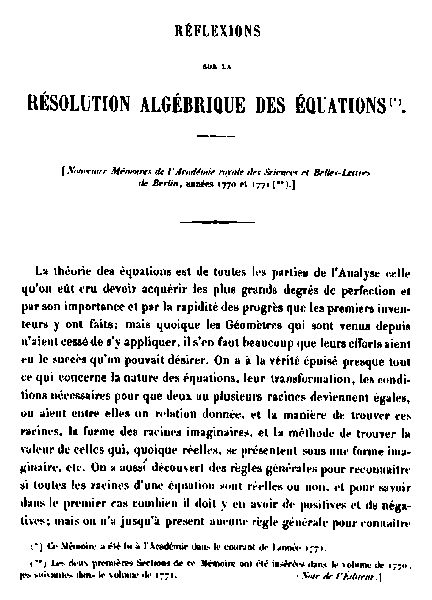
他在柏林的工作涵盖了许多主题:天文学、太阳系的稳定性、力学、动力学、流体力学、概率论以及微积分的基础。他还从事数论的研究,于1770年证明了每个正整数都是四个平方数之和。1771年,他证明了约翰·威尔逊的定理(最初由爱德华·华林提出但未加证明),即是prime当且仅当能被整除。1770年,他还提交了他的重要著作Réflexions sur la résolution algébrique des équations Ⓣ(关于方程代数解的思考),该著作对为何次数不超过4的方程可以用根式求解进行了基础性研究。这篇论文首次将方程的根视为抽象量,而非具有数值的量。他研究了根的排列,尽管他在论文中没有复合置换,但这可以被视为group theory发展的第一步,随后由保罗·鲁菲尼、埃瓦里斯特·伽罗瓦和奥古斯丁·路易·柯西继续推进。
拉格朗日对力学做出了众多重大贡献,但尚未写出一部综合性著作。他决定写一部包含自己贡献的权威著作,并于1782年9月15日写信给皮埃尔·西蒙·拉普拉斯:-
我几乎完成了《Traité de mécanique analytique》Ⓣ(分析力学论),它完全基于虚速度原理;但由于我还不知道何时何地能够付印,所以并不急于做最后的润色。
Caraccioli此时已在西西里,他希望看到拉格朗日回到意大利,并于1781年安排那不勒斯宫廷向他发出邀请。被授予那不勒斯科学院哲学主任一职,拉格朗日拒绝了,因为他只想要安宁来做数学,而柏林的职位为他提供了理想的条件。在柏林的岁月里,他的健康状况多次相当糟糕,而他妻子的健康更差。她在多年病痛后于1783年去世,拉格朗日非常抑郁。三年后腓特烈二世去世,拉格朗日在柏林的地位变得不那么愉快。许多意大利邦国看到了机会,试图引诱他回意大利。
然而,对拉格朗日最具吸引力的提议并非来自意大利,而是来自巴黎,并包含一项条款,意味着拉格朗日无需教学。1787年5月18日,他离开柏林,成为巴黎Académie des Sciences的成员,并在那里度过了余下的职业生涯。拉格朗日在法国大革命中幸存下来,而其他人则未能幸免,这在一定程度上可能归因于他多年前所表达的态度,他写道:
我认为,一般来说,每个智者的首要原则之一就是严格遵守他所居住国家的法律,即使这些法律不合理。
拉格朗日在柏林撰写的Mécanique analytiqueⓉ(分析力学)于1788年出版。它已获Académie des Sciences的一个委员会批准出版,该委员会由皮埃尔·西蒙·拉普拉斯、Cousin、阿德里安-马里·勒让德和尼古拉·德·孔多塞组成。阿德里安-马里·勒让德担任该著作的编辑,负责校对和其他工作。Mécanique analytique总结了自艾萨克·牛顿时代以来力学领域的所有工作,并因其运用微分方程理论而著称。通过这部著作,拉格朗日将力学转变为数学分析的一个分支。他在序言中写道:
在这部著作中找不到图形。我所阐述的方法既不需要作图,也不需要几何或力学论证,只需要代数运算,遵循规则而统一的进程。
1790年5月,拉格朗日成为Académie des Sciences负责统一度量衡的委员会成员。他们致力于公制,并提倡十进制。拉格朗日于1792年第二次结婚,妻子是Renée-Françoise-Adélaide Le Monnier,他是他在Académie des Sciences的一位天文学家同事的女儿。他当然并非不受政治事件的影响。1793年,恐怖统治开始,Académie des Sciences与其他学术团体一起于8月8日被取缔。度量衡委员会是唯一被允许继续存在的,当化学家Lavoisier、让-夏尔·德博尔达、皮埃尔·西蒙·拉普拉斯、夏尔·奥古斯丁·德·库仑、Brisson和让·巴蒂斯特·约瑟夫·德朗布尔等人被逐出委员会时,拉格朗日成为了其主席。
1793年9月,通过了一项法律,下令逮捕所有出生在敌国的外国人,并没收其全部财产。Lavoisier代表拉格朗日进行了干预,后者确实符合该法律的规定,并获得了豁免。1794年5月8日,经过不到一天的审判,一个革命法庭判处曾使拉格朗日免于逮捕的Lavoisier及其他27人死刑。Lavoisier在审判当天下午被送上断头台,拉格朗日在Lavoisier去世时说:
只需片刻就能让这颗头颅落下,而一百年也不足以产生一个与之相媲美的人。
巴黎综合理工学院成立于1794年3月11日,并于1794年12月开学(尽管在其成立的第一年被称为中央公共工程学院)。拉格朗日是该校首位分析学教授,于1794年开学时受聘。1795年,巴黎高等师范学院成立,旨在培养学校教师。拉格朗日在那里教授初等数学课程。我们上文提到,拉格朗日的合同中写有“不教学”条款,但大革命改变了情况,拉格朗日被要求授课。然而,他并不是一位好讲师,因为1795年在巴黎高等师范学院听过他课的约瑟夫·傅里叶写道:
他的声音非常微弱,至少他不会变得激动;他有很重的意大利口音,把s发成z……学生们,其中大多数无法欣赏他,对他不太欢迎,但教授们弥补了这一点。
同样,1799年在巴黎综合理工学院听过他课的Bugge写道:
……这位伟人所说的任何话都值得最高程度的考虑,但他对年轻人来说太抽象了。
拉格朗日出版了两卷微积分讲义。1797年,他出版了第一部实变量函数理论,即Théorie des fonctions analytiquesⓉ(《解析函数理论》),尽管他未能对收敛性问题给予足够关注。他指出,这部著作的目的是给出:
……微分学的原理,摆脱了对无穷小量或消失量、极限或流数的一切考虑,被归结为有限量的代数分析。
他还指出:——
代数的通常运算足以解决曲线论中的问题。
然而,并非所有人都认为拉格朗日处理微积分的方法是最好的,例如de Prony在1835年写道:——
拉格朗日的微积分基础无疑是人们可以称之为纯哲学研究的一个非常有趣的部分:但是,当问题在于使超越分析成为探索天文学、海洋工程、大地测量学以及工程师的不同科学分支所提出的问题的工具时,对无穷小的考虑以一种更恰当、更迅速、更直接适应问题性质的方式导向目标,这就是莱布尼茨方法在法国学校中普遍盛行的原因。
拉格朗日关于这一主题的第二部著作Leçons sur le calcul des fonctionsⓉ(《函数计算教程》)于1800年问世。
1808年,拿破仑授予拉格朗日荣誉军团勋章和帝国伯爵爵位。1813年4月3日,他被授予留尼汪帝国勋章大十字勋章。一周后他去世了。
Joseph-Louis Lagrange is usually considered to be a French mathematician, but the Italian Encyclopaedia [40] refers to him as an Italian mathematician. They certainly have some justification in this claim since Lagrange was born in Turin and baptised in the name of Giuseppe Lodovico Lagrangia. Lagrange's father was Giuseppe Francesco Lodovico Lagrangia who was Treasurer of the Office of Public Works and Fortifications in Turin, while his mother Teresa Grosso was the only daughter of a medical doctor from Cambiano near Turin. Lagrange was the eldest of their 11 children but one of only two to live to adulthood.
Turin had been the capital of the duchy of Savoy, but became the capital of the kingdom of Sardinia in 1720, sixteen years before Lagrange's birth. Lagrange's family had French connections on his father's side, his great-grandfather being a French cavalry captain who left France to work for the Duke of Savoy. Lagrange always leant towards his French ancestry, for as a youth he would sign himself Lodovico LaGrange or Luigi Lagrange, using the French form of his family name.
Despite the fact that Lagrange's father held a position of some importance in the service of the king of Sardinia, the family were not wealthy since Lagrange's father had lost large sums of money in unsuccessful financial speculation. A career as a lawyer was planned out for Lagrange by his father, and certainly Lagrange seems to have accepted this willingly. He studied at the College of Turin and his favourite subject was classical Latin. At first he had no great enthusiasm for mathematics, finding Greek geometry rather dull.
Lagrange's interest in mathematics began when he read a copy of Halley's 1693 work on the use of algebra in optics. He was also attracted to physics by the excellent teaching of Beccaria at the College of Turin and he decided to make a career for himself in mathematics. Perhaps the world of mathematics has to thank Lagrange's father for his unsound financial speculation, for Lagrange later claimed:-
If I had been rich, I probably would not have devoted myself to mathematics.
He certainly did devote himself to mathematics, but largely he was self taught and did not have the benefit of studying with leading mathematicians. On 23 July 1754 he published his first mathematical work which took the form of a letter written in Italian to Giulio Fagnano. Perhaps most surprising was the name under which Lagrange wrote this paper, namely Luigi De la Grange Tournier. This work was no masterpiece and showed to some extent the fact that Lagrange was working alone without the advice of a mathematical supervisor. The paper draws an analogy between the binomial theorem and the successive derivatives of the product of functions.
Before writing the paper in Italian for publication, Lagrange had sent the results to Euler, who at this time was working in Berlin, in a letter written in Latin. The month after the paper was published, however, Lagrange found that the results appeared in correspondence between Johann Bernoulli and Leibniz. Lagrange was greatly upset by this discovery since he feared being branded a cheat who copied the results of others. However this less than outstanding beginning did nothing more than make Lagrange redouble his efforts to produce results of real merit in mathematics. He began working on the tautochrone, the curve on which a weighted particle will always arrive at a fixed point in the same time independent of its initial position. By the end of 1754 he had made some important discoveries on the tautochrone which would contribute substantially to the new subject of the calculus of variations (which mathematicians were beginning to study but which did not receive the name 'calculus of variations' before Euler called it that in 1766).
Lagrange sent Euler his results on the tautochrone containing his method of maxima and minima. His letter was written on 12 August 1755 and Euler replied on 6 September saying how impressed he was with Lagrange's new ideas. Although he was still only 19 years old, Lagrange was appointed professor of mathematics at the Royal Artillery School in Turin on 28 September 1755. It was well deserved for the young man had already shown the world of mathematics the originality of his thinking and the depth of his great talents.
In 1756 Lagrange sent Euler results that he had obtained on applying the calculus of variations to mechanics. These results generalised results which Euler had himself obtained and Euler consulted Maupertuis, the president of the Berlin Academy, about this remarkable young mathematician. Not only was Lagrange an outstanding mathematician but he was also a strong advocate for the principle of least action so Maupertuis had no hesitation but to try to entice Lagrange to a position in Prussia. He arranged with Euler that he would let Lagrange know that the new position would be considerably more prestigious than the one he held in Turin. However, Lagrange did not seek greatness, he only wanted to be able to devote his time to mathematics, and so he shyly but politely refused the position.
Euler also proposed Lagrange for election to the Berlin Academy and he was duly elected on 2 September 1756. The following year Lagrange was a founding member of a scientific society in Turin, which was to become the Royal Academy of Sciences of Turin. One of the major roles of this new Society was to publish a scientific journal the Mélanges de Turin which published articles in French or Latin. Lagrange was a major contributor to the first volumes of the Mélanges de Turin volume 1 of which appeared in 1759, volume 2 in 1762 and volume 3 in 1766.
The papers by Lagrange which appear in these transactions cover a variety of topics. He published his beautiful results on the calculus of variations, and a short work on the calculus of probabilities. In a work on the foundations of dynamics, Lagrange based his development on the principle of least action and on kinetic energy.
In the Mélanges de Turin Lagrange also made a major study on the propagation of sound, making important contributions to the theory of vibrating strings. He had read extensively on this topic and he clearly had thought deeply on the works of Newton, Daniel Bernoulli, Taylor, Euler and d'Alembert. Lagrange used a discrete mass model for his vibrating string, which he took to consist of masses joined by weightless strings. He solved the resulting system of differential equations, then let tend to infinity to obtain the same functional solution as Euler had done. His different route to the solution, however, shows that he was looking for different methods than those of Euler, for whom Lagrange had the greatest respect.
In papers which were published in the third volume, Lagrange studied the integration of differential equations and made various applications to topics such as fluid mechanics (where he introduced the Lagrangian function). Also contained are methods to solve systems of linear differential equations which used the characteristic value of a linear substitution for the first time. Another problem to which he applied his methods was the study the orbits of Jupiter and Saturn.
The Académie des Sciences in Paris announced its prize competition for 1764 in 1762. The topic was on the libration of the Moon, that is the motion of the Moon which causes the face that it presents to the Earth to oscillate causing small changes in the position of the lunar features. Lagrange entered the competition, sending his entry to Paris in 1763 which arrived there not long before Lagrange himself. In November of that year he left Turin to make his first long journey, accompanying the Marquis Caraccioli, an ambassador from Naples who was moving from a post in Turin to one in London. Lagrange arrived in Paris shortly after his entry had been received but took ill while there and did not proceed to London with the ambassador. D'Alembert was upset that a mathematician as fine as Lagrange did not receive more honour. He wrote on his behalf [1]:-
Monsieur de la Grange, a young geometer from Turin, has been here for six weeks. He has become quite seriously ill and he needs, not financial aid, for the Marquis de Caraccioli directed upon leaving for England that he should not lack for anything, but rather some signs of interest on the part of his native country ... In him Turin possesses a treasure whose worth it perhaps does not know.
Returning to Turin in early 1765, Lagrange entered, later that year, for the Académie des Sciences prize of 1766 on the orbits of the moons of Jupiter. D'Alembert, who had visited the Berlin Academy and was friendly with Frederick II of Prussia, arranged for Lagrange to be offered a position in the Berlin Academy. Despite no improvement in Lagrange's position in Turin, he again turned the offer down writing:-
It seems to me that Berlin would not be at all suitable for me while M Euler is there.
By March 1766 d'Alembert knew that Euler was returning to St Petersburg and wrote again to Lagrange to encourage him to accept a post in Berlin. Full details of the generous offer were sent to him by Frederick II in April, and Lagrange finally accepted. Leaving Turin in August, he visited d'Alembert in Paris, then Caraccioli in London before arriving in Berlin in October. Lagrange succeeded Euler as Director of Mathematics at the Berlin Academy on 6 November 1766.
Lagrange was greeted warmly by most members of the Academy and he soon became close friends with Lambert and Johann(III) Bernoulli. However, not everyone was pleased to see this young man in such a prestigious position, particularly Castillon who was 32 years older than Lagrange and considered that he should have been appointed as Director of Mathematics. Just under a year from the time he arrived in Berlin, Lagrange married his cousin Vittoria Conti. He wrote to d'Alembert:-
My wife, who is one of my cousins and who even lived for a long time with my family, is a very good housewife and has no pretensions at all.
They had no children, in fact Lagrange had told d'Alembert in this letter that he did not wish to have children.
Turin always regretted losing Lagrange and from time to time his return there was suggested, for example in 1774. However, for 20 years Lagrange worked at Berlin, producing a steady stream of top quality papers and regularly winning the prize from the Académie des Sciences of Paris. He shared the 1772 prize on the three body problem with Euler, won the prize for 1774, another one on the motion of the moon, and he won the 1780 prize on perturbations of the orbits of comets by the planets.
His work in Berlin covered many topics: astronomy, the stability of the solar system, mechanics, dynamics, fluid mechanics, probability, and the foundations of the calculus. He also worked on number theory proving in 1770 that every positive integer is the sum of four squares. In 1771 he proved Wilson's theorem (first stated without proof by Waring) that is prime if and only if is divisible by . In 1770 he also presented his important work Réflexions sur la résolution algébrique des équations Ⓣ which made a fundamental investigation of why equations of degrees up to 4 could be solved by radicals. The paper is the first to consider the roots of an equation as abstract quantities rather than having numerical values. He studied permutations of the roots and, although he does not compose permutations in the paper, it can be considered as a first step in the development of group theory continued by Ruffini, Galois and Cauchy.
Although Lagrange had made numerous major contributions to mechanics, he had not produced a comprehensive work. He decided to write a definitive work incorporating his contributions and wrote to Laplace on 15 September 1782:-
I have almost completed a 'Traité de mécanique analytique' Ⓣ, based uniquely on the principle of virtual velocities; but, as I do not yet know when or where I shall be able to have it printed, I am not rushing to put the finishing touches to it.
Caraccioli, who was by now in Sicily, would have liked to see Lagrange return to Italy and he arranged for an offer to be made to him by the court of Naples in 1781. Offered the post of Director of Philosophy of the Naples Academy, Lagrange turned it down for he only wanted peace to do mathematics and the position in Berlin offered him the ideal conditions. During his years in Berlin his health was rather poor on many occasions, and that of his wife was even worse. She died in 1783 after years of illness and Lagrange was very depressed. Three years later Frederick II died and Lagrange's position in Berlin became a less happy one. Many Italian States saw their chance and attempts were made to entice him back to Italy.
The offer which was most attractive to Lagrange, however, came not from Italy but from Paris and included a clause which meant that Lagrange had no teaching. On 18 May 1787 he left Berlin to become a member of the Académie des Sciences in Paris, where he remained for the rest of his career. Lagrange survived the French Revolution while others did not and this may to some extent be due to his attitude which he had expressed many years before when he wrote:-
I believe that, in general, one of the first principles of every wise man is to conform strictly to the laws of the country in which he is living, even when they are unreasonable.
The Mécanique analytique Ⓣ which Lagrange had written in Berlin, was published in 1788. It had been approved for publication by a committee of the Académie des Sciences comprising of Laplace, Cousin, Legendre and Condorcet. Legendre acted as an editor for the work doing proof reading and other tasks. The Mécanique analytique summarised all the work done in the field of mechanics since the time of Newton and is notable for its use of the theory of differential equations. With this work Lagrange transformed mechanics into a branch of mathematical analysis. He wrote in the Preface:-
One will not find figures in this work. The methods that I expound require neither constructions, nor geometrical or mechanical arguments, but only algebraic operations, subject to a regular and uniform course.
Lagrange was made a member of the committee of the Académie des Sciences to standardise weights and measures in May 1790. They worked on the metric system and advocated a decimal base. Lagrange married for a second time in 1792, his wife being Renée-Françoise-Adélaide Le Monnier the daughter of one of his astronomer colleagues at the Académie des Sciences. He was certainly not unaffected by the political events. In 1793 the Reign of Terror commenced and the Académie des Sciences, along with the other learned societies, was suppressed on 8 August. The weights and measures commission was the only one allowed to continue and Lagrange became its chairman when others such as the chemist Lavoisier, Borda, Laplace, Coulomb, Brisson and Delambre were thrown off the commission.
In September 1793 a law was passed ordering the arrest of all foreigners born in enemy countries and all their property to be confiscated. Lavoisier intervened on behalf of Lagrange, who certainly fell under the terms of the law, and he was granted an exception. On 8 May 1794, after a trial that lasted less than a day, a revolutionary tribunal condemned Lavoisier, who had saved Lagrange from arrest, and 27 others to death. Lagrange said on the death of Lavoisier, who was guillotined on the afternoon of the day of his trial:-
It took only a moment to cause this head to fall and a hundred years will not suffice to produce its like.
The École Polytechnique was founded on 11 March 1794 and opened in December 1794 (although it was called the École Centrale des Travaux Publics for the first year of its existence). Lagrange was its first professor of analysis, appointed for the opening in 1794. In 1795 the École Normale was founded with the aim of training school teachers. Lagrange taught courses on elementary mathematics there. We mentioned above that Lagrange had a 'no teaching' clause written into his contract but the Revolution changed things and Lagrange was required to teach. However, he was not a good lecturer as Fourier, who attended his lectures at the École Normale in 1795 wrote:-
His voice is very feeble, at least in that he does not become heated; he has a very pronounced Italian accent and pronounces the s like z ... The students, of whom the majority are incapable of appreciating him, give him little welcome, but the professors make amends for it.
Similarly Bugge who attended his lectures at the École Polytechnique in 1799 wrote:-
... whatever this great man says, deserves the highest degree of consideration, but he is too abstract for youth.
Lagrange published two volumes of his calculus lectures. In 1797 he published the first theory of functions of a real variable with Théorie des fonctions analytiques Ⓣ although he failed to give enough attention to matters of convergence. He states that the aim of the work is to give:-
... the principles of the differential calculus, freed from all consideration of the infinitely small or vanishing quantities, of limits or fluxions, and reduced to the algebraic analysis of finite quantities.
Also he states:-
The ordinary operations of algebra suffice to resolve problems in the theory of curves.
Not everyone found Lagrange's approach to the calculus the best however, for example de Prony wrote in 1835:-
Lagrange's foundations of the calculus is assuredly a very interesting part of what one might call purely philosophical study: but when it is a case of making transcendental analysis an instrument of exploration for questions presented by astronomy, marine engineering, geodesy, and the different branches of science of the engineer, the consideration of the infinitely small leads to the aim in a manner which is more felicitous, more prompt, and more immediately adapted to the nature of the questions, and that is why the Leibnizian method has, in general, prevailed in French schools.
The second work of Lagrange on this topic Leçons sur le calcul des fonctions Ⓣ appeared in 1800.
Napoleon named Lagrange to the Legion of Honour and Count of the Empire in 1808. On 3 April 1813 he was awarded the Grand Croix of the Ordre Impérial de la Réunion. He died a week later.
正文里的方括号编号指向这里,悬停即可直接看到条目。书目保留原文——译了书名反而查不到文献。
原站列出的延伸阅读与外部数据库,照原样保留,目标多为英文页面。
关于约瑟夫·拉格朗日的其它页面:
原站的交叉引用。指向本站已镜像专题的留在站内,其余仍指回原站。