数学家传记
西莫恩·德尼·泊松研究定积分和约瑟夫·傅里叶级数。这为后来约翰·彼得·古斯塔夫·勒热纳·狄利克雷和波恩哈德·黎曼在这一领域的工作奠定了基础。
西莫恩·德尼·泊松的父母并非出身贵族,尽管在法国大革命前的岁月里,贵族与资产阶级之间的界限日益难以区分,但法国的阶级制度仍然对他的早年产生了重大影响。主要原因是军队是少数几个贵族享有显著制度特权的职业之一,而泊松的父亲曾是一名士兵。当然,泊松的父亲在军队上层受到贵族的歧视,这给他留下了深刻的印象。退役后,他被任命到一个低级的行政职位,在他的儿子泊松-泊松出生时他正担任此职。毫无疑问,泊松-泊松的家人投入了大量精力帮助他在人生中有一个良好的开端。
泊松-泊松并不是其父母第一个孩子,但他的几个哥哥姐姐都未能存活。事实上,他小时候的健康也非常脆弱,他能挺过来算是幸运的。这可能是因为他的母亲担心年幼的孩子会夭折,将他托付给一位保姆照料,以度过危险期。他的父亲对年幼的儿子影响很大,花时间教他读书写字。
1789年7月14日的巴黎起义宣告法国大革命的开始时,泊松-泊松八岁。正如一个曾在贵族手中遭受歧视的人所可能表现的那样,老泊松对政治局势的转变充满热情。他支持大革命的一个直接后果是,他成为了Pithiviers地区的区长,该地区位于法国中部,巴黎以南约80公里处。从这个职位上,他能够影响他儿子的未来职业生涯。
泊松的父亲认定医学职业能为儿子提供安稳的未来。泊松的一位叔叔是枫丹白露的外科医生,泊松被送到那里当外科学徒。然而,泊松发现自己完全不适合当外科医生。首先,他在很大程度上缺乏协调能力,这意味着他完全无法掌握所需的精细动作。其次,很快就明显看出,尽管他是个聪明的孩子,但他对医学职业毫无兴趣。泊松从枫丹白露回到家中,学徒生涯基本上未能达标,他的父亲不得不重新考虑为他寻找职业。
法国当时已是共和国,时局变化相当迅速。某些职业不再像过去那样由贵族控制,并且已经朝着让所有人接受教育的方向迈进。1796年,泊松被父亲送回枫丹白露,这次是进入那里的中央学校。一方面,他表现出严重缺乏动手能力,但此时他显示出极强的学习天赋,尤其是数学。他在中央学校的老师们印象极为深刻,并鼓励他参加巴黎综合理工学院的入学考试。他参加了考试,证明老师们没有看错,因为尽管他所受的正规教育远少于大多数参加考试的年轻人,他却取得了第一名。
很少有人能像泊松那样迅速地取得学术成就。当他在1798年开始在巴黎综合理工学院学习数学时,他已经具备了应对繁重课程严苛要求的良好基础,同时还能弥补早期教育的不足。当然,他也有一些问题需要克服,因为他突然被投入到一个陌生的社会和学术环境中,对此他几乎没有经验。因此,他能够以极大的热情和勤奋投入学术研究,同时还能抽出时间享受巴黎的剧院和其他社交活动,这值得称赞。他唯一的弱点是协调性差,这使他无法从事外科医生的职业。在某些方面,这对他仍然是一个障碍,因为绘制数学图表对他来说完全不可能。
他的老师皮埃尔·西蒙·拉普拉斯和约瑟夫·拉格朗日很快发现了他的数学天赋。他们与这位极其出色的年轻学生结下了终生的友谊,并以各种方式给予他大力支持。泊松18岁时写的一篇关于有限差分的论文引起了阿德里安-马里·勒让德的注意。然而,泊松发现画法几何——由于加斯帕尔·蒙日的原因,这是巴黎综合理工学院的一门重要课程——对他来说无法成功,因为他不会绘图。如果他打算进入公职部门,这将是一个无法克服的问题,但对于那些志在从事纯科学研究的人来说,绘图要求可以免除,因此泊松并未受到阻碍。在学习的最后一年,他写了一篇关于方程理论和艾蒂安·贝祖定理的论文,这篇论文质量极高,以至于他获准在1800年免于参加期末考试而毕业。他随即获得了巴黎综合理工学院辅导教师的职位,这主要得益于皮埃尔·西蒙·拉普拉斯的大力推荐。在巴黎获得首次任命是非常不寻常的,大多数顶尖数学家都不得不在外省任职后才能回到巴黎。
泊松于1802年被任命为巴黎综合理工学院的副教授,他一直担任此职直到1806年,被任命为巴黎综合理工学院的教授,这个职位是约瑟夫·傅里叶被拿破仑派往格勒诺布尔后空出的。事实上,泊松几乎没有时间搞政治,因为他把全部精力都用于支持数学、科学、教育和巴黎综合理工学院。1804年,当巴黎综合理工学院的学生即将发表一篇攻击拿破仑大帝国的文章时,泊松设法阻止了他们,这不是因为他支持拿破仑的观点,而是因为他看出学生的行动会损害巴黎综合理工学院。然而,拿破仑政府并不理解泊松的动机,他们视泊松为支持者,这对他的职业生涯毫无损害。
在此期间,泊松研究了与常微分方程和偏微分方程相关的问题。他特别研究了在阻力介质中的摆和声学理论等若干物理问题的应用。然而,他的研究纯粹是理论性的,因为正如我们上面提到的,他动手能力极差[19]:-
泊松……满足于对实验研究的种种变迁完全陌生。他极不可能尝试过实验测量,也没有尝试过设计实验方案。
他第一次尝试当选研究所院士是在1806年,当时他得到皮埃尔·西蒙·拉普拉斯、约瑟夫·拉格朗日、西尔维斯特·佛朗索瓦·拉克鲁瓦、阿德里安-马里·勒让德和让-巴蒂斯特·毕奥的支持,争取数学部的一个席位。夏尔·博叙当时76岁,如果他去世,泊松本可获得一个席位。然而夏尔·博叙又活了七年,所以泊松没有进入数学部的途径。不过,他确实获得了更多有声望的职位。除了在巴黎综合理工学院的教授职位外,1808年泊松成为经度局的天文学家。1809年他又增加了一个职位,即新开设的科学学院的力学讲席。
1808年和1809年,泊松在科学院上发表了三篇重要论文。在第一篇Sur les inégalités des moyens mouvements des planètesⓉ(论行星平均运动的不等式)中,他研究了皮埃尔·西蒙·拉普拉斯和约瑟夫·拉格朗日提出的关于行星摄动的数学问题。他处理这些问题的方法是使用级数展开来推导近似解。这是他认为有趣的那类问题的典型。Libri写道[1]:-
……他特别喜欢别人处理过的未解决问题,或者仍有工作可做的领域。
1809年他发表了两篇论文,第一篇是Sur le mouvement de rotation de la terreⓉ(论地球的旋转运动),第二篇是Sur la variation des constantes arbitraires dans les questions de mécaniqueⓉ(论力学问题中任意常数的变分),这是约瑟夫·拉格朗日的任意常数变分方法发展的直接结果,而该方法受到泊松1808年论文的启发。此外,他于1808年出版了亚历克西斯·克劳德·克莱罗的Théorie de la figure de la terreⓉ(地球形状理论)的新版本。该著作最初由亚历克西斯·克劳德·克莱罗于1743年出版,它证实了艾萨克·牛顿-克里斯蒂安·惠更斯关于地球在两极扁平的信念。1811年泊松出版了他的两卷本专著Traité de mécaniqueⓉ(力学专论),这是一部基于他在巴黎综合理工学院课程笔记的异常清晰的论述。
已知艾蒂安-路易·马吕斯在1811年身患绝症,他的去世将在科学院物理学部留下一个空缺。数学家们打算在空缺出现时让泊松填补这一空缺,于是将大奖赛的题目定为电学,以尽可能增加泊松的机会。该奖项的题目如下(例如见[20]):-
通过计算确定并通过实验证实电在带电体表面的分布方式,这些带电体可以是孤立的,也可以是彼此存在的——例如两个带电球体彼此存在时的表面。为了简化问题,学部只要求考察每个表面上电的分布始终保持同一种类的情形。
在艾蒂安-路易·马吕斯于1812年2月24日去世之前,泊松已在该问题上取得了相当大的进展。泊松于3月9日向科学院提交了他解答的第一部分,题为Sur la distribution de l'électricité à la surface des corps conducteurs Ⓣ(论电在导电体表面的分布)。正如数学家们所预期的那样,这成为泊松当选科学院物理学部成员以接替艾蒂安-路易·马吕斯的决定性因素。这也标志着在被视为物理学的领域中,从实验研究转向理论研究,在这方面科学院正追随皮埃尔·西蒙·拉普拉斯所引领的方向。
泊松在他本已忙碌的生活中继续增添各种职责。1815年,他成为军事学校的考官,次年又成为巴黎综合理工学院毕业考试的考官。
泊松投入的工作量之大令人瞩目;他既从事研究,又从事教学,还在法国数学的组织工作中发挥着越来越重要的作用。1817年他与Nancy de Bardi结婚后,发现家庭生活又给他增添了一重压力,但他不知怎么挺过了这些压力,继续承担更多的职责。他的研究贡献涵盖了应用数学的广泛主题。尽管他没有提出创新的新理论,但他为他人理论的发展作出了重大贡献,常常是第一个揭示其真正意义的人。现在我们只提及他当选科学院院士后所研究的少数几个主题。
1813年,泊松研究了吸引质量内部的potential,所得结果后来在静电学中得到应用。他在电学和磁学方面做出了重要工作,随后又研究了弹性表面。接着发表了关于气体中声速、热的传播以及弹性振动的论文。1815年,他发表了一部关于热的著作,这惹恼了约瑟夫·傅里叶,后者写道:-
泊松太有才华,不应将其用于他人的工作。用它去发现已知的东西,是在浪费它……
约瑟夫·傅里叶接着对泊松的论点提出了有效的反对意见,后者在1820年和1821年后来的回忆录中作了修正。
1823年,泊松发表了关于热的著作,所得结果影响了萨迪·卡诺。泊松的许多工作是由皮埃尔·西蒙·拉普拉斯的结果所推动的,特别是他关于声的相对速度的工作和他关于吸引力的工作。后一项工作不仅受到皮埃尔·西蒙·拉普拉斯工作的影响,也受到詹姆斯·艾沃里早期贡献的影响。泊松关于吸引力的工作本身对乔治·格林1828年的重要论文产生了重大影响,尽管泊松似乎从未发现乔治·格林是受他的表述所启发的。
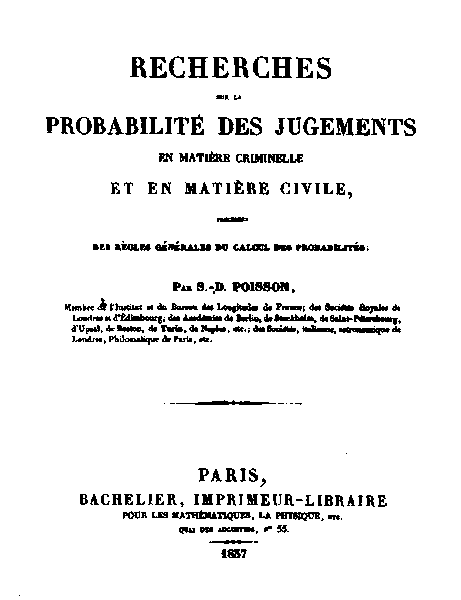
在Recherches sur la probabilité des jugements en matière criminelle et matière civile Ⓣ(关于刑事和民事判决可能性的研究)——一部1837年出版的关于probability的重要著作——中,泊松分布首次出现。泊松分布描述的是随机事件在一段时间或空间间隔内发生的概率,其条件是事件发生的概率非常小,但试验次数非常大,以致事件实际发生几次。他还引入了“大数定律”这一表述。尽管我们现在认为这部著作极为重要,但它在当时却很少受到青睐,唯一的例外是在俄罗斯,巴夫尼提·列波维奇·切比雪夫在那里发展了他的思想。
有趣的是,泊松并没有表现出他那个时代许多科学家所具有的沙文主义态度。约瑟夫·拉格朗日和皮埃尔·西蒙·拉普拉斯承认皮埃尔·德·费马是微分和积分的发明者;毕竟他是法国人,而哥特弗里德·威廉·莱布尼茨和艾萨克·牛顿都不是!然而,泊松在1831年写道:-
这种[微分和积分]运算在于一组规则……而不是在于使用无穷小量……就此而言,它的创立并不早于哥特弗里德·威廉·莱布尼茨,后者是算法和普遍流行的记号的作者。
他总共发表了300到400篇数学著作。尽管产量异常庞大,但他一次只研究一个主题。Libri写道[1]:-
泊松从不愿意同时忙于两件事;当他在工作过程中想到一个与当时所做之事没有直接联系的研究项目时,他满足于在自己的小笔记本上写下几个字。那些他曾与之交流科学思想的人知道,一旦他完成一篇论文,他就会不间断地转向另一个主题,并且他通常从笔记本中挑选出他应该从事的问题。以这种方式预先预见那些有一定成功机会的问题,并能够等待一段时间再着手处理它们,这证明了一个既敏锐又有条理的头脑。
泊松的名字与各种各样的概念联系在一起,例如:- 泊松积分、势论中的泊松方程、微分方程中的泊松括号、弹性中的泊松比,以及电学中的泊松常数。然而,无论是生前还是死后,他都没有受到其他法国数学家的高度重视。他的声誉是由外国数学家的尊重所保证的,这些数学家似乎比他的本国同行更能认识到他思想的重要性。泊松本人完全献身于数学。弗朗索瓦·阿拉戈报告说泊松经常说:-
人生只有两件事是美好的:发现数学和教授数学。
Siméon-Denis Poisson's parents were not from the nobility and, although it was becoming increasingly difficult to distinguish between the nobility and the bourgeoisie in France in the years prior to the Revolution, nevertheless the French class system still had a major influence on his early years. The main reason for this was that the army was one of the few occupations where the nobility enjoyed significant institutional privileges and Poisson's father had been a soldier. Certainly Poisson's father was discriminated against by the nobility in the upper ranks of the army and this made a large impression on him. After retiring from active service he was appointed to a lowly administrative post which he held at the time that his son Siméon-Denis was born. There is no doubt that Siméon-Denis's family put a great deal of energy into helping him have a good start in life.
Siméon-Denis was not the first of his parents children but several of his older brothers and sisters had failed to survive. Indeed his health was also very fragile as a child and he was fortunate to pull through. This may have been because his mother, fearing that her young child would die, entrusted him to the care of a nurse to bring him through the critical period. His father had a large influence on his young son, devoting time to teach him to read and write.
Siméon-Denis was eight years old when the Parisian insurrection of 14 July 1789 heralded the start of the French Revolution. As might be expected of someone who had suffered discrimination at the hands of the nobility, Poisson senior was enthusiastic about the political turn of events. One immediate consequence for his support of the Revolution was the fact that he became president of the district of Pithiviers which is in central France, about 80 km south of Paris. From this position he was able to influence the future career of his son.
Poisson's father decided that the medical profession would provide a secure future for his son. An uncle of Poisson's was a surgeon in Fontainebleau and Poisson was sent there to become an apprentice surgeon. However, Poisson found that he was ill suited to be a surgeon. Firstly he lacked coordination to quite a large degree which meant that he completely failed to master the delicate movements required. Secondly it was quickly evident that, although he was a talented child, he had no interest in the medical profession. Poisson returned home from Fontainebleau having essentially failed to make the grade in his apprenticeship and his father had to think again to find a career for him.
Times were changing quite quickly in France which was by this time a republic. No longer were certain professions controlled by the nobility as they had been and there had been moves towards making education available to everyone. In 1796 Poisson was sent back to Fontainebleau by his father, this time to enrol in the École Centrale there. On the one hand he had shown a great lack of manual dexterity, but he now showed that he had great talents for learning, especially mathematics. His teachers at the École Centrale were extremely impressed and encouraged him to sit the entrance examinations for the École Polytechnique in Paris. He sat these examinations and proved his teachers right, for although he had far less formal education than most of the young men taking the examinations he achieved the top place.
Few people can have achieved academic success as quickly as Poisson did. When he began to study mathematics in 1798 at the École Polytechnique he was therefore in a strong position to cope with the rigours of a hard course, yet overcome the deficiencies of his early education. There were certainly problems for him to overcome for he had little experience of the social or academic environment into which he was suddenly thrust. It was therefore to his credit that he was able to undertake his academic studies with great enthusiasm and diligence, yet find time to enjoy the theatre and other social activities in Paris. His only weakness was the lack of coordination which had made a career as a surgeon impossible. This was still a drawback to him in some respects for drawing mathematical diagrams was quite beyond him.
His teachers Laplace and Lagrange quickly saw his mathematical talents. They were to become friends for life with their extremely able young student and they gave him strong support in a variety of ways. A memoir on finite differences, written when Poisson was 18, attracted the attention of Legendre. However, Poisson found that descriptive geometry, an important topic at the École Polytechnique because of Monge, was impossible for him to succeed with because of his inability to draw diagrams. This would have been an insurmountable problem had he been going into public service, but those aiming at a career in pure science could be excused the drawing requirements, and Poisson was not held back. In his final year of study he wrote a paper on the theory of equations and Bézout's theorem, and this was of such quality that he was allowed to graduate in 1800 without taking the final examination. He proceeded immediately to the position of répétiteur in the École Polytechnique, mainly on the strong recommendation of Laplace. It was quite unusual for anyone to gain their first appointment in Paris, most of the top mathematicians having to serve in the provinces before returning to Paris.
Poisson was named deputy professor at the École Polytechnique in 1802, a position he held until 1806 when he was appointed to the professorship at the École Polytechnique which Fourier had vacated when he had been sent by Napoleon to Grenoble. In fact Poisson had little time for politics for rather his whole energies were directed to support mathematics, science, education and the École Polytechnique. When the students at the École had been about to publish an attack on Napoleon's ideas for the Grand Empire in 1804, Poisson had managed to stop them, not because he supported Napoleon's views but rather because he saw that the students would damage the École Polytechnique by their actions. Poisson's motives were not understood by Napoleon's administration, however, and they saw Poisson as a supporter which did his career no harm at all.
During this period Poisson studied problems relating to ordinary differential equations and partial differential equations. In particular he studied applications to a number of physical problems such as the pendulum in a resisting medium and the theory of sound. His studies were purely theoretical, however, for as we mentioned above, he was extremely clumsy with his hands [19]:-
Poisson ... was content to remain totally unfamiliar with the vicissitudes of experimental research. It is quite unlikely that he ever attempted an experimental measurement, nor did he try his hand at drafting experimental designs.
His first attempt to be elected to the Institute was in 1806 when he was backed by Laplace, Lagrange, Lacroix, Legendre and Biot for a place in the Mathematics Section. Bossut was 76 years old at the time and, had he died, Poisson would have gained a place. However Bossut lived for another seven years so there was no route into the mathematics section for Poisson. He did, however, gain further prestigious posts. In addition to his professorship at the École Polytechnique, in 1808 Poisson became an astronomer at Bureau des Longitudes. In 1809 he added another appointment, namely that of the chair of mechanics in the newly opened Faculté des Sciences.
In 1808 and 1809 Poisson published three important papers with the Academy of Sciences. In the first Sur les inégalités des moyens mouvements des planètes Ⓣ he looked at the mathematical problems which Laplace and Lagrange had raised about perturbations of the planets. His approach to these problems was to use series expansions to derive approximate solutions. This was typical of the type of problem which he found interesting. Libri wrote [1]:-
... he especially liked unresolved questions that had been treated by others or areas in which there was still work to be done.
In 1809 he published two papers, the first Sur le mouvement de rotation de la terre Ⓣ and the second, Sur la variation des constantes arbitraires dans les questions de mécanique Ⓣ was a direct consequence of developments in Lagrange's method of variation of arbitrary constants which had been inspired by Poisson's 1808 paper. In addition he published a new edition of Clairaut's Théorie de la figure de la terre Ⓣ in 1808. The work had been first published by Clairaut in 1743 and it confirmed the Newton-Huygens belief that the Earth was flattened at the poles. In 1811 Poisson published his two volume treatise Traité de mécanique Ⓣ which was an exceptionally clear treatment based on his course notes at the École Polytechnique.
Malus was known to have a terminal illness by 1811 and his death would leave a vacancy in the physics section of the Institute. The mathematicians, aiming to have Poisson fill that vacancy when it occurred, set the topic for the Grand Prix on electricity so as to maximise Poisson's chances. The topic for the prize was as follows (see for example [20]):-
To determine by calculation and to confirm by experiment the manner in which electricity is distributed at the surface of electrical bodies considered either in isolation or in the presence of each other - for example at the surface of two electrified spheres in the presence of each other. In order to simplify the problem, the Class asks only for an examination of cases where the electricity spread on each surface remains always of the same kind.
Poisson had made considerable progress with the problem before Malus died on 24 February 1812. Poisson submitted the first part of his solution to the Academy on 9 March entitled Sur la distribution de l'électricité à la surface des corps conducteurs Ⓣ. As the mathematicians had intended, this was the deciding factor in Poisson being elected to the physics section of the Institute to replace Malus. It also marked a move away from experimental research towards theoretical research in what was considered to constitute physics, and in this the Institute was following the lead given by Laplace.
Poisson continued to add various responsibilities to his already busy life. In 1815 he became examiner for the École Militaire and in the following year he became an examiner for the final examinations at the École Polytechnique.
It is remarkable how much work Poisson put in; to his research, to his teaching and to playing an ever increasingly important role in the organisation of mathematics in France. When he married Nancy de Bardi in 1817 he found that family life put yet another pressure on him yet somehow he survived the pressures continuing to take on further duties. His research contributions covered a wide range of applied mathematics topics. Although he devised no innovative new theories, he made major contributions to further developing the theories of others often being the first to exhibit their real significance. We mention now just a few of the topics he studied after his election to the Academy.
In 1813 Poisson studied the potential in the interior of attracting masses, producing results which would find application in electrostatics. He produced major work on electricity and magnetism, followed by work on elastic surfaces. Papers followed on the velocity of sound in gasses, on the propagation of heat, and on elastic vibrations. In 1815 he published a work on heat which annoyed Fourier who wrote:-
Poisson has too much talent to apply it to the work of others. To use it to discover what is already known is to waste it ...
Fourier went on to make valid objections to Poisson's arguments which he corrected in later memoirs of 1820 and 1821.
In 1823 Poisson published on heat, producing results which influenced Sadi Carnot. Much of Poisson's work was motivated by results of Laplace, in particular his work on the relative velocity of sound and his work on attractive forces. This latter work was not only influenced by Laplace's work but also by the earlier contributions of Ivory. Poisson's work on attractive forces was itself a major influence on Green's major paper of 1828 although Poisson never seems to have discovered that Green was inspired by his formulations.
In Recherches sur la probabilité des jugements en matière criminelle et matière civile Ⓣ, an important work on probability published in 1837, the Poisson distribution first appears. The Poisson distribution describes the probability that a random event will occur in a time or space interval under the conditions that the probability of the event occurring is very small, but the number of trials is very large so that the event actually occurs a few times. He also introduced the expression "law of large numbers". Although we now rate this work as of great importance, it found little favour at the time, the exception being in Russia where Chebyshev developed his ideas.
It is interesting that Poisson did not exhibit the chauvinistic attitude of many scientists of his day. Lagrange and Laplace recognised Fermat as the inventor of the differential and integral calculus; he was French after all, while neither Leibniz nor Newton were! Poisson, however, wrote in 1831:-
This [differential and integral] calculus consists in a collection of rules ... rather than in the use of infinitely small quantities ... and in this regard its creation does not predate Leibniz, the author of the algorithm and of the notation that has generally prevailed.
He published between 300 and 400 mathematical works in all. Despite this exceptionally large output, he worked on one topic at a time. Libri writes [1]:-
Poisson never wished to occupy himself with two things at the same time; when, in the course of his labours, a research project crossed his mind that did not form any immediate connection with what he was doing at the time, he contented himself with writing a few words in his little wallet. The persons to whom he used to communicate his scientific ideas know that as soon as he had finished one memoir, he passed without interruption to another subject, and that he customarily selected from his wallet the questions with which he should occupy himself. To foresee beforehand in this manner the problems that offer some chance of success, and to be able to wait before applying oneself to them, is to show proof of a mind both penetrating and methodical.
Poisson's name is attached to a wide variety of ideas, for example:- Poisson's integral, Poisson's equation in potential theory, Poisson brackets in differential equations, Poisson's ratio in elasticity, and Poisson's constant in electricity. However, he was not highly regarded by other French mathematicians either during his lifetime or after his death. His reputation was guaranteed by the esteem that he was held in by foreign mathematicians who seemed more able than his own colleagues to recognise the importance of his ideas. Poisson himself was completely dedicated to mathematics. Arago reported that Poisson frequently said:-
Life is good for only two things, discovering mathematics and teaching mathematics.
正文里的方括号编号指向这里,悬停即可直接看到条目。书目保留原文——译了书名反而查不到文献。
原站列出的延伸阅读与外部数据库,照原样保留,目标多为英文页面。
关于西莫恩·德尼·泊松的其它页面:
原站的交叉引用。指向本站已镜像专题的留在站内,其余仍指回原站。