数学家传记
布莱兹·帕斯卡是一位极具影响力的法国数学家和哲学家,他对数学的许多领域都有贡献。他研究圆锥曲线和射影几何学,并与皮埃尔·德·费马通信,为概率论奠定了基础。
布莱兹·帕斯卡是埃蒂安·帕斯卡尔的第三个孩子,也是他唯一的儿子。帕斯卡的母亲在他只有三岁时去世。1632年,帕斯卡一家,艾蒂安和他的四个孩子,离开克莱蒙,定居巴黎。帕斯卡的父亲有非正统的教育观点,决定亲自教儿子。埃蒂安·帕斯卡尔决定帕斯卡在15岁之前不学习数学,所有数学书籍都从家中移走。然而,帕斯卡因此被激起好奇心,12岁时开始自学几何。他发现三角形内角和为两个直角,当父亲发现后,他让步并允许帕斯卡拥有一本欧几里得。
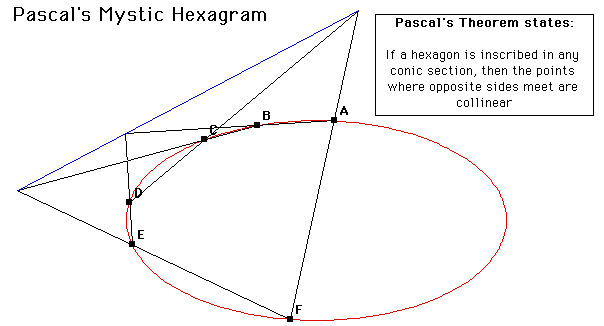
14岁时,帕斯卡开始陪同父亲参加马兰·梅森的会议。马兰·梅森属于最小兄弟会修会,他在巴黎的居室是皮埃尔·伽桑狄、罗贝瓦尔、皮埃尔·德·卡克维、阿德里安·奥祖、Mydorge、米隆、吉拉尔·笛沙格等人经常聚会的地方。很快,肯定到15岁时,帕斯卡开始钦佩吉拉尔·笛沙格的工作。16岁时,帕斯卡于1639年6月向马兰·梅森的一次会议提交了一张纸。上面包含若干射影几何定理,包括帕斯卡的神秘六边形。
你可以在THIS LINK看到Mystic Hexagram的图片。
1639年12月,帕斯卡一家离开巴黎,住到鲁昂,艾蒂安被任命为上诺曼底的税务官。在鲁昂安顿后不久,帕斯卡的第一部作品Essay on Conic Sections于1640年2月出版。
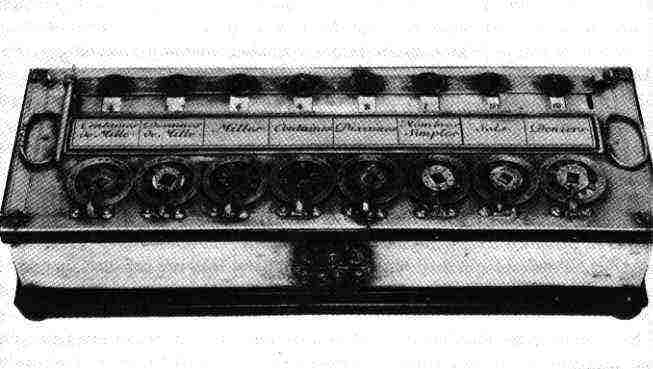
帕斯卡发明了第一台数字计算器,以帮助父亲收税工作。他在1642年至1645年间为此工作了三年。该设备称为帕斯卡计算器,类似于20世纪40年代的机械计算器。这几乎可以肯定使帕斯卡成为第二个发明机械计算器的人,因为威廉·施卡德在1624年制造了一台。
你可以在THIS LINK和THIS LINK看到帕斯卡计算器的图片。
帕斯卡在设计计算器时面临的问题,源于当时法国货币的设计。一里弗尔含20苏,一苏含12德尼耶。这一制度在法国一直沿用到1799年,而在英国,类似进位的制度则持续到1971年。帕斯卡必须解决比将里弗尔分为100份时困难得多的技术问题,才能应对将里弗尔分为240份的情况。然而,机器的生产始于1642年,但正如帕斯卡在[3]中所写,
到1652年,已生产出五十台样机,但售出的机器很少,帕斯卡的算术计算器也在当年停止了制造。
1646年的事件对年轻的帕斯卡意义重大。那一年,他的父亲腿部受伤,不得不在家中休养。照顾他的是来自鲁昂城外一个宗教运动的两名年轻兄弟。他们对年轻的帕斯卡产生了深远影响,使他变得极为虔诚。
大约从这时起,帕斯卡开始了一系列关于大气压力的实验。到1647年,他已确信并证明真空是存在的。勒内·笛卡儿于9月23日拜访了帕斯卡。这次拜访仅持续了两天,两人就真空问题发生了争论,勒内·笛卡儿并不相信真空的存在。勒内·笛卡儿在这次拜访后写给克里斯蒂安·惠更斯的一封信中,相当刻薄地写道,帕斯卡
……脑子里的真空太多了。
1648年8月,帕斯卡观察到大气压随高度降低,并推断大气之上存在真空。勒内·笛卡儿于1647年6月写信给皮埃尔·德·卡克维,谈及帕斯卡的实验,说:-
两年前是我建议他做这件事的,因为虽然我自己没有做,但我并不怀疑它会成功……
1647年10月,帕斯卡写了New Experiments Concerning Vacuums,这引发了与一些科学家的争论,他们和勒内·笛卡儿一样,不相信真空存在。
埃蒂安·帕斯卡尔于1651年9月去世,此后帕斯卡写信给他的一位姐妹,赋予死亡一般意义以及他父亲之死特殊意义以深刻的基督教含义。他这里的想法后来成为他后期哲学著作Pensées的基础。
从1653年5月起,帕斯卡研究数学和物理学,撰写了Treatise on the Equilibrium of Liquids(1653),其中解释了帕斯卡的压力定律。Adamson在[3]中写道:-
这篇论著是流体静力学体系的完整纲要,是科学史上的第一部,它体现了他对物理理论最独特和最重要的贡献。
他研究圆锥曲线,并在射影几何中得出重要定理。在The Generation of Conic Sections(大部分于1648年3月完成,但在1653年和1654年再次研究)中,帕斯卡考虑了由圆的中心投影生成的圆锥曲线。这原本是一篇关于圆锥曲线的论著的第一部分,帕斯卡从未完成。该著作现已失传,但哥特弗里德·威廉·莱布尼茨和埃伦弗里德·瓦尔特·冯·切恩豪斯从中做了笔记,正是通过这些笔记,现在才有可能对该著作有相当完整的了解。
帕斯卡并不是第一个研究帕斯卡三角形的人,他在Treatise on the Arithmetical Triangle中关于这一主题的工作是这方面最重要的,并且通过约翰·沃利斯的工作,帕斯卡关于二项式系数的工作引导艾萨克·牛顿发现了分数幂和负幂的一般二项式定理。
在与皮埃尔·德·费马的通信中,他为theory of probability奠定了基础。这次通信包括五封信,发生在1654年夏天。他们考虑了吉罗拉莫·卡尔达诺已经研究过的骰子问题,以及吉罗拉莫·卡尔达诺和大约同时的卢卡·帕西奥利和尼科洛·塔尔塔利亚也考虑过的点数问题。骰子问题问的是,在期望出现双六之前,必须掷一对骰子多少次,而点数问题问的是,如果一局骰子游戏未完成,如何分配赌注。他们解决了两人游戏的点数问题,但没有发展出足够强大的数学方法来解决三人或更多玩家的点数问题。
在这段通信期间,帕斯卡身体不适。在1654年7月写给皮埃尔·德·费马的一封信中,他写道
……尽管我仍卧床不起,但我必须告诉你,昨天晚上我收到了你的来信。
然而,尽管有健康问题,他仍紧张地研究科学和数学问题,直到1654年10月。大约在那时,他几乎在一次事故中丧生。拉他马车的马脱缰,马车悬在塞纳河上的一座桥上。尽管他获救且未受任何身体伤害,但他似乎在心理上受到了很大影响。不久之后,在1654年11月23日,他又经历了一次宗教体验,并将自己的生命献给了基督教。
此后,帕斯卡访问了位于巴黎西南约30公里处的詹森派修道院波尔罗亚尔修道院。他开始出版关于宗教主题的匿名作品,在1656年和1657年初出版了十八篇Provincial Letters。这些作品是为了捍卫他的朋友安托尼·阿尔诺而写的,安托尼·阿尔诺是耶稣会的反对者和詹森主义的捍卫者,他因有争议的宗教作品而在巴黎神学院受审。帕斯卡最著名的哲学著作是PenséesⓉ(思想录),这是一本关于人类苦难和对上帝信仰的个人思想集,他于1656年末开始撰写,并在1657年和1658年继续工作。这部作品包含“帕斯卡的赌注”,它声称用以下论证证明信仰上帝是理性的。
如果上帝不存在,信仰他也不会失去什么;而如果他存在,不信仰他就会失去一切。
在“帕斯卡的赌注”中,他使用了概率和数学论证,但他的主要结论是
……我们被迫赌博……
他最后一项工作是关于摆线的,即一个滚动圆圆周上一点所描出的曲线。1658年,帕斯卡因疼痛夜不能寐,又开始思考数学问题。他把博纳文图拉·卡瓦列里的不可分法应用于摆线任意一段的面积以及任意一段的重心问题。他还解决了摆线绕x轴旋转所形成的旋转体的体积和表面积问题。
帕斯卡发表了一项挑战,为这些问题的解答向克里斯托弗·雷恩、Laloubère、哥特弗里德·威廉·莱布尼茨、克里斯蒂安·惠更斯、约翰·沃利斯、皮埃尔·德·费马和其他几位数学家提供了两项奖金。约翰·沃利斯和Laloubère参加了竞赛,但Laloubère的解答是错误的,约翰·沃利斯也没有成功。Sluze、里奇、克里斯蒂安·惠更斯、克里斯托弗·雷恩和皮埃尔·德·费马都将他们的发现传达给了帕斯卡,但没有参加竞赛。克里斯托弗·雷恩一直在研究帕斯卡的挑战,他反过来又挑战帕斯卡、皮埃尔·德·费马和罗贝瓦尔寻找摆线的弧长,即拱的长度。
帕斯卡在Letters to Carcavi中发表了他自己对挑战问题的解答。此后,他对科学失去了兴趣,并在最后几年里施舍穷人,在巴黎从一个教堂到另一个教堂,参加一个又一个宗教仪式。
帕斯卡在39岁时去世,当时他胃部的恶性肿瘤已扩散到脑部,他承受着剧烈的疼痛。[3]中这样描述他:-
……他身材瘦小,声音洪亮,举止有些傲慢。……他成年后的大部分岁月都在极大的痛苦中度过。他一直体弱多病,年轻时甚至患有偏头痛……
他的性格被描述为:-
……早熟,顽强执着,是个完美主义者,好斗到近乎欺凌般的无情,却又力求温顺谦卑……
在1中给出了以下评价:-
他既是物理学家,又是数学家,还是无穷小中雄辩的政论家……帕斯卡因其才华过于丰富而陷入窘境。有人提出,正是他过于具体的思维方式妨碍了他发现无穷小微积分,而在无穷小的某些篇章中,人与上帝之间的神秘关系被当作一个几何问题来处理。但这些考虑远不及他从其多种天赋中所获得的益处重要,他的宗教著作因其科学训练而严谨……
Blaise Pascal was the third of Étienne Pascal's children and his only son. Blaise's mother died when he was only three years old. In 1632 the Pascal family, Étienne and his four children, left Clermont and settled in Paris. Blaise Pascal's father had unorthodox educational views and decided to teach his son himself. Étienne Pascal decided that Blaise was not to study mathematics before the age of 15 and all mathematics texts were removed from their house. Blaise however, his curiosity raised by this, started to work on geometry himself at the age of 12. He discovered that the sum of the angles of a triangle are two right angles and, when his father found out, he relented and allowed Blaise a copy of Euclid.
At the age of 14 Blaise Pascal started to accompany his father to Mersenne's meetings. Mersenne belonged to the religious order of the Minims, and his cell in Paris was a frequent meeting place for Gassendi, Roberval, Carcavi, Auzout, Mydorge, Mylon, Desargues and others. Soon, certainly by the time he was 15, Blaise came to admire the work of Desargues. At the age of sixteen, Pascal presented a single piece of paper to one of Mersenne's meetings in June 1639. It contained a number of projective geometry theorems, including Pascal's mystic hexagon.
You can see pictures of the Mystic Hexagram at THIS LINK.
In December 1639 the Pascal family left Paris to live in Rouen where Étienne had been appointed as a tax collector for Upper Normandy. Shortly after settling in Rouen, Blaise had his first work, Essay on Conic Sections published in February 1640.
Pascal invented the first digital calculator to help his father with his work collecting taxes. He worked on it for three years between 1642 and 1645. The device, called the Pascaline, resembled a mechanical calculator of the 1940s. This, almost certainly, makes Pascal the second person to invent a mechanical calculator for Schickard had manufactured one in 1624.
You can see pictures of the Pascaline at THIS LINK and at THIS LINK.
There were problems faced by Pascal in the design of the calculator which were due to the design of the French currency at that time. There were 20 sols in a livre and 12 deniers in a sol. The system remained in France until 1799 but in Britain a system with similar multiples lasted until 1971. Pascal had to solve much harder technical problems to work with this division of the livre into 240 than he would have had if the division had been 100. However production of the machines started in 1642 but, as Adamson writes in [3],
By 1652 fifty prototypes had been produced, but few machines were sold, and manufacture of Pascal's arithmetical calculator ceased in that year.
Events of 1646 were very significant for the young Pascal. In that year his father injured his leg and had to recuperate in his house. He was looked after by two young brothers from a religious movement just outside Rouen. They had a profound effect on the young Pascal and he became deeply religious.
From about this time Pascal began a series of experiments on atmospheric pressure. By 1647 he had proved to his satisfaction that a vacuum existed. Descartes visited Pascal on 23 September. His visit only lasted two days and the two argued about the vacuum which Descartes did not believe in. Descartes wrote, rather cruelly, in a letter to Huygens after this visit that Pascal
...has too much vacuum in his head.
In August of 1648 Pascal observed that the pressure of the atmosphere decreases with height and deduced that a vacuum existed above the atmosphere. Descartes wrote to Carcavi in June 1647 about Pascal's experiments saying:-
It was I who two years ago advised him to do it, for although I have not performed it myself, I did not doubt of its success ...
In October 1647 Pascal wrote New Experiments Concerning Vacuums which led to disputes with a number of scientists who, like Descartes, did not believe in a vacuum.
Étienne Pascal died in September 1651 and following this Blaise wrote to one of his sisters giving a deeply Christian meaning to death in general and his father's death in particular. His ideas here were to form the basis for his later philosophical work Pensées.
From May 1653 Pascal worked on mathematics and physics writing Treatise on the Equilibrium of Liquids (1653) in which he explains Pascal's law of pressure. Adamson writes in [3]:-
This treatise is a complete outline of a system of hydrostatics, the first in the history of science, it embodies his most distinctive and important contribution to physical theory.
He worked on conic sections and produced important theorems in projective geometry. In The Generation of Conic Sections (mostly completed by March 1648 but worked on again in 1653 and 1654) Pascal considered conics generated by central projection of a circle. This was meant to be the first part of a treatise on conics which Pascal never completed. The work is now lost but Leibniz and Tschirnhaus made notes from it and it is through these notes that a fairly complete picture of the work is now possible.
Although Pascal was not the first to study the Pascal triangle, his work on the topic in Treatise on the Arithmetical Triangle was the most important on this topic and, through the work of Wallis, Pascal's work on the binomial coefficients was to lead Newton to his discovery of the general binomial theorem for fractional and negative powers.
In correspondence with Fermat he laid the foundation for the theory of probability. This correspondence consisted of five letters and occurred in the summer of 1654. They considered the dice problem, already studied by Cardan, and the problem of points also considered by Cardan and, around the same time, Pacioli and Tartaglia. The dice problem asks how many times one must throw a pair of dice before one expects a double six while the problem of points asks how to divide the stakes if a game of dice is incomplete. They solved the problem of points for a two player game but did not develop powerful enough mathematical methods to solve it for three or more players.
Through the period of this correspondence Pascal was unwell. In one of the letters to Fermat written in July 1654 he writes
... though I am still bedridden, I must tell you that yesterday evening I was given your letter.
However, despite his health problems, he worked intensely on scientific and mathematical questions until October 1654. Sometime around then he nearly lost his life in an accident. The horses pulling his carriage bolted and the carriage was left hanging over a bridge above the river Seine. Although he was rescued without any physical injury, it does appear that he was much affected psychologically. Not long after he underwent another religious experience, on 23 November 1654, and he pledged his life to Christianity.
After this time Pascal made visits to the Jansenist monastery Port-Royal des Champs about 30 km south west of Paris. He began to publish anonymous works on religious topics, eighteen Provincial Letters being published during 1656 and early 1657. These were written in defence of his friend Antoine Arnauld, an opponent of the Jesuits and a defender of Jansenism, who was on trial before the faculty of theology in Paris for his controversial religious works. Pascal's most famous work in philosophy is Pensées Ⓣ, a collection of personal thoughts on human suffering and faith in God which he began in late 1656 and continued to work on during 1657 and 1658. This work contains 'Pascal's wager' which claims to prove that belief in God is rational with the following argument.
If God does not exist, one will lose nothing by believing in him, while if he does exist, one will lose everything by not believing.
With 'Pascal's wager' he uses probabilistic and mathematical arguments but his main conclusion is that
...we are compelled to gamble...
His last work was on the cycloid, the curve traced by a point on the circumference of a rolling circle. In 1658 Pascal started to think about mathematical problems again as he lay awake at night unable to sleep for pain. He applied Cavalieri's calculus of indivisibles to the problem of the area of any segment of the cycloid and the centre of gravity of any segment. He also solved the problems of the volume and surface area of the solid of revolution formed by rotating the cycloid about the x-axis.
Pascal published a challenge offering two prizes for solutions to these problems to Wren, Laloubère, Leibniz, Huygens, Wallis, Fermat and several other mathematicians. Wallis and Laloubère entered the competition but Laloubère's solution was wrong and Wallis was also not successful. Sluze, Ricci, Huygens, Wren and Fermat all communicated their discoveries to Pascal without entering the competition. Wren had been working on Pascal's challenge and he in turn challenged Pascal, Fermat and Roberval to find the arc length, the length of the arch, of the cycloid.
Pascal published his own solutions to his challenge problems in the Letters to Carcavi. After that time on he took little interest in science and spent his last years giving to the poor and going from church to church in Paris attending one religious service after another.
Pascal died at the age of 39 in intense pain after a malignant growth in his stomach spread to the brain. He is described in [3] as:-
... a man of slight build with a loud voice and somewhat overbearing manner. ... he lived most of his adult life in great pain. He had always been in delicate health, suffering even in his youth from migraine ...
His character is described as:-
... precocious, stubbornly persevering, a perfectionist, pugnacious to the point of bullying ruthlessness yet seeking to be meek and humble ...
In [1] the following assessment is given:-
At once a physicist, a mathematician, an eloquent publicist in the Provinciales ... Pascal was embarrassed by the very abundance of his talents. It has been suggested that it was his too concrete turn of mind that prevented his discovering the infinitesimal calculus, and in some of the Provinciales the mysterious relations of human beings with God are treated as if they were a geometrical problem. But these considerations are far outweighed by the profit that he drew from the multiplicity of his gifts, his religious writings are rigorous because of his scientific training...
正文里的方括号编号指向这里,悬停即可直接看到条目。书目保留原文——译了书名反而查不到文献。
原站列出的延伸阅读与外部数据库,照原样保留,目标多为英文页面。
关于布莱兹·帕斯卡的其它页面:
关于布莱兹·帕斯卡的其它网站:
原站的交叉引用。指向本站已镜像专题的留在站内,其余仍指回原站。