数学家传记
丢番图是一位希腊数学家,有时被称为“代数之父”,他以《算术》最为著名。该书对数论的发展产生了巨大影响。
丢番图,常被称为‘代数之父’,最著名的是他的Arithmetica,一部关于代数方程解和数论的著作。然而,关于他的生活基本上一无所知,关于他生活的年代有很多争论。
对于丢番图的生活年代,有一些限制。一方面,丢番图引用了多边形数的定义,来自Hypsicles的著作,所以他一定是在公元前150年之后写的。另一方面,亚历山大的席恩 丢番图,希帕蒂娅的父亲,引用了丢番图的一个定义,所以这意味着丢番图写作不晚于公元350年。然而,这留下了500年的跨度,所以通过这些信息,我们并没有大大缩小丢番图的年代范围。
还有另一条信息,多年来一直被接受为能给出相当准确的年代。托马斯·利特尔·希思[3]引用了生活在11世纪后半叶的Michael Psellus的一封信。Psellus写道(托马斯·利特尔·希思在[3]中的译文):-
丢番图更准确地处理了[埃及算术],但非常博学的Anatolius以不同的方式收集了丢番图所陈述的学说中最本质的部分,并以最简洁的形式,将他的工作献给了丢番图。
丢番图在这封信中还描述了这样一个事实:他给未知量的幂起的名称与埃及人给它们起的名称不同。这封信最初由保罗·塔内里在[7]中发表,在那部著作中他评论说,他相信丢番图是在引用一部现已失传、可能由希帕蒂娅撰写的对丢番图的评注。然而,上面引用的这段话被用来确定丢番图的年代,其依据是这样一种理论:这里提到的Anatolius就是那位既是作家又是数学教师、生活在三世纪的Laodicea主教。由此推断出丢番图大约在公元250年前后写作,我们给出的他的年代就是基于这一论证。
但人们立刻会怀疑有什么不对劲:有人竟然会编纂他人著作的节本,然后将其题献给他本人,这似乎很奇怪,而“以不同的方式”这一限定语本身空洞无物,鉴于“最精华”和“最简洁”这些措辞,它本应是多余的。
威尔伯·诺尔对同一段落给出了不同的翻译(表明希腊数学研究对任何非古典希腊语专家而言有多么困难),其含义有显著差异:-
丢番图更准确地处理了[埃及算术],但那位极为博学的Anatolius收集了此人学说中最精华的部分,以另一种丢番图最简明地论述了它。
……我们必须考虑这样一种可能性:丢番图生活在公元三世纪之前,甚至可能早于公元一世纪的Heron。
关于丢番图生平的最详细记载(这些记载可能完全是虚构的)来自约公元500年由Metrodorus编纂的希腊文选。这部谜题集中有一道关于丢番图的谜题,其中写道:——
……他的童年占其一生的分之一;又过了分之一他才结婚;再过分之一他有了胡子,又过了5年他的儿子出生;儿子活到了父亲年龄的一半,儿子死后4年父亲也去世了。
因此他在26岁时结婚,有一个儿子在42岁时去世,比丢番图自己去世早四年,丢番图去世时84岁。根据这些信息,我们确定他的寿命为84岁。
Arithmetica是一部包含130个问题的文集,给出了确定方程(具有唯一解的方程)和不定方程的数值解。求解后者的方法现在被称为Diophantine analysis。人们认为原书13卷中只有6卷留存下来,并且认为其余各卷在写成后不久就必定已经失传。有许多阿拉伯文译本,例如阿布·瓦法的译本,但只有这6卷的内容出现。托马斯·利特尔·希思在1920年的[4]中写道:-
缺失的各卷显然在很早的时期就已失传。保罗·塔内里认为希帕蒂娅的注释只延伸到前6卷,而她没有触及其余7卷,部分因此之故,这7卷先是被遗忘,然后失传。
然而,伊朗马什哈德的阿斯坦·库德斯图书馆(圣陵图书馆)中有一份阿拉伯文手稿,其标题声称它是卒于912年的Qusta ibn Luqa对丢番图的Arithmetica第四至第七卷的译本。F Sezgin于1968年做出了这一非凡发现。在[19]和[20]中,Rashed将这份阿拉伯文译本中的四卷与已知的六卷希腊文卷进行了比较,并声称该文本是丢番图失传著作的译本。然而,Rozenfeld在评论这两篇文章时并不完全信服:-
这位熟悉该手稿阿拉伯文文本的评论者并不怀疑该手稿译自丢番图所著的希腊文文本,但丢番图的《算术》将代数问题与数论的深刻问题相结合,而这些卷只包含代数内容,两者之间的巨大差异使得该文本极有可能并非出自丢番图之手,而是出自其某位注释者(或许是希帕蒂娅?)。
现在是时候来看看这部希腊数学中最杰出的代数著作了。该著作考虑了许多关于线性方程和二次方程的问题的解法,但只考虑这些问题的正有理的解。会导致负解或无理数平方根的方程,丢番图认为毫无用处。举一个具体的例子,他称方程为“荒谬的”,因为它会导致无意义的答案。换句话说,一个问题怎么会导致-4本书这样的解呢?没有证据表明丢番图意识到二次方程可以有两个解。然而,他总是满足于有理数解而不要求整数解,这一事实比我们今天可能意识到的更为精深。
丢番图 考察了三种类型的二次方程 和 。对 丢番图 来说有三种情况,而今天只有一种情况,原因是他没有零的概念,并且通过在上述三种情况中都将给定数 视为正数来避免负系数。
然而,丢番图还考虑了许多其他类型的问题。他解决了诸如成对的联立二次方程等问题。
考虑。丢番图会通过构造一个关于x的单一二次方程来求解。令,于是,将和相加,得到,然后相减得到。现在
,所以
得到。
在第III卷中,丢番图 解决了求使两个线性表达式同时成为平方数的值的问题。例如,他展示了如何求 使 和 都为平方数(他求出 )。其他问题寻求 的一个值,使得 中特定类型的次数不超过6的多项式为平方数。例如,他在第VI卷中解决了求 使 为平方数的问题。同样在第VI卷中,他解决了诸如求 使 同时为立方数且 为平方数的问题(他轻松找到答案 )。
丢番图在第四卷中研究的另一类问题是,在给定的界限之间寻找幂。例如,要在和2之间找到一个平方数,他将两者都乘以64,发现平方数100介于80和128之间,从而得到原问题的解。在第五卷中,他解决了诸如将13写成两个各自大于6的平方数之和的问题(他给出了解和)。他还将10写成三个各自大于3的平方数之和,找到了这三个平方数
。
托马斯·利特尔·希思考察了数论的结果,丢番图显然知道这些结果,但尚不清楚他是否有证明。当然,这些结果可能在丢番图所写的其他书中得到了证明,或者他可能由于实验证据而觉得它们“显然”为真。这类结果包括[4]:-
……形如或的数不可能是两个平方数之和;
……形如的数不可能是三个平方数之和。
丢番图似乎也知道每个数都可以写成四个平方数之和。如果他确实知道这个结果,那将是非常了不起的,因为即使是陈述了这一结果的皮埃尔·德·费马也未能提供证明,直到约瑟夫·拉格朗日利用莱昂哈德·欧拉的结果才证明了它。
尽管丢番图没有使用复杂的代数符号,但他确实引入了一种代数符号体系,用缩写表示未知数及未知数的幂。正如Vogel在[1]中所写:-
丢番图首次引入、无疑是他自己设计的符号体系,提供了一种简短且易于理解的方式来表达方程……由于“等于”一词也采用了缩写,丢番图从文字代数向符号代数迈出了根本性的一步。
从我们引用的例子中可以清楚地看到一点,那就是丢番图更常关注具体问题而非一般方法。原因在于,尽管他在符号体系上取得了重要进展,但他仍然缺乏表达更一般方法所需的记号。例如,他只有表示一个未知量的记号,当问题涉及不止一个未知量时,丢番图只能用语词表达“第一未知量”、“第二未知量”等。他也缺乏表示一般数的符号。在我们要写的地方,丢番图不得不用语词写成:-
……一个六倍的数加上十二,再除以该数的平方超过三的差。
尽管记号有所改进,且丢番图引入了这些改进,代数仍有很长的路要走,才能真正简洁地写出并求解一般问题。
丢番图另一本书On polygonal numbers的残篇留存了下来,这是毕达哥拉斯及其追随者极为感兴趣的主题。在[1]中指出,这部著作包含:-
……几乎没有原创内容,[并且]因其使用几何证明而立即与《算术》区分开来。
丢番图本人提到了另一部著作,它是由一组称为The Porisms的引理组成的,但这本书已完全失传。我们确实知道The Porisms中包含的三个引理,因为丢番图在Arithmetica中提到了它们。其中一个引理是:两个有理数的立方差等于另外两个有理数的立方和,即给定任意数a, b,则存在数使得。
另一部现存的著作Preliminaries to the geometric elements,曾被归于海伦名下,最近在[16]中得到了研究,其中提出归于海伦是不正确的,该著作应归于丢番图。文章[14]的作者认为他可能又辨认出了丢番图的另一部著作。他写道:-
我们推测丢番图有一部失传的理论著作,题为“算术基础教程”。我们的论断基于一位匿名拜占庭评注者的一条注疏。
直到约翰·缪勒在1463年写道,欧洲数学家才知道丢番图的Arithmetica中的瑰宝:-
还没有人把丢番图的十三卷从希腊文译成拉丁文,整个算术的精华就隐藏在其中……
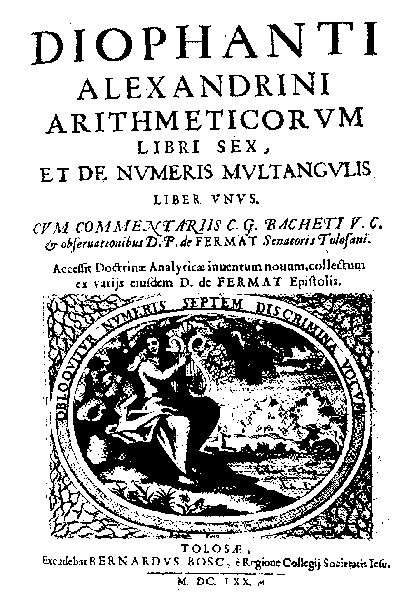
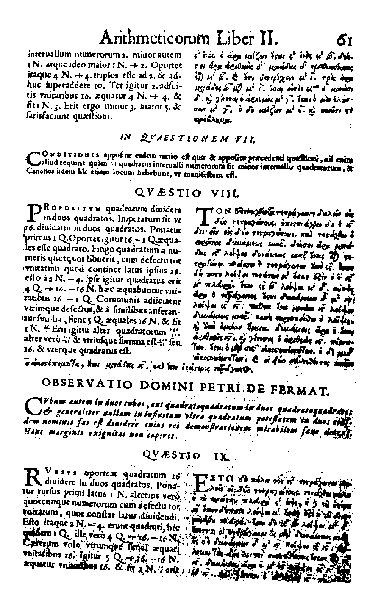
拉法耶尔·蓬贝利在1570年翻译了这部著作的大部分,但从未出版。拉法耶尔·蓬贝利确实借用了丢番图的许多问题用于他自己的Algebra。丢番图的Arithmetica最著名的拉丁文译本出自克劳德-加斯帕·巴歇·德·梅齐里亚克1621年的译本,皮埃尔·德·费马研究的正是这个版本。当然,皮埃尔·德·费马受到了这部著作的启发,近年来它因与费马大定理的联系而闻名。
我们在本文开头提到,丢番图常被视为“代数之父”,但毫无疑问,许多解线性与二次方程的方法都可追溯到巴比伦数学。为此,1写道[1]:-
……丢番图并非如人们常称的那样是代数之父。然而,他那非凡却不成体系的不定问题集是一项独特的成就,直到很久以后才得到充分赏识和进一步发展。
Diophantus, often known as the 'father of algebra', is best known for his Arithmetica, a work on the solution of algebraic equations and on the theory of numbers. However, essentially nothing is known of his life and there has been much debate regarding the date at which he lived.
There are a few limits which can be put on the dates of Diophantus's life. On the one hand Diophantus quotes the definition of a polygonal number from the work of Hypsicles so he must have written this later than 150 BC. On the other hand Theon of Alexandria, the father of Hypatia, quotes one of Diophantus's definitions so this means that Diophantus wrote no later than 350 AD. However this leaves a span of 500 years, so we have not narrowed down Diophantus's dates a great deal by these pieces of information.
There is another piece of information which was accepted for many years as giving fairly accurate dates. Heath [3] quotes from a letter by Michael Psellus who lived in the last half of the 11th century. Psellus wrote (Heath's translation in [3]):-
Diophantus dealt with [Egyptian arithmetic] more accurately, but the very learned Anatolius collected the most essential parts of the doctrine as stated by Diophantus in a different way and in the most succinct form, dedicating his work to Diophantus.
Psellus also describes in this letter the fact that Diophantus gave different names to powers of the unknown to those given by the Egyptians. This letter was first published by Paul Tannery in [7] and in that work he comments that he believes that Psellus is quoting from a commentary on Diophantus which is now lost and was probably written by Hypatia. However, the quote given above has been used to date Diophantus using the theory that the Anatolius referred to here is the bishop of Laodicea who was a writer and teacher of mathematics and lived in the third century. From this it was deduced that Diophantus wrote around 250 AD and the dates we have given for him are based on this argument.
Knorr in [16] criticises this interpretation, however:-
But one immediately suspects something is amiss: it seems peculiar that someone would compile an abridgement of another man's work and then dedicate it to him, while the qualification "in a different way", in itself vacuous, ought to be redundant, in view of the terms "most essential" and "most succinct".
Knorr gives a different translation of the same passage (showing how difficult the study of Greek mathematics is for anyone who is not an expert in classical Greek) which has a remarkably different meaning:-
Diophantus dealt with [Egyptian arithmetic] more accurately, but the very learned Anatolius, having collected the most essential parts of that man's doctrine, to a different Diophantus most succinctly addressed it.
The conclusion of Knorr as to Diophantus's dates is [16]:-
... we must entertain the possibility that Diophantus lived earlier than the third century, possibly even earlier that Heron in the first century.
The most details we have of Diophantus's life (and these may be totally fictitious) come from the Greek Anthology, compiled by Metrodorus around 500 AD. This collection of puzzles contain one about Diophantus which says:-
... his boyhood lasted th of his life; he married after th more; his beard grew after th more, and his son was born 5 years later; the son lived to half his father's age, and the father died 4 years after the son.
So he married at the age of 26 and had a son who died at the age of 42, four years before Diophantus himself died aged 84. Based on this information we have given him a life span of 84 years.
The Arithmetica is a collection of 130 problems giving numerical solutions of determinate equations (those with a unique solution), and indeterminate equations. The method for solving the latter is now known as Diophantine analysis. Only six of the original 13 books were thought to have survived and it was also thought that the others must have been lost quite soon after they were written. There are many Arabic translations, for example by Abu'l-Wafa, but only material from these six books appeared. Heath writes in [4] in 1920:-
The missing books were evidently lost at a very early date. Paul Tannery suggests that Hypatia's commentary extended only to the first six books, and that she left untouched the remaining seven, which, partly as a consequence, were first forgotten and then lost.
However, an Arabic manuscript in the library Astan-i Quds (The Holy Shrine library) in Meshed, Iran has a title claiming it is a translation by Qusta ibn Luqa, who died in 912, of Books IV to VII of Arithmetica by Diophantus of Alexandria. F Sezgin made this remarkable discovery in 1968. In [19] and [20] Rashed compares the four books in this Arabic translation with the known six Greek books and claims that this text is a translation of the lost books of Diophantus. Rozenfeld, in reviewing these two articles is, however, not completely convinced:-
The reviewer, familiar with the Arabic text of this manuscript, does not doubt that this manuscript is the translation from the Greek text written in Alexandria but the great difference between the Greek books of Diophantus's Arithmetic combining questions of algebra with deep questions of the theory of numbers and these books containing only algebraic material make it very probable that this text was written not by Diophantus but by some one of his commentators (perhaps Hypatia?).
It is time to take a look at this most outstanding work on algebra in Greek mathematics. The work considers the solution of many problems concerning linear and quadratic equations, but considers only positive rational solutions to these problems. Equations which would lead to solutions which are negative or irrational square roots, Diophantus considers as useless. To give one specific example, he calls the equation 'absurd' because it would lead to a meaningless answer. In other words how could a problem lead to the solution -4 books? There is no evidence to suggest that Diophantus realised that a quadratic equation could have two solutions. However, the fact that he was always satisfied with a rational solution and did not require a whole number is more sophisticated than we might realise today.
Diophantus looked at three types of quadratic equations and . The reason why there were three cases to Diophantus, while today we have only one case, is that he did not have any notion for zero and he avoided negative coefficients by considering the given numbers to all be positive in each of the three cases above.
There are, however, many other types of problems considered by Diophantus. He solved problems such as pairs of simultaneous quadratic equations.
Consider . Diophantus would solve this by creating a single quadratic equation in x. Put so, adding and , we have , then subtracting them gives . Now
, so
leading to .
In Book III, Diophantus solves problems of finding values which make two linear expressions simultaneously into squares. For example he shows how to find to make and both squares (he finds ). Other problems seek a value for such that particular types of polynomials in up to degree 6 are squares. For example he solves the problem of finding such that is a square in Book VI. Again in Book VI he solves problems such as finding such that simultaneously is a cube and is a square (for which he easily finds the answer ).
Another type of problem which Diophantus studies, this time in Book IV, is to find powers between given limits. For example to find a square between and 2 he multiplies both by 64, spots the square 100 between 80 and 128, so obtaining the solution to the original problem. In Book V he solves problems such as writing 13 as the sum of two square each greater than 6 (and he gives the solution and ). He also writes 10 as the sum of three squares each greater than 3, finding the three squares
.
Heath looks at number theory results of which Diophantus was clearly aware, yet it is unclear whether he had a proof. Of course these results may have been proved in other books written by Diophantus or he may have felt they were "obviously" true due to his experimental evidence. Among such results are [4]:-
... no number of the form or can be the sum of two squares;
... a number of the form cannot be the sum of three squares.
Diophantus also appears to know that every number can be written as the sum of four squares. If indeed he did know this result it would be truly remarkable for even Fermat, who stated the result, failed to provide a proof of it and it was not settled until Lagrange proved it using results due to Euler.
Although Diophantus did not use sophisticated algebraic notation, he did introduce an algebraic symbolism that used an abbreviation for the unknown and for the powers of the unknown. As Vogel writes in [1]:-
The symbolism that Diophantus introduced for the first time, and undoubtedly devised himself, provided a short and readily comprehensible means of expressing an equation... Since an abbreviation is also employed for the word "equals", Diophantus took a fundamental step from verbal algebra towards symbolic algebra.
One thing will be clear from the examples we have quoted and that is that Diophantus is concerned with particular problems more often than with general methods. The reason for this is that although he made important advances in symbolism, he still lacked the necessary notation to express more general methods. For instance he only had notation for one unknown and, when problems involved more than a single unknown, Diophantus was reduced to expressing "first unknown", "second unknown", etc. in words. He also lacked a symbol for a general number . Where we would write , Diophantus has to write in words:-
... a sixfold number increased by twelve, which is divided by the difference by which the square of the number exceeds three.
Despite the improved notation and that Diophantus introduced, algebra had a long way to go before really general problems could be written down and solved succinctly.
Fragments of another of Diophantus's books On polygonal numbers, a topic of great interest to Pythagoras and his followers, has survived. In [1] it is stated that this work contains:-
... little that is original, [and] is immediately differentiated from the Arithmetica by its use of geometric proofs.
Diophantus himself refers to another work which consists of a collection of lemmas called The Porisms but this book is entirely lost. We do know three lemmas contained in The Porisms since Diophantus refers to them in the Arithmetica. One such lemma is that the difference of the cubes of two rational numbers is equal to the sum of the cubes of two other rational numbers, i.e. given any numbers a, b then there exist numbers such that .
Another extant work Preliminaries to the geometric elements, which has been attributed to Heron, has been studied recently in [16] where it is suggested that the attribution to Heron is incorrect and that the work is due to Diophantus. The author of the article [14] thinks that he may have identified yet another work by Diophantus. He writes:-
We conjecture the existence of a lost theoretical treatise of Diophantus, entitled "Teaching of the elements of arithmetic". Our claims are based on a scholium of an anonymous Byzantine commentator.
European mathematicians did not learn of the gems in Diophantus's Arithmetica until Regiomontanus wrote in 1463:-
No one has yet translated from the Greek into Latin the thirteen Books of Diophantus, in which the very flower of the whole of arithmetic lies hid...
Bombelli translated much of the work in 1570 but it was never published. Bombelli did borrow many of Diophantus's problems for his own Algebra. The most famous Latin translation of the Diophantus's Arithmetica is due to Bachet in 1621 and it is that edition which Fermat studied. Certainly Fermat was inspired by this work which has become famous in recent years due to its connection with Fermat's Last Theorem.
We began this article with the remark that Diophantus is often regarded as the 'father of algebra' but there is no doubt that many of the methods for solving linear and quadratic equations go back to Babylonian mathematics. For this reason Vogel writes [1]:-
... Diophantus was not, as he has often been called, the father of algebra. Nevertheless, his remarkable, if unsystematic, collection of indeterminate problems is a singular achievement that was not fully appreciated and further developed until much later.
正文里的方括号编号指向这里,悬停即可直接看到条目。书目保留原文——译了书名反而查不到文献。
原站列出的延伸阅读与外部数据库,照原样保留,目标多为英文页面。
关于丢番图的其它页面:
原站的交叉引用。指向本站已镜像专题的留在站内,其余仍指回原站。