数学家传记
吉拉尔·笛沙格是一位法国数学家,射影几何学的创始人之一。他的工作集中在圆锥曲线理论和透视法上。
吉拉尔·笛沙格的家庭(在他母亲和父亲两边)几代以来都非常富有,并向巴黎的Parlement以及里昂的Parlement(当时法国第二重要的城市)提供了律师和法官。笛沙格的父亲,同样拥有笛沙格这个名字,在法国东部罗讷省的小镇Condrieu与Jeanne Croppet结婚。他们搬到了里昂,但肯定保留了Condrieu的财产,因为笛沙格(小)在晚年曾在那里度过时光。在里昂,笛沙格(大)担任法警的调查员,然后担任税务员和皇家公证人,这是他儿子笛沙格出生时的职业。笛沙格和Jeanne 笛沙格有八个孩子,四个女儿Marie、Clemence、Francoise和Catherine,以及四个儿子Fleury、Philippe、路易·安托万和笛沙格(本传记的主题)。看来他们的儿子笛沙格是八个孩子中最小的,这相当令人惊讶,因为他继承了父亲的名字。
本传记的主人公 笛沙格,于1591年3月2日在圣十字教区教堂受洗,当时他出生九天。事实上,直到勒内·塔顿 [28] 1962年发表的研究成果,笛沙格 的出生日期才为人所知。在塔顿的研究之前,人们错误地认为 笛沙格 出生于1593年,因为阿德里安·巴耶1691年所写的 勒内·笛卡儿 传记中称 笛沙格 比 勒内·笛卡儿 大三岁。塔顿发现了一份 笛沙格 的星占图,上面给出他的出生时间为1591年2月21日6时30分。关于 笛沙格 的教育和早年生活,没有留下任何信息。直到他三十五六岁时,我们才对他的活动有了确切了解。
笛沙格 似乎曾多次长时间前往巴黎,处理一桩追讨巨额债务的诉讼。尽管遭受了这一损失,家族在里昂仍拥有几处大宅,在附近的武尔勒村拥有一座庄园(及其地产),还有一座小城堡,周围环绕着当地最好的葡萄园。因此很明显,笛沙格 有充分机会接受良好教育,买得起他想要的任何书籍,也有闲暇沉溺于他可能喜欢的任何追求。在他晚年,这些追求似乎包括设计一座精巧的螺旋楼梯和一种巧妙的新型水泵,但 笛沙格 最重要的兴趣是几何学。他发明了一种新的、非希腊式的几何学方法,现在被称为“projective”或“现代”几何学。作为数学家,他确实非常出色:极具原创性且完全严谨。然而,他的数学文风却远谈不上清晰。
不清楚他何时第一次去巴黎,但我们知道他在1626年9月9日在那里,因为那天他写信给巴黎市的商人和地方法官领袖,提议他和一位同事François Villette建造或让人建造一台机器,以提高塞纳河的水位,将其分配给巴黎居民。不清楚François Villette是谁,但有一位名叫François Villette的眼镜商,他于1621年出生在里昂。显然不可能是那个François Villette,他当时只有五岁,但可能是他的父亲。笛沙格的信,于1626年9月9日在巴黎市政厅写成,全文见[14]。信的开头是:-
François Villette和笛沙格,两位里昂的资产阶级,向巴黎市的商人和地方法官领袖提议,为了该城市的装饰、公共便利和美化,提出以下主张:
在所有塞纳河能使小麦磨坊全年运转的地方,将其水提升到约四十英尺的高度,连续流动的水量是它通过新桥的Samaritaine泵提升的两倍;并且这是通过一台机器实现的,一旦建立良好,每年维护费用可低于三百磅……
我们注意到,萨马里坦水泵自1608年起运行,从塞纳河抽水至新桥上方的一个水库,为卢浮宫和杜伊勒里花园供水。巴黎的领导人必须同意支付一笔款项,并提供所需的保证,为Villette和笛沙格的机器安装提供场地,然后他们将建造它,或让人建造它,并等待一个月才能获得付款,只有在被认为令人满意时才会支付。他们收到了一份回复,以今天的标准来看快得惊人,日期是1626年9月15日,说这些提议[14]:-
……只能是为了公众的利益和便利,以及这座城市的装饰和美化。因此,我们同意Villette和笛沙格自费开始实施这些提议,但条件是,在我们的面前,由城市工程主管和桥梁主管给予许可之前,他们不得以任何方式将机器安置在河中,也不得安置在河岸和河边的任何地方,以免损害或妨碍航道、货物的靠近和卸载。
没有进一步的通信留存下来,据推测Villette和笛沙格选择不在强加给他们的条件下继续进行。我们认为,笛沙格寄信所用的地址以及他没有提供任何巴黎推荐人的事实,表明他刚到巴黎不久。
我们上面提到了Adrien Baillet 1691年的勒内·笛卡儿传记,其中给出了笛沙格错误的出生年份。因此,不清楚我们应该多大程度信任这部作品,尽管我们不能因为一个错误就过于苛刻。Baillet说笛沙格是一位工程师,参与了1628年的拉罗谢尔围城战,正是在那里他第一次遇到了勒内·笛卡儿。没有额外证据证实这一说法,尽管鉴于笛沙格的技能,它确实显得合理。让我们简要解释一下1628年的拉罗谢尔围城战。这是当时天主教-新教敌意的结果。胡格诺派,即新教徒,在拉罗谢尔有他们的据点,并得到英国人的支持。天主教一方,由路易十三的皇家军队组成,想要夺取拉罗谢尔并阻止英国登陆船只提供支持。皇家一方,由国王和黎塞留红衣主教领导,建造了防御工事来围困城市,还建造了大规模的海上防御工事,以阻止英国支持到达胡格诺派。笛沙格参与这样的行动似乎确实可能。然而,在C Adam和保罗·塔内里(编),Oeuvres de Descartes Ⓣ(勒内·笛卡儿的作品)(1897)中有一项声明,说勒内·笛卡儿在1637年第一次遇到了笛沙格。
在巴黎时,笛沙格成为围绕马兰·梅森(1588-1648)的数学圈子的一部分。这个圈子包括勒内·笛卡儿(1597-1650)、埃蒂安·帕斯卡尔(1588-1651)和他的儿子布莱兹·帕斯卡(1623-1662)。很可能主要是为了这个有限的朋友读者群,笛沙格准备了他的数学作品,并让人印刷。其中一些后来由马克斯·亚伯拉罕 Bosse(1602-1676)扩展成更可出版的形式,他如今最被铭记为雕刻师,但也是一位透视学教师。Bosse说笛沙格在1630年获得了皇家许可出版他的几部作品。这为笛沙格协助黎塞留红衣主教围城,并可能参与皇家一方的其他工作增添了一点分量。
笛沙格究竟何时加入马兰·梅森的“学院”尚不清楚。马兰·梅森在他的一封信中写道,笛沙格在1632年之前在巴黎遇到了皮埃尔·伽桑狄。马兰·梅森在1635年指出,笛沙格是他会议的定期参加者,他的评论让人觉得他已经这样做了一段时间。在1635-36年,马兰·梅森出版了La Harmonie UniverselleⓉ(《普遍和谐》),其中包含笛沙格的一篇短文,题为Une méthode aisée pour apprendre et enseigner à lire et escrire la musiqueⓉ(《一种学习和教授读写音乐的简便方法》)。Mark Schneider在[8]中写道:-
笛沙格的“简便方法”是他唯一已知的不涉及几何及其应用的著作。在这里,也许我们有迹象表明,笛沙格在他的几何思想形成确定形式的时期,一直受到马兰·梅森的影响。
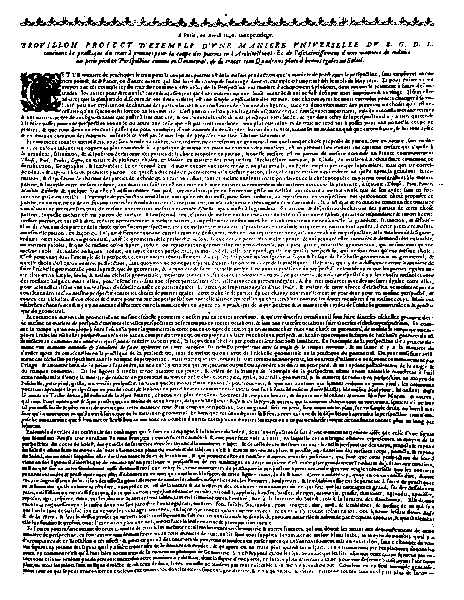
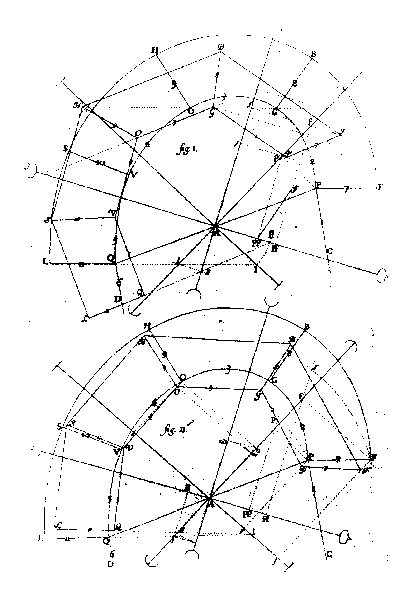
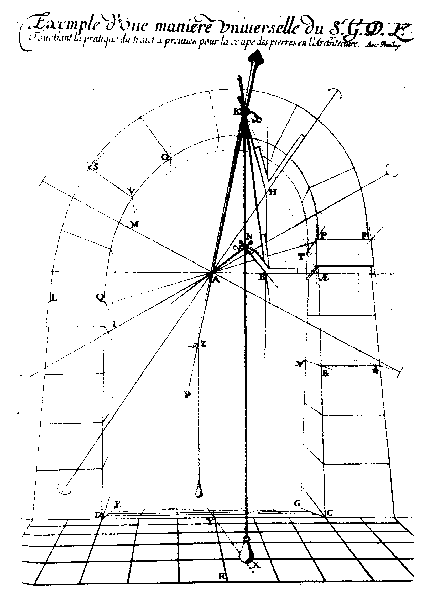
笛沙格 撰写了关于“实用”主题的著作,例如 Exemple de l'une des manières universelles du S.G.D.L. touchant la pratique de la perspective sans emploier aucun tiers point, de distance ny d'autre nature, qui soit hors du champ de l'ouvrage Ⓣ 中的透视法(关于 笛沙格 在不使用任何第三点、距离点或任何其他位于画面之外的点的前提下影响透视实践的一种通用方法的示例)(1636年),Brouillon project d'exemple d'une manière universelle du S.G.D.L. touchant la pratique du trait a preuves pour la coupe des pierres en l'architecture Ⓣ 中用于建筑的石头切割(笛沙格 关于线条实践的通用方法示例的草图方案,有证据表明其用于建筑中的石头切割)(1640年),以及 Manière universelle de poser le style aux rayons du soleil en quelconque endroit possible, avec la règle, le compas, l'esquerre et le plomb Ⓣ 中的日晷(在任何可能的位置利用直尺、圆规、直角尺和铅锤将晷针置于太阳光线中的通用方法)(1640年)。然而,他的著作内容密集,对所涉主题采取理论性的处理方法。其中没有那种真正面向工匠的文本中常见的冗长而初级的逐步解释。
这部透视法著作的标题译为 Example of one of S.G.D.L.'s general methods concerning drawing in perspective without using any third point, a distance point or any other kind, which lies outside the picture field。人们立刻会问“S.G.D.L.”是谁或是什么,但这只是“笛沙格”,来自“Sieur 笛沙格 Lyonnais”的首字母。这部透视法著作必定引导 笛沙格 发展出了一种新的几何学方法。关于他的石头切割著作,Mark Schneider 写道[8]:-
笛沙格 的石头切割方法行之有效,确实是一项辉煌的发明,但同时也必须指出,如果没有作者本人的亲自指导,当时的石匠不太可能理解它。
对笛沙格的石材切割方法的描述,以石材加工者能够理解的形式,是由笛沙格的弟子亚伯拉罕 Bosse(1604-1676)于1643年完成的。Bosse还描述了笛沙格关于日晷的工作,由于笛沙格的原始出版物未能留存,这是我们关于该文本的唯一信息。
1640年,当时16岁的 布莱兹·帕斯卡 提出了他的“神秘六边形”。在其中他提到了 笛沙格:-
我们还将证明这一性质,其最初的发明者是里昂的 M 笛沙格,他是这个时代最伟大的头脑之一,也是最精通数学的人之一,尤其是在圆锥曲线等方面,他关于此事的著作虽然数量不多,但已向那些希望了解的人充分证明了他的能力:我承认,我在这方面所发现的少许成果归功于他的著作,并且我已尽可能模仿他在这方面的方法,……
布莱兹·帕斯卡在这里一定是指笛沙格最重要的著作,他在其中发明了他的新形式的几何学,书名为Brouillon project d'une atteinte aux evenemens des rencontres du Cone avec un Plan Ⓣ(关于取圆锥平面截线结果的论文草稿)。1639年在巴黎印刷了少量副本。现在已知仅存一本,在1951年这本被重新发现之前,笛沙格的工作只能通过菲利普·德拉伊尔(1640-1718)制作的手稿副本为人所知。这本书很短,但非常密集。它从直线束和直线上点列开始,考虑六点的对合(笛沙格没有使用或定义交比),严格处理涉及‘无穷’距离的情形,然后转向圆锥曲线,表明它们可以用投影下不变的性质来讨论。我们得到了圆锥曲线的统一理论。
笛沙格著名的“透视定理”——当两个三角形处于透视位置时,对应边的交点共线——最早于1648年发表,见于亚伯拉罕 Bosse的一部透视学著作中。
关于这一结果,你可以在THIS LINK看到更多内容。
显然,尽管笛沙格决心用本族语言解释问题,并且不直接引用古代数学家的定理或词汇,他仍熟知古代几何学家的工作,例如阿波罗尼奥斯和帕普斯。他选择以不同方式解释自己,或许是因为他认识到自己的工作也深深受益于实用传统,特别是透视学研究(透视学是圆锥投影的一种形式)。事实上,笛沙格的新思想极有可能正是从他关于透视及相关问题的研究中产生的。当射影几何被加斯帕尔·蒙日(1746—1818)的学生们重新发明时,这种重新发明来自画法几何,而画法几何是一种与透视学有许多共同之处的技术。
笛沙格关于透视的工作引发了一场非常不愉快的争论。1642年,一部匿名著作题为La Perspective practique nécessaire à tous peintres, graveurs, sculpteurs, architectes, orfèvres, bordeurs, tapissiers & autres se servans du Dessein Ⓣ(对所有画家、雕刻师、雕塑家、建筑师、银匠、饰边师、室内装潢师和其他使用设计的人必要的实用透视),由出版商Melchior Tavernier和Francois l'Anglois出版。这部著作实际上由Jean Du Breuil(1602-1670)撰写,他是书商Claude Du Breuil的儿子,主要是一位建筑师。这是1642年至1647年间出版的三卷中的第一卷。书的前言归功于笛沙格,但他看到自己的想法被呈现时带有许多错误,非常不安,他的反应是在巴黎各处张贴告示。一张标题为“难以置信的错误”,另一张为“巨大的过失和欺骗”。一张告示声称Du Breuil:-
... 在这本关于实用透视的书中塞入了一幅[来自笛沙格的]图,他声称这是他自己的例子,他用嫉妒的小爪子对其进行了修改和伪造。
这看起来像是笛沙格的过度反应,并引发了Du Breuil同样恶毒的反击,他用一本小册子进行反击,声称笛沙格1636年关于透视的论文提出了Jean-Louis de Vauzelard在Perspective cilindrique et conique Ⓣ(圆柱和圆锥透视)(1630)和Jacques Aleaume在Introduction a la perspective, ensemble a l'usage de compas optique et perspective Ⓣ(透视导论,连同光学罗盘和透视的使用)(1628)中早已发表的想法。他还激怒了笛沙格,声称就所有实际目的而言,他的工作毫无价值。
笛沙格通过出版Six erreurs des pages 87, 118, 124, 128, 132 et 134. du livre intitulé 'La Perspective practique nécessarie à tous peintres ...' Ⓣ(在题为“所有画家所必需的实际透视……”的书第87、118、124、128、132和134页上的六个错误)于1642年继续争论,其中他详细描述了Du Breuil作品中的错误。出版商Melchior Tavernier和Francois l'Anglois随后通过出版一本文集攻击笛沙格,在Advis charitables sur les diverses oeuvres et feuilles volantes du Sieur Girard Desargues, Lyonnois Ⓣ(关于里昂的M. Desargues的各种作品和手稿的有益建议)(1642)中批评他的作品。这部作品包括让·博格朗在1640年8月,即他去世前不久写的一封信,其中他批评了笛沙格对圆锥曲线的射影研究。
关于Mark Schneider在[8]中对这部作品中针对笛沙格的批评的总结,见THIS LINK。
此时,笛沙格似乎转向亚伯拉罕 Bosse,以出版对其作品的澄清并为其辩护,抵御这些攻击。正如我们上面所指出的,Bosse在1643年出版了两篇论文,以更简单的方式呈现了笛沙格关于石切割和日晷的工作。
1644年,雅克·屈拉贝尔以一本81页的书Examen des oeuvres de Sieur Desargues, LyonnoisⓉ(对里昂的M. Desargues著作的审查)发起了新的攻击。屈拉贝尔攻击了笛沙格的全部工作,包括博斯在1643年的两篇出版物,他说他只能发现:-
……其中除了平庸、错误、剽窃和没有实际意义的信息之外,什么也找不到。
屈拉贝尔声称,笛沙格缺乏实践经验使他的工作毫无用处。他写道:-
如果上述先生理解并实践过他想谈论的事情,他大概就不会陷入这样的错误,实践对于帮助和加强我们的感官是必要的;它将证实或否定我们头脑的思辨所产生的东西。
随后,屈拉贝尔和笛沙格之间展开了一场恶毒的争论,各种小册子互相攻击,笛沙格威胁说,如果屈拉贝尔不撤回言论,就要起诉他。在多次激烈的交锋中,两人制定了一套带有规则和条例的辩论,将任命裁判来决定胜者,胜者将从败者那里获得一大笔钱。然而,没有证据表明这件事曾经发生过。
笛沙格似乎对他卷入的持续战斗感到厌倦,从1645年起转向建筑。1648年,他回到里昂,似乎更多地参与建筑设计,出版很少。他确实在1649-50年和1657-1660年再次回到巴黎,在那里他负责设计了几座豪宅。人们不禁要问,如果这位杰出的数学家没有受到如此广泛的批评,他可能会做出哪些其他辉煌的数学工作。
让我们以两段关于笛沙格数学贡献的引文来结束这篇传记。弗洛里安·卡乔里在他的History of Mathematics(1893年)中写道:-
我们把对合理论与截线理论归功于笛沙格;还有那个优美的构想:一条直线的两个端点可以看作在无穷远处相交,而平行线与其他线对的区别仅在于它们的交点在无穷远处。他重新发明了外摆线,并展示了它在构造轮齿中的应用,这一课题后来由菲利普·德拉伊尔更充分地加以阐述。
大卫·尤金·史密斯在其History of Mathematics(1958年)第2卷中写道:-
近代所要迈出的最初重要步骤之一……应归功于笛沙格。在1639年出版的一部著作中,笛沙格阐述了四调和点理论的基础,不是像今天那样做的,而是基于两个共轭点到中心的距离之积为常数这一事实。他还处理了极点与极线理论,尽管没有使用这些术语
Girard Desargues's family (on both his mother's and his father's side) had been very rich for several generations and had supplied lawyers and judges to the Parlement in Paris as well as to that in Lyon (then the second most important city in France). Girard's father, also having the name Girard Desargues, married Jeanne Croppet in Condrieu a small town in the Rhône department in eastern France. They moved to Lyon but certainly retained the property in Condrieu since Girard (Junior) spent time there towards the end of his life. In Lyon Girard (Senior) worked as an investigator for the bailiff, then as a tax collector and royal notary, which was his occupations when his son Girard was born. Girard and Jeanne Desargues had eight children, four daughters Marie, Clemence, Francoise and Catherine, and four sons Fleury, Philippe, Antoine and Girard (the subject of this biography). It appears that their son Girard was the youngest of the eight children, which is rather surprising since he took his father's name.
Girard, the subject of this biography, was baptised in the parish church of Sainte-Croix on 2 March 1591 when he was nine days old. In fact Desargues' date of birth was unknown until the work of René Taton [28] published in 1962. Prior to Taton's research it was wrongly believed that Desargues was born in 1593 because in Adrien Baillet's 1691 biography of Descartes states that Desargues was three years older than Descartes. Taton discovered a horoscope of Desargues giving his birth at 6:30 on 21 February 1591. There is no information about Desargues' education and about his early life. He is in his middle 30s before we have any definite information about his activities.
Desargues seems to have made several extended visits to Paris in connection with a lawsuit for the recovery of a huge debt. Despite this loss, the family still owned several large houses in Lyon, a manor house (and its estate) at the nearby village of Vourles, and a small chateau surrounded by the best vineyards in the vicinity. It is thus clear that Desargues had every opportunity of acquiring a good education, could afford to buy what books he chose, and had leisure to indulge in whatever pursuits he might enjoy. In his later years, these seem to have included designing an elaborate spiral staircase, and an ingenious new form of pump, but the most important of Desargues' interests was Geometry. He invented a new, non-Greek way of doing geometry, now called 'projective' or 'modern' geometry. As a mathematician he was very good indeed: highly original and completely rigorous. He was, however, far from lucid in his mathematical style.
It is unclear when he first went to Paris but we know that he was there on 9 September 1626 for on that day he wrote to the leaders of the merchants and magistrates of the city of Paris proposing that he and a colleague François Villette build, or have built, a machine to raise the level of the water of the river Seine to distribute it to the inhabitants of Paris. It is unclear who François Villette was but there was an optician named François Villette who was born in Lyon in 1621. Clearly it could not have been that François Villette, who was only five years old at the time, but it is possible that it could have been his father. Desargues' letter, written at the Hotel de Ville of Paris on 9 September 1626, is given in full in [14]. It begins:-
François Villette and Girard Desargues, both bourgeois of Lyon, propose to the leaders of the merchants and magistrates of the city of Paris for the decoration, public convenience and embellishment of the said city, the following assertion:
In all the places where the Seine river can make a wheat mill grind throughout the year, to raise its water to a height of about forty feet, continuously flowing twice as much as it will rise by the pump of the Samaritaine of the Pont Neuf; and this achieved by means of a machine, which, once well established, can be maintained for less than three hundred pounds per year ...
We note that the Samaritaine, operating from 1608, pumped water from the Seine into a reservoir above the Pont-Neuf which supplied the Louvre palace and the Tuileries gardens. The Parisian leaders would have to agree a sum in payment, with the required assurances, provide a site for Villette and Desargues' machine to be installed, and then they would build it, or have it built, and wait a month for their payment, only to be made when it is judged satisfactory. They received a reply, amazingly quickly by today's standards, on 15 September 1626 saying that the proposals [14]:-
... can be only for the good and the convenience of the public, decoration and embellishment of this city. And therefore we agree that Villette and Desargues begin to execute them at their own expense, with the charge that they will not be able in any way to plant their machines in the river nor in any place on the edges and shores of it before permission is given in our presence by the masters of works of the city and masters of the bridges of it, so that they cannot harm or prejudice the navigation path, the approach and the unloading of goods.
No further correspondence survives and it is assumed that Villette and Desargues chose not to go ahead under the conditions imposed on them. We suggest that the address from which Desargues sent his letter and the fact that he offers no Paris recommendations, indicates that he had newly arrived in Paris.
We mentioned above Adrien Baillet's 1691 biography of Descartes where Desargues' incorrect year of birth is given. It is unclear, therefore, how much we should trust this work although we must not be too harsh on it because of one error. Baillet states that Desargues was an engineer involved in the siege of La Rochelle in 1628 and it was there that he first met Descartes. There is no additional evidence to substantiate this claim, although given Desargues' skills, it certainly appears plausible. Let us explain briefly about the siege of La Rochelle in 1628. This was a consequence of the Catholic-Protestant hostility at the time. The Huguenots, who were Protestant, had their stronghold at La Rochelle and were supported by the English. The Catholic side, which consisted of royal troops of Louis XIII, wanted to take La Rochelle and prevent the English landing ships in support. Fortifications were built by the Royal side, led by the King and Cardinal Richelieu, to lay siege to the city and also massive sea defences were built to prevent the English support reaching the Huguenots. That Desargues would be involved in such an undertaking would certainly seem possible. There is, however, a statement in C Adam and P Tannery (eds.), Oeuvres de Descartes Ⓣ (1897) that Descartes first met Desargues in 1637.
When in Paris, Desargues became part of the mathematical circle surrounding Marin Mersenne (1588-1648). This circle included René Descartes (1597-1650), Étienne Pascal (1588-1651) and his son Blaise Pascal (1623-1662). It was probably essentially for this limited readership of friends that Desargues prepared his mathematical works, and had them printed. Some of them were later expanded into more publishable form by Abraham Bosse (1602-1676), who is now best remembered as an engraver, but was also a teacher of perspective. Bosse states that Desargues was given a royal licence to publish several of his writings in 1630. This adds a little weight to Desargues assisting Cardinal Richelieu in the siege and, probably, being involved in other work by the Royal side.
Exactly when Desargues joined Marin Mersenne's "academy" is unclear. Mersenne writes in one of his letters that Desargues met Pierre Gassendi in Paris before 1632. Mersenne states in 1635 that Desargues was a regular attender of his meetings and his comment makes it look as though he had been doing so for some time. In 1635-36 Mersenne published La Harmonie Universelle Ⓣ which contains a short paper by Desargues entitled Une méthode aisée pour apprendre et enseigner à lire et escrire la musique Ⓣ. Mark Schneider writes in [8]:-
Desargues' "Easy Method" is his only known writing which does not deal with geometry and its application. Here perhaps we have an indication that Desargues had been under the influence of Mersenne during the period in which his ideas on geometry were taking their definitive form.
Desargues wrote on 'practical' subjects such as perspective in Exemple de l'une des manières universelles du S.G.D.L. touchant la pratique de la perspective sans emploier aucun tiers point, de distance ny d'autre nature, qui soit hors du champ de l'ouvrage Ⓣ (1636), the cutting of stones for use in building in Brouillon project d'exemple d'une manière universelle du S.G.D.L. touchant la pratique du trait a preuves pour la coupe des pierres en l'architecture Ⓣ (1640) and sundials in Manière universelle de poser le style aux rayons du soleil en quelconque endroit possible, avec la règle, le compas, l'esquerre et le plomb Ⓣ (1640). His writings are, however, dense in content and theoretical in their approach to the subjects concerned. There is none of the wordy and elementary step-by-step explanation which one finds in texts that are truly addressed to artisans.
The title of the work on perspective translates as Example of one of S.G.D.L.'s general methods concerning drawing in perspective without using any third point, a distance point or any other kind, which lies outside the picture field. One immediately wonders who or what "S.G.D.L." is, but this is simply "Desargues" from the initials of "Sieur Girard Desargues Lyonnais". This work on perspective must have led Desargues to develop a new approach to geometry. Concerning his work on stone cutting, Mark Schneider writes [8]:-
Desargues' method of stone-cutting works and is indeed a brilliant invention, but, at the same time, it must be noted that without the author's personal tutoring no mason of the time would have been likely to understand it.
The description of Desargues' stone cutting method, in a form that those working on stone would understand, was produced by Desargues' disciple Abraham Bosse (1604-1676) in 1643. Bosse also describes Desargues' work on sundials and, as Desargues's original publication has not survived, this is our only information about this text.
In 1640 Blaise Pascal, who was 16 years old at the time, produced his 'mystic hexagram'. In it he referred to Desargues:-
We shall also demonstrate this property of which the original inventor is M Desargues of Lyon who is one of the great minds of this time and one of the most versed in mathematics, in particular among others in conics, whose writings on this matter, though small in number, have given ample testimony of his ability to those who have desired to become aware of it: and I will admit that I owe the little that I have found on this matter to his writings, and that I have tried to imitate as much that it is possible for me his method on this subject, ...
Pascal must be referring here to Desargues' most important work, the one in which he invented his new form of geometry, which has the title Brouillon project d'une atteinte aux evenemens des rencontres du Cone avec un Plan Ⓣ). A small number of copies was printed in Paris in 1639. Only one is now known to survive, and until this was rediscovered, in 1951, Desargues' work was known only through a manuscript copy made by Philippe de la Hire (1640-1718). The book is short, but very dense. It begins with pencils of lines and ranges of points on a line, considers involutions of six points (Desargues does not use or define a cross ratio), gives a rigorous treatment of cases involving 'infinite' distances, and then moves on to conics, showing that they can be discussed in terms of properties that are invariant under projection. We are given a unified theory of conics.
Desargues' famous 'perspective theorem' - that when two triangles are in perspective the meets of corresponding sides are collinear - was first published in 1648, in a work on perspective by Abraham Bosse.
You can see more about this result at THIS LINK.
It is clear that, despite his determination to explain matters in the vernacular, and without direct reference to the theorems or the vocabulary of Ancient mathematicians, Desargues is well aware of the work of ancient geometers, for instance Apollonius and Pappus. His choosing to explain himself differently may perhaps be due to his recognition that his own work was also deeply indebted to the practical tradition, specifically to the study of perspective (which is a form of conical projection). It seems highly likely that it was in fact from his work on perspective and related matters that Desargues' new ideas arose. When projective geometry was reinvented, by the pupils of Gaspard Monge (1746-1818), the reinvention was from descriptive geometry, a technique that has much in common with perspective.
Desargues' work on perspective led to a very unpleasant argument. In 1642 an anonymous work entitled La Perspective practique nécessaire à tous peintres, graveurs, sculpteurs, architectes, orfèvres, bordeurs, tapissiers & autres se servans du Dessein Ⓣ was published by the publishers Melchior Tavernier and Francois l'Anglois. The work was actually written by Jean Du Breuil (1602-1670), the son of the bookseller Claude Du Breuil, who was primarily an architect. It was the first of three volumes published between 1642 and 1647. The preface to the book credited Desargues but he was very upset to see his ideas presented with many errors and his reaction was to place placards around Paris. One was headed "Incredible error" and another "Enormous faults and duplicities". One placard claimed that Du Breuil had:-
... stuffed into this book on practical perspective, a diagram [due to Desargues] which he claims is an example of his own, which he had altered and falsified with the petty claws of envy.
This looks like a massive overreaction by Desargues and it prompted an equally vicious response by Du Breuil who counterattacked with a pamphlet claiming that Desargues' 1636 paper on perspective presented ideas that had been published earlier by Jean-Louis de Vauzelard in Perspective cilindrique et conique Ⓣ (1630) and by Jacques Aleaume in Introduction a la perspective, ensemble a l'usage de compas optique et perspective Ⓣ (1628). He also infuriated Desargues by claiming that, for all practical purposes, his work was without value.
Desargues kept up the argument by publishing Six erreurs des pages 87, 118, 124, 128, 132 et 134. du livre intitulé 'La Perspective practique nécessarie à tous peintres ...' Ⓣ in 1642 in which he detailed errors in Du Breuil's work. The publishers Melchior Tavernier and Francois l'Anglois then attacked Desargues by publishing a collection of articles criticising his work in Advis charitables sur les diverses oeuvres et feuilles volantes du Sieur Girard Desargues, Lyonnois Ⓣ (1642). This work included a letter written by Jean Beaugrand in August 1640, shortly before his death, in which he criticised Desargues' projective study of conics.
For Mark Schneider's summary in [8] of the criticisms made against Desargues in this work, see THIS LINK.
At this point Desargues seems to have turned to Abraham Bosse to publish clarifications of his work and to defend it against these attacks. As we noted above, Bosse published two treatises in 1643 presenting in a simpler way Desargues' work on stone cutting and on sundials.
A new attack came in 1644 from Jacques Curabelle with the 81-page book Examen des oeuvres de Sieur Desargues, Lyonnois Ⓣ. Curabelle attacked all of Desargues' work, including the two publications by Bosse in 1643, saying that he could find:-
... find nothing in them but mediocrity, errors, plagiarism, and information of no practical interest.
Curabelle claimed that Desargues' lack of practical experience makes his work useless. He writes:-
If the said Sieur had understood and practiced the things he wanted to talk about, he probably would not fall into such errors, practice being necessary to help and strengthen our senses; it will confirm or deny what the speculation of our minds would have produced.
A vicious argument between Curabelle and Desargues followed with various pamphlets attacking each other and with Desargues threatening to sue Curabelle if he did not retract. The two, during a number of bitter exchanges, set up a debate with rules and regulations, judges were to be appointed to decide on the winner who would receive a large sum from the loser. There is no evidence, however, that this ever took place.
Desargues appears to have grown tired of the continuous battles he was involved in and, from 1645, turned to architecture. In 1648 he returned to Lyon where he seems to have been more involved in architectural design and published little. He did go back to Paris in 1649-50 and again in 1657-1660 where he was responsible for the design of several mansions. One has to wonder what other brilliant mathematical work this outstanding mathematician might have done if he had not been subjected to such widespread criticism.
Let us end this biography with two quotes regarding Desargues' mathematical contributions. Florian Cajori writes in his History of Mathematics (1893):-
We owe to Desargues the theory of involution and of transversals; also the beautiful conception that the two extremities of a straight line may be considered as meeting at infinity, and that parallels differ from other pairs of lines only in having their points of intersection at infinity. He re-invented the epicycloid and showed its application to the construction of gear teeth, a subject elaborated more fully later by La Hire.
David Eugene Smith in Volume 2 of his History of Mathematics (1958) writes:-
One of the first important steps to be taken in modern times ... was due to Desargues. In a work published in 1639 Desargues set forth the foundation of the theory of four harmonic points, not as done today but based on the fact that the product of the distances of two conjugate points from the centre is constant. He also treated the theory of poles and polars, although not using these terms
正文里的方括号编号指向这里,悬停即可直接看到条目。书目保留原文——译了书名反而查不到文献。
原站列出的延伸阅读与外部数据库,照原样保留,目标多为英文页面。
关于吉拉尔·笛沙格的其它页面:
原站的交叉引用。指向本站已镜像专题的留在站内,其余仍指回原站。