数学家传记
吉罗拉莫·吉罗拉莫·卡尔达诺或吉罗拉莫·卡尔达诺是一位意大利医生和数学家,他以著作《大衍术》而闻名,这是第一部专门论述代数的拉丁文论著。在其中,他给出了他从尼科洛·塔尔塔利亚那里学到的三次和四次方程的解法。
Girolamo或Hieronimo 卡尔达诺的拉丁文名字是Hieronymus Cardanus,有时也以其名字的英文形式吉罗拉莫·卡尔达诺为人所知。
卡尔达诺是Fazio 卡尔达诺和Chiara Micheria的私生子。他的父亲是米兰的一名律师,但其数学专长如此出众,以至于列奥纳多·达·芬奇就几何问题向他咨询。除了律师业务外,Fazio还在帕维亚大学以及米兰的Piatti基金会讲授几何,后者时间更长。五十多岁时,Fazio遇到了Chiara Micheria,她是一位三十多岁的年轻寡妇,正艰难地抚养三个孩子。
Chiara怀孕了,但在她临产前,瘟疫袭击了米兰,她被说服离开该城,前往附近相对安全的帕维亚,住在Fazio富有的朋友家中。因此,卡尔达诺出生在帕维亚,但他母亲的喜悦很短暂,因为她收到消息,她的前三个孩子在米兰死于瘟疫。Chiara与Fazio分居多年,但后来在晚年,他们确实结了婚。
卡尔达诺起初成为他父亲的助手,但他是个体弱多病的孩子,当工作对卡尔达诺来说变得过于繁重时,Fazio不得不从两个侄子那里寻求帮助。然而,卡尔达诺开始渴望比做父亲的助手更伟大的事情。Fazio教了儿子数学,卡尔达诺开始考虑学术生涯。经过一番争论,Fazio允许卡尔达诺去上大学,他进入了帕维亚大学,他父亲曾在那里学习,尽管父亲希望他学法律,他还是选择了医学。
战争爆发后,大学被迫关闭,卡尔达诺转到帕多瓦大学完成学业。这次转学后不久,他的父亲去世了,但此时卡尔达诺正忙于竞选大学校长。他是一名才华横溢的学生,但直言不讳且极具批判性,卡尔达诺并不受人喜欢[4]:-
我认识到这是我诸多缺点中独特而突出的一点——我坚持的习惯,即宁愿说出我知道会令听者不悦的话,胜过一切。我意识到这一点,却仍故意坚持,并非不知道这会为我树敌多少。
然而,他的校长竞选成功了,因为他以一票之差击败了对手。
卡尔达诺挥霍了父亲留下的小笔遗产,转向赌博以增加收入。纸牌游戏、骰子和国际象棋是他谋生的手段。卡尔达诺对probability的理解使他在对手面前占有优势,总的来说,他赢多输少。他不得不与可疑的人为伍进行赌博。有一次,当他以为在牌局中被骗时,总是随身带刀的卡尔达诺划伤了对手的脸。赌博成了一种持续多年的瘾,夺走了卡尔达诺宝贵的时间、金钱和声誉。
卡尔达诺于1525年获得医学博士学位,并申请加入米兰的医师学院,他的母亲仍住在那里。学院不愿接纳他,因为尽管他作为杰出学生赢得了尊重,但他以难以相处著称,其非传统、不妥协的观点被咄咄逼人地提出,很少考虑策略或后果。卡尔达诺私生子的发现给了学院拒绝他申请的理由。
卡尔达诺在朋友的建议下,去了距帕多瓦15公里的一个小村庄萨科。他开了一个小而不太成功的诊所。1531年末,卡尔达诺娶了邻居Aldobello Bandarini的女儿Lucia,他是当地民兵的上尉。卡尔达诺在萨科的诊所收入不足以养活妻子,因此,1532年4月,他搬到了米兰附近的加拉拉泰。他再次申请加入米兰的医师学院,但再次未被允许入会。无法行医,卡尔达诺在1533年重操赌博以支付开销,但事情变得如此糟糕,他被迫典当妻子的珠宝甚至一些家具。拼命寻求转运,Cardan一家搬到了米兰,但在这里情况更糟,他们不得不屈辱地进入济贫院。
卡尔达诺幸运地获得了Fazio之前在米兰皮亚蒂基金会数学讲师的职位,这给了他大量空闲时间,他用一些时间来治疗少数病人,尽管他不是医师学院的成员。卡尔达诺取得了一些近乎奇迹的治愈,他作为医生日益增长的声誉导致学院成员向他咨询。他感激的病人及其亲属成为全心全意的支持者,通过这种方式,卡尔达诺能够建立起一个有影响力的支持者基础。
卡尔达诺仍对持续被学院排斥感到愤怒,并在1536年鲁莽地出版了一本书,不仅攻击学院的医疗能力,还攻击他们的品格[4]:-
如今,最能给医生带来声誉的是他的举止、仆人、马车、衣着、精明和谨慎,所有这些都以一种做作而乏味的方式展现出来……
这不是进入学院的办法,毫不奇怪,卡尔达诺在1537年的入会申请再次被拒绝。然而,两年后,在他的仰慕者施加了很大压力之后,学院修改了关于合法出生的条款,接纳了卡尔达诺。同年,卡尔达诺的前两部数学著作出版,第二部The Practice of Arithmetic and Simple Mensuration预示着更伟大的成就即将到来。这是卡尔达诺多产写作生涯的开端,除了数学之外,他还撰写了医学、哲学、天文学和神学等多种主题的作品。
1539年,卡尔达诺找到尼科洛·塔尔塔利亚,后者因在解cubics的竞赛中获胜而声名鹊起,并试图让他透露方法。尼科洛·塔尔塔利亚最终同意,条件是让卡尔达诺发誓在尼科洛·塔尔塔利亚自己发表该方法之前不发表它。尼科洛·塔尔塔利亚对卡尔达诺所发誓言的记述是:-
我以神圣的福音书向你发誓,作为一个真正的荣誉之人,不仅绝不发表你教给我的发现,而且我还向你承诺,并以一个真正基督徒的信仰担保,将它们用密码记录下来,以便在我死后无人能够理解它们。
随后是卡尔达诺进行密集数学研究的一段时期,他在接下来的六年里致力于求解三次方程和由根式提出的四次方程。
卡尔达诺遇到的第一个问题之一是,即使答案是一个“正常”的数,公式有时也会涉及负数的平方根。1539年8月4日,卡尔达诺写信给尼科洛·塔尔塔利亚:-
我已派人去询问那些你未给我答复的各类问题的解法,其中之一涉及立方等于未知数加一个数。我当然掌握了这条法则,但当未知数系数的三分之一的立方在数值上大于该数的一半的平方时,那么,看来我就无法使它适合方程。
确实,卡尔达诺恰好给出了这里公式涉及负数平方根的条件。尼科洛·塔尔塔利亚此时极为后悔告诉了卡尔达诺这个方法,并试图用他的回复来迷惑他(尽管事实上尼科洛·塔尔塔利亚,像卡尔达诺一样,不会理解当时正进入数学的复数):-
……因此我在回复中说,你尚未掌握解决这类问题的真正方法,而且我确实要说你的方法完全错误。
我们在文章塔尔塔利亚与卡尔达诺中给出了与尼科洛·塔尔塔利亚争论的细节,其中事件以数学家自己的话叙述。
1540年,卡尔达诺辞去了他在皮亚蒂基金会的数学职位,空缺由卡尔达诺的助手洛多维科·费拉里填补,后者出色地解决了用根式求解四次方程的问题。从1540年到1542年,卡尔达诺放弃了他的学业,除了赌博什么也不做;整天玩棋。在1543-1552年间,卡尔达诺在米兰和帕维亚的大学讲授医学,因为战争经常迫使帕维亚的大学关闭。
1545年,卡尔达诺出版了他最伟大的数学著作Artis magnae sive de regulis algebraicis liber unus Ⓣ(《一本书中的代数法则的伟大艺术》)或Ars Magna Ⓣ(《伟大的艺术》)。在其中他给出了三次和四次方程的解法。事实上,他在1543年发现尼科洛·塔尔塔利亚并非第一个用根式解三次方程的人,因此觉得尽管有誓言也可以出版。洛多维科·费拉里在1547年4月写道:-
四年前,当卡尔达诺要去佛罗伦萨而我陪同他时,我们在博洛尼亚见到了Hannibal Della Nave,一个聪明而仁慈的人,他给我们看了一本希皮奥内·德尔·费罗——他的岳父——手写的小书,写于很久以前,其中那个发现被优雅而有学问地呈现出来。
值得称赞的是,尽管不能指望卡尔达诺理解复数,他却在Ars MagnaⓉ(《伟大的艺术》)中首次给出了复数的计算。在解一个特定的三次方程时,他写道:-
抛开精神上的折磨,将5 + √-15乘以5 - √-15,我们得到25 - (-15)。因此乘积是40。……算术的精妙之处至此已极,正如我所说,这种极致如此精妙,以至于毫无用处。
卡尔达诺的妻子露西亚于1546年去世,但卡尔达诺似乎并未十分悲伤,他更感兴趣的是从自己的书中获得的声誉,这些书是当时最畅销的书籍之一。他成为医学院院长,并赢得了世界上最伟大医生的声誉。卡尔达诺收到了许多欧洲国家元首的邀请,他们渴望得到最好的医疗照顾,但只有一次,足够大的诱惑使他离开了意大利。
弗瑞兹·约翰 圣安德鲁斯大主教患哮喘已有十年,但发作的频率和严重程度逐渐加重。法国国王和德国皇帝的宫廷医生们尽了最大努力,但最终无济于事,圣安德鲁斯大主教已濒临死亡。他绝望地转向 卡尔达诺,许诺如果 卡尔达诺 愿意来苏格兰,将给他一大笔钱。卡尔达诺 收到请求时没有在授课,于是接受了这个提议,于1552年2月23日从米兰出发。
卡尔达诺 正处于名声的巅峰,因此,他前往苏格兰的旅程引人注目,所到之处,科学界都把他当作名人和世界顶尖科学家来对待。他于6月29日抵达爱丁堡,立即见到了大主教。到 卡尔达诺 于9月13日离开时,大主教已经在康复了。卡尔达诺 收下了两千多金克朗,但拒绝了在苏格兰宫廷永久任职的提议。不到两年,大主教就让 卡尔达诺 知道他已完全康复。
回来后,卡尔达诺被任命为帕维亚大学医学教授,凭借许多富有的病人,他成了一个富有而成功的人。但正当卡尔达诺处于名声巅峰时,他收到了他所谓的“最大的不幸”。卡尔达诺的长子詹巴蒂斯塔于1557年取得医生资格,但他秘密娶了布兰多尼亚·迪·塞罗尼,一个被卡尔达诺描述为[4]的女孩:-
一个毫无价值、不知羞耻的女人。
卡尔达诺继续在经济上支持儿子,这对年轻夫妇搬去与Brandonia的父母同住。然而,di Seroni一家只对能从Giambatista和他富有的父亲那里榨取什么感兴趣,而Brandonia则公开嘲笑她的丈夫不是他们三个孩子的父亲。
这些嘲弄驱使詹巴蒂斯塔毒死了妻子,被捕后他供认了罪行。卡尔达诺 聘请了最好的律师,但在审判中,法官裁定,要救儿子的命,卡尔达诺 必须与迪·塞罗尼一家达成协议。他们索要的金额是 卡尔达诺 永远拿不出来的。詹巴蒂斯塔在狱中遭受酷刑,左手被砍掉,并于1560年4月13日被处决。
这是 卡尔达诺 再也无法从中恢复的打击。他无法原谅自己未能避免这场灾难,他最喜爱的儿子的可怕苦难不断萦绕在他心头。作为一个被定罪的杀人犯的父亲,卡尔达诺 成了一个被人憎恨的人。意识到必须搬走,卡尔达诺 申请了博洛尼亚大学的医学教授职位并获得了任命。卡尔达诺 在博洛尼亚的时光充满争议。他的名声,加上他傲慢的举止,使他树敌众多。他当着学生的面指出一位医学教授同事讲课中的错误,使其蒙羞。几年后,卡尔达诺 的同事们试图让元老院解雇他,散布谣言说他的课实际上无人听讲。
卡尔达诺与子女之间还有更多问题。他剩下的儿子Aldo是个赌徒,并与品行可疑的人交往。卡尔达诺在其自传中写到了他一生中最大的四件悲伤事[4]:-
第一是我的婚姻;第二,我儿子的痛苦死亡;第三,监禁;第四,我最小的儿子的卑劣品性。
1569年,Aldo不仅赌光了自己所有的衣服和财物,还输掉了他父亲的一大笔钱。为了弄到钱,Aldo闯入他父亲的房子,偷走了大量现金和珠宝。卡尔达诺伤心地向当局举报了Aldo,Aldo被逐出博洛尼亚。
1570年,卡尔达诺因异端罪名被投入监狱。他曾为耶稣基督占星,并写了一本书赞美尼禄——迫害殉道者的人。这些可能是卡尔达诺故意为之,以博取恶名——他在自传中用整整一章写希望“让自己的名字流传”——从而在历史上留名。奇怪的是,在所有其他方面,卡尔达诺都全力支持教会。然而,宗教裁判所正想拿那些信仰可能受到质疑的知名人物开刀,而卡尔达诺恰好符合条件。
卡尔达诺受到了宽大处理,也许是因为公众舆论认为他受到了严厉对待,因此他只被监禁了几个月。获释后,他被禁止担任大学职位,并被禁止进一步出版他的著作。
获释后,卡尔达诺前往罗马,在那里受到了出乎意料的热情接待。他立即被授予医师学院的成员资格,教皇——此时显然已经原谅了卡尔达诺——授予他一笔养老金。正是在这一时期,他的自传[4]写成,尽管当时并未出版。它于1643年在巴黎、1654年在阿姆斯特丹出版。意大利文译本在米兰(1821年和1922年)和都灵(1945年)出版。德文译本于1914年在耶拿出版,法文译本于1936年在巴黎出版。参考文献[4]是该自传的英译本。
据报告,卡尔达诺准确预测了自己去世的确切日期,但有人声称他是通过自杀做到这一点的。尽管与Aldo和解了,卡尔达诺在遗嘱中写道,他:-
“……表现出这样一个恶习累累的青年,以至于我宁愿把我拥有的一切传给我长子的儿子。”
卡尔达诺在父母双亡后收养了他的孙子。
除了卡尔达诺对代数学的重大贡献外,他还在概率、流体力学、力学和地质学方面做出了重要贡献。他的书Liber de Ludo Aleae Ⓣ(论赌博)于1663年出版,但关于赌博的书很可能在1563年就完成了。卡尔达诺首次涉足了此前未被触及的概率论领域。这是对掷骰子等事物的首次研究,基于这样一个前提:存在基本的科学原理支配着实现难以捉摸的“双六”的可能性,而不仅仅是运气或偶然。
卡尔达诺也被认为发明了Cardan joint,一种轴中的万向节,使轴在不对齐时仍能旋转。
卡尔达诺还出版了两部自然科学百科全书。Giliozzi [1]说它们:-
……包含了一切的一点点,从宇宙论到机器的构造,从自然科学的用处到恶魔的邪恶影响,从力学定律到密码学。这是一座事实的矿藏,既有真实的也有想象的,有关于科学状况、迷信、技术、炼金术和各种神秘学分支的笔记。
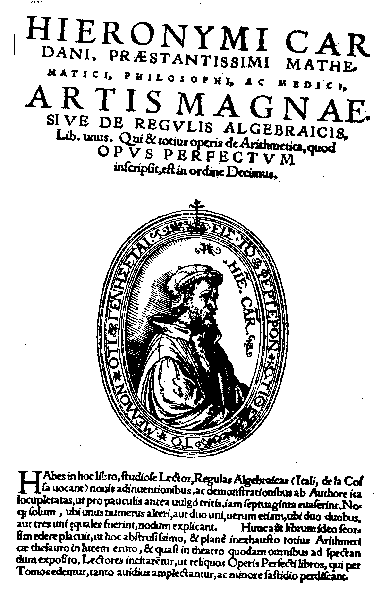
上图来自他的Ars Magna Ⓣ(伟大的艺术)第一版的标题页。
Girolamo or Hieronimo Cardano's name was Hieronymus Cardanus in Latin and he is sometimes known by the English version of his name Jerome Cardan.
Girolamo Cardano was the illegitimate child of Fazio Cardano and Chiara Micheria. His father was a lawyer in Milan but his expertise in mathematics was such that he was consulted by Leonardo da Vinci on questions of geometry. In addition to his law practice, Fazio lectured on geometry, both at the University of Pavia and, for a longer spell, at the Piatti foundation in Milan. When he was in his fifties, Fazio met Chiara Micheria, who was a young widow in her thirties, struggling to raise three children.
Chiara became pregnant but, before she was due to give birth, the plague hit Milan and she was persuaded to leave the city for the relative safety of nearby Pavia to stay with wealthy friends of Fazio. Thus Cardan was born in Pavia but his mother's joy was short lived when she received news that her first three children had died of the plague in Milan. Chiara lived apart from Fazio for many years but, later in life, they did marry.
Cardan at first became his father's assistant but he was a sickly child and Fazio had to get help from two nephews when the work became too much for Cardan. However, Cardan began to wish for greater things than an assistant to his father. Fazio had taught his son mathematics and Cardan began to think of an academic career. After an argument, Fazio allowed Cardan to go university and he entered Pavia University, where his father had studied, to read medicine despite his father's wish that he should study law.
When war broke out, the university was forced to close and Cardan moved to the University of Padua to complete his studies. Shortly after this move, his father died but by this time Cardan was in the middle of a campaign to become rector of the university. He was a brilliant student but, outspoken and highly critical, Cardan was not well liked [4]:-
This I recognise as unique and outstanding amongst my faults - the habit, which I persist in, of preferring to say above all things what I know to be displeasing to the ears of my hearers. I am aware of this, yet I keep it up wilfully, in no way ignorant of how many enemies it makes for me.
However, his campaign for rector was successful since he beat his rival by a single vote.
Cardan squandered the small bequest from his father and turned to gambling to boost his finances. Card games, dice and chess were the methods he used to make a living. Cardan's understanding of probability meant he had an advantage over his opponents and, in general, he won more than he lost. He had to keep dubious company for his gambling. Once, when he thought he was being cheated at cards, Cardan, who always carried a knife, slashed the face of his opponent. Gambling became an addiction that was to last many years and rob Cardan of valuable time, money and reputation.
Cardan was awarded his doctorate in medicine in 1525 and applied to join the College of Physicians in Milan, where his mother still lived. The College did not wish to admit him for, despite the respect he had gained as an exceptional student, he had a reputation as a difficult man, whose unconventional, uncompromising opinions were aggressively put forward with little tact or thought for the consequences. The discovery of Cardan's illegitimate birth gave the College a reason to reject his application.
Cardan, on the advice of a friend, went to Sacco, a small village 15km from Padua. He set up a small, and not very successful, medical practice. In late 1531 Cardan married Lucia, the daughter of a neighbour Aldobello Bandarini, a captain of the local militia. Cardan's practice in Sacco did not provide enough income for him to support a wife so, in April 1532, he moved to Gallarate, near Milan. He applied again to the College of Physicians in Milan but again was not allowed membership. Unable to practise medicine, Cardan reverted, in 1533, to gambling to pay his way, but things went so badly that he was forced to pawn his wife's jewellery and even some of his furniture. Desperately seeking a change of fortune, the Cardans moved to Milan, but here they fared even worse and they had to ignominiously enter the poorhouse.
Cardan was fortunate to obtain Fazio's former post of lecturer in mathematics at the Piatti Foundation in Milan which gave him plenty of free time and he used some of this to treat a few patients, despite not being a member of the College of Physicians. Cardan achieved some near miraculous cures and his growing reputation as a doctor led to his being consulted by members of the College. His grateful patients and their relatives became whole hearted supporters and in this way, Cardan was able to build up a base of influential backers.
Cardan was still furious at his continuing exclusion from the College and, in 1536, he rashly published a book attacking not only the College's medical ability but their character [4]:-
The things which give most reputation to a physician nowadays are his manners, servants, carriage, clothes, smartness and caginess, all displayed in a sort of artificial and insipid way...
This was not the way to gain entry to the College and not surprisingly Cardan's application to join in 1537 was again rejected. However, two years later, after much pressure from his admirers, the College modified the clause regarding legitimate birth and admitted Cardan. In the same year, Cardan's first two mathematical books were published, the second The Practice of Arithmetic and Simple Mensuration was a sign of greater things to come. This was the beginning of Cardan's prolific literary career writing on a diversity of topics medicine, philosophy, astronomy and theology in addition to mathematics.
In 1539 Cardan approached Tartaglia, who had achieved fame in winning a contest on solving cubics, and tried to get him to divulge the method. Tartaglia eventually agreed after getting Cardan to swear an oath that he would not publish the method until Tartaglia had himself published it. Tartaglia's account of the oath sworn by Cardan was:-
I swear to you, by God's holy Gospels, and as a true man of honour, not only never to publish your discoveries, if you teach me them, but I also promise you, and I pledge my faith as a true Christian, to note them down in code, so that after my death no one will be able to understand them.
There followed a period of intense mathematical study by Cardan who worked on solving cubic and quartic equations by radical over the next six years.
One of the first problems that Cardan hit was that the formula sometimes involved square roots of negative numbers even though the answer was a 'proper' number. On 4 August 1539 Cardan wrote to Tartaglia:-
I have sent to enquire after the solution to various problems for which you have given me no answer, one of which concerns the cube equal to an unknown plus a number. I have certainly grasped this rule, but when the cube of one-third of the coefficient of the unknown is greater in value than the square of one-half of the number, then, it appears, I cannot make it fit into the equation.
Indeed Cardan gives precisely the conditions here for the formula to involve square roots of negative numbers. Tartaglia by this time greatly regretted telling Cardan the method and tried to confuse him with his reply (although in fact Tartaglia, like Cardan, would not have understood the complex numbers now entering into mathematics):-
... and thus I say in reply that you have not mastered the true way of solving problems of this kind, and indeed I would say that your methods are totally false.
We give details of the dispute with Tartaglia in the article Tartaglia v Cardan where the events are recounted in the mathematicians own words.
In 1540 Cardan resigned his mathematics post at the Piatti Foundation, the vacancy being filled by Cardan's assistant Ferrari who had brilliantly solved quartic equations by radicals. From 1540 to 1542 Cardan abandoned his studies and did nothing but gamble; playing chess all day. During the years 1543-1552, Cardan lectured on medicine at the universities of Milan and Pavia, as war frequently forced the closure of the university in Pavia.
In 1545 Cardan published his greatest mathematical work Artis magnae sive de regulis algebraicis liber unus Ⓣ or Ars Magna Ⓣ. In it he gave the methods of solution of the cubic and quartic equation. In fact he had discovered in 1543 that Tartaglia was not the first to solve the cubic equation by radicals and therefore felt that he could publish despite his oath. Ferrari wrote in April 1547:-
Four years ago when Cardano was going to Florence and I accompanied him, we saw at Bologna Hannibal Della Nave, a clever and humane man who showed us a little book in the hand of Scipione del Ferro, his father-in-law, written a long time ago, in which that discovery was elegantly and learnedly presented.
It is to Cardan's credit that, although one could not expect him to understand complex numbers, he does present the first calculation with complex numbers in Ars Magna Ⓣ. Solving a particular cubic equation, he writes:-
Dismissing mental tortures, and multiplying 5 + √-15 by 5 - √-15, we obtain 25 - (-15). Therefore the product is 40. .... and thus far does arithmetical subtlety go, of which this, the extreme, is, as I have said, so subtle that it is useless.
Cardan's wife Lucia died in 1546, but Cardan seemed not greatly saddened, being more interested in the fame he had achieved from his books which were amongst the best sellers of the day. He became rector of the College of Physicians and gained the reputation of being the greatest physician in the world. Cardan received many offers from the heads of state in Europe, anxious to receive the best medical attention, but only once was the incentive great enough to tempt him from Italy.
John Hamilton, Archbishop of St Andrews, had suffered from asthma for ten years but gradually the frequency and severity of the attacks had grown worse. The court physicians of both the French king and German emperor did their best but ultimately failed and the Archbishop of St Andrews was near death. He turned in desperation to Cardan, promising him a huge sum if he would come to Scotland. Cardan was not lecturing when he received the plea and so accepted the offer, setting out from Milan on 23 February 1552.
Cardan was at the height of his fame and, as a consequence, his journey to Scotland was remarkable in that everywhere he went scientific communities treated him as a celebrity and the world's leading scientist. He arrived in Edinburgh on 29 June and saw the Archbishop immediately. By the time Cardan left on the 13 September, the Archbishop was already recovering. Cardan accepted over two thousand gold crowns but turned down the offer of a permanent place at the Scottish court. Within two years the archbishop let Cardan know that he had made a complete recovery.
On his return, Cardan was appointed professor of medicine at Pavia University and, with many wealthy patients, he was a rich and successful man. But as Cardan was at the height of his fame, he received what he called his "crowning misfortune". Cardan's eldest son, Giambatista, had qualified as a doctor in 1557 but he secretly married Brandonia di Seroni, a girl whom Cardan described as [4]:-
a worthless, shameless woman.
Cardan continued to support his son financially and the young couple moved in with Brandonia's parents. However, the di Seronis were only interested in what they could extort from Giambatista and his wealthy father, whilst Brandonia publicly mocked her husband for not being the father of their three children.
These taunts drove Giambatista to poison his wife and, following his arrest, he confessed to the crime. Cardan recruited the best lawyers but at the trial the judge decreed that to save his son's life, Cardan must come to terms with the di Seronis. They demanded a sum which Cardan could never have found. Giambatista was tortured in jail, his left hand was cut off and, on 13 April 1560, he was executed.
This was a blow from which Cardan never recovered. He could not forgive himself for failing to avert the disaster and the terrible sufferings of his favourite son haunted him constantly. As the father of a convicted murderer, Cardan became a hated man. Realising he had to move, Cardan applied for a professorship of medicine at Bologna and was appointed to the post. Cardan's time in Bologna was full of controversy. His reputation, in addition to his arrogant manner, ensured he created many enemies. He humiliated a fellow medical professor in front of his students by pointing out errors in his lectures. After a few years Cardan's colleagues tried to get the Senate to dismiss him, by spreading rumours that his lectures were practically unattended.
Cardan had further problems with his children. His remaining son Aldo was a gambler and associated with individuals of dubious character. Cardan writes, in his autobiography, of his four greatest sadnesses in his life [4]:-
The first was my marriage; the second, the bitter death of my son; the third, imprisonment ; the fourth, the base character of my youngest son.
In 1569 Aldo gambled away all of his own clothes and possessions in addition to a considerable sum of his father's money. In an attempt to get money Aldo broke into his father's house and stole a large amount of cash and jewellery. Cardan sadly reported Aldo to the authorities, and Aldo was banished from Bologna.
In 1570 Cardan was put in jail on the charge of heresy. He had cast the horoscope of Jesus Christ and written a book in praise of Nero, tormentor of the martyrs. These may have been a deliberate attempt on Cardan's part to gain notoriety - he wrote a whole chapter in his autobiography on wishing to "perpetrate his name" - and thus gain a place in history. It is strange for in all other respects Cardan gave the church his full support. However the inquisition was looking to make examples of prominent men whose commitment could be questioned and Cardan fitted the bill nicely.
Cardan was treated leniently, perhaps because public opinion was that he had been treated harshly and so he was only imprisoned for a few months. On his release, he was forbidden to hold a university post and barred from further publication of his work.
On his release Cardan went to Rome, where he received an unexpectedly warm reception. He was granted immediate membership of the College of Physicians and the Pope, who had now apparently forgiven Cardan, granted him a pension. It was in this period that his autobiography [4] was written, although it was not published. It was published in Paris in 1643 and Amsterdam in 1654. Italian translations were published in Milan (1821 and 1922) and Turin (1945). A German translation appeared in Jena in 1914, and a French translation in Paris in 1936. The reference [4] is the English translation of the autobiography.
Cardan is reported to have correctly predicted the exact date of his own death but it has been claimed that he achieved this by committing suicide. Despite being reconciled with Aldo, Cardan wrote in his will that he:-
... had shown himself a youth of such evil habits that I should prefer to have all I own pass to my grandson by my eldest son.
Cardan had adopted his grandson on the death of both parents.
In addition to Cardan's major contributions to algebra he also made important contributions to probability, hydrodynamics, mechanics and geology. His book Liber de Ludo Aleae Ⓣ was published in 1663 but the book on games of chance was probably completed by 1563. Cardan makes the first ever foray into the, until then untouched, realm of probability theory. It is the first study of things such as dice rolling, based on the premise that there are fundamental scientific principles governing the likelihood of achieving the elusive 'double six', outside of mere luck or chance.
Cardan is also credied with the invention of the Cardan joint a type of universal joint in a shaft that enables it to rotate when out of alignment.
Cardan also published two encyclopaedias of natural science. Giliozzi [1] says that they:-
... contain a little of everything, from cosmology to the construction of machines, from the usefulness of natural sciences to the evil influence of demons, from the laws of mechanics to cryptology. It is a mine of facts, both real and imaginary, of notes on the state of sciences, of superstition, technology, alchemy and various branches of the occult.
The picture above is from the title page of the first edition of his Ars Magna Ⓣ.
正文里的方括号编号指向这里,悬停即可直接看到条目。书目保留原文——译了书名反而查不到文献。
原站列出的延伸阅读与外部数据库,照原样保留,目标多为英文页面。
关于吉罗拉莫·卡尔达诺的其它页面:
原站的交叉引用。指向本站已镜像专题的留在站内,其余仍指回原站。