数学家传记
博纳文图拉·卡瓦列里是一位意大利数学家,他发展了一种不可分方法,该方法成为积分微积分发展的一个因素。
博纳文图拉·卡瓦列里出生时被命名为Francesco。他的父亲名叫卡瓦列里,但当Francesco于1615年在米兰加入耶稣会士修会时,他取了卡瓦列里这个名字。他一直以这个名字为人所知。他加入的耶稣会士修会由锡耶纳的Giovanni Colombini和他的朋友Francesco Miani于1360年创立。最初,耶稣会士照顾那些感染黑死病的人,但随着时间的推移,该修会招募的人越来越少。1606年,曾试图鼓励更多年轻人加入。尽管他们在招募方面取得了一些成功,特别是卡瓦列里加入了,但该修会最终还是失败了,并于1668年被教皇克莱门特九世解散。该修会之所以被命名为耶稣会士,是因为他们的布道总是以高喊“耶稣”的名字开始和结束。作为耶稣会士,卡瓦列里总是穿着凉鞋并每天鞭打自己。
在米兰待了一年后,他于1616年转入比萨的耶稣会士修道院,即圣吉罗拉莫修道院,除了大约1617年在佛罗伦萨度过的一年外,他一直待到1620年。在比萨,卡瓦列里由贝内代托·卡斯泰利教授数学,贝内代托·卡斯泰利是比萨大学的数学讲师。贝内代托·卡斯泰利于1611年被任命到比萨,并享有优秀教师的声誉,学生从许多不同地区前来向他学习。贝内代托·卡斯泰利是本笃会士,但由于比萨没有本笃会修道院,贝内代托·卡斯泰利住在当地的耶稣会士修道院。他教卡瓦列里几何学,并向他介绍了伽利略的思想。卡瓦列里对数学的兴趣是由欧几里得的Elements激发的,在遇到伽利略后,他自认为是这位天文学家的弟子。与伽利略的会面是由费德里科·博罗梅奥枢机安排的,他曾与贝内代托·卡斯泰利通信。这位枢机本人在卡瓦列里还在米兰修道院时[12]就清楚地看到了他的天才:-
这导致在1619年至1641年期间,卡瓦列里给伽利略写了100多封信。伽利略没有回复所有信件,但偶尔给卡瓦列里寄一封信;这些信件中除极少数外都已消失。
卡瓦列里表现出如此大的潜力,以至于他有时会接替贝内代托·卡斯泰利在大学里的讲座。乌尔巴诺·迪维索是卡瓦列里的学生和第一位传记作者,在卡瓦列里去世约30年后写作,他声称贝内代托·卡斯泰利告诉卡瓦列里学习数学,因为那能治愈他的抑郁症。然而,这一说法没有其他证据,而且迪维索关于卡瓦列里生平的记述中,某些可核查的说法肯定是不正确的。
1619年,卡瓦列里申请博洛尼亚的数学讲席,该职位因乔凡尼·安东尼奥·马吉尼去世而空缺,但未能成功,因为他被认为太年轻,不适合这一资深职位。当贝内代托·卡斯泰利于1626年前往罗马时,他也未能获得包括罗马和比萨在内的其他几所大学的数学讲席。卡瓦列里自己将这些申请失败归因于他属于耶稣会士修会。他觉得该修会在罗马不受欢迎,这当然是事实,但是否确实解释了他申请失败则无法断言。然而,他在神职生涯中确实有所进展。1621年,卡瓦列里成为执事,并在米兰圣吉罗拉莫修道院担任费德里科·博罗梅奥枢机的助手。正是在米兰期间,他开始发展他今天闻名的不可分方法。他在米兰教授神学,直到1623年成为洛迪圣伯多禄修院的院长。在洛迪三年后,他前往帕尔马的耶稣会士修道院,担任院长[1]:-
1626年秋,在从帕尔马前往米兰的旅途中,他痛风发作,这种病自幼便折磨着他,并将困扰他终生。这场病使他在米兰滞留了数月。
他在1626年至1629年这三年间待在帕尔马。1627年12月16日,他写信给伽利略和费德里科·博罗梅奥枢机,告诉他们他已经完成了他的书Geometria。这本书包含了不可分方法,该方法成为积分微积分发展的一个因素。1629年,卡瓦列里被任命为博洛尼亚的数学讲席。他的申请得到了伽利略的支持,后者[1]:-
……在1629年写信给切萨雷·马尔西利,一位博洛尼亚绅士和Accademia dei Lincei成员,后者受命寻找一位新的数学讲师。在信中,伽利略谈到卡瓦列里时说:“自阿基米德以来,很少有人——如果有的话——像他那样深入而深刻地探究几何学。”为支持自己对博洛尼亚职位的申请,卡瓦列里将自己的几何学手稿和一篇关于conic sections及其在光学中应用的小论文寄给了马尔西利。正如马尔西利写信告诉他的那样,伽利略的推荐促使“军团绅士们”将第一个数学讲席托付给卡瓦列里,后者从1629年起一直担任该讲席直至去世。
博洛尼亚的数学讲席并非他获得的唯一职位,因为他同时被任命为博洛尼亚耶稣会修道院的院长,该修道院附属于圣玛丽亚·德拉·马斯卡雷拉教堂。这对卡瓦列里来说是一个理想的环境,他现在可以在耶稣会修道院中安心从事数学研究,同时在大学里教授数学,从而与其他数学家保持联系。在博洛尼亚的十八年间,他出版了十一本书。然而,在他被任命到博洛尼亚前后,他的健康状况开始恶化,腿部问题一直困扰着他余生。事实上,卡瓦列里被任命到博洛尼亚最初只是一个为期三年的试用期,但正如我们下面将要说明的,这一期限被延长了。
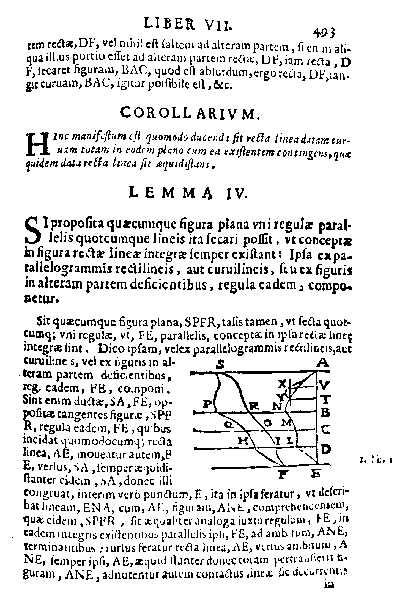
卡瓦列里的几何学手稿曾是他被任命到博洛尼亚的一个因素,尽管该手稿于1627年12月完成,但直到1635年才出版。他在1635年的Geometria indivisibilibus continuorum nova quadam ratione promota中提出的不可分理论,是对阿基米德的穷竭法的发展,其中融入了约翰内斯·开普勒的无穷小几何量理论。这一理论使卡瓦列里能够简单而迅速地求出各种几何图形的面积和体积。Howard Eves写道[26]:-
卡瓦列里关于不可分方法的论著冗长且写得不够清晰,从中不易确切了解卡瓦列里所说的“不可分”是什么意思。看来,一个给定平面图形的不可分是该图形的一条弦,而一个平面图形可以被看作由无穷多条这样的平行不可分组成。类似地,一个给定立体的不可分似乎是该立体的一个平面截面,而一个立体可以被看作由无穷多个这种类型的平行不可分组成。现在,卡瓦列里论证说,如果我们把某个平面图形的一组平行不可分中的每一个沿其自身的轴滑动,使得这些不可分的端点仍然描出一条连续的边界,那么这样形成的新平面图形的面积与原平面图形的面积相同,因为这两个图形由相同的不可分组成。对给定立体的一组平行不可分中的元素进行类似的滑动,将得到另一个与原立体体积相同的立体。(这最后一个结果可以通过取一叠竖直的卡片,然后把叠的侧面推成曲面来生动地说明;被弄乱的叠的体积与原叠的体积相同。)这些结果给出了所谓的卡瓦列里原理:
1. 如果两个平面图形被夹在一对平行线之间,并且如果它们在任何平行于这对夹线的直线上所截出的两条线段的长度总是相等,那么这两个平面图形的面积也相等。
2. 如果两个立体被夹在一对平行平面之间,并且如果它们在任何平行于这对夹面的平面上所截出的两个截面的面积总是相等,那么这两个立体的体积也相等。
不可分方法没有被建立在严格的基础上,他的书受到广泛攻击。特别是,保罗·古尔丁攻击了卡瓦列里 [8]:-
卡瓦列里与保罗·古尔丁之间的争论通常与保罗·古尔丁对卡瓦列里使用不可分提出的反对意见联系在一起被提及。尽管那可能是卡瓦列里与保罗·古尔丁之间的主要问题,但更仔细地阅读这场争论将使我们能够指出其他有趣问题的存在……
争论实际上围绕这样一个事实:保罗·古尔丁是一位遵循古希腊数学家方法的古典几何学家。然而,他的第一点是指责卡瓦列里剽窃了约翰内斯·开普勒的Stereometria Doliorum(1615)和Sover的Curvi ac Recti Proportio(1630)。他的论证中有些内容与约翰内斯·开普勒有关,因为在那部著作中约翰内斯·开普勒确实把圆看作由无穷小组成的无穷多边形。然而,卡瓦列里的不可分不同于约翰内斯·开普勒的无穷小。至于提到Sover,卡瓦列里在辩护中指出,他写自己的书是在Sover的书出版之前。保罗·古尔丁攻击卡瓦列里的不可分,论证说当一条曲面由一条直线绕轴旋转生成时,该曲面不仅仅是一组直线。他写道(见[8]):-
在我看来,没有几何学家会同意卡瓦列里,认为该曲面是、并且可以用几何语言称为“这样一个图形的所有直线”;事实上,若干条直线,或所有直线,永远不能被称为曲面;因为直线的数量,无论可能多么大,甚至不能构成最小的曲面。
正如Mancosu所写[8]:-
保罗·古尔丁是一位“古典主义”几何学家,深谙明确构造的思想,对几何学领域中的无穷概念持怀疑态度,并警惕最终陷入连续统的原子论理论的风险。
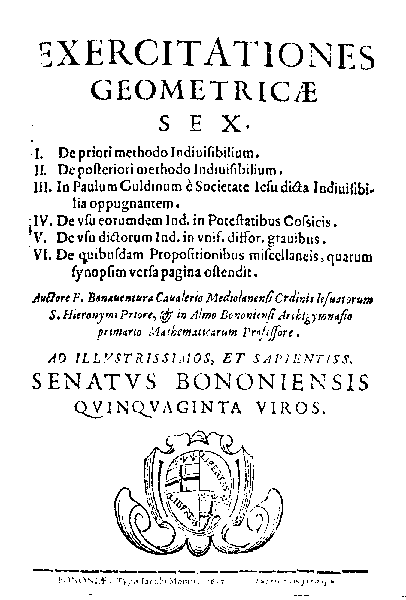
如果问保罗·古尔丁还是卡瓦列里是对的,那么答案必定是卡瓦列里。然而,保罗·古尔丁攻击的一个积极方面是,卡瓦列里改进其论述,出版了Exercitationes geometricae sex(1647),该书成为17世纪数学家的主要资料来源。
卡瓦列里还主要通过其著作Directorium Generale Uranometricum,在意大利引入对数作为计算工具方面发挥了重要作用。我们上文提到,他被任命到博洛尼亚最初是为期3年。这本对数著作由卡瓦列里出版,作为他成功申请延长职位的一部分。他出版的 logarithm 表包括供天文学家使用的三角函数对数[31]:-
该著作分为三部分,分别致力于对数、平面三角学和球面三角学。除了术语上的值得注意的创新外,该著作还包括对约翰·纳皮尔球面三角形规则的重要论证,以及每个球面三角形求积定理,该定理归于阿尔伯特‧吉拉德,后来被约瑟夫·拉格朗日声称拥有。
伽利略赞扬卡瓦列里在对数方面的工作,特别是他撰写的题为A hundred varied problems to illustrate the use of logarithms(1639)的著作。
卡瓦列里还撰写了关于圆锥曲线、三角学、光学、天文学和占星术的著作。他提出了透镜焦距的一般规则,并描述了一种反射望远镜。他还研究了许多运动问题。Piero Ariotti写道,关于反射望远镜[13]:-
……卡瓦列里值得关注的著作是他的《Specchio ustorio》,1632年印刷,1650年再版。在这部著作中,卡瓦列里专注于反射镜,明确目的是解决长期以来的争论,即阿基米德据称如何烧毁了公元前212年围攻锡拉库萨的罗马舰队。然而,这本书远远超出了所述目的,系统地论述了圆锥曲线的性质、光、声、热(和冷!)的反射、运动学和动力学问题,以及反射望远镜的想法。
卡瓦列里声称将凹面镜与凹透镜组合可获得望远镜,这使一些历史学家声称卡瓦列里在詹姆斯·格雷果里或艾萨克·牛顿之前发明了反射望远镜。
他甚至出版了一些关于占星术的书籍,其中一本于1639年出版,题为Nuova pratica astromlogica,另一本是他最后一部作品,于1646年出版的Trattato della ruota planetaria perpetua。然而,尽管这些书使用了占星术的术语,但它们是严肃的天文学著作。卡瓦列里不相信人们可以从占星术的考虑中预测未来,当然也不实践占星术。他在1639年的著作中清楚地表明了这一点。
卡瓦列里与许多数学家通信,包括伽利略、马兰·梅森、Renieri、Rocca、埃万杰利斯塔·托里拆利和温琴佐·维维亚尼。埃万杰利斯塔·托里拆利对卡瓦列里的方法充满赞誉,写道(见[1]):-
我不敢断言这种不可分几何实际上是一项新发现。我更愿意相信,古代几何学家利用这种方法来发现更困难的定理,尽管在证明中他们可能更喜欢另一种方式,要么是为了隐藏他们艺术的秘密,要么是为了不给怀有恶意的诋毁者提供批评的机会。无论如何,可以肯定的是,这种几何在证明中代表了惊人的省力,并通过简短、直接和肯定的证明建立了无数几乎不可理解的定理,这是古代学说所无法做到的。不可分几何确实在数学的荆棘丛中是一条所谓的皇家大道,而卡瓦列里首先开辟并铺设给公众,作为一种奇妙发明的装置。
事实上,埃万杰利斯塔·托里拆利继续发展了卡瓦列里在Arithmetica infinitorum(1655)中引入的思想。也许卡瓦列里最著名的学生是斯特凡诺‧德力‧安杰利。他在博洛尼亚跟随卡瓦列里学习,当时卡瓦列里已相当年老并患有关节炎。斯特凡诺‧德力‧安杰利写了卡瓦列里在学习期间寄给他的数学家同行的许多信件。
我们提到了卡瓦列里大约从1629年开始的腿部问题,以及他长期患有痛风的问题。1636年,他痛风严重,为了寻求治疗,去了Arcetri的疗养院,在那里度过了夏天。当时伽利略正被软禁在Arcetri,卡瓦列里整个夏天都在与他讨论数学。回到博洛尼亚后,卡瓦列里的生活变得越来越困难。他的健康没有改善,大学当局催促他研究天文学而不是数学,而数学是卡瓦列里所热爱的主题。当比萨大学提供数学讲席时,他有机会离开博洛尼亚,但他拒绝了。红衣主教Federico Borromeo为他提供了米兰Biblioteca Ambrosiana的职位,但卡瓦列里再次选择留在博洛尼亚。到1646年,他的健康状况变得如此糟糕,以至于他被迫放弃教学。到第二年去世时,他已完全瘫痪,无法行走。他被安葬在博洛尼亚的Santa Maria della Mascarella教堂。
Bonaventura Cavalieri was given the name Francesco when he was born. His father's name was Bonaventura Cavalieri but when Francesco joined the religious order of the Jesuati in Milan in 1615 he took the name Bonaventura. He is always known by that name. The religious order of the Jesuati, which he joined, was founded by Giovanni Colombini of Siena and his friend Francesco Miani in 1360. Originally the Jesuati cared for those afflicted with the Black Death, but the order recruited fewer as time went on. In 1606 an attempt was made to encourage more young men to join. Although they had some success in recruiting, and in particular Cavalieri joined, nevertheless the order eventually failed and was dissolved by pope Clement IX in 1668. The order was named Jesuati because their sermons always began and ended with the name of 'Jesus' being shouted out. As a Jesuati, Cavalieri would have always worn sandals and flagellated himself daily.
After a year in Milan, in 1616 he transferred to the Jesuati monastery in Pisa, the San Girolamo monastery, where, except for one year spent in Florence in around 1617, he remained until 1620. In Pisa, Cavalieri was taught mathematics by Benedetto Antonio Castelli, a lecturer in mathematics at the University of Pisa. Castelli had been appointed to Pisa in 1611 and had a reputation as a fine teacher, students coming from many different regions to study with him. Castelli was a Benedictine but, as there was no Benedictine monastery in Pisa, Castelli lived in the Jesuati monastery there. He taught Cavalieri geometry and introduced him to the ideas of Galileo. Cavalieri's interest in mathematics had been stimulated by Euclid's Elements and, after meeting Galileo, he considered himself a disciple of the astronomer. The meeting with Galileo was set up by Cardinal Federico Borromeo, who had corresponded with Castelli. The Cardinal himself saw clearly the genius in Cavalieri while he was at the monastery in Milan [12]:-
This resulted in more than 100 letters from Cavalieri to Galileo in the period 1619-1641. Galileo did not answer all of them, but sent an occasional letter to Cavalieri; of these all but a very few have disappeared.
Cavalieri showed such promise that he sometimes took over Castelli's lectures at the university. Urbano Diviso, Cavalieri's pupil and first biographer writing about 30 years after Cavalieri's death, claimed that Castelli told Cavalieri to study of mathematics since that would cure him of depression. However, there is no other evidence for this claim and certainly some checkable claims in Diviso's account of Cavalieri's life are incorrect.
In 1619 Cavalieri applied for the chair of mathematics in Bologna, which had become vacant following the death of Giovanni Antonio Magini, but was not successful since he was considered too young for a position of this seniority. He also failed to get the chair of mathematics at several other universities including Rome and Pisa when Castelli left for Rome in 1626. Cavalieri himself blamed the fact that he was in the Jesuati order as the reason for his lack of success in these applications. He felt that the order was not popular in Rome, which was certainly true, but whether this did indeed explain his failed applications it is impossible to say. He did progress in his clerical career, however. In 1621 Cavalieri became a deacon and assistant to Cardinal Federico Borromeo at the monastery of San Girolamo in Milan. It was during his time in Milan that he began to develop his method of indivisibles for which he is famed today. He taught theology in Milan until 1623 when he became prior of St Peter's at Lodi. After three years at Lodi he went to the Jesuati monastery in Parma where he was the prior [1]:-
In the autumn of 1626, during a trip from Parma to Milan, he fell ill with the gout, from which he had suffered since childhood and which was to plague him to the end of his life. This illness kept him at Milan for a number of months.
He spend the three years 1626-1629 at Parma. On 16 December 1627 he wrote to Galileo and to Cardinal Federico Borromeo telling them that he had completed his book Geometria. This contains the method of indivisibles which became a factor in the development of the integral calculus. In 1629 Cavalieri was appointed to the chair of mathematics at Bologna. His application had been supported by Galileo who [1]:-
... in 1629, wrote to Cesare Marsili, a gentleman of Bologna and member of the Accademia dei Lincei, who had been commissioned to find a new lecturer in mathematics. In his letter, Galileo said of Cavalieri, "few, if any, since Archimedes, have delved as far and as deep into the science of geometry." In support of his application to the Bologna position, Cavalieri sent Marsili his geometry manuscript and a small treatise on conic sections and their applications in optics. Galileo's testimonial, as Marsili wrote him, induced the "Gentlemen of the Regiment" to entrust the first chair in mathematics to Cavalieri, who held it continuously from 1629 to his death.
The chair of mathematics at Bologna was not the only position he received for he was also appointed prior of the Jesuati convent in Bologna attached to the Church of Santa Maria della Mascarella. This was an ideal situation for Cavalieri who now had the peace to undertake mathematics research at the Jesuati convent while teaching mathematics at the university where he could have contacts with other mathematicians. He published eleven books during his eighteen years in Bologna. However, his health deteriorated around the time of his appointment to Bologna, and he suffered from problems with his legs which persisted throughout the rest of his life. In fact Cavalieri's appointment to Bologna had, in the first instance, been for a 3-year trial period but, as we explain below, it was extended.
Cavalieri's geometry manuscript which had been a factor in his appointment to Bologna, although completed in December 1627, was not published until 1635. The theory of indivisibles, presented in his Geometria indivisibilibus continuorum nova quadam ratione promota of 1635, was a development of Archimedes' method of exhaustion incorporating Kepler's theory of infinitesimally small geometric quantities. This theory allowed Cavalieri to find simply and rapidly the area and volume of various geometric figures. Howard Eves writes [26]:-
Cavalieri's treatise on the method of indivisibles is voluble and not clearly written, and it is not easy to learn from it precisely what Cavalieri meant by an "indivisible." It seems that an indivisible of a given planar piece is a chord of the piece, and a planar piece can be considered as made up of an infinite parallel set of such indivisibles. Similarly, it seems that an indivisible of a given solid is a planar section of that solid, and a solid can be considered as made up of an infinite parallel set of this kind of indivisible. Now, Cavalieri argued, if we slide each member of a parallel set of indivisibles of some planar piece along its own axis, so that the endpoints of the indivisibles still trace a continuous boundary, then the area of the new planar piece so formed is the same as that of the original planar piece, inasmuch as the two pieces are made up of the same indivisibles. A similar sliding of the members of a parallel set of indivisibles of a given solid will yield another solid having the same volume as the original one. (This last result can be strikingly illustrated by taking a vertical stack of cards and then pushing the sides of the stack into curved surfaces; the volume of the disarranged stack is the same as that of the original stack.) These results give the so-called Cavalieri principles:
1. If two planar pieces are included between a pair of parallel lines, and if the lengths of the two segments cut by them on any line parallel to the including lines are always equal, then the areas of the two planar pieces are also equal.
2. If two solids are included between a pair of parallel planes, and if the areas of the two sections cut by them on any plane parallel to the including planes are always equal, then the volumes of the two solids are also equal.
The method of indivisibles was not put on a rigorous basis and his book was widely attacked. In particular, Paul Guldin attacked Cavalieri [8]:-
The debate between Cavalieri and Guldin is usually mentioned in connection with the objections made by Guldin to Cavalieri's use of indivisibles. Although that is probably the main issue between Cavalieri and Guldin, a more careful reading of the debate will allow us to indicate the existence of other interesting issues ...
The argument really centres around the fact that Guldin was a classical geometer following the methods of the ancient Greek mathematicians. His first point, however, was to accuse Cavalieri of plagiarising Kepler's Stereometria Doliorum (1615) and Sover's Curvi ac Recti Proportio (1630). There is something in his argument relating to Kepler since in that work Kepler does regard a circle as an infinite polygon composed of infinitesimals. However, Cavalieri's indivisibles are different from Kepler's infinitesimals. As to the reference to Sover, Cavalieri, in his defence, pointed out that he wrote his book before Sover's book was published. Guldin attacked Cavalieri's indivisibles by arguing that when a surface is generated by rotating a line about the axis, the surface is not just a set of lines. He writes (see [8]):-
In my opinion no geometer will grant Cavalieri that the surface is, and could, in geometrical language be called "all the lines of such a figure"; never in fact can several lines, or all the lines, be called surfaces; for, the multitude of lines, however great that might be, cannot compose even the smallest surface.
As Mancosu writes [8]:-
Guldin was a "classicist" geometer, steeped in the idea of explicit construction, sceptical of considerations of infinity in the domain of geometry, and wary of the risk of ending up with an atomistic theory of the continuum.
If one asks whether Guldin or Cavalieri is right, then the answer must be Cavalieri. However, a positive side to Guldin's attack was that Cavalieri improved his exposition publishing Exercitationes geometricae sex (1647) which became the main source for 17th Century mathematicians.
Cavalieri was also largely responsible for introducing logarithms as a computational tool in Italy through his book Directorium Generale Uranometricum. We mentioned above that his appointment to Bologna had been initially for a 3-year period. This book of logarithms was published by Cavalieri as part of his successful application to have the position extended. The tables of logarithms which he published included logarithms of trigonometric functions for use by astronomers [31]:-
The work is divided into three parts, devoted to logarithms, plane trigonometry, and spherical trigonometry. In addition to noteworthy innovations in terminology, the work includes important demonstrations of John Napier's rules of the spherical triangle and the theorem of the squaring of each spherical triangle that, attributed to Albert Girard, was later claimed by Joseph Lagrange.
Galileo praised Cavalieri for his work on logarithms, in particular the book he wrote entitled A hundred varied problems to illustrate the use of logarithms (1639).
Cavalieri also wrote on conic sections, trigonometry, optics, astronomy, and astrology. He developed a general rule for the focal length of lenses and described a reflecting telescope. He also worked on a number of problems of motion. Piero Ariotti writes that, regarding the reflecting telescope [13]:-
... Cavalieri's work of interest is his 'Specchio ustorio', printed in 1632 and reprinted in 1650. In this work Cavalieri concerned himself with reflecting mirrors for the express purpose of resolving the age-long dispute of how Archimedes allegedly burned the Roman fleet that was besieging Syracuse in 212 B.C. The book, however, goes well beyond the stated purpose and systematically treats the properties of conic sections, reflection of light, sound, heat (and cold!), kinematic and dynamic problems, and the idea of the reflecting telescope.
Cavalieri's claim that one would obtain a telescope by combining concave mirrors with concave lens have led some historians to claim that Cavalieri invented the reflecting telescope before James Gregory or Isaac Newton.
He even published a number of books on astrology, one in 1639 entitled Nuova pratica astromlogica and another, his last work, Trattato della ruota planetaria perpetua in 1646. However, although these use the terminology of astrology, they are serious astronomical works. Cavalieri did not believe that one could predict the future from astrological considerations, and certainly did not practice astrology. He states this clearly in his 1639 work.
Cavalieri corresponded with many mathematicians including Galileo, Mersenne, Renieri, Rocca, Torricelli and Viviani. Torricelli was full of praise for Cavalieri's methods writing (see [1]):-
I should not dare affirm that this geometry of indivisibles is actually a new discovery. I should rather believe that the ancient geometricians availed themselves of this method in order to discover the more difficult theorems, although in their demonstration they may have preferred another way, either to conceal the secret of their art or to afford no occasion for criticism by invidious detractors. Whatever it was, it is certain that this geometry represents a marvellous economy of labour in the demonstrations and establishes innumerable, almost inscrutable, theorems by means of brief, direct, and affirmative demonstrations, which the doctrine of the ancients was incapable of. The geometry of indivisibles was indeed, in the mathematical briar bush, the so-called royal road, and one that Cavalieri first opened and laid out for the public as a device of marvellous invention.
In fact, Torricelli continued to develop the ideas that Cavalieri introduced in Arithmetica infinitorum (1655). Perhaps Cavalieri's most famous student was Stefano degli Angeli. He studied with Cavalieri at Bologna at a time when Cavalieri was quite old and suffering from arthritis. Angeli wrote many of the letters which Cavalieri sent to his fellow mathematicians during his time of study.
We mentioned Cavalieri's problems with his legs that began around 1629 and also his longstanding problems with gout. In 1636 he was suffering badly from gout and, to seek a cure, went to the health spa in Arcetri where he spent the summer. This was at a time when Galileo was living under house arrest in Arcetri, and Cavalieri spent the summer discussing mathematics with him. Returning to Bologna, life became increasingly difficult for Cavalieri. His health had not improved and he was being pressed by the university authorities to work on astronomy rather than on mathematics, the topic that Cavalieri loved. He had the chance to leave Bologna when he was offered the chair of mathematics at Pisa, but he turned it down. Cardinal Federico Borromeo offered him a position at the Biblioteca Ambrosiana in Milan, but again Cavalieri chose to remain in Bologna. By 1646 his health had become so poor that he was forced to give up teaching. By the time of his death in the following year he was totally crippled and unable to walk. He was buried in the church of Santa Maria della Mascarella in Bologna.
正文里的方括号编号指向这里,悬停即可直接看到条目。书目保留原文——译了书名反而查不到文献。
原站列出的延伸阅读与外部数据库,照原样保留,目标多为英文页面。
关于博纳文图拉·卡瓦列里的其它页面:
原站的交叉引用。指向本站已镜像专题的留在站内,其余仍指回原站。