数学家传记
埃万杰利斯塔·托里拆利是一位意大利科学家,他是第一个制造持续真空并发现气压计原理的人。他还在微积分的发展中取得了一些重要成果。
埃万杰利斯塔·托里拆利的父母是Gaspare 托里拆利和Caterina Angetti。这是一个相当贫穷的家庭,Gaspare是一名纺织工人。托里拆利是父母三个孩子中的长子,有两个弟弟,至少其中一个后来也从事布料工作。值得大大赞扬的是,他的父母看出长子有非凡的才能,但缺乏资源为他提供教育,于是把他送到他的叔叔那里,叔叔是一位Camaldolese修士。Jacopo修士确保托里拆利接受了良好的教育,直到他长大到可以进入一所耶稣会学校。
托里拆利于1624年进入一所耶稣会学院,在那里学习数学和哲学直到1626年。他究竟在哪所学院学习并不完全清楚,大多数历史学家认为他就读于法恩扎的耶稣会学院,而有些人认为他进入了罗马的Collegio Romano。毫无疑问的是,在耶稣会学院学习之后,他当时在罗马。某些事实是清楚的,即托里拆利的父亲在1626年或之前去世,他的母亲搬到了罗马,因为她肯定在1641年去世时住在那里。托里拆利的两个兄弟也搬到了罗马,我们再次确切知道他们在1647年住在那里。最可能的情况似乎是,在Gaspare 托里拆利去世后,Caterina和她的两个小儿子搬到罗马与托里拆利团聚,后者要么已经住在那里,要么即将搬到那个城市。
在耶稣会学院,托里拆利显示出他有杰出的才能,他的叔叔雅各波修士安排他与贝内代托·卡斯泰利学习。卡斯泰利,像雅各波一样是一名卡马尔多利会修士,在罗马的萨皮恩扎大学任教。萨皮恩扎是当时罗马大学所占建筑的名称,它给大学起了名字。没有证据表明托里拆利实际上注册在大学,几乎可以肯定他只是作为私人安排由贝内代托·卡斯泰利教授。除了由卡斯泰利教授数学、力学、水力学和天文学外,托里拆利还成为他的秘书,并从1626年到1632年担任这一职位。这是一种安排,意味着他为贝内代托·卡斯泰利工作,以换取他所接受的学费。很久以后,当贝内代托·卡斯泰利不在罗马时,他接替了贝内代托·卡斯泰利的教学。
仍然存在一封托里拆利于1632年9月11日写给伽利略的信,它为我们提供了关于托里拆利科学进展的非常有用的信息。伽利略曾写信给贝内代托·卡斯泰利,但由于贝内代托·卡斯泰利当时不在罗马,他的秘书托里拆利写信给伽利略解释了这一情况。托里拆利是一个有抱负的年轻人,他非常钦佩伽利略,因此他借此机会向伽利略告知了自己的数学工作。托里拆利首先告诉伽利略,他是一名职业数学家,并且研究过阿波罗尼奥斯、阿基米德和比提尼亚的狄奥多西的经典著作。他还阅读了同时代数学家第谷·布拉赫、约翰内斯·开普勒和Longomontanus所写的几乎所有内容,并且他告诉伽利略,他确信尼古拉·哥白尼的理论,即地球围绕太阳旋转。此外,他仔细研究了伽利略在托里拆利写信前约六个月出版的Dialogue Concerning the Two Chief Systems of the World - Ptolemaic and Copernican。
从他的信中可以看出,托里拆利对天文学着迷,并且是伽利略的坚定支持者。然而,宗教裁判所禁止销售Dialogue,并命令伽利略到罗马出庭。1633年伽利略审判后,托里拆利意识到如果继续对哥白尼理论感兴趣,他将处于危险境地,因此他故意将注意力转移到似乎争议较小的数学领域。在接下来的九年里,他担任Giovanni Ciampoli的秘书,此人是伽利略的朋友,可能还担任过其他一些教授的秘书。我们不知道托里拆利在此期间住在哪里,但由于Ciampoli曾担任翁布里亚和马尔凯地区多个城市的 governor,他很可能在Montalto、Norcia、San Severino和Fabriano居住过一段时间。
到1641年,托里拆利已经完成了大部分工作,这些工作将于1644年以三部分出版为Opera geometrica Ⓣ(几何著作)。我们将在本传记后面给出这项工作的更多细节,但目前我们感兴趣的是三部分中的第二部分De motu gravium Ⓣ(重物的运动)。这基本上延续了伽利略对抛射体抛物线运动的研究,该研究出现在1638年出版的Discourses and mathematical demonstrations concerning the two new sciences中。托里拆利在1641年初肯定在罗马,当时他请贝内代托·卡斯泰利对De motu gravium发表意见。贝内代托·卡斯泰利对此印象深刻,以至于他亲自写信给伽利略,当时伽利略住在佛罗伦萨附近Arcetri的家中,受到宗教裁判所官员的监视。1641年4月,贝内代托·卡斯泰利从罗马前往威尼斯,途中在Arcetri停留,将托里拆利的手稿副本交给伽利略,并建议他雇用托里拆利作为助手。
当贝内代托·卡斯泰利外出旅行时,托里拆利留在罗马并代替他讲课。尽管伽利略渴望得到托里拆利的帮助,但此事发生之前有所延迟。一方面,贝内代托·卡斯泰利有一段时间没有返回罗马,而托里拆利母亲的去世进一步推迟了他的离开。1641年10月10日,托里拆利到达了伽利略在Arcetri的家中。他与伽利略以及已经在协助伽利略的温琴佐·维维亚尼一起住在那里。然而,他与伽利略只相处了几个月,这位著名科学家就于1642年1月去世了。在伽利略去世后,托里拆利推迟了返回罗马的时间,随后被任命接替伽利略担任托斯卡纳大公费迪南多二世的宫廷数学家。他没有获得伽利略也曾拥有的宫廷哲学家头衔。他担任这一职位直到去世,住在佛罗伦萨的公爵宫殿中。
在考察托里拆利的成就时,我们首先应该把他的数学工作放在背景中来看。卡斯泰利的另一位学生博纳文图拉·卡瓦列里在博洛尼亚担任数学讲席。博纳文图拉·卡瓦列里在1635年出版的Geometria indivisibilis continuorum nova中提出了他的不可分理论。该方法是对阿基米德的穷竭法的发展,结合了约翰内斯·开普勒关于infinitesimally小几何量的理论。这一理论使博纳文图拉·卡瓦列里能够以简单而迅速的方式求出各种几何图形的面积和体积。托里拆利研究了博纳文图拉·卡瓦列里提出的方法,起初对这些方法持怀疑态度。然而,他很快就确信这些强大的方法是正确的,并开始自己进一步发展它们。事实上,他结合了新方法和旧方法,用不可分法来发现他的结果,但常常给出这些结果的经典几何证明。他这样做并不是因为他怀疑不可分法的正确性,而是因为他想给出一个证明:-
……按照古代几何学家的通常方法……
这样,不熟悉新方法的读者仍然会确信他的结果的正确性。
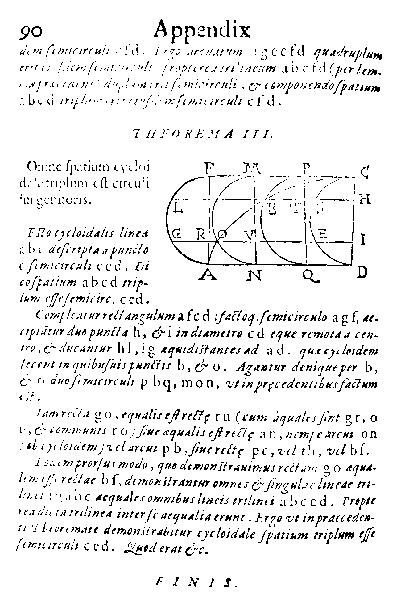
到1641年,他已经用这些方法证明了一些令人印象深刻的结果,这些方法他将在三年后发表。他考察了通过将正多边形绕对称轴旋转而得到的三维图形。托里拆利还计算了摆线的面积和重心。然而,他最引人注目的结果来自于他将博纳文图拉·卡瓦列里的不可分法扩展到涵盖曲线不可分。有了这些工具,他能够证明,将轴与曲线上一个固定点之间的矩形双曲线的无限区域旋转,当绕轴旋转时,会得到一个有限的体积。请注意,我们用坐标几何的现代记号陈述了这个结果,而托里拆利完全无法使用这种记号。这最后一个结果,在[1]中被描述为:-
……当时数学文献中的一颗明珠……
在[23]中对此进行了详细讨论,其中指出,在1644年发表后,该结果立即引起了极大的兴趣和赞赏,因为它完全违背了当时数学家的直觉。
我们提到了托里拆利关于摆线的结果,这些结果导致了他与罗贝瓦尔之间的争论。文章[19]讨论了:-
……一封日期为1643年10月的信,托里拆利通过这封信与罗贝瓦尔取得联系,并向他报告了他关于抛物线的重心、半广义抛物线、摆线的表面及其历史、由圆锥曲线生成的旋转体以及双曲锐角体的观点和结果。
我们还应该注意到托里拆利做出的另一项出色贡献是解决了一个由皮埃尔·德·费马提出的问题,他确定了三角形平面内的一点,使得该点到顶点的距离之和最小(称为三角形的isogonic centre)。这一贡献在[20]中有详细描述,并在该论文中总结如下:-
大约在1640年,托里拆利为一个问题设计了几何解法,据称该问题最早由皮埃尔·德·费马在17世纪初提出:‘给定平面上的三个点,找到第四个点,使得该点到三个给定点的距离之和尽可能小’。
托里拆利是第一个制造持续真空并发现气压计原理的人。1643年,他提出了一个实验,后来由他的同事温琴佐·维维亚尼进行,该实验证明大气压决定了液体在倒置于同种液体上的管中上升的高度。这一概念导致了气压计的发展。托里拆利于1644年6月11日写信给他的朋友里奇,后者和他一样曾是卡斯泰利的学生。此时托里拆利在佛罗伦萨,写信给他在罗马的朋友里奇。
我已经提请注意某些正在进行的哲学实验……与真空有关,其目的不仅在于制造真空,还在于制造一种仪器,用以显示大气的变化,大气有时较重较密,有时较轻较稀。许多人主张真空不存在,另一些人则声称,尽管自然厌恶真空,真空只能勉强存在;我不知道有谁主张真空可以轻易存在而没有任何自然的阻力。
真空是否存在,是一个争论了几个世纪的问题。亚里士多德只是声称真空是逻辑矛盾,但由此产生的困难使文艺复兴时期的科学家将其修改为“自然厌恶真空”的主张,这与那些托里拆利认为相信真空存在的人一致,尽管有“自然的厌恶”。伽利略观察到了抽水泵只能将水提升约九米的实验证据,但基于“真空产生的力”给出了错误的解释。托里拆利随后描述了一个实验,并首次给出了正确的解释:-
我们制作了许多玻璃容器……带有两腕尺长的管子。这些容器装满水银,开口端用手指堵住,然后将管子倒置在一个装有水银的容器中。……我们看到形成了一个空的空间,并且在形成这个空间的容器中没有发生任何事情……我主张,阻止水银下落的力量是外部的,并且该力量来自管外。在盆中水银的表面上,承受着五十英里高空气柱的重量。水银对于进入容器既无倾向也无厌恶,哪怕是最轻微的厌恶也没有,那么它进入容器并上升到足够高的柱高,以与迫使它上升的外部空气的重量平衡,这有什么奇怪的吗?
他试图检查他能够创造的真空,并测试声音是否在真空中传播。他还试图观察昆虫是否能在真空中生存。然而,他似乎没有在这些实验中取得成功。
在De motu graviumⓉ(重物的运动)中,该文作为托里拆利1644年Opera geometricaⓉ(几何著作)的一部分出版,托里拆利还证明了液体通过孔口的流量与液体高度的平方根成正比,这一结果现在被称为托里拆利定理。这是另一项卓越的贡献,使一些人认为这一结果使他成为流体动力学的奠基人。同样在De motu gravium中,托里拆利研究了抛体运动。他发展了伽利略关于水平发射抛体抛物线轨迹的思想,给出了任意角度发射抛体的理论。他还给出了数值表,帮助炮手找到火炮的正确仰角以获得所需的射程。三年后,他收到了热那亚的Renieri的一封信,后者声称他进行了一些实验,这些实验与抛物线轨迹理论相矛盾。两人就这一主题通信,托里拆利说他的理论实际上是基于忽略某些效应,这些效应会使实验数据略有不同。
托里拆利不仅在理论工作方面有高超的技能,而且作为仪器制造者也有高超的技能。他是一位熟练的透镜研磨师,制作了出色的望远镜和小型、短焦距、简单的显微镜,他似乎在与伽利略一起生活期间学会了这些技术。Gliozzi在[1]中写道:-
……托里拆利的一块望远镜透镜……于1924年……使用衍射光栅进行了检查。发现其工艺精湛,以至于一个面被加工得比作为参考表面的镜子还要好……
事实上,他在佛罗伦萨生命的最后阶段凭借磨制透镜的技艺赚了很多钱,大公给了他许多礼物以换取科学仪器。
托里拆利的许多数学和科学工作没有留存下来,主要是因为他只出版了我们上面提到的那一部著作。除了留存下来、告诉我们关于他成就的重要事实的信件之外,我们还有他做过的一些讲座。这些讲座在他去世后被收集并出版,其中包括1642年他被选入秕糠学会时所作的一次讲座,以及随后几年中在科学院所作的其他七次讲座。其中一次是关于风的,这很重要,因为托里拆利再次第一个给出了正确的科学解释,他提出[1]:-
……风是由地球两个区域之间空气温度差异、因而密度差异产生的。
我们上面提到了托里拆利与罗贝瓦尔之间关于摆线的争论,1646年托里拆利开始收集两人之间关于这一主题的往来通信。显然,托里拆利是一个诚实的人,他觉得需要出版这些材料,向世界呈现真相。毫无疑问,这两位伟大的数学家关于摆线做出了相似的发现,但两人都没有受到对方思想的影响。然而,在他完成准备出版这些通信的工作之前,托里拆利于1647年10月感染了伤寒,几天后去世,年仅39岁,正值他作为研究数学家和科学家的鼎盛时期。
在他去世前几小时,他试图确保他未出版的手稿和信件交给某人准备出版,并将它们托付给他的朋友Ludovico Serenai。在贝内代托·卡斯泰利和里奇都不愿承担这项任务之后,尽管温琴佐·维维亚尼确实同意准备这些材料以供出版,但他未能完成这项任务。托里拆利的一些手稿丢失了,直到1919年,剩余材料才如托里拆利所希望的那样出版。他的文集出版时,Gino Loria和Guiseppe Vassura担任编辑,前三卷于1919年出版,第四卷于1944年出版,距托里拆利去世近300年。遗憾的是,他留下的带有自己签名的材料于1944年在法恩扎的托里拆利博物馆被毁。
托里拆利的卓越贡献意味着,如果他能活得更久,他肯定会做出其他杰出的数学发现。在他的手稿中发现了因不恰当使用新微积分而产生的悖论集,显示了他理解的深度。事实上,他可能确实做出了永远不会为人所知的贡献,因为他思想的全部范围从未被适当记录下来。
Evangelista Torricelli's parents were Gaspare Torricelli and Caterina Angetti. It was a fairly poor family with Gaspare being a textile worker. Evangelista was the eldest of his parents three children, having two younger brothers at least one of whom went on to work with cloth. It is greatly to his parents' credit that they saw that their eldest son had remarkable talents and, lacking the resources to provide an education for him themselves, they sent him to his uncle who was a Camaldolese monk. Brother Jacopo saw that Evangelista was given a sound education until he was old enough to enter a Jesuit school.
Torricelli entered a Jesuit College in 1624 and studied mathematics and philosophy there until 1626. It is not entirely clear at which College he studied, with most historians believing that he attended the Jesuit College in Faenza, while some believe that he entered the Collegio Romano in Rome. What is undoubtedly the case is that after study at the Jesuit College he was then in Rome. Certain facts are clear, namely that Torricelli's father died in or before 1626 and that his mother moved to Rome for she was certainly living there in 1641 at the time of her death. Torricelli's two brothers also moved to Rome and again we know for certain that they were living there in 1647. The most likely events seem to be that after Gaspare Torricelli died, Caterina and her two younger sons moved to Rome to be with Evangelista who was either already living there or about to move to that city.
At the Jesuit College Torricelli showed that he had outstanding talents and his uncle, Brother Jacopo, arranged for him to study with Benedetto Castelli. Castelli, who like Jacopo was a Camaldolese monk, taught at the University of Sapienza in Rome. Sapienza was the name of the building which the University of Rome occupied at this time and it gave its name to the University. There is no evidence that Torricelli was actually enrolled at the university, and it is almost certain that he was simply being taught by Castelli as a private arrangement. As well as being taught mathematics, mechanics, hydraulics, and astronomy by Castelli, Torricelli became his secretary and held this post from 1626 to 1632. It was an arrangement which meant that he worked for Castelli in exchange for the tuition he received. Much later he took over Castelli's teaching when he was absent from Rome.
There does still exist a letter which Torricelli wrote to Galileo on 11 September 1632 and it gives us some very useful information about Torricelli's scientific progress. Galileo had written to Castelli but, since Castelli was away from Rome at the time, his secretary Torricelli wrote to Galileo to explain this fact. Torricelli was an ambitious young man and he greatly admired Galileo, so he took the opportunity to inform Galileo of his own mathematical work. Torricelli began by telling Galileo that he was a professional mathematician and that he had studied the classical texts of Apollonius, Archimedes and Theodosius. He had also read almost everything that the contemporary mathematicians Brahe, Kepler and Longomontanus had written and, he told Galileo, he was convinced by the theory of Copernicus that the Earth revolved round the sun. Moreover, he had carefully studied Dialogue Concerning the Two Chief Systems of the World - Ptolemaic and Copernican which Galileo had published about six months before Torricelli wrote his letter.
It was clear from his letter that Torricelli was fascinated by astronomy and was a strong supporter of Galileo. However the Inquisition banned the sale of the Dialogue and ordered Galileo to appear in Rome before them. After Galileo's trial in 1633, Torricelli realised that he would be on dangerous ground were he to continue with his interests in the Copernican theory so he deliberately shifted his attention onto mathematical areas which seemed less controversial. During the next nine years he served as secretary to Giovanni Ciampoli, a friend of Galileo, and possibly a number of other professors. We do not know where Torricelli lived during this period but, as Ciampoli served as governor of a number of cities in Umbria and the Marches, it is likely that he lived for periods in Montalto, Norcia, San Severino and Fabriano.
By 1641 Torricelli had completed much of the work which he was to publish in three parts as Opera geometrica Ⓣ in 1644. We shall give more details of this work later in this biography, but for the moment we are interested in the second of the three parts De motu gravium Ⓣ. This basically carried on developing Galileo's study of the parabolic motion of projectiles which had appeared in Discourses and mathematical demonstrations concerning the two new sciences published in 1638. Torricelli was certainly in Rome in early 1641 when he asked Castelli for his opinion on De motu gravium. Castelli was so impressed that he wrote to Galileo himself, at this time living in his home in Arcetri near Florence, watched over by officers from the Inquisition. In April 1641 Castelli travelled from Rome to Venice and, on the way, stopped in Arcetri to give Galileo a copy of Torricelli's manuscript and suggest that he employed him as an assistant.
Torricelli remained in Rome while Castelli was on his travels and gave his lectures in his place. Although Galileo was keen to have Torricelli's assistance there was a delay before this could happen. On the one hand Castelli did not return to Rome for some time, while the death of Torricelli's mother further delayed his departure. On 10 October 1641 Torricelli arrived at Galileo's house in Arcetri. He lived there with Galileo and also with Viviani who was already assisting Galileo. He only had a few months with Galileo, however, before that famous scientist died in January 1642. Delaying his return to Rome for a while after Galileo died, Torricelli was appointed to succeed Galileo as the court mathematician to Grand Duke Ferdinando II of Tuscany. He did not receive the title of Court Philosopher to the Grand Duke which Galileo had also held. He held this post until his death living in the ducal palace in Florence.
In looking at Torricelli's achievements we should first put his mathematical work into context. Another pupil of Castelli, Bonaventura Cavalieri, held the chair of mathematics at Bologna. Cavalieri presented his theory of indivisibles in Geometria indivisibilis continuorum nova published in 1635. The method was a development of Archimedes' method of exhaustion incorporating Kepler's theory of infinitesimally small geometric quantities. This theory allowed Cavalieri to find, in a simple and rapid way, the area and volume of various geometric figures. Torricelli studied the methods being proposed by Cavalieri and at first was suspicious of them. However, he soon became convinced that these powerful methods were correct and began to develop them further himself. In fact he used a combination of the new and old methods, using the method of indivisibles to discover his results, but often giving a classical geometrical proof of them. He gave this not because he doubted the correctness of the method of indivisibles, rather because he wanted to give a proof:-
... according to the usual method of the ancient geometers ...
so that readers not familiar with the new methods would still be convinced of the correctness of his results.
By 1641 he had proved a number of impressive results using the methods which he would publish three years later. He examined the three dimensional figures obtained by rotating a regular polygon about an axis of symmetry. Torricelli also computed the area and centre of gravity of the cycloid. His most remarkable results, however, resulted from his extension of Cavalieri's method of indivisibles to cover curved indivisibles. With these tools he was able to show that rotating the unlimited area of a rectangular hyperbola between the -axis and a fixed point on the curve, resulted in a finite volume when rotated round the -axis. Notice that we have stated this result in the modern notation of coordinate geometry which was totally unavailable to Torricelli. This last result, described in [1] as:-
... a gem of the mathematical literature of the time ...
is considered in detail in [23] where it is noted that, immediately after its publication in 1644, the result aroused great interest and admiration because it went totally against the intuition of mathematicians of the period.
We mentioned Torricelli's results on the cycloid and these resulted in a dispute between him and Roberval. The article [19] discusses:-
... a letter dated October 1643, by which Torricelli gets in touch with Roberval and reports to him about his views and results on the centre of gravity of the parabola, the semigeneral parabolas, the surface of the cycloid and its history, the solid of revolution generated by a conic and the hyperbolic acute solid.
We should also note another fine contribution made by Torricelli was in solving a problem due to Fermat when he determined the point in the plane of a triangle so that the sum of its distances from the vertices is a minimum (known as the isogonic centre of the triangle). This contribution, described in detail in [20], is summarised in that paper as follows:-
Around 1640, Torricelli devised a geometrical solution to a problem, allegedly first formulated in the early 1600s by Fermat: 'given three points in a plane, find a fourth point such that the sum of its distances to the three given points is as small as possible'.
Torricelli was the first person to create a sustained vacuum and to discover the principle of a barometer. In 1643 he proposed an experiment, later performed by his colleague Vincenzo Viviani, that demonstrated that atmospheric pressure determines the height to which a fluid will rise in a tube inverted over the same liquid. This concept led to the development of the barometer. Torricelli wrote a letter to his friend Michelangelo Ricci, who like him had been a student of Castelli, on 11 June 1644. At this stage Torricelli was in Florence, writing to his friend Ricci who was in Rome.
I have already called attention to certain philosophical experiments that are in progress ... relating to vacuum, designed not just to make a vacuum but to make an instrument which will exhibit changes in the atmosphere, which is sometimes heavier and denser and at other times lighter and thinner. Many have argued that a vacuum does not exist, others claim it exists only with difficulty in spite of the repugnance of nature; I know of no one who claims it easily exists without any resistance from nature.
Whether a vacuum existed was a question which had been argued over for centuries. Aristotle had simply claimed that a vacuum was a logical contradiction, but difficulties with this had led Renaissance scientists to modify this to the claim that 'nature abhors a vacuum' which is in line with those who Torricelli suggests believe a vacuum exists despite 'the repugnance of nature'. Galileo had observed the experimental evidence that a suction pump could only raise water by about nine metres but had given an incorrect explanation based on the "force created by a vacuum". Torricelli then described an experiment and gives for the first time the correct explanation:-
We have made many glass vessels ... with tubes two cubits long. These were filled with mercury, the open end was closed with the finger, and the tubes were then inverted in a vessel where there was mercury. .. We saw that an empty space was formed and that nothing happened in the vessel where this space was formed ... I claim that the force which keeps the mercury from falling is external and that the force comes from outside the tube. On the surface of the mercury which is in the bowl rests the weight of a column of fifty miles of air. Is it a surprise that into the vessel, in which the mercury has no inclination and no repugnance, not even the slightest, to being there, it should enter and should rise in a column high enough to make equilibrium with the weight of the external air which forces it up?
He attempted to examine the vacuum which he was able to create and test whether sound travelled in a vacuum. He also tried to see if insects could live in the vacuum. However he seems not to have succeeded with these experiments.
In De motu gravium Ⓣ which was published as part of Torricelli's 1644 Opera geometrica Ⓣ, Torricelli also proved that the flow of liquid through an opening is proportional to the square root of the height of the liquid, a result now known as Torricelli's theorem. It was another remarkable contribution which has led to some suggesting that this result makes him the founder of hydrodynamics. Also in De motu gravium Torricelli studied projectile motion. He developed Galileo's ideas on the parabolic trajectory of projectiles launched horizontally, giving a theory for projectiles launched at any angle. He also gave numerical tables which would help gunners find the correct elevation of their guns to give the required range. Three years later he received a letter from Renieri of Genoa who claimed that he had conducted some experiments which contradicted the theory of parabolic trajectories. The two corresponded on the topic with Torricelli saying that his theory was in fact based on ignoring certain effects which would make the experimental data slightly different.
Torricelli not only had great skills in theoretical work but he also had great skill as a maker of instruments. He was a skilled lens grinder, making excellent telescopes and small, short focus, simple microscopes, and he seems to have learnt these techniques during the time he lived with Galileo. Gliozzi writes in [1]:-
... one of Torricelli's telescope lenses ... was examined in 1924 ... using a diffraction grating. It was found to be of exquisite workmanship, sos much so that one face was seen to have been machined better than the mirror taken a reference surface ...
In fact he made much money from his skill in lens grinding in the last period of his life in Florence and the Grand Duke gave him many gifts in return for scientific instruments.
Much of Torricelli's mathematical and scientific work has not survived, mainly because he published only the one work we referred to above. In addition to letters which have survived which tell us important facts about his achievements, we also have some lectures which he gave. These were collected and published after his death and include one he gave when he was elected to the Accademia della Crusca in 1642 and seven others given to the Academy during the next few years. One of these was on the wind and it is important for again Torricelli was the first to give the correct scientific explanation when he proposed that [1]:-
... winds are produced by differences of air temperature, and hence density, between two regions of the earth.
We referred above to the argument between Torricelli and Roberval concerning the cycloid, and in 1646 Torricelli began gathering together the correspondence which had passed between the two on the topic. It is clear that Torricelli was an honest man who felt that he needed to publish the material to present the truth to the world. There can be no doubt that these two great mathematicians had made similar discoveries about the cycloid but neither had been influenced by the other's ideas. However, before he completed the task of preparing the correspondence for publication Torricelli contracted typhoid in October 1647 died a few days later at the young age of 39 while in his prime as a research mathematician and scientist.
Hours before his death he tried to ensure that his unpublished manuscripts and letters be given to someone to prepare for publication and he entrusted them to his friend Ludovico Serenai. After neither Castelli nor Michelangelo Ricci would undertake the task and although Viviani did agree to prepare the material for publication he failed to accomplish the task. Some of Torricelli's manuscripts were lost and it was not until 1919 that the remaining material was published as Torricelli had wished. His collected works were published with Gino Loria and Guiseppe Vassura as editors, three volumes being published in 1919 and the fourth volume in 1944 nearly 300 years after Torricelli's death. Sadly material left by him, bearing his own signature, was destroyed in the Torricelli Museum in Faenza in 1944.
Torricelli's remarkable contributions mean that had he lived he would certainly have made other outstanding mathematical discoveries. Collections of paradoxes which arose through inappropriate use of the new calculus were found in his manuscripts and show the depth of his understanding. In fact he may indeed have made contributions which will never be known, for the full range of his ideas were never properly recorded.
正文里的方括号编号指向这里,悬停即可直接看到条目。书目保留原文——译了书名反而查不到文献。
原站列出的延伸阅读与外部数据库,照原样保留,目标多为英文页面。
关于埃万杰利斯塔·托里拆利的其它页面:
原站的交叉引用。指向本站已镜像专题的留在站内,其余仍指回原站。