数学家传记
巴夫尼提·列波维奇·切比雪夫主要因在数论方面的研究而被人们记住。巴夫尼提·列波维奇·切比雪夫也对力学感兴趣,并因他发明的正交多项式而闻名。
巴夫尼提·列波维奇·切比雪夫的父母是Agrafena Ivanova Pozniakova和Lev Pavlovich切比雪夫。切比雪夫出生于Okatovo,这是俄罗斯西部莫斯科西南方向的一个小镇。在他出生时,他的父亲已从军队退役,但在其军事生涯的早期,Lev Pavlovich曾作为一名军官与拿破仑的入侵军队作战。切比雪夫 Lvovich出生在这个小家族庄园中,属于一个有着令人印象深刻历史的上层阶级家庭。Lev Pavlovich和Agrafena Ivanova有九个孩子,其中一些人继承了父亲的军事传统。
让我们稍微谈谈切比雪夫 Lvovich成长时期俄罗斯的生活。在俄罗斯击败拿破仑之后,这个国家有着强烈的民族自豪感,他们的胜利导致其他欧洲国家以恐惧和尊敬交织的态度看待俄罗斯。一方面,国内有些人认为俄罗斯优于其他国家,并主张它应当与其他国家隔绝。另一方面,曾在军队中服役的受过教育的年轻俄罗斯人见过欧洲,学会了阅读和说法语和德语,对欧洲文化、文学和科学有所了解,他们主张国家西化。
切比雪夫 Lvovich的早期教育是在家中进行的,他的母亲和他的表亲Avdotia Kvintillianova Soukhareva都是他的老师。他从母亲那里学到了阅读和写作的基本技能,而他的表亲则担任这个小男孩的女家庭教师,教他法语和算术。在后来的生活中,切比雪夫 Lvovich将极大地受益于他流利的法语,因为这会使法国成为自然的访问之地,使法语成为在国际舞台上交流数学的自然语言,并提供与欧洲领先数学家的联系。然而,对这个小男孩来说,一切并不容易,因为他的一条腿比另一条长,走路跛行,这使他无法参加许多正常的童年活动。
1832年,当切比雪夫 Lvovich十一岁时,全家搬到了莫斯科。在那里,他继续在家中接受教育,但现在由P N Pogorelski辅导数学,后者被认为是莫斯科最好的初等数学导师。Pogorelski是当时俄罗斯一些最受欢迎的初等数学教材的作者,无疑启发了他的学生,并给了他扎实的数学教育。因此,切比雪夫为1837年进入莫斯科大学学习数学科学做好了充分准备。
切比雪夫进入的俄罗斯大学体系已经发生了相当大的变化。他进入的莫斯科大学成立于1755年,以德国大学为蓝本。然而,在俄罗斯战胜拿破仑之后,该国出现了我们上面提到的西化运动。俄罗斯皇帝亚历山大一世将大学视为他所认为来自西欧的危险学说的滋生地,大学在1820年代受到压力,要求解雇教授此类学说的教职人员。1825年成为俄罗斯皇帝的尼古拉一世于1833年任命了一位新教育部长,他推动了大学中更自由的知识氛围,但另一方面,下层阶级的子女被排除在外。
在莫斯科大学,对切比雪夫影响最大的人是尼古莱·布拉什曼,他自1834年起担任该大学的应用数学教授。尼古莱·布拉什曼对力学特别感兴趣,但他的兴趣范围广泛,除了机械工程和水力学课程外,他还教学生代数函数的积分理论和probability的微积分。切比雪夫始终承认尼古莱·布拉什曼在大学学习期间对他的巨大影响,并将他视为引导其研究兴趣的主要影响者,提到他们“宝贵的个人交谈”。
切比雪夫就读的物理与数学系宣布了1840-41年度的奖项竞赛。切比雪夫提交了一篇关于The calculation of roots of equations的论文,其中他通过使用的反函数的级数展开来求解方程。该论文当时没有发表(尽管在1950年代发表了),并且在竞赛中仅获得二等奖,而不是它几乎肯定应得的金奖。切比雪夫于1841年获得第一个学位毕业,并在尼古莱·布拉什曼的指导下继续攻读硕士学位。
很久以后,在他的职业生涯中,切比雪夫反对被描述为“杰出的俄罗斯数学家”,并说他肯定是“世界性的数学家”而不是俄罗斯数学家。很明显,从他开始攻读硕士学位时起,切比雪夫就旨在获得国际认可。他的第一篇论文用法语写成,是关于多重积分的。他于1842年底将论文提交给约瑟夫·刘维尔,该论文于1843年出现在约瑟夫·刘维尔的期刊上。它包含一个未加证明的公式,该期刊第8卷第一部分的下一篇论文包含乌惹内·查尔斯·卡塔兰给出的该公式的证明。在[12]中,作者提出切比雪夫可能于1842年陪同俄罗斯地理学家奇哈乔夫访问巴黎,后者肯定在那年12月遇到了乌惹内·查尔斯·卡塔兰(他协助约瑟夫·刘维尔制作了他的期刊)。没有确凿的证据,但极有可能的是,如果切比雪夫没有在1842年亲自访问巴黎,那么他通过奇哈乔夫将论文寄给了约瑟夫·刘维尔。
切比雪夫继续以他的第二篇论文争取国际认可,该论文再次用法语写成,于1844年由奥古斯都·利奥波德·克雷勒在其期刊上发表。这篇论文是关于泰勒级数的收敛性的。1846年夏天,切比雪夫参加了硕士论文答辩,并于同年在该论文的基础上发表了一篇论文,同样发表在奥古斯都·利奥波德·克雷勒的期刊上。该论文是关于概率论的,在其中他以严谨但初等的方式发展了该理论的主要结果。特别是他从论文中发表的论文考察了西莫恩·德尼·泊松的大数弱定律。
1843年期间,切比雪夫写出了一篇学位论文的初稿,他打算一旦找到合适职位就提交以取得授课资格。时局艰难,莫斯科没有适合切比雪夫的职位,但在1847年,他被任命到圣彼得堡大学,并提交了他的学位论文On integration by means of logarithms。在这篇论文中,他推广了米哈伊尔·奥斯特罗格拉德斯基的方法,以证明尼尔斯·阿贝尔在1826年关于的积分所作的一个猜想成立,其中和是多项式。在1852年他写的一篇关于访问巴黎的报告中,切比雪夫描述了他如何被要求进一步发展这些思想(例如见[11]):-
约瑟夫·刘维尔和夏尔·埃尔米特提出了发展我学位论文所依据的思想的想法。……在论文中,我考虑了积分号下的微分包含一个有理函数的平方根的情形。但从若干方面来看,将这些原理推广到任意次根是很有意思的。
切比雪夫的学位论文直到他去世后才发表,他在1853年发表了一篇包含其中部分结果的论文。
在抵达圣彼得堡和1853年发表切比雪夫之间,他发表了一些他最著名的数论成果。他写了一本关于同余理论的重要著作Teoria sravneny,并将其提交作为他的学位论文,于1849年5月27日进行答辩。这项工作还获得了科学院颁发的奖项。他与维克托·布尼亚科夫斯基合作,制作了莱昂哈德·欧拉的99篇数论论文的完整版本,他们于1849年分两卷出版。切比雪夫在素数方面的工作包括确定不超过给定数的素数个数,于1848年发表,以及证明约瑟·伯特兰的猜想。
1845年,约瑟·伯特兰猜想在与之间对于总至少有一个素数。切比雪夫在1850年证明了约瑟·伯特兰的猜想。切比雪夫也接近于证明素数定理,他证明了如果
(其中为不超过的素数个数)当时有极限,则该极限为1。然而,他无法证明
。
存在。这一结果的证明在切比雪夫去世两年后,才由雅克·阿达马和(独立地)夏尔-让·德拉瓦莱·普桑完成。
切比雪夫于1850年在圣彼得堡被提升为编外教授。两年后,即1852年7月至11月间,他访问了法国、伦敦和德国。我们上文提到过他关于那次旅行的报告,其间他有机会实地考察各种蒸汽机及其力学原理。他的报告涵盖了他对应用力学的研究,以及他与法国数学家包括约瑟夫·刘维尔、Bienaymé、夏尔·埃尔米特、约瑟夫·阿尔弗雷德·塞雷、让-维克托·彭赛列,和英国数学家包括阿瑟·凯莱和詹姆斯·约瑟夫·西尔维斯特的讨论。在柏林,他会见了约翰·彼得·古斯塔夫·勒热纳·狄利克雷:-
结识著名的几何学家Lejeune-约翰·彼得·古斯塔夫·勒热纳·狄利克雷对我来说极有兴趣。……[我]每天都能找到机会与这位几何学家谈论[微积分在数论中的应用]以及纯分析与应用分析的其他问题。……[我]特别高兴地参加了他关于理论力学的一次讲座。
事实上,切比雪夫对机构理论和逼近理论的兴趣都源于他1852年的旅行。在[31]中,Tikhomirov研究了切比雪夫关于逼近理论的工作,并写道:-
切比雪夫……奠定了俄罗斯逼近理论学派的基础:我们展示切比雪夫在逼近理论中的思想与应用问题(机构理论和计算数学)的关系。
作为这次旅行直接成果而出现的论文包括1854年发表的Théorie des mécanismes connus sous le nom de parallélogrammes。正是在这项工作中,他著名的切比雪夫多项式首次出现,但后来他继续发展了一般正交多项式理论。在[28]中,Roy讨论了他对正交多项式的贡献,并将这项工作置于其历史背景中:-
切比雪夫可能是第一位认识到正交多项式一般概念的数学家。在他的工作之前,人们已经知道一些特殊的正交多项式。阿德里安-马里·勒让德和皮埃尔·西蒙·拉普拉斯在18世纪末研究天体力学时遇到了阿德里安-马里·勒让德多项式。皮埃尔·西蒙·拉普拉斯在19世纪初研究概率论的过程中发现并研究了夏尔·埃尔米特多项式。其他各种数学家的著作中出现的正交多项式的孤立实例将在后面提到。是切比雪夫看到了建立一般理论及其应用的可能性。他的工作源于最小二乘逼近理论和概率论;他将自己的结果应用于插值、近似求积和其他领域。他发现了卡尔·古斯塔夫·雅各布·雅可比多项式的离散类似物,但直到本世纪其重要性才被认识到。它们被汉斯·哈恩重新发现,并在重新发现后以他的名字命名。Geronimus指出,在其关于正交多项式的第一篇论文中,切比雪夫已经有了埃尔温·布鲁诺·克里斯托费尔-让·加斯东·达布公式。
切比雪夫在1852年进行的旅行是众多旅行之一。除了我们在那次旅行中提到的他会见的数学家外,他还与其他欧洲数学家有过接触,如爱德华·卢卡斯、卡尔·威廉·博尔夏特、利奥波德·克罗内克和卡尔·魏尔斯特拉斯(例如见[12])。几乎每个夏天切比雪夫都在西欧旅行,但当他不旅行时,他就在Reval附近的Catherinenthal(现称爱沙尼亚塔林)度过夏天。我们没有关于他多次西欧访问的完整信息,但我们确实知道,他在1873年至1882年间在法国科学促进会会议上发言,提交了十六份报告,并出席了1873年在里昂、1876年在克莱蒙费朗、1878年在巴黎和1882年在拉罗谢尔的会议。除了他1852年的法国之行以及刚才提到的1873年至1882年间的那些访问外,我们还有他1856年、1864年、1884年和1893年访问的记录。1884年的访问可能使他访问了一些欧洲大学,最后在列日大学结束,他在那里主持了纪念乌惹内·查尔斯·卡塔兰退休的庆祝活动。
我们已经提到了切比雪夫对概率论的一些贡献。1867年,他发表了一篇论文On mean values,使用Bienaymé不等式给出了广义大数定律。由于他在这方面的研究工作,这个不等式今天通常被称为Bienaymé-切比雪夫不等式。二十年后,切比雪夫发表了On two theorems concerning probability,为将概率论应用于统计数据提供了基础,推广了亚伯拉罕·棣莫弗和皮埃尔·西蒙·拉普拉斯的中心极限定理。对此,安德雷·柯尔莫哥洛夫写道(例如见[1]):-
切比雪夫工作的主要意义在于,他始终力求以在任何检验次数下都绝对成立的不等式形式,精确估计对极限规律性的可能偏离。此外,切比雪夫是第一个清晰估计并使用“随机量”及其“期望(均值)”这类概念的人。
让我们再提一下切比雪夫工作的几个方面。在积分理论中,他推广了贝塔函数,并考察了如下形式的积分
。
他作出贡献的其他主题包括地图的构造、几何体积的计算,以及19世纪70年代计算机构的构造。在力学中,他研究了通过机械联接将旋转运动转换为直线运动所涉及的问题。切比雪夫平行运动是由三根连杆近似实现直线运动。他写了许多关于其机械发明的论文;爱德华·卢卡斯在巴黎国立工艺学院展出了其中一些发明的模型和图纸。1893年,他的七项机械发明在芝加哥世界博览会上展出,该博览会是为庆祝克里斯托弗·哥伦布发现美洲400周年而举办的,其中包括他发明的一种供女性使用的特殊自行车。
若干著名数学家曾受教于切比雪夫,并对他作为讲师作了描述。我们给出的第一段引文出自李雅普诺夫,他在19世纪70年代听过切比雪夫的讲座。这段引文在若干地方都有给出(例如见[1]或[11]):-
他的课程并不冗长,他也不考虑所传授知识的数量;相反,他力求阐明他所讲问题中一些最重要的方面。这些讲座生动而引人入胜;关于某些问题和科学方法的意义与重要性的奇思妙想总是层出不穷。有时他会就他们考虑过的某个具体情形顺带说一句,但听过的人总是把它记在心里。因此,他的讲座极具启发性;学生在每次讲座中都会获得某种新的、本质性的东西;他教给人们更广阔的视野和不寻常的立场。
我们关于切比雪夫作为教师的第二段引文出自Dmitry 德米特里·格雷夫的著作,他在19世纪80年代听过切比雪夫的讲座(例如见[11]):-
切比雪夫是一位出色的讲师。他的课程很短。铃声一响,他立刻放下粉笔,一瘸一拐地离开讲堂。另一方面,他总是准时,从不迟到。特别有趣的是他的题外话,他会告诉我们他在国外讲过什么,或者夏尔·埃尔米特或其他人的反应。那时整个讲堂都紧张地听着,生怕漏掉一个字。
让我们引用切比雪夫在1856年的一次演讲,他在其中解释了他如何看待数学纯理论与应用方面的相互作用。这是一段有趣的引文,因为切比雪夫在数学方面的许多工作都是遵循这些原则完成的(例如参见[1]或[11]):-
理论与实践观点的更紧密相互接近带来了最有益的结果,而且并非只有实践方面获益;在它的影响下,科学得以发展,因为这种接近提供了新的研究对象或长期熟悉主题中的新方面。尽管由于过去三个世纪杰出数学家的著作,数学科学取得了巨大进步,但实践在许多方面清楚地揭示了它们的不完善;它提出了对科学来说本质上是新的问题,从而挑战人们去寻找全新的方法。如果说当旧方法的新应用或发展出现时理论获益良多,那么当新方法被发现时获益更大;而在这里,科学在实践中找到了可靠的指南。
至于切比雪夫的个人生活,他从未结婚,独自住在一栋有十个房间的大房子里。他很富有,在日常舒适上花费很少,但他有一个巨大的爱好,那就是购买房产。他大部分钱都花在这上面,但他确实在经济上支持一个他拒绝正式承认的女儿。他确实花时间与这个女儿相处,尤其是在她嫁给一位上校之后。切比雪夫经常在他姐姐Nadiejda的家中,在Rudakovo见到她和她的丈夫。
切比雪夫于1882年从圣彼得堡大学的教授职位上退休;他是在22年前被任命到这个特定职位的。他在职业生涯中获得了许多荣誉,还有几项荣誉即将到来。他于1853年成为圣彼得堡科学院的初级院士,担任应用数学讲席,1856年成为非常任院士,1859年成为常任院士,再次担任应用数学讲席。他于1856年当选为列日皇家科学学会通讯会员,同年当选为数学爱好者学会通讯会员,1871年当选为柏林科学院通讯会员,1873年当选为博洛尼亚科学院通讯会员,1877年当选为伦敦皇家学会通讯会员,1880年当选为意大利皇家科学院通讯会员,1893年当选为瑞典科学院通讯会员。他于1860年当选为法兰西学会通讯会员,1874年当选为法兰西学会外籍会员。此外,每所俄罗斯大学都选举他担任荣誉职位,他成为圣彼得堡炮兵学院的荣誉成员,并被授予法国荣誉军团勋章。
Pafnuty Chebyshev's parents were Agrafena Ivanova Pozniakova and Lev Pavlovich Chebyshev. Pafnuty was born in Okatovo, a small town in western Russia, south-west of Moscow. At the time of his birth his father had retired from the army, but earlier in his military career Lev Pavlovich had fought as an officer against Napoleon's invading armies. Pafnuty Lvovich was born on the small family estate into a upper class family with an impressive history. Lev Pavlovich and Agrafena Ivanova had nine children some of whom followed in their father's military tradition.
Let us say a little about life in Russia at the time Pafnuty Lvovich was growing up. There was a great deal of national pride in the country following the Russian defeat of Napoleon, and their victory led to Russia being viewed by other European countries with a mixture of fear and respect. On the one hand there was those in the country who viewed Russia as superior to other countries and argued that it should isolate itself from them. On the other hand, educated young Russians who had served in the army had seen Europe, learned to read and speak French and German, knew something of European culture, literature, and science, and they argued for a westernisation of the country.
Pafnuty Lvovich's early education was at home where both his mother and his cousin Avdotia Kvintillianova Soukhareva were his teachers. From his mother he learnt the basic skills of reading and writing, while his cousin acted as a governess to the young boy and taught him French and arithmetic. Later in life Pafnuty Lvovich would greatly benefit from his fluency in French, for it would make France a natural place to visit, French a natural language in which to communicate mathematics on an international stage, and provide a link with the leading European mathematicians. All was not easy for the young boy, however, for with one leg longer than the other he had a limp which prevented him from taking part in many of the normal childhood activities.
In 1832, when Pafnuty Lvovich was eleven years old, the family moved to Moscow. There he continued to be educated at home but he was now tutored in mathematics by P N Pogorelski who was considered the best elementary mathematics tutor in Moscow. Pogorelski was the author of some of the most popular elementary mathematics texts in Russia at the time and certainly inspired his pupil and gave him a solid mathematical education. Chebyshev was, therefore, well prepared for his study of the mathematical sciences when he entered Moscow University in 1837.
The Russian university system that Chebyshev entered had undergone considerable change. Moscow University that he entered had been founded in 1755 and modelled on the German universities. However following the Russian victory over Napoleon there was the westernising movement in the country which we mentioned above. Alexander I, the emperor of Russia, saw the universities as the breeding grounds for what he considered as dangerous doctrines coming from western Europe and the universities were put under pressure in the 1820s to dismiss staff who taught such doctrines. A new minister of education was appointed in 1833 under Nicholas I, who had become Russian emperor in 1825, and he promoted a freer intellectual atmosphere in the universities but on the other hand children of the lower classes were excluded.
At Moscow University the person who was to influence Chebyshev most was Nikolai Dmetrievich Brashman who had been professor of applied mathematics at the university since 1834. Brashman was particularly interested in mechanics but his interests were wide ranging and, in addition to courses on mechanical engineering and hydraulics, he taught his students the theory of integration of algebraic functions and the calculus of probability. Chebyshev always acknowledged the great influence Brashman had been on him while studying at university, and credited him as the main influence in directing his research interests, referring to their "precious personal talks".
The department of physics and mathematics in which Chebyshev studied announced a prize competition for the year 1840-41. Chebyshev submitted a paper on The calculation of roots of equations in which he solved the equation by using a series expansion for the inverse function of . The paper was not published at the time (although it was published in the 1950s) and it was awarded only second prize in the competition rather than the Gold Medal it almost certainly deserved. Chebyshev graduated with his first degree in 1841 and continued to study for his Master's degree under Brashman's supervision.
Once, much later in his career, Chebyshev objected to being described as a "splendid Russian mathematician" and said that surely he was a "world-wide mathematician" rather than a Russian mathematician. It is very clear that right from the time he began his studies for his Master's degree that Chebyshev aimed at international recognition. His very first paper was written in French and was on multiple integrals. He submitted the paper to Liouville in late 1842 and the paper appeared in Liouville's journal in 1843. It contains a formula which is stated without proof and the following paper in the first part of volume 8 of the journal contains a proof of the formula given by Catalan. In [12] the authors suggest that Chebyshev may have visited Paris in 1842 accompanying the Russian geographer Chikhachev who certainly met Catalan (who assisted Liouville in producing his journal) in December of that year. There is no conclusive evidence, but it must be highly likely that if Chebyshev did not personally visit Paris in 1842 then he sent his paper to Liouville via Chikhachev.
Chebyshev continued to aim at international recognition with his second paper, written again in French, appearing in 1844 published by Crelle in his journal. This paper was on the convergence of Taylor series. In the summer of 1846 Chebyshev was examined on his Master's thesis and in the same year published a paper based on that thesis, again in Crelle's journal. The thesis was on the theory of probability, and in it he developed the main results of the theory in a rigorous but elementary way. In particular the paper he published from his thesis examined Poisson's weak law of large numbers.
During 1843 Chebyshev produced a first draft of a thesis which he intended to submit to obtain his right to lecture once he found a suitable position. Times were hard and Moscow had no suitable positions available for Chebyshev but, in 1847, he was appointed to the University of St Petersburg submitting his thesis On integration by means of logarithms. In it he generalised methods of Ostrogradski to show that a conjecture which Abel made in 1826 about the integral of , where and are polynomials, was true. In a report which he wrote about a visit to Paris in 1852, Chebyshev described how he was asked to develop the ideas further (see for example [11]):-
Liouville and Hermite suggested the idea of developing the ideas on which my thesis had been based. ... in the thesis I considered the case where the differential under the integral contains the square root of a rational function. But it was interesting in several respects to extend those principles to a root of any degree.
Although Chebyshev's thesis was not published until after his death, he published a paper containing some of its results in 1853.
Between arriving in St Petersburg and this 1853 publication Chebyshev published some of his most famous results on number theory. He wrote an important book Teoria sravneny on the theory of congruences which he submitted for his doctorate, defending it on 27 May 1849. This work also received a prize from the Academy of Sciences. He collaborated with Bunyakovsky in producing a complete edition of Euler's 99 number theory papers which they published in two volumes in 1849. Chebyshev's work on prime numbers included the determination of the number of primes not exceeding a given number, published in 1848, and a proof of Bertrand's conjecture.
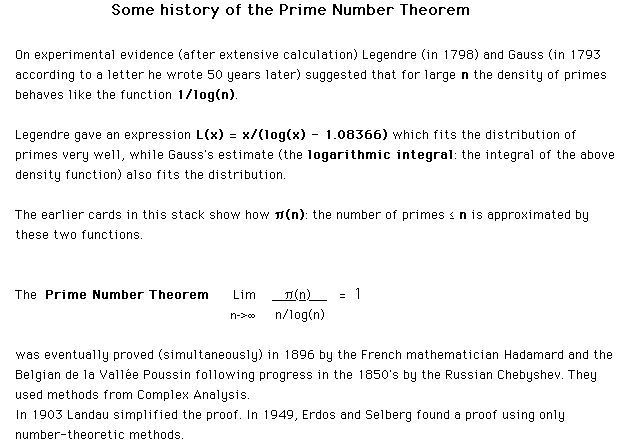
In 1845 Bertrand conjectured that there was always at least one prime between and for . Chebyshev proved Bertrand's conjecture in 1850. Chebyshev also came close to proving the Prime Number Theorem, proving that if
(with the number of primes ≤ ) had a limit as then that limit is 1. He was unable to prove, however, that
.
exists. The proof of this result was only completed two years after Chebyshev's death by Hadamard and (independently) de la Vallée Poussin.
Chebyshev was promoted to extraordinary professor at St Petersburg in 1850. Two years later, between July and November 1852, he visited France, London and Germany. We mentioned above his report on that trip during which he had the opportunity to investigate various steam engines and their mechanics in practice. His report covers his studies of applied mechanics as well as his discussions with French mathematicians including Liouville, Bienaymé, Hermite, Serret, Poncelet, and English mathematicians including Cayley and Sylvester. In Berlin he met Dirichlet:-
It was of great interest for me to become acquainted with the celebrated geometer Lejeune-Dirichlet. ... [I] found an occasion each day to talk with this geometer concerning [applications of calculus to number theory] as well as other questions on pure and applied analysis. ... [I attended] with particular pleasure one of his lectures on theoretical mechanics.
In fact Chebyshev's interest both in the theory of mechanisms and in the theory of approximation stem from his 1852 trip. In [31] Tikhomirov studied Chebyshev's work on approximation theory and writes:-
Chebyshev ... set the foundations of the Russian school of approximation theory: we show the relation of Chebyshev's ideas in approximation theory to applied problems (theory of mechanisms and computational mathematics).
Papers which arose as a direct consequence of the trip included Théorie des mécanismes connus sous le nom de parallélogrammes published in 1854. It was in this work that his famous Chebyshev polynomials appeared for the first time but he later went on to develop a general theory of orthogonal polynomials. In [28] Roy discusses his contributions to on orthogonal polynomials and puts the work into its historical context:-
Chebyshev was probably the first mathematician to recognise the general concept of orthogonal polynomials. A few particular orthogonal polynomials were known before his work. Legendre and Laplace had encountered the Legendre polynomials in their work on celestial mechanics in the late eighteenth century. Laplace had found and studied the Hermite polynomials in the course of his discoveries in probability theory during the early nineteenth century. Other isolated instances of orthogonal polynomials occurring in the work of various mathematicians is mentioned later. It was Chebyshev who saw the possibility of a general theory and its applications. His work arose out of the theory of least squares approximation and probability; he applied his results to interpolation, approximate quadrature and other areas. He discovered the discrete analogue of the Jacobi polynomials but their importance was not recognized until this century. They were rediscovered by Hahn and named after him upon their rediscovery. Geronimus has pointed out that in his first paper on orthogonal polynomials, Chebyshev already had the Christoffel-Darboux formula.
The trip Chebyshev undertook in 1852 was one of many. In addition to the mathematicians we have mentioned that he met on that trip, he also had contacts with other European mathematicians such as Lucas, Borchardt, Kronecker, and Weierstrass (see for example [12]). Almost every summer Chebyshev travelled in Western Europe, but when he did not, he spent the summer in Catherinenthal near Reval (now known as Tallinn in Estonia). We do not have full information about his many Western European visits, but we do know that he spoke at sessions of the French Association for the Advancement of Science between 1873 and 1882, presenting sixteen reports, being at the meetings in Lyon in 1873, Clermont-Ferrand in 1876, Paris in 1878, and La Rochelle in 1882. In addition to his 1852 trip to France, and those just mentioned between 1873 and 1882, we have records of visits he made in 1856, 1864, 1884 and 1893. The 1884 visit, which probably saw him visit a number of European universities, ended at the University of Liège where he led the celebrations to honour Catalan's retirement.
We have mentioned some contributions that Chebyshev made to the theory of probability. In 1867 he published a paper On mean values which used Bienaymé's inequality to give a generalised law of large numbers. As a result of his work on this topic the inequality today is often known as the Bienaymé-Chebyshev inequality. Twenty years later Chebyshev published On two theorems concerning probability which gives the basis for applying the theory of probability to statistical data, generalising the central limit theorem of de Moivre and Laplace. Of this Kolmogorov wrote (see for example [1]):-
The principal meaning of Chebyshev's work is that through it he always aspired to estimate exactly in the form of inequalities absolutely valid under any number of tests the possible deviations from limit regularities. Further, Chebyshev was the first to estimate clearly and make use of such notions as "random quantity" and its "expectation (mean) value".
Let us mention a few further aspects of Chebyshev's work. In the theory of integrals he generalised the beta function and examined integrals of the form
.
Other topics to which he contributed were the construction of maps, the calculation of geometric volumes, and the construction of calculating machines in the 1870s. In mechanics he studied problems involved in converting rotary motion into rectilinear motion by mechanical coupling. The Chebyshev parallel motion is three linked bars approximating rectilinear motion. He wrote many papers on his mechanical inventions; Lucas exhibited models and drawings of some of these at the Conservatoire National des Arts et Métiers in Paris. In 1893 seven of his mechanical inventions were exhibited at the World's Exposition in Chicago, organised to celebrate the 400th anniversary of Christopher Columbus's discovery of America, including his invention of a special bicycle for women.
A number of famous mathematicians were taught by Chebyshev and gave a descriptions of him as a lecturer. The first quote we give is by Lyapunov who attended lectures by Chebyshev in the 1870s. The quote is given in a number of places (see for example [1] or [11]):-
His courses were not voluminous, and he did not consider the quantity of knowledge delivered; rather, he aspired to elucidate some of the most important aspects of the problems he spoke on. These were lively, absorbing lectures; curious remarks on the significance and importance of certain problems and scientific methods were always abundant. Sometimes he made a remark in passing, in connection with some concrete case they had considered, but those who attended always kept it in mind. Consequently his lectures were highly stimulating; students received something new and essential at each lecture; he taught broader views and unusual standpoints.
Our second quote concerning Chebyshev as a teacher comes from the writings of Dmitry Grave who attended lectures by Chebyshev in the 1880s (see for example [11]):-
Chebyshev was a wonderful lecturer. His courses were very short. As soon as the bell sounded, he immediately dropped the chalk, and, limping, left the auditorium. On the other hand he was always punctual and not late for classes. Particularly interesting were his digressions when he told us about what he had spoken outside the country or about the response of Hermite or others. Then the whole auditorium strained not to miss a word.
Let us quote from a lecture given by Chebyshev in 1856 where he explained how he saw the interaction of the pure and applied sides of mathematics. It is an interesting quote, for much of Chebyshev's work in mathematics was done following these principles (see for example [1] or [11]):-
The closer mutual approximation of the points of view of theory and practice brings most beneficial results, and it is not exclusively the practical side that gains; under its influence the sciences are developing in that this approximation delivers new objects of study or new aspects in subjects long familiar. In spite of the great advance of the mathematical sciences due to the works of the outstanding mathematicians of the last three centuries, practice clearly reveals their imperfection in many respects; it suggests problems essentially new for science and thus challenges one to seek quite new methods. And if theory gains much when new applications or developments of old methods occur, the gain is still greater when new methods are discovered; and here science finds a reliable guide in practice.
As to Chebyshev's personal life, he never married and lived alone in a large house with ten rooms. He was rich, spending little on everyday comforts but he had one great love, namely that of buying property. It was on this that he spent most of his money but he did financially support a daughter whom he refused to officially acknowledge. He did spend time with this daughter, especially after she married a colonel. Chebyshev often met her and her husband in Rudakovo at the home of his sister Nadiejda.
Chebyshev retired from his professorship at St Petersburg University in 1882; he had been appointed to this particular post 22 years earlier. He had received many honours during his career and a few more were still to come his way. He became a junior academician of the St Petersburg Academy of Sciences in 1853 with the chair of applied mathematics, an extraordinary academician in 1856 and an ordinary academician in 1859, again with the chair of applied mathematics. He was elected a Corresponding Member of the Société Royale des Sciences of Liège in 1856, of the Société Philomathique, also in 1856, of the Berlin Academy of Sciences in 1871, the Bologna Academy in 1873, the Royal Society of London in 1877, the Italian Royal Academy in 1880, and the Swedish Academy of Sciences in 1893. He was elected a Corresponding Member of the Institut de France in 1860 and a foreign associate of the Institut in 1874. In addition every Russian university elected him to an honorary position, he became an honorary member of the St Petersburg Artillery Academy and the was awarded the French Légion d'Honneur.
正文里的方括号编号指向这里,悬停即可直接看到条目。书目保留原文——译了书名反而查不到文献。
原站列出的延伸阅读与外部数据库,照原样保留,目标多为英文页面。
关于巴夫尼提·列波维奇·切比雪夫的其它页面:
原站的交叉引用。指向本站已镜像专题的留在站内,其余仍指回原站。