数学家传记
约翰·纳皮尔是一位苏格兰学者,最著名的是发明了对数,但其他数学贡献包括用于解球面三角的公式的记忆法以及两个称为约翰·纳皮尔类比式的公式。
约翰·纳皮尔的父亲Archibald Napier是16世纪晚期苏格兰的重要人物。他的家族自1430年代起就拥有Merchiston庄园,当时他的一位祖先获得了该庄园,成为第一代Merchiston的Napare。(我们稍后将评论纳皮尔名字的不同拼写。)家族还拥有Lennox和Menteith的庄园以及Gartness的一处住所。Archibald Napier于1549年与奥克尼主教的姐妹Janet Bothwell结婚,当时他年仅15岁。他们的儿子纳皮尔于次年出生。Archibald Napier是一名司法代表,并于1565年被封为爵士。他于1582年被任命为铸币厂厂长。
在继续之前,我们应该评论一下纳皮尔的拼写。名字弗瑞兹·约翰最容易处理为纳皮尔,而他同时代几乎所有人也都使用旧拼写“Jhone”。他的姓氏出现了大量不同的拼写形式。Napeir、Nepair、Nepeir、Neper、Napare、Naper、Naipper这些形式都能见到,但纳皮尔在当时最常写作Jhone Neper。我们唯一确定在纳皮尔有生之年不会使用的纳皮尔形式,就是现在的现代拼写“纳皮尔”!
关于纳皮尔的早年生活,人们所知甚少。我们掌握的少数零星信息之一,来自奥克尼主教——约翰的叔父——写给Archibald Napier的一封信,当时约翰十一岁:-
我恳请您,先生,把您的儿子约翰送去上学;去法国或佛兰德斯;因为他在家里学不好,在这个极其危险的世界里也得不到益处——愿他能在其中得救;——愿他追求荣誉和利益,我相信他会的……
这是对奥克尼主教实际所写古苏格兰语的翻译。有兴趣者,原文如下:-
我恳求您,先生,把您的儿子Jhone送到学校去;去法国或佛兰德斯;因为他在家里学不到任何有益的东西,在这个极其危险的世界里也得不到任何益处……
纳皮尔在圣安德鲁斯大学接受教育,1563年13岁时进入该大学。他的母亲安排他住在圣萨尔瓦托学院,并特别安排大学校长John Rutherford亲自照顾他。纳皮尔的名字出现在1563年圣萨尔瓦托学院的入学名册上。纳皮尔入学后不久,他的母亲去世了。我们知道纳皮尔在圣安德鲁斯大学度过了一段时间,多年后他亲笔写道,正是在圣安德鲁斯,他第一次对神学产生了强烈的兴趣。
纳皮尔的名字没有出现在随后几年被授予学位的名单中,因此他一定是在完成学位之前离开圣安德鲁斯去欧洲学习的。我们还可以确定其他一些事实。纳皮尔的高等数学知识不是在圣安德鲁斯获得的,他深厚的古典文学知识也不是在那里获得的。这两者一定是在他于欧洲学习期间获得的,但没有记录显示他在哪里学习,尽管巴黎大学极有可能,而且他很可能也在意大利和荷兰待过一段时间。
到1571年,纳皮尔已经回到苏格兰,因为他出席了那年举行的他父亲的第二次婚礼。正是在1571年,纳皮尔本人开始为自己的婚姻做准备,但婚礼几乎是在两年后才举行。1572年,纳皮尔家族的大部分地产被转让给纳皮尔,并计划在加特内斯的地产上建造一座城堡。
当城堡于1574年竣工时,纳皮尔和他的妻子在那里居住。纳皮尔致力于经营他的地产。他非常认真地对待这项任务,并且作为一位伟大的发明天才,他将自己的技能应用于这些任务。他以科学的方式对待农业,并进行了以下实验:-
……用普通盐改良和施肥各种田地,从而使同样的土地能够更丰富地生产各种草和谷物,并且比苏格兰以前使用的普通施肥方法便宜得多。
以上内容引用自[12],未注明出处。
纳皮尔参与了当时的宗教争论。他是一位狂热的新教徒,并出版了他认为最重要的著作Plaine Discovery of the Whole Revelation of St. John(1593年)。
纳皮尔从在圣安德鲁斯读本科时起就是一个狂热的新教徒。根据他的序言,他写了Plaine Discovery of the Whole Revelation of St. John:-
……为了防止在这个岛屿内出现的教皇制的明显危险……
事实上,有充分的理由让纳皮尔认为苏格兰的宗教状况可能会发生变化,因为一段时间以来,一直有传言说西班牙的腓力可能入侵苏格兰。这部Plaine Discovery of the Whole Revelation of St. John确实为纳皮尔赢得了相当的声誉,不仅在苏格兰境内,而且在作品被翻译成荷兰语、法语和德语之后,在欧洲大陆也是如此。然而,Gibson在[12]中评论道:-
……我想,当今这一代人中,读过甚至听说过这本书的人确实寥寥无几;无论它曾经有什么优点,它们都无法引起现代人的兴趣……
纳皮尔对数学的研究只是一种爱好,在他的数学著作中,他写道,在研究神学之余,他常常很难找到时间进行必要的计算。然而,他最著名的是发明了对数,但他的其他数学贡献还包括用于解球面三角的公式的记忆法、用于解球面三角的两个被称为“纳皮尔类比”的公式,以及一种称为“纳皮尔骨”的发明,用于机械地进行乘法、除法以及求平方根和立方根。纳皮尔还发现了三角函数的指数表达式,并引入了分数的十进制记法。
纳皮尔关于对数的大部分工作似乎是在他住在Gartness时完成的。Statistical Account(第xvi卷,第108页)包含以下内容:-
与Gartness的磨坊相邻的是一座旧房子的遗迹,Merchiston的纳皮尔,对数的发明者,在进行计算时,大部分时间(若干年)都居住在那里。据传,瀑布的轰鸣声虽然持续不断,却从未使他感到不安,但磨坊的咔嗒声,虽然只是偶尔响起,却极大地扰乱了他的思绪。因此,当他深入思考时,有时不得不请磨坊主停下磨坊,以免他的思路被打断。
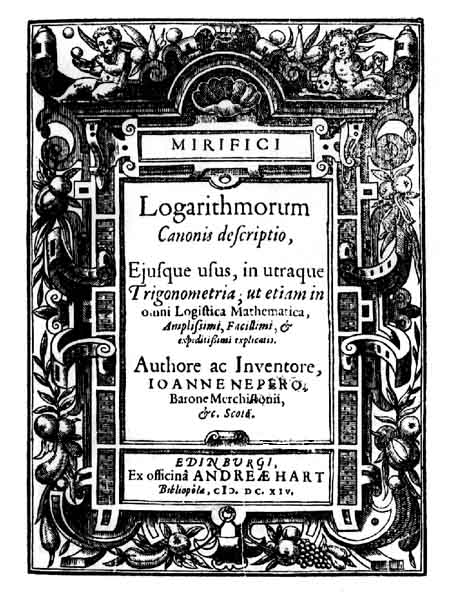
纳皮尔关于对数的论述于1614年出现在Mirifici logarithmorum canonis descriptio中。两年后,纳皮尔的原始拉丁文本的英译本出版了,由爱德华·梅特兰·赖特翻译。在该书的前言中,纳皮尔解释了他这一伟大发现背后的思考(我们引用1614年原始拉丁文本1616年英译本的译文):-
鉴于在数学实践中,没有什么比大数的乘法、除法、平方与立方开方更麻烦,也没有比这些更困扰和妨碍计算者,它们除了耗费大量时间外,还大多容易产生许多难以捉摸的错误,因此我开始在心中思考,能否通过某种确定而便捷的技艺来消除这些障碍。为此我思考了许多事情,最终发现了一些极好的简短规则,或许将在以后讨论。但在所有方法中,没有比这更有利的了:它连同艰难而冗长的乘法、除法和开方,甚至从工作中抛弃了那些要被乘、除和开方的数字本身,并用其他数字取而代之,这些数字仅通过加法和减法、除以二或除以三就能完成同样多的工作。
与今天使用的对数不同,纳皮尔的对数实际上并不以任何数为底,尽管用我们现在的术语说它们以为底并非不合理(但或许有点误导)。当然,它们涉及一个常数,这个常数以我们现在将要解释的方式从构造中产生。纳皮尔没有以代数方式思考对数,事实上在纳皮尔的时代,代数还没有充分发展到使这成为一种现实的方法。相反,他通过动态类比来思考。考虑两条线,长度固定,和,长度无限。点和同时开始向右移动,分别从和出发,具有相同的初始速度;以匀速运动,的速度等于距离。纳皮尔将定义为的对数,即
= Nap.log 。
纳皮尔选择长度为,基于他所能获得的最好的正弦表给出到七位小数,并且他认为自变量具有的形式。
Nap.log 1不等于0这一事实是一个主要困难,这使得Nap.logs在计算中远不如我们的对数方便。将对数改为log 1 = 0是在纳皮尔和亨利·布里格斯之间的讨论中发生的。亨利·布里格斯读了纳皮尔1614年的拉丁文文本,并于1615年3月10日在给朋友的信中写道:-
马克斯顿的领主纳皮尔用他新颖而令人钦佩的对数让我的头脑和双手忙碌起来。如果上帝愿意,我希望今年夏天见到他,因为我从未见过一本让我更满意或更惊奇的书。
事实上,亨利·布里格斯确实在1615年夏天从伦敦到爱丁堡的艰难旅程中去见了纳皮尔(他是否会梦想到现在乘火车只需4小时,而在当时骑马和马车至少需要4天)。他们的会面描述由约翰 Marr告诉William Lilly,后者写道(见[12]):-
亨利·布里格斯先生指定了某一天在爱丁堡会面;但未能如愿,梅奇斯顿担心他不会来。有一天,当约翰马尔和Lord Napier正在谈论亨利·布里格斯先生时,“哦!约翰,”梅奇斯顿说,“亨利·布里格斯先生现在不会来了”;就在那一刻,有人敲门,约翰马尔急忙下楼,结果发现是亨利·布里格斯先生,他非常满意。他把亨利·布里格斯先生带进大人的房间,在那里几乎花了一刻钟,彼此钦佩地注视着对方,一言未发。最后亨利·布里格斯先生开始说:“大人,我特意进行了这次长途旅行,是为了见到您本人,并了解您最初是通过何种智慧或独创性的机制想到这对天文学最卓越的帮助,即对数……
亨利·布里格斯在会面之前的一封信中向纳皮尔建议,对数应以10为底(用我们的术语来说),并且亨利·布里格斯已经开始构建表格。纳皮尔回复说他有同样的想法,但([12]):-
……由于健康状况不佳以及其他重要原因,他无法承担编制新表的工作。
在他们的会面中,纳皮尔向亨利·布里格斯建议新表格应以10为底构建,并且log 1 = 0,而亨利·布里格斯确实构建了这样的表格。事实上,亨利·布里格斯在1615年第一次访问时与纳皮尔共度了一个月,1616年又从伦敦到爱丁堡进行了第二次旅程再次拜访纳皮尔,并且本应在次年进行第三次访问,但纳皮尔在计划夏季访问之前的春天去世了。
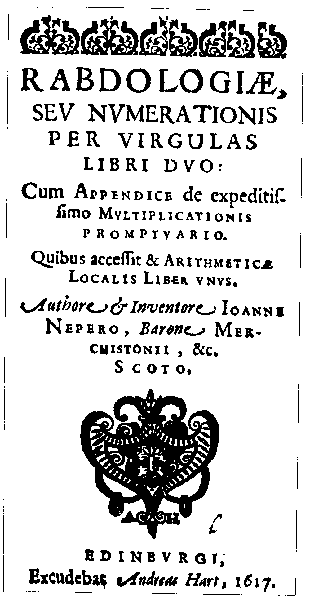
纳皮尔 在他 1617 年出版的 Rabdologiae 中提出了一种简化计算的机械手段。他描述了一种使用“编号棒”进行乘法的方法,棒上标有数字。出版这部著作的原因由 纳皮尔 在献词中给出,他说,许多曾看过这些编号棒的朋友对它们非常满意,以至于它们已经被广泛使用,甚至开始在国外使用。
纳皮尔 的编号棒是用象牙制成的,因此看起来像骨头,这解释了为什么它们现在被称为 纳皮尔 的骨头。为了相乘,把骨头并排放置,然后读出相应的乘积。詹姆斯·惠特布雷德·李·格莱舍 在他为 Encyclopaedia Britannica 写的一篇文章中描述了如何使用 纳皮尔 的骨头,这一描述被引用于 [10] 中。纳皮尔 的骨头也在 [6]、[16] 和 [19] 中有所描述。
像纳皮尔这样智力超群的人如果对他的同时代人来说不显得相当奇怪,那才会令人惊讶,而且鉴于他所生活的迷信时代,奇怪的故事开始流传。许多传统表明纳皮尔是
……与黑暗势力勾结……
这些说法在Mark Napier所写的带有偏见的传记7中被认真对待,Mark Napier是纳皮尔的后代之一。Mark Napier认为,纳皮尔故意利用其仆人的原始信仰,带着一只涂满烟灰的公鸡四处走动。甚至上文引用的Statistical Account也说:-
[纳皮尔]经常穿着睡袍、戴着睡帽外出。这一点,再加上一些在普通人看来相当古怪的事情,使他落下了男巫的名声。以前人们相信并且当时也普遍传言他与魔鬼有契约;还说他在研究上花的时间都用来学习黑魔法并与老尼克交谈了。
然而,纳皮尔将因对知识进步作出最重要的贡献之一而被铭记。正是通过使用对数,约翰内斯·开普勒才得以整理他的观测数据并取得突破,这反过来又为艾萨克·牛顿的引力理论奠定了基础。在上文引用的Mirifici logarithmorum canonis descriptio的序言中,纳皮尔说,他希望他的对数能节省计算者大量时间,并使他们摆脱计算中的slippery errors。200年后,皮埃尔·西蒙·拉普拉斯对此表示赞同,他说对数:-
……通过缩短劳动,使天文学家的寿命加倍。
John Napier's father, Archibald Napier, was an important man in late 16th century Scotland. His family had owned the Merchiston estate from the 1430s when one of his ancestors acquired the estate, becoming the first Napare of Merchiston. (We shall comment shortly on the different spellings of Napier's name.) The family also owned estates at Lennox and at Menteith and a residence at Gartness. Archibald Napier married Janet Bothwell, the sister of the Bishop of Orkney, in 1549 when he was only 15 years old. Their son John Napier was born the following year. Archibald Napier was a justice-depute and was knighted in 1565. He was appointed Master of the Mint in 1582.
Before continuing we should comment on the spelling of John Napier. The name John is most easily dealt with as John Napier, and almost everyone else around his time, used the old spelling "Jhone". His surname appears in a large variety of different spellings. The forms Napeir, Nepair, Nepeir, Neper, Napare, Naper, Naipper are all seen but John Napier would most commonly have been written Jhone Neper at that time. The only form of Napier that we are sure would not have been used in Napier's lifetime was the present modern spelling "Napier"!
Little is known about John Napier's early years. One of the few scraps of information that we have is from a letter from the Bishop of Orkney, John's uncle, to Archibald Napier written when John was eleven years old:-
I pray you, sir, to send your son John to school; over to France or Flanders; for he cannot learn well at home nor get profit in this most perilous world - that he may be saved in it; - that he may seek honour and profit as I do not doubt that he will...
This is a translation of the old Scots that the Bishop of Orkney actually wrote. For those interested the original version reads:-
I pray you, schir, to send your son Jhone to the schuyllis; oyer to France or Flandaris; for he can leyr na guid at hame, nor get na proffeitt in this maist perullous worlde ...
Napier was educated at St Andrews University, entering the university in 1563 at the age of 13. His mother arranged for him to live in St Salvator's College and special arrangements were made for the Principal of the University, John Rutherford, to take care of him personally. Napier's name appears on the matriculation roll of St Salvator's College for 1563. Shortly after Napier matriculated his mother died. We know that Napier spent some time at St Andrews University and he wrote himself many years later that it was in St Andrews that he first became passionately interested in theology.
However Napier's name does not appear in the list of those being awarded degrees in the subsequent years so he must have left St Andrews to study in Europe before completing a degree. Of other facts we can also be certain. Napier did not acquire his knowledge of higher mathematics at St Andrews nor did he acquire his deep knowledge of classical literature there. Both these must have been acquired during his studies in Europe but no record exists to show where he studied, although the University of Paris is highly likely and it is also probable that he spent some time in Italy and the Netherlands.
By 1571 Napier had returned to Scotland for he was present at his father's second marriage which took place in that year. It was in 1571 that Napier himself began to make arrangements for his own marriage but it was at nearly two years before that took place. In 1572 most of the estates of the Napier family were made over to John Napier and a castle was planned for the estate at Gartness.
When the castle was completed in 1574, Napier and his wife took up residence there. Napier devoted himself to running his estates. This task he took very seriously and, being a great genius as an inventor, he applied his skills to these tasks. He approached agriculture in a scientific way and he experimented with:-
... improving and manuring of all sorts of field land with common salts, whereby the same may bring forth in more abundance, both of grass and corn of all sorts, and far cheaper than by the common way of dunging used heretofore in Scotland.
The above is quoted in [12] without reference to its origin.
Napier took part in the religious controversies of the time. He was a fervent Protestant and published, what he considered his most important work, the Plaine Discovery of the Whole Revelation of St. John (1593).
Napier had been a fanatical Protestant from his days as an undergraduate at St Andrews. He wrote the Plaine Discovery of the Whole Revelation of St. John according to his preface:-
... for preventing the apparent danger of Papistry arising within this Island...
In fact there were good reasons why Napier thought that a change in the religious situation in Scotland might occur, for there had, for some time, been rumours that Philip of Spain might invade Scotland. The Plaine Discovery of the Whole Revelation of St. John did gain Napier quite a reputation, not only within Scotland, but also on the Continent after the work was translated into Dutch, French and German. Gibson, in [12], remarks however:-
... I suppose that there are few indeed of the present generation who have read, or even heard of, the book; whatever its merits may have been they do not appeal to the modern mind...
Napier's study of mathematics was only a hobby and in his mathematical works he writes that he often found it hard to find the time for the necessary calculations between working on theology. He is best known, however, for his invention of logarithms but his other mathematical contributions include a mnemonic for formulae used in solving spherical triangles, two formulae known as "Napier's analogies" used in solving spherical triangles and an invention called "Napier's bones" used for mechanically multiplying dividing and taking square roots and cube roots. Napier also found exponential expressions for trigonometric functions, and introduced the decimal notation for fractions.
Much of Napier's work on logarithms seems to have been done while he was living at Gartness. The Statistical Account (Vol. xvi, page 108) contains the following:-
Adjoining the mill at Gartness are the remains of an old house in which John Napier of Merchiston, Inventor of Logarithms, resided a great part of his time (some years) when he was making his calculations. It is reported that the noise of the cascade, being constant, never gave him uneasiness, but that the clack of the mill, which was only occasional, greatly disturbed his thoughts. He was therefore, when in deep study, sometimes under the necessity of desiring the miller to stop the mill that the train of his ideas might not be interrupted.
Napier's discussion of logarithms appears in Mirifici logarithmorum canonis descriptio in 1614. Two years later an English translation of Napier's original Latin text was published, translated by Edward Wright. In the preface of the book Napier explains his thinking behind his great discovery (we quote from the English translation of 1616 of the original Latin of 1614):-
Seeing there is nothing (right well-beloved Students of the Mathematics) that is so troublesome to mathematical practice, nor that doth more molest and hinder calculators, than the multiplications, divisions, square and cubical extractions of great numbers, which besides the tedious expense of time are for the most part subject to many slippery errors, I began therefore to consider in my mind by what certain and ready art I might remove those hindrances. And having thought upon many things to this purpose, I found at length some excellent brief rules to be treated of (perhaps) hereafter. But amongst all, none more profitable than this which together with the hard and tedious multiplications, divisions, and extractions of roots, doth also cast away from the work itself even the very numbers themselves that are to be multiplied, divided and resolved into roots, and putteth other numbers in their place which perform as much as they can do, only by addition and subtraction, division by two or division by three.
Unlike the logarithms used today, Napier's logarithms are not really to any base although in our present terminology it is not unreasonable (but perhaps a little misleading) to say that they are to base . Certainly they involve a constant which arose from the construction in a way that we will now explain. Napier did not think of logarithms in an algebraic way, in fact algebra was not well enough developed in Napier's time to make this a realistic approach. Rather he thought by dynamical analogy. Consider two lines of fixed length and of infinite length. Points and begin moving simultaneously to the right, starting at and respectively with the same initial velocity; moves with uniform velocity and with a velocity which is equal to the distance . Napier defined as the logarithm of , that is
= Nap.log .
Napier chose the length to be , based on the fact that the best tables of sines available to him were given to seven decimal places and he thought of the argument as being of the form .
The fact that Nap.log 1 does not equal 0 is a major difficulty which make Nap.logs much less convenient for calculations than our logs. A change to logs with log 1 = 0 came about in discussions between Napier and Briggs. Briggs read Napier's 1614 Latin text and, on the 10 March 1615 wrote in a letter to a friend:-
Napper, lord of Markinston, hath set my head and hands a work with his new and admirable logarithms. I hope to see him this summer, if it please God, for I never saw a book which pleased me better or made me more wonder.
In fact Briggs did make the difficult journey from London to Edinburgh to see Napier in the summer of 1615 (would he have dreamed that now it takes 4 hours by train, rather than at least 4 days by horse and coach in those times). A description of their meeting was told by John Marr to William Lilly who writes the following (see [12]):-
Mr Briggs appoints a certain day when to meet at Edinburgh; but failing thereof, Merchiston was fearful he would not come. It happened one day as John Marr and the Lord Napier were speaking of Mr Briggs, "Oh! John," saith Merchiston, "Mr Briggs will not come now"; at the very instant one knocks at the gate, John Marr hastened down and it proved to be Mr Briggs to his great contentment. He brings Mr Briggs into my Lord's chamber, where almost one quarter of an hour was spent, each beholding other with admiration, before one word was spoken. At last Mr Briggs began, -"My Lord, I have undertaken this long journey purposely to see your person, and to know by what engine of wit or ingenuity you came first to think of this most excellent help unto astronomy, viz. the Logarithms ...
Briggs had suggested to Napier in a letter sent before their meeting that logs should be (in our terminology) to base 10 and Briggs had begun to construct tables. Napier replied that he had the same idea but ([12]):-
... he could not, on account of ill-health and for other weighty reasons undertake the construction of new tables.
At their meeting Napier suggested to Briggs the new tables should be constructed with base 10 and with log 1 = 0, and indeed Briggs did construct such tables. In fact Briggs spent a month with Napier on his first visit of 1615, made a second journey from London to Edinburgh to visit Napier again in 1616 and would have made yet a third visit the following year but Napier died in the spring before the planned summer visit.
Napier presented a mechanical means of simplifying calculations in his Rabdologiae published in 1617. He described a method of multiplication using "numbering rods" with numbers marked off on them. The reason for publishing the work is given by Napier in the dedication, where he says that so many of his friends, to whom he had shown the numbering rods, were so pleased with them that they were already becoming widely used, even beginning to be used in foreign countries.
Napier's numbering rods were made of ivory, so that they looked like bones which explains why they are now known as Napier's bones. To multiply numbers the bones were placed side by side and the appropriate products read off. Glaisher described how to use Napier's bones in an article he wrote for Encyclopaedia Britannica and this description is quoted in [10]. Napier's bones are also described in [6], [16] and [19].
It would be surprising if a man of such great an intellect as Napier did not appear rather strange to his contemporaries and, given the superstitious age in which he lived, strange stories began to circulate. Many traditions suggest that Napier was
... in league with the powers of darkness...
and these are taken seriously in the biased biography [7] written by Mark Napier, one of John Napier's descendants. Mark Napier suggests that John Napier deliberately played upon the primitive beliefs of his servants by going round with a cock which he had covered in soot. Even the Statistical Account (quoted above) says:-
[Napier] used frequently to walk out in his nightgown and cap. This, with some things which to the vulgar appear rather odd, fixed on him the character of a warlock. It was formerly believed and currently reported that he was in compact with the devil; and that the time he spent in study was spent in learning the black art and holding conversation with Old Nick.
Napier, however, will be remembered for making one of the most important contributions to the advance of knowledge. It was through the use of logarithms that Kepler was able to reduce his observations and make his breakthrough which then in turn underpinned Newton's theory of gravitation. In the preface to the Mirifici logarithmorum canonis descriptio, quoted above, Napier says he hoped that his logarithms will save calculators much time and free them from the slippery errors of calculations. Laplace, 200 year later, agreed, saying that logarithms:-
...by shortening the labours, doubled the life of the astronomer .
正文里的方括号编号指向这里,悬停即可直接看到条目。书目保留原文——译了书名反而查不到文献。
原站列出的延伸阅读与外部数据库,照原样保留,目标多为英文页面。
关于约翰·纳皮尔的其它页面:
关于约翰·纳皮尔的其它网站:
原站的交叉引用。指向本站已镜像专题的留在站内,其余仍指回原站。