数学家传记
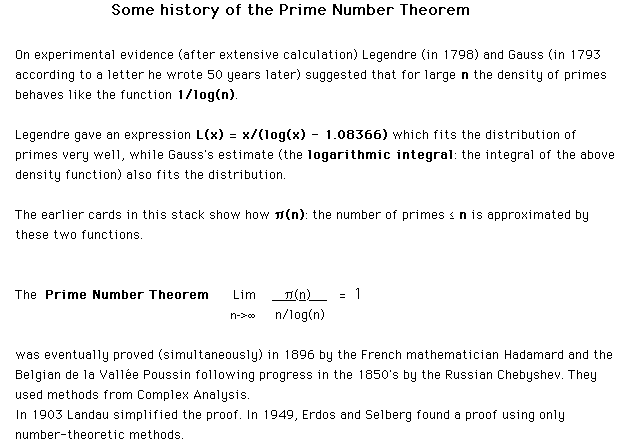
雅克·阿达马是一位法国数学家,其最重要的成果是1896年证明的素数定理。该定理指出,小于n的素数个数以与n/log_e n相同的速度趋于无穷大。
雅克·阿达马的父亲Amédée 阿达马于1864年6月6日与Claire Marie Jeanne Picard结婚。Amédée 阿达马出身犹太家庭,是一名教师,教授古典文学、语法、历史和地理等多门科目,而阿达马的母亲则在家中教授私人钢琴课。阿达马出生时,Amédée在凡尔赛的帝国中学任教,但当阿达马三岁时,父亲在查理曼中学谋得职位,全家便搬到了巴黎。
对一个孩子来说,在巴黎长大正值一个不幸的时期。1870年7月19日开始的普法战争对法国来说进展不利,1870年9月19日普鲁士人开始围攻巴黎。对城中居民来说这是一个绝望的时期,他们杀死自己的马、猫和狗作为食物。阿达马的家庭和许多其他家庭一样,吃大象肉以求生存。巴黎于1871年1月28日投降,1871年5月10日签署的《法兰克福条约》对法国来说是一种屈辱。在投降和签署条约之间,巴黎实质上发生了一场内战,Hadamard家的房子被烧毁。
战争并不是哈达玛一家悲伤的唯一原因。阿达马的妹妹Jeanne于1870年在巴黎围城之前去世,另一个妹妹Suzanne生于1871年,于1874年去世。
阿达马在查理曼中学开始上学,他的父亲在那里教书。在学校的最初几年里,他除了数学之外的所有科目都很好。他尤其擅长希腊语和拉丁语。他在1936年写道:-
……在算术方面,直到五年级,我都是最后一名或接近最后一名。
他的这一说法并不准确,因为尽管起初他在算术方面确实较弱,但到五年级时,他在中学里已是班上第二名。到这时(1875年),他已在许多科目的全国中学生竞赛Concours Général中获奖。正是在这个五年级,一位优秀的数学教师将他引向了数学和科学。
1875年,阿达马的父亲因作为教师名声不佳而被调往路易大帝中学,阿达马从1876年起就读于这所学校。1882年他毕业于Bachelier ès lettres et ès sciences,次年获得Baccalauréat ès sciences。他在1883年的Concours Général中获得代数一等奖和力学一等奖。
1884年,阿达马参加了巴黎综合理工学院和巴黎高等师范学院的入学考试;他在两场考试中都名列第一。他选择了巴黎高等师范学院,在那里他很快与包括皮埃尔·杜埃姆和保罗·潘勒韦在内的同学成为了朋友。他的老师中有于乐·达奈希、夏尔·埃尔米特、让·加斯东·达布、保尔·阿佩尔、爱徳华·古尔萨和埃米尔·皮卡。在这个阶段,他就开始进行研究,探讨由幂级数的系数生成的行列式的估计问题。他于1888年10月30日从巴黎高等师范学院毕业。
在攻读博士学位期间,他担任学校教师。起初,他被分配到卡昂中学,但没有教学任务。从1889年6月起,他在圣路易中学任教,然后从1890年9月起在布丰中学任教三年。尽管他的研究进展极好,但他的教学却不太受赏识,可能是因为他对学生的要求超出了他们的能力。他的一大成功是教了莫里斯·弗雷歇,两人通信约九年。
阿达马于1892年获得博士学位,其学位论文研究由布鲁克·泰勒级数定义的函数。这项关于复变量函数的工作是最早考察解析函数一般理论的工作之一,特别是他的学位论文包含了关于奇点的第一部一般性工作。
同年,阿达马因其论文Determination of the number of primes less than a given number而获得数学科学大奖。奖项提出的主题涉及填补波恩哈德·黎曼关于ζ函数的工作中的空白,是由夏尔·埃尔米特考虑到他的朋友汤姆斯·斯蒂尔吉斯而提出的。汤姆斯·斯蒂尔吉斯在1885年声称证明了黎曼假设,但从未发表他的“证明”,并且在1890年奖项主题公布后,汤姆斯·斯蒂尔吉斯在他的“证明”中发现了一个他无法填补的空白。他从未提交参赛作品,但阿达马在他的学位论文提交和口试之间意识到他的结果可以应用于zeta函数。他关于整函数和zeta函数的论文获得了一等奖。
1892年对阿达马来说,除了上述学术成就外,也是重要的一年。那年6月,他与Louise-Anna Trénel结婚,她像阿达马一样有犹太背景。他们从小相识,并共同热爱音乐。第二年,当阿达马被任命为波尔多大学讲师时,他们搬到了波尔多。如果说他在布丰中学作为教师未能达到标准,那么现在情况远非如此,因为他以研究和教学技能给每个人留下了深刻印象。1896年2月1日,他被任命为波尔多大学天文学和理性力学教授。
他在波尔多度过的这四年,不仅因家庭生活而忙碌——在此期间两个儿子Pierre和Étienne出生——而且对阿达马的研究来说也是极其多产的时期。他在这四年里发表了29篇论文,但这些论文之所以引人注目,更多是因为其深度和所涵盖主题的广泛,而非数量。也许他在这段时间证明的最重要成果是他在1896年证明的素数定理。该定理指出:-
不超过的素数个数当时趋于∞。
这个定理在18世纪就被猜想出来,但直到1896年才被证明,当时阿达马和(独立地)夏尔-让·德拉瓦莱·普桑使用了复分析。该证明的轮廓由波恩哈德·黎曼在1851年给出,但当时必要的工具尚未发展出来。这个问题是从1851年到1896年复分析发展的主要动力之一,直到波恩哈德·黎曼所勾勒的证明最终完成。
解决这个重要的未解决问题并不是阿达马在1896年唯一的杰出贡献。同年,他发表了一篇关于动力学轨迹性质的论文,获得了科学院的博尔丁奖。该奖项提出的主题是关于测地线的,而阿达马在研究曲面上质点轨迹方面的工作导致了某些非线性微分方程,其解也给出了测地线的性质。因此,他的工作是对几何学和动力学的一大贡献。
阿达马在波尔多期间发表的另一个结果是他1893年著名的行列式不等式。其行列式满足该关系中等式的矩阵今天被称为Hadamard matrices,在积分方程理论、编码理论和其他领域中很重要。
阿达马在波尔多期间首次涉足政治。Alfred Dreyfus的妻子是阿达马的亲戚,他来自阿尔萨斯。马克斯·玻恩一个犹太家庭,Dreyfus开始了军事生涯。1894年,当他在陆军部时,他被指控向德国人出售军事机密,并被判处终身监禁。尽管他的审判极不规范,但许多人的反犹观点使这一判决广受欢迎。伪造的文件和掩盖行为很快表明,法律程序存在疑点。起初,阿达马和许多人一样,认为Dreyfus有罪。然而,在1897年搬到巴黎后,他开始发现针对Dreyfus的证据是如何被伪造的。他成为试图纠正这一不公正行为的主要成员之一。保罗·潘勒韦描述了他在1897年就此事与阿达马的一次谈话(例如见[6]):-
在将近一个小时里,阿达马试图说服我德雷福斯是无辜的,最后,面对我的怀疑,他尽力让我理解他论点的内在价值以及他完全缺乏激情和多愁善感……他把自己的信念建立在事实之上。
1898年,小说家埃米尔·左拉写了一封公开信,指控军队掩盖其对德雷福斯的错误定罪。此案将法国分裂成两个对立的阵营,引发的问题远远超出德雷福斯有罪或无罪本身。有人要求将左拉绳之以法,反犹骚乱爆发,还有人请愿要求重审德雷福斯。左拉被判处一年监禁并罚款3000法郎。到1899年,已有人供认伪造文件,随后又有一人自杀,德雷福斯获得重审,再次被判有罪,但获得赦免。阿达马积极参与为德雷福斯洗清罪名,这一目标最终于1906年7月22日实现,德雷福斯恢复职务并被授予荣誉军团勋章。洛朗·施瓦茨写道(例如见[27]):-
正是德雷福斯事件,从捍卫正义的意义上说,是阿达马一生中的重大事件。从他理解到以国家利益为名对一个人犯下的不义之巨大,以及反犹主义可能造成的后果那一刻起,他就热情地投身于对该案审判的复审。这一事件标志了他的一生。
早在德雷福斯事件结束之前,正如我们已经指出的,阿达马已从波尔多迁往巴黎。1897年,他辞去在波尔多的讲席,接受较低的职位,一个在索邦大学理学院,一个在法兰西公学院。1897年10月抵达巴黎后不久,他出版了Leçons de Géométrie ElémentaireⓉ(初等几何教程)的第一卷。这一关于二维几何的卷册于1898年问世,随后于1901年出版了关于三维几何的第二卷。这部著作是应让·加斯东·达布之请而作,后来对法国的数学教学产生了重大影响。
阿达马因过去十年的研究成果于1898年获得让-维克托·彭赛列奖。从他在巴黎任职时起,他的研究更多地转向数学物理,但他总是强烈主张自己是一名数学家,而不是物理学家。他认为正是他工作的严谨性使其成为数学。特别是,他研究数学物理的偏微分方程,产生了极其重要的结果。他1898年关于负曲率曲面测地线的著名工作奠定了符号动力学的基础。他考虑的主题包括弹性、几何光学、流体动力学和边值问题。他引入了适定初值和边值问题的概念。
阿达马在巴黎的头五年又出生了三个孩子,先是另一个儿子马蒂厄,然后是两个女儿塞西尔和杰奎琳。他继续因研究而获奖,并在1906年进一步获得荣誉,当选为法国数学会主席。1909年,他被任命为法兰西学院力学讲席。次年,他出版了Leçons sur le calcul des variationsⓉ(变分法教程),这有助于奠定泛函分析的基础(他引入了functional一词)。然后在1912年,他被任命为巴黎综合理工学院分析学教授,接替卡米耶·若尔当。
儒勒·昂利·庞加莱曾大力支持阿达马获得这一讲席,但几个月内,他就去世了,年仅58岁,令人悲痛。阿达马随后承担了考察儒勒·昂利·庞加莱著作这一极其艰巨的任务,到1912年夏末,他已写出两篇重要文章。正如保罗·莱维所写:-
必须得是阿达马才敢于承担阐述[儒勒·昂利·庞加莱]涉及如此多不同领域的全部巨著,并在一个夏天内完成。
1912年末,阿达马当选为科学院院士,接替儒勒·昂利·庞加莱。他后来写道,从结婚时开始的多年“纯粹快乐”,在1916年结束了。正是第一次世界大战给阿达马带来了巨大的悲剧,他的两个年长的儿子在战斗中阵亡。两人都在凡尔登阵亡,而皮埃尔阵亡时,阿达马正在罗马讲学。他在收到消息前就离开了,尽管基诺·法诺、维多·沃尔泰拉的妻子和其他人尽力把消息传给他,但他直到回到巴黎才发现。大约两个月后,艾蒂安在凡尔登附近阵亡。
阿达马只知道一种方法,足以将这些悲剧的痛苦推开,让他得以继续前行,那就是更加精力充沛地投身于数学。1920年,他被任命为保尔·阿佩尔在中央学校的分析讲席,但保留了他在巴黎综合理工学院和法兰西公学院的职位。从被任命到1933年间的这些年里,他广泛旅行,两次访问美国,还有西班牙、捷克斯洛伐克、意大利、瑞士、巴西、阿根廷和埃及。
他继续产出最高质量的著作和论文,于1922年出版了他或许最著名的著作Lectures on Cauchy's problem in linear partial differential equations。这本书基于他在美国耶鲁大学讲授的一门课程。他还涉足新的课题,撰写了数篇关于概率论的论文,特别是关于马尔可夫链的论文。他还发表了许多关于数学教育以及一般教育的文章。
两次世界大战之间,阿达马的政治立场转向左翼,主要是对1933年纳粹上台的回应。第二次世界大战开始后,1940年法国沦陷,阿达马及其家人逃往美国,他在哥伦比亚大学获得了一个访问职位。然而,他未能在美国找到永久职位,并于1944年收到可怕的消息:他的第三个儿子Mathieu在战争中阵亡。阿达马不久后离开美国,在英国待了一年,战争结束后便尽快返回巴黎。
战后,他成为积极的和平运动者,需要美国数学家的强力支持,他才得以进入美国参加1950年在马萨诸塞州剑桥举行的国际数学家大会。他被选为大会名誉主席。
在他去世前,还有一场悲剧降临到阿达马身上。1962年,当他96岁时,他的孙子Étienne在一次登山事故中丧生。这似乎最终击垮了阿达马的精神,此后他不再离开家门,几乎是在等待死亡。
在[3]中,人们致以如下悼词:-
阿达马不仅是科学院的元老——他于1912年12月当选为该院院士,填补儒勒·昂利·庞加莱去世后留下的席位——而且是整个法兰西学会的元老。去年12月,人们正式向他赠送了一枚特别铸造的金质奖章,以纪念他当选该院院士五十周年,世界各地的科学家都向他致敬。
这样一篇文章无论如何也无法表明阿达马数学贡献的范围。除了约300篇科学论文和书籍外,阿达马还为更广泛的读者写书。他的书The psychology of invention in the mathematical field(1945年)是一部关于数学的精彩著作。然而,我们也应该指出阿达马的教学风格。在庆祝他诞辰一百周年的会议上,他的一位学生说,他曾受教于:-
……一位活跃、生动的老师,他的推理既精确又充满活力。因此,讲座变成了一场斗争和一次冒险。在没有严谨性受损的情况下,直觉的重要性被重新赋予我们,较好的学生感到欣喜。
洛朗·施瓦茨在庆祝阿达马诞辰一百周年的这个仪式上谈到了阿达马:-
我相信他对他的时代产生了巨大的影响,所有在世的分析学家都直接或间接地受他塑造。
Jacques Hadamard's father, Amédée Hadamard, married Claire Marie Jeanne Picard on 6 June 1864. Amédée Hadamard, who was of a Jewish background, was a teacher who taught several subjects such as classics, grammar, history and geography while Jacques' mother taught piano giving private lessons in their home. At the time that Jacques was born Amédée was teaching at the Lycée Impérial in Versailles but the family moved to Paris when Jacques was three years old when his father took up a position at the Lycée Charlemagne.
This was an unfortunate time for a child to be growing up in Paris. The Franco-Prussian War which began on 19 July 1870 went badly for France and on 19 September 1870 the Prussians began a siege of Paris. This was a desperate time for the inhabitants of the town who killed their horses, cats and dogs for food. Hadamard's family, like many others, ate elephant meat to survive. Paris surrendered on 28 January 1871 and the Treaty of Frankfurt, signed on 10 May 1871, was a humiliation for France. Between the surrender and the signing of the treaty there was essentially a civil war in Paris and the Hadamards' house was burnt down.
The war was not the only cause of sadness for the Hadamards. Jacques' young sister Jeanne died in 1870 before the siege of Paris and another sister Suzanne, who was born in 1871, died in 1874.
Jacques began his schooling at the Lycée Charlemagne where his father taught. In his first few years at school he was good at all subjects except mathematics. He excelled in particular in Greek and Latin. He wrote in 1936:-
... in arithmetic, until the fifth grade, I was last or nearly last.
He was not accurate in this statement, for although at first it is true he was weak in arithmetic, by the fifth class he was placed second in his class at the Lycée. By this time (1875) he was winning prizes in many subjects in the Concours Général, the national competition for school pupils. It was a good mathematics teacher who turned him towards mathematics and science, when he was in this fifth class.
In 1875 Hadamard's father, having acquired a poor reputation as a teacher, was transferred to the Lycée Louis-le-Grand and Jacques attended this school from 1876. In 1882 he graduated Bachelier ès lettres et ès sciences then, in the following year, he received his Baccalauréat ès sciences. He was awarded first prize in algebra and first prize in mechanics in the Concours Général of 1883.
In 1884 Hadamard took the entrance examinations for École Polytechnique and École Normale Supérieure; he was placed first in both examinations. He chose the École Normale Supérieure, where he soon made friends with his fellow students including Duhem and Painlevé. Among his teachers were Jules Tannery, Hermite, Darboux, Appell, Goursat and Émile Picard. Already at this stage he began to undertake research, investigating the problem of finding an estimate for the determinant generated by coefficients of a power series. He graduated from the École Normale Supérieure on 30 October 1888.
While undertaking research for his doctorate he worked as a school teacher. At first he was attached to the Lycée de Caen but without teaching duties. From June 1889 he taught at the Lycée Saint-Louis and then from September 1890 at the Lycée Buffon where he taught for three years. Although his research went extremely well, his teaching was less appreciated, probably because he demanded more of his pupils than their abilities allowed. His one great success was teaching Fréchet, and the two corresponded over a period of about nine years.
Hadamard obtained his doctorate in 1892 for a thesis on functions defined by Taylor series. This work on functions of a complex variable was one of the first to examine the general theory of analytic functions, in particular his thesis contained the first general work on singularities.
In the same year Hadamard received the Grand Prix des Sciences Mathématiques for his paper Determination of the number of primes less than a given number. The topic proposed for the prize, concerning filling gaps in Riemann's work on zeta functions, had been put forward by Hermite with his friend Stieltjes in mind. Stieltjes had claimed in 1885 to have proved the Riemann hypothesis but had never published his "proof" and, after the prize topic was announced in 1890, Stieltjes discovered a gap in his "proof" which he was unable to fill. He never submitted an entry for the prize but Hadamard, between the time his thesis was submitted and his oral examination, realised that his results could be applied to zeta functions. His paper on entire functions and zeta functions was awarded first prize.
The year 1892 was significant for Hadamard in addition to the academic achievements described above. In June of that year he married Louise-Anna Trénel who was, like Hadamard, of a Jewish background. They had known each other from childhood and shared a love of music. They moved to Bordeaux the following year when Hadamard was appointed as a lecturer at the University. If he had failed to come up to scratch as a teacher at the Lycée Buffon, this was far from the case now, for he impressed everyone with both his research and teaching skills. On 1 February 1896 he was appointed as Professor of Astronomy and Rational Mechanics at Bordeaux.
The four years which he spent in Bordeaux were not only busy ones for his family life, with two sons Pierre and Étienne being born during this time, but they were also extremely productive ones for Hadamard's research. He published 29 papers during these four years, but they are remarkable more for their depth and the range of the topics which they covered rather than their number. Perhaps his most important result proved during this time was the prime number theorem which he proved in 1896. This states that:-
The number of primes ≤ tends to ∞ as .
This theorem was conjectured in the 18th century, but it was not proved until 1896, when Hadamard and (independently) Charles de la Vallée Poussin, used complex analysis. The proof had been outlined by Riemann in 1851, but the necessary tools had not been developed at that time. This problem was one of the major motivations for the development of complex analysis from 1851 to 1896 when Riemann's outlined proof was finally completed.
Solving this important open problem was not Hadamard's only remarkable contribution of 1896. In the same year he published a paper on properties of dynamic trajectories which won the Bordin Prize of the Academy of Sciences. The topic proposed for the prize had been one on geodesics and Hadamard's work in studying the trajectories of point masses on a surface led to certain non-linear differential equations whose solution also gave properties of geodesics. His work was therefore a major contribution to both geometry and to dynamics.
Another result which Hadamard published during his time in Bordeaux was his famous determinant inequality of 1893. Matrices whose determinants satisfied equality in the relation are today called Hadamard matrices and are important in the theory of integral equations, coding theory and other areas.
Hadamard first became involved in politics during his time in Bordeaux. Alfred Dreyfus, whose wife was a relation of Hadamard, came from Alsace. Born into a Jewish family, Dreyfus embarked on a military career. In 1894, when he was in the War Ministry, he was accused of selling military secrets to the Germans and he was sentenced to life imprisonment. Although his trial had been highly irregular, the anti-Semitic views of many people made the verdict popular. Forged documents and cover-ups soon showed that the legal process had been suspect. At first Hadamard, like many people, assumed that Dreyfus was guilty. However after moving to Paris in 1897 he began to discover how evidence against Dreyfus had been forged. He became a leading member of those trying to correct the injustice. Painlevé described a conversation he had with Hadamard on the matter in 1897 (see for example [6]):-
For almost an hour, [Hadamard] tried to convince me of Dreyfus's innocence, and at the end, faced with my disbelief, he did his best to make me understand the intrinsic value of his arguments and his complete lack of passion and sentimentality ... he based his belief in his innocence on the facts.
In 1898 the novelist Émile Zola wrote an open letter accusing the army of covering up its mistaken conviction of Dreyfus. The case split France into two opposing camps leading to issues far beyond the guilt or innocence of Dreyfus. There were demands to bring Zola to justice, anti-Semitic riots broke out, and there was a petition demanding that Dreyfus be retried. Zola was sentenced to a year in prison and fined 3,000 francs. By 1899 there had been a confession to the forgeries, followed by a suicide, and Dreyfus was retried, again found guilty, but pardoned. Hadamard took an active part in clearing Dreyfus's name which finally happened on 22 July 1906, when Dreyfus was reinstated and decorated with the Legion of Honour. Laurent Schwartz wrote (see for example [27]):-
It is the Dreyfus Affair which was in the sense of defence of justice the great affair of [Hadamard's] life. From the moment when he understood the enormity of the injustice perpetrated against a man in the name of reason of state, and the consequences which anti-Semitism could have, he devoted himself passionately to the review of the trial. This affair marked his life.
Long before the Dreyfus Affair had ended Hadamard had, as we have indicated, moved from Bordeaux to Paris. In 1897 he resigned his chair in Bordeaux to take up lesser posts, one in the Faculty of Science of the Sorbonne and one at the Collège de France. Soon after arriving in Paris in October 1897, he published the first volume of Leçons de Géométrie Elémentaire Ⓣ . This volume on two dimensional geometry appeared in 1898, and was followed by a second volume on three dimensional geometry in 1901. This work had been requested by Darboux and it went on to have a major influence on the teaching of mathematics in France.
Hadamard received the Prix Poncelet in 1898 for his research achievements over the preceding ten years. His research turned more towards mathematical physics from the time he took up the posts in Paris, yet he always argued strongly that he was a mathematician, not a physicist. He believed that it was the rigour of his work which made it mathematics. In particular he worked on the partial differential equations of mathematical physics producing results of outstanding importance. His famous 1898 work on geodesics on surfaces of negative curvature laid the foundations of symbolic dynamics. Among the topics he considered were elasticity, geometrical optics, hydrodynamics and boundary value problems. He introduced the concept of a well-posed initial value and boundary value problem.
During Hadamard's first five years in Paris another three children were born, first another son Mathieu and then two daughters Cécile and Jacqueline. He continued to receive prizes for his research and he was further honoured in 1906 with election as President of the French Mathematical Society. In 1909 he was appointed to the chair of mechanics at the Collège de France. In the following year he published Leçons sur le calcul des variations Ⓣ which helped lay the foundations of functional analysis (he introduced the word functional). Then in 1912 he was appointed as professor of analysis at the École Polytechnique where he succeed Jordan.
Poincaré had strongly supported Hadamard for this chair but, within a few months, he died at the tragically young age of 58. Hadamard then undertook the hugely difficult task of surveying Poincaré's work and by the end of the summer of 1912 he had produced two major articles. As Paul Lévy wrote:-
One had to be Hadamard to dare to undertake the exposition of all of [Poincaré's] immense work which dealt with so many different areas, and to finish it in one summer.
Near the end of 1912 Hadamard was elected to the Academy of Sciences to succeed Poincaré. He wrote later that his many years of "pure joy", beginning from the time of his marriage, came to an end in 1916. It was World War I which led to a great tragedy for Hadamard with his two older sons being killed in action. Both were killed at Verdun and Hadamard was lecturing in Rome when Pierre was killed. He left before receiving the news which he did not discover until arriving back in Paris despite the best efforts of Fano, Volterra's wife and others to get news to him. Étienne was killed near Verdun about two months later.
Hadamard knew only one way to push the pain of these tragedies away enough to allow him to keep going, and that was to throw himself even more vigorously into mathematics. He was appointed to Appell's chair of analysis at the École Centrale in 1920 but retained his positions in the École Polytechnique and the Collège de France. During the years between his appointment and 1933 he travelled widely visiting the United States twice, Spain, Czechoslovakia, Italy, Switzerland, Brazil, Argentina, and Egypt.
He continued to produce books and papers of the highest quality, publishing perhaps his most famous text Lectures on Cauchy's problem in linear partial differential equations in 1922. The book was based on a lecture course he had given at Yale University in the United States. He also took up new topics, writing several papers on probability theory, in particular on Markov chains. He also published many articles on mathematical education and education in general.
Between the wars Hadamard's politics moved towards the left, mainly in response to the Nazis rise to power in 1933. After the start of World War II, when France fell in 1940, Hadamard and his family escaped to the United States where he was appointed to a visiting position at Columbia University. However, he failed to find a permanent post in America and in 1944 received the terrible news that his third son Mathieu had been killed in the war. Hadamard left the United States soon after and spent a year in England before returning to Paris as soon as was possible after the end of the war.
After the War he became an active peace campaigner and it required the strong support of mathematicians in the USA to allow him to enter the country for the International Congress in Cambridge, Massachusetts in 1950. He was made honorary president of the Congress.
One further tragedy was to hit Hadamard before his death. In 1962, when he was 96 years old, his grandson Étienne was killed in a mountaineering accident. This seemed to finally kill Hadamard's spirit and he did not leave his house after this, almost waiting to die.
The following tribute is paid in [3]:-
Hadamard was the doyen not only of the Academy of Sciences, to which he was elected in December 1912, in the seat left vacant by the death of Henri Poincaré, but of the entire Institut de France. In December last year, he was formally presented with a gold medal specially struck to commemorate the fiftieth anniversary of his election to the academy, and tributes were paid to him by scientists all over the world.
There is no way that an article of this length can even indicate the range of Hadamard's mathematical contributions. As well as about 300 scientific papers and books Hadamard also wrote books for a wider audience. His book The psychology of invention in the mathematical field (1945) is a wonderful work about mathematics. We should also, however, indicate Hadamard's style of teaching. At the conference to celebrate the centenary of his birth, one of his students said he had been taught by:-
... a teacher who was active, alive, whose reasoning combined exactness and dynamism. Thus the lecture became a struggle and an adventure. Without rigour suffering, the importance of intuition was restored to us, and the better students were delighted.
Laurent Schwartz spoke about Hadamard at this ceremony held to celebrate the centenary of Hadamard's birth:-
I believe that he had a fantastic influence on his time, and that all living analysts were shaped by him, directly or indirectly.
正文里的方括号编号指向这里,悬停即可直接看到条目。书目保留原文——译了书名反而查不到文献。
原站列出的延伸阅读与外部数据库,照原样保留,目标多为英文页面。
关于雅克·阿达马的其它页面:
原站的交叉引用。指向本站已镜像专题的留在站内,其余仍指回原站。