数学家传记
尼尔斯·阿贝尔是一位挪威数学家,他证明了五次一般方程不可能用代数方法求解。
尼尔斯·阿贝尔的一生为贫困所主宰,我们首先将其置于背景中,简要考察导致挪威经济问题的政治问题。18世纪末,挪威是丹麦的一部分,丹麦人试图在拿破仑战争中保持中立。然而,1794年的一项中立条约被英国视为侵略行为,1801年,英国舰队在哥本哈根港的一场战斗中摧毁了大部分丹麦舰队。尽管如此,丹麦-挪威一直避免参战,直到1807年,英国担心丹麦舰队可能被法国用来入侵。本着进攻是最好的防御形式的哲学,英国于1807年10月发动攻击并俘获了整个丹麦舰队。
丹麦随后加入了反英联盟。大陆列强封锁了英国,作为反击,英国封锁了挪威。双重封锁对挪威来说是一场灾难,阻止了其木材出口(此前主要出口到英国),也阻止了其从丹麦进口粮食。挪威随之发生经济危机,人民遭受饥饿和极端贫困。1813年,瑞典从南方进攻丹麦,在1814年1月的基尔条约中,丹麦将挪威割让给瑞典。几个月后挪威试图独立,导致瑞典于1814年7月进攻挪威。瑞典获得了对挪威的控制权,为挪威建立了完整的内部自治政府,政府在克里斯蒂安尼亚(今称奥斯陆)。在这个困难时期,阿贝尔在挪威东南部的耶尔斯塔德长大。
阿贝尔的父亲索伦Georg Abel拥有神学和语文学学位,他的父亲(阿贝尔的祖父)是里瑟尔附近格耶斯塔德的新教牧师。索伦阿贝尔是一位挪威民族主义者,积极参与争取挪威独立的政治运动。索伦阿贝尔与商人兼船主的女儿阿内·玛丽·西蒙森结婚,并被任命为芬诺伊的牧师。阿贝尔是七个孩子中的第二个,他祖父去世时他才一岁,父亲被任命接替祖父担任格耶斯塔德的牧师。阿贝尔就是在这个镇上长大的,13岁之前一直在牧师住宅由父亲教导。然而,这13年正是上文所述挪威经济危机的时期,阿贝尔的父母无法很好地养活家人。问题也不完全是政治性的,因为[14]:
[阿贝尔的]父亲可能是个酒鬼,他的母亲被指责品行不端。
然而,阿贝尔的父亲在挪威政治中很重要,1814年瑞典控制挪威后,他作为挪威立法机构议会的成员参与了为挪威撰写新宪法。1815年,阿贝尔和他的哥哥被送到克里斯蒂安尼亚的大教堂学校。克里斯蒂安尼亚大学的创立带走了大教堂学校的好教师去充实1813年开学授课的大学。阿贝尔到来时,这所曾经的好学校已处于糟糕状态。由于对糟糕的学校缺乏热情,他表现出相当普通的学生水平,在数学和物理方面有些天赋。
1817年,一位新的数学教师Bernt Holmboe加入学校,阿贝尔的情况发生了显著变化。前任数学教师因惩罚一个男孩过于严厉致其死亡而被解雇。阿贝尔开始学习大学水平的数学教材,在Holmboe到来一年内,阿贝尔就在阅读莱昂哈德·欧拉、艾萨克·牛顿、拉朗德和让·勒朗·达朗贝尔的著作。Holmboe确信阿贝尔有巨大天赋,大力鼓励他,引导他研究约瑟夫·拉格朗日和皮埃尔·西蒙·拉普拉斯的著作。然而,1820年,悲剧降临阿贝尔的家庭,他的父亲去世了。
阿贝尔的父亲在1818年再次当选为议会成员后,因对同事提出虚假指控而耻辱地结束了自己的政治生涯。他酗酒的习惯也导致了他的解职,因此他去世时家庭陷入了最深的困境。此时已没有钱让阿贝尔完成学业,也没有钱让他上大学,此外,阿贝尔还肩负着供养母亲和家庭的责任。
Holmboe帮助阿贝尔获得了留在学校的奖学金,阿贝尔得以在1821年进入克里斯蒂安尼亚大学,此时距该大学成立已有十年。Holmboe从同事那里筹集了资金,使阿贝尔能够在大学学习,他于1822年毕业。然而,在学校的最后一年,阿贝尔已经开始研究根式的五次方程的解法。他相信自己已在1821年解决了五次方程,并向丹麦数学家费迪南德·德根提交了一篇论文,供哥本哈根皇家学会发表。德根要求阿贝尔给出他方法的一个数值例子,在试图提供例子时,阿贝尔发现了论文中的错误。德根给了阿贝尔一些重要建议,这使他开始研究一个数学领域(见[2]):
……其发展对分析和力学产生的影响最为深远。我指的是椭圆积分。一位具备此类研究所需资质的严肃研究者,绝不会局限于这些最非凡函数的众多优美性质,而是能够发现一条麦哲伦海峡,通往广阔无垠的分析学海洋。
在克里斯蒂安尼亚大学,阿贝尔得到了天文学教授Christopher Hansteen的支持,后者既提供了经济资助,也给予了鼓励。Hansteen的妻子开始像对待自己的儿子一样照料阿贝尔。1823年,阿贝尔在Hansteen创办的一份新科学期刊上发表了关于函数方程和积分的论文。在阿贝尔的第三篇论文Solutions of some problems by means of definite integrals中,他给出了一个积分方程的首个解。
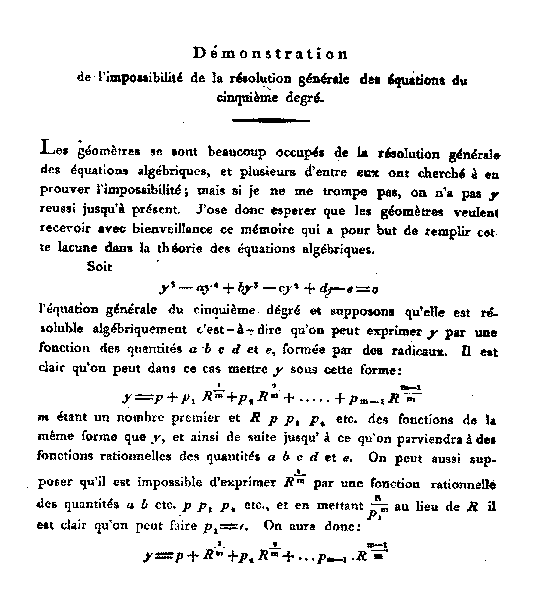
阿贝尔获得了一笔小额资助,前往哥本哈根拜访Degen和其他数学家。在那里,他遇到了Christine Kemp,后者不久后成为了他的未婚妻。回到克里斯蒂安尼亚后,阿贝尔试图让克里斯蒂安尼亚大学给他一笔更大的资助,以便他能拜访德国和法国的顶尖数学家。他不会说法语或德语,因此,部分为了省钱,他获得了留在克里斯蒂安尼亚两年的资金,以便在旅行前有机会熟练掌握这些语言。阿贝尔重新开始研究五次方程,并于1824年证明了用根式求解一般五次方程是不可能的。他用法语发表了这项工作,并自费出版,因为他希望旅行时能随身携带一份令人印象深刻的作品。正如Ayoub在[6]中所写:-
他选择了一本小册子,作为最快付印的方式,并且为了节省印刷费用,他将证明缩减到半张对开纸[六页]的篇幅。
此时,阿贝尔似乎已经对保罗·鲁菲尼的工作有所了解,因为他在本科期间就研究过奥古斯丁·路易·柯西1815年的工作,而在这篇论文中引用了保罗·鲁菲尼的工作。阿贝尔1824年的论文开头写道([6]):-
几何学家们曾大量研究代数方程的一般解,其中几位曾试图证明其不可能性。但是,如果我没有弄错的话,他们至今尚未成功。
阿贝尔把这本小册子寄给了几位数学家,包括卡尔·弗里德里希·高斯,他打算在旅行途中到哥廷根拜访此人。1825年8月,阿贝尔获得了挪威政府提供的奖学金,得以出国旅行。他用了一个月处理完事务后,便与四位朋友出发前往欧洲大陆,首先拜访了挪威和丹麦的数学家。到达哥本哈根时,阿贝尔发现Degen已经去世,于是他改变了主意,没有采纳Hansteen直接去巴黎的建议,因为他不想独自旅行,宁愿和要去柏林的朋友们待在一起。正如他在后来的一封信([7])中所写:-
现在我的天性使我无法忍受孤独。独自一人时,我会抑郁,会变得脾气暴躁,而且几乎没有工作的意愿。
阿贝尔从那里的一位数学家那里得到了一封给奥古斯都·利奥波德·克雷勒的介绍信。阿贝尔在柏林遇到了奥古斯都·利奥波德·克雷勒,两人成了坚定的朋友。这被证明是阿贝尔整个旅程中最有用的部分,特别是因为奥古斯都·利奥波德·克雷勒即将开始出版一份致力于数学研究的期刊。阿贝尔受到奥古斯都·利奥波德·克雷勒的鼓励,把他关于五次方程不可解性的工作写成了一个更清晰的版本,其结果就是Recherches sur les fonctions elliptiques Ⓣ(《椭圆函数研究》),该文于1827年发表在Crelle's Journal第一卷上,同时发表的还有阿贝尔的另外六篇论文。在柏林期间,阿贝尔得知克里斯蒂安尼亚大学——挪威唯一的大学——的数学教授职位已经给了Holmboe。由于在挪威没有获得大学职位的希望,阿贝尔开始担心自己的未来。
Crelle's Journal继续是阿贝尔论文的来源,而阿贝尔开始致力于在严格的基础上建立数学分析。他从柏林写信给Holmboe[2]:-
我的眼界以最令人惊讶的方式被打开了。如果你不考虑最简单的情形,那么在整个数学中,没有一个无穷级数的和已经被严格确定。换句话说,数学中最重要的部分没有基础。诚然,其中大部分是有效的,但这非常令人惊讶。我努力为它寻找一个理由,这是一个极其有趣的问题。
阿贝尔原本打算与奥古斯都·利奥波德·克雷勒一起去巴黎,并在途中到哥廷根拜访卡尔·弗里德里希·高斯。然而,消息传回阿贝尔那里,说卡尔·弗里德里希·高斯收到他关于五次方程不可解性的工作后并不高兴,所以阿贝尔决定最好还是不去哥廷根。不确定卡尔·弗里德里希·高斯为何对阿贝尔的工作持这种态度,因为他肯定从未读过它——这篇论文在卡尔·弗里德里希·高斯去世后被找到时还未开封。Ayoub给出了两个可能的原因[6]:-
第一种可能是卡尔·弗里德里希·高斯自己证明了这一结果,并愿意让阿贝尔获得荣誉。另一种解释是他并不十分重视根式可解性。
第二种解释似乎更有可能,特别是因为卡尔·弗里德里希·高斯在其1801年的学位论文中曾写道,方程的代数解并不比为一个方程的根发明一个符号,然后说该方程有一个等于该符号的根更好。
奥古斯都·利奥波德·克雷勒被滞留在柏林,无法与阿贝尔一同前往巴黎。因此阿贝尔没有直接去巴黎,而是选择再次与他的挪威朋友们一起前往意大利北部,然后翻越阿尔卑斯山进入法国。在Paris Abel失望地发现自己的作品很少有人感兴趣。他写信给Holmboe([7]):——
法国人对陌生人比德国人更加矜持。要获得他们的亲近极为困难,我不敢把自己的要求推进到那种程度;最后,每个初来者在这里要引起注意都极为困难。我刚完成了一篇关于某一类超越函数的 extensive 论文,准备提交给研究院,这将在下周一完成。我把它给奥古斯丁·路易·柯西先生看了,但他几乎不屑一顾。
阿贝尔这篇论文的内容和重要性在[2]中有描述:——
它涉及给定代数函数的积分之和。阿贝尔的定理指出,任何这样的和都可以表示为固定数目p个这样的积分,其积分自变量是原始自变量的代数函数。最小数p就是该代数函数的亏格,这是这个基本量第一次出现。阿贝尔的定理是莱昂哈德·欧拉关于椭圆积分的关系的一个巨大推广。
任命了两位审稿人,奥古斯丁·路易·柯西和阿德里安-马里·勒让德,来审阅这篇论文,而阿贝尔在巴黎待了几个月[14]:-
……消瘦、忧郁、疲惫,并且一直忧心忡忡。他……一天只吃得起一顿饭。
他发表了一些文章,主要是关于他已经为Crelle's Journal写好的结果,然后由于没有钱且健康状况极差,他于1826年底回到了柏林。在柏林,阿贝尔借了一些钱,继续研究椭圆函数。他写了一篇论文,其中[2]:-
……他通过使用椭圆积分的反函数,将椭圆积分理论彻底转变为椭圆函数理论……
奥古斯都·利奥波德·克雷勒试图说服阿贝尔留在柏林,直到他能为其找到一个学术职位,他甚至向阿贝尔提供了Crelle's Journal的编辑职位。然而,阿贝尔想回家,而此时他已负债累累。他于1827年5月到达克里斯蒂安尼亚,大学授予了他一小笔钱,尽管他们确保有权从他未来挣得的任何薪水中扣除相应金额。为了多挣一点钱,阿贝尔给学童做家教,他的未婚妻则在弗罗兰为阿贝尔家的朋友做家庭教师。
Hansteen获得了一大笔资助去西伯利亚研究地球磁场,需要一个人替代他在大学和军事学院授课。阿贝尔被任命担任这个职位,这稍微改善了他的处境。
1828年,阿贝尔看到了卡尔·古斯塔夫·雅各布·雅可比关于椭圆积分变换的一篇论文。阿贝尔很快表明卡尔·古斯塔夫·雅各布·雅可比的结果是他自己结果的推论,并在其关于椭圆函数的主要著作的第二部分加了一个注记说明这一点。他再次研究方程的代数解,目的是解决哪些方程是根式可解的问题(埃瓦里斯特·伽罗瓦几年后解决的那个问题)。他把这个搁置一旁,以便在椭圆函数理论上与卡尔·古斯塔夫·雅各布·雅可比竞争,迅速写了几篇关于这个主题的论文。
阿德里安-马里·勒让德看到了阿贝尔和卡尔·古斯塔夫·雅各布·雅可比正在撰写的论文中的新思想,并说([2]):-
通过这些工作,你们两人将被归入我们时代最杰出的分析学家之列。
阿贝尔在健康状况持续恶化之际,仍不断产出高质量的数学成果。1828年暑假,他与未婚妻在弗罗兰度过。他提交给巴黎科学院的杰作似乎已经遗失,于是他把主要结果重新写了下来[3]:-
这篇论文只有短短两页,但在他众多作品中或许是最令人心酸的。他只称之为“一个定理”:没有引言,没有多余的评论,没有应用。它是一座以其简洁线条而熠熠生辉的纪念碑——他巴黎回忆录中的主要定理,用寥寥数语表述出来。
1828年圣诞节,阿贝尔乘雪橇再次前往弗罗兰探望未婚妻。他在雪橇旅途中病得很重,尽管病情有所好转,使他们得以享受圣诞节,但他很快又病得非常严重。奥古斯都·利奥波德·克雷勒得知后,加倍努力为阿贝尔在柏林谋取职位。他成功了,并于1829年4月8日写信给阿贝尔告知这个好消息。但为时已晚,阿贝尔已经去世。Ore[3]描述了他最后几天的情形:-
……虚弱和咳嗽加剧,他只能在床铺整理时离开床几分钟。偶尔他会尝试研究数学,但已无法书写。有时他活在过去,谈论自己的贫困和Fru Hansteen的善良。他始终温和而耐心。……
他在4月5日夜间经受了最剧烈的痛苦。临近早晨时他变得较为安静,上午十一点钟,他呼出了最后一口气。
阿贝尔去世后,他的巴黎回忆录于1830年被奥古斯丁·路易·柯西经过大量搜寻后发现。它于1841年付印,但相当引人注目的是它再次消失,直到1952年才在佛罗伦萨重新出现。同样在阿贝尔去世后,人们发现了关于方程代数解法的未发表工作。事实上,在1828年10月18日阿贝尔写给奥古斯都·利奥波德·克雷勒的一封信中,他给出了定理[13]:-
如果一个prime次不可约方程的每三个根之间都以这样一种方式相互关联,使得其中一个根可以用另外两个根有理地表示出来,那么这个方程可用根式求解。
这一结果与埃瓦里斯特·伽罗瓦在其1830年著名回忆录中给出的一个结果本质上是相同的。同样在1830年,Paris Academy因阿贝尔和卡尔·古斯塔夫·雅各布·雅可比的杰出工作而授予他们大奖。
Niels Abel's life was dominated by poverty and we begin by putting this in context by looking briefly at the political problems which led to economic problems in Norway. At the end of the 18th century Norway was part of Denmark and the Danish tried to remain neutral through the Napoleonic wars. However a neutrality treaty in 1794 was considered a aggressive act by Britain and, in 1801, the British fleet destroyed most of the Danish fleet in a battle in the harbour at Copenhagen. Despite this Denmark-Norway avoided the war until 1807 when Britain feared that the Danish fleet might be used by the French to invade. Using the philosophy that attack is the best form of defence, the English attacked and captured the whole Danish fleet in October 1807.
Denmark then joined the alliance against Britain. The continental powers blockaded Britain, and as a counter to this Britain blockaded Norway. The twin blockade was a catastrophe to Norway preventing their timber exports, which had been largely to Britain, and preventing their grain imports from Denmark. An economic crisis in Norway followed with the people suffering hunger and extreme poverty. In 1813 Sweden attacked Denmark from the south and, at the treaty of Kiel in January 1814, Denmark handed over Norway to Sweden. An attempt at independence by Norway a few months later led to Sweden attacking Norway in July 1814. Sweden gained control of Norway, setting up a complete internal self-government for Norway with a government in Christiania (which is called Oslo today). In this difficult time Abel was growing up in Gjerstad in south-east Norway.
Abel's father, Sören Georg Abel, had a degree in theology and philology and his father (Niels Abel's grandfather) was a Protestant minister at Gjerstad near Risor. Sören Abel was a Norwegian nationalist who was active politically in the movement to make Norway independent. Sören Abel married Ane Marie Simonson, the daughter of a merchant and ship owner, and was appointed as minister at Finnoy. Niels Abel, the second of seven children, was one year old when his grandfather died and his father was appointed to succeed him as the minister at Gjerstad. It was in that town that Abel was brought up, taught by his father in the vicarage until he reached 13 years of age. However, these were the 13 years of economic crisis for Norway described above and Abel's parents would have not been able to feed their family very well. The problems were not entirely political either for [14]:-
[Abel's] father was probably a drunkard and his mother was accused of having lax morals.
Abel's father was, however, important in the politics of Norway and, after Sweden gained control of Norway in 1814, he was involved in writing a new constitution for Norway as a member of the Storting, the Norwegian legislative body. In 1815 Abel and his older brother were sent to the Cathedral School in Christiania. The founding of the University of Christiania had taken away the good teachers from the Cathedral School to staff the University when it opened for teaching in 1813. What had been a good school was in a bad state when Abel arrived. Uninspired by the poor school, he proved a rather ordinary pupil with some talent for mathematics and physics.
When a new mathematics teacher Bernt Holmboe joined the school in 1817 things changed markedly for Abel. The previous mathematics teacher had been dismissed for punishing a boy so severely that he had died. Abel began to study university level mathematics texts and, within a year of Holmboe's arrival, Abel was reading the works of Euler, Newton, Lalande and d'Alembert. Holmboe was convinced that Abel had great talent and encouraged him greatly taking him on to study the works of Lagrange and Laplace. However, in 1820 tragedy struck Abel's family when his father died.
Abel's father had ended his political career in disgrace by making false charges against his colleagues in the Storting after he was elected to the body again in 1818. His habits of drinking to excess also contributed to his dismissal and the family was therefore in the deepest trouble when he died. There was now no money to allow Abel to complete his school education, nor money to allow him to study at university and, in addition, Abel had the responsibility of supporting his mother and family.
Holmboe was able to help Abel gain a scholarship to remain at school and Abel was able to enter the University of Christiania in 1821, ten years after the university was founded. Holmboe had raised money from his colleagues to enable Abel to study at the university and he graduated in 1822. While in his final year at school, however, Abel had begun working on the solution of quintic equations by radicals. He believed that he had solved the quintic in 1821 and submitted a paper to the Danish mathematician Ferdinand Degen, for publication by the Royal Society of Copenhagen. Degen asked Abel to give a numerical example of his method and, while trying to provide an example, Abel discovered the mistake in his paper. Degen had given Abel some important advice that was to set him working on an area of mathematics (see [2]):-
... whose development would have the greatest consequences for analysis and mechanics. I refer to elliptic integrals. A serious investigator with suitable qualifications for research of this kind would by no means be restricted to the many beautiful properties of these most remarkable functions, but could discover a Strait of Magellan leading into wide expanses of a tremendous analytic ocean.
At the University of Christiania Abel found a supporter in the professor of astronomy Christopher Hansteen, who provided both financial support and encouragement. Hansteen's wife began to care for Abel as if he was her own son. In 1823 Abel published papers on functional equations and integrals in a new scientific journal started up by Hansteen. In Abel's third paper, Solutions of some problems by means of definite integrals he gave the first solution of an integral equation.
Abel was given a small grant to visit Degen and other mathematicians in Copenhagen. While there he met Christine Kemp who shortly afterwards became his fiancée. Returning to Christiania, Abel tried to get the University of Christiania to give him a larger grant to enable him to visit the top mathematicians in Germany and France. He did not speak French or German so, partly to save money, he was given funds to remain in Christiania for two years to give him the chance to become fluent in these languages before travelling. Abel began working again on quintic equations and, in 1824, he proved the impossibility of solving the general equation of the fifth degree in radicals. He published the work in French and at his own expense since he wanted an impressive piece of work to take with him when he was on his travels. As Ayoub writes in [6]:-
He chose a pamphlet as the quickest way to get it into print, and in order to save on the printing costs, he reduced the proof to fit on half a folio sheet [six pages].
By this time Abel seems to have known something of Ruffini's work for he had studied Cauchy's work of 1815 while he was an undergraduate and in this paper there is a reference to Ruffini's work. Abel's 1824 paper begins ([6]):-
Geometers have occupied themselves a great deal with the general solution of algebraic equations and several among them have sought to prove the impossibility. But, if I am not mistaken, they have not succeeded up to the present.
Abel sent this pamphlet to several mathematicians including Gauss, whom he intended to visit in Göttingen while on his travels. In August 1825 Abel was given a scholarship from the Norwegian government to allow him to travel abroad and, after taking a month to settle his affairs, he set out for the Continent with four friends, first visiting mathematicians in Norway and Denmark. On reaching Copenhagen, Abel found that Degen had died and he changed his mind about taking Hansteen's advice to go directly to Paris, preferring not to travel alone and stay with his friends who were going to Berlin. As he wrote in a later letter ([7]):-
Now I am so constituted that I cannot endure solitude. Alone, I am depressed, I get cantankerous, and I have little inclination to work.
In Copenhagen Abel was given a letter of introduction to Crelle by one of the mathematicians there. Abel met Crelle in Berlin and the two became firm friends. This proved the most useful part of Abel's whole trip, particularly as Crelle was about to begin publishing a journal devoted to mathematical research. Abel was encouraged by Crelle to write a clearer version of his work on the insolubility of the quintic and this resulted in Recherches sur les fonctions elliptiques Ⓣ which was published in 1827 in the first volume of Crelle's Journal, along with six other papers by Abel. While in Berlin, Abel learnt that the position of professor of mathematics at the University of Christiania, the only university in Norway, had been given to Holmboe. With no prospects of a university post in Norway, Abel began to worry about his future.
Crelle's Journal continued to be a source for Abel's papers and Abel began to work to establish mathematical analysis on a rigorous basis. He wrote to Holmboe from Berlin [2]:-
My eyes have been opened in the most surprising manner. If you disregard the very simplest cases, there is in all of mathematics not a single infinite series whose sum had been rigorously determined. In other words, the most important parts of mathematics stand without foundation. It is true that most of it is valid, but that is very surprising. I struggle to find a reason for it, an exceedingly interesting problem.
It had been Abel's intention to travel with Crelle to Paris and to visit Gauss in Göttingen on the way. However, news got back to Abel that Gauss was not pleased to receive his work on the insolubility of the quintic, so Abel decided that he would be better not to go to Göttingen. It is uncertain why Gauss took this attitude towards Abel's work since he certainly never read it - the paper was found unopened after Gauss's death. Ayoub gives two possible reasons [6]:-
... the first possibility is that Gauss had proved the result himself and was willing to let Abel take the credit. ... The other explanation is that he did not attach very much importance to solvability by radicals...
The second of these explanations does seem the more likely, especially since Gauss had written in his thesis of 1801 that the algebraic solution of an equation was no better than devising a symbol for the root of the equation and then saying that the equation had a root equal to the symbol.
Crelle was detained in Berlin and could not travel with Abel to Paris. Abel therefore did not go directly to Paris, but chose to travel again with his Norwegian friends to northern Italy before crossing the Alps to France. In Paris Abel was disappointed to find there was little interest in his work. He wrote back to Holmboe ([7]):-
The French are much more reserved with strangers than the Germans. It is extremely difficult to gain their intimacy, and I do not dare to urge my pretensions as far as that; finally every beginner had a great deal of difficulty getting noticed here. I have just finished an extensive treatise on a certain class of transcendental functions to present it to the Institute which will be done next Monday. I showed it to Mr Cauchy, but he scarcely deigned to glance at it.
The contents and importance of this treatise by Abel is described in [2]:-
It dealt with the sum of integrals of a given algebraic function. Abel's theorem states that any such sum can be expressed as a fixed number p of these integrals, with integration arguments that are algebraic functions of the original arguments. The minimal number p is the genus of the algebraic function, and this is the first occurrence of this fundamental quantity. Abel's theorem is a vast generalisation of Euler's relation for elliptic integrals.
Two referees, Cauchy and Legendre, were appointed to referee the paper and Abel remained in Paris for a few months [14]:-
... emaciated, gloomy, weary and constantly worried. He ... could only afford to eat one meal a day.
He published some articles, mainly on the results he had already written for Crelle's Journal, then with no money left and his health in a very poor state, he returned to Berlin at the end of 1826. In Berlin, Abel borrowed some money and continued working on elliptic functions. He wrote a paper in which [2]:-
... he radically transformed the theory of elliptic integrals to the theory of elliptic functions by using their inverse functions ...
Crelle tried to persuade Abel to remain in Berlin until he could find an academic post for him and he even offered Abel the editorship of Crelle's Journal. However, Abel wanted to get home and by this time he was heavily in debt. He reached Christiania in May 1827 and was awarded a small amount of money by the university although they made sure they had the right to deduct a corresponding amount from any future salary he earned. To make a little more money Abel tutored schoolchildren and his fiancée was employed as a governess to friends of Abel's family in Froland.
Hansteen received a major grant to investigate the Earth's magnetic field in Siberia and a replacement was needed to teach for him at the University and also at the Military Academy. Abel was appointed to this post which improved his position a little.
In 1828 Abel was shown a paper by Jacobi on transformations of elliptic integrals. Abel quickly showed that Jacobi's results were consequences of his own and added a note to this effect to the second part of his major work on elliptic functions. He had been working again on the algebraic solution of equations, with the aim of solving the problem of which equations were soluble by radicals (the problem which Galois solved a few years later). He put this to one side to compete with Jacobi in the theory of elliptic functions, quickly writing several papers on the topic.
Legendre saw the new ideas in the papers which Abel and Jacobi were writing and said ([2]):-
Through these works you two will be placed in the class of the foremost analysts of our times.
Abel continued to pour out high quality mathematics as his health continued to deteriorate. He spent the summer vacation of 1828 with his fiancée in Froland. The masterpiece which he had submitted to the Paris Academy seemed to have been lost and so he wrote the main result down again [3]:-
The paper was only two brief pages, but of all his many works perhaps the most poignant. He called it only "A theorem": it had no introduction, contained no superfluous remarks, no applications. It was a monument resplendent in its simple lines - the main theorem from his Paris memoir, formulated in few words.
Abel travelled by sled to visit his fiancée again in Froland for Christmas 1828. He became seriously ill on the sled journey and despite an improvement which allowed them to enjoy Christmas, he soon became very seriously ill again. Crelle was told and he redoubled his efforts to obtain an appointment for Abel in Berlin. He succeeded and wrote to Abel on the 8 April 1829 to tell him the good news. It was too late, Abel had already died. Ore [3] describes his last few days:-
... the weakness and cough increased and he could remain out of bed only the few minutes while it was being made. Occasionally he would attempt to work on his mathematics, but he could no longer write. Sometimes he lived in the past, talking about his poverty and about Fru Hansteen's goodness. Always he was kind and patient. ...
He endured his worst agony during the night of April 5. Towards morning he became more quiet and in the forenoon, at eleven o'clock, he expired his last sigh.
After Abel's death his Paris memoir was found by Cauchy in 1830 after much searching. It was printed in 1841 but rather remarkably vanished again and was not found until 1952 when it turned up in Florence. Also after Abel's death unpublished work on the algebraic solution of equations was found. In fact in a letter Abel had written to Crelle on 18 October 1828 he gave the theorem [13]:-
If every three roots of an irreducible equation of prime degree are related to one another in such a way that one of them may be expressed rationally in terms of the other two, then the equation is soluble in radicals.
This result is essentially identical to one given by Galois in his famous memoir of 1830. In this same year 1830 the Paris Academy awarded Abel and Jacobi the Grand Prix for their outstanding work.
正文里的方括号编号指向这里,悬停即可直接看到条目。书目保留原文——译了书名反而查不到文献。
原站列出的延伸阅读与外部数据库,照原样保留,目标多为英文页面。
关于尼尔斯·阿贝尔的其它页面:
原站的交叉引用。指向本站已镜像专题的留在站内,其余仍指回原站。