数学家传记
乔治·伯克利是一位爱尔兰主教和哲学家,他对数学最著名的贡献是对艾萨克·牛顿所发展的微积分的逻辑基础的攻击。
乔治·伯克利的父亲是William Berkeley,他的母亲据信是伊丽莎白·萨瑟恩,尽管这尚未完全确定。William Berkeley是一位乡绅农民,其家族最初来自英格兰的斯塔福德郡,而伊丽莎白·萨瑟恩是都柏林酿酒商的女儿。伯克利在他父亲拥有的托马斯敦附近的戴瑟特城堡长大。他于1696年7月进入基尔肯尼的奥蒙德公爵学校,在那里学习到1700年1月,然后,尽管还不到十五岁,他进入了都柏林三一学院。他于1700年3月入学,刚满十五岁,作为自费生,这意味着他没有奖学金并支付自己在学院的食宿费用。1701年,他被选为伊拉斯谟·史密斯展览会成员,并在次年获得奖学金。他于1704年春季获得学士学位毕业。
Stewart写道[3]:-
毕业后,他编写了一本初等教科书,在其中探讨了算术记号的基础以及作为该记号之函数的各项主要算术运算,并在解释这些内容时不借助代数或几何方法。他于1707年将此书以⟦E1⟧为名出版,同时出版的还有另一组题为⟦E2⟧的研究……并表明数学已是他的主要兴趣达三年之久。
伯克利当时正在撰写这些数学文本,其全名为Arithmetica absque Algebra aut Euclide demonstrata(不借助代数或欧几里得而证明的算术),等待机会竞争一个研究员职位。1706年,一个学院研究员职位空缺,在参加了一些极为严苛的竞争性考试后,他于1707年6月9日成为都柏林三一学院的初级研究员。同年晚些时候,11月19日,他在都柏林哲学学会宣读了其文章Of infinites,但这部数学与哲学著作只在他去世后才出版。这部著作,如同先前的数学著作一样,清楚表明伯克利深受洛克影响。除了承担一些轻松的辅导工作外,他还研习神学,并于1709年2月被任命为执事,次年又被任命为牧师。在此期间,他出版了两部重要著作,1709年的An Essay towards a New Theory of Vision和1710年的A Treatise concerning the Principles of Human Knowledge。据伯克利所述,第一部著作的目的是:-
……展示我们如何通过视觉感知物体的距离、大小和位置。还要考虑视觉观念与触觉观念之间的差异,以及是否存在两种感官共有的观念。
在第二部著作中,他考察了抽象观念。他在导言中陈述了他深入讨论的那些概念:-
所有人都同意,事物的性质或样式从来不会各自真正单独存在,与所有其他性质分离,而是可以说混合在一起,若干性质融合于同一对象之中。但我们被告知,心灵能够单独考虑每一性质,或将其与和它结合的其他性质分开来抽象考虑,借此为自身形成抽象观念。……并非颜色或运动能够离开广延而存在:而只是心灵能够通过抽象为自身形成排除广延的颜色观念,以及排除颜色和广延两者的运动观念。
伯克利将A Treatise concerning the Principles of Human Knowledge寄给了萨缪尔·克拉克和威廉·惠斯顿。
关于威廉·惠斯顿的评论,见THIS LINK。
伯克利继续保有都柏林三一学院的会士职位直到1724年,但1713年至1724年的大部分时间他都不在都柏林。1713年1月他前往伦敦,在那里安排出版了他的一些著作。同年11月,他作为彼得伯勒勋爵的随行牧师动身前往意大利。他写道:
绿色的田野和树林、繁花盛开的草地和潺潺的溪流,在任何地方都不如在英格兰那样完美:但如果你想见识明媚的日子、温暖的阳光和湛蓝的天空,你就必须到意大利来;而要使一个人能够描绘岩石和悬崖,他绝对必须翻越阿尔卑斯山。
他于1714年8月返回英格兰,那年年底他发烧了,约翰·亚毕诺对此作了描述,并开了一个针对伯克利哲学的玩笑:
19 October 1714: ... poor philosopher Berkeley has now 'the idea of health', which was very hard to produce in him; for he had 'an idea' of a strange fever on him so strong, that it was very hard to destroy it by introducing a contrary one。
伯克利于1716年与三一学院院长的儿子伯克利 Ashe一起返回意大利,并在那里度过了四年。他生动地描述了1717年维苏威火山的喷发:
1717年4月17日:……我费了很大力气才到达维苏威火山的山顶,在那里我看到一个巨大的喷口,充满了烟雾,使人无法看清它的深度和形状。我听到那可怕的深渊中传出某些奇怪的声音,似乎是从山腹中发出的;一种低沉的喃喃声、叹息声、搏动声、搅动声……6月5日,在一阵可怕的噪音之后,从那不勒斯可以看到火山从火山口喷出一点东西。6日情况依旧。7日,直到入夜前两小时才观察到动静,那时它开始发出可怕的吼叫,持续了整夜和第二天直到中午,使窗户,据一些人断言,甚至那不勒斯的房屋都为之震动。从那时起,它向南喷出大量熔融物质,沿着山坡流下,像一口大锅沸腾溢出。
在返回英格兰的途中,伯克利在里昂逗留了一段时间,在那里他撰写了论文De motu(论运动),并将其提交给科学院的大奖赛。他没有成功。他在1721年初抵达伦敦,到1721-22学年开始时,他已在都柏林,此时他是高级研究员(这一职位是他在1717年在意大利时被任命的)。他承担了额外的职责,如[3]:-
... 图书管理员、初级院长、希腊语讲师、神学讲师、高级学监和希伯来语讲师。
1724年5月,伯克利辞去了在三一学院的职位,成为伦敦德里郡的圣公会主任牧师,但他从未在该市居住,接下来的四年大部分时间都在伦敦度过。在这些年里,他计划在百慕大建立一所学院,以培训殖民者和美洲原住民的儿子,他希望将他们转变为:-
... 宗教、道德和公民生活。
在伦敦下议院投票后,为伯克利的项目承诺了10000英镑的资金:-
向陛下呈递一份谦卑的致辞,即从圣克里斯托弗的土地中,根据乌得勒支条约由法国割让给大不列颠,陛下将慷慨地为此目的授予圣保罗学院在百慕大的院长和研究员使用,陛下认为适当。
1728年8月1日,他与安妮·福斯特结婚,不久之后他们便启航前往美洲。他们抵达了罗德岛纽波特,并买下了一座农场。他们的头两个孩子亨利和伯克利出生时,全家正住在罗德岛纽波特附近。他在那里等待10000英镑拨款到位,以便能够建造计划中的学院。然而,到1731年中期,显然他拿不到这笔拨款了,于是他于10月返回伦敦。他在美洲期间写了许多文章,并在返回后的两三年内发表。
1734年1月,伯克利被任命为克洛因主教,并于1734年5月19日在都柏林圣保罗教堂祝圣。在这个职位上,他致力于爱尔兰的社会和经济困境,作为一名圣公会主教,他尽力帮助这个以罗马天主教为主的国家中所有人的境况。1745年,詹姆斯党叛乱时期,伯克利向他教区内的罗马天主教徒发表讲话,1749年他又向罗马天主教神职人员发表了A Word to the Wise。他在1749年11月18日的《都柏林日报》上收到了一封回复,天主教神职人员在回复中表达了:-
……对这位可敬作者的真诚而衷心的感谢,向他保证他们决心尽最大努力遵行他在讲话中推荐的每一项具体内容。……[伯克利的讲话]每一页都包含着作者广博仁爱的证明;他的观点只着眼于公共利益;他所规定的办法容易遵行;他对待处于他们那种境况的人的方式如此独特,清楚地显示出他是一个好人、一位彬彬有礼的绅士和一位真正的爱国者。
他忠于克洛因,总是就地购买自己的衣服,尽管这意味着衣服质量不是最好的,但他想支持就业。他开办了一所学校,教孩子们纺纱,还想使亚麻制造成为可能。他写道:-
孩子们开始从得到硬通货报酬中找到乐趣;据我所知,他们不会把钱交给父母,而是留着给自己买衣服……我正在为强壮的流浪者建造一所济贫院,并打算种植大约两英亩大麻来雇用他们。
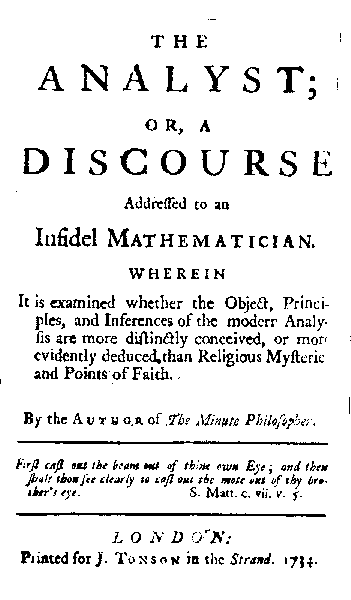
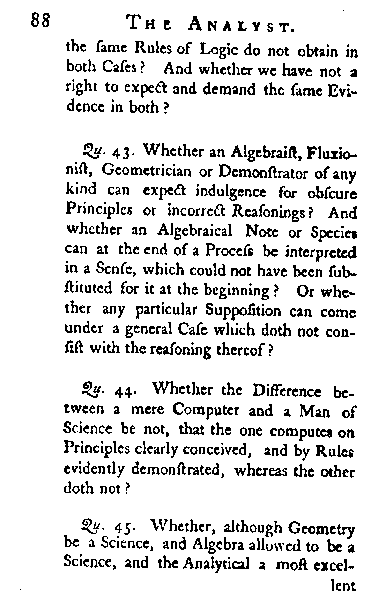
伯克利在数学界最为人所知的是他攻击了由艾萨克·牛顿发展起来的微积分的逻辑基础。在他1734年出版的The analyst: or a discourse addressed to an infidel mathematician中,他试图论证,尽管微积分能得出正确的结果,但其基础并不比宗教的基础更稳固。他宣称微积分涉及一种假设转移的逻辑谬误。他对导数描述如下:-
那么这些流数是什么?是正在消失的增量的速度。那么这些相同的正在消失的增量又是什么?它们既不是有限量,也不是无限小量,也不是零。我们难道不能称它们为已逝去量的鬼魂吗?
伯克利的批评是有充分根据且重要的,因为它使数学家的注意力集中在微积分的逻辑澄清上。他发展了一种巧妙的理论来解释所得到的正确结果,声称这是两个相互补偿的错误的结果。Ren在[30]中写道:-
通过回顾伯克利的一生和《分析家》的内容,我们得出结论,他的批评是正确的,并且客观上推动了微积分基础的改进。积极接受各种形式的批评有助于数学的正常发展。
我们给出的许多其他参考文献也讨论了伯克利对微积分的攻击;见[5]、[11]、[19]、[21]、[26]、[30]和[33]。亚伯拉罕·棣莫弗、布鲁克·泰勒、科林·麦克劳林、约瑟夫·拉格朗日、雅各布·伯努利和约翰·伯努利都尝试将希腊人的严格论证引入微积分。Treatise on fluxions中的科林·麦克劳林对伯克利给出了最好的回应。
到18世纪40年代末,伯克利的健康状况日益恶化。他最小的儿子威廉于1751年去世,这加剧了他的衰弱。尽管如此,他还是在1752年7月与妻子前往牛津,去看他的次子伯克利在基督堂学院开始学业。事实上,他打算在牛津度过余生,而他预计这余生不会很长。1753年1月14日星期日晚上,他与家人坐在一起听妻子朗读时,因心脏病发作去世。他死得如此安详,据说这一变故竟未被察觉,家人还以为他睡着了。他留下遗愿,要求至少五天内不得下葬,最终于1月20日被安葬在牛津的基督堂学院。
George Berkeley's father was William Berkeley and his mother is believed to have been Elisabeth Southerne, although this has not been verified with complete certainty. William Berkeley was a gentleman farmer whose family originally came from Staffordshire in England while Elisabeth Southerne was the daughter of a Dublin brewer. George grew up in Dysert Castle, near Thomastown, which his father owned. He entered the Duke of Ormonde's School in Kilkenny in July 1696 and studied there until January 1700 and then, although still not fifteen years of age, he entered Trinity College, Dublin. He matriculated in March 1700, just after he reached the age of fifteen as a pensioner, meaning that he did not have a scholarship and paid for his own keep in College. In 1701 he was elected to an Erasmus Smith exhibition, and was awarded a scholarship in the following year. He graduated with a B.A. in the spring of 1704.
Stewart writes [3]:-
After graduating he prepared an elementary textbook in which he explored the basis of arithmetical notation and the principal arithmetical processes as functions of that notation, explaining these without resort to algebraic or geometrical techniques. He published this in 1707 as "Arithmetica", jointly with a further set of studies entitled "Miscellanea mathematica" ... and indicated that mathematics had been his primary interest for three years.
Berkeley was working on these mathematics texts, whose full title is Arithmetica absque Algebra aut Euclide demonstrata (Arithmetic demonstrated without algebra or Euclid), waiting for the chance to compete for a fellowship. In 1706 a College Fellowship became available and, after taking some extremely demanding competitive examinations, he became a Junior Fellow of Trinity College, Dublin on 9 June 1707. Later in that year, on 19 November, he read his article Of infinites to the Dublin Philosophical Society, but this mathematical and philosophical work was only published after his death. This work, as the previous mathematical ones, clearly shows that Berkeley was much influenced by Locke. As well as carrying out some light tutoring duties, he studied divinity and was ordained deacon in February 1709 and ordained a priest in the following year. During this time he published two important works, An Essay towards a New Theory of Vision in 1709 and A Treatise concerning the Principles of Human Knowledge in 1710. The purpose of the first, as stated by Berkeley, is:-
... to show the manner wherein we perceive by sight the distance, magnitude, and situation of objects. Also to consider the difference there is between the ideas of sight and touch, and whether there is any idea common to both senses.
In the second work he examines abstract ideas. He states in the introduction the notions he discusses in depth:-
It is agreed on all hands, that the qualities or modes of things do never really exist each of them apart by itself, and separated from all others, but are mixed, as it were, and blended together, several in the same object. But we are told, the mind being able to consider each quality singly, or abstracted from those other qualities with which it is united, does by that means frame to itself abstract ideas. ... Not that it is possible for colour or motion to exist without extension: but only that the mind can frame to itself by abstraction the idea of colour exclusive of extension, and of motion exclusive of both colour and extension.
Berkeley sent A Treatise concerning the Principles of Human Knowledge to Samuel Clarke and William Whiston.
See THIS LINK for Whiston's comments.
Although Berkeley continued to hold his fellowship at Trinity College, Dublin, until 1724, he spent most of the period from 1713 to 1724 away from Dublin. He went to London in January 1713 where he arranged publication of some of his works. In November of that year he set off for Italy as chaplain to Lord Peterborough. He wrote:-
Green fields and groves, flowery meadows and purling streams, are no where in such perfection as in England: but if you would know lightsome days, warm suns, and blue skies, you must come to Italy, and to enable a man to describe rocks and precipices, it is absolutely necessary that he pass the Alps.
He returned to England in August 1714 and towards the end of the year he had a fever which Arbuthnot described with a joke aimed at Berkeley's philosophy:-
19 October 1714 : ... poor philosopher Berkeley has now 'the idea of health', which was very hard to produce in him; for he had 'an idea' of a strange fever on him so strong, that it was very hard to destroy it by introducing a contrary one.
Berkeley returned to Italy in 1716 with George Ashe, son of the Trinity College provost, and he spent four years there. He gives a vivid description of the eruption of Vesuvius in 1717:-
April 17, 1717 : ... with much difficulty I reached the top of Mount Vesuvius, in which I saw a vast aperture full of smoke, which hindered the seeing its depth and figure. I heard within that horrid gulf certain odd sounds, which seemed to proceed from the belly of the mountain; a sort of murmuring, sighing, throbbing, churning ... June 5, after a horrid noise, the mountain was seen at Naples to spew a little out of the crater. The same continued the sixth. The seventh, nothing was observed till within two hours of night, when it began a hideous bellowing, which continued all that night and the next day till noon, causing the windows, and, as some affirm, the very houses in Naples to shake. From that time it spewed vast quantities of molten stuff to the South, which streamed down the side of the mountain like a great pot boiling over.
On the journey back to England Berkeley spent some time in Lyon where he wrote the essay De motu (On motion) which he submitted for the Grand Prix of the Academy of Sciences. He was not successful. He reached London early in 1721 and by the start of the 1721-22 academic year he was in Dublin where he was now a Senior Fellow (a position to which he had been appointed in 1717 while in Italy). He took on additional duties such as [3]:-
... librarian, junior dean, Greek lecturer, divinity lecturer, senior proctor, and Hebrew lecturer.
In May 1724 Berkeley resigned his position at Trinity College to become Anglican Dean of Londonderry, but he never resided in the city spending most of the next four years in London. Over these years he planned to establish a College in Bermuda to train the sons of colonists and Native Americans whom he wished to convert to:-
... religion, morality, and civil life.
Funds of 10000 pounds for Berkeley's project were promised after the House of Commons in London voted:-
That an humble address be presented to his majesty, that out of the lands in St Christopher's, yielded by France to Great Britain by the treaty of Utrecht, his majesty would be graciously pleased to make such grant for the use of the president and fellows of the college of St Paul, in Bermuda, as his majesty shall think proper.
On 1 August 1728 he married Anne Foster, and soon after they set sail for America. They reached Newport, Rhode Island, and bought a farm. Their first two children Henry and George were born while the family lived near Newport, Rhode Island. There he waited for the 10000 pound grant to be paid which would enable him to build the planned College. However, by the middle of 1731 it became obvious that he would not receive the grant, and he returned to London in October. He wrote a number of articles during his time in America which he published in the two or three years after his return.
In January 1734 Berkeley was appointed Bishop of Cloyne and was consecrated in St Paul's Church, Dublin, on 19 May 1734. In this office he devoted himself to the social and economic plight of Ireland, doing his best as an Anglican bishop to help the conditions of all in the predominantly Roman Catholic country. In 1745, at the time of the Jacobite rebellion, Berkeley addressed Roman Catholics in his diocese, and in 1749 he addressed to the Roman Catholic Clergy A Word to the Wise. He received a reply in the Dublin Journal of 18 November 1749 in which the Catholic Clergy expressed:-
... their sincere and hearty thanks to the worthy author, assuring him that they are determined to comply with every particular recommended in his address to the utmost of their power. ... in every page [Berkeley's address] contains a proof of the author's extensive charity; his views are only towards the public good; the means he prescribes are easily complied with; and his manner of treating persons in their circumstances so very singular, that they plainly show the good man, the polite gentleman, and the true patriot.
He was devoted to Cloyne and he always purchased his clothes locally even though this meant that they were not of top quality, but he wanted to support employment. He set up a school to teach spinning to children, and he wanted to make possible the manufacture of linen. He wrote:-
The children begin to find a pleasure in being paid in hard money; which I understand they will not give to their parents, but keep to buy clothes for themselves ... I am building a workhouse for sturdy vagrants, and design to raise about two acres of hemp for employing them.
Berkeley is best known in the world of mathematics for his attack on the logical foundation of the calculus as developed by Newton. In his tract The analyst: or a discourse addressed to an infidel mathematician, published in 1734, he tried to argue that although the calculus led to true results its foundations were no more secure than those of religion. He declared that the calculus involved a logical fallacy of a shift in the hypothesis. He described derivatives as follows:-
And what are these fluxions? The velocities of evanescent increments. And what are these same evanescent increments? They are neither finite quantities, nor quantities infinitely small, nor yet nothing. May we not call them ghosts of departed quantities?
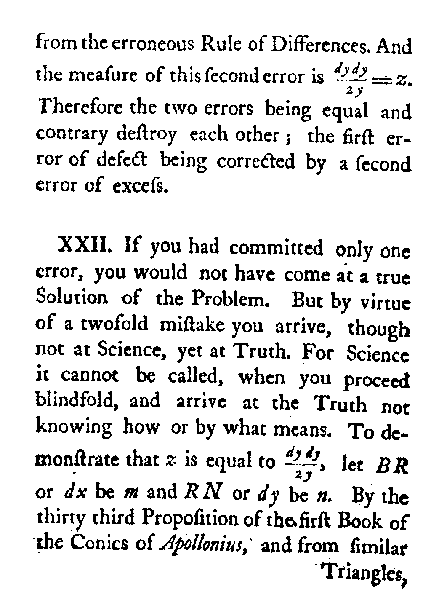
Berkeley's criticisms were well founded and important in that they focused the attention of mathematicians on a logical clarification of the calculus. He developed an ingenious theory to explain the correct results obtained, claiming that it was the result of two compensating errors. Ren writes in [30]:-
By reviewing Berkeley's lifetime and the content of the "Analysts", we conclude that his critique was correct and that it impelled the improvement of the foundations of calculus objectively. It is helpful for the normal development of mathematics to accept various forms of critique positively.
Many of the other references which we give also discuss Berkeley's attack on the calculus; see [5], [11], [19], [21], [26], [30], and [33]. De Moivre, Taylor, Maclaurin, Lagrange, Jacob Bernoulli and Johann Bernoulli all made attempts to bring the rigorous arguments of the Greeks into the calculus. Maclaurin in Treatise on fluxions gave the best response to Berkeley.
By the late 1740s Berkeley's health was deteriorating. His youngest son William died in 1751 which added to his decline. Despite this he travelled with his wife to Oxford in July 1752 to see his second son George begin his studies at Christ Church. In fact his intention was to remain at Oxford for the rest of his life, which he anticipated would not be very long. He died of a heart attack on the evening of Sunday 14 January 1753, sitting with his family listening to his wife reading. He died so peacefully that it is said that the event went unnoticed, the family thinking he had fallen asleep. He left instructions that he was not to be buried for at least five days and he was buried at Christ Church, Oxford on 20 January.
正文里的方括号编号指向这里,悬停即可直接看到条目。书目保留原文——译了书名反而查不到文献。
原站列出的延伸阅读与外部数据库,照原样保留,目标多为英文页面。
关于乔治·伯克利的其它页面:
关于乔治·伯克利的其它网站:
原站的交叉引用。指向本站已镜像专题的留在站内,其余仍指回原站。