数学家传记
阿尔·花拉子米是一位伊斯兰数学家,他撰写了关于印度-阿拉伯数字的著作。算法一词源自他的名字。他的代数论著《还原与对消计算概要》为我们提供了代数一词,并可被视为第一部关于代数写成的书。
我们对花拉子米 Ja'far Muhammad 花拉子米的生平所知甚少。这种知识匮乏的一个不幸后果,似乎是诱使人们根据极少的证据进行猜测。在[1]中,Toomer提出,花拉子米这个名字可能表明他来自中亚咸海以南的花剌子模。他接着写道:-
但历史学家al-Tabari给他加了一个额外的称号“al-Qutrubbulli”,表明他来自Qutrubbull,这是底格里斯河与幼发拉底河之间距巴格达不远的一个地区,所以也许他的祖先,而非他本人,来自花剌子模……al-Tabari给他的另一个称号“al-Majusi”,似乎表明他是古老琐罗亚斯德教的信徒。……花拉子米的《代数》中虔诚的序言表明他是一位正统穆斯林,因此al-Tabari的称号可能仅仅意味着他的先辈,也许还有他年轻时,曾是琐罗亚斯德教徒。
然而,Rashed[7]对al-Tabari的同一段话作出了相当不同的解释:-
……al-Tabari的话应读作:“Muhammad 花拉子米和al-Majusi al-Qutrubbulli……”,(并且有两个人物花拉子米和al-Majusi al-Qutrubbulli):字母“wa”在早期抄本中被遗漏了。如果不是因为已经得出了关于花拉子米性格的一系列结论,甚至偶尔还有关于其知识来源的结论,这一点本不值得提及。在他的文章([1])中,G J Toomer以天真的自信,在这个错误上构建了一整套幻想,不可否认其具有引人入胜的阅读价值。
这并非我们在描述花拉子米的生平与工作时将遇到的最后一个分歧。然而,在我们审视关于他生平为数不多确凿已知的事实之前,我们应当花点时间铺垫一下花拉子米工作所处的文化与科学背景。
哈伦·拉希德于786年9月14日成为阿拔斯王朝的第五任哈里发,大约就在花拉子米出生之时。哈伦从首都巴格达的宫廷统治着从地中海延伸到印度的伊斯兰帝国。他将文化带入宫廷,并试图建立当时在阿拉伯世界尚未繁荣的学术学科。他有两个儿子,长子是阿明,幼子是马蒙。哈伦于809年去世,兄弟之间爆发了武装冲突。
马蒙赢得了武装斗争,阿明于813年战败被杀。此后,马蒙成为哈里发,从巴格达统治帝国。他延续了其父开创的对学术的赞助,并创立了一所名为智慧宫的学院,希腊哲学和科学著作在那里被翻译。他还建立了一个手稿图书馆,这是自亚历山大图书馆以来建立的第一个大型图书馆,从费隆收集重要著作。除智慧宫外,马蒙还建立了天文台,穆斯林天文学家可以在那里以早期民族获得的知识为基础继续发展。
花拉子米及其同事巴努·穆萨是巴格达智慧宫的学者。他们在那里承担的任务包括翻译希腊科学手稿,他们还研究并撰写了代数、几何和天文学方面的著作。可以肯定,花拉子米在马蒙的赞助下工作,他将两部著作献给了哈里发。这两部著作分别是他的代数论著和天文学论著。代数论著Hisab al-jabr w'al-muqabala是花拉子米所有著作中最著名、最重要的一部。正是这部著作的标题给了我们“algebra”这个词,并且从某种意义上说——我们将在下文更充分地探讨——它是第一部关于代数的书。
Rosen对花拉子米本人描述该书目的之文字的翻译告诉我们,花拉子米意图教授[11](另见[1]):-
……算术中最容易、最有用的部分,例如人们在继承、遗赠、分配、诉讼和贸易中,以及在彼此之间的一切往来中经常需要的部分,或者涉及土地测量、开凿运河、几何计算以及其他各种各类对象的部分。
这听起来不像一本代数教材的内容,事实上书中只有第一部分是在讨论我们今天会认作代数的内容。然而,重要的是要认识到,这本书意在高度实用,而代数被引入是为了解决当时伊斯兰帝国日常生活中真实存在的问题。在书的开头,花拉子米用一些对我们这些如此熟悉这套系统的人来说几乎可笑的措辞描述了自然数,但理解这里抽象与理解的新深度是很重要的[11]:-
当我考虑人们在计算中一般想要什么时,我发现它总是一个数。我还观察到,每个数都由单位组成,并且任何数都可以分成单位。此外,我发现,从一到十可以表示出来的每个数,都比前一个数多一个单位:之后,十像之前的单位一样被加倍或三倍:于是产生二十、三十等等,直到一百:然后,百以与单位和十相同的方式被加倍和三倍,直到一千;……如此直到计数的极限。
在引入自然数之后,花拉子米引入了本书第一部分的主要主题,即方程的解法。他的方程是一次或quadratic,并由单位、根和平方组成。例如,对花拉子米来说,单位是一个数,根是,平方是。然而,尽管我们在本文中将使用现在熟悉的代数记号来帮助读者理解这些概念,Al-Khwarizmi的数学完全是用文字完成的,没有使用任何符号。
他首先把一个方程(一次或二次)化简为六种标准形式之一:
1. 平方等于根。
2. 平方等于数。
3. 根等于数。
4. 平方与根等于数;例如。
5. 平方与数等于根;例如。
6. 根与数等于平方;例如。
化简是通过al-jabr和al-muqabala两种运算进行的。这里“al-jabr”意为“还原”,是从方程中消去负项的过程。例如,用花拉子米自己的一个例子,“al-jabr”将变换为。术语“al-muqabala”意为“平衡”,是当方程两边出现同次的正项时将其合并的过程。例如,两次应用“al-muqabala”将化简为(一次处理常数项,另一次处理根项)。
然后花拉子米展示了如何求解六种标准类型的方程。他同时使用了代数解法和几何解法。例如,为求解方程,他写道[11]:-
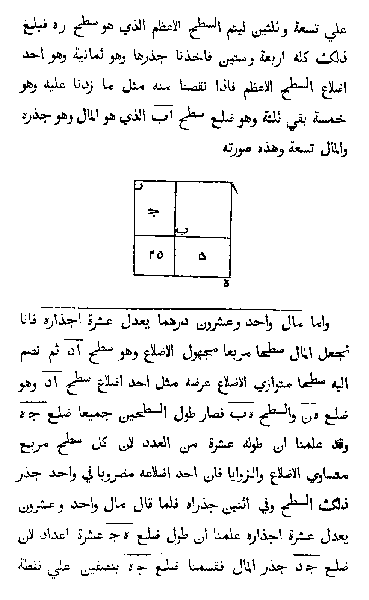
……一个平方与10个根等于39个单位。因此,在这类方程中,问题大致如下:什么样的平方与它的十个根相结合,其总和为39?解这类方程的方法是取上述根的一半。现在,我们问题中的根是10。因此取5,将其自乘得25,将此数加到39上得64。然后取它的平方根,即8,从中减去根的一半,即5,剩下3。因此数字三代表这个平方的一个根,而这个平方本身当然是9。所以九给出这个平方。
插图:Completesquare.gif ↗
接下来是配方法的几何证明。花拉子米从一个边长为的正方形开始,因此它表示(图1)。在这个正方形上,我们必须加上,这通过向该正方形添加四个矩形来完成,每个矩形的宽为10/4,长为(图2)。图2的面积为,它等于39。现在我们通过添加四个小正方形来完成这个正方形,每个小正方形的面积为。因此,图3中外侧正方形的面积为。所以这个正方形的边长是8。但边长是的长度,所以,从而得到。
这些几何证明是专家们存在分歧的问题。这个问题似乎没有简单的答案,即花拉子米是否熟悉欧几里得的Elements。我们知道他有可能熟悉,或许甚至可以说“本应”熟悉欧几里得的工作。在拉希德统治时期,当花拉子米还年轻时,哈贾吉已将欧几里得的Elements译成阿拉伯文,而哈贾吉是花拉子米在智慧宫的同事之一。这将支持图默在[1]中的评论:-
……在他的导论部分,花拉子米使用几何图形来解释方程,这无疑表明他熟悉欧几里得的《几何原本》第二卷。
拉希德[9]写道,花拉子米的:-
……这种处理很可能受到了当时对《几何原本》的新知识的启发。
然而,Gandz在[6]中(另见[23])提出了一个非常不同的观点:-
[花拉子米]对欧几里得的《几何原本》的精神和文字完全一无所知。Al-Khwarizmi既没有定义,也没有公理,也没有公设,也没有任何欧几里得式的证明。
我[EFR]认为,无论花拉子米是否研究过欧几里得的Elements,他显然受到了其他几何著作的影响。正如Parshall在[35]中所写:-
……因为他对实用几何的处理如此紧密地遵循了希伯来文本《Mishnat ha Middot》,该文本大约可追溯到公元150年,所以闪米特渊源存在的证据是有的。
花拉子米在Hisab al-jabr w'al-muqabala中继续他对代数的研究,考察算术定律如何扩展为适用于他的代数对象的算术。例如,他展示了如何展开诸如
尽管我们仍应强调,花拉子米只用文字来描述他的表达式,没有使用任何符号。Rashed [9] 在花拉子米的这些计算中看到了非凡的深度和新颖性,而当我们从现代视角审视时,这些计算对我们来说显得相对初等。他写道 [9]:-
花拉子米的代数概念现在可以更精确地把握:它涉及含单个未知数的线性与二次方程理论,以及相对二项式与三项式的初等算术。……解法必须同时是普遍的、可计算的,并且以数学方式,即几何方式,建立起来。……对次数的限制,以及对简单项数的限制,立刻得到了解释。从其真正的诞生来看,代数可以被视为一种通过根式求解方程的理论,以及对相关表达式进行代数计算的理论……
如果这一解释是正确的,那么花拉子米就如Sarton所写:-
……那个时代最伟大的数学家,而且如果考虑所有情况,是有史以来最伟大的人物之一……
类似地,Rashed写道 [9]:-
无论如何强调花拉子米的代数的构思与风格的独创性都不为过……
但Crossley持不同观点,他写道[4]:-
[花拉子米]可能并非很有独创性……
而Toomer在[1]中写道:-
……花拉子米的科学成就充其量只是平庸。
在[23]中,Gandz对花拉子米的代数学给出了这样的评价:-
花拉子米的代数被视为各门科学的基础和基石。从某种意义上说,花拉子米比丢番图更有资格被称为“代数之父”,因为花拉子米是第一个以初等形式并为代数本身而教授代数的人,而丢番图主要关注的是数论。
花拉子米的Algebra的下一部分由应用和演算示例组成。接着他继续探讨求圆等图形面积的规则,以及求球、锥体和棱锥等立体体积的规则。这一关于求积的部分与印度和希伯来文本的共通之处,确实多于与任何希腊著作的共通之处。该书的最后一部分讨论复杂的伊斯兰继承规则,但除了求解线性方程之外,几乎不需要前面代数的内容。
花拉子米还写了一篇关于印度-阿拉伯数字的论著。阿拉伯文原文已佚失,但一部拉丁文译本,即英文的Algoritmi de numero IndorumAl-Khwarizmi on the Hindu Art of Reckoning,催生了algorithm一词,该词源自标题中他的名字。遗憾的是,已知这部拉丁文译本(在[19]中译成英文)与花拉子米的原文(甚至连标题都不为人知)相比已有很大改动。该著作描述了基于1、2、3、4、5、6、7、8、9和0的印度位值制数字系统。在位置基数记数法中首次将零用作占位符,可能应归功于花拉子米在这部著作中的工作。书中给出了算术计算方法,并且已知阿拉伯文原稿中有求平方根的方法,尽管拉丁文版本中缺失了这一方法。1写道[1]:-
……十进制位值制是相当晚近才从印度传入的,而……花拉子米的著作是第一部系统阐述它的著作。因此,尽管它属于初等水平,却具有开创性的重要意义。
在[17]中讨论了七部十二世纪拉丁文论著,它们都以花拉子米这部已佚失的阿拉伯文算术论著为基础。
花拉子米的另一部重要著作是他关于天文学的著作Sindhind zij。这部著作在[48]中有详细描述,它以印度天文学著作为基础[47]:-
……这与后来大多数伊斯兰天文学手册相反,后者利用了克劳狄乌斯·托勒密的《天文学大成》Ⓣ(主要论题:来自阿拉伯语“al-majisti”——希腊语“Mathematike Syntaxis”的阿拉伯语译本,后来被译成拉丁语为“Magna Syntaxis”)中阐述的希腊行星模型……
花拉子米撰写论著所依据的印度文本,是约在770年由印度一个政治使团作为礼物赠送给巴格达宫廷的。花拉子米用阿拉伯文写成的著作有两个版本,但都已失传。十世纪时,al-Majriti对较短的版本作了批判性修订,该修订本由巴斯的巴斯的阿德拉德译成拉丁文。较长的版本也有一个拉丁文译本,这两部拉丁文著作都保存了下来。花拉子米在Sindhind zij中涵盖的主要主题有:历法;计算太阳、月亮和行星的真实位置,正弦表和正切表;球面天文学;占星表;视差和日食月食计算;以及月亮的可见性。一部相关的、归于花拉子米名下的关于球面三角学的抄本在[39]中有所讨论。
尽管他的天文学工作以印度人的工作为基础,而且他据以编制表格的大多数数值来自印度天文学家,花拉子米也必定受到了克劳狄乌斯·托勒密工作的影响[1]:-
可以肯定,克劳狄乌斯·托勒密的表格经亚历山大的亚历山大的席恩修订后,已为一些伊斯兰天文学家所知;而且极有可能的是,这些表格直接或通过中介影响了花拉子米表格的编制形式。
al-Khwarizmi写了一部重要的地理学著作,给出了2402个地点的纬度和经度,作为世界地图的基础。该书以克劳狄乌斯·托勒密的Geography为依据,列出了城市、山脉、海洋、岛屿、地理区域和河流及其纬度和经度。该抄本确实包含地图,这些地图总体上比克劳狄乌斯·托勒密的地图更为准确。特别是,在花拉子米能获得更多本地知识的地方,例如伊斯兰地区、非洲和远东,他的著作显然比克劳狄乌斯·托勒密的著作准确得多,但对于欧洲,花拉子米似乎使用了克劳狄乌斯·托勒密的数据。
花拉子米还写了一些次要著作,主题包括星盘(他为此写了两部著作)、日晷以及犹太历法。他还写了一部包含显要人物星占的政治史。
我们已经讨论过关于花拉子米的代数重要性的各种不同观点,代数是他在数学上最重要的贡献。让我们以Mohammad Kahn在[3]中给出的一段引文来结束本文:-
在有史以来最杰出的数学家中,花拉子米名列前茅。他撰写了最古老的算术和代数著作。在此后数百年间,这些著作是东西方数学知识的主要来源。算术著作首次将印度数字引入欧洲,正如algorism这个名字本身所表明的那样;而代数著作……在欧洲世界为数学这一重要分支赋予了名称……
We know few details of Abu Ja'far Muhammad ibn Musa al-Khwarizmi's life. One unfortunate effect of this lack of knowledge seems to be the temptation to make guesses based on very little evidence. In [1] Toomer suggests that the name al-Khwarizmi may indicate that he came from Khwarizm south of the Aral Sea in central Asia. He then writes:-
But the historian al-Tabari gives him the additional epithet "al-Qutrubbulli", indicating that he came from Qutrubbull, a district between the Tigris and Euphrates not far from Baghdad, so perhaps his ancestors, rather than he himself, came from Khwarizm ... Another epithet given to him by al-Tabari, "al-Majusi", would seem to indicate that he was an adherent of the old Zoroastrian religion. ... the pious preface to al-Khwarizmi's "Algebra" shows that he was an orthodox Muslim, so Al-Tabari's epithet could mean no more than that his forebears, and perhaps he in his youth, had been Zoroastrians.
However, Rashed [7], put a rather different interpretation on the same words by Al-Tabari:-
... Al-Tabari's words should read: "Muhammad ibn Musa al-Khwarizmi and al-Majusi al-Qutrubbulli ...", (and that there are two people al-Khwarizmi and al-Majusi al-Qutrubbulli): the letter "wa" was omitted in the early copy. This would not be worth mentioning if a series of conclusions about al-Khwarizmi's personality, occasionally even the origins of his knowledge, had not been drawn. In his article ([1]) G J Toomer, with naive confidence, constructed an entire fantasy on the error which cannot be denied the merit of making amusing reading.
This is not the last disagreement that we shall meet in describing the life and work of al-Khwarizmi. However before we look at the few facts about his life that are known for certain, we should take a moment to set the scene for the cultural and scientific background in which al-Khwarizmi worked.
Harun al-Rashid became the fifth Caliph of the Abbasid dynasty on 14 September 786, about the time that al-Khwarizmi was born. Harun ruled, from his court in the capital city of Baghdad, over the Islam empire which stretched from the Mediterranean to India. He brought culture to his court and tried to establish the intellectual disciplines which at that time were not flourishing in the Arabic world. He had two sons, the eldest was al-Amin while the younger was al-Mamun. Harun died in 809 and there was an armed conflict between the brothers.
Al-Mamun won the armed struggle and al-Amin was defeated and killed in 813. Following this, al-Mamun became Caliph and ruled the empire from Baghdad. He continued the patronage of learning started by his father and founded an academy called the House of Wisdom where Greek philosophical and scientific works were translated. He also built up a library of manuscripts, the first major library to be set up since that at Alexandria, collecting important works from Byzantium. In addition to the House of Wisdom, al-Mamun set up observatories in which Muslim astronomers could build on the knowledge acquired by earlier peoples.
Al-Khwarizmi and his colleagues the Banu Musa were scholars at the House of Wisdom in Baghdad. Their tasks there involved the translation of Greek scientific manuscripts and they also studied, and wrote on, algebra, geometry and astronomy. Certainly al-Khwarizmi worked under the patronage of Al-Mamun and he dedicated two of his texts to the Caliph. These were his treatise on algebra and his treatise on astronomy. The algebra treatise Hisab al-jabr w'al-muqabala was the most famous and important of all of al-Khwarizmi's works. It is the title of this text that gives us the word "algebra" and, in a sense that we shall investigate more fully below, it is the first book to be written on algebra.
Rosen's translation of al-Khwarizmi's own words describing the purpose of the book tells us that al-Khwarizmi intended to teach [11] (see also [1]):-
... what is easiest and most useful in arithmetic, such as men constantly require in cases of inheritance, legacies, partition, lawsuits, and trade, and in all their dealings with one another, or where the measuring of lands, the digging of canals, geometrical computations, and other objects of various sorts and kinds are concerned.
This does not sound like the contents of an algebra text and indeed only the first part of the book is a discussion of what we would today recognise as algebra. However it is important to realise that the book was intended to be highly practical and that algebra was introduced to solve real life problems that were part of everyday life in the Islam empire at that time. Early in the book al-Khwarizmi describes the natural numbers in terms that are almost funny to us who are so familiar with the system, but it is important to understand the new depth of abstraction and understanding here [11]:-
When I consider what people generally want in calculating, I found that it always is a number. I also observed that every number is composed of units, and that any number may be divided into units. Moreover, I found that every number which may be expressed from one to ten, surpasses the preceding by one unit: afterwards the ten is doubled or tripled just as before the units were: thus arise twenty, thirty, etc. until a hundred: then the hundred is doubled and tripled in the same manner as the units and the tens, up to a thousand; ... so forth to the utmost limit of numeration.
Having introduced the natural numbers, al-Khwarizmi introduces the main topic of this first section of his book, namely the solution of equations. His equations are linear or quadratic and are composed of units, roots and squares. For example, to al-Khwarizmi a unit was a number, a root was , and a square was . However, although we shall use the now familiar algebraic notation in this article to help the reader understand the notions, Al-Khwarizmi's mathematics is done entirely in words with no symbols being used.
He first reduces an equation (linear or quadratic) to one of six standard forms:
1. Squares equal to roots.
2. Squares equal to numbers.
3. Roots equal to numbers.
4. Squares and roots equal to numbers; e.g. .
5. Squares and numbers equal to roots; e.g. .
6. Roots and numbers equal to squares; e.g. .
The reduction is carried out using the two operations of al-jabr and al-muqabala. Here "al-jabr" means "completion" and is the process of removing negative terms from an equation. For example, using one of al-Khwarizmi's own examples, "al-jabr" transforms into . The term "al-muqabala" means "balancing" and is the process of reducing positive terms of the same power when they occur on both sides of an equation. For example, two applications of "al-muqabala" reduces to (one application to deal with the numbers and a second to deal with the roots).
Al-Khwarizmi then shows how to solve the six standard types of equations. He uses both algebraic methods of solution and geometric methods. For example to solve the equation he writes [11]:-
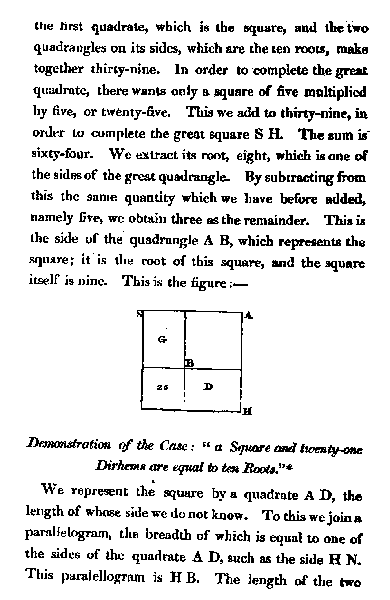
... a square and 10 roots are equal to 39 units. The question therefore in this type of equation is about as follows: what is the square which combined with ten of its roots will give a sum total of 39? The manner of solving this type of equation is to take one-half of the roots just mentioned. Now the roots in the problem before us are 10. Therefore take 5, which multiplied by itself gives 25, an amount which you add to 39 giving 64. Having taken then the square root of this which is 8, subtract from it half the roots, 5 leaving 3. The number three therefore represents one root of this square, which itself, of course is 9. Nine therefore gives the square.
插图:Completesquare.gif ↗
The geometric proof by completing the square follows. Al-Khwarizmi starts with a square of side , which therefore represents (Figure 1). To the square we must add and this is done by adding four rectangles each of breadth 10/4 and length to the square (Figure 2). Figure 2 has area which is equal to 39. We now complete the square by adding the four little squares each of area . Hence the outside square in Fig 3 has area . The side of the square is therefore 8. But the side is of length so , giving .
These geometrical proofs are a matter of disagreement between experts. The question, which seems not to have an easy answer, is whether al-Khwarizmi was familiar with Euclid's Elements. We know that he could have been, perhaps it is even fair to say "should have been", familiar with Euclid's work. In al-Rashid's reign, while al-Khwarizmi was still young, al-Hajjaj had translated Euclid's Elements into Arabic and al-Hajjaj was one of al-Khwarizmi's colleagues in the House of Wisdom. This would support Toomer's comments in [1]:-
... in his introductory section al-Khwarizmi uses geometrical figures to explain equations, which surely argues for a familiarity with Book II of Euclid's "Elements".
Rashed [9] writes that al-Khwarizmi's:-
... treatment was very probably inspired by recent knowledge of the "Elements".
However, Gandz in [6] (see also [23]), argues for a very different view:-
Euclid's "Elements" in their spirit and letter are entirely unknown to [al-Khwarizmi]. Al-Khwarizmi has neither definitions, nor axioms, nor postulates, nor any demonstration of the Euclidean kind.
I [EFR] think that it is clear that whether or not al-Khwarizmi had studied Euclid's Elements, he was influenced by other geometrical works. As Parshall writes in [35]:-
... because his treatment of practical geometry so closely followed that of the Hebrew text, Mishnat ha Middot, which dated from around 150 AD, the evidence of Semitic ancestry exists.
Al-Khwarizmi continues his study of algebra in Hisab al-jabr w'al-muqabala by examining how the laws of arithmetic extend to an arithmetic for his algebraic objects. For example he shows how to multiply out expressions such as
although again we should emphasise that al-Khwarizmi uses only words to describe his expressions, and no symbols are used. Rashed [9] sees a remarkable depth and novelty in these calculations by al-Khwarizmi which appear to us, when examined from a modern perspective, as relatively elementary. He writes [9]:-
Al-Khwarizmi's concept of algebra can now be grasped with greater precision: it concerns the theory of linear and quadratic equations with a single unknown, and the elementary arithmetic of relative binomials and trinomials. ... The solution had to be general and calculable at the same time and in a mathematical fashion, that is, geometrically founded. ... The restriction of degree, as well as that of the number of unsophisticated terms, is instantly explained. From its true emergence, algebra can be seen as a theory of equations solved by means of radicals, and of algebraic calculations on related expressions...
If this interpretation is correct, then al-Khwarizmi was as Sarton writes:-
... the greatest mathematician of the time, and if one takes all the circumstances into account, one of the greatest of all time....
In a similar vein Rashed writes [9]:-
It is impossible to overstress the originality of the conception and style of al-Khwarizmi's algebra...
but a different view is taken by Crossley who writes [4]:-
[Al-Khwarizmi] may not have been very original...
and Toomer who writes in [1]:-
... Al-Khwarizmi's scientific achievements were at best mediocre.
In [23] Gandz gives this opinion of al-Khwarizmi's algebra:-
Al-Khwarizmi's algebra is regarded as the foundation and cornerstone of the sciences. In a sense, al-Khwarizmi is more entitled to be called "the father of algebra" than Diophantus because al-Khwarizmi is the first to teach algebra in an elementary form and for its own sake, Diophantus is primarily concerned with the theory of numbers.
The next part of al-Khwarizmi's Algebra consists of applications and worked examples. He then goes on to look at rules for finding the area of figures such as the circle and also finding the volume of solids such as the sphere, cone, and pyramid. This section on mensuration certainly has more in common with Hindu and Hebrew texts than it does with any Greek work. The final part of the book deals with the complicated Islamic rules for inheritance but require little from the earlier algebra beyond solving linear equations.
Al-Khwarizmi also wrote a treatise on Hindu-Arabic numerals. The Arabic text is lost but a Latin translation, Algoritmi de numero Indorum in English Al-Khwarizmi on the Hindu Art of Reckoning gave rise to the word algorithm deriving from his name in the title. Unfortunately the Latin translation (translated into English in [19]) is known to be much changed from al-Khwarizmi's original text (of which even the title is unknown). The work describes the Hindu place-value system of numerals based on 1, 2, 3, 4, 5, 6, 7, 8, 9, and 0. The first use of zero as a place holder in positional base notation was probably due to al-Khwarizmi in this work. Methods for arithmetical calculation are given, and a method to find square roots is known to have been in the Arabic original although it is missing from the Latin version. Toomer writes [1]:-
... the decimal place-value system was a fairly recent arrival from India and ... al-Khwarizmi's work was the first to expound it systematically. Thus, although elementary, it was of seminal importance.
Seven twelfth century Latin treatises based on this lost Arabic treatise by al-Khwarizmi on arithmetic are discussed in [17].
Another important work by al-Khwarizmi was his work Sindhind zij on astronomy. The work, described in detail in [48], is based in Indian astronomical works [47]:-
... as opposed to most later Islamic astronomical handbooks, which utilised the Greek planetary models laid out in Ptolemy's "Almagest" Ⓣ ...
The Indian text on which al-Khwarizmi based his treatise was one which had been given to the court in Baghdad around 770 as a gift from an Indian political mission. There are two versions of al-Khwarizmi's work which he wrote in Arabic but both are lost. In the tenth century al-Majriti made a critical revision of the shorter version and this was translated into Latin by Adelard of Bath. There is also a Latin version of the longer version and both these Latin works have survived. The main topics covered by al-Khwarizmi in the Sindhind zij are calendars; calculating true positions of the sun, moon and planets, tables of sines and tangents; spherical astronomy; astrological tables; parallax and eclipse calculations; and visibility of the moon. A related manuscript, attributed to al-Khwarizmi, on spherical trigonometry is discussed in [39].
Although his astronomical work is based on that of the Indians, and most of the values from which he constructed his tables came from Hindu astronomers, al-Khwarizmi must have been influenced by Ptolemy's work too [1]:-
It is certain that Ptolemy's tables, in their revision by Theon of Alexandria, were already known to some Islamic astronomers; and it is highly likely that they influenced, directly or through intermediaries, the form in which Al-Khwarizmi's tables were cast.
Al-Khwarizmi wrote a major work on geography which give latitudes and longitudes for 2402 localities as a basis for a world map. The book, which is based on Ptolemy's Geography, lists with latitudes and longitudes, cities, mountains, seas, islands, geographical regions, and rivers. The manuscript does include maps which on the whole are more accurate than those of Ptolemy. In particular it is clear that where more local knowledge was available to al-Khwarizmi such as the regions of Islam, Africa and the Far East then his work is considerably more accurate than that of Ptolemy, but for Europe al-Khwarizmi seems to have used Ptolemy's data.
A number of minor works were written by al-Khwarizmi on topics such as the astrolabe, on which he wrote two works, on the sundial, and on the Jewish calendar. He also wrote a political history containing horoscopes of prominent persons.
We have already discussed the varying views of the importance of al-Khwarizmi's algebra which was his most important contribution to mathematics. Let us end this article with a quote by Mohammad Kahn, given in [3]:-
In the foremost rank of mathematicians of all time stands Al-Khwarizmi. He composed the oldest works on arithmetic and algebra. They were the principal source of mathematical knowledge for centuries to come in the East and the West. The work on arithmetic first introduced the Hindu numbers to Europe, as the very name algorism signifies; and the work on algebra ... gave the name to this important branch of mathematics in the European world...
正文里的方括号编号指向这里,悬停即可直接看到条目。书目保留原文——译了书名反而查不到文献。
原站列出的延伸阅读与外部数据库,照原样保留,目标多为英文页面。
关于花拉子米的其它页面:
原站的交叉引用。指向本站已镜像专题的留在站内,其余仍指回原站。