数学家传记
拉法耶尔·蓬贝利是意大利数学家,撰写了一部有影响力的代数教材,并自由使用负数和复数。
拉法耶尔·蓬贝利的父亲是安东尼奥·马佐利,但他将名字从马佐利改为蓬贝利。或许值得稍微介绍一下家庭背景。本蒂沃利奥家族从1443年起统治博洛尼亚。桑特·本蒂沃利奥从1443年起是博洛尼亚的“signore”(意为领主),他的继任者是乔瓦尼二世·本蒂沃利奥,他改善了博洛尼亚城,特别是发展了其水道。马佐利家族是本蒂沃利奥家族的支持者,但当教皇尤利乌斯二世于1506年控制博洛尼亚,将本蒂沃利奥家族驱逐流放时,他们的命运发生了变化。1508年试图重新控制失败,安东尼奥·马佐利的祖父,像其他几个失败的本蒂沃利奥政变支持者一样,被处决。马佐利家族多年来因财产被没收而受苦,但财产被归还给安东尼奥·马佐利,即蓬贝利的父亲。
安东尼奥·马佐利得以回到博洛尼亚居住。在那里,他继续从事羊毛商人的生意,并娶了裁缝的女儿迪亚曼特·斯库迪耶里。蓬贝利是他们的长子,他是六个孩子中的一个。蓬贝利没有接受大学教育。他由工程师兼建筑师皮耶·弗朗切斯科·克莱门蒂教授,所以蓬贝利本人转向那个职业也许并不太令人惊讶。蓬贝利在亚历山德罗·鲁菲尼那里找到了赞助人,鲁菲尼是一位罗马贵族,后来成为梅尔菲主教。
目前尚不清楚蓬贝利究竟是如何了解到当时领先的数学著作的,但他当然生活在意大利的合适地区,得以参与围绕cubic和四次方程求解的重大事件。希皮奥内·德尔·费罗,第一个解出三次方程的人,是博洛尼亚——蓬贝利的家乡——的教授,但del 希皮奥内·德尔·费罗在蓬贝利出生那年去世了。Fior与尼科洛·塔尔塔利亚之间的竞赛(见尼科洛·塔尔塔利亚的传记)发生在1535年,当时蓬贝利九岁,而吉罗拉莫·卡尔达诺关于该主题的重要著作Ars Magna Ⓣ(《大术》)于1545年出版。显然,蓬贝利研究过吉罗拉莫·卡尔达诺的著作,他也密切关注吉罗拉莫·卡尔达诺、洛多维科·费拉里和尼科洛·塔尔塔利亚之间非常公开的争论,这些争论在1548年米兰的洛多维科·费拉里与尼科洛·塔尔塔利亚之间的竞赛中达到高潮(详见洛多维科·费拉里的传记)。
大约从1548年起,蓬贝利的老师Pier Francesco Clementi为宗座内库工作,这是罗马教廷的一个专门部门,负责处理法律和财务事务。宗座内库雇用Clementi开垦位于意大利中部佩鲁贾东南、托皮诺河畔福利尼奥附近的沼泽。该地区于1439年成为教宗国的一部分。蓬贝利很可能协助了他的老师Clementi进行这个项目,但我们没有直接证据表明情况如此。我们确实知道,大约在1549年,蓬贝利开始对邻近地区的另一个开垦项目产生了兴趣。
正是在1549年,蓬贝利的赞助人Alessandro Rufini获得了开垦瓦尔迪基亚纳沼泽中属于教宗国的那部分的权利。瓦尔迪基亚纳是托斯卡纳亚平宁山脉中一个相当中心的地区,无论是流经佛罗伦萨和比萨入海的西北流向的阿尔诺河,还是向南流经罗马的台伯河,都没有很好地为其排水。到1551年,蓬贝利已在瓦尔迪基亚纳记录待开垦土地的边界。他一直从事这个项目,直到1555年开垦工作中断。
蓬贝利在等待Val di Chiana工程重新启动期间,决定写一本代数书。他感到,顶尖数学家之间许多争论的原因在于缺乏对该主题的细致阐述。在蓬贝利看来,只有吉罗拉莫·卡尔达诺深入探索了这一主题,而他的伟大杰作对于没有彻底掌握数学的人来说是无法理解的。蓬贝利觉得,一本自足的、无需高水平数学训练即可阅读的文本将会有所裨益。他在其著作[2]的序言中写道(另见[3]):-
我首先回顾了迄今为止大多数撰写过[代数]的作者,以便能够代替他们处理此事,因为这样的人非常多。
到1557年,Val di Chiana的工程仍处于暂停状态,蓬贝利已开始撰写他的代数文本。我们将在下文详细研究该著作的内容。目前只需说,1560年Val di Chiana工程重新启动时,蓬贝利尚未完成他的代数书。
瓦尔迪基亚纳沼泽的工作在被暂停时不可能离完成很远,因为它在1560年底之前就完成了。该计划取得了巨大成功,通过这个项目,蓬贝利作为水利工程师赢得了很高的声誉。1561年,蓬贝利前往罗马,但修复台伯河上的圣玛丽亚桥的尝试失败了。然而,由于声誉仍然很高,蓬贝利被聘为排干蓬蒂内沼泽项目的顾问。这些位于意大利中南部拉齐奥地区的沼泽自罗马共和国时期以来一直是疟疾危害健康的地区。几位皇帝和教宗都曾尝试开垦该地区但均未成功,包括蓬贝利为教宗庇护四世担任顾问的那次尝试,也一无所获。[直到1928年,蓬蒂内沼泽才最终被排干。]
在蓬贝利一次访问罗马时,他做出了一项激动人心的数学发现。在罗马大学教授数学的Antonio Maria Pazzi向蓬贝利展示了丢番图的Arithmetica的一份手稿,在蓬贝利审阅之后,两人决定进行翻译。蓬贝利在[2]中写道(另见[3]):-
……[我们],为了以如此精美的作品丰富世界,决定翻译它,我们已经翻译了五卷(总共七卷);剩余部分由于这样或那样的工作压力,我们未能完成。
尽管从未完成这项任务,蓬贝利开始根据他在丢番图中的发现修订他的代数文本。特别是,蓬贝利在第三卷中给出的272个问题中有143个取自丢番图。蓬贝利没有指明哪些问题是他自己的,哪些是丢番图的,但他充分归功于丢番图,承认他从Arithmetica中借用了文本中给出的许多问题。
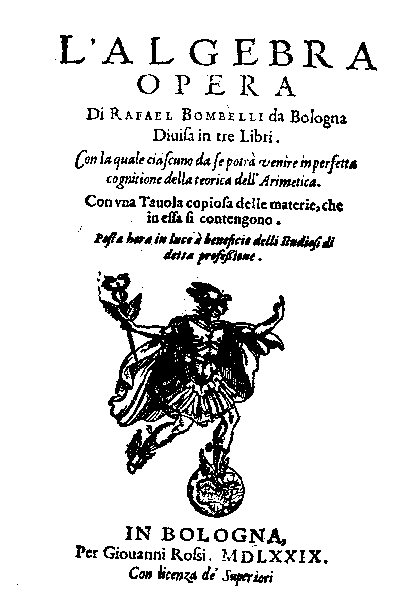
蓬贝利的Algebra原本打算分为五卷。前三卷于1572年出版,在第三卷末尾他写道[1]:-
……几何部分,即第四卷和第五卷,尚未准备好付印,但很快就会出版。
蓬贝利从未能够完成这最后两卷,因为他在前三卷出版后不久就去世了。然而,1923年,Bortolotti在博洛尼亚的一家图书馆发现了蓬贝利的手稿。除了三卷已出版书籍的手稿版本外,还有另外两卷未完成的手稿。Bortolotti于1929年出版了蓬贝利著作中未完成的几何部分。蓬贝利未完成的第四卷中的一些结果也在[17]中有所描述,作者在那里指出蓬贝利的方法与奥马尔·海亚姆的几何程序有关。
蓬贝利的Algebra详尽叙述了当时已知的代数,并包含了蓬贝利对复数的重要贡献。在考察他对复数的卓越贡献之前,我们应当指出,蓬贝利首次写下了如何用负数进行计算。他写道(见[2]或[3]):-
加乘加得加
减乘减得加
加乘减得减
减乘加得减
正8乘正8得正64
负5乘负6得正30
负4乘正5得负20
正5乘负4得负20
正如⟦N1⟧在[3]中所指出的:-
蓬贝利明确地在使用带符号的数进行运算。他对此毫无顾虑,尽管在他随后处理的问题中,他忽略了可能的负解。
在蓬贝利的Algebra中,甚至有一个几何证明表明负乘负得正;即便在今天,尽管我们的数学已相当精深,这一点仍让许多人感到困难。
蓬贝利本人起初并不觉得使用复数容易,他在[2]中写道(另见[3]):-
尽管对许多人来说这显得荒谬,因为甚至我前些时候也持这种看法,它在我看来更像是诡辩而非真理,然而我还是努力搜寻并找到了证明,这将在下面指出。……但请读者竭尽全力运用其心智,否则连他也会发现自己受骗。
蓬贝利是第一个写下复数加法、减法和乘法规则的人。他把写作“负之加”,把写作“负之减”,并给出诸如(见[2]或[3])这样的规则:-
负之加乘以负之加得负[]
负之加乘以负之减得加[]
负之减乘以负之加得加[]
负之减乘以负之减得负[]
在给出复数乘法的这一描述之后,蓬贝利接着给出了它们的加法和减法规则。
然后他表明,使用他的复数演算,即使当吉罗拉莫·卡尔达诺-尼科洛·塔尔塔利亚公式给出涉及负数平方根的表达式时,也能从该三次方程求解公式中获得正确的实数解。
插图:Bombelli.gif ↗
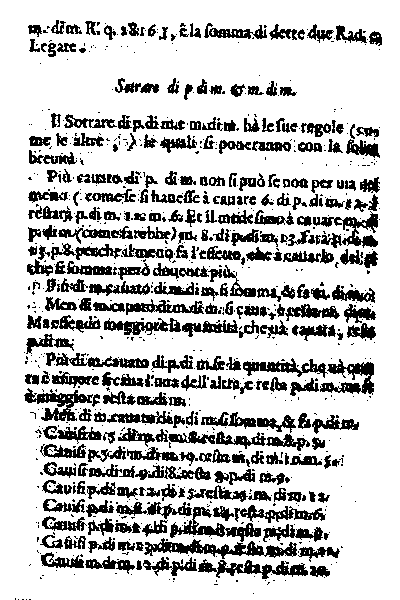
最后,我们应当对蓬贝利的记号作一些评论。尽管像卢卡·帕西奥利这样的作者对记号的使用有限,其他如吉罗拉莫·卡尔达诺则根本没有使用符号。然而,蓬贝利使用了相当精妙的记号。值得指出的是,他著作的印刷版本使用的记号与他的手稿略有不同,这其实并不令人惊讶,因为印刷数学记号存在一些问题,这在一定程度上限制了印刷中可使用的记号类型。
以下是蓬贝利记号的一些例子。
尽管出版延迟,蓬贝利的Algebra仍是一部极具影响力的著作,并促使哥特弗里德·威廉·莱布尼茨称赞蓬贝利,称他是一位:-
……杰出的分析艺术大师。
Jayawardene在[1]中写道,蓬贝利在处理复数时:-
……显示出他远远超越了他的时代,因为他的处理方式几乎就是今天所遵循的方式。
Crossley在[3]中写道:-
因此,我们有一位工程师蓬贝利,他实际运用复数,或许是因为复数给了他有用的结果,而吉罗拉莫·卡尔达诺则认为负数的平方根毫无用处。蓬贝利是第一个对任何复数给出处理的人……他在阐述复数计算法则时的详尽程度令人瞩目……
把蓬贝利称为复数的发明者似乎相当公允。在他之前,没有人给出过处理这类数的规则,也没有人提出过处理这类数可能有用。然而,让·迪厄多内似乎并不同意这一评价,因为在他对[5]和[6]的评论中,他写道:-
……虚数早在蓬贝利的书之前很久就已被使用,因此称他为复数的“第一位发现者”并不十分公正。
我[EFR]觉得让·迪厄多内在这里错了,正如我认为他写到蓬贝利的Algebra时也是错的一样
……销路并不很好,显然对后来的发展也没有多大影响。
我认为蓬贝利的Algebra是16世纪数学最卓越的成就之一,必须归功于他在显然没有其他人理解复数重要性的时候理解了复数的重要性。
Rafael Bombelli's father was Antonio Mazzoli but he changed his name from Mazzoli to Bombelli. It is perhaps worth giving a little family background. The Bentivoglio family ruled over Bologna from 1443. Sante Bentivoglio was "signore" (meaning lord) of Bologna from 1443 and he was succeeded by Giovanni II Bentivoglio who improved the city of Bologna, in particular developing its waterways. The Mazzoli family were supporters of the Bentivoglio family but their fortunes changed when Pope Julius II took control of Bologna in 1506, driving the Bentivoglio family into exile. An attempt to regain control in 1508 was defeated and Antonio Mazzoli's grandfather, like several other supporters of the failed Bentivoglio coup, were executed. The Mazzoli family suffered for many years by having their property confiscated, but the property was returned to Antonio Mazzoli, Rafael Bombelli's father.
Antonio Mazzoli was able to return to live in Bologna. There he carried on his trade as a wool merchant and married Diamante Scudieri, a tailor's daughter. Rafael Bombelli was their eldest son, and he was one of a family of six children. Rafael received no university education. He was taught by an engineer- architect Pier Francesco Clementi so it is perhaps not too surprising that Bombelli himself should turn to that occupation. Bombelli found himself a patron in Alessandro Rufini who was a Roman noble, later to become the Bishop of Melfi.
It is unclear exactly how Bombelli learnt of the leading mathematical works of the day, but of course he lived in the right part of Italy to be involved in the major events surrounding the solution of cubic and quartic equations. Scipione del Ferro, the first to solve the cubic equation was the professor at Bologna, Bombelli's home town, but del Ferro died the year that Bombelli was born. The contest between Fior and Tartaglia (see Tartaglia's biography) took place in 1535 when Bombelli was nine years old, and Cardan's major work on the topic Ars Magna Ⓣ was published in 1545. Clearly Bombelli had studied Cardan's work and he also followed closely the very public arguments between Cardan, Ferrari and Tartaglia which culminated in the contest between Ferrari and Tartaglia in Milan in 1548 (see Ferrari's biography for details).
From about 1548 Pier Francesco Clementi, Bombelli's teacher, worked for the Apostolic Camera, a specialised department of the papacy in Rome set up to deal with legal and financial matters. The Apostolic Camera employed Clementi to reclaim marshes near Foligno on the Topino River, southeast of Perugia in central Italy. This region had became part of the Papal States in 1439. It is probable that Bombelli assisted his teacher Clementi with this project, but we have no direct evidence that this was the case. We certainly know that around 1549 Bombelli became interested in another reclamation project in a neighbouring region.
It was in 1549 that Alessandro Rufini, Bombelli's patron, acquired the rights to reclaim that part of the marshes of the Val di Chiana which belonged to the Papal States. The Val di Chiana is a fairly central region in the Tuscan Apennines which was not well drained either by the Arno river which runs north west going through Florence and Pisa to the sea, or by the Tiber which runs south through Rome. By 1551 Bombelli was in the Val di Chiana recording the boundaries to the land that was to be reclaimed. He worked on this project until 1555 when there was an interruption to the reclamation work.
While Bombelli was waiting for the Val di Chiana project to recommence, he decided to write an algebra book. He had felt that the reason for the many arguments between leading mathematicians was the lack of a careful exposition of the subject. Only Cardan had, in Bombelli's opinion, explored the topic in depth and his great masterpiece was not accessible to people without a thorough grasp of mathematics. Bombelli felt that a self-contained text which could be read by those without a high level of mathematical training would be beneficial. He wrote in the preface of his book [2] (see also [3]):-
I began by reviewing the majority of those authors who have written on [algebra] up to the present, in order to be able to serve instead of them on the matter, since there are a great many of them.
By 1557, the work at Val di Chiana still being suspended, Bombelli had begun writing his algebra text. We will study in detail the contents of the work below. Suffice to say for the moment that, in 1560 when work at Val di Chiana recommenced, Bombelli had not completed his algebra book.
Work at the Val di Chiana marshes could not have been far from completion when it had been suspended, for it was completed before the end of 1560. The scheme was a great success and through the project Bombelli gained a high reputation as an hydraulic engineer. In 1561 Bombelli went to Rome but failed in an attempt to repair the Santa Maria bridge over the Tiber. However, with reputation still high, Bombelli was taken on as a consultant for a project to drain the Pontine Marshes. These marshes in the Lazio region of south-central Italy had been an area where malaria had been a health hazard since the period of the Roman Republic. Several emperors and popes made unsuccessful attempts to reclaim the area but all, including the one which Bombelli acted as consultant on for Pope Pius IV, came to nothing. [It was not until 1928 that the Pontine Marshes were finally drained.]
On one of Bombelli's visits to Rome he made an exciting mathematical discovery. Antonio Maria Pazzi, who taught mathematics at the University of Rome, showed Bombelli a manuscript of Diophantus's Arithmetica and, after Bombelli had examined it, the two men decided to make a translation. Bombelli wrote in [2] (see also [3]):-
... [we], in order to enrich the world with a work so finely made, decided to translate it and we have translated five of the books (there being seven in all); the remainder we were not able to finish because of pressure of work on one or other.
Despite never completing the task, Bombelli began to revise his algebra text in the light of what he had discovered in Diophantus. In particular, 143 of the 272 problems which Bombelli gives in Book III are taken from Diophantus. Bombelli does not identify which problems are his own and which are due to Diophantus, but he does give full credit to Diophantus acknowledging that he has borrowed many of the problems given in his text from the Arithmetica.
Bombelli's Algebra was intended to be in five books. The first three were published in 1572 and at the end of the third book he wrote that [1]:-
... the geometrical part, Books IV and V, is not yet ready for the publisher, but its publication will follow shortly.
Unfortunately Bombelli was never able to complete these last two volumes for he died shortly after the publication of the first three volumes. In 1923, however, Bombelli's manuscript was discovered in a library in Bologna by Bortolotti. As well as a manuscript version of the three published books, there was the unfinished manuscript of the other two books. Bortolotti published the incomplete geometrical part of Bombelli's work in 1929. Some results from Bombelli's incomplete Book IV are also described in [17] where author remarks that Bombelli's methods are related to the geometrical procedures of Omar Khayyam.
Bombelli's Algebra gives a thorough account of the algebra then known and includes Bombelli's important contribution to complex numbers. Before looking at his remarkable contribution to complex numbers we should remark that Bombelli first wrote down how to calculate with negative numbers. He wrote (see [2] or [3]):-
Plus times plus makes plus
Minus times minus makes plus
Plus times minus makes minus
Minus times plus makes minus
Plus 8 times plus 8 makes plus 64
Minus 5 times minus 6 makes plus 30
Minus 4 times plus 5 makes minus 20
Plus 5 times minus 4 makes minus 20
As Crossley notes in [3]:-
Bombelli is explicitly working with signed numbers. He has no reservations about doing this, even though in the problems he subsequently treats he neglects possible negative solutions.
In Bombelli's Algebra there is even a geometric proof that minus time minus makes plus; something which causes many people difficulty even today despite our mathematical sophistication.
Bombelli, himself, did not find working with complex numbers easy at first, writing in [2] (see also [3]):-
And although to many this will appear an extravagant thing, because even I held this opinion some time ago, since it appeared to me more sophistic than true, nevertheless I searched hard and found the demonstration, which will be noted below. ... But let the reader apply all his strength of mind, for [otherwise] even he will find himself deceived.
Bombelli was the first person to write down the rules for addition, subtraction and multiplication of complex numbers. He writes as "plus of minus", as "minus of minus", and gives rules such as (see [2] or [3]):-
Plus of minus times plus of minus makes minus []
Plus of minus times minus of minus makes plus []
Minus of minus times plus of minus makes plus []
Minus of minus times minus of minus makes minus []
After giving this description of multiplication of complex numbers, Bombelli went on to give rules for adding and subtracting them.
He then showed that, using his calculus of complex numbers, correct real solutions could be obtained from the Cardan-Tartaglia formula for the solution to a cubic even when the formula gave an expression involving the square roots of negative numbers.
插图:Bombelli.gif ↗
Finally we should make some comments on Bombelli's notation. Although authors such as Pacioli had made limited use of notation, others such as Cardan had used no symbols at all. Bombelli, however, used quite sophisticated notation. It is worth remarking that the printed version of his book uses a slightly different notation from his manuscript, and this is not really surprising for there were problems printing mathematical notation which to some extent limited the type of notation which could be used in print.
Here are some examples of Bombelli's notation.
Despite the delay in publication, Bombelli's Algebra was a very influential work and led to Leibniz praising Bombelli saying he was an:-
... outstanding master of the analytical art.
Jayawardene writes in [1] that in his treatment of complex numbers Bombelli:-
... showed himself to be far ahead of his time, for his treatment was almost that followed today.
Crossley writes in [3]:-
Thus we have an engineer, Bombelli, making practical use of complex numbers perhaps because they gave him useful results, while Cardan found the square roots of negative numbers useless. Bombelli is the first to give a treatment of any complex numbers... It is remarkable how thorough he is in his presentation of the laws of calculation of complex numbers...
It seems to be quite fair to describe Bombelli as the inventor of complex numbers. Nobody before him had given rules for working with such numbers, nor had they suggested that working with such numbers might prove useful. Dieudonné does not appear to agree with this assessment, however, for in his review of [5] and [6], he writes:-
... imaginaries had been used long before Bombelli's book, and it is therefore not quite justified to call him the "first discoverer" of complex numbers.
I [EFR] feel that Dieudonné is wrong here as I believe he is when he writes that Bombelli's Algebra
... did not sell very well, nor apparently did it have much influence on later developments.
I think that Bombelli's Algebra is one of the most remarkable achievements of 16th century mathematics, and he must be credited with understanding the importance of complex numbers at a time when clearly nobody else did.
正文里的方括号编号指向这里,悬停即可直接看到条目。书目保留原文——译了书名反而查不到文献。
原站列出的延伸阅读与外部数据库,照原样保留,目标多为英文页面。
关于拉法耶尔·蓬贝利的其它页面:
关于拉法耶尔·蓬贝利的其它网站:
原站的交叉引用。指向本站已镜像专题的留在站内,其余仍指回原站。