数学家传记
安德斯·摄尔修斯是一位瑞典天文学家、物理学家和数学家。他参加了皮埃尔·莫佩尔蒂在拉普兰测量纬度一度的探险。他以他提出并以他命名的温标而闻名。
安德斯·摄尔修斯的祖父是摄尔修斯 Spole(1630-1699),一位出生于瑞典巴纳普的天文学家,曾在乌普萨拉学习。年轻时,Spole游历欧洲,结识了许多重要的天文学家,后来成为隆德大学的天文学教授。在那里,他在自己的房子里建造了一座天文台,并经常访问第谷·布拉赫在文岛。因此,Spole对欧洲的科学状况非常了解。在关于地球形状的争论中,他站在乔凡尼·多美尼科·卡西尼一边,与艾萨克·牛顿对立。1676年丹麦入侵瑞典南部后,隆德大学解散,Spole离开了隆德。他选择参战,可能作为奖赏,1679年他被授予乌普萨拉大学天文学教授的职位。
Spole在乌普萨拉的学生之一是Nils 摄尔修斯(1658-1724),他是Magnus Celsius(1621-1679)的儿子,后者于1668年至1679年间任乌普萨拉数学教授。在Spole指导下,Nils撰写了学位论文De Principiis Astronomicis Propiis Ⓣ(重要的天文学性质)(1679),其中他声明只有经验观察,而非神学教义,才是天文学的支柱。由于乌普萨拉是瑞典的教会中心,且尚未接受日心说,这违背了大学的共识,导致该学位论文被禁。这种对最新天文学思想的拒绝,部分解释了18世纪初乌普萨拉大学缺乏适当天文仪器的情况。Spole试图通过在自己家中建造天文台来弥补这一点,但它在1702年的一场大火中烧毁。Nils娶了Spole的一个女儿Gunilla Maria Spole(1672-1756)。1699年Spole去世后,大学无视他让Nils 摄尔修斯继任的建议,而是任命Per Elvius(1660-1718)(他娶了Spole的另一个女儿)为天文学教授。直到1718年Elvius去世,Nils 摄尔修斯才成为天文学教授。他还是乌普萨拉Trivial学校的校长。Trivial学校之所以得名,是因为它们教授文科的前三个科目,即三艺:语法、修辞和逻辑。
摄尔修斯成长过程中可以使用一个大家族图书馆,该图书馆在1702年的大火中幸存下来。这使他早期就能接触到艾萨克·牛顿的Principia1687年版的副本。他最初在数学和天文学方面的学术教学很差,但到十二岁时,他成功解决了大学教科书中的所有数学问题。他于1711年6月12日在乌普萨拉开始中学教育。中学毕业后,摄尔修斯在乌普萨拉大学学习天文学、数学和实验物理学,并主要归功于摄尔修斯 Gabriel Duhre(约1680-1739),他在1724-25年访问乌普萨拉并讲授了一门课程,从而对数学产生了深刻的欣赏。当时乌普萨拉的数学教授是Elof Steuch(1687-1772),他似乎数学能力很少或对该学科兴趣不大,在被任命为乌普萨拉数学讲席之前曾是隆德大学的希腊语教授。摄尔修斯对数学教学非常不满,以至于他以为自己会专攻法律,但在他参加了Duhre的课程后,这一切都改变了。
自18世纪20年代初起,摄尔修斯为Erik Burman(1692-1729)进行观测,Burman是Nils 摄尔修斯在乌普萨拉天文学教授职位上的继任者,并且,在Burman教授了气象学和实验物理学之后,摄尔修斯于1724年发表了他的头两篇论文,都与气压计有关。1727年12月12日,他接受了Burman对其天文学学位论文Disputatio astronomy ca de motu vertiginis lunae Ⓣ(关于月球旋转运动的天文学讲座)的考试。1728年5月21日,他接受了Johan Hermansson对其学位论文Dissertatio gradualis de existentia mentis Ⓣ(关于精神存在等级的观察)的考试,Hermansson是法律、语文学和政治学教授。
毕业后,摄尔修斯成为数学代课讲师,而教授皮埃尔·萨米埃尔 Klingenstierna(1698-1765)正在国外。事实上,Klingenstierna和摄尔修斯都曾申请乌普萨拉大学空缺的数学讲席,但Klingenstierna被任命,主要是因为哥特弗里德·威廉·莱布尼茨的学生Christian Wolff的一封非常有力的推荐信。Klingenstierna获得了访问欧洲学术中心的旅行资助,直到1731年返回后才能就任乌普萨拉的数学讲席,因此他不得不自掏腰包支付摄尔修斯承担数学讲席职责的费用。
当Erik Burman于1729年去世时,摄尔修斯除了代替数学教授外,还接管了他的天文学讲座。这一经历使他于1730年被任命为乌普萨拉的天文学教授。自1724年以来,他一直是乌普萨拉皇家科学学会的助理秘书,在Burman去世后,他担任了秘书一职。乌普萨拉大学现在是一个非常强大的数学和天文学中心,Klingenstierna和摄尔修斯都是世界级学者。
1732年,摄尔修斯追随祖父的脚步,决定游历欧洲,并于当年5月23日获得许可。他并非独自旅行,因为他的旅伴是Jonas Meldercreutz(1714-1785),一位年轻的数学家,将在Klingenstierna于1751年退休后被任命为乌普萨拉的数学讲席。摄尔修斯和Meldercreutz承担的任务之一是访问学术团体和科学院,旨在与乌普萨拉皇家科学学会建立联系。在旅行期间,摄尔修斯用在柏林购买的一台象限仪进行了几次天文观测。1733年,他在纽伦堡期间发表了316条关于北极光的观测记录。同年,也在纽伦堡,他与天文学家和出版商Michael Adelbulner出版了一本天文学杂志,题为Commercium litterarium ad astronomiae incrementum inter huius scientiae amatores communi consilio institutum Ⓣ(该学科爱好者与学术机构之间天文学文献交流的增长)。其中包括关于未来值得观测的天文现象的信息,以及新闻和评论。在最初抱怨新闻太旧(由于当时邮寄缓慢)之后,摄尔修斯开始接受读者的观测记录,但该杂志在两年后停刊,可能出版了45期。1733年末,他前往博洛尼亚,在那里协助Eustachio Manfredi进行观测。他的工作于1736年发表在Manfredi的书Liber de gnomon meridian Bononiensi Ⓣ(博洛尼亚观测集)中。在博洛尼亚之后,他前往罗马,在那里再次进行观测。摄尔修斯热爱意大利,并写信给母亲说,他希望他能用乌普萨拉换一座意大利城市,这样他就永远不必离开。
摄尔修斯于1734年末抵达巴黎,科学界正在讨论地球的形状。与他的祖父不同,摄尔修斯支持皮埃尔·莫佩尔蒂,后者为艾萨克·牛顿关于地球扁球体的理论论证辩护。Académie des Sciences决定派出两支探险队,一支前往赤道附近的秘鲁,一支前往北极圈,以测量子午弧一度的长度。科学院要求摄尔修斯在瑞典进行相应的观测,但他不得不拒绝他们的请求,因为他既没有资金支持,也没有必要的仪器。因此,摄尔修斯加入了由皮埃尔·莫佩尔蒂率领的北极圈探险队,很可能是在他的建议下决定前往拉普兰。他的祖父曾在1694年率领过一支类似目标的探险队,但没有成功。
摄尔修斯被派往伦敦进行一次短途旅行,向当时受人尊敬的仪器制造者Graham定制一台天顶仪。在访问伦敦期间,摄尔修斯参加了古物学会的一次会议,并在皇家学会的Philosophical Transactions上发表了文章。探险队于1736年4月从法国敦刻尔克出发。除了摄尔修斯和皮埃尔·莫佩尔蒂之外,数学家和天文学家亚历克西斯·克劳德·克莱罗、Pierre Charles Le Monnier(1715-1799)和夏尔·艾蒂安·路易·加缪也在队伍中。他们于1736年夏天抵达托尔讷。在那里,他们沿托尔讷河(南北走向)测量了一个三角网。冬季期间,使用天顶仪在三角网的北端和南端确定了差值。探险队于1737年夏天返回巴黎。皮埃尔·莫佩尔蒂在其1738年关于探险队发现La Figure de la Terre Ⓣ(地球的形状)[2]的报告中描述了摄尔修斯的贡献:-
这些观测大多归功于le Monnier先生和摄尔修斯先生的警觉,在一个天空常常拒绝观测的国家里,他们持续专注,不让任何可能的观测机会溜走。
结果证实了艾萨克·牛顿是正确的。摄尔修斯参加了随后的辩论,在辩论中雅克·卡西尼及其追随者对探险期间所做观测的准确性提出了质疑。摄尔修斯在De Observationibus Pro Figura Tellius Determinanda in Gallia Habitis, Disquisitio Ⓣ(关于在法国为确定地球形状所做观测的探讨)(1738年)中为他们辩护,驳斥了所有指控。在其中,摄尔修斯表明,在他先前对法国子午线的测量中,雅克·卡西尼所犯的错误比他所指责他们犯的错误更大。这一点被后来对法国子午线的测量所证实,而秘鲁探险的结果也证实了拉普兰探险的发现。
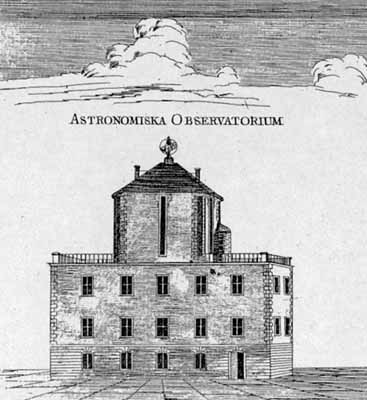
由于拉普兰探险的成功,摄尔修斯从法国政府获得每年1000里弗尔的养老金。他还赢得了一些国际认可,这增加了乌普萨拉与欧洲其他地区之间的交流。回到乌普萨拉后,摄尔修斯致力于改善乌普萨拉和瑞典天文学的地位,此前它一直处于衰落状态。他购买了新仪器以使收藏达到当时的标准(有些是从伦敦的Graham处订购的),并在Svatbäck街建造了一座新天文台(之前由Spole建造的那座在1702年大火中烧毁)。它于1741年完工。从未结婚的摄尔修斯住在这座建筑里。
乌普萨拉天文台的照片在THIS LINK。
后来发现该天文台建在不稳定的地基上,因此1853年在远离城市的地方建造了一座新天文台,那里大教堂不会遮挡南方的天空。
在制造精密温度计时,摄尔修斯发明了一种新的刻度,分为100度,0度为水的沸点,100度为水的冰点。他在1742年的报告Observationer om twänne beständiga Grader på en TermometerⓉ(关于温度计上二十个固定度的观测)中解释了他对固定点的选择。为了证明他的选择,摄尔修斯进行了一系列实验:他表明冰点不随纬度或气压的变化而变化,沸点也不取决于沸腾时间的长短或水的来源。他知道华伦海特已经表明沸点取决于气压,因此他在不同条件下进行实验,并得出结论:“气压计读数变化一英寸大约等于沸点变化一度”,这在当时是极其精确的。他指出,只有在确定的气压条件下,水的沸点才能作为可靠的固定点,他提出该气压为25.3英寸汞柱。他的刻度最重要的方面是确定了两个易于复现的固定点。摄尔修斯在欧洲旅行期间研究了当时众多的温标,希望创建一种国际温标。在上述论文中,他说:-
那么人们可以确信,若干这样的温度计放在相同的空气中,将总是显示相同的度数,例如在巴黎制造的温度计,在相同的热度下,将显示与在乌普萨拉制造的温度计相同的高度。
他于1741年12月25日首次使用的这个刻度,在他去世后得到了广泛使用,但其方向被颠倒了(现在0度摄尔修斯是水的冰点,而100度是水的沸点)。
摄尔修斯在乌普萨拉期间继续他的天文学研究,有时与他在巴黎的联系人合作。他研究了木星卫星食的计时(De Satelliti Bus Jovis Ⓣ(木星的卫星),1741),并提出了恒星演化的理论(他认为恒星曾经是像火星这样的行星,一旦所有水蒸发就开始发光),以及其他主题。与Olof Hiorter(1696-1750)一起,他是最早发现罗盘偏差与北极光之间相关性的人之一。他还试图让瑞典改用格里高利历,尽管在这方面没有成功。摄尔修斯一直担任乌普萨拉皇家科学学会的秘书直到去世,并负责在1737年拉普兰探险后回到乌普萨拉时重振该学会。
摄尔修斯还努力编制一份星表,为此他写了Constellatione Tauri Ⓣ(金牛座),1743年,以及Constellatione Leonis Ⓣ(狮子座),1741年,以及其他著作。他打算从黄道星座开始,因为为了提高太阳、月亮和行星表,必须更精确地测定这些星座。不幸的是,乌普萨拉天文台不太适合这项任务,因为黄道星座的恒星从未升到地平线以上很高,而且在明亮的夏夜观测很麻烦。另一方面,向南的视野被大教堂和山丘遮挡。很长一段时间里,摄尔修斯犹豫不决,不确定是把这项工作的经典仪器安置在天文台还是他在塞夫亚的家中。他于1744年因肺结核去世,年仅不到43岁,未能完成这个项目。由于在恶劣条件下进行探险和在寒冷的夜晚持续观测,他的健康已经恶化。他于4月25日早上7点去世,葬于老乌普萨拉教堂墓地。
关于摄尔修斯的性格,我们引用[11]中的话:-
摄尔修斯是一个多才多艺的人。他写瑞典语和拉丁语诗歌。无论多么忙碌,他总是快乐而开朗,似乎从不匆忙。
Anders Celsius's grandfather was Anders Spole (1630-1699) an astronomer born in Barnarp, Sweden, who had studied in Uppsala. In his youth, Spole travelled through Europe, meeting many important astronomers, and later became Professor of Astronomy at the University of Lund. There, he constructed an observatory in his house and made frequent visits to Tycho Brahe in Hven. Because of this, Spole was well informed of the scientific state of Europe. He sided with Giovanni Domenico Cassini on his and Isaac Newton's argument about the shape of the Earth. Spole left Lund after the Danish invasion of southern Sweden in 1676, which caused the University of Lund to dissolve. He chose to participate in the war and, possibly as a reward, in 1679 he was offered the position of professor of astronomy at the University of Uppsala.
One of Spole's students in Uppsala was Nils Celsius (1658-1724), the son of Magnus Celsius (1621-1679) who was professor of mathematics at Uppsala between 1668 and 1679. Under Spole, Nils wrote the dissertation De Principiis Astronomicis Propiis Ⓣ (1679), in which he stated that only empirical observations, and not theological doctrine, were the pillars of astronomy. Since Uppsala was the ecclesiastical centre of Sweden and it had not yet accepted heliocentrism, this went against the consensus at the University and caused the dissertation to be banned. This refusal of the latest astronomical ideas explains, in part, the lack of proper astronomical instruments in the University of Uppsala at the beginning of the 18th century. Spole tried to remedy this by building an astronomical observatory in his own house, but it burned down in a great fire in 1702. Nils married one of Spole's daughters, Gunilla Maria Spole (1672-1756). After Spole's death in 1699, the university disregarded his suggestion of having Nils Celsius succeed him and, instead, they appointed Per Elvius (1660-1718) (who was married to another of Spole's daughters) as professor of astronomy. Only when Elvius died in 1718 did Nils Celsius become professor of astronomy. He was also the headmaster of the Trivial school of Uppsala. The Trivial schools were given that name because they taught the first three subjects, the trivium, of the liberal arts, namely grammar, rhetoric and logic.
Anders Celsius grew up with access to a big family library, which managed to survive the fire of 1702. This gave him early access to a copy of the 1687 edition of Isaac Newton's Principia. His academic teaching in mathematics and astronomy was poor in the beginning, but by the age of twelve he managed to solve all of the mathematical problems in a university textbook. He began his secondary schooling in Uppsala on 12 June 1711. After graduating from secondary school, Celsius studied astronomy, mathematics, and experimental physics at the University of Uppsala and gained a deep appreciation for mathematics mainly thanks to Anders Gabriel Duhre (about 1680-1739), who visited Uppsala in 1724-25 and gave a lecture course. The mathematics professor at Uppsala at this time was Elof Steuch (1687-1772) who seems to have had little mathematical ability or interest in the subject having been professor of Greek at the University of Lund before being appointed to the chair of mathematics in Uppsala. Celsius had been so unhappy with the mathematics teaching that he thought he would specialise in law but this all changed after he attended Duhre's course.
Celsius had, from the early 1720s, carried out observations for Erik Burman (1692-1729), Nils Celsius's successor as professor of astronomy in Uppsala, and, having been taught about meteorology and experimental physics by Burman, Celsius published his first two papers in 1724 both relating to barometers. On 12 December 1727 he was examined on his astronomy thesis Disputatio astronomy ca de motu vertiginis lunae Ⓣ by Burman. On 21 May 1728 he was examined on his thesis Dissertatio gradualis de existentia mentis Ⓣ by Johan Hermansson, the professor of law, philology and politics.
After graduating, Celsius became a substitute lecturer in mathematics, while the professor, Samuel Klingenstierna (1698-1765), was abroad. In fact Klingenstierna and Celsius had both been applicants for the vacant chair of mathematics in the University of Uppsala, but Klingenstierna had been appointed, mainly because of a very strong letter of recommendation from Christian Wolff, a pupil of Gottfried Leibniz. Klingenstierna had been awarded a travel grant to visit the European centres of learning and was not able to take up the chair of mathematics at Uppsala until he returned in 1731, so he had to pay Celsius out of his own pocket for taking on the duties of the chair of mathematics.
When Erik Burman died in 1729, Celsius took over his lectures in astronomy in addition to substituting for the professor of mathematics. This experience allowed him to be appointed Professor of Astronomy in Uppsala in 1730. He had been an assistant secretary of the Royal Society of Sciences in Uppsala since 1724 and, following the death of Burman he took on the role of secretary. The University of Uppsala was now a very strong centre for mathematics and astronomy with Klingenstierna and Celsius both world-class scholars.
In 1732, following in his grandfather's footsteps, Celsius decided to travel through Europe and he received permission on 23 May of that year. He did not travel alone for he had as a travelling companion Jonas Meldercreutz (1714-1785), a young mathematician who would be appointed to the chair of mathematics at Uppsala after Klingenstierna retired in 1751. One of the tasks Celsius and Meldercreutz undertook was to visit learned societies and academies, aiming to set up links with the Royal Society of Sciences in Uppsala. During his trips, Celsius made several astronomical observations with a quadrant he bought in Berlin. In 1733, he published 316 of his observations on the northern lights while in Nuremberg. In the same year, also in Nuremberg, he published an astronomical magazine with astronomer and publisher Michael Adelbulner titled Commercium litterarium ad astronomiae incrementum inter huius scientiae amatores communi consilio institutum Ⓣ. It included information about future astronomical phenomena worthy of observation, along with news and reviews. After initial complaints that the news was too old (due to the slow posting of the time), Celsius started admitting observations from the readers, but the magazine stopped publication two years later after probably 45 issues. In late 1733 he travelled to Bologna, where he assisted Eustachio Manfredi with his observations. His work was published in Manfredi's book, Liber de gnomon meridian Bononiensi Ⓣ, in 1736. After Bologna he travelled to Rome where again he made observations. Celsius loved Italy and wrote to his mother, saying that he wished he could swap Uppsala for an Italian city so that he would never have to leave.
When Celsius arrived at Paris in late 1734, the scientific community was in the middle of a discussion about the shape of the Earth. Unlike his grandfather, Celsius supported Pierre de Maupertuis, who defended Newton's theoretical argument of an oblate Earth. The Académie des Sciences had decided to send two expeditions, one to Peru near the Equator and one to the Arctic Circle, to measure the length of one degree of the meridian arc. The Academy asked Celsius to make the corresponding observations in Sweden but he had to turn down their request since he had neither the financial support nor the necessary instruments. Celsius, therefore, joined the Arctic Circle expedition, headed by Maupertuis, and it was probably on his suggestion that it was decided to go to Lapland. His grandfather had led an expedition with a similar goal in 1694, but without success.
Celsius was sent on a short trip to London to commission a zenith sector from Graham, a revered instrument maker of the time. During his visit to London, Celsius attended a meeting of the Society of Antiquaries and published in Philosophical Transactions of the Royal Society. The expedition departed from Dunkirk, France, in April 1736. In addition to Celsius and Maupertuis, the mathematicians and astronomers Alexis Clairaut, Pierre Charles Le Monnier (1715-1799) and Charles-Étienne Camus were among the party. They arrived at Tornea in the summer of 1736. There, they measured a network of triangles along the river Torne (oriented north to south). During winter, the difference was established using the zenith sector at the northern and southern ends of the network. The expedition returned to Paris in the summer of 1737. Maupertuis describes the contributions of Celsius in his 1738 report of the findings of the expedition La Figure de la Terre Ⓣ [2]:-
Most of these observations are due to the vigilance of M le Monnier and M Celsius, who, in a country where the Sky often refuses observations, were continuously attentive to not allow any of the possible ones to escape.
The results confirmed that Newton was in the right. Celsius took part in the debate which followed, where Jacques Cassini and his followers put into question the accuracy of the observations made during the expedition. Celsius defended them in De Observationibus Pro Figura Tellius Determinanda in Gallia Habitis, Disquisitio Ⓣ (1738), rebutting all their allegations. In it, Celsius shows that, in his previous measures of the meridian in France, Cassini had committed bigger mistakes than the ones he was accusing them of having made. This was confirmed by a later measurement of the French meridian and the results of the Peru expedition confirmed the findings of the Lapland expedition.
Due to the success of the Lapland expedition, Celsius received a pension of 1000 livres per year from the French government. He also earned some international recognition, which generated an increased number of exchanges between Uppsala and the rest of Europe. When he returned to Uppsala, Celsius worked to improve the standing of astronomy in Uppsala and Sweden, which had been in decline. He bought new instruments to bring the collection up to the standards of the time (some he ordered from Graham, in London) and built a new observatory on Svatbäck Street (the previous one, built by Spole, had burnt down in the 1702 fire). It was finished in 1741. Celsius, who never married, lived in the building.
A picture of the Uppsala Observatory is at THIS LINK.
The observatory was later found to be built on unstable foundations, so a new one was built in 1853 further away from the city, where the cathedral would not block the southern sky.
When building a precise thermometer, Celsius invented a new scale divided into 100 degrees, with 0 being the boiling point of water and 100 its freezing point. He explains his choice of fixed points in his 1742 report Observationer om twänne beständiga Grader på en Termometer Ⓣ. To justify his choice, Celsius carried out a number of experiments: he showed the freezing point did not change when varying latitude or pressure and that the boiling point did not depend on the length of the boiling time or the origin of the water. He was aware Fahrenheit had shown that the boiling point depended on pressure, so he experimented with different conditions and concluded that "the change of one inch in barometer reading approximately equals a change of one degree in the boiling point", which is remarkably accurate for the time. He stated that the boiling point of water is reliable as a fixed point only with a defined barometric pressure, which he proposed to be 25.3 inches of mercury. The most important aspect of his scale was the identification of two easily reproducible fixed points. Celsius had studied the numerous temperature scales of the time during his travels through Europe in hopes of creating an international scale. In the above paper, he says:-
Then one can be sure that several such thermometers placed in the same air, will always show the same degree, for instance a thermometer made in Paris, will show the same height as a thermometer made in Uppsala at the same heat.
The scale, which he used for the first time on 25 December 1741, became widely utilised after his death, but its orientation was reversed (0 degrees Celsius is now the freezing point of water, while 100 degrees is its boiling point).
Celsius continued his astronomical studies during his time in Uppsala, sometimes in collaboration with his contacts in Paris. He studied the timing of eclipses of the moons of Jupiter (De Satelliti Bus Jovis Ⓣ, 1741) and proposed a theory for the evolution of the stars (he thought stars were once planets like Mars which started glowing once all water evaporated), among other topics. Along with Olof Hiorter (1696-1750), he was one of the first to find a correlation between compass deviations and the aurora borealis. He also tried to covert Sweden to the Gregorian calendar, though he was unsuccessful in this regard. Celsius served as secretary of the Royal Society of Sciences at Uppsala until his death and was responsible for reviving the Society when he returned to Uppsala in 1737 after the Lapland expedition.
Celsius also endeavoured to create a star catalogue and for this he wrote Constellatione Tauri Ⓣ, 1743, and Constellatione Leonis Ⓣ, 1741, among other works. He intended to begin with the zodiac constellations since a more accurate determination of these was necessary in order to improve the solar, lunar and planetary tables. Unfortunately the Uppsala Observatory was not well suited for this task, as the stars of the zodiac never rise high above the horizon and observing on bright summer nights was troublesome. On the other hand, the view to the south was obscured by the cathedral and the hill. For a long time Celsius hesitated unsure whether to set up the classical instrument for this work at the observatory or at his home in Sävja. His death due to tuberculosis in 1744, at not yet age 43, did not allow him to complete this project. His health had degenerated because of his expeditions in harsh conditions and continuous observations in the cold of the night. He died at 7 o'clock in the morning on 25 April and was buried in the Old Uppsala Churchyard.
We quote from [11] regarding Celsius's character:-
Celsius was a versatile man. He wrote Swedish and Latin verses. Always happy and cheerful, no matter how busy he was, he never seemed to be in a hurry.
正文里的方括号编号指向这里,悬停即可直接看到条目。书目保留原文——译了书名反而查不到文献。
原站列出的延伸阅读与外部数据库,照原样保留,目标多为英文页面。
关于安德斯·摄尔修斯的其它页面:
关于安德斯·摄尔修斯的其它网站:
原站的交叉引用。指向本站已镜像专题的留在站内,其余仍指回原站。