数学家传记
格奥尔格·康托尔是一位俄罗斯出生的数学家,可以被视为集合论的创始人,他通过发现基数引入了无穷数的概念。他还推进了三角级数的研究。
格奥尔格·康托尔的父亲康托尔瓦尔德马康托尔是一位成功的商人,在圣彼得堡担任批发代理,后来在圣彼得堡证券交易所担任经纪人。康托尔瓦尔德马康托尔出生于丹麦,是一个深爱文化和艺术的人。康托尔的母亲玛丽亚·安娜·伯姆是俄罗斯人,非常热爱音乐。当然,康托尔从父母那里继承了相当多的音乐和艺术天赋,是一位杰出的小提琴家。康托尔被抚养为新教徒,这是他父亲的宗教,而康托尔的母亲是罗马天主教徒。
在早年由私人教师在家中接受教育后,康托尔在圣彼得堡上了小学,然后于1856年,当他十一岁时,全家搬到了德国。然而,康托尔[21]:-
……怀着极大的怀旧之情回忆他在俄罗斯的早年岁月,在德国从未感到自在,尽管他在那里度过了余生,而且似乎从未用俄语写作,而他必定是懂俄语的。
康托尔的父亲身体欠佳,迁往德国是为了寻找比圣彼得堡严冬更温暖的气候。起初他们住在威斯巴登,康托尔就读于文理中学,随后他们搬到了法兰克福。康托尔在达姆施塔特的实科中学就读,寄宿在那里。他于1860年毕业,成绩报告极为优异,特别提到他在数学方面的非凡才能,尤其是三角学。1860年起他在达姆施塔特的高级职业学校就读,之后于1862年进入苏黎世理工学院。康托尔的父亲选择送他进高级职业学校的原因是,他希望康托尔成为:
……工程界苍穹中一颗闪耀的明星。
然而,1862年康托尔征得父亲同意在大学学习数学,当父亲最终应允时他欣喜若狂。然而,他在苏黎世的学业因1863年6月父亲的去世而中断。康托尔转到柏林大学,在那里他与同学赫尔曼·阿曼杜斯·施瓦茨成为朋友。康托尔听了卡尔·魏尔斯特拉斯、恩斯特·爱德华·库默尔和利奥波德·克罗内克的讲座。1866年夏季学期他在哥廷根大学度过,之后回到柏林,于1867年完成了关于数论 De aequationibus secundi gradus indeterminatis Ⓣ(二次不定方程)的学位论文。
在柏林期间,康托尔积极参与了一个学生数学学会,并在1864-65年担任该学会的主席。他还是一个由年轻数学家组成的小团体的成员,他们每周在一家酒馆聚会。1867年获得博士学位后,康托尔在柏林的一所女子学校任教。然后,在1868年,他加入了舍尔巴赫数学教师研讨班。在此期间,他致力于他的教授资格论文(Habilitation),并在1869年被任命到哈勒后立即提交了他的论文,再次关于数论,并获得了授课资格。
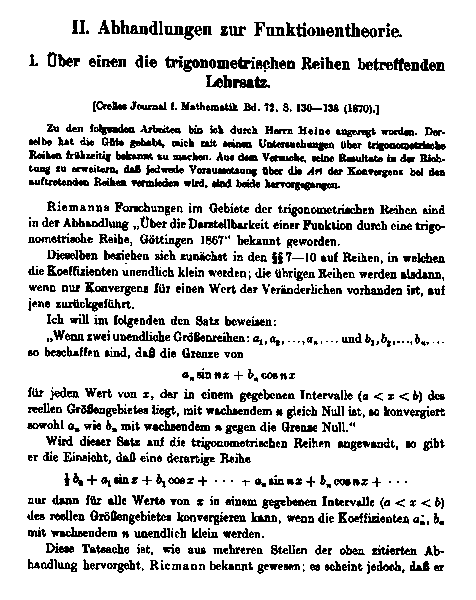
在哈勒,康托尔的研究方向从数论转向了分析。这是由于爱德华·海涅,他在哈勒的一位资深同事,向康托尔提出挑战,要求证明关于函数表示为三角级数的唯一性的未解决问题。这是一个困难的问题,许多数学家都曾试图解决但未成功,包括爱德华·海涅本人以及约翰·彼得·古斯塔夫·勒热纳·狄利克雷、鲁道夫·利普希茨和波恩哈德·黎曼。康托尔在1870年4月之前解决了这个问题,证明了表示的唯一性。他在1870年至1872年间发表了更多关于三角级数的论文,这些论文都显示了卡尔·魏尔斯特拉斯教学的影响。
康托尔于1872年被提升为哈勒的编外教授,同年他与理查德·戴德金开始了友谊,他们是在瑞士度假时相识的。康托尔于1872年发表了一篇关于三角级数的论文,其中他用有理的数的收敛序列定义了无理数数。理查德·戴德金也在1872年发表了他通过“理查德·戴德金分割”对实数的定义,在这篇论文中理查德·戴德金提到了康托尔1872年的论文,那是康托尔寄给他的。
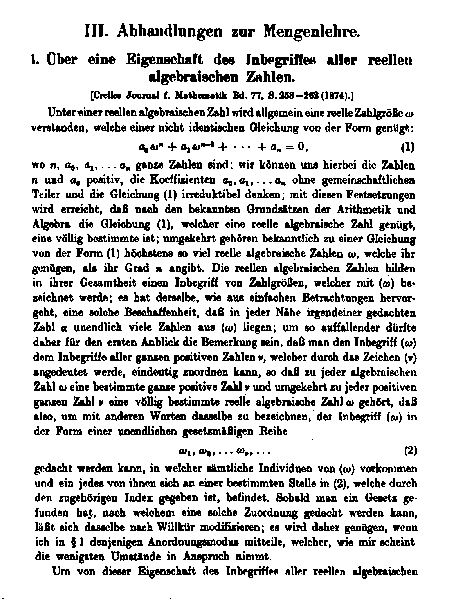
1873年,康托尔证明了有理数是可数的,即它们可以与自然数建立一一对应。他还证明了代数数,即整系数多项式方程的根所对应的数,是可数的。根据[37],他给出的证明没有承认理查德·戴德金的重要贡献。
然而,他试图判定实数是否可数的努力被证明更为艰难。到1873年12月,他已经证明了实数不可数,并于1874年在一篇论文中发表了这一结果。正是在这篇论文中,一一对应的思想首次出现,但在这项工作中它只是隐含的。他同样没有承认来自理查德·戴德金的贡献。
超越的数是指不是任何整系数多项式方程根的无理数。约瑟夫·刘维尔在1851年确立了超越数的存在。二十年后,在这项1874年的工作中,康托尔通过证明实数不可数(而他此前已证明代数数是可数的),表明在某种意义下“几乎所有”数都是超越数。
康托尔奋力推进,始终与理查德·戴德金通信往来。1874年1月,他问自己的下一个问题是,单位正方形能否与一条单位长度的直线建立点与点之间的一一对应。在1874年1月5日写给理查德·戴德金的一封信中,他写道[1]:
一个曲面(比如包含边界的正方形)能否与一条线(比如包含端点的直线段)建立唯一对应,使得曲面上的每一点都对应直线上的一个点,反之,直线上的每一点都对应曲面上的一个点?我认为回答这个问题绝非易事,尽管答案似乎如此明显是“否”,以至于证明几乎显得没有必要。
1874年是康托尔个人生活中重要的一年。那年春天,他与妹妹的朋友Vally Guttmann订婚。他们于1874年8月9日结婚,并在瑞士的因特拉肯度蜜月,在那里康托尔花了很多时间与理查德·戴德金进行数学讨论。
康托尔继续与理查德·戴德金通信,分享他的想法并寻求理查德·戴德金的意见,他于1877年写信给理查德·戴德金,证明区间[0, 1]上的点与维空间中的点之间存在一一对应。康托尔对自己的发现感到惊讶,写道:-
我看到了,但我不相信!
当然,这对几何学和空间维度的概念有影响。康托尔于1877年提交给奥古斯都·利奥波德·克雷勒的Journal的一篇关于维度的主要论文被利奥波德·克罗内克怀疑,只有在理查德·戴德金代表康托尔干预后才发表。康托尔对利奥波德·克罗内克反对他的工作非常不满,再也没有向奥古斯都·利奥波德·克雷勒的Journal提交任何论文。
1878年发表在奥古斯都·利奥波德·克雷勒的Journal上的关于维数的论文,使一一对应的概念变得精确。该论文讨论了可数集,即与自然数一一对应的集合。它研究了等势集,即彼此一一对应的集合。康托尔还讨论了维数的概念,并强调了他关于区间[0, 1]与单位正方形之间的对应不是连续映射这一事实。
1879年至1884年间,康托尔在Mathematische Annalen上发表了一系列六篇论文,旨在提供集合论的基本介绍。菲利克斯·克莱因可能对促使Mathematische Annalen发表这些论文产生了重大影响。然而,这些年中出现了一些问题,对康托尔来说颇为困难。尽管他在1879年经爱德华·海涅推荐被提升为正教授,康托尔一直希望在一所更有声望的大学获得讲席。他与赫尔曼·阿曼杜斯·施瓦茨的长期通信于1880年结束,因为对康托尔思想的反对持续增长,赫尔曼·阿曼杜斯·施瓦茨不再支持康托尔工作的发展方向。随后在1881年10月,爱德华·海涅去世,需要有人填补哈勒的讲席。
康托尔拟定了三位数学家的名单来填补爱德华·海涅的讲席,名单获得批准。名单将理查德·戴德金列在首位,其次是海因里希·马丁·韦伯,最后是弗朗茨·梅滕斯。当理查德·戴德金在1882年初拒绝这一职位时,这无疑是对康托尔的沉重打击,而海因里希·马丁·韦伯和随后弗朗茨·梅滕斯的拒绝使打击更加严重。在拟定新名单后,Wangerin被任命,但他从未与康托尔建立密切关系。康托尔与理查德·戴德金之间丰富的数学通信于1882年晚些时候结束。
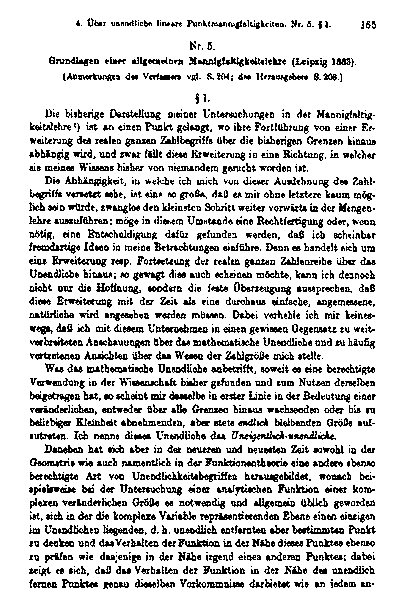
几乎在康托尔-理查德·戴德金通信结束的同时,康托尔开始了与约斯塔·米塔格-莱弗勒的另一重要通信。很快康托尔在约斯塔·米塔格-莱弗勒的期刊Acta Mathematica上发表文章,但他在Mathematische Annalen中的重要系列六篇论文也继续出现。这个系列中的第五篇论文Grundlagen einer allgemeinen Mannigfaltigkeitslehre Ⓣ(一般流形理论的基础)也作为单独的专著出版,并且由于多种原因特别重要。首先,康托尔意识到他的集合论没有获得他所希望的接受,而Grundlagen旨在回应批评。其次[3]:-
《基础》的主要成就是它将超限数呈现为自然数的自主和系统扩展。
康托尔本人在论文中相当清楚地表明,他意识到反对他观点的力量有多强大:-
……我意识到,在这项工作中,我使自己与关于数学无限的广泛持有的观点以及关于数之本质的经常被维护的意见处于某种对立之中。
1884年5月底,康托尔首次有记录地发作抑郁症。几周后他恢复了,但现在似乎不那么自信了。6月底他写信给约斯塔·米塔格-莱弗勒[3]:-
……我不知道何时才能回到我科学工作的继续之中。此刻我对此完全无能为力,只能限于我讲课中最必要的职责;要是我有必需的精神上的清新,能从事科学活动,那我会幸福得多。
曾有一时人们认为,他的抑郁症是由数学上的忧虑以及特别是他与利奥波德·克罗内克关系上的困难造成的。然而近来,对精神疾病有了更好的理解,这意味着我们现在可以确定,康托尔的数学忧虑和他困难的人际关系被他的抑郁症大大放大了,但并不是其原因(例如见[3]和[21])。在1884年这次精神疾病之后[3]:-
……他在他喜爱的哈茨山度假,并且由于某种原因决定试图与利奥波德·克罗内克和解。利奥波德·克罗内克接受了这一姿态,但他们两人想必都难以忘记彼此的敌意,而且他们之间的哲学分歧依然未受影响。
此时,数学上的忧虑开始困扰康托尔,特别是他开始担心自己无法证明连续统假设,即实数的无穷阶是紧接自然数无穷阶之后的下一个。事实上,他以为自己证明了它是错的,但第二天就发现了自己的错误。他又一次以为自己证明了它是对的,却又很快发现了自己的错误。
在其他方面也并非一切顺利,因为1885年,约斯塔·米塔格-莱弗勒说服康托尔从Acta Mathematica撤回了一篇已经进入校对阶段的论文,因为他认为它“... about one hundred years too soon”。康托尔对此开玩笑,但显然受到了伤害:——
如果约斯塔·米塔格-莱弗勒得逞,我就得等到1984年,这在我看来要求太高了!……但当然,我再也不想了解《数学学报》的任何事情了。
约斯塔·米塔格-莱弗勒本意是出于好意,但这确实表明他对康托尔工作的重要性缺乏认识。在此事件之后不久,约斯塔·米塔格-莱弗勒与康托尔之间的通信几乎完全停止,而曾导致康托尔在大约12年间迅速发展集合论的大量新思想似乎也几乎停止了。
1886年,康托尔在汉德尔街购买了一栋漂亮的新房子,这条街以德国作曲家亨德尔命名。年底前一个儿子出生,使他的六个孩子的家庭完整。他从集合论的数学发展转向两个新方向,首先与许多哲学家讨论其理论的哲学方面(他于1888年出版了这些信件),其次在阿尔弗雷德·克莱布什去世后接手他创建Deutsche Mathematiker-Vereinigung的想法,并于1890年实现。康托尔于1891年9月在哈勒主持了该协会的第一次会议,尽管他与利奥波德·克罗内克之间存在激烈对立,康托尔仍邀请利奥波德·克罗内克在第一次会议上致辞。
然而利奥波德·克罗内克从未在会议上致辞,因为他的妻子在夏末的一次登山事故中受重伤,不久后去世。康托尔在第一次会议上当选为Deutsche Mathematiker-Vereinigung主席,并担任此职至1893年。他帮助组织了1893年9月在慕尼黑举行的协会会议,但他在会议前再次生病,无法出席。
康托尔在1894年发表了一篇相当奇怪的论文,其中列出了所有不超过1000的偶数写成两个primes之和的方式。由于40年前已经完成了对哥德巴赫猜想直到10000的验证,这篇奇怪的论文很可能更多地反映了康托尔的精神状态,而不是关于克里斯蒂安·哥德巴赫的猜想。
他关于集合论的最后几篇重要论文分别于1895年和1897年发表,同样是在Mathematische Annalen上、由菲利克斯·克莱因担任编辑,这些论文是对超限算术的出色综述。两篇论文之间相当长的间隔是由于这样一个事实:尽管康托尔在第一部分发表六个月后就完成了第二部分的写作,但他希望能在第二部分中包含连续统假设的证明。然而,这未能实现,但第二篇论文描述了他的良序集和序数理论。
1897年,康托尔出席了在苏黎世举行的第一届国际数学家大会。在大会的演讲中[4]:——
……阿道夫·赫维兹公开表达了他对康托尔的极大钦佩,并宣称他是使函数论得到丰富的人。雅克·阿达马表达了他的观点,即集合论的概念是已知的且不可或缺的工具。
在大会上康托尔遇到了理查德·戴德金,他们重续了友谊。然而到大会时,康托尔已经发现了集合论中的第一个悖论。他是在撰写1895年和1897年的综述论文时发现这些悖论的,并于1896年写信给大卫·希尔伯特,向他解释这个悖论。切萨雷·布拉利-福尔蒂独立发现了这个悖论,并于1897年发表。康托尔开始与理查德·戴德金通信,试图理解如何解决这些问题,但反复发作的精神疾病迫使他在1899年停止给理查德·戴德金写信。
康托尔 曾一度受抑郁困扰,他倾向于远离数学,转向哲学以及他最大的文学兴趣——即相信弗朗西斯·培根写了莎士比亚的戏剧。例如,在1884年患病期间,他请求允许讲授哲学而非数学,并开始深入研究伊丽莎白时代文学,试图证明他的培根-莎士比亚理论。1896年和1897年,他开始出版关于这一文学问题的册子。1896年10月母亲去世和1899年1月弟弟去世,给康托尔带来了额外的压力。
1899年10月,康托尔申请并获准在1899-1900年冬季学期免于教学。然后,在1899年12月16日,康托尔最小的儿子去世了。从那时起直到他生命的尽头,他一直在与抑郁症这种精神疾病作斗争。他确实继续教学,但也不得不在若干冬季学期免于教学,即1902-03、1904-05和1907-08学年。从1899年起,在他精神疾病发作最严重的时候,康托尔也在疗养院度过了一些时间。他确实继续工作和发表关于他的培根-莎士比亚理论的文章,并且肯定没有完全放弃数学。1903年9月,他在Deutsche Mathematiker-Vereinigung的一次会议上讲授了集合论的悖论,并于1904年8月出席了在海德堡举行的国际数学家大会。
1905年,康托尔从医院住院一段时间回家后写了一部宗教著作。他还与Jourdain就集合论的历史和他的宗教小册子通信。1909年因健康不佳而请假大半年后,他在1910年和1911年履行了大学职责。正是在那一年,他高兴地收到苏格兰圣安德鲁斯大学的邀请,作为杰出外国学者参加该大学建校500周年庆典。庆典于1911年9月12日至15日举行,但[21]:-
在访问期间,他显然开始行为古怪,长篇大论地谈论培根-莎士比亚问题;然后他前往伦敦待了几天。
康托尔曾希望见到刚刚出版Principia Mathematica的伯特兰·罗素。然而健康不佳以及儿子生病的消息使康托尔未见到伯特兰·罗素就返回了德国。第二年,康托尔被圣安德鲁斯大学授予荣誉法学博士学位,但他病得太重,无法亲自领取学位。
康托尔于1913年退休,晚年因德国战时的条件而患病,食物匮乏。1915年计划在哈勒举行的一次纪念康托尔70岁生日的重要活动因战争不得不取消,但在他的家中举行了一次较小的活动。1917年6月,他最后一次进入疗养院,并不断写信给妻子,请求允许他回家。他死于心脏病发作。
大卫·希尔伯特将康托尔的工作描述为:-
……数学天才最精美的产物,也是纯粹人类智力活动最崇高的成就之一。
Georg Cantor's father, Georg Waldemar Cantor, was a successful merchant, working as a wholesaling agent in St Petersburg, then later as a broker in the St Petersburg Stock Exchange. Georg Waldemar Cantor was born in Denmark and he was a man with a deep love of culture and the arts. Georg's mother, Maria Anna Böhm, was Russian and very musical. Certainly Georg inherited considerable musical and artistic talents from his parents being an outstanding violinist. Georg was brought up a Protestant, this being the religion of his father, while Georg's mother was a Roman Catholic.
After early education at home from a private tutor, Cantor attended primary school in St Petersburg, then in 1856 when he was eleven years old the family moved to Germany. However, Cantor [21]:-
... remembered his early years in Russia with great nostalgia and never felt at ease in Germany, although he lived there for the rest of his life and seemingly never wrote in the Russian language, which he must have known.
Cantor's father had poor health and the move to Germany was to find a warmer climate than the harsh winters of St Petersburg. At first they lived in Wiesbaden, where Cantor attended the Gymnasium, then they moved to Frankfurt. Cantor studied at the Realschule in Darmstadt where he lived as a boarder. He graduated in 1860 with an outstanding report, which mentioned in particular his exceptional skills in mathematics, in particular trigonometry. After attending the Höhere Gewerbeschule in Darmstadt from 1860 he entered the Polytechnic of Zürich in 1862. The reason Cantor's father chose to send him to the Höheren Gewerbeschule was that he wanted Cantor to become:-
... a shining star in the engineering firmament.
However, in 1862 Cantor had sought his father's permission to study mathematics at university and he was overjoyed when eventually his father consented. His studies at Zürich, however, were cut short by the death of his father in June 1863. Cantor moved to the University of Berlin where he became friends with Hermann Schwarz who was a fellow student. Cantor attended lectures by Weierstrass, Kummer and Kronecker. He spent the summer term of 1866 at the University of Göttingen, returning to Berlin to complete his dissertation on number theory De aequationibus secundi gradus indeterminatis Ⓣ in 1867.
While at Berlin Cantor became much involved with a student Mathematical Society, being president of the Society during 1864-65. He was also part of a small group of young mathematicians who met weekly in a wine house. After receiving his doctorate in 1867, Cantor taught at a girl's school in Berlin. Then, in 1868, he joined the Schellbach Seminar for mathematics teachers. During this time he worked on his habilitation and, immediately after being appointed to Halle in 1869, he presented his thesis, again on number theory, and received his habilitation.
At Halle the direction of Cantor's research turned away from number theory and towards analysis. This was due to Heine, one of his senior colleagues at Halle, who challenged Cantor to prove the open problem on the uniqueness of representation of a function as a trigonometric series. This was a difficult problem which had been unsuccessfully attacked by many mathematicians, including Heine himself as well as Dirichlet, Lipschitz and Riemann. Cantor solved the problem proving uniqueness of the representation by April 1870. He published further papers between 1870 and 1872 dealing with trigonometric series and these all show the influence of Weierstrass's teaching.
Cantor was promoted to Extraordinary Professor at Halle in 1872 and in that year he began a friendship with Dedekind whom he had met while on holiday in Switzerland. Cantor published a paper on trigonometric series in 1872 in which he defined irrational numbers in terms of convergent sequences of rational numbers. Dedekind published his definition of the real numbers by "Dedekind cuts" also in 1872 and in this paper Dedekind refers to Cantor's 1872 paper which Cantor had sent him.
In 1873 Cantor proved the rational numbers countable, i.e. they may be placed in one-one correspondence with the natural numbers. He also showed that the algebraic numbers, i.e. the numbers which are roots of polynomial equations with integer coefficients, were countable. According to [37] the proof he gave did not acknowledge significant contributions from Dedekind.
However his attempts to decide whether the real numbers were countable proved harder. He had proved that the real numbers were not countable by December 1873 and published this in a paper in 1874. It is in this paper that the idea of a one-one correspondence appears for the first time, but it is only implicit in this work. Again he gave did not acknowledge contributions from Dedekind.
A transcendental number is an irrational number that is not a root of any polynomial equation with integer coefficients. Liouville established in 1851 that transcendental numbers exist. Twenty years later, in this 1874 work, Cantor showed that in a certain sense 'almost all' numbers are transcendental by proving that the real numbers were not countable while he had proved that the algebraic numbers were countable.
Cantor pressed forward, exchanging letters throughout with Dedekind. The next question he asked himself, in January 1874, was whether the unit square could be mapped into a line of unit length with a 1-1 correspondence of points on each. In a letter to Dedekind dated 5 January 1874 he wrote [1]:-
Can a surface (say a square that includes the boundary) be uniquely referred to a line (say a straight line segment that includes the end points) so that for every point on the surface there is a corresponding point of the line and, conversely, for every point of the line there is a corresponding point of the surface? I think that answering this question would be no easy job, despite the fact that the answer seems so clearly to be "no" that proof appears almost unnecessary.
The year 1874 was an important one in Cantor's personal life. He became engaged to Vally Guttmann, a friend of his sister, in the spring of that year. They married on 9 August 1874 and spent their honeymoon in Interlaken in Switzerland where Cantor spent much time in mathematical discussions with Dedekind.
Cantor continued to correspond with Dedekind, sharing his ideas and seeking Dedekind's opinions, and he wrote to Dedekind in 1877 proving that there was a 1-1 correspondence of points on the interval [0, 1] and points in -dimensional space. Cantor was surprised at his own discovery and wrote:-
I see it, but I don't believe it!
Of course this had implications for geometry and the notion of dimension of a space. A major paper on dimension which Cantor submitted to Crelle's Journal in 1877 was treated with suspicion by Kronecker, and only published after Dedekind intervened on Cantor's behalf. Cantor greatly resented Kronecker's opposition to his work and never submitted any further papers to Crelle's Journal.
The paper on dimension which appeared in Crelle's Journal in 1878 makes the concepts of 1-1 correspondence precise. The paper discusses denumerable sets, i.e. those which are in 1-1 correspondence with the natural numbers. It studies sets of equal power, i.e. those sets which are in 1-1 correspondence with each other. Cantor also discussed the concept of dimension and stressed the fact that his correspondence between the interval [0, 1] and the unit square was not a continuous map.
Between 1879 and 1884 Cantor published a series of six papers in Mathematische Annalen designed to provide a basic introduction to set theory. Klein may have had a major influence in having Mathematische Annalen published them. However there were a number of problems which occurred during these years which proved difficult for Cantor. Although he had been promoted to a full professor in 1879 on Heine's recommendation, Cantor had been hoping for a chair at a more prestigious university. His long standing correspondence with Schwarz ended in 1880 as opposition to Cantor's ideas continued to grow and Schwarz no longer supported the direction that Cantor's work was going. Then in October 1881 Heine died and a replacement was needed to fill the chair at Halle.
Cantor drew up a list of three mathematicians to fill Heine's chair and the list was approved. It placed Dedekind in first place, followed by Heinrich Weber and finally Mertens. It was certainly a severe blow to Cantor when Dedekind declined the offer in the early 1882, and the blow was only made worse by Heinrich Weber and then Mertens declining too. After a new list had been drawn up, Wangerin was appointed but he never formed a close relationship with Cantor. The rich mathematical correspondence between Cantor and Dedekind ended later in 1882.
Almost the same time as the Cantor-Dedekind correspondence ended, Cantor began another important correspondence with Mittag-Leffler. Soon Cantor was publishing in Mittag-Leffler's journal Acta Mathematica but his important series of six papers in Mathematische Annalen also continued to appear. The fifth paper in this series Grundlagen einer allgemeinen Mannigfaltigkeitslehre Ⓣ was also published as a separate monograph and was especially important for a number of reasons. Firstly Cantor realised that his theory of sets was not finding the acceptance that he had hoped and the Grundlagen was designed to reply to the criticisms. Secondly [3]:-
The major achievement of the Grundlagen was its presentation of the transfinite numbers as an autonomous and systematic extension of the natural numbers.
Cantor himself states quite clearly in the paper that he realises the strength of the opposition to his ideas:-
... I realise that in this undertaking I place myself in a certain opposition to views widely held concerning the mathematical infinite and to opinions frequently defended on the nature of numbers.
At the end of May 1884 Cantor had the first recorded attack of depression. He recovered after a few weeks but now seemed less confident. He wrote to Mittag-Leffler at the end of June [3]:-
... I don't know when I shall return to the continuation of my scientific work. At the moment I can do absolutely nothing with it, and limit myself to the most necessary duty of my lectures; how much happier I would be to be scientifically active, if only I had the necessary mental freshness.
At one time it was thought that his depression was caused by mathematical worries and as a result of difficulties of his relationship with Kronecker in particular. Recently, however, a better understanding of mental illness has meant that we can now be certain that Cantor's mathematical worries and his difficult relationships were greatly magnified by his depression but were not its cause (see for example [3] and [21]). After this mental illness of 1884 [3]:-
... he took a holiday in his favourite Harz mountains and for some reason decided to try to reconcile himself with Kronecker. Kronecker accepted the gesture, but it must have been difficult for both of them to forget their enmities and the philosophical disagreements between them remained unaffected.
Mathematical worries began to trouble Cantor at this time, in particular he began to worry that he could not prove the continuum hypothesis, namely that the order of infinity of the real numbers was the next after that of the natural numbers. In fact he thought he had proved it false, then the next day found his mistake. Again he thought he had proved it true only again to quickly find his error.
All was not going well in other ways too, for in 1885 Mittag-Leffler persuaded Cantor to withdraw one of his papers from Acta Mathematica when it had reached the proof stage because he thought it "... about one hundred years too soon". Cantor joked about it but was clearly hurt:-
Had Mittag-Leffler had his way, I should have to wait until the year 1984, which to me seemed too great a demand! ... But of course I never want to know anything again about Acta Mathematica.
Mittag-Leffler meant this as a kindness but it does show a lack of appreciation of the importance of Cantor's work. The correspondence between Mittag-Leffler and Cantor all but stopped shortly after this event and the flood of new ideas which had led to Cantor's rapid development of set theory over about 12 years seems to have almost stopped.
In 1886 Cantor bought a fine new house on Händelstrasse, a street named after the German composer Handel. Before the end of the year a son was born, completing his family of six children. He turned from the mathematical development of set theory towards two new directions, firstly discussing the philosophical aspects of his theory with many philosophers (he published these letters in 1888) and secondly taking over after Clebsch's death his idea of founding the Deutsche Mathematiker-Vereinigung which he achieved in 1890. Cantor chaired the first meeting of the Association in Halle in September 1891, and despite the bitter antagonism between himself and Kronecker, Cantor invited Kronecker to address the first meeting.
Kronecker never addressed the meeting, however, since his wife was seriously injured in a climbing accident in the late summer and died shortly afterwards. Cantor was elected president of the Deutsche Mathematiker-Vereinigung at the first meeting and held this post until 1893. He helped to organise the meeting of the Association held in Munich in September 1893, but he took ill again before the meeting and could not attend.
Cantor published a rather strange paper in 1894 which listed the way that all even numbers up to 1000 could be written as the sum of two primes. Since a verification of Goldbach's conjecture up to 10000 had been done 40 years before, it is likely that this strange paper says more about Cantor's state of mind than it does about Goldbach's conjecture.
His last major papers on set theory appeared in 1895 and 1897, again in Mathematische Annalen under Klein's editorship, and are fine surveys of transfinite arithmetic. The rather long gap between the two papers is due to the fact that although Cantor finished writing the second part six months after the first part was published, he hoped to include a proof of the continuum hypothesis in the second part. However, it was not to be, but the second paper describes his theory of well-ordered sets and ordinal numbers.
In 1897 Cantor attended the first International Congress of Mathematicians in Zürich. In their lectures at the Congress [4]:-
... Hurwitz openly expressed his great admiration of Cantor and proclaimed him as one by whom the theory of functions has been enriched. Jacques Hadamard expressed his opinion that the notions of the theory of sets were known and indispensable instruments.
At the Congress Cantor met Dedekind and they renewed their friendship. By the time of the Congress, however, Cantor had discovered the first of the paradoxes in the theory of sets. He discovered the paradoxes while working on his survey papers of 1895 and 1897 and he wrote to Hilbert in 1896 explaining the paradox to him. Burali-Forti discovered the paradox independently and published it in 1897. Cantor began a correspondence with Dedekind to try to understand how to solve the problems but recurring bouts of his mental illness forced him to stop writing to Dedekind in 1899.
Whenever Cantor suffered from periods of depression he tended to turn away from mathematics and turn towards philosophy and his big literary interest which was a belief that Francis Bacon wrote Shakespeare's plays. For example in his illness of 1884 he had requested that he be allowed to lecture on philosophy instead of mathematics and he had begun his intense study of Elizabethan literature in attempting to prove his Bacon-Shakespeare theory. He began to publish pamphlets on the literary question in 1896 and 1897. Extra stress was put on Cantor with the death of his mother in October 1896 and the death of his younger brother in January 1899.
In October 1899 Cantor applied for, and was granted, leave from teaching for the winter semester of 1899-1900. Then on 16 December 1899 Cantor's youngest son died. From this time on until the end of his life he fought against the mental illness of depression. He did continue to teach but also had to take leave from his teaching for a number of winter semesters, those of 1902-03, 1904-05 and 1907-08. Cantor also spent some time in sanatoria, at the times of the worst attacks of his mental illness, from 1899 onwards. He did continue to work and publish on his Bacon-Shakespeare theory and certainly did not give up mathematics completely. He lectured on the paradoxes of set theory to a meeting of the Deutsche Mathematiker-Vereinigung in September 1903 and he attended the International Congress of Mathematicians at Heidelberg in August 1904.
In 1905 Cantor wrote a religious work after returning home from a spell in hospital. He also corresponded with Jourdain on the history of set theory and his religious tract. After taking leave for much of 1909 on the grounds of his ill health he carried out his university duties for 1910 and 1911. It was in that year that he was delighted to receive an invitation from the University of St Andrews in Scotland to attend the 500th anniversary of the founding of the University as a distinguished foreign scholar. The celebrations were 12-15 September 1911 but [21]:-
During the visit he apparently began to behave eccentrically, talking at great length on the Bacon-Shakespeare question; then he travelled down to London for a few days.
Cantor had hoped to meet with Russell who had just published the Principia Mathematica. However ill health and the news that his son had taken ill made Cantor return to Germany without seeing Russell. The following year Cantor was awarded the honorary degree of Doctor of Laws by the University of St Andrews but he was too ill to receive the degree in person.
Cantor retired in 1913 and spent his final years ill with little food because of the war conditions in Germany. A major event planned in Halle to mark Cantor's 70th birthday in 1915 had to be cancelled because of the war, but a smaller event was held in his home. In June 1917 he entered a sanatorium for the last time and continually wrote to his wife asking to be allowed to go home. He died of a heart attack.
Hilbert described Cantor's work as:-
...the finest product of mathematical genius and one of the supreme achievements of purely intellectual human activity.
正文里的方括号编号指向这里,悬停即可直接看到条目。书目保留原文——译了书名反而查不到文献。
原站列出的延伸阅读与外部数据库,照原样保留,目标多为英文页面。
关于格奥尔格·康托尔的其它页面:
原站的交叉引用。指向本站已镜像专题的留在站内,其余仍指回原站。