数学家传记
奥马尔·海亚姆是一位伊斯兰学者,既是诗人也是数学家。他编制了天文表,为历法改革做出了贡献,并发现了一种通过抛物线与圆相交来求解三次方程的几何方法。
奥马尔·海亚姆 海亚姆的全名是 Ghiyath al-Din Abu'l-Fath Umar ibn Ibrahim Al-Nisaburi 奥马尔·海亚姆。名字 奥马尔·海亚姆(或 al-Khayyam)的字面意思是“帐篷制造者”,这可能是他父亲 Ibrahim 的职业。海亚姆在写作时利用了自己名字的含义:-
海亚姆,曾缝制科学之帐篷,
已坠入悲伤的熔炉,骤然被焚,
命运之剪剪断了他生命的帐篷绳,
希望之掮客将他白白卖掉!
11世纪的政治事件在海亚姆的一生中起了重要作用。塞尔柱突厥人是11世纪入侵西南亚的部落,最终建立了一个包括美索不达米亚、叙利亚、巴勒斯坦和伊朗大部分地区的帝国。塞尔柱人占领了呼罗珊的牧场,然后在1038年至1040年间,他们征服了整个伊朗东北部。塞尔柱统治者 Toghrïl Beg 于1038年在内沙布尔自称苏丹,并于1055年进入巴格达。海亚姆就是在这样一个困难而不稳定的军事帝国中长大的,该帝国还因试图建立一个正统的穆斯林国家而存在宗教问题。
海亚姆在内沙布尔学习哲学,他的一位同学写道,他:-
……才智敏锐,具有最高的天赋能力……
然而,这并不是一个博学之人——即使是像海亚姆这样博学的人——能够轻松生活的帝国,除非他们得到众多宫廷中某位统治者的支持。即使有这样的赞助,也不会提供太多的稳定性,因为地方政治和地方军事政权的命运决定了谁在任何时候掌权。海亚姆本人在其 Treatise on Demonstration of Problems of Algebra 的导言中描述了这一时期博学之士的困难(例如见[1]):-
我无法专心学习这门代数并持续专注于它,因为时间的变幻莫测阻碍了我;因为我们被剥夺了所有有知识的人,只剩下少数人,他们有许多烦恼,他们生活中的关切是抓住机会,在时间沉睡时, meanwhile 致力于研究和完善一门科学;因为大多数模仿哲学家的人混淆真假,他们除了欺骗和假装知识外什么也不做,他们利用所知的科学只是为了卑鄙和物质的目的;如果他们看到某个人寻求正确并偏好真理,尽力驳斥虚假和不真实,摒弃虚伪和欺骗,他们就愚弄他并嘲笑他。
然而⟦N1⟧是一位杰出的数学家和天文学家,尽管他在此引文中描述了困难,他确实写了几部作品,包括Problems of Arithmetic,一本关于音乐的书和一本关于代数的书,在他25岁之前。1070年,他搬到乌兹别克斯坦的撒马尔罕,这是中亚最古老的城市之一。在那里,⟦N1⟧得到了撒马尔罕著名法学家Abu Tahir的支持,这使他能够写出他最著名的代数著作Treatise on Demonstration of Problems of Algebra,我们上面的引文即出自该书。我们将在本传记后面描述这部作品的数学内容。
塞尔柱王朝的创始人Toghril Beg将伊斯法罕作为其领地的首都,他的孙子Malik-Shah从1073年起是该城市的统治者。Malik-Shah和他的维齐尔Nizam al-Mulk向Khayyam发出邀请,请他去伊斯法罕在那里建立天文台。其他领先的天文学家也被带到伊斯法罕天文台,18年来Khayyam领导科学家并产生了杰出质量的工作。这是一个和平时期,在此期间政治局势允许Khayyam有机会完全致力于他的学术工作。
在此期间,⟦N1⟧领导了编制天文表的工作,他还在1079年对历法改革做出了贡献。Cowell引用《加尔各答评论》第59期:-
当马利克沙阿决定改革历法时,奥马尔·海亚姆是受雇从事这项工作的八位学者之一,结果是贾拉利历(以贾拉尔丁命名,国王的名字之一)——吉本说,‘一种时间计算,超越了儒略历,接近格里高利历的精确度。’
⟦N1⟧测量了一年的长度为365.24219858156天。对此结果有两点评论。首先,它显示出令人难以置信的信心,试图将结果精确到这种程度。我们现在知道,在一生中,一年的长度在小数点后第六位发生变化。其次,它极其精确。作为比较,19世纪末一年的长度为365.242196天,而今天是365.242190天。
1092年,政治事件结束了⟦N1⟧的和平生活时期。马利克沙阿于那年11月去世,一个月前,他的维齐尔尼扎姆·穆尔克在从伊斯法罕到巴格达的路上被名为阿萨辛的恐怖运动谋杀。马利克沙阿的第二任妻子接任统治者两年,但她曾与尼扎姆·穆尔克争论,所以现在他支持的人发现支持被撤回。运行天文台的资金停止,⟦N1⟧的历法改革被搁置。⟦N1⟧还受到正统穆斯林的攻击,他们认为⟦N1⟧质疑的心灵不符合信仰。他在他的诗Rubaiyat中写道:-
我长久钟爱的那些偶像
已大大损害了我在人们眼中的信誉:
把我的荣誉淹没在一只浅杯中,
为了一支歌出卖了我的名声。
尽管四面受冷落,海亚姆仍留在宫廷,试图重获恩宠。他写了一部著作,在其中将伊朗以前的统治者描述为极其尊贵之人,他们曾支持公共工程、科学和学术。
马利克沙阿的第三个儿子桑贾尔曾任呼罗珊总督,于1118年成为塞尔柱帝国的最高统治者。此后某时,海亚姆离开伊斯法罕,前往桑贾尔定为塞尔柱帝国首都的梅尔夫(今土库曼斯坦马里)。桑贾尔在梅尔夫创建了一个伟大的伊斯兰学术中心,海亚姆在那里撰写了更多数学著作。
海亚姆的论文[18]是在其著名代数著作之前的一部早期代数作品。在其中他考虑了这样一个问题:-
在四分之一圆弧上找一点,使得从该点向一条边界半径作正规时,法线长度与半径长度之比等于由法线足所确定的两线段之比。
海亚姆表明这个问题等价于求解第二个问题:-
求一个直角三角形,使其斜边等于一条直角边加上斜边上的高。
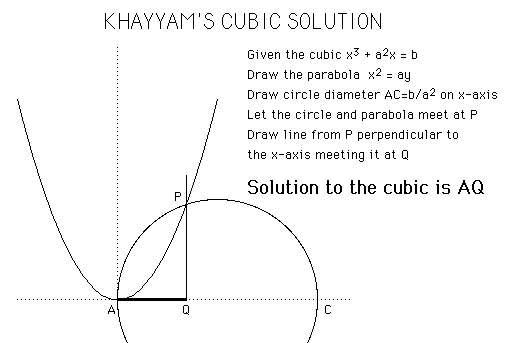
这个问题反过来又引导海亚姆去解三次方程,他通过考虑一个矩形双曲线与一个圆的交点,求出了这个三次方程的一个正根。
关于这一作图的图形,见THIS LINK。
随后,通过在三角函数表中进行插值,找到了一个近似的数值解。也许更值得注意的是,海亚姆指出,这个三次方程的求解需要使用conic sections,并且它无法用尺规方法求解——这一结果在此后750年内都未被证明。海亚姆还写道,他希望在后来的著作[18]中给出三次方程求解的完整描述:-
如果机会出现,并且我能够成功,我将给出所有这十四种形式及其所有分支和情形,以及如何区分哪些是可能的、哪些是不可能的,从而准备好一篇包含在这门技艺中极为有用的要素的论文。
确实,海亚姆写出了这样一部著作,即Treatise on Demonstration of Problems of Algebra,其中包含了对三次方程的完整分类,并给出了通过圆锥曲线相交找到的几何解。事实上,海亚姆给出了一段有趣的历史叙述,其中他声称希腊人在三次方程理论方面没有留下任何东西。确实,正如海亚姆所写,较早的作者如al-Mahani和al-Khazin的贡献在于将几何问题转化为代数方程(在花拉子米的工作之前,这本质上是不可能的)。然而,海亚姆本人似乎是最早构想出三次方程一般理论的人。海亚姆写道(例如见[9]或[10]):-
在代数学中,人们会遇到依赖于某些极其困难的预备定理的问题,大多数尝试解决这些问题的人都未能成功。至于古人,他们没有关于这一主题的著作流传到我们手中;也许他们在寻找解法并加以检验之后,无法洞悉其中的困难;或者也许他们的研究不需要这样的检验;或者最后,他们关于这一主题的著作,如果曾经存在的话,没有被翻译成我们的语言。
这部代数文本的另一项成就是海亚姆认识到一个三次方程可以有不止一个解。他证明了存在有两个解的方程,但不幸的是,他似乎没有发现一个三次方程可以有三个解。他确实希望有一天能够找到“算术解”,他写道(例如见[1]):-
也许我们之后的某个人会在这种情况下发现它,那时不仅有三类已知的幂,即数、事物和平方。
“我们之后的某个人”实际上是16世纪的del 希皮奥内·德尔·费罗、尼科洛·塔尔塔利亚和洛多维科·费拉里。此外,在他的代数书中,Khayyam提到了他另一部现已失传的著作。在这部失传的著作中,Khayyam讨论了帕斯卡三角形,但他并不是第一个这样做的人,因为卡拉吉在此之前就讨论了帕斯卡三角形。事实上,我们可以相当确定Khayyam使用了一种基于binomial expansion、因而基于二项式系数的求n次根的方法。这从他代数书中的以下段落可以推知(例如参见[1]、[9]或[10]):-
印度人拥有基于对九个数字的平方的认识来求平方和立方边长的方法,即1、2、3等的平方,以及它们彼此相乘所得的乘积,即2、3等的乘积。我撰写了一部著作来证明这些方法的准确性,并证明了它们确实能达到所求的目标。此外,我还增加了种类,即我展示了如何求平方-平方、四次方-立方、立方-立方等的边长,达到任意长度,这是此前未曾做到的。我在这一场合给出的证明只是基于欧几里得的《几何原本》中算术部分的算术证明。
在Commentaries on the difficult postulates of Euclid's book中,Khayyam对non-euclidean geometry做出了贡献,尽管这并非他的本意。在试图证明平行公设时,他意外地证明了非欧几何中图形的性质。Khayyam还在这部书中给出了关于比的重要结果,将欧几里得的工作扩展到包括比的乘法。Khayyam贡献的重要性在于,他考察了欧几里得的比相等定义(即欧多克索斯首先提出的定义)以及早期伊斯兰数学家如al-Mahani提出的基于连分数的比相等定义。Khayyam证明了这两个定义是等价的。他还提出了比是否可以视为数的问题,但未作回答。
在数学世界之外,Khayyam最为人所知的是Edward Fitzgerald于1859年对近600首四行短诗Rubaiyat.的流行翻译。Khayyam作为诗人的名声使一些人忘记了他的科学成就,而这些成就实质上要重要得多。Rubaiyat中所用形式和诗句的版本在Khayyam之前的波斯文学中就已存在,只有大约120首诗可以确定归于他。在所有诗句中,最著名的是以下这首:-
移动的手指在书写,写罢便继续前行:
你所有的虔诚或智慧
都无法诱使它回来抹去半行,
你所有的泪水也洗不掉其中的一个字。
Omar Khayyam's full name was Ghiyath al-Din Abu'l-Fath Umar ibn Ibrahim Al-Nisaburi al-Khayyami. A literal translation of the name al-Khayyami (or al-Khayyam) means 'tent maker' and this may have been the trade of Ibrahim his father. Khayyam played on the meaning of his own name when he wrote:-
Khayyam, who stitched the tents of science,
Has fallen in grief's furnace and been suddenly burned,
The shears of Fate have cut the tent ropes of his life,
And the broker of Hope has sold him for nothing!
The political events of the 11th Century played a major role in the course of Khayyam's life. The Seljuq Turks were tribes that invaded southwestern Asia in the 11th Century and eventually founded an empire that included Mesopotamia, Syria, Palestine, and most of Iran. The Seljuq occupied the grazing grounds of Khorasan and then, between 1038 and 1040, they conquered all of north-eastern Iran. The Seljuq ruler Toghrïl Beg proclaimed himself sultan at Nishapur in 1038 and entered Baghdad in 1055. It was in this difficult unstable military empire, which also had religious problems as it attempted to establish an orthodox Muslim state, that Khayyam grew up.
Khayyam studied philosophy at Naishapur and one of his fellow students wrote that he was:-
... endowed with sharpness of wit and the highest natural powers ...
However, this was not an empire in which those of learning, even those as learned as Khayyam, found life easy unless they had the support of a ruler at one of the many courts. Even such patronage would not provide too much stability since local politics and the fortunes of the local military regime decided who at any one time held power. Khayyam himself described the difficulties for men of learning during this period in the introduction to his Treatise on Demonstration of Problems of Algebra (see for example [1]):-
I was unable to devote myself to the learning of this algebra and the continued concentration upon it, because of obstacles in the vagaries of time which hindered me; for we have been deprived of all the people of knowledge save for a group, small in number, with many troubles, whose concern in life is to snatch the opportunity, when time is asleep, to devote themselves meanwhile to the investigation and perfection of a science; for the majority of people who imitate philosophers confuse the true with the false, and they do nothing but deceive and pretend knowledge, and they do not use what they know of the sciences except for base and material purposes; and if they see a certain person seeking for the right and preferring the truth, doing his best to refute the false and untrue and leaving aside hypocrisy and deceit, they make a fool of him and mock him.
However Khayyam was an outstanding mathematician and astronomer and, despite the difficulties which he described in this quote, he did write several works including Problems of Arithmetic, a book on music and one on algebra before he was 25 years old. In 1070 he moved to Samarkand in Uzbekistan which is one of the oldest cities of Central Asia. There Khayyam was supported by Abu Tahir, a prominent jurist of Samarkand, and this allowed him to write his most famous algebra work, Treatise on Demonstration of Problems of Algebra from which we gave the quote above. We shall describe the mathematical contents of this work later in this biography.
Toghril Beg, the founder of the Seljuq dynasty, had made Esfahan the capital of his domains and his grandson Malik-Shah was the ruler of that city from 1073. An invitation was sent to Khayyam from Malik-Shah and from his vizier Nizam al-Mulk asking Khayyam to go to Esfahan to set up an Observatory there. Other leading astronomers were also brought to the Observatory in Esfahan and for 18 years Khayyam led the scientists and produced work of outstanding quality. It was a period of peace during which the political situation allowed Khayyam the opportunity to devote himself entirely to his scholarly work.
During this time Khayyam led work on compiling astronomical tables and he also contributed to calendar reform in 1079. Cowell quotes The Calcutta Review No 59:-
When the Malik Shah determined to reform the calendar, Omar was one of the eight learned men employed to do it, the result was the Jalali era (so called from Jalal-ud-din, one of the king's names) - 'a computation of time,' says Gibbon, 'which surpasses the Julian, and approaches the accuracy of the Gregorian style.'
Khayyam measured the length of the year as 365.24219858156 days. Two comments on this result. Firstly it shows an incredible confidence to attempt to give the result to this degree of accuracy. We know now that the length of the year is changing in the sixth decimal place over a person's lifetime. Secondly it is outstandingly accurate. For comparison the length of the year at the end of the 19th century was 365.242196 days, while today it is 365.242190 days.
In 1092 political events ended Khayyam's period of peaceful existence. Malik-Shah died in November of that year, a month after his vizier Nizam al-Mulk had been murdered on the road from Esfahan to Baghdad by the terrorist movement called the Assassins. Malik-Shah's second wife took over as ruler for two years but she had argued with Nizam al-Mulk so now those whom he had supported found that support withdrawn. Funding to run the Observatory ceased and Khayyam's calendar reform was put on hold. Khayyam also came under attack from the orthodox Muslims who felt that Khayyam's questioning mind did not conform to the faith. He wrote in his poem the Rubaiyat :-
Indeed, the Idols I have loved so long
Have done my Credit in Men's Eye much Wrong:
Have drowned my Honour in a shallow cup,
And sold my reputation for a Song.
Despite being out of favour on all sides, Khayyam remained at the Court and tried to regain favour. He wrote a work in which he described former rulers in Iran as men of great honour who had supported public works, science and scholarship.
Malik-Shah's third son Sanjar, who was governor of Khorasan, became the overall ruler of the Seljuq empire in 1118. Sometime after this Khayyam left Esfahan and travelled to Merv (now Mary, Turkmenistan) which Sanjar had made the capital of the Seljuq empire. Sanjar created a great centre of Islamic learning in Merv where Khayyam wrote further works on mathematics.
The paper [18] by Khayyam is an early work on algebra written before his famous algebra text. In it he considers the problem:-
Find a point on a quadrant of a circle in such manner that when a normal is dropped from the point to one of the bounding radii, the ratio of the normal's length to that of the radius equals the ratio of the segments determined by the foot of the normal.
Khayyam shows that this problem is equivalent to solving a second problem:-
Find a right triangle having the property that the hypotenuse equals the sum of one leg plus the altitude on the hypotenuse.
This problem in turn led Khayyam to solve the cubic equation and he found a positive root of this cubic by considering the intersection of a rectangular hyperbola and a circle.
See THIS LINK for a picture of the construction.
An approximate numerical solution was then found by interpolation in trigonometric tables. Perhaps even more remarkable is the fact that Khayyam states that the solution of this cubic requires the use of conic sections and that it cannot be solved by ruler and compass methods, a result which would not be proved for another 750 years. Khayyam also wrote that he hoped to give a full description of the solution of cubic equations in a later work [18]:-
If the opportunity arises and I can succeed, I shall give all these fourteen forms with all their branches and cases, and how to distinguish whatever is possible or impossible so that a paper, containing elements which are greatly useful in this art will be prepared.
Indeed Khayyam did produce such a work, the Treatise on Demonstration of Problems of Algebra which contained a complete classification of cubic equations with geometric solutions found by means of intersecting conic sections. In fact Khayyam gives an interesting historical account in which he claims that the Greeks had left nothing on the theory of cubic equations. Indeed, as Khayyam writes, the contributions by earlier writers such as al-Mahani and al-Khazin were to translate geometric problems into algebraic equations (something which was essentially impossible before the work of al-Khwarizmi). However, Khayyam himself seems to have been the first to conceive a general theory of cubic equations. Khayyam wrote (see for example [9] or [10]):-
In the science of algebra one encounters problems dependent on certain types of extremely difficult preliminary theorems, whose solution was unsuccessful for most of those who attempted it. As for the Ancients, no work from them dealing with the subject has come down to us; perhaps after having looked for solutions and having examined them, they were unable to fathom their difficulties; or perhaps their investigations did not require such an examination; or finally, their works on this subject, if they existed, have not been translated into our language.
Another achievement in the algebra text is Khayyam's realisation that a cubic equation can have more than one solution. He demonstrated the existence of equations having two solutions, but unfortunately he does not appear to have found that a cubic can have three solutions. He did hope that "arithmetic solutions" might be found one day when he wrote (see for example [1]):-
Perhaps someone else who comes after us may find it out in the case, when there are not only the first three classes of known powers, namely the number, the thing and the square.
The "someone else who comes after us" were in fact del Ferro, Tartaglia and Ferrari in the 16th century. Also in his algebra book, Khayyam refers to another work of his which is now lost. In the lost work Khayyam discusses the Pascal triangle but he was not the first to do so since al-Karaji discussed the Pascal triangle before this date. In fact we can be fairly sure that Khayyam used a method of finding nth roots based on the binomial expansion, and therefore on the binomial coefficients. This follows from the following passage in his algebra book (see for example [1], [9] or [10]):-
The Indians possess methods for finding the sides of squares and cubes based on such knowledge of the squares of nine figures, that is the square of 1, 2, 3, etc. and also the products formed by multiplying them by each other, i.e. the products of 2, 3 etc. I have composed a work to demonstrate the accuracy of these methods, and have proved that they do lead to the sought aim. I have moreover increased the species, that is I have shown how to find the sides of the square-square, quatro-cube, cubo-cube, etc. to any length, which has not been made before now. the proofs I gave on this occasion are only arithmetic proofs based on the arithmetical parts of Euclid's "Elements".
In Commentaries on the difficult postulates of Euclid's book Khayyam made a contribution to non-euclidean geometry, although this was not his intention. In trying to prove the parallels postulate he accidentally proved properties of figures in non-euclidean geometries. Khayyam also gave important results on ratios in this book, extending Euclid's work to include the multiplication of ratios. The importance of Khayyam's contribution is that he examined both Euclid's definition of equality of ratios (which was that first proposed by Eudoxus) and the definition of equality of ratios as proposed by earlier Islamic mathematicians such as al-Mahani which was based on continued fractions. Khayyam proved that the two definitions are equivalent. He also posed the question of whether a ratio can be regarded as a number but leaves the question unanswered.
Outside the world of mathematics, Khayyam is best known as a result of Edward Fitzgerald's popular translation in 1859 of nearly 600 short four line poems the Rubaiyat. Khayyam's fame as a poet has caused some to forget his scientific achievements which were much more substantial. Versions of the forms and verses used in the Rubaiyat existed in Persian literature before Khayyam, and only about 120 of the verses can be attributed to him with certainty. Of all the verses, the best known is the following:-
The Moving Finger writes, and, having writ,
Moves on: nor all thy Piety nor Wit
Shall lure it back to cancel half a Line,
Nor all thy Tears wash out a Word of it.
正文里的方括号编号指向这里,悬停即可直接看到条目。书目保留原文——译了书名反而查不到文献。
原站列出的延伸阅读与外部数据库,照原样保留,目标多为英文页面。
关于奥马尔·海亚姆的其它页面:
关于奥马尔·海亚姆的其它网站:
原站的交叉引用。指向本站已镜像专题的留在站内,其余仍指回原站。