数学家传记
亨利·布里格斯是一位英国数学家,他出版了约翰·纳皮尔的对数表,并且是最促使科学家接受对数的人。
亨利·布里格斯是最促使科学家们接受对数的人。他在数学发展中极为重要,但正如⟦N2⟧在[8]中所写:-
……尽管布里格斯作为数学家本身很重要,但他最大的重要性在于他是一位联络人和公关人。
布里格斯出生于约克郡哈利法克斯教区的沃利伍德(或沃利伍德)。他的出生记录在哈利法克斯教区登记册中为1561年2月,然而这一信息与J Mede于1630年2月6日在剑桥基督学院写的一则通知相矛盾,该通知写于布里格斯去世后几天,其中写道(例如见[1]):-
牛津的布里格斯,那位伟大的数学家,最近去世了,享年74岁。
如果Mede是正确的,那么布里格斯应该出生于1556年,但他正确的可能性似乎极低,因为似乎没有任何可能的理由认为哈利法克斯教区记录可能有误。我们对布里格斯的家庭知之甚少,但Blomefield写有一部诺福克史,其中称布里格斯的家庭原出自该郡的Salle。已知Blomefield在其他若干此类说法上是错误的,因此不应过分重视这一陈述,尽管另一方面,有一些证据表明布里格斯家庭的其他成员确实与诺福克有联系。事实上,Richard Briggs,即布里格斯的兄弟,成为了诺福克一所学校的校长。Richard Briggs有重要的朋友,如剧作家、诗人和文学评论家Ben Jonson,且Ben Jonson写给Richard Briggs的一封信仍然存世。
布里格斯在沃利伍德附近的一所文法学校就读,在那里他精通希腊语和拉丁语。完成学业后,他于1577年进入剑桥大学圣弗瑞兹·约翰学院。布里格斯于1577年11月5日被录取为学者,1581年获得学士学位,四年后获得硕士学位。1588年(有些资料作1589年),他被选为圣约翰学院会士,随后在1592年,他成为:-
由林纳克博士设立的物理学讲座的读者。
托马斯·林纳克出生于布里格斯之前几乎整整100年,他因医学由未经适当资格的理发师和神职人员执业而感到非常不安,于是创立了伦敦皇家内科医学院。因此,布里格斯被任命的林纳克讲座是一个医学讲座,但在1592年同一年,布里格斯也被任命为剑桥的数学考官和讲师。显然,他的才能非常广泛。
1596年,布里格斯成为伦敦格雷沙姆学院的第一位几何学教授,该学院刚刚成立。他在格雷沙姆学院担任这一职位23年,该学院因在布里格斯离开约25年后成为伦敦皇家学会的诞生地而闻名。我们对布里格斯此时的工作有所了解,因为他在1609年与James Ussher成为密友。Ussher当时是都柏林三一学院的教授,但后来在1625年成为阿马大主教。寄给Ussher的信件保存了下来,有些已经出版,特别是布里格斯在1610年8月写的一封信。这封信表明,此时布里格斯对天文学非常感兴趣,特别是他正在研究日食。这是一个涉及许多繁重计算的主题,因此当布里格斯读到约翰·纳皮尔关于对数的工作时,他深受震撼,因为这些对数将为从事天文学的人提供巨大帮助。
吸引布里格斯使用对数的不仅仅是它们对天文计算如此有用这一事实。他已经深度参与制作辅助计算的表格,并且在读到约翰·纳皮尔的对数之前,他已经出版了两种类型的表格。1602年,布里格斯出版了A Table to find the Height of the Pole, the 磁偏角 being given,1610年,他出版了Tables for the Improvement of Navigation。
布里格斯阅读了约翰·纳皮尔1614年关于对数的拉丁文文本,并于1615年3月10日在给朋友詹姆斯·厄舍的信中写道,他:-
……完全致力于当时新发现的高贵的对数发明。
布里格斯续:-
马克斯顿的领主纳皮尔用他新颖而令人钦佩的对数让我的头脑和双手忙碌起来。如果上帝愿意,我希望今年夏天见到他,因为我从未见过一本让我更满意或更惊奇的书。
布里格斯一读到关于对数的内容,就开始思考改进方法,并很快向他的学生讲授这个新课题。他写道(例如见[1]):-
我本人在伦敦向格雷沙姆学院的听众公开阐述这一学说时,就指出,若将0保留为整个正弦的对数,将会方便得多……关于此事,我立即写信给作者本人。
让我们看看布里格斯试图解决的问题。约翰·纳皮尔发明的Nap.log对数与今天使用的对数不同。Nap.log 1不等于0这一事实是一个重大困难,使得Nap.log在计算上远不如今天的对数方便。数学史书籍中常写道,布里格斯促成了向log 1 = 0的对数的转变。然而,尽管log 1 = 0的对数最早出现在布里格斯的著作中,他本人却将这一想法归功于约翰·纳皮尔。当然,这一想法是在约翰·纳皮尔与布里格斯的讨论中产生的。
1615年夏天,布里格斯从伦敦到爱丁堡经历了艰难的旅程去见约翰·纳皮尔。这不是我们今天可以乘坐火车4小时完成的轻松旅程,而是对布里格斯来说,至少需要骑马和乘马车4天的旅程。这不是一个人会轻易踏上的旅程,但布里格斯迫切渴望见到约翰·纳皮尔。约翰 Marr向William Lilly讲述了他们会面的情景,后者写下了以下内容(见[6]):-
布里格斯约定某日在爱丁堡会面;但未能如期而至,梅奇斯顿担心他不会来了。有一天,约翰 Marr和约翰·纳皮尔勋爵正在谈论布里格斯,“哦!约翰,”梅奇斯顿说,“布里格斯现在不会来了”;就在那一刻,有人敲门,约翰 Marr赶紧下楼,结果发现是布里格斯,他非常满意。他把布里格斯带进勋爵的房间,在那里几乎花了一刻钟,彼此钦佩地注视着对方,一言未发。最后布里格斯开口了——“勋爵,我特意长途跋涉来见您本人,想知道您最初是凭借什么样的智慧或独创性才想到这对天文学最卓越的帮助,即对数;但是,勋爵,既然是您发现的,我奇怪为什么没有别人更早发现它,因为现在知道了它是如此容易。”
布里格斯在会面之前寄给约翰·纳皮尔的一封信中建议,对数应以10为底(用我们的术语来说),而布里格斯已开始编制这样的表。约翰·纳皮尔回复说,他也有同样的想法,但([6]):-
……由于健康状况不佳以及其他重要原因,他无法承担编制新表的工作。
在他们的会面中,约翰·纳皮尔向布里格斯建议,新表应以10为底,且log 1 = 0。布里格斯写道,约翰·纳皮尔提议(例如见[1]):-
……0应为1的对数,而10,000,000,000应为整个正弦的对数,我不得不承认这是迄今为止最方便的。
布里格斯确实编制了这样的表。他在1615年首次访问时与约翰·纳皮尔共度了一个月,1616年又从伦敦到爱丁堡第二次拜访约翰·纳皮尔,本打算次年进行第三次访问,但约翰·纳皮尔在计划夏季访问之前的春天去世了。
布里格斯关于对数的最初著作Logarithmorum Chilias Prima于1617年在伦敦出版。序言中提到了约翰·纳皮尔的最近去世,以及布里格斯出版该著作的原因,即:-
……为了他在格雷沙姆学院的朋友和听众。
布里格斯在约翰·纳皮尔的Canon的Wright英译本中发表了一篇文章A Description of an Instrument Table to find the Part Proportional, devised by Mr Edward Wright。Wright去世后,布里格斯出版了两版这部著作(1616年和1618年),并附有他自己写的序言。布里格斯的数学论著Arithmetica Logarithmica于1624年出版。该书给出了从1到20,000以及从90,000到100,000的自然数的对数,计算到14位小数。它还给出了计算到15位小数的自然正弦函数表,以及计算到10位小数的正切和正割函数表。在这本书中,布里格斯建议缺失数字的对数可以由一个团队来计算,他甚至提出为此提供专门设计的纸张。
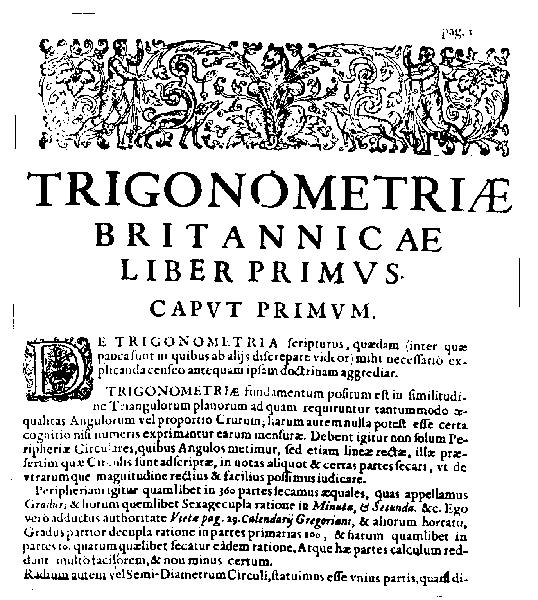
完整的表于1628年在荷兰的豪达印刷,由阿德里安·弗拉克出版,其中阿德里安·弗拉克添加了从20,000到90,000的自然数的对数。这些表也于1633年在伦敦出版,书名为Trigonometria Britannica。伦敦版的印刷是在布里格斯去世后进行的,但他曾请他的朋友Henry Gellibrand代表他照看这个项目。Gellibrand是格雷沙姆学院的天文学教授,对对数在三角学中的应用特别感兴趣。因此,他添加了一篇自己的序言,论述对数在平面三角学和球面三角学中的应用。
我们已经追溯了布里格斯对数的参与,但我们应该回顾一下他的其他工作以及他离开格雷沙姆学院后生命的最后阶段。他在格雷沙姆学院期间对天文学的兴趣一直持续,并且仍然存在六封信,这些信是克里斯托弗·海登爵士在1603年至1619年间写给他的,内容涉及彗星和其他天文及数学主题。
1619年,亨利·萨维尔在牛津设立了几何学讲席,因为:-
……几何学在英格兰几乎完全无人知晓,遭到废弃。
亨利·萨维尔自己首先讲授了课程,然后请布里格斯来填补这个讲席。布里格斯接受了,并在最后一讲中受到亨利·萨维尔的高度赞扬后,接过了课程,从亨利·萨维尔所讲到的位置继续,即欧几里得的Elements的第九个命题。布里格斯被选为牛津大学默顿学院会士,以便他能担任萨维尔讲席,但他直到几个月后才辞去格雷沙姆学院的职位,于1620年7月25日结束了他在格雷沙姆学院23年的任职。
布里格斯在牛津大学任职后的第一部出版物是欧几里得的Elements前六卷的版本,他于1620年出版。他选择不在这文本上注明自己是编辑,只是将整个作品归功于欧几里得。他的下一部作品于1622年出版,不是数学主题,而是当时非常感兴趣的一个主题:A Treatise of the Northwest Passage to the South Sea, Through the Continent of Virginia and by Fretum Hudson。这个出版物比看起来更自然,因为布里格斯在学术界之外有兴趣,是一家与弗吉尼亚贸易的公司的成员。再次,布里格斯选择不在作品上署名,作者仅显示为H. B.。
除了他的出版物,布里格斯还写了许多其他从未出版的作品。这些包括关于彼得吕斯·拉米斯的几何学和关于隆戈蒙塔努斯对squaring the circle的论述的作品。一篇关于几何学的论述和另一篇关于算术的论述同样从未出版。
布里格斯受到其他数学家的高度评价。我们已经提到亨利·萨维尔对他的高度评价,另一位同时代人威廉·欧垂这样描述布里格斯:-
……那个时代在几何学卓越技能方面的典范。
伊萨克·巴罗,生于布里格斯去世的那一年,1662年被任命为格雷沙姆学院的几何学教授。在他的就职演讲中,他提到大约50年前担任同一职位的布里格斯,称其使对数成为所有科学家的重要工具。
关于他的性格,我们只能从著作中得知他的谦逊,他公平地给予他人充分的归功以及[12]:-
……从同时代人对他的提及……可以看出他是一个性格和蔼的人。
关于他的性格,最后一点值得提及,即在占星术对大多数学者都是重要话题的时代,布里格斯强烈反对它。威廉·莉莉,我们上面引用了他对约翰·纳皮尔和布里格斯会面的描述,写道(例如见[12]):-
……约翰·纳皮尔是占星术的狂热爱好者,但布里格斯是已知最讽刺它的人。
Henry Briggs was the man most responsible for scientists' acceptance of logarithms. He is of great importance in the development of mathematics but, as Hill writes in [8]:-
... significant though Briggs was as a mathematician in his own right, his greatest importance was as a contact and public relations man.
Briggs was born at Warley Wood (or Warleywood) in the parish of Halifax, Yorkshire. His birth is recorded in the Halifax parish register as February 1561 yet this information contradicts a notice by J Mede written at Christ's College Cambridge on 6 February 1630, a few days after Briggs died, which states (see for example [1]):-
Mr Henry Briggs of Oxford, the great mathematician, is lately dead, at 74 years of age.
If Mede were correct then Briggs would have been born in 1556, but it seem highly unlikely that he is correct, for there seems no possible reason to think that the Halifax parish records could be wrong. We know little of Briggs's family but there is a history of Norfolk, by Blomefield, which states that Briggs's family were originally from Salle in that county. Blomefield is known to be wrong in a number of other such claims so not too much weight should be put on this statement, although, on the other hand, there is some evidence that other members of Briggs's family did have Norfolk connections. In fact Richard Briggs, who was Henry Briggs's brother, became headmaster of a school in Norfolk. Richard Briggs had important friends such as Ben Jonson, the dramatist, poet, and literary critic and a letter from Ben Jonson to Richard Briggs still exists.
Henry Briggs attended a grammar school near Warley Wood where he became highly proficient at Greek and Latin. After completing his school studies, he entered St John's College of Cambridge University in 1577. Admitted as a scholar on 5 November 1577, Briggs received the degree of B.A. in 1581, receiving his M.A. four years later. In 1588 (some sources give 1589) he was elected a fellow of St John's College and then, in 1592, he became:-
Reader of the Physic Lecture founded by Dr Linacre.
Thomas Linacre, born almost exactly 100 years before Briggs, had been so upset by the fact that medicine was practised by barbers and clergymen without proper qualifications that he founded the Royal College of Physicians of London. The Linacre lectureship that Briggs was appointed to was therefore a medical lectureship but, in the same year of 1592, Briggs was also appointed as an examiner and lecturer in mathematics at Cambridge. It certainly appears that his talents were wide ranging.
In 1596 Briggs became the first professor of geometry at Gresham College, London which had just been founded. He was to hold this position in Gresham College for 23 years, the College being famed as the birthplace of the Royal Society of London about 25 years after Briggs left. We know something of Briggs's work at this time since he became firm friends with James Ussher in 1609. Ussher was then a professor at Trinity College, Dublin, but later, in 1625, became archbishop of Armagh. Letters sent to Ussher have survived and some have been published, in particular one written by Briggs in August 1610. This letter shows that at this time Briggs was greatly interested in astronomy, in particular he was studying eclipses. This was a topic which involved many heavy calculations so Briggs was greatly struck when he read Napier's work on logarithms by the great help that they would provide to those involved in astronomy.
It was not only the fact that logarithms were so useful for astronomical calculations which attracted Briggs to them. He was already highly involved in producing tables to aid calculation and he had published two types of tables before he read about Napier's logarithms. In 1602 Briggs had published A Table to find the Height of the Pole, the Magnetic Declination being given and in 1610 he had published Tables for the Improvement of Navigation.
Briggs read Napier's 1614 Latin text on logarithms and, on the 10 March 1615, wrote in a letter to his friend James Ussher that he was:-
... wholly employed about the noble invention of logarithms, then lately discovered.
Briggs continued:-
Napper, lord of Markinston, hath set my head and hands a work with his new and admirable logarithms. I hope to see him this summer, if it please God, for I never saw a book which pleased me better or made me more wonder.
As soon as Briggs had read about logarithms he began thinking about improvements and was soon teaching his students about the new topic. He wrote (see for example [1]):-
I myself, when expounding this doctrine publicly in London to my auditors in Gresham College, remarked that it would be much more convenient that 0 should be kept for the logarithm of the whole sine ... concerning this matter I wrote immediately to the author himself.
Let us look at the problem which Briggs was attempting to address. The logarithms Nap.log invented by Napier are different from the logarithms that we use today. The fact that Nap.log 1 does not equal 0 is a major difficulty which makes Nap.logs much less convenient for calculations than today's logarithms. It is often written in books on the history of mathematics that Briggs was responsible for the change to logarithms with log 1 = 0. However, although logarithms with log 1 = 0 first appear in print in Briggs's work, he himself gives the credit for the idea to Napier. Certainly the idea came about in discussions between Napier and Briggs.
Briggs made the difficult journey from London to Edinburgh to see Napier in the summer of 1615. It was not the easy journey of 4 hours by train that we could make today, but rather for Briggs it was a journey of at least 4 days by horse and coach. It was not a journey one would undertake lightly but Briggs was desperately keen to meet Napier. A description of their meeting was told by John Marr to William Lilly who writes the following (see [6]):-
Mr Briggs appoints a certain day when to meet at Edinburgh; but failing thereof, Merchiston was fearful he would not come. It happened one day as John Marr and the Lord Napier were speaking of Mr Briggs, "Oh! John," saith Merchiston, "Mr Briggs will not come now"; at the very instant one knocks at the gate, John Marr hastened down and it proved to be Mr Briggs to his great contentment. He brings Mr Briggs into my Lord's chamber, where almost one quarter of an hour was spent, each beholding the other with admiration, before one word was spoken. At last Mr Briggs began, -"My Lord, I have undertaken this long journey purposely to see your person, and to know by what engine of wit or ingenuity you came first to think of this most excellent help unto astronomy, viz. the Logarithms; but, my Lord, being by you found out, I wonder nobody else found it out before, when now known it is so easy.
Briggs had suggested to Napier in a letter sent before their meeting that logs should be (in our terminology) to base 10 and Briggs had begun to construct such tables. Napier replied that he had had the same idea but ([6]):-
... he could not, on account of ill-health and for other weighty reasons undertake the construction of new tables.
At their meeting Napier suggested to Briggs the new tables should be constructed with base 10 and with log 1 = 0. Briggs wrote that Napier proposed (see for example [1]):-
... that 0 should be the logarithm of unity and 10,000,000,000 that of the whole sine, which I could not but admit was by far the most convenient.
Indeed Briggs did construct such tables. He spent a month with Napier on his first visit of 1615, made a second journey from London to Edinburgh to visit Napier again in 1616, and would have made yet a third visit the following year but Napier died in the spring before the planned summer visit.
Briggs's first work on logarithms Logarithmorum Chilias Prima was published in London in 1617. The recent death of Napier is referred to in the preface as is Briggs reason to publish that work, namely:-
... for the sake of his friends and hearers at Gresham College.
Briggs published an article A Description of an Instrument Table to find the Part Proportional, devised by Mr Edward Wright in Wright's English translation of Napier's Canon. After Wright's death, Briggs published two further editions of this work (1616 and 1618) with a preface he wrote himself. Briggs's mathematical treatise Arithmetica Logarithmica was published in 1624. This gave the logarithms of the natural numbers from 1 to 20,000 and 90,000 to 100,000 computed to 14 decimal places. It also gave tables of natural sine functions to 15 decimal places, and the tan and sec functions to 10 decimal places. In this book Briggs suggested that the logs of the missing numbers might be computed by a team of people and he even offered to supply specially designed paper for the purpose.
The completed tables were printed at Gouda, in the Netherlands, in 1628 in an edition by Vlacq in which Vlacq had added the logarithms of the natural numbers from 20,000 to 90,000. The tables were also published in London in 1633 under the title of Trigonometria Britannica. The printing of the London edition took place after Briggs had died but he had asked his friend Henry Gellibrand to look after the project on his behalf. Gellibrand was professor of astronomy at Gresham College and was particularly interested in applications of logarithms to trigonometry. He therefore added a preface of his own on applications of logarithms to both plane trigonometry and to spherical trigonometry.
We have followed through Briggs involvement with logarithms but we should go back and look at his other work and the final stage of his life after he left Gresham College. His interest in astronomy continued throughout his years at Gresham College and six letters still exist which were written to him between 1603 and 1619 by Sir Christopher Heydon on comets and other astronomical and mathematical topics.
In 1619 Savile founded a chair of geometry at Oxford because:-
... geometry is almost totally unknown and abandoned in England.
Savile gave the first lectures himself then asked Briggs to fill the chair. Briggs accepted and after receiving high praise from Savile in his last lecture, took over the course continuing from the point that Savile had reached, namely the ninth proposition of Euclid's Elements. Briggs was made a fellow of Merton College Oxford to enable him to hold the Savilian chair but he did not resign his position in Gresham College until a few months later, ending his 23 year employment with the Gresham College on 25 July 1620.
Briggs's first publication after his appointment at Oxford was an edition of the first six book of Euclid's Elements which he published in 1620. He chose not to include the fact that he was the editor on these texts, merely attributing the entire work to Euclid. His next work published in 1622 was not on a mathematical topic, but rather on one of great interest at the time: A Treatise of the Northwest Passage to the South Sea, Through the Continent of Virginia and by Fretum Hudson. This publication was more natural than it appears for Briggs had interests outside the academic world, being a member of a company trading with Virginia. Again Briggs chose not to put his name on the work, the author simply appearing as H. B.
In addition to his publications, Briggs wrote a number of other works which have never been published. These include works on the geometry of Ramus and on Longomontanus's treatise on squaring the circle. A treatise on geometry and another on arithmetic were similarly never published.
Briggs was highly regarded by other mathematicians. We have already referred to Savile's high regard for him and another contemporary, Oughtred, described Briggs as:-
... the mirror of the age for excellent skill in geometry.
Barrow, born the year the Briggs died, was appointed professor of geometry at Gresham College in 1662. In his inaugural lecture he referred to Briggs, who had held the same post some 50 years earlier, as the man who made logarithms a vital tool for all scientists.
Of his character we know only his modesty from his writings, his fairness in giving full attributions to others and [12]:-
... from the references to him by his contemporaries ... that he was a man of amiable character.
A final comment on his character is worth making, namely that in an age where astrology was an important topic for most men of learning, Briggs strongly opposed it. William Lilly, from whom we quoted the description of the meeting of Napier and Briggs above, wrote that (see for example [12]):-
... Napier was a great lover of astrology, but Briggs was the most satirical man against it that hath been known.
正文里的方括号编号指向这里,悬停即可直接看到条目。书目保留原文——译了书名反而查不到文献。
原站列出的延伸阅读与外部数据库,照原样保留,目标多为英文页面。
关于亨利·布里格斯的其它页面:
原站的交叉引用。指向本站已镜像专题的留在站内,其余仍指回原站。