数学家传记
伯纳德·波尔查诺成功地将微积分从无穷小概念中解放出来。他还给出了无限集合的元素与真子集的元素之间一一对应的例子。
伯纳德·波尔查诺的父母是波尔查诺·庞培·波尔查诺和玛丽亚·塞西莉亚·毛雷尔。他的母亲玛丽亚是布拉格一位商人的女儿,讲德语,是一位虔诚的罗马天主教徒。老波尔查诺,即本传记主人公的父亲,出生于意大利北部,后移居布拉格。他以艺术品交易为生,但家境并不富裕。他受过良好教育,也是一位虔诚的罗马天主教徒,对他人极为关心。他将信仰付诸实践的一个明证是,他是布拉格一所孤儿院创建的主要推动者。本传记的主人公波尔查诺出生在布拉格最古老的部分,在父母十二个孩子中排行第四。尽管家庭庞大,波尔查诺和他的一个兄弟约翰是仅有的两个活到成年的孩子。然而,他的身体娇弱,一生都在与呼吸系统问题作斗争。
波尔查诺的成长经历是他后来所教授思想的一个主要因素。他深受父亲积极照顾同胞的影响,而波尔查诺在1791年至1796年间在布拉格就读的虔劳会文理中学强化了这一点。在那里,他由约瑟夫·卡拉桑斯的罗马天主教追随者教导,卡拉桑斯是西班牙人,创立了Ordo Clericorum Regularium Pauperum Matris Dei Scholarum Piarum(虔诚学校上帝之母贫苦教士常规修会)。尽管是西班牙人,卡拉桑斯于17世纪初在罗马创立了通常称为虔劳会的修会。虔劳会成员是教师,除了修士通常的三个誓愿外,还发第四个誓愿,特别照顾年轻人。可以说,波尔查诺离开这个环境时,更加确信那些在他成长和学校教育中最重要的道德信念,而不是纯粹的基督教宗教信念。
波尔查诺于1796年进入布拉格查理大学哲学系,学习哲学、物理学和数学。波尔查诺在数学学习中尤其受到阅读亚伯拉罕·哥特黑尔弗·凯斯特纳的Mathematische AnfangsgründeⓉ(数学基础)的影响。亚伯拉罕·哥特黑尔弗·凯斯特纳关注数学中的哲学问题,对数学哲学深感兴趣,并且非常用心地证明许多当时其他数学家认为“显然”因而无需证明的结果。波尔查诺很快对这种进路产生了坚定的信念,他写道:-
因此,我在数学中的特殊乐趣尤其在于其纯粹思辨的部分,换句话说,我只珍视数学中同时属于哲学的那部分。
在1799-1800年间,波尔查诺与František Josef Gerstner一起从事数学研究,同时也思考自己的未来。1800年秋天,他违背父亲的意愿,开始在查理大学进行三年的神学研究。在攻读神学期间,他准备了一篇关于几何学的博士论文。他于1804年获得博士学位,论文阐述了他对数学的看法,以及什么构成正确的数学证明。在序言中他写道:-
如果证明不是从待证命题所包含的概念中推导出来,而是使用了某种偶然的、外来的中间概念,我就不能对完全严格的证明感到满意,因为那总是向另一种类的错误过渡。
获得博士学位两天后,波尔查诺被任命为罗马天主教神父。然而,正如Russ在[50]中指出的:-
他逐渐认识到,教学而非牧灵才是他真正的天职。
事实上,他多年研习神学并未使他更加接受基督教赖以建立的宗教信仰。然而,他在查理大学的教授曾提出一个波尔查诺觉得非常有说服力的论点,即如果对某一教义的信仰能导致道德上的善,那么这种信仰就是正当的。后来,波尔查诺在其著作中为这一论点的一种更普遍的形式进行了辩护:-
在你所能采取的一切行动中,始终选择那一个在权衡一切后果之后最能促进整体及其各个部分的善的行动。
这使波尔查诺能够为了人类更大的善而接受基督教的神秘要素,尽管他并不认为这些要素在历史上是真实的。
为了理解波尔查诺一生中的事件,我们需要补充一点关于波希米亚局势的背景。从17世纪初罗马天主教势力击败波希米亚新教徒之后,波希米亚一直由哈布斯堡家族统治。它被并入奥地利帝国,德语成为文法学校和查尔斯大学的教学语言,捷克民族主义受到压制。1781年,约瑟夫二世给予宗教宽容,但法国大革命带来了一个统治者所畏惧的自由思想时代。为了维系帝国,统治者决定打击一切民族主义组织,因为他们认为这些组织鼓励帝国各地独立的观念。1804年,从维也纳进行统治的皇帝弗朗茨决定,对抗启蒙影响的一种办法是加强罗马天主教会的控制,因为天主教会往往非常保守并反对自由思想。他在大学设立宗教哲学讲席,作为实现其目标的手段之一。
大学讲席通过竞争填补,波尔查诺参加了查尔斯大学两个此类讲席的竞争。一个是因Stanisław Vydra去世而空缺的数学讲席,另一个是皇帝弗朗茨刚刚设立的宗教哲学新讲席。波尔查诺在两个竞争中都名列第一,但大学更愿意把宗教哲学讲席给他,因为这样他们就能把数学讲席给Ladislaw Jandera,后者曾在1801年至1804年Vydra患病期间代其授课。从许多方面看,鉴于设立这一讲席的原因,波尔查诺恰恰是最不适合担任该讲席的人,因为他代表了弗朗茨所畏惧的一切观念:他是一个自由思想者,信奉社会正义、和平主义,以及讲捷克语的波希米亚人的平等。
他的讲席任命必须在维也纳得到确认,而他们当然明白他并不是他们所希望被任命的那种罗马天主教保守派。对他的任命的确认被推迟了,因为维也纳在考虑采取什么最佳行动,但在1807年,任命获得了批准[10]:-
……他讲授宗教和道德哲学,带有强烈的和平主义与社会主义色彩。他利用讲道坛在数百名印象深刻的学生面前宣扬一种乌托邦社会主义。在他的布道中,他试图证明所有人的本质平等,攻击不劳而获的私有财产,并劝诫他的听众在争取人权的斗争中牺牲一切。
波尔查诺的任命受到维也纳奥地利统治者的怀疑。他批评他所看到的一切歧视,主要是讲德语的波希米亚人对他们的捷克同胞公民的歧视,他也批评德国和捷克波希米亚人所表现出的反犹主义。罗马天主教会的一些成员也不高兴,因为波尔查诺的讲座包含理性主义元素。他当然在教会内有支持者,例如重要的布拉格大主教和指导莱特梅里茨神学院的费斯尔博士。1815年,波尔查诺当选为皇家波希米亚科学学会会员,这是一个双语学会,其成员主要来自讲德语者,但也来自讲捷克语者。波尔查诺于1816年出版了On the Condition of the Two Nationalities in Bohemia,在其中他印行了他的担忧,即捷克波希米亚人被讲德语的波希米亚人所支配。农民讲捷克语,城市主要由讲德语者居住,但波尔查诺看到了由于日益增长的工业化所造成的问题,这种工业化使讲捷克语者迁入城市。尽管1816年维也纳法院对他提出了指控,波尔查诺的事业继续蓬勃发展,并于1818年当选为查理大学哲学学院院长。
在奥地利政府的压力下,波尔查诺于1819年12月被停职。除了被停职教授职位外,他还被软禁,邮件被审查,并被禁止出版。1821年至1825年间,他受到教会的审判,尽管他强烈为自己的观点辩护,但仍被要求放弃所谓的异端。他拒绝这样做并辞去了他的讲席。从1823年起,他在波希米亚南部的泰霍布兹村附近度过了夏天,住在他朋友约瑟夫和安娜·霍夫曼的庄园里,而冬天则住在布拉格与他兄弟约翰一起。J J I 霍夫曼是一位数学家,曾评论过波尔查诺的几部早期著作(见[54])。1830年至1841年间,他全年与霍夫曼一家住在一起,有大量时间投入研究。当安娜·霍夫曼于1841年生病时,波尔查诺和霍夫曼一家搬到了布拉格,他们都与Johann Bolzano住在一起(安娜于1842年去世)。在那里,波尔查诺再次成为皇家波希米亚科学学会的活跃成员,并在1842-43年担任主席。他一生大部分时间都患有呼吸系统问题,随着年龄增长,这些问题变得更加严重。1848年冬天,他感冒了,鉴于他的肺部状况不佳,这导致了他的死亡。
尽管由于政府审查,他的一些书不得不在奥地利帝国之外出版,但他继续写作并在他的国家的知识生活中发挥重要作用。事实上,他赢得了部分解除出版禁令,他只被禁止出版任何宗教或政治性质的东西。
波尔查诺写了Beyträge zu einer begründeteren Darstellung der Mathematik. Erste LieferungⓉ(为更全面的数学观辩护的贡献。第一部分)(1810),这是计划中的数学基础系列的第一部分。波尔查诺写了该系列的第二部分,但没有出版。相反,他决定:-
……通过发表一些论文,使自己在学术界更为知名,这些论文的标题更适合引起注意。
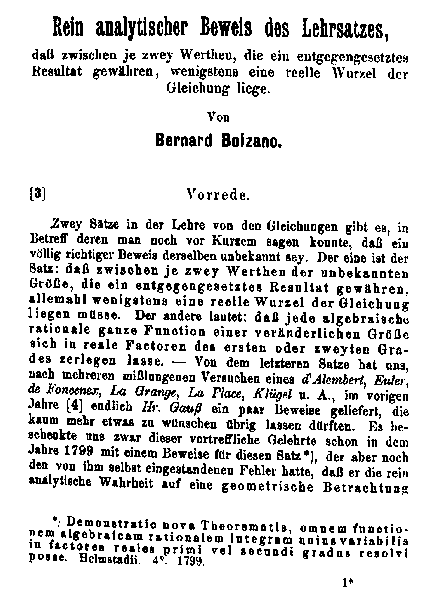
遵循这一策略,他出版了Der binomische Lehrsatz ……Ⓣ(二项式定理……)(1816)和Rein analytischer Beweis……Ⓣ(纯解析证明……)(1817),其中包含试图使微积分摆脱无穷小概念的努力。他在第一部的序言中明确表达了他的意图,指出这部著作是:-
……一种发展分析的新方法的样例。
波尔查诺确实实现了他所设定的目标,但他并非在短期内做到这一点,他的思想只是在他去世后才广为人知。在[50]中,Russ描述了波尔查诺在1817年论文中的目标:-
在这项工作中……波尔查诺……并不只想清除极限、收敛和导数概念中的几何成分,并以纯算术概念取而代之。他意识到一个更深层的问题:需要精炼和丰富数本身的概念。
该论文用波尔查诺的新方法给出了介值定理的证明,并且在这项工作中他定义了现在所谓的奥古斯丁·路易·柯西序列。这一概念在四年后出现在奥古斯丁·路易·柯西的工作中,但奥古斯丁·路易·柯西不太可能读过波尔查诺的工作。
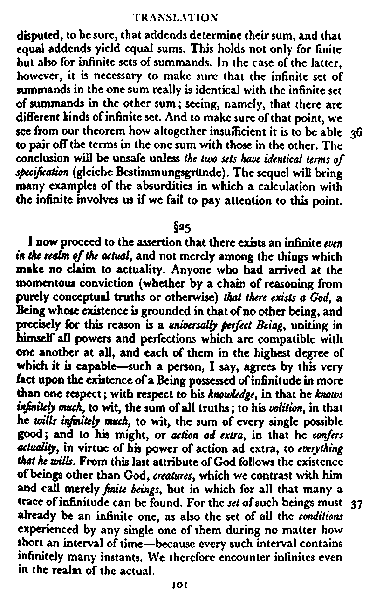
1817年之后,波尔查诺多年没有发表进一步的数学著作。然而,在1837年,他发表了WissenschaftslehreⓉ(科学理论),试图建立一个完整的科学与知识理论。在1830年前的某个时候到1840年代之间,波尔查诺致力于一部重要著作GrössenlehreⓉ(大理论)。这部试图将整个数学置于逻辑基础之上的著作是分部分出版的,而波尔查诺希望他的学生能完成并出版整部著作。他关于悖论的著作Paradoxien des UnendlichenⓉ(无穷的悖论),一项对无穷悖论的研究,于1851年,即他去世三年后,由他的一名学生出版。集合一词在这里首次出现。在这部著作中,波尔查诺给出了无穷集合的元素与其真子集的元素之间一一对应的例子。
波尔查诺的大部分著作仍以手稿形式留存,未引起注意,因此没有影响该学科的发展。他的许多著作直到1862年或更晚才出版。波尔查诺的数学无穷理论预见了格奥尔格·康托尔的无穷集合理论。同样值得注意的是,他给出了一个处处连续但无处可微的函数的例子。
出版波尔查诺手稿的尝试在我们的文章Bernard Bolzano's manuscripts中有描述。
作为波尔查诺在担任宗教哲学教授期间所从事的数学工作的一个例子,以下是他在1816年记录在其笔记本Miscellanea mathematica中的内容的描述。该描述由Dauben在1996年该材料首次出版时评述:-
波尔查诺以关于无理数和超越数及函数的笔记开启了这本《数学杂记》笔记本。但他也在阅读并记录关于许多其他主题的想法,包括如何最好地接近对零的恰当数学理解这一问题;阿德里安-马里·勒让德关于曲面、凸性、凹性以及全等条件的工作;对其他几何概念的分析,包括长度、面积、体积和球面;三角公式和球面三角学;虚数和指数数;微分的定义以及对无穷的讨论和关于它的各种观点,还有极大值和极小值的各个方面。……这里涵盖的其他主题包括处理微积分的各种方法(包括穷竭法),以及断言数学确定性的依据。
除了他的数学工作之外,波尔查诺作为哲学家和逻辑学家也很重要。我们简要提及两部主要著作。首先是Lehrbuch der Religionswissenschaft(宗教科学教科书)(1834年),他在其中将宗教哲学建立在伦理学基础上[35]:-
他批评康德的绝对命令及其公设学说,并提倡一种功利主义。
我们提及的他的第二部主要著作是WissenschaftslehreⓉ(科学理论),于1837年分四卷出版。前两卷涵盖了他关于逻辑哲学的思想,第三卷提出了科学发现的理论,而最后一卷则提出了他编写教科书的方法论[17]:-
波尔查诺的科学理论(Wissenschaftslehre)包含了大量关于逻辑学从亚里士多德的开端到后康德时期发展的非常有价值的信息。在一篇批判性阐述中,波尔查诺呈现了其前辈的观点,并将它们与自己的观点进行了比较。
Bernard Bolzano's parents were Bernard Pompeius Bolzano and Maria Cecilia Maurer. His mother Maria, the daughter of a Prague merchant, was German speaking and a devout Roman Catholic. Bernard Bolzano senior, the father of the subject of this biography, was born in the north of Italy and had emigrated to Prague. He made his living as a dealer in art, but was a man of modest means. Well educated, he was also a pious Roman Catholic who showed great concern towards others. An indication of how seriously he put his beliefs into practice is the fact that he was the driving force behind the founding of an orphanage in Prague. Bernard, the subject of this biography, was born in the oldest part of the city of Prague, being the fourth of his parents twelve children. Despite the large family, Bernard and one of his brothers, Johann, were the only two to reach adulthood. His health, however, was delicate and he had to fight against respiratory problems throughout his life.
Bolzano's upbringing was a major factor in the ideas that he taught later in his life. He was much influenced by his father's active attempts to care for his fellow men, and this was strengthened by the Piarist Gymnasium that Bolzano attended in Prague between 1791 and 1796. There he was taught by the Roman Catholic followers of Joseph Calasanz who was the Spanish founder of the Ordo Clericorum Regularium Pauperum Matris Dei Scholarum Piarum (Order of Poor Clerks Regular of the Mother of God of the Pious Schools). Although Spanish, Calasanz founded Order, usually called by the name Piarists, in Rome at the beginning of the 17th century. Members of the Piarist Order were teachers who made a fourth vow to take special care of young people in addition to the usual three vows made by monks. It is fair to say that Bolzano left this environment more convinced of the moral beliefs, which had been foremost in his upbringing and in his schooling, than in the purely religious Christian beliefs.
Bolzano entered the Philosophy Faculty of the Charles University of Prague in 1796, studying philosophy, physics and mathematics. Bolzano was particularly influenced in his mathematical studies by reading Kaestner's Mathematische Anfangsgründe Ⓣ. Kaestner was concerned with philosophical questions in mathematics, was deeply interested in the philosophy of mathematics, and took great care to prove many results which were thought "obvious", so not requiring proof, by other mathematicians of the day. Bolzano, who soon developed a strong belief in this approach, wrote:-
My special pleasure in mathematics rested therefore particularly on its purely speculative parts, in other words I prized only that part of mathematics which was at the same time philosophy.
During the year 1799-1800 Bolzano undertook research in mathematics with František Josef Gerstner and also contemplated his future. In the autumn of 1800, against his father's wishes, he began three years of theological study at the Charles University. While pursuing his theological studies he prepared a doctoral thesis on geometry. He received his doctorate in 1804 writing a thesis giving his view of mathematics, and what constitutes a correct mathematical proof. In the preface he wrote:-
I could not be satisfied with a completely strict proof if it were not derived from concepts which the thesis to be proved contained, but rather made use of some fortuitous, alien, intermediate concept, which is always an erroneous transition to another kind.
Two days after receiving his doctorate Bolzano was ordained a Roman Catholic priest. However, as Russ points out in [50]:-
He came to realise that teaching and not ministering defined his true vocation.
In fact his years of study of theology had done nothing to strengthen his acceptance of the religious beliefs on which Christianity is founded. However, his professor at the Charles University had put forward an argument which Bolzano had found very persuasive, namely that faith in a doctrine was justified if it led to moral good. Later in his writings Bolzano argued for a more general form of this argument:-
Of all actions possible to you, choose always the one which, weighing all consequences, will most further the good of the totality, in all its parts.
This allowed Bolzano to accept the mystical elements of Christianity for the greater good of mankind, although he did not accept them to be historically true.
In order to understand the events of Bolzano's life, we need to fill in a little background about the situation in Bohemia. From early in the 17th century, after Roman Catholic forces defeated the Bohemian Protestants, Bohemia had been ruled by the Habsburgs. It was absorbed into the Austrian Empire, German became the language of instruction in grammar schools and the Charles University, and Czech nationalism was suppressed. In 1781 Joseph II granted religious tolerance but the French Revolution brought in an era of free thinking which the rulers feared. To hold the Empire together, the rulers decided to move against all nationalistic organisations which they believed encouraged ideas of independence for various parts of the Empire. In 1804, Emperor Franz who ruled from Vienna, decided that one way to counter the impact of the enlightenment was to strengthen the hold of the Roman Catholic Church which tended to be very conservative and opposed to liberal thinking. He set up chairs of philosophy of religion in the universities as one of the means to achieve his aims.
Chairs in the universities were filled by competition and Bolzano entered two such competitions for chairs at the Charles University. One was for the chair of mathematics which became vacant on the death of Stanisław Vydra, the other being for the new chair in the philosophy of religion which Emperor Franz had just established. Bolzano came top in both competitions, but the university preferred to give him the chair in the philosophy of religion since they were then able to give the mathematics chair to Ladislaw Jandera who had substituted for Vydra during his illness between 1801 and 1804. In many ways Bolzano was exactly the wrong person to fill this chair given the reasons for its creation, for he stood for all the ideas which Franz feared, being a free thinker who believed in social justice, pacifism, and equality for the Czech speaking Bohemians.
His appointment to the chair had to be confirmed in Vienna, and they certainly understood that he was not the Roman Catholic conservative that they had been hoping would be appointed. Confirmation of his appointment was delayed while Vienna considered what its best action should be, but in 1807 it was granted [10]:-
... he lectured on religion and moral philosophy with strong pacifistic and socialistic overtones. He used the pulpit to proclaim before hundreds of impressed students a kind of utopian socialism. In his sermons he tried to prove the essential equality of all human beings, attacked private property obtained without work, and exhorted his listeners to sacrifice everything in their struggle for human rights.
The appointment of Bolzano was viewed with suspicion by the Austrian rulers in Vienna. He criticised discrimination wherever he saw it, principally by the German speaking Bohemians against their Czech fellow citizens, and also he criticised the anti-Semitism displayed by both the German and Czech Bohemians. Some members of the Roman Catholic Church were also unhappy because Bolzano's lectures contains elements of rationalism. He certainly had supporters within the Church, for example the important Archbishop of Prague and Dr Fessl who directed the seminary of Leitmeritz. In 1815 Bolzano was elected to the Royal Bohemian Society of Sciences which was bilingual society drawing its members mainly from the German speakers but also from Czech speakers. Bolzano published On the Condition of the Two Nationalities in Bohemia in 1816 in which he put into print his concerns that the Czech Bohemians were dominated by the German speaking Bohemians. The peasants were Czech speaking, the cities largely inhabited by German speakers but Bolzano saw the problems which were being created due to increasing industrialisation which saw Czech speakers moving into the cities. Bolzano's career continued to flourish, despite the fact that charges were brought against him at the Vienna court in 1816, and in 1818 he was elected Dean of the Faculty of Philosophy at Charles University.
Bolzano was suspended from his position in December 1819 after pressure from the Austrian government. In addition to being suspended from his professorship, he was put under house arrest, had his mail censored, and not allowed to publish. Between 1821 and 1825 he was tried by the Church, and despite his strong defence of his views, was required to recant his supposed heresies. He refused to do so and resigned his chair. From 1823 he had spent the summers living near the village of Techobuz in southern Bohemia, on the estate of his friends Josef and Anna Hoffmann, while he spent the winter living in Prague with his brother Johann. J J I Hoffmann was a mathematician who had reviewed several of Bolzano's earlier works (see [54]). Between 1830 and 1841 he lived throughout the year with the Hoffmanns, having much time to devote to study. When Anna Hoffmann took ill in 1841, Bolzano and the Hoffmanns moved to Prague where they all lived with Johann Bolzano (Anna died in 1842). There Bolzano again became an active member of the Royal Bohemian Society of Sciences and was president during 1842-43. He had suffered from respiratory problems for most of his life and these became more severe as he grew older. In the winter of 1848 he contracted a cold which, given the poor condition of his lungs, led to his death.
Although some of his books had to be published outside the Austrian Empire because of government censorship, he continued to write and to play an important role in the intellectual life of his country. In fact he had won a partial lifting of the publication ban, and he was only forbidden from publishing anything of a religious or political nature.
Bolzano wrote Beyträge zu einer begründeteren Darstellung der Mathematik. Erste Lieferung Ⓣ (1810), the first of an intended series on the foundations of mathematics. Bolzano wrote the second of his series but did not publish it. Instead he decided to:-
... make myself better known to the learned world by publishing some papers which, by their titles, would be more suited to arouse attention.
Pursuing this strategy he published Der binomische Lehrsatz ... Ⓣ. (1816) and Rein analytischer Beweis ... Ⓣ (1817), which contain an attempt to free calculus from the concept of the infinitesimal. He is clear in his intention stating in the preface of the first of these that the work is:-
... a sample of a new way of developing analysis.
Although Bolzano did achieve exactly what he set out to achieve, he did not do so in the short term, his ideas only becoming well known after his death. In [50] Russ describes Bolzano's aims in the 1817 paper:-
In this work ... Bolzano ... did not wish only to purge the concepts of limit, convergence, and derivative of geometrical components and replace them by purely arithmetical concepts. He was aware of a deeper problem: the need to refine and enrich the concept of number itself.
The paper gives a proof of the intermediate value theorem with Bolzano's new approach and in the work he defined what is now called a Cauchy sequence. The concept appears in Cauchy's work four years later but it is unlikely that Cauchy had read Bolzano's work.
After 1817, Bolzano published no further mathematical works for many years. However, in 1837, he published Wissenschaftslehre Ⓣ , an attempt at a complete theory of science and knowledge. Between sometime before 1830 and the 1840s, Bolzano worked on a major work Grössenlehre Ⓣ. This attempted to put the whole of mathematics on a logical foundation was published in parts, while Bolzano hoped that his students would finish and publish the complete work. His work on paradoxes Paradoxien des Unendlichen Ⓣ, a study of paradoxes of the infinite, was published in 1851, three years after his death, by one of his students. The word set appears here for the first time. In this work Bolzano gives examples of 1-1 correspondences between the elements of an infinite set and the elements of a proper subset.
Most of Bolzano's works remained in manuscript and did not become noticed and therefore did not influence the development of the subject. Many of his works were not published until 1862 or later. Bolzano's theories of mathematical infinity anticipated Georg Cantor's theory of infinite sets. It is also remarkable that he gave an example of a function which is nowhere differentiable yet everywhere continuous.
Attempts to publish Bolzano's manuscripts are described in our article Bernard Bolzano's manuscripts.
As an example of the mathematics that Bolzano was working on while he was professor of the philosophy of religion, here is a description of what he recorded in his notebook Miscellanea mathematica in 1816. The description is by Dauben reviewing this material when it was first published in 1996:-
Bolzano opens this notebook of Miscellanea mathematica with notes on irrational and transcendental numbers and functions. But he was reading and recording his ideas on a host of other subjects as well, including the problem of how best to approach the proper mathematical understanding of zero; Legendre's work on surfaces, convexity, concavity, and conditions for congruity; analysis of other geometric concepts, including lengths, areas, volumes, and spheres; trigonometric formulas and spherical trigonometry; imaginary and exponential numbers; definition of the differential and discussion of the infinite and various opinions about it, as well as aspects of maxima and minima. ... Other topics covered here include various approaches to the calculus (including the method of exhaustion), and grounds for asserting the certainty of mathematics.
In addition to his mathematical work, Bolzano was important as a philosopher and as a logician. We mention briefly two major works. First there is Lehrbuch der Religionswissenschaft (Textbook of the Science of Religion) (1834) in which he bases his religious philosophy on ethics [35]:-
He criticises Kant's categorical imperative and his doctrine of postulates, and advocates a version of utilitarianism.
His second major work which we mention is Wissenschaftslehre Ⓣ published in four volumes in 1837. The first two volumes cover his ideas on the philosophy of logic, the third volume presents a theory of scientific discovery, while the final volume presents his methodology of writing textbooks [17]:-
Bolzano's theory of science (Wissenschaftslehre) contains a great amount of very valuable information concerning the development of logic from its beginnings in Aristotle till the post-Kantian period. In a critical exposition, Bolzano presents views of his predecessors and compares them with his own point of view.
正文里的方括号编号指向这里,悬停即可直接看到条目。书目保留原文——译了书名反而查不到文献。
原站列出的延伸阅读与外部数据库,照原样保留,目标多为英文页面。
关于伯纳德·波尔查诺的其它页面:
原站的交叉引用。指向本站已镜像专题的留在站内,其余仍指回原站。