数学家传记
尼各马科是毕达哥拉斯学派的主要成员之一,其《算术引论》是1000多年来的标准算术教材。
尼各马科 在少数资料中被提及,我们可以根据所给信息相当准确地确定他的年代。尼各马科 本人提到了卒于公元36年的Thrasyllus,这给出了他年代的下限。另一方面,阿普列乌斯,这位柏拉图主义哲学家、修辞学家和作家,其年代为公元124年至约175年,将尼各马科的Introduction to Arithmetic翻译成拉丁文,这给出了他年代的上限。最有趣的参考文献之一出自卢奇安,这位修辞学家、小册子作者和讽刺作家,约生于公元120年,他让他笔下的一个人物说道:-
你算起来像尼各马科。
尼各马科因其算术工作而声名鹊起!
在论文[7]中,Dillon论证尼各马科于公元196年去世。他的论证基于这样一个事实:[Marinus]声称[普罗克洛]相信自己是尼各马科的转世。由于[普罗克洛]生于公元412年,而毕达哥拉斯学派中有一种信仰认为转世以216年为间隔发生,因此这个日期是吻合的。尽管公元196年并未被其译者于公元175年去世这一事实所排除(虽然已经很接近了),但对Dillon理论最严重的反对似乎是缺乏证据表明[普罗克洛]本人相信216年的间隔。
让我们从猜测转向更为确定的领域,并记载尼各马科是一位毕达哥拉斯主义者。这从他关于数和音乐的著作中可以明显看出,但[波菲利]也告诉了我们这一点,他说他是毕达哥拉斯学派的领袖成员之一。
尼各马科写了Arithmetike eisagoge(《算术引论》),这是第一部将算术作为与几何分开的独立主题来处理的著作。与[欧几里得]不同,尼各马科没有给出其定理的抽象证明,仅仅陈述定理并用数值例子加以说明。
然而Introduction to Arithmetic确实包含相当初等的错误,这表明尼各马科选择不给出其结果的证明,因为他通常没有这样的证明。许多结果被尼各马科知道是真的,因为它们连同证明一起出现在[欧几里得]中,尽管是以几何形式表述的。有时尼各马科陈述了一个完全错误的结果,然后用一个恰好具有该结果所描述性质的例子来加以说明。我们必须由此推断,其中一些结果仅仅是基于数值例子的证据所作的猜测(在某些情况下甚至可能仅基于一个例子!)。
一个例子是我们更仔细地考察尼各马科在[完全数]中所引用的结果。他陈述说第个完全数有位数字,并且所有完全数交替地以6和8结尾。这些陈述必定仅仅是从尼各马科已知有四个完全数这一事实出发所作的错误推论,即6、28、496和8128。
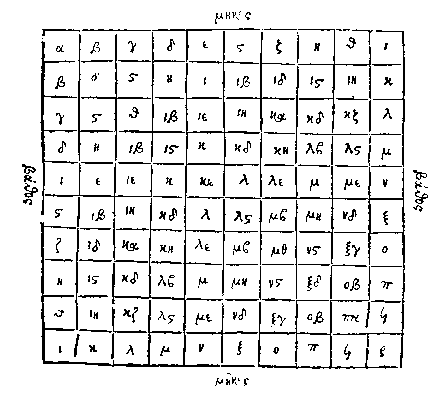
这部著作包含了希腊文本中的第一张乘法表。它还引人注目地使用了阿拉伯数字,而非希腊数字。然而,在许多方面,这本书的风格显得陈旧,因为它似乎更契合毕达哥拉斯那种带有神秘色彩的数论思想,而非真正的数学方法。为了说明尼各马科对数字颇为奇特的处理方式——赋予其道德属性,我们来看他对盈数和亏数的描述。盈数是指其真因数之和大于该数,而deficient number则是指其真因数之和小于该数。尼各马科在Introduction to Arithmetic中写到了这些数(见[6],或[3]中的另一种译文):-
在“过多”的情况下,产生的是过剩、多余、夸张和滥用;在“过少”的情况下,产生的是匮乏、缺失、剥夺和不足。而在那些介于过多与过少之间的情况,即平等之中,产生的是美德、恰当的尺度、合宜、美以及诸如此类的事物——其中最具典范性的形式便是那种被称为完全数的数。
接着,他继续将盈数描述为类似于一种动物:-
……有十张嘴,或九片唇,并配有三排牙齿;或者有一百条手臂,或者其中一只手上手指过多……
而亏数则像一只动物:-
……只有一只眼睛,……只有一条胳膊,或者一只手不到五个手指,或者没有舌头……
1000多年来,Introduction to Arithmetic一直是标准的算术课本。鉴于我们对这部著作所作的评论,这似乎是一个令人惊讶的事实。数学家们不喜欢这部著作,尤其是据说帕普斯鄙视它。然而,包括波爱修斯在内的好几个人将Introduction to Arithmetic翻译成拉丁文,它被用作学校课本。那么,一本糟糕的书怎么会变得如此流行呢?托马斯·利特尔·希思试图在[4]中解释这一明显的矛盾,提出:-
……它最初是被哲学家而非数学家阅读的,后来在已经没有数学家留下,只有顺便对数学感兴趣的哲学家的时候,它才普遍流行起来。
尼各马科的Introduction to Arithmetic的阿拉伯文译本很重要,在[5]中,Brentjes研究了这些阿拉伯文译本的影响。她得出结论,大多数由数学家撰写的关于数论的阿拉伯文文本都受到欧几里得和尼各马科的影响,但主要受到欧几里得的影响。然而,非数学家撰写的文本受尼各马科的影响最大。[5]中的这项研究倾向于支持托马斯·利特尔·希思在这个问题上的观点。
尼各马科还写了两卷Theologoumena arithmetikes(《数的神学》),完全涉及数的神秘属性。然而托马斯·利特尔·希思写道[4]:-
然而,以那个标题流传下来、由Ast编辑[1817年在莱比锡出版]的那部稀奇古怪的杂集,肯定不是尼各马科所作;因为其中摘录的作者包括老底嘉主教阿纳托利乌斯(公元270年);但它包含引自尼各马科的引文,这些引文似乎出自真作。
尼各马科另一部留存下来的著作是Manual of Harmonics,这是一部关于音乐的著作。同样,尼各马科显示出毕达哥拉斯的影响,但也显示出亚里士多德的音乐理论的影响。这部著作考察了音符和八度。它研究了张紧弦的调音原理,以及将八度扩展到两个八度范围的问题。
……将数和数值比赋予音符和音程,他承认八度和全音不可分割……但是,与试图通过数学定理来证明音乐命题的欧几里得不同,尼各马科试图通过测量弦长来表明它们的有效性。
波菲利和扬布利科斯都写过毕达哥拉斯的传记,其中引用了尼各马科。根据这一证据,一些历史学家推测尼各马科也写过毕达哥拉斯的传记,尽管没有直接证据,但这确实很有可能。
Nicomachus of Gerasa is mentioned in a small number of sources and we can date him fairly accurately from the information given. Nicomachus himself refers to Thrasyllus who died in 36 AD so this gives lower limits on his dates. On the other hand Apuleius, the Platonic philosopher, rhetorician and author whose dates are 124 AD to about 175 AD, translated Nicomachus's Introduction to Arithmetic into Latin so this gives an upper limit on his dates. One of the most interesting references is by Lucian, the rhetorician, pamphleteer and satirist who was born about 120 AD, who makes one of his characters say:-
You calculate like Nicomachus.
Clearly Nicomachus had achieved fame for his arithmetical work!
In the paper [7] Dillon argues that Nicomachus died in 196 AD. His argument is based on the fact that Marinus claimed that Proclus believed that he was the reincarnation of Nicomachus. Since Proclus was born in 412 AD and there was a belief among Pythagoreans that reincarnations occurred with an interval of 216 years, the date fits. Although 196 AD is not ruled out by his translator dying in 175 AD (although it comes close) the most serious objection to Dillon's theory seems to be the lack of evidence that Proclus himself believed in the 216 year interval.
Let us move from conjectures to more certain ground, and record that Nicomachus was a Pythagorean. This is obvious from his writings on numbers and music, but we are also told this by Porphyry who says that he was one of the leading members of the Pythagorean School.
Nicomachus wrote Arithmetike eisagoge (Introduction to Arithmetic) which was the first work to treat arithmetic as a separate topic from geometry. Unlike Euclid, Nicomachus gave no abstract proofs of his theorems, merely stating theorems and illustrating them with numerical examples.
However Introduction to Arithmetic does contain quite elementary errors which show that Nicomachus chose not to give proofs of his results because he did not in general have such proofs. Many of the results were known by Nicomachus to be true since they appeared with proofs in Euclid, although in a geometrical formulation. Sometimes Nicomachus stated a result which is simply false and then illustrated it with an example which happens to have the properties described in the result. We must deduce from this that some of the results are merely guesses based on the evidence of the numerical examples (and in some cases perhaps even based on one example!).
An example of this we look more closely at the results which Nicomachus quotes on perfect numbers. He states that the th perfect number has digits, and that all perfect numbers end in 6 and 8 alternately. These statements must be merely false deductions from the fact that there were four perfect numbers known to Nicomachus, namely 6, 28, 496 and 8128.
The work contains the first multiplication table in a Greek text. It is also remarkable in that it contains Arabic numerals, not Greek ones. However, in many respects the book is old fashioned in its style since it appears more in tune with the number theoretic ideas of Pythagoras with his mystical approach, rather than a true mathematical approach. To illustrate Nicomachus's rather strange approach to numbers, giving the moral properties, we look at his description of abundant numbers and deficient numbers. An abundant number has the sum of its proper divisors greater than the number, while a deficient number has the sum of its proper divisors less than the number. Nicomachus writes of these numbers in Introduction to Arithmetic (see [6], or [3] for a different translation):-
In the case of the too much, is produced excess, superfluity, exaggerations and abuse; in the case of too little, is produced wanting, defaults, privations and insufficiencies. And in the case of those that are found between the too much and the too little, that is in equality, is produced virtue, just measure, propriety, beauty and things of that sort - of which the most exemplary form is that type of number which is called perfect.
He then continues his description of abundant numbers as resembling an animal:-
... with ten mouths, or nine lips, and provided with three lines of teeth; or with a hundred arms, or having too many fingers on one of its hands....
while a deficient number is like an animal:-
... with a single eye, ... one armed or one of his hands has less than five fingers, or if he does not have a tongue...
For over 1000 years Introduction to Arithmetic was the standard arithmetic text. In view of the comments we have made regarding the work, this may seem a surprising fact. Mathematicians disliked the work, in particular Pappus is said to have despised it. However, several people including Boethius translated Introduction to Arithmetic into Latin and it was used as a school book. How then could a poor book become so popular. Heath tries to explain the apparent contradiction in [4], suggesting that:-
... it was at first read by philosophers rather than mathematicians, and afterwards became generally popular at a time when there were no mathematicians left, but only philosophers who incidentally took an interest in mathematics.
Arab translations of Nicomachus's Introduction to Arithmetic were important and in [5] Brentjes studies the influence of these Arabic translations. She concludes that most Arabic texts on number theory written by mathematicians were influenced by both Euclid and Nicomachus, but were mainly influenced by Euclid. However, texts by non-mathematicians were most strongly influenced by Nicomachus. This research in [5] tends to support the views of Heath on this subject.
Nicomachus also wrote two volumes Theologoumena arithmetikes (The Theology of Numbers) which was completely concerned with mystic properties of numbers. However Heath writes [4]:-
The curious farrago which has come down to us under that title and which was edited by Ast [published in Leipzig in 1817] is, however, certainly not by Nicomachus; for among the authors from whom it gives extracts is Anatolius, Bishop of Laodicaea (270 AD); but it contains quotations from Nicomachus which appear to come from the genuine work.
Another work by Nicomachus which has survived is Manual of Harmonics which is a work on music. Again Nicomachus shows the influence of Pythagoras but also Aristotle's theories of music. The work looks at musical notes and the octave. The principles of tuning a stretched string are studied as is an extension of the octave to the two-octave range.
The influences of Pythagoras's theory of music are seen from Nicomachus's (see [1]):-
... assignment of number and numerical ratios to notes and intervals, his recognition of the indivisibility of the octave and the whole tone... But, unlike Euclid, who attempts to prove musical propositions through mathematical theorems, Nicomachus seeks to show their validity by measurement of the lengths of strings.
Both Porphyry and Iamblichus wrote biographies of Pythagoras which quote from Nicomachus. From this evidence some historians have conjectured that Nicomachus also wrote a biography of Pythagoras and, although there is no direct evidence, it is indeed quite possible.
正文里的方括号编号指向这里,悬停即可直接看到条目。书目保留原文——译了书名反而查不到文献。
原站列出的延伸阅读与外部数据库,照原样保留,目标多为英文页面。
原站的交叉引用。指向本站已镜像专题的留在站内,其余仍指回原站。