数学家传记
波爱修斯是一位罗马数学家和哲学家,撰写了关于几何学和算术的著作,这些著作在欧洲数学成就处于显著低谷的时期被使用了多个世纪。
波爱修斯出身于阿尼基家族,该家族成为基督徒已有约100年。他大约七岁时成为孤儿,当时他的父亲——于487年成为执政官——不久后去世。波爱修斯在贵族家族昆图斯·奥雷利乌斯·梅米乌斯·叙马库斯的家中长大。事实上,叙马库斯本人就在波爱修斯的父亲之前于485年担任执政官。
波爱修斯受过极好的教育,通晓希腊语,对希腊哲学家的著作非常熟悉。虽然没有确凿证据证明波爱修斯曾在雅典或亚历山大里亚学习过,但许多历史学家认为,他必定曾在那里学习,才能在同胞中达到独一无二的学术水平。
他娶了波爱修斯的女儿鲁斯蒂西亚娜,他们有两个儿子,这两个儿子后来都像父亲一样被任命担任高级公职。波爱修斯在510年担任过一任执政官,而522年他的两个儿子同时担任执政官。
教育和知识对波爱修斯很重要,他运用自己的才能进行写作和翻译。然而,他对数学的理解相当有限,他写的算术文本质量很差,尽管他的几何文本没有流传下来,但几乎没有理由相信它会更好。尽管如此,他的数学文本是当时最好的,并在欧洲数学成就处于极低点的时期被使用了许多世纪。波爱修斯的Arithmetic基于尼各马科的工作,尽管以今天的数学标准来看这赋予了它一种奇怪的特征,但它向中世纪学者传授了毕达哥拉斯数论。
波爱修斯是四艺的主要材料来源之一,四艺是一门引入修道院的教育课程,由四个主题组成:算术、几何、天文学和音乐理论。关于最后一个主题,波爱修斯写了音乐与科学的关系,提出人听到的一个音符的音高与声音的频率有关。
他开始了一项雄心勃勃的计划,翻译并撰写对柏拉图和亚里士多德所有著作的注释。他的目的是展示这两位最重要的希腊哲学家在哪些方面彼此一致。这是一个波爱修斯永远无法完成的计划,特别是他在能够翻译柏拉图的著作并实现调和两种哲学的目标之前就去世了。
然而,他确实将亚里士多德的Categories和De interpretatione以及波菲利的IsagogeⓉ(导论)连同两篇注释翻译成了拉丁文,这些在整个中世纪被广泛使用。直到12世纪,他的著作和翻译是欧洲逻辑学的主要作品,被统称为Logica vetus(意为旧逻辑)。
伯特兰·罗素说,波爱修斯是一位学识渊博、热情极高的人,摆脱了迷信和狂热。他在[14]中写道:-
他在任何时代都会是杰出的,在他所生活的时代,他简直令人惊叹。
波爱修斯成为意大利和哥特人的国王狄奥多里克治下所有政府和宫廷事务的首脑。伯特兰·罗素在[14]中写道:-
狄奥多里克任用波爱修斯改革铸币,并用日晷和水钟之类的装置来让不那么老练的蛮族国王们惊叹。
狄奥多里克实际上作为独立的君主统治意大利,尽管他是拜占庭皇帝名义上的代表。494年,他从奥多亚塞手中夺回意大利后,在拉文纳自立为王。约520年,波爱修斯在狄奥多里克手下成为宫廷大臣。大约在这个时候,波爱修斯致力于修复罗马教会与君士坦丁堡教会之间的关系,这可能最终导致了他失宠。
君士坦丁堡的查士丁一世是正统基督徒,而狄奥多里克是阿里乌斯派。当参议员阿尔比努斯被指控叛国“因为写信给查士丁皇帝反对狄奥多里克的统治”时,他由波爱修斯辩护。这导致波爱修斯本人被指控叛国,还提出了其他严重指控,例如施行魔法和亵渎神圣。
波爱修斯被投入监狱,在那里他写下了他最著名的作品De consolatione philosophiae。伯特兰·罗素说:-
狄奥多里克……无论对错,相信有一个涉及他自己政府中人员的阴谋。这导致他监禁并处决了他的大臣、元老波爱修斯。
波爱修斯的岳父为他辩护,反对这些指控,但这只导致西马库斯本人被指控。波爱修斯被判处死刑,判决可能违背元老院意愿地得到批准,并被执行。西马库斯也被判处死刑,当狄奥多里克本人于526年去世时,人们普遍认为他为其罪行得到了报应。
De consolatione philosophiae审视了[2]:-
……关于善恶的本质、命运、偶然或自由,以及神圣预知的问题。……例如,在第五卷中,他试图解决调和人类自由与神圣预知的明显困难,这个问题在斯多葛派思想家中——尽管绝非仅在他们之中——长期以来一直普遍存在。
从De consolatione philosophiae中闪耀出的强大而简单的柏拉图式有神论和道德观,使它在整个中世纪和文艺复兴时期极为流行。也许意识到他翻译柏拉图的目的无法实现,波爱修斯在他的著作中加入了柏拉图式的知识和现实观。这部著作最初是用拉丁文写的,但后来被翻译成许多不同的语言。
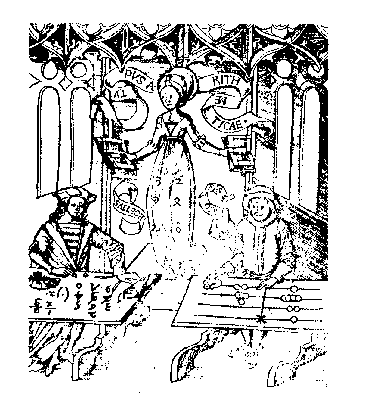
我们给出一个波爱修斯在书房中的图片示例,该图片取自De consolatione philosophiae的法文译本。该译本由让·德·默恩制作,献给法国的腓力四世。这意味着原作出产于1314年腓力去世之前。这幅画取自安德烈·卢梭制作的副本,他是布尔日大学附属的书商,于1476年2月1日完成。著名艺术家让·科隆布绘制了七幅插图,其中“波爱修斯在书房中”出现在波爱修斯原著导言的译本中。
Anicius Manlius Severinus Boethius came from the family of Anicii who had been Christians for around 100 years. He became an orphan when he was about seven years old when his father, who became consul in 487, died soon afterwards. Boethius was brought up in the house of the aristocratic family of Quintus Aurelius Memmius Symmachus. In fact Symmachus himself had been consul in 485 just before Boethius's father.
Boethius was extremely well educated, being fluent in Greek and very familiar with the works of the Greek philosophers. Although there is no firm evidence to prove that Boethius ever studied in Athens or Alexandria, many historians believe that this must have been the case for him to have achieved a unique level of scholarship among his countrymen.
He married Symmachus's daughter Rusticiana and they had two sons who would follow their father in being appointed to high public office. Boethius served a term as consul in 510 while in 522 his two sons held the office of consul simultaneously.
Education and knowledge were important to Boethius and he used his talents in writing and translating. His understanding of mathematics was rather limited, however, and the text he wrote on arithmetic was of poor quality and although his geometry text has not survived there is little reason to believe that is was any better. Despite this his mathematics texts were the best available and were used for many centuries during a time when mathematical achievement in Europe was at a remarkably low point. Boethius's Arithmetic was based on the work of Nicomachus and, although this gave it a strange character by the mathematical standards of today, it taught medieval scholars about Pythagorean number theory.
Boethius was one of the main sources of material for the quadrivium, an educational course introduced into monasteries consisting of four topics: arithmetic, geometry, astronomy, and the theory of music. On this last topic Boethius wrote on the relation of music to science, suggesting that the pitch of a note one hears is related to the frequency of sound.
He embarked on an ambitious project to translate and write commentaries on all the works of both Plato and Aristotle. His aim was to show the ways in which these two most important Greek philosophers agreed with each other. It was a project that Boethius was never to finish, in particular he died before he could translate Plato's work and fulfil his aim of harmonising the two philosophies.
He did, however, make Latin translations of Aristotle's Categories and De interpretatione and of Porphyry's Isagoge Ⓣ with two commentaries, which were widely used throughout the Middle Ages. Up to the 12th century his writings and translations were the main works on logic in Europe becoming known collectively as the Logica vetus (meaning the old logic).
Russell says that Boethius stands out as a man of great learning and great zeal, free from superstition and fanaticism. He writes in [14]:-
He would have been remarkable in any age, in the age in which he lived, he is utterly amazing.
Boethius became head of all the government and court services under Theodoric, king of Italy and of the Goths. Russell writes in [14]:-
Theodoric employed Boethius to reform the coinage, and to astonish less sophisticated barbarian kings with such devices as sun-dials and water-clocks.
Theodoric ruled Italy as essentially an independent monarch although he was the nominal representative of the Byzantine emperor. He had himself proclaimed king at Ravenna in 494 after taking back Italy from Odoacer. Boethius became magister officiorum under Theodoric in about 520. It was about this time that Boethius worked to mend relations between the Church in Rome and the Church in Constantinople which may in the end have been the reasons that he fell from favour.
Justin I in Constantinople was an orthodox Christian whereas Theodoric was an Arian. When the senator Albinus was accused of treason "for having written to the Emperor Justin against the rule of Theodoric" he was defended by Boethius. This led to Boethius himself being charged with treason, and other serious charges were also brought such as the practice of magic and of sacrilege.
Boethius was put in prison and there he wrote his most famous work De consolatione philosophiae. Russell says:-
Theodoric ... believed, rightly or wrongly, that there was a plot involving men in his own government. This led him to imprison and execute his minister, the senator Boethius.
Symmachus, Boethius's father-in-law, defended him against the charges but this only led to Symmachus himself being charged. Boethius was sentenced to death, the sentence was ratified by the Senate probably against its will, and it was carried out. Symmachus was also sentenced to death and, when Theodoric himself died in 526 it was widely believed that he had been paid back for his crimes.
The De consolatione philosophiae looked at the [2]:-
... questions of the nature of good and evil, of fortune, chance, or freedom, and of divine foreknowledge. ... in the fifth book, for example, he attempted to resolve the apparent difficulty of reconciling human freedom with the divine foreknowledge, a problem that among Stoic thinkers - though by no means uniquely among them - had been in general currency for a long time.
The powerful, yet simple, Platonic theism and morality which shines out of the De consolatione philosophiae made it extremely popular during the Middle Ages and the Renaissance. Perhaps aware that his aim in translating Plato was not to be fulfilled, Boethius put into his work a Platonic view of knowledge and reality. The work was originally written in Latin but it was later translated into many different languages.
We give an example of a picture of Boethius in his study which is taken from a translation of De consolatione philosophiae into French. The translation was made by Jean de Meun and dedicated to Philip IV of France. This means that the original was produced before Philip's death in 1314. The drawing is taken from a copy made by André Rousseau, a bookseller attached to the University of Bourges, completed on 1 February 1476. There are seven illustrations by the famous artist Jean Colombe, of which "Boethius in his study" appears in the translation of Boethius's original introduction.
正文里的方括号编号指向这里,悬停即可直接看到条目。书目保留原文——译了书名反而查不到文献。
原站列出的延伸阅读与外部数据库,照原样保留,目标多为英文页面。
关于波爱修斯的其它页面:
原站的交叉引用。指向本站已镜像专题的留在站内,其余仍指回原站。