数学家传记
伯多禄·卡塔迪是意大利数学家,撰写了约30本数学书籍,以及一些其他主题的书籍。
伯多禄·卡塔迪的父亲是Paolo Cataldi,他和儿子一样出生在博洛尼亚。卡塔迪在博洛尼亚接受教育,尽管他似乎没有上过那里的大学;相反,他十七岁就开始教数学。请注意特别重要的是,他选择用意大利当地方言而不是当时习惯的拉丁语教学。这使许多人受益于他的教学。1569年至1570年,他在佛罗伦萨的设计学院任教,然后去了意大利中部翁布里亚的佩鲁贾。他既在佩鲁贾大学教数学,于1572年5月12日进行了第一次讲座,也在佩鲁贾的设计学院任教。他在那里待到1584年,然后回到博洛尼亚,在那里获得了哲学和医学博士学位。他在博洛尼亚大学教数学和天文学近四十年,直到去世。
卡塔迪写了大约三十本数学著作,还有一些其他主题的著作。他写了算术方面的著作,在1602年至1617年间分四部分出版了Practica aritmetica Ⓣ(实用算术)。这部著作献给博洛尼亚元老院,但据信他是自费出版的。Carruccio写道[1]:-
卡塔迪通过将免费分发其《实用算术》副本的任务交给各方济各会修道院的上司,分发给修道院、神学院和贫困儿童,以此展现了他的仁慈。
然而,他最著名的是他在完全数和连分数方面的工作。他对完全数的贡献是在1603年做出的。欧几里得知道如果是素数,那么是一个完全数。分别取 = 2、3、5、7,这给出了完全数6、28、496和8128。这些为古希腊人所知,而下一个完全数是在1536年由Hudalrichus Regius找到的,他证明了是素数,给出33350336作为下一个完全数(这此前已被若干数学家发现,但他们的发现只是相对最近才成为常识)。卡塔迪在1603年证明了如果是合数,那么是合数,他还证明了对于和,是素数。他没有使用任何巧妙的技巧,仅仅是通过将每个数除以直到其平方根的所有素数来检验这些数是素数。当然,要做到这一点,他需要一份直到724(的近似平方根)的素数表。事实上,卡塔迪计算了一份直到750的所有素数的表,以及一份直到800的所有数的因数分解表。他分别出版了这些表。通过证明和是素数,卡塔迪实际上找到了第六和第七个完全数8589869056和137438691328。他还猜想对于 = 23、29、31和37,是素数,但除了 = 31之外,所有这些结果都被证明是错误的。皮埃尔·德·费马在1640年证明了和是合数。莱昂哈德·欧拉在1732年证明了是素数;这导致了自约130年前卡塔迪的那些完全数以来首次发现一个完全数。莱昂哈德·欧拉还在1738年推翻了卡塔迪猜想的最后一部分,当时他证明了是合数。
卡塔迪通过使用无穷级数来求数的平方根,这导致了对连分数的早期研究。这项关于连分数的工作出现在Trattato del modo brevissimo di trovar la radice quadra delli numeri Ⓣ(论求数的平方根的极短方法)(1613)中,尽管他在Operetta delle linee rette equidistanti et non equidistanti Ⓣ(论等距与非等距直线)(1603)中宣布了它们。他的方法使一些可追溯到海伦的想法变得精确[1]:-
在这项工作中,一个数的平方根是通过使用无穷级数和无限连分数来求得的。它代表了对无穷算法发展的显著贡献。
卡塔迪通过首先取整数a使得来计算数的平方根。余数则是。他对的第一次近似是
和 或 和 。
他给出
,;
,;
,;
……
让我们通过令 (因此 )来计算 的这个序列。
注意,经过 5 次迭代后,结果已经精确到 47 位。
卡塔迪计算了√18的渐近分数,并意识到这些渐近分数交替地大于和小于√18。我们注意到,他没有使用今天所谓的“简单连分数”,而他的方法总能给出一个周期为1的平方根的连分数。他写道:-
现在让我们考虑另一种求根的方法,即通过在前一法则的分数分母上逐行相加来继续。但为了更大的便利,我将假设一个其根容易求出的数,并假设根的第一部分是一个整数。那么设18为所提出的数,如果我假设第一个根是,即,这将超出,即分数的平方。
这里是,而的超出部分是。因此第一个渐近分数是。他找到,使得具有√18的四舍五入最小值,他观察到这当且仅当具有√18的四舍五入最小值时成立,所以。卡塔迪继续:-
第二个根将通过上述方法求得为4. & . & ,即 & ,即太小。这源于将整个分数乘以,其中整个分数小于作为添加分数的。
因此第二个渐近分数是。卡塔迪继续计算第三个渐近分数为。然后他计算并指出第三个渐近分数超出。他继续计算直到达到第十五个渐近分数。注意第三个渐近分数给出√18精确到5位小数,而第十五个渐近分数给出√18精确到23位小数。让我们指出,卡塔迪使用的符号与现代符号非常相似,因为他写道
4. & . & . & . &
其中 & 就是我们的 +,而 . 表示其后的内容要加到分母上。卡塔迪 只用了数值例子,但他清楚地知道,如果把这些收敛项写成 、、、……,那么它们满足基本关系
他的其他著作包括献给大公科西莫二世的 Transformatione geometrica Ⓣ(几何变换)(1611),以及一本研究火炮射程问题的书,其中包含博洛尼亚的日出和正午时刻表(1613)。1618年,他出版了 Operetta di ordinanze quadre Ⓣ(关于平方规则的工作),研究代数的军事应用。1612年,他出版了一本关于化圆为方的书 Trattato della quadratura del cerchio dove si esamina un nuovo modo di quadrarlo per numeri. Et insieme si mostra come, Dato un rettilineo, si formi un curvilineo equale ad esso Dato. Et di più alcune transformationi di curvilinei misti fra loro Ⓣ(论化圆为方,其中考察了一种用数来化圆为方的新方法。同时说明如何给定一条直线,作出与它等长的曲线。以及一些混合在一起的曲线变换)。卡塔迪 以对最近出版的同一主题著作的评论开始这部作品,即 Pellegrino Borello 的 Regola e modo facilissimo di quadrare il cerchio Ⓣ(化圆为方的一条规则和一种非常容易的方法)(1609)。奥古斯塔斯·德摩根 在 A Budget of paradoxes 中写道:-
[卡塔迪 Antonio Cataldi 的《化圆为方论》。博洛尼亚,1612] 声称从雷焦的 Pellegrino Borello 的求积开始,后者认为圆恰好是3个直径加上直径的 。卡塔迪 采用 Van Ceulen 的近似值,努力寻找几乎表示该比值的整数。他当时还没有“连分数”,这是他第二年在他关于平方根的著作中给出的一种表示方式。他只有 Van Ceulen 的三十位中的二十位,这些他取自 克里斯托佛·克拉乌……
卡塔迪 接着考察更一般的问题:构造面积等于若干给定曲边图形面积的正方形和矩形。他用收集在书末的图表说明了这些图形。
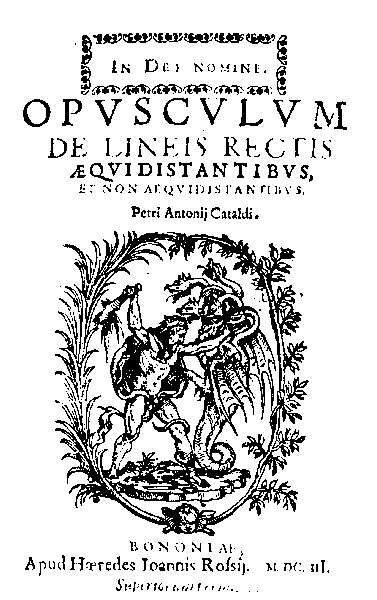
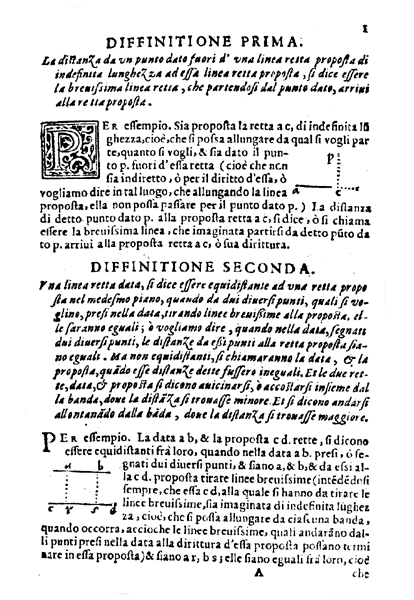
卡塔迪 还出版了 欧几里得 的 Elements 的一个版本。他研究 欧几里得 的第五公设,试图在 Operetta delle linee rette equidistanti et non equidistanti Ⓣ(论等距与非等距直线)(1603)中证明该公设是其他公设的推论。他的方法如下。他如下定义等距直线:
同一平面内的一条给定直线称为与另一条直线等距,当从第一条直线上任意两个不同点向第二条直线所作的两条最短线段相等。
然后他继续正确地推导出了第五公设。但等一下,我们知道第五公设不能从前四条推导出来,因为非欧几何就是这样产生的。某处一定有一个错误,那么它在哪里呢?事实上,它就在卡塔迪给出的等距的定义中,因为这个定义,即我们上面引用的,假设给定的直线是与第二条直线保持恒定距离的点的轨迹,并且还假设它是一条直线。这两个假设的相容性(当然)等价于第五公设。如果你仍然觉得这有点难以理解,只需考虑球面上的一个大圆(这是两点之间的最短距离,因此在这个几何中就是直线)。现在考虑一条与给定大圆等距的线。这将不是一个大圆,因此不是两点之间的最短距离,所以在这个几何中不是直线的类似物。
卡塔迪试图在博洛尼亚建立一所数学科学院,但没有成功。尽管失败了,他在遗嘱中留下钱在自己的房子里建立一所学校,但这似乎也没有实现。
Pietro Cataldi's father was Paolo Cataldi who, like his son, was born in Bologna. Pietro was educated in Bologna although he does not seem to have attended the university there; rather he began teaching mathematics at the age of seventeen. Note that of particular significance is the fact that he chose to teach in the local dialect of Italian rather than in Latin as was the custom in those days. This enabled many people to benefit from his teaching. He taught in Florence in the Academy of Design from 1569 until 1570 then he went to Perugia, in Umbria in central Italy. He taught mathematics both at the University of Perugia, giving his first lecture on 12 May 1572, and also at the Academy of Design in Perugia. He remained there until 1584 and then returned to Bologna where he was awarded a doctorate in philosophy and in medicine. He taught mathematics and astronomy at the Studio di Bologna for almost forty years until his death.
Cataldi wrote around thirty books on mathematics, and some on other topics. He wrote on arithmetic publishing Practica aritmetica Ⓣ in four parts between 1602 and 1617. This work was dedicated to the Senate of Bologna, but it is believed that he published it at his own expense. Carruccio writes [1]:-
Cataldi showed his benevolence by giving the superiors of various Franciscan monasteries the task of distributiong free copies of his 'Practica aritmetica' to monasteries, seminaries, and poor children.
He is, however, best known for his work on perfect numbers and on continued fractions. His contributions to perfect numbers were made in 1603. Euclid knew that if is prime, then is a perfect number. This gives the perfect numbers 6, 28, 496 and 8128 by taking = 2, 3, 5, 7 respectively. These were known to the ancient Greeks, and the next perfect number had been found in 1536 by Hudalrichus Regius who showed that is prime giving 33350336 as the next perfect number (this had been discovered earlier by a number of mathematicians but their discoveries only became common knowledge comparatively recently). Cataldi, in 1603, showed that if is composite then is composite, and he also showed that is prime for and . He used no clever tricks, merely checked that these numbers were prime by dividing each by all primes up to their square roots. Of course, to do this he required a list of primes up to 724 (the approximate root of ). In fact Cataldi calculated a list of all primes up to 750 and a list of the factorisation of all numbers up to 800. He published these lists separately. By showing that and were prime, Cataldi had, in fact, found the sixth and seventh perfect numbers 8589869056 and 137438691328. He also conjectured that was prime for = 23, 29, 31 and 37 but all of these turned out to be false except for = 31. Fermat showed that and were composite in 1640. Euler showed that was prime in 1732; it gave rise to the first discovery of a perfect number since those of Cataldi about 130 years earlier. Euler also disproved the last part of Cataldi's conjecture in 1738 when he showed that is composite.
Cataldi found square roots of numbers by use of an infinite series leading to an early investigation into continued fractions. This work on continued fractions appears in Trattato del modo brevissimo di trovar la radice quadra delli numeri Ⓣ (1613) although he announced them in Operetta delle linee rette equidistanti et non equidistanti Ⓣ (1603). His methods make precise some ideas which went back to Heron [1]:-
In this work the square root of a number is found through the use of infinite series and unlimited continued fractions. It represents a notable contribution to the development of infinite algorithms.
Cataldi calculates the square root of a number by first taking the integer a such that . The remainder is then . His first approximation to is
and or and .
He puts
, ;
, ;
, ;
...
Let us compute this sequence for by putting (so ).
Note that after 5 iterations, the result is already correct to 47 places.
Cataldi calculated the convergents of √18 and realised that the convergents are alternately greater than and smaller that √18. We note that he does not use what are called today 'simple continued fractions' and his method will always give a continued fraction for a square root which has period 1. He writes:-
Let us now proceed to the consideration of another method of finding roots continuing by adding row on row to the denominator of the fraction of the preceding rule. But for greater convenience, I shall assume a number whose root may be easily taken and I shall assume that the first part of the root is an integer. Then let 18 be the proposed number, and if I assume that the first root is , that is , this will be in excess by which is the square of the fraction .
Here the is and the excess of is . The first convergent is therefore . He finds such that has a rounded minimum value of √18 which he observes is when (and only when) has a rounded minimum value of √18, so . Cataldi continues:-
The second root will be found by the above mentioned method to be 4. & . & which is & , which is too small. This arises from multiplying the entire fraction by in which the whole fraction is less than the which is the added fraction.
The second convergent is therefore . Cataldi continues to calculate the third convergent to be . He then computes and states that the third convergent is too large by . He continues the calculation until he reaches the fifteenth convergent. Note that the third convergent gives √18 correct to 5 decimal places, and the fifteenth convergent gives √18 correct to 23 decimal places. Let us remark that Cataldi is using a notation quite similar to modern notation for he writes
4. & . & . & . &
where & is just our + and the . indicates that what follows is to be added to the denominator. Cataldi only worked with numerical examples, yet he clearly understood that if the convergents are written as , , , ... then they satisfy the fundamental relation
Among his other works were Transformatione geometrica Ⓣ (1611), dedicated to the Grand Duke Cosimo II, and a book which studied problems of the range of artillery which included tables on the rising of the sun and the time of midday for Bologna (1613). In 1618 he published Operetta di ordinanze quadre Ⓣ which studied military applications of algebra. In 1612 he published a book on squaring the circle Trattato della quadratura del cerchio dove si esamina un nuovo modo di quadrarlo per numeri. Et insieme si mostra come, Dato un rettilineo, si formi un curvilineo equale ad esso Dato. Et di più alcune transformationi di curvilinei misti fra loro Ⓣ. Cataldi begins this work with a commentary on a recently published work on the same topic, namely Pellegrino Borello's Regola e modo facilissimo di quadrare il cerchio Ⓣ (1609). Augustus De Morgan writes in A Budget of paradoxes:-
[Trattato della quadratura del cerchio by Pietro Antonio Cataldi. Bologna, 1612] claims a place as beginning with the quadrature of Pellegrino Borello of Reggio, who will have the circle to be exactly 3 diameters and of a diameter. Cataldi, taking Van Ceulen's approximation, works hard at the finding of integers which nearly represent the ratio. He had not then the 'continued fraction', a mode of representation which he gave the next year in his work on the square root. He has but twenty of Van Ceulen's thirty places, which he takes from Clavius ...
Cataldi then looks at the more general question of constructing squares and rectangles with an area equal to that of a number of given shapes with curved edges. He illustrated these shapes with diagrams collected at the end of the book.
Cataldi also published an edition of Euclid's Elements. He worked on Euclid's fifth postulate, attempting to prove the postulate was a consequence of the others in Operetta delle linee rette equidistanti et non equidistanti Ⓣ (1603). His approach was the following. He defined equidistant straight lines as follows:
A given straight line is said to be equidistant from another straight line in the same plane when the two shortest lines that are drawn from any two different points on the first line to the second line are equal.
He then proceeded to correctly deduce the Fifth Postulate. But wait a minute, we know that the Fifth Postulate cannot be deduced from the first four, for that is how non-Euclidean geometries come about. There must be an error somewhere, so where is it? In fact it is in the definition which Cataldi gave of equidistant for this definition, which we quoted above, assumes that the given line is the locus of points at a constant distance from the second line and it also assumes that it is a straight line. The compatibility of these two assumptions is (of course) equivalent to the Fifth Postulate. If you are still finding this a little difficult to understand, just consider a great circle on a sphere (this is the shortest distance between two points and so the straight line in this geometry). Now consider a line equidistant from the given great circle. This will not be a great circle, so is not the shortest distance between two points and so is not the analogue of a straight line in this geometry.
Cataldi tried, without success, to set up an academy of mathematics in Bologna. Despite the failure he left money in his will to set up a school in his own house but this also seems not to have happened.
正文里的方括号编号指向这里,悬停即可直接看到条目。书目保留原文——译了书名反而查不到文献。
原站列出的延伸阅读与外部数据库,照原样保留,目标多为英文页面。
原站的交叉引用。指向本站已镜像专题的留在站内,其余仍指回原站。