数学家传记
阿特勒·塞尔伯格是一位挪威数学家,以在解析数论以及离散群和自守形式方面的工作而闻名。
阿特勒·塞尔伯格的父母是Ole Michael Ludvigsen 塞尔伯格(1877-1950)和Anna Kristina Brigtsdatter Skeie(1874-1971)。Ole Selberg是一名数学教师,48岁时凭借学位论文Ein Beitrag zur Theorie der algebraisch auflösbaren Gleichungen von Primzahlgrad Ⓣ(对素数次可解代数方程理论的贡献)获得奥斯陆大学博士学位。塞尔伯格出生时,他的父亲是Langesund中学的高级教师。然而,塞尔伯格出生后不久,他的父亲搬到Hordaland的Voss一所学校任教三年。到1921年,他在卑尔根郡中学任教。塞尔伯格的母亲Anna Skeie是教师Brigt Arnesen Skeie(1846-1939)和Brita Hansdatter Bru(1842-1915)的女儿,也是一名教师。Ole和Anna Selberg于1903年7月30日在Halandsdal结婚,他们有九个孩子,五男四女,塞尔伯格是最小的。塞尔伯格的三个兄弟也成为了数学家。Henrik Selberg(1906-1993)出生于卑尔根。他成为奥斯陆大学数学教授,对复函数感兴趣。双胞胎Sigmund 塞尔伯格(1910-1994)和Arne Selberg(1910-1994)于1910年8月11日出生在Langesund。Sigmund成为挪威理工学院数学教授,对素数感兴趣。Arne也成为挪威理工学院教授。他是一名应用数学家,特别对悬索桥设计感兴趣。
我们上面已经注意到,塞尔伯格的父亲因担任不同职位而搬迁,因此当塞尔伯格成长时,他住在沃斯、卑尔根,然后住在约维克,他的父亲于1932年在那里成为一所学校的校长。现在人们可能会认为塞尔伯格会从父亲那里学到很多数学,但情况似乎并非如此。相反,正是他父亲藏书丰富的图书馆中的数学书籍,在塞尔伯格还是个男孩时将他引向了数学。大约12岁时,当全家住在卑尔根附近的奈斯图恩时,塞尔伯格在卑尔根上中学。他说[2]:-
中学时我乘火车去卑尔根。从某种意义上说,这相当不错,有点像通勤列车,车程略超过半小时。我们在火车上做了很多学校作业。有不少学生像这样通勤。
塞尔伯格通过阅读父亲书房里的书籍,自学了解方程的方法。在父亲手抄的卡尔·斯特默讲义中,他遇到了级数
多年后他回忆起那个场合,当时他说(例如见[18]):-
……如此奇特而美妙的关系,以至于我决定要读那本书,以弄清那个公式是如何得来的。
然而,卡尔·斯特默的讲义一开始就用理查德·戴德金分割来引入实数,这让塞尔伯格感到困惑。但他继续读下去,并发现这些讲义很有启发性。此时,分析是他的主要兴趣,但他的兄弟Sigmund建议他阅读父亲所藏的一本约瑟夫·阿尔弗雷德·塞雷著作中关于巴夫尼提·列波维奇·切比雪夫素数分布的工作。塞尔伯格当时正在Gjovik上高中,而他的兄弟Sigmund是奥斯陆大学的学生。塞尔伯格大约17岁时,偶然看到了Sigmund从大学图书馆借出并带回家的拉马努金文集。他不仅对所读到的数学印象深刻,还被拉马努金的个性所吸引,他形容其具有“神秘的气息”。卡尔·斯特默曾在Norsk Matematisk Tidsskrift上发表过一篇关于拉马努金的文章,塞尔伯格也读过这篇文章。受到阅读拉马努金及其著作的启发,塞尔伯格转向研究数论,并开始进行自己的数学探索。这些进展顺利,他写下了第一篇论文“On some arithmetical identities”。这篇23页的论文用德语写成,于1936年发表。因此,可以说塞尔伯格在高中时就成为了一名数论学家。数学并不是塞尔伯格在高中时自学的唯一科目,他还自学了外语。事实上,他在小学时就开始学习英语,得到了姐姐Anna的帮助。
1935年,塞尔伯格从Gjovik的高中毕业,并考入奥斯陆大学。他的兄弟Henrik将他介绍给卡尔·斯特默,后者的著作已经影响了他。他发现卡尔·斯特默乐于帮助这位已经开始撰写数学论文的年轻本科生。对塞尔伯格数学发展的另一个主要影响是埃里希·赫克在1936年奥斯陆国际数学会议上的讲座。还在本科阶段时,他参加了1938年在赫尔辛基举行的斯堪的纳维亚数学大会,并在由Torsten Carleman主持的一次会议上做了20分钟的报告。他主修数学,于1939年春季从奥斯陆大学毕业,获得硕士学位。在接下来的几个月里,他完成了义务兵役的第一部分。他曾计划去汉堡与埃里希·赫克讨论研究。他为此申请了奖学金并获得了批准,但由于1939年秋天第二次世界大战爆发,他改变了计划。他本会留在奥斯陆进行博士研究,但图书馆藏书匮乏,所以他去了乌普萨拉,在那里听了Trygve Nagell(1895-1988)的讲座,后者研究丢番图方程。塞尔伯格在乌普萨拉的大部分时间都在图书馆工作,然后于1939年12月返回奥斯陆。然而,塞尔伯格说[7]:-
……1940年4月初,战争降临挪威,这中断了我的数学研究。在古德布兰斯达尔与挪威军队一起抗击德国入侵者时,我没有想过数学。我们还到过奥斯特达尔的上部,最后到了安达尔内斯附近。我是赫格斯塔德少校炮兵营的一名士兵,我对他极为敬重。同样,当我在特兰杜姆战俘营做战俘时,[我也没有想过数学]。当我最终获释后,我去了挪威西海岸,后来又与家人去了哈当厄尔。
他于1942年被任命为研究员,即获得博士学位的前一年。他的学位论文于1943年10月22日答辩,就在德国入侵者于11月底关闭大学之前,论文题目是On the zeros of Riemann's zeta-function。他的答辩委员是哈拉尔·玻尔和陶拉尔夫·斯科伦,但由于战争,从丹麦逃到瑞典的哈拉尔·玻尔无法前往挪威。卡尔·斯特默出席了答辩,宣读了哈拉尔·玻尔的报告。答辩结束后,塞尔伯格立即被德国人逮捕并投入监狱,但获释的条件是他离开奥斯陆,回到父母居住的约维克。他在约维克独自研究波恩哈德·黎曼猜想,度过了战争余下的时光。
1947年8月13日,他在斯德哥尔摩与工程师Hedvig Liebermann(1919年11月20日-1995年7月6日)结婚。Hedvig是来自特兰西瓦尼亚的家具制造商Luzar Liebermann和Serena Sarolta Jakobovits的女儿。塞尔伯格和Hedvig 塞尔伯格有两个孩子:Ingrid Maria Selberg(生于1950年3月13日,现与剧作家Mustapha Matura结婚)和Lars 塞尔伯格。结婚后不久,Selberg一家去了美国,塞尔伯格在普林斯顿高等爱德华·斯图迪研究院度过了1947-48学年。这一年之后,他获得了在高等斯图迪研究院第二年的机会,但选择去看看另一所美国大学。然而,为了这样做,他不得不离开该国并获得新签证。他和妻子前往蒙特利尔,费了一些周折获得新签证后返回普林斯顿。埃尔德什在塞尔伯格在加拿大期间抵达了研究院,他一回来他们就见面了。正是在这个时候,塞尔伯格和埃尔德什得出了素数定理的一个初等证明。我们将在下面进一步讨论这一点。
接下来的一年,他在锡拉丘兹大学担任数学副教授,并于1949年作为永久成员回到普林斯顿高等斯图迪研究院。1951年,塞尔伯格被提升为普林斯顿大学教授。我们注意到,塞尔伯格的妻子Hedvig在20世纪50年代是高等斯图迪研究院的研究员,在冯·诺依曼的群中工作,后来在普林斯顿等离子体物理实验室工作。
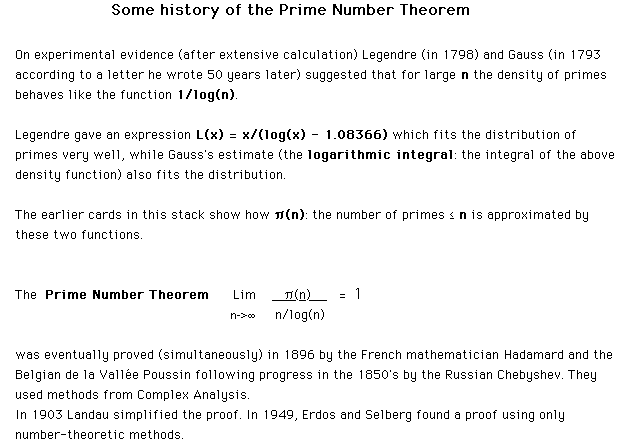
1950年,塞尔伯格在哈佛举行的国际数学家大会上被授予菲尔兹奖。约翰·查尔斯·菲尔兹奖章授予他,是为了表彰他在维戈·布朗筛法推广方面的工作,以及他在波恩哈德·黎曼 zeta函数零点方面的主要工作,他证明了其零点中有正比例满足波恩哈德·黎曼假设。引文还提到了他对素数定理的初等证明(与埃尔德什合作),并推广到任意等差数列中的素数。素数定理的历史非常有趣。该定理表述为:-
不超过的素数个数,当时趋于。
它在18世纪被猜想出来,但尽管付出了许多努力,当时仍未找到证明。波恩哈德·黎曼接近证明该结果,但复变函数理论尚未充分发展,使他无法完成证明。到1896年,必要的分析工具已经为人所知,雅克·阿达马和夏尔-让·德拉瓦莱·普桑各自独立地使用复分析证明了该定理。这一结果的成功证明被视为解析数论最伟大的成就之一。1949年,塞尔伯格和埃尔德什找到了一个不使用复函数理论的初等证明。随后的事情并不完全清楚,但塞尔伯格在Annals of Mathematics第50卷上发表了两篇论文An elementary proof of the prime number theorem和An elementary proof of Dirichlet's theorem about primes in an arithmetic progression 。第二年,他发表了An elementary proof of the prime number theorem for arithmetic progressions。不难看出塞尔伯格与埃尔德什之间的误解从何而来。基本上,所有数学家都可以在一条“合作”线上找到自己的位置。塞尔伯格和埃尔德什处于两个极端——埃尔德什的大部分工作发表在合著论文中,而塞尔伯格几乎没有合著出版物。他们处于“合作”线的两端!
在[12]中,恩里科·邦别里解释了塞尔伯格数论筛法的来源,并表明塞尔伯格的方法和他筛法的思想源于他在波恩哈德·黎曼ζ函数分析理论方面的工作。在这项工作中,塞尔伯格还通过方法引入了所谓的软化子。可能塞尔伯格最好且最重要的工作是他关于的迹公式,这完成于他获得约翰·查尔斯·菲尔兹奖章的工作数年之后。塞尔伯格使用他的迹公式证明了波恩哈德·黎曼曲面的“塞尔伯格 zeta函数”满足波恩哈德·黎曼假设的类似物。
在塞尔伯格做出的许多杰出数学贡献中,有他在以下方面的工作:-
……罗伯特·亚历山大·兰金-塞尔伯格方法,波恩哈德·黎曼的zeta函数理论中的“软化子”手段及其在临界线上或附近的零点的深刻应用,以及作为副产品的塞尔伯格筛法,……塞尔伯格迹公式,塞尔伯格的zeta函数,……自守函数,约翰·彼得·古斯塔夫·勒热纳·狄利克雷级数。
塞尔伯格的论文集分两卷出版(1989,1991)。Matti Jutila在评论这些文集时写道:-
塞尔伯格论文集的出版受到数学界最热烈的欢迎,原因有几个。首先,作者是一位在世的经典人物,在大约五十年间深刻影响了数学,尤其是广义上的解析数论。其次,他1947年以前的论文,大多发表在发行范围有限的挪威丛书或期刊上,部分甚至发表于第二次世界大战期间,如今终于容易获取了。第三,大量极有趣的数学通过塞尔伯格论文集的这两卷重见天日……[这部作品使]人能够仿佛从内部欣赏作者创造性工作的宏伟建筑。
塞尔伯格是1977年在奥斯陆出版的阿克塞尔·图厄的Selected mathematical papers的四位编者之一。1989年,塞尔伯格发表了Reflections around the Ramanujan centenary,这是他在1988年1月于孟买塔塔研究所举行的拉马努金百年纪念会议结束时所作演讲的文本。这篇在拉马努金诞辰100周年之际对他的致敬,显示了拉马努金对塞尔伯格数学发展的重要影响。
Roger Heath-Brown在[18]中写到塞尔伯格,其中引用了塞尔伯格的话:-
塞尔伯格非常谦逊,甚至对自己最重要的成就也是如此,正如他在1990年所说:“我认为我所做的事情……尽管有时有技术细节,有时甚至在我早期的一些工作中有大量计算……基本想法总是相当简单,并且可以用相当简单的术语来解释……在某些方面,我可能有一个相当简单化的头脑,所以这些是我唯一能处理的想法。我不认为其他人在理解我的工作上有过严重困难。”认识他的人会认出的不仅是这种情感,还有他特有的措辞方式。
让我们记录下塞尔伯格在[2]被问及爱好时的回答:-
我年轻时对植物学很感兴趣,并收集了一个大型植物标本集。我不再收集植物了。但我仍然对它们感兴趣,而且我可能比大多数人知道并能识别更多的物种。我收集贝壳已有相当多年。
除了约翰·查尔斯·菲尔兹奖章外,塞尔伯格还因其工作获得了许多荣誉。他与塞缪尔·艾伦伯格分享了1986年沃尔夫数学基金会奖。该奖项授予塞尔伯格[4]:-
……因其在数论、离散群和自守形式方面深刻而原创的工作。……在早期工作中,塞尔伯格教授证明了波恩哈德·黎曼zeta函数在临界线上的零点具有正密度。他构想并发展了通用筛法,这已成为解析数论的基本工具。他在筛法上的想法引导他得出了著名的‘塞尔伯格公式’,这是他素数定理初等证明的基础。他发现了以他名字命名的迹公式。由此产生了群表示与数论的新互动。他开创了格算术性的研究。他的贡献如此深刻和众多,以至于他的名字已成为数学史的一部分
我们还注意到,当尼尔斯·阿贝尔奖于2002年设立时,他们授予塞尔伯格[5]荣誉奖:-
决定授予著名挪威数学家塞尔伯格荣誉奖,以表彰他作为世界领先数学家之一的地位。他对数学的贡献如此深刻和原创,以至于他的名字将永远是数学史的重要部分。
除了这些奖项之外,他还当选为Norwegian Academy of Sciences、Royal Danish Academy of Sciences和美国艺术与科学院。1987年,他被授予挪威皇家圣奥拉夫勋章星级司令。
1987年,他年满七十岁时,从普林斯顿的斯图迪高等研究院退休。在普林斯顿期间,他一直保留挪威国籍,但在1990年代他加入了美国国籍。他的妻子赫德维格于1995年7月去世。2003年2月14日,他与贝蒂·弗朗西斯(“米基”)·康普顿(1929-)结婚。他在普林斯顿的家中因心脏病发作去世,享年90岁。他去世后,许多人致以敬意。其中两篇记录在[2](以及其他几篇文章)中。斯图迪高等研究院院长彼得·戈达德说:-
塞尔伯格的逝世对研究院和整个科学界都是巨大的损失。他影响深远的贡献在数学界留下了深刻的印记,我们不仅失去了一位数学巨人,还失去了一位挚友。
普林斯顿大学尤金·希金斯数学教授Peter Sarnak说:-
20世纪有幸拥有许多非常有才华的数学家,其中,有少数几位我会说他们有点石成金的本领。在他们深入思考的任何主题上,他们看得比前几代人更远,发现得更多——似乎毫不费力。他们的工作为许多未来的发展奠定了基础。塞尔伯格就是这样一位数学家;他是数学家的数学家。
我们以[20]的这段致敬作为结束:-
刻画塞尔伯格数学天才的一种方式是,他拥有一种“点石成金”的能力。在他深入思考过的那些领域中,他比前几代人看得更远,一再揭示出隐藏在表面之下的真理。他对长期悬而未决问题的突破,建立在富有想象力和新颖的想法之上,这些想法一旦被消化,便被视为简单而 decisive。
Atle Selberg's parents were Ole Michael Ludvigsen Selberg (1877-1950) and Anna Kristina Brigtsdatter Skeie (1874-1971). Ole Selberg was a school teacher of mathematics who, at age 48, was awarded his doctorate from the University of Oslo for his thesis Ein Beitrag zur Theorie der algebraisch auflösbaren Gleichungen von Primzahlgrad Ⓣ. At the time Atle was born his father was senior master at the Middle School in Langesund. However, shortly after Atle was born, his father moved to a school in Voss in Hordaland where he taught for three years. By 1921 he was teaching at Bergen County Middle School. Atle's mother, Anna Skeie, the daughter of the teacher Brigt Arnesen Skeie (1846-1939) and Brita Hansdatter Bru (1842-1915), was also a teacher. Ole and Anna Selberg married on 30 July 1903 in Halandsdal and they had nine children, five boys and four girls, Atle being the youngest of them. Three of Atle's brothers also became mathematicians. Henrik Selberg (1906-1993) was born in Bergen. He became professor of mathematics at the University of Oslo and was interested in complex functions. The twins Sigmund Selberg (1910-1994) and Arne Selberg (1910-1994) were born on 11 August 1910 in Langesund. Sigmund became a professor of mathematics at the Norwegian Institute of Technology where he was interested in prime numbers. Arne also became a professor at the Norwegian Institute of Technology. He was an applied mathematician with a particular interest in the design of suspension bridges.
We have noted above that Atle's father moved to take up different positions so while Atle was growing up he lived in Voss, Bergen, and then in Gjovik where his father became principal of a school in 1932. Now one might expect that Atle would have learnt a lot of mathematics from his father but this does not seem to be the case. Rather it was the mathematics books that his father kept in his well-stocked library that turned Atle towards mathematics when he was a boy. At around the age of 12, when the family were living in Nesttun near Bergen, Atle attended Middle School in Bergen. He said [2]:-
For middle school I went to Bergen by train. It was rather nice in a way, sort of a commuter train that took a little over half an hour. We did a lot of school work on the train. There were quite a few students commuting like that.
Atle taught himself methods of solving equations by reading the books in his father's library. In a hand-written copy that his father had of Carl Stormer's lecture notes he came across the series
He remembered the occasion years later when he said it was (see for example [18]):-
... such a very strange and beautiful relationship that I determined that I would read that book in order to find out how that formula came about.
However, Stormer's lecture notes began by introducing the real numbers with Dedekind cuts which baffled Selberg. However, he kept reading and found these notes inspiring. At this time it was analysis that was his main interest but his brother Sigmund suggested that he read about Chebyshev's work on the distribution of primes in his father's copy of one of J A Serret's books. Selberg was attending high school in Gjovik at this time while his brother Sigmund was a student at the University of Oslo. Selberg was about 17 years old when he came across Ramanujan's collected works which Sigmund had taken out of the university library and brought home. He was not only greatly impressed by the mathematics he read but also he was intrigued by Ramanujan's personality which he described as having "the air of mystery". Stormer had published an article about Ramanujan in the Norsk Matematisk Tidsskrift, and Selberg had read this too. Inspired by reading about Ramanujan and reading his work, Selberg turned to study number theory and began to make his own mathematical explorations. These went well and he wrote his first paper "On some arithmetical identities". This 23-page paper, written in German, was published in 1936. It is, therefore, fair to say that Selberg became a number theorist while still at high school. Mathematics wasn't the only topic that Selberg studied on his own while at high school for he also taught himself foreign languages. In fact he had started to learn English even earlier, while he was at primary school, assisted by his older sister Anna.
In 1935 Selberg graduated from the high school in Gjovik and matriculated at the University of Oslo. His brother Henrik introduced him to Stormer whose writing had already influenced him. He found Stormer ready to help the young undergraduate who had started to write mathematics papers. Another major influence on Selberg's mathematical development was a lecture by Erich Hecke at the International Mathematical Conference in Oslo in 1936. While still an undergraduate, he attended the Scandinavian Mathematical Congress in Helsinki in 1938 where he gave a 20-minute talk in a session chaired by Torsten Carleman. Majoring in mathematics, he graduated from the University of Oslo with a Master's Degree in the spring of 1939. In the following months he completed the first part of his compulsory military service. He had planned to go to Hamburg and discuss research with Erich Hecke. He had applied for a scholarship to fund this which he received, but he changed his plans because the autumn of 1939 saw the start of World War II. He would have remained in Oslo to undertake his doctoral research but the library was poor so he went to Uppsala where he attended lectures by Trygve Nagell (1895-1988) who worked on Diophantine equations. Selberg spent most of his time in Uppsala working in the library, then returned to Oslo in December 1939. However, Selberg said [7]:-
... the war came to Norway at the beginning of April 1940, and that caused an interruption of my mathematical research. I did not think about mathematics while I fought with the Norwegian forces against the German invaders in Gudbrandsdalen. We were also in the upper part of Osterdalen, and ended up near Andalsnes. I was a soldier in Major Hegstad's artillery battalion, and I held him in very high esteem. Also [I did not think about mathematics] while I was a prisoner of war at the prison camp at Trandum. When I finally was released, I travelled to the west coast of Norway, and later with my family to Hardanger.
He was appointed a research fellow in 1942, the year before the award of his doctorate. His thesis, which he defended on 22 October 1943 just before the German invaders closed down the university at the end of November, was On the zeros of Riemann's zeta-function. His examiners were Harald Bohr and Thoralf Skolem but because of the war Harald Bohr, who had escaped from Denmark to Sweden, could not travel to Norway. Stormer was present at the examination reading from Harald Bohr's report. Immediately after the examination, Selberg was arrested by the Germans and put in prison but was released on condition that he left Oslo and returned to Gjovik where his parents were living. He spent the rest of the war undertaking research on the Riemann hypothesis on his own in Gjovik.
On 13 August 1947 he married the engineer Hedvig Liebermann (20.11.1919-6.7.1995) in Stockholm. Hedvig was the daughter of the furniture manufacturer Luzar Liebermann from Transylvania and Serena Sarolta Jakobovits. Atle and Hedvig Selberg had two children, Ingrid Maria Selberg (born 13 March 1950 and now married to the playwright Mustapha Matura) and Lars Atle Selberg. Shortly after marrying, the Selbergs went to the United States where Atle spent the academic year 1947-48 at the Institute for Advanced Study in Princeton. After this year, he was offered a second year at the Institute for Advanced Study but chose to see another American University. However, to do so he had to leave the country and get a new visa. He and his wife travelled to Montreal and, with some difficulty, got new visas and returned to Princeton. Paul Erdős had arrived at the Institute while Selberg was in Canada and they met as soon as he returned. It was at this time that Selberg and Erdős arrived at an elementary proof of the prime number theorem. We say more about this below.
The following year he spent as associate professor of mathematics at Syracuse University, returning to the Institute for Advanced Study at Princeton in 1949 as a permanent member. In 1951 Selberg was promoted to professor at Princeton. We note that Selberg's wife Hedvig was a researcher at the Institute for Advanced Study in the 1950s working in von Neumann's group and later at Princeton's Plasma Physics Laboratory.
In 1950 Selberg was awarded a Fields Medal at the International Congress of Mathematicians at Harvard. The Fields Medal was awarded for his work on generalisations of the sieve methods of Viggo Brun, and for his major work on the zeros of the Riemann zeta function where he proved that a positive proportion of its zeros satisfy the Riemann hypothesis. The citation also mentions his elementary proof of the prime number theorem (with P Erdős), with a generalization to prime numbers in an arbitrary arithmetic progression. The history of the prime number theorem is very interesting. The theorem states:-
The number of primes ≤ tends to as .
It was conjectured in the 18th century but despite many efforts, no proof had been found around that time. Riemann came close to proving the result, but the theory of functions of a complex variable was not sufficiently developed to enable him to complete the proof. The necessary analytic tools were known by 1896 when Jacques Hadamard and Charles de la Vallée Poussin independently proved the theorem using complex analysis. The successful proof of this result was seen as one of the greatest achievements of analytic number theory. In 1949 Selberg and Erdős found an elementary proof that makes no use of complex function theory. Subsequent events are not entirely clear but Selberg published two papers An elementary proof of the prime number theorem and An elementary proof of Dirichlet's theorem about primes in an arithmetic progression in volume 50 of the Annals of Mathematics. The following year he published An elementary proof of the prime number theorem for arithmetic progressions. It is not too difficult to see where the misunderstanding between Selberg and Erdős arose. Basically all mathematicians fit somewhere onto a "collaboration" line. Selberg and Erdős are at the opposite extremes - most of Erdős's work is published in joint papers while Selberg has hardly any joint publications. They are at opposite ends of the "collaboration" line!
In [12] Enrico Bombieri explains the source of Selberg's number theory sieve and shows that the idea of Selberg's method and of his sieve has its origin in his work on the analytic theory of the Riemann zeta function. In this work Selberg also introduced so-called mollifiers by the method. Probably Selberg's best and most important work is his trace formula for , which was done several years after the work for which he was awarded the Fields Medal. Selberg used his trace formula to prove that the "Selberg zeta function" of a Riemann surface satisfies an analogue of the Riemann hypothesis.
Among the many outstanding mathematical contributions Selberg has made, there is his work on:-
... the Rankin-Selberg method, the "mollifier" device in the theory of Riemann's zeta function with its deep applications to zeros on or near the critical line and with Selberg's sieve as a by-product, ... Selberg's trace formula, Selberg's zeta function, ... automorphic functions, Dirichlet series.
Selberg's collected papers were published in two volumes (1989, 1991). Matti Jutila, reviewing these, writes:-
The publication of the collected papers of Atle Selberg is most warmly welcomed by the mathematical community for several reasons. First of all, the author is a living classic who has profoundly influenced mathematics, especially analytic number theory in a broad sense, for about fifty years. Secondly, his papers up to 1947, which appeared mostly in Norwegian series or journals of limited distribution and partly even during World War II, are now at last easily accessible. And thirdly, a lot of highly interesting mathematics comes into daylight via the two volumes of Selberg's collected papers ... [The work puts] one is in a position to appreciate as if from the inside the monumental architecture of the author's creative work.
Selberg was one of the four editors of Axel Thue's Selected mathematical papers published in Oslo in 1977. In 1989 Selberg published Reflections around the Ramanujan centenary which is the text of a talk he gave at the conclusion of the Ramanujan Centenary Conference in January 1988 at the Tata Institute in Bombay. This tribute to Ramanujan, on the 100th aniversary of his birth, shows the important influence that Ramanujan had in Selberg's mathematical development.
Roger Heath-Brown writes about Selberg in [18] where he quotes from Selberg:-
Selberg was very modest, even about his most significant achievements, as is exemplified when he said, in 1990, 'I think the things I have done ... although sometimes there were technical details, and sometimes even a lot of calculation, in some of my early work ... the basic ideas were rather simple always, and could be explained in rather simple terms ... in some ways, I probably have a rather simplistic mind, so that these are the only kind of ideas I can work with. I don't think that other people have had grave difficulties in understanding my work.' Those who knew him will recognize not just the sentiment, but also his characteristic turn of phrase.
Let us record Selberg's answer in [2] when he was asked about his hobbies:-
In my youth I was very interested in botany, and I collected a large herbarium. I don't collect plants anymore. But I'm still interested in them, and I probably know and can identify more species than most. I have collected seashells for quite a number of years.
Selberg has received many distinctions for his work in addition to the Fields Medal. He shared the 1986 Wolf Foundation Prize in Mathematics with Samuel Eilenberg. The award was made to Selberg [4]:-
... for his profound and original work on number theory and on discrete groups and automorphic forms. ... In early work, Professor Atle Selberg proved that the zeros of the Riemann zeta function on the critical line have positive density. He conceived and developed the general sieve method, which has become a fundamental tool in analytic number theory. His ideas on sieves led him to his celebrated 'Selberg formula' which is the basis of his elementary proof of the prime number theorem. He discovered the trace formula, which bears his name. Out of it grew a new interaction of group representations and number theory. He initiated the study of the arithmeticity of lattices. His contributions are so deep and so many that his name is already part of the history of mathematic
We also note that when the Abel Prize was established in 2002 they gave an honorary award to Selberg [5]:-
It was decided to award an honorary prize to the renowned Norwegian mathematician Atle Selberg in recognition of his status as one of the world's leading mathematicians. His contributions to mathematics are so deep and original that his name will always be an important part of the history of mathematics.
In addition to these awards, he has been elected to the Norwegian Academy of Sciences, the Royal Danish Academy of Sciences and the American Academy of Arts and Sciences. In 1987 he was named Commander with Star of the Royal Norwegian Order of St Olav.
When he reached the age of seventy, in 1987, he retired from the Institute for Advanced Study at Princeton. Throughout his time at Princeton he had remained a Norwegian citizen but in the 1990s he took American nationality. His wife, Hedvig, died in July 1995. On 14 February 2003 he married Betty Frances ("Mickey") Compton (1929-). He died following a heart attack at his home in Princeton at the age of 90. After his death many tributes were paid. Two of these are recorded in [2] (and in several other articles). Peter Goddard, Director of the Institute for Advanced Study said:-
Atle's passing marks a great loss, both to the Institute and to the larger scientific community. His far-reaching contributions have left a profound imprint on the world of mathematics, and we have lost not only a mathematical giant, but a dear friend.
Peter Sarnak, Eugene Higgins Professor of Mathematics at Princeton University, said:-
The 20th century was blessed with a number of very talented mathematicians, and of those, there are a few who I would say had a golden touch. In any topic about which they thought in depth, they saw further and uncovered much more - seemingly effortlessly - than the generations before them. Their work set the stage for many future developments. Atle was one such mathematician; he was a mathematician's mathematician.
We end with this tribute from [20]:-
One way of characterising Atle Selberg's mathematical genius is that he had a "golden touch". In those domains he thought about in depth, he saw further than generations before him, repeatedly uncovering truths lying beneath the surface. His breakthroughs on long-standing problems were based on imaginative and novel ideas which, once digested, were appreciated as simple and decisive.
正文里的方括号编号指向这里,悬停即可直接看到条目。书目保留原文——译了书名反而查不到文献。
原站列出的延伸阅读与外部数据库,照原样保留,目标多为英文页面。
原站的交叉引用。指向本站已镜像专题的留在站内,其余仍指回原站。