数学家传记
埃尔德什提出并解决了数论及其他领域的问题,并创立了离散数学领域。
埃尔德什来自一个犹太家庭(原姓Engländer),尽管他的父母都不信奉犹太教。埃尔德什的父亲Lajos和母亲Anna有两个女儿,分别为三岁和五岁,就在埃尔德什出生前几天死于猩红热。这自然使得Lajos和Anna对埃尔德什极为保护。他将由父母引入数学,他们本人都是数学教师。
埃尔德什才一岁多时,第一次世界大战爆发了。埃尔德什的父亲Lajos在俄军进攻奥匈军队时被俘。他在西伯利亚度过了六年的俘虏生活。Lajos一被俘,由于埃尔德什的母亲Anna白天要教书,便雇了一位德国女家庭教师来照看埃尔德什。Anna在失去两个女儿后过度保护,在埃尔德什早年的大部分时间里都不让他上学,并请了一位家庭教师在家教他。
第一次世界大战结束时,匈牙利的局势一片混乱。在短暂地作为民主共和国之后,共产党人Béla Kun接管了政权,匈牙利变成了左翼苏维埃共和国。Anna此时被任命为她所在学校的校长,但当有人呼吁罢工反对Kun的政权时,她继续工作,不是出于政治原因,而只是因为她不希望孩子们的教育受到影响。
在控制匈牙利四个月后,Kun在1919年7月罗马尼亚军队向布达佩斯推进时逃往维也纳。右翼民族主义者Miklós Horthy接管了国家。他迅速对那些被视为共产党人的人采取行动,而Anna Erdős由于在Kun掌权时没有服从罢工号召而落入这一类别。她被解除了职务,并且随着Horthy的人在马路上游荡杀害犹太人和共产党人,她一直生活在对自己生命的恐惧中。到1920年,Horthy已经引入了类似于希特勒十三年后在德国引入的反犹太法律。
1920年对埃尔德什来说并非全是坏事,因为他的父亲Lajos从西伯利亚回到了家。他在俘虏生活中学会了英语以打发漫长的时光,但由于没有英语老师,他不知道单词怎么发音。他现在开始教埃尔德什说英语,但这给埃尔德什带来的奇怪英语口音成为他一生中的一个特点。
尽管匈牙利对犹太人进入大学有限制,埃尔德什作为全国考试的获胜者,于1930年获准入学。他在布达佩斯的帕兹马尼罗莎·培特大学攻读博士学位。1934年获得博士学位后,他在曼彻斯特获得了博士后奖学金,实际上是因为他是犹太人而被迫离开匈牙利。在奖学金任职期间,埃尔德什在英国广泛旅行。他于1934年在剑桥遇到了戈弗雷·哈罗德·哈代,并于1935年也在剑桥遇到了斯坦尼斯瓦夫·乌拉姆。他与斯坦尼斯瓦夫·乌拉姆的友谊后来在埃尔德什在美国时证明是重要的。
到20世纪30年代末,匈牙利的局势显然使犹太出身的人不可能返回。然而,在他担任曼彻斯特研究员期间,他每年访问布达佩斯三次。1938年3月,希特勒控制了奥地利,埃尔德什不得不取消他原定的春季布达佩斯之行。他确实在暑假期间访问了那里,但1938年9月3日的捷克危机使他决定匆忙返回英国。几周内,埃尔德什就前往美国,在普林斯顿获得了一个研究员职位。他希望自己的研究员职位能够续期,但埃尔德什不符合普林斯顿的标准,因此他只获得了六个月的延期,而不是预期的一年。普林斯顿发现他[3]:-
……粗野而非常规……
而斯坦尼斯瓦夫·乌拉姆邀请埃尔德什访问麦迪逊以提供帮助。我们稍后将回来进一步详述埃尔德什从此以后所过的奇特生活,他专门致力于寻找并解决好的数学问题。首先我们对其数学作一些评论。
埃尔德什对数学的贡献众多而广泛。然而,基本上埃尔德什是一个问题解决者,而不是理论构建者。最吸引他的问题是组合数学、图论和数论中的问题。然而,他不仅仅想解决问题,他想以优雅和初等的方式解决它们。对埃尔德什来说,证明必须提供对结果为何为真的洞察,而不仅仅提供一系列复杂的步骤,这些步骤构成形式证明,却未能提供任何理解。
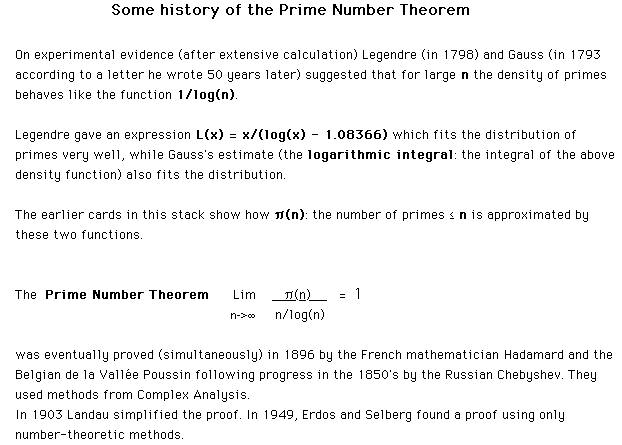
与埃尔德什联系最紧密的一些结果在埃尔德什出生之前就已被首次证明。1845年约瑟·伯特兰猜想对于,在与之间总至少有一个prime。巴夫尼提·列波维奇·切比雪夫于1850年证明了约瑟·伯特兰的猜想,但当埃尔德什还只是布达佩斯一名十八岁的学生时,他就找到了这一结果的一个优雅的初等证明。另一个与埃尔德什相关的关于素数的结果是素数定理,即:-
……不超过的素数个数当时趋于∞。
该定理在18世纪被猜想,巴夫尼提·列波维奇·切比雪夫本人已接近给出证明,但直到1896年才被证明,当时雅克·阿达马和夏尔-让·德拉瓦莱·普桑各自独立地使用复分析证明了它。1949年埃尔德什和阿特勒·塞尔伯格找到了一个初等证明。随后的事件在[15]中描述:-
阿特勒·塞尔伯格和埃尔德什同意在同一期刊上以背靠背的论文发表他们的工作,解释各自所做的工作并分享荣誉。但在最后一刻阿特勒·塞尔伯格……抢先完成了他的证明并首先发表。第二年阿特勒·塞尔伯格因此项工作获得了菲尔兹奖。埃尔德什不太关心数学的竞争方面,对这一插曲持达观态度。
这个结果是埃尔德什所研究的数学类型的典型代表。他提出并解决了那些优美、易于理解但以难解著称的问题。
埃尔德什确实在1951年获得了美国数学会的科尔奖,因为他在数论方面的许多论文,特别是1949年发表在国家科学院会议录上的论文On a new method in elementary number theory which leads to an elementary proof of the prime number theorem。
1941年8月发生的一个相当愚蠢的事件是否对埃尔德什的生活产生了真正影响,或者它只是被用作借口,很难说。埃尔德什和两位同行数学家在长岛一个军事无线电发射器附近被警察带走。这是一个相当无辜的事件,三位数学家过于专注于数学讨论,没有注意到“禁止入内”的标志。在与警察友好交谈后,意识到没有恶意。然而,这给埃尔德什留下了联邦调查局的记录,后来被用来对付他。
斯坦尼斯瓦夫·乌拉姆于1943年离开麦迪逊,加入新墨西哥州洛斯阿拉莫斯的其他数学家和物理学家,参与原子弹项目。他邀请埃尔德什加入该项目,但尽管埃尔德什对此感兴趣并接受了面试,他在面试中给出的回答,他一定知道并非面试官想听到的。埃尔德什只是太诚实地说,他希望战争结束后回到布达佩斯。这段插曲确实让人觉得埃尔德什从未想在洛斯阿拉莫斯工作,而只是自娱自乐。
1943年,埃尔德什在普渡大学工作,接受了兼职任命。尽管那是一个艰难的时期,他在匈牙利的家人的命运充满不确定性,但在数学上,埃尔德什却蓬勃发展。从1941年到1945年布达佩斯解放,他没有收到家人的任何消息。匈牙利的犹太人从1944年起遭受了难以置信的苦难,许多人被谋杀,其他人被驱逐到奥斯维辛。当时在美国的埃尔德什不太可能完全理解恐怖的规模。然而,1945年8月,埃尔德什收到一封电报,详细说明了他的家人情况。他的父亲于1942年死于心脏病发作。他的母亲幸存下来,而相当引人注目的是,一个表亲Magda Fredro被送往奥斯维辛但幸存了下来。然而,这个家庭在纳粹对犹太人的迫害中遭受了可怕的苦难,埃尔德什的四个叔叔和阿姨被谋杀。
1948年底,埃尔德什得以返回匈牙利探亲,在那里他与幸存的家人和朋友团聚。在接下来的三年里,他频繁往返于英国和美国之间,然后在1952年接受了圣母大学的临时职位。这是一个鼓舞人心的提议,给了埃尔德什完全的自由,随时可以冲出去做一些联合研究。埃尔德什无法让自己永久接受同样慷慨的提议,尽管圣母大学和埃尔德什的朋友们都努力鼓励他接受。
20世纪50年代初,参议员约瑟夫·R·麦卡锡在美国煽起了强烈的反共情绪。埃尔德什开始受到当局的怀疑,他们到处看到想象中的问题。1954年,他在阿姆斯特丹参加完会议返回美国时,美国移民局问他如何看待马克思,埃尔德什做出了不明智的回答:-
我没有能力评判,但毫无疑问他是个伟人。
随后是一连串关于他是否会重返匈牙利的问题。埃尔德什说:-
我现在不打算访问匈牙利,因为我不知道他们是否会让我再出来。我只打算去英国和荷兰。
那么,是不是仅仅因为担心不被允许离开匈牙利才阻止了他去那里。埃尔德什天真地回答道:-
当然,我母亲在那里,而且我在那里有很多朋友。
埃尔德什不被允许返回美国,但没有给出理由。文件表明,官方理由并不是埃尔德什对上述问题的回答,而是他曾与一位后来从美国回到中国的中国数学家通信,以及埃尔德什1941年的联邦调查局记录。
在接下来的十年里,他大部分时间都在以色列度过。在20世纪60年代初,他多次请求允许返回美国,最终在1963年11月获得了签证。然而,此时埃尔德什已经成为一个旅行者,从一个大学搬到另一个大学,从一个数学家的家搬到另一个数学家的家。然而,他确实在朋友葛立恒那里有一个类似家的地方。埃尔德什和葛立恒在1963年的一次数论会议上相遇,并很快开始了数学合作。是葛立恒在他家里提供了一个房间,埃尔德什可以在他想住的时候住,他还在那里存放了埃尔德什的论文,并在许多方面充当了埃尔德什的秘书。
尽管有些夸张,但下面引自[12]的话表明了埃尔德什在同行数学家中受到的高度尊重:-
数学家们说,从未有过像埃尔德什这样的人。他是本世纪最伟大的数学家之一,在数论和其他领域提出并解决了棘手的问题,并创立了离散数学这一领域,而离散数学是计算机科学的基础。他也是历史上最多产的数学家之一,名下有1500多篇论文。而且,他的朋友们说,他也是最不寻常的人之一。
埃尔德什赢得了许多奖项,包括1983年5万美元的沃尔夫奖。然而,他的生活方式几乎不需要钱,他捐出了:-
……他从数学会议演讲中赚到的大部分钱,将其捐赠用于帮助学生或作为解决他提出的问题的奖品。
1976年,斯坦尼斯瓦夫·乌拉姆对埃尔德什作了如下描述:-
他曾是一个真正的神童,十八岁时就在数论和组合分析方面发表了他的第一批成果。由于是犹太人,他不得不离开匈牙利,而事实证明,这救了他的命。1941年,他二十七岁,思乡、不快乐,并不断担心留在匈牙利的母亲的命运。……埃尔德什身材略低于中等高度,是一个极度紧张和激动的人。……他的眼睛表明他总是在思考数学,这一过程只被他关于世界事务、政治或一般人类事务的相当悲观的言论所打断,他对这些事务的看法是阴暗的。……他的怪癖如此之多,不可能全部描述。……现在六十多岁的他,已有七百多篇论文。
Paul Erdős came from a Jewish family (the original family name being Engländer) although neither of his parents observed the Jewish religion. Paul's father Lajos and his mother Anna had two daughters, aged three and five, who died of scarlet fever just days before Paul was born. This naturally had the effect making Lajos and Anna extremely protective of Paul. He would be introduced to mathematics by his parents, themselves both teachers of mathematics.
Paul was not much over a year old when World War I broke out. Paul's father Lajos was captured by the Russian army as it attacked the Austro-Hungarian troops. He spent six years in captivity in Siberia. As soon as Lajos was captured, with Paul's mother Anna teaching during the day, a German governess was employed to look after Paul. Anna, excessively protective after the loss of her two daughters, kept Paul away from school for much of his early years and a tutor was provided to teach him at home.
The situation in Hungary was chaotic at the end of World War I. After a short while as a democratic republic, a communist Béla Kun took over, and Hungary became a left wing Soviet Republic. Anna was at this time made head teacher of her school but when there was a call for strike action against Kun's regime she continued working, not for political reasons but simply because she did not wish to see children's education suffer.
After four months in control of Hungary, Kun fled to Vienna when Romanian troops advanced on Budapest in July 1919. Miklós Horthy, a right-wing nationalist, took over control of the country. He quickly moved against those perceived as Communists and Anna Erdős fell into that category due to her failing to obey the strike call when Kun was in power. She was dismissed from her post and she was left in fear of her life as Horthy's men roamed the streets killing Jews and Communists. By 1920 Horthy had introduced anti-Jewish laws similar to those Hitler would introduce in Germany thirteen years later.
The year 1920 was not all bad for Paul, for his father Lajos returned home from Siberia. He had learnt English to pass the long hours in captivity but, having no English teacher, did not know how to pronounce the words. He now set about teaching Paul to speak English, but the strange English accent which this gave Paul remained one of his characteristics throughout his life.
Despite the restrictions on Jews entering universities in Hungary, Erdős, as the winner of a national examination, was allowed to enter in 1930. He studied for his doctorate at the University Pázmány Péter in Budapest. Awarded a doctorate in 1934, he took up a post-doctoral fellowship at Manchester, essentially being forced to leave Hungary because he was Jewish. During his tenure of the fellowship, Erdős travelled widely in the UK. He met Hardy in Cambridge in 1934 and Ulam, also in Cambridge, in 1935. His friendship with Ulam was to prove important later when Erdős was in the United States.
The situation in Hungary by the late 1930s clearly made it impossible for someone of Jewish origins to return. However he did visit Budapest three times a year during his tenure of the Manchester fellowship. In March 1938 Hitler took control of Austria and Erdős had to cancel his intended spring visit to Budapest. He did visit during the summer vacation but the Czech crisis on 3 September 1938 made him decide to return hurriedly to England. Within weeks Erdős was on his way to the USA where he took up a fellowship at Princeton. He hoped for his fellowship to be renewed but Erdős did not conform to Princeton's standards so he was offered only a six month extension rather than the expected year. Princeton found him [3]:-
... uncouth and unconventional...
and Ulam invited Erdős to visit Madison to help out. We shall return later to give further details of the strange life which Erdős lived from this time on, devoted exclusively to seeking out and solving good mathematical problems. First we make some comments about his mathematics.
The contributions which Erdős made to mathematics were numerous and broad. However, basically Erdős was a solver of problems, not a builder of theories. The problems which attracted him most were problems in combinatorics, graph theory, and number theory. He did not just want to solve problems, however, he wanted to solve them in an elegant and elementary way. To Erdős the proof had to provide insight into why the result was true, not just provide a complicated sequence of steps which would constitute a formal proof yet somehow fail to provide any understanding.
Some results with which Erdős is most closely associated had been first proved before Erdős was born. In 1845 Bertrand conjectured that there was always at least one prime between and for . Chebyshev proved Bertrand's conjecture in 1850 but when Erdős was only an eighteen year old student in Budapest he found an elegant elementary proof of this result. Another result on prime numbers associated with Erdős is the Prime Number Theorem, namely:-
.. the number of primes ≤ tends to ∞ as .
The theorem was conjectured in the 18th century, Chebyshev himself came close to a proof, but it was not proved until 1896, when Hadamard and de la Vallée Poussin independently proved it using complex analysis. In 1949 Erdős and Atle Selberg found an elementary proof. Subsequent events are described in [15]:-
Selberg and Erdős agreed to publish their work in back-to-back papers in the same journal, explaining the work each had done and sharing the credit. But at the last minute Selberg ... raced ahead with his proof and published first. The following year Selberg won the Fields Medal for this work. Erdős was not much concerned with the competitive aspect of mathematics and was philosophical about the episode.
This result was typical of the type of mathematics Erdős worked on. He posed and solved problems that were beautiful, simple to understand, but notoriously difficult to solve.
Erdős did receive the Cole Prize of the American Mathematical Society in 1951 for his many papers on the theory of numbers, and in particular for the paper On a new method in elementary number theory which leads to an elementary proof of the prime number theorem published in the Proceedings of the National Academy of Sciences in 1949.
Whether a rather silly event which took place in August 1941 was to have any real effect on Erdős's life, or whether it was simply used as an excuse, is hard to tell. Erdős and two fellow mathematicians were picked up by the police near a military radio transmitter on Long Island. It was quite an innocent event with the three mathematicians being too absorbed in discussion of mathematics to notice a NO TRESPASSING sign. After a friendly session with the police it was realised that no harm had been intended. However, it gave Erdős an FBI record which was later used against him.
Ulam left Madison in 1943 to join other mathematicians and physicists at Los Alamos in New Mexico working on the atomic bomb project. He asked Erdős to join the project but, although he was interested enough to be interviewed, Erdős gave answers to those interviewing him which he must have known were not what they wanted to hear. Erdős was simply too honest in saying that he would wish to return to Budapest at the end of the war. This episode does give the feeling that Erdős never wanted to work at Los Alamos, but was simply amusing himself.
In 1943 Erdős worked at Purdue University, taking a part-time appointment. Although it was a difficult time with great uncertainty about the fate of his family in Hungary, yet mathematically Erdős flourished. He had heard nothing from his family between 1941 and the time when Budapest was liberated in 1945. The Jews in Hungary had suffered incredible hardship from 1944 with many being murdered, and others deported to Auschwitz. It is unlikely that the full extent of the horror was understood by Erdős in the United States at the time. However, in August 1945, Erdős received a telegram giving details of his family. His father had died of a heart attack in 1942. His mother had survived while, quite remarkably, a cousin Magda Fredro had been sent to Auschwitz but had survived. The family had suffered terribly through the Nazi campaign against the Jews, however, and four of Erdős's uncles and aunts had been murdered.
Near the end of 1948 Erdős was able to return to Hungary for a visit and there he was reunited with his surviving family and friends. For the next three years he travelled frequently between England and the United States before accepting a temporary post at the University of Notre Dame in 1952. It was an inspired offer which gave Erdős complete freedom to rush off to do some joint research whenever he wanted. Erdős could not bring himself to accept the same generous offer on a permanent basis, which both the University of Notre Dame and Erdős's friends tried hard to encourage him to accept.
During the early 1950s senator Joseph R McCarthy whipped up strong feelings against communism in the United States. Erdős began to come under suspicion from authorities who saw imaginary problems everywhere. When asked by US immigration, as he returned after a conference in Amsterdam in 1954, what he thought of Marx, Erdős made the ill judged reply:-
I'm not competent to judge, but no doubt he was a great man.
This was followed by a line of questioning about whether he would ever return to Hungary. Erdős said:-
I'm not planning to visit Hungary now because I don't know whether they would let me back out. I'm planning to go only to England and Holland.
So, was it only the fear of not being let out of Hungary that stopped him going there. Erdős replied innocently:-
Of course, my mother is there and I have many friends there.
Erdős was not allowed back to the United States but no reason was given. The files indicate that the official reasons were not the answers Erdős gave to the above questions, but the fact that he had corresponded with a Chinese mathematician who had subsequently returned from the United States to China and also Erdős's 1941 FBI record.
He spent much of the next ten years in Israel. During the early 1960s he made numerous requests to be allowed to return to the United States and a visa was finally granted in November 1963. By this time, however, Erdős had become a traveller moving from one university to another, and from the home of one mathematician to another. However, he did have a home of sorts with his friend Ronald Graham. Erdős and Graham met at a number theory conference in 1963 and soon began a mathematical collaboration. It was Graham who provided a room in his house where Erdős could live when he wanted, he also stored Erdős's papers there and, in many ways, acted as a secretary to Erdős.
Although somewhat over the top, the following quote from [12] shows the high regard in which Erdős was held by his fellow mathematicians:-
Never, mathematicians say, has there been an individual like Paul Erdős. He was one of the century's greatest mathematicians, who posed and solved thorny problems in number theory and other areas and founded the field of discrete mathematics, which is the foundation of computer science. He was also one of the most prolific mathematicians in history, with more than 1,500 papers to his name. And, his friends say, he was also one of the most unusual.
Erdős won many prizes including the Wolf Prize of 50 000 dollars in 1983. However he had a lifestyle that needed little money and he gave away:-
... most of the money he earned from lecturing at mathematics conferences, donating it to help students or as prizes for solving problems he had posed.
In 1976 Ulam gave this description of Erdős:-
He had been a true child prodigy, publishing his first results at the age of eighteen in number theory and in combinatorial analysis. Being Jewish he had to leave Hungary, and as it turned out, this saved his life. In 1941 he was twenty-seven years old, homesick, unhappy, and constantly worried about the fate of his mother who remained in Hungary. ... Erdős is somewhat below medium height, an extremely nervous and agitated person. ... His eyes indicated he was always thinking about mathematics, a process interrupted only by his rather pessimistic statements on world affairs, politics, or human affairs in general, which he viewed darkly. ... His peculiarities are so numerous it is impossible to describe them all. ... Now over sixty, he has more than seven hundred papers to his credit.
正文里的方括号编号指向这里,悬停即可直接看到条目。书目保留原文——译了书名反而查不到文献。
原站列出的延伸阅读与外部数据库,照原样保留,目标多为英文页面。
关于埃尔德什的其它页面:
关于埃尔德什的其它网站:
原站的交叉引用。指向本站已镜像专题的留在站内,其余仍指回原站。