数学家传记
Giovanni Saccheri是一位意大利耶稣会士,在非欧几何方面做出了重要的早期工作。
Giovanni Saccheri的父亲乔瓦尼Felice Saccheri是一名律师。小时候,Saccheri“明显早慧”。他于1685年3月24日在热那亚加入耶稣会,从而进入一个高度参与高等教育的修会。1554年,热那亚的耶稣会开始对高等教育产生兴趣,并创办了自己的学院。Saccheri就读的那座建筑由巴尔托洛梅奥·比安科设计,建于约1640年;今天它被称为巴尔比宫,是热那亚大学的主楼。头两年他完全专注于学业,但从1687年起,他开始在学院任教,同时学习哲学和神学。1690年,耶稣会的上级派他前往米兰的布雷拉学院。这所学院由耶稣会士于1571年创办,由马尔蒂诺劳拉·巴斯设计,并由弗朗切斯科·玛丽亚·里基尼继续建造。耶稣会士将学院办成一所能够授予博士学位的高等教育学校。它于1572年获得教皇格里高利十三世颁发的教皇诏书。那里教授的科目有圣经、经院神学、数学、哲学、希腊语、希伯来语、人文学科、修辞学和语法。
在这所耶稣会学院,Saccheri教授语法并学习哲学和神学。正是在布雷拉学院学习期间,他的一位老师Tommaso Ceva鼓励他从事数学,并建议他阅读克里斯托佛·克拉乌版本的欧几里得的Elements。有两位切瓦兄弟都曾在米兰的布雷拉学院接受教育。托马索留在学院并在那里任教四十年,而他的兄弟乔瓦尼·塞瓦于1684年被任命为曼图亚公国的数学家。两人都对Saccheri产生了重大影响,托马索通过布雷拉学院的个人接触,乔瓦尼则通过通信。数学在两位切瓦兄弟的生活中都发挥了重要作用,他们很快把这种热情传给了Saccheri。也许乔瓦尼·塞瓦在数学上的影响最大,因为他对几何的热情,见于他的著作De lineis rectisⓉ(直线)(1678年),鼓励Saccheri在这一领域工作。正是通过乔瓦尼·塞瓦的影响,Saccheri发表了他的第一部数学著作Quaesita geometricaⓉ(对几何的探索)(1693年),尽管这本书也是在Tommaso Ceva的大量建议和帮助下写成的。在这本书中,Saccheri将其献给米兰总督古兹曼,他解决了许多初等几何问题。这不是一部特别重要的著作,但表明Saccheri正深入思考欧几里得几何。此时我们还应该提到,Tommaso Ceva也鼓励Saccheri与在佛罗伦萨工作的数学家温琴佐·维维亚尼通信。
Saccheri于1694年3月在科莫被任命为神父,同年晚些时候,他被耶稣会的高级长上派往都灵的耶稣会学院教授哲学。这所学院由瓜里诺·瓜里尼于1679年建造,一直运营到1759年移交给科学院。在学院期间,Saccheri结识了萨伏依公爵维托里奥·阿梅迪奥二世,后者在外交中发挥了重要作用,最终促成了意大利国家的建立。公爵在需要有人进行艰难的数学计算时,常常找他。Saccheri从1694年到1697年在都灵的学院任教,这三年很重要,因为它们促成了Logica demonstrativaⓉ(《逻辑学论证》)(1697年)的出版。这部作品献给了米兰元老院的菲利波·阿尔金蒂奥伯爵。Alberto Pascal 写道[13]:-
这三年哲学教学的成果是一本小书,它很值得更广为人知:也许它的极度稀有导致了这种遗忘,甚至直到1903年乔瓦尼·瓦伊拉蒂揭示了它的卓越价值。
事实上,这部作品的第一版似乎不是Saccheri写的,因为它以格拉韦雷伯爵的名义出现,而格拉韦雷伯爵是Saccheri的学生。当格拉韦雷伯爵的论文被审查并发表时,Saccheri借此机会出版了他一直在都灵学院讲授的逻辑学课程。然而,他似乎乐于让它看起来像是格拉韦雷伯爵写的,就像那些论文一样。这部作品仅存一本,上面写着“作者:耶稣会士海罗尼莫·萨凯里神父”。G·B·豪斯泰德写道[11]:-
Saccheri精明而审慎,他以伯爵的名义发表这部天才之作,自有其理由,这部作品花了三年才写成。后来他作为教授更换了学科和住所,仅仅四年之后,这本书才以他的名字出现。第一版Saccheri从未提及。所谓的第二版,他反复而坚持地提到。它与第一版的不同在于一些删减,尤其是在前言中,但在这四年的等待中,并没有增加任何思想。
这部作品的目标是研究定义。Saccheri区分了两种不同类型的定义:第一种他称为“definitiones quid nominis”或“nomindes”,其目的仅在于给出被定义术语的含义;第二种他称为“definitiones quid rei”或“reales”,除了给出术语的含义外,还声称被定义的概念实际存在。例如,我们可以将线段的中点定义为将该线段分成两条相等线段的点。这将是第二种类型的定义,即我们还知道这样定义的中点可以被构造出来。当然,如果这个定义是在构造方法已知之前做出的,那么它就是一个“nomindes”,在给出构造之后会变成“reales”。Saccheri明确指出,欧几里得理解这一区分,因为在The Elements的第一卷中他定义了一个正方形,但直到给出证明之后才假定其存在。然而,Saccheri警告说,其他作者没有充分领会这一区分,并因给出一个他们假定存在但实际上不可能的定义而被引向错误的证明。瓦伊拉蒂在1903年重新发现了这部作品,他写道:-
这使Saccheri在现代逻辑史上占有显著地位。
远远第一个设想出这个困难问题,并对由于未能认识到它可能引起的各种谬误形式进行分析,这种功绩是多么高啊!
1697年,即Logica demonstrativaⓉ(《逻辑论证》)首次出版的那一年,Saccheri被派往帕维亚的耶稣会学院教授哲学和神学。他在帕维亚学院任教直至去世,但从1699年起直到去世,他还担任帕维亚大学的数学讲席。我们注意到,帕维亚在罗马时代被称为Ticinum,这所大学成立于1361年,也被称为Università Ticinese。名为Collegio Borromeo和Collegio Ghislieri的住院医师宿舍建于16世纪。这一大学任命是由米兰元老院做出的,所以也许将Logica demonstrativaⓉ(《逻辑论证》)献给元老院的Filippo Archintio伯爵是一个好举措。为了感谢米兰元老院的任命,Saccheri将他的下一部作品Neo-staticaⓉ(《新静力学》),出版于1708年,献给了他们。这是一部关于静力学的作品,相对而言不太重要。
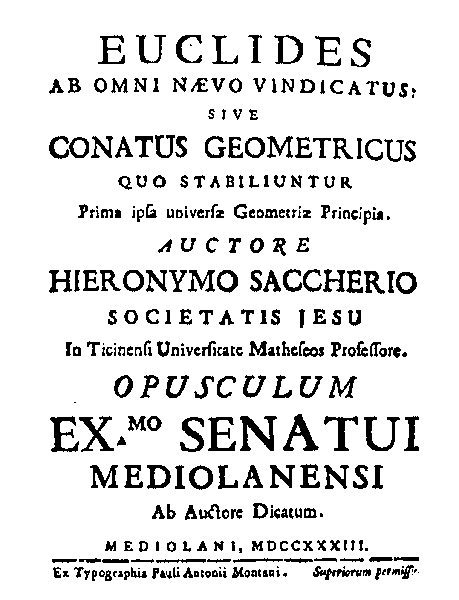
然而,Saccheri今天之所以被人们铭记,主要原因在于另一部作品,这部作品在首次出版150年后才被贝尔特拉米重新发现。在1733年出版的Euclides ab Omni Naevo VindicatusⓉ(欧几里得清除了所有缺陷)中,他在non-euclidean geometry方面做了重要的早期工作,尽管他本人并不这么认为,而是试图证明欧几里得的平行公设。这部作品同样献给米兰元老院,在许多方面可以看作遵循了他在Logica demonstrativaⓉ(逻辑论证)中引入的逻辑方法。目前尚不清楚Saccheri是否知道奥马尔·海亚姆的Discussion of Difficulties in Euclid ,或者他的方法是否完全创新。他肯定知道约翰·沃利斯和纳西尔丁·图西关于平行公设的工作,因为他在书中对两者都进行了批评。他是否知道奥马尔·海亚姆的见解并不重要,因为Saccheri的工作无疑是一部杰作。让我们看看他是如何处理平行公设问题的。
Saccheri取一条线段,比如,带有两条相等的线段和,每条都垂直于。连接得到一个四边形。Saccheri知道,如果他能不使用平行公设证明和处的角是直角,那么他就可以从其他公理推导出平行公设。他很容易证明和处的角相等,但证明它们是直角却一点也不容易。Saccheri随后采用了他著名的方法:他假设和处的角不是直角。他现在的目标是,使用欧几里得除平行公设以外的所有公理,得出矛盾。然后他有两种情况需要考虑:要么和处的两个相等角小于直角,要么它们大于直角。
对于第二种情况,Saccheri能够相当快地处理掉,尽管他用了13个命题。熟悉非欧几何基础的读者可能会对这句话感到相当困惑,因为他们知道有些几何中三角形的内角和大于两个直角,这使得Saccheri四边形中的两个角都可能大于直角。然而,必须认识到欧几里得做出的假设比他写下的五条公理更多。欧几里得还假设了阿基米德性质,即如果以给定长度足够多次地延长一条线段,它将超过任何给定长度;他还假设每条直线都是无界的、无限的,并将平面分成两部分。Saccheri充分理解欧几里得的这些额外假设,他也做出了这些假设以及欧几里得的前四条公理。正是这些额外假设使他能够处理钝角假设,因为有了这个假设,他能够证明直线具有有限长度。
Next Saccheri假设他的四边形中的两个相等角都小于直角。在这种情况下,经过另外20个命题后,他无法得到任何矛盾,并发展出了许多非欧几何的定理。正如Corrado Segre所写:-
尽管如此,前七十页(除了少数孤立的短语外),直到命题32为止,构成了一个逻辑与几何洞察力的整体,堪称完美。
对于Saccheri工作的建设性部分,即前七十页,直到命题32,所有鉴赏家都热情地表达了他们的钦佩,对其优雅、精致艺术性的喜悦。
Saccheri在这七十页中证明了许多定理。例如,让我们引用三个:-
如果一个三角形的角和等于、大于或小于两个直角,那么每个三角形也是如此。
根据半圆内接角是直角、钝角或锐角,直角、钝角或锐角假设成立
在直角假设下,两条不同的直线相交,除非在一条截线以相等的对应角切割它们的情况下。在钝角假设下,两条直线总是相交。在锐角假设下,通过给定点且不在给定直线上的无限多条直线不与给定直线相交。
现在,Saccheri最终确信自己找到了他所寻找的矛盾,以排除三角形角和小于两个直角的情况。他相当无力地写道:-
锐角的假设是绝对错误的;因为它与直线的本性相悖。
然而,他对这第二种情形并不满意,从他随后所写的内容可以明显看出:-
在此考虑上述对两个假设的反驳之间的一个显著差异是恰当的。因为就钝角假设而言,事情比正午的阳光还要清楚。……但相反,如果不事先证明这样一条直线——其所有点与同它共面的某条给定直线等距——等于这条给定直线,我就无法证明另一个假设即锐角假设的虚假性。
事实上,Euclides ab Omni Naevo Vindicatus Ⓣ(欧几里得已清除一切缺陷)分为两部分,第一部分由39个命题组成,包含我们刚刚描述的材料。该著作的第二部分为欧几里得在The Elements第五卷中对比例的处理进行辩护。关于这第二部分,G·B·豪斯泰德写道[11]:-
它再次显示了Saccheri的智慧、洞察力和现代性。
正如我们上面所写,1697年之后,Saccheri在帕维亚度过了余生。然而,也有人试图引诱他去其他大学担任讲席。1713年,萨伏依公爵维克托·阿玛迪乌斯二世试图通过提供都灵数学讲席将他召回都灵。Saccheri选择不回去。还有一个似乎不太可能真实的故事,说维克托·阿玛迪乌斯二世提出,如果Saccheri回到都灵,就给他一个主教职位。这似乎不真实,但这个故事很可能是因为维克托·阿玛迪乌斯二世如此渴望再次得到Saccheri的协助而产生的。可以肯定的是,Saccheri曾被提供帕多瓦大学(威尼斯共和国大学)的数学讲席,该讲席在近一个世纪前曾由伽利略担任。这是一个有声望的讲席,但Saccheri再次选择留在帕维亚。然而,他是米兰的Academia Claelia Vigilantium的成员,并在大学假期前往米兰,在Colleggio di Nobili度过时光。
Euclides ab Omni Naevo Vindicatus Ⓣ(欧几里得清除了所有缺陷)的出版只能在宗教裁判所批准之后进行,它于1733年7月13日获得了批准。该著作随后于1733年8月16日转交耶稣会省分会以获得他们的批准。Saccheri两个月后在米兰去世,直到170年后该著作的意义才被认识到。公平地说,罗巴切夫斯基和鲍耶对非欧几何的发现并非归功于Saccheri的这部杰作。两人似乎都从未听说过他。
Giovanni Saccheri's father, Giovanni Felice Saccheri, was a lawyer. As a child Saccheri 'was notably precocious'. He entered the Jesuit Order at Genoa on 24 March 1685 so entering an Order highly involved in higher education. In 1554 the Company of Jesus of Genoa had begun taking an interest in higher education and had founded its own college. The building in which Saccheri studied was designed by Bartolomeo Bianco and built around 1640; today it is called the Palazzo Balbi and forms the main building of the University of Genoa. For the first two years he was totally taken up with his studies, but from 1687 onwards he began teaching at the College as well as studying philosophy and theology. In 1690 the Superiors of the Company of Jesus sent him to the Collegio di Brera in Milan. This College was founded by the Jesuits in 1571, designed by Martino Bassi and continued by Francesco Maria Ricchini. The Jesuits made the College into a school of higher education able to award doctorates. It received a papal bull in 1572 from Pope Gregory XIII. The topics taught there were Holy Scripture, Scholastic theology, mathematics, philosophy, Greek, Hebrew, the humanities, rhetoric and grammar.
In this Jesuit College Saccheri taught grammar and studied philosophy and theology. It was while he was studying in Brera College that he was encouraged to take up mathematics by one of his teachers Tommaso Ceva who suggested that he read Christopher Clavius's edition of Euclid's Elements. There were two Ceva brothers who had both been educated at the Brera College in Milan. Tommaso had remained at the College and taught there for forty years, while his brother Giovanni Ceva had been appointed as mathematician to the Duchy of Mantua in 1684. Both exerted a major influence on Saccheri, Tommaso through personal contacts at Brera College and Giovanni through correspondence. Mathematics played an important part in the lives of both Ceva brothers, and they soon imparted this enthusiasm to Saccheri. Perhaps Giovanni Ceva had the greatest mathematical influence for his passion for geometry, seen in his book De lineis rectis Ⓣ (1678), encouraged Saccheri to work in this area. It was through the influence of Giovanni Ceva that Saccheri published his first mathematical work Quaesita geometrica Ⓣ (1693), although the book was also written with considerable advice and help from Tommaso Ceva. In this book, which Saccheri dedicated to Guzman who was the governor of Milan, he solved many problems in elementary geometry. It was not a particularly significant work but showed that Saccheri was becoming deeply involved in thinking about Euclidean geometry. We should also mention at this point that Tommaso Ceva also encouraged Saccheri to correspond with the mathematician Vincenzo Viviani who worked in Florence.
Saccheri was ordained a priest in March 1694 at Como and then later in the year he was sent by the Superiors of the Jesuit Order to teach philosophy at the Jesuit College in Turin. This College, built by Guarini in 1679, operated until 1759 when it was handed over to the Academy of Sciences. While at the College, Saccheri made the acquaintance of Victor Amadeus II, the Duke of Savoy who played a major role in diplomacy that eventually led to the creation of the Italian State. The Duke often called on him when needing someone to undertake hard mathematical calculations. Saccheri taught at the College in Turin from 1694 to 1697, three important years for they led to the publication of Logica demonstrativa Ⓣ (1697). The work was dedicated to Count Filippo Archintio, who was on the Senate of Milan. Alberto Pascal writes [13]:-
Fruit of these three years of philosophic teaching was a little book which well merits to be better known: perhaps its extreme rarity has contributed to this oblivion, even since Giovanni Vailati, in 1903, brought to light its superlative merit.
In fact the first edition of the work does not seem to be written by Saccheri since it appears under the name of Count Gravere who was Saccheri's student. When Count Gravere's theses were examined and published, Saccheri took the opportunity to publish the course on logic that he had been delivering at the College in Turin. However he seemed happy to let it appear as if was, like the theses, written by Count Gravere. Only one copy of this work has survived on which it is written "Author Father Hyeronymo Saccherio Societatis Jesu." George Halsted writes [11]:-
Saccheri, astute and prudent, had his reasons for issuing this three-year child of his genius under the count's cloak. Then as professor he changed subjects and residence, and only four years afterward did the book appear with his name. The first issue Saccheri never mentions. The second edition, so called, he refers to repeatedly and insistently. It differs from the first by some suppressions, especially in the preface, but no thought has been added during these four years of waiting.
The aim of this work is to study definitions. Saccheri distinguishes between two different types of definitions: the first he calls 'definitiones quid nominis' or 'nomindes' which are only intended to give the meaning of the term being defined; the second he calls 'definitiones quid rei' or 'reales' which in addition to giving the meaning of the term also claims that the concept being defined actually exists. For example we could define the mid-point of a line segment as the point which divides the segment into two equal segments. This would be a definition of the second type, namely one where we also know that the mid-point so defined could be constructed. Of course if this definition were made before a method of construction were known, then it would be a 'nomindes' which would become a 'reales' after the construction was given. Saccheri make it clear that Euclid understood this distinction for in Book I of The Elements he defines a square, but he does not assume its existence until after he has given a proof. However, Saccheri warns that other authors have not fully appreciated the distinction and have been led to false proofs by giving a definition which they assume to exist when in actual fact it is impossible. Vailati, who rediscovered this work in 1903, writes:-
This gives him [Saccheri] the right to an eminent place in the history of modern logic.
How high the merit of having been far the first to envisage this difficult matter and to have proffered an analysis of the various forms of fallacy to which its non-recognition may give rise!
In 1697, the year that Logica demonstrativa Ⓣ was first published, Saccheri was sent to the Jesuit College of Pavia to teach philosophy and theology. He taught at the College in Pavia until his death, but he also held the chair of mathematics at the University of Pavia from 1699 until his death. We note that Pavia was known as Ticinum in Roman times and the university, founded in 1361, was also called the Università Ticinese. The residencies named Collegio Borromeo and Collegio Ghislieri were built in the 16th century. This university appointment was by the Senate of Milan so perhaps dedicating Logica demonstrativa Ⓣ to Count Filippo Archintio on the Senate had been a good move. In recognition of his appreciation of the appointment by the Senate of Milan, Saccheri dedicated his next work Neo-statica Ⓣ, published in 1708, to them. It is a work on statics of relatively little importance.
However, the main reason that Saccheri is remembered today is because of another work which was only rediscovered by Eugenio Beltrami 150 years after its first publication. In Euclides ab Omni Naevo Vindicatus Ⓣ, published in 1733, he did important early work on non-euclidean geometry, although he did not see it as such, rather an attempt to prove the parallel postulate of Euclid. This work, also dedicated to the Senate of Milan, can in many ways be seen as following the logical methods which he had introduced in Logica demonstrativa Ⓣ. It is unclear whether Saccheri was aware of Omar Khayyam's Discussion of Difficulties in Euclid or whether his approach was totally innovative. He was certainly aware of the work of John Wallis and Nasir al-Din al-Tusi on the Parallel Postulate since he criticises both in his book. It matters little whether he was aware of Omar Khayyam's insights, for Saccheri's work is certainly a masterpiece. Let us look at how he approached the question of the Parallel Postulate.
Saccheri took a line segment, say , with two equal segments and each perpendicular to . Join to obtain a quadrilateral. Saccheri knew that if he could prove that the angles at and were right angles without using the Parallel Postulate, then he could deduce the Parallel Postulate from the other axioms. He was easily able to prove that the angles at and were equal but proving that they were right angles was not at all easy. Saccheri then adopted his famous approach: he assumed that the angles at and were not right angles. His aim now was, working with all of Euclid's axioms except the Parallel Postulate, to obtain a contradiction. He had then two cases to consider: either the two equal angles at and were less than right angles or, alternatively, they were greater than right angles.
The second of these alternatives Saccheri was able to dispose of fairly quickly although it took him 13 propositions. Readers who are familiar with the basics of non-Euclidean geometry may be rather puzzled by this statement for they will know of geometries in which the angles in a triangle add to more than two right angles, making it possible for the two angles in Saccheri's quadrilateral each to be greater than a right angle. However, one has to realise that Euclid made more assumptions than the five axioms that he wrote down. Euclid had also assumed the Archimedean property, namely that if one extends a line segment by a given length sufficiently often it will exceed any given length, he had also assumed that every straight line is unbounded, is infinite, and divides the plane into two parts. Saccheri well understood these extra assumptions of Euclid, and he too made these assumptions as well as the first four of Euclid's axioms. It was these extra assumptions which allowed him to dispose of the obtuse angle hypothesis, for with this assumption he was able to show that straight lines were of finite length.
Next Saccheri assumed that the two equal angles in his quadrilateral were each less than a right angle. In this case, after 20 more propositions he was unable to obtain any contradiction and he developed many theorems of non-Euclidean geometry. As Corrado Segre wrote:-
Nevertheless the first seventy pages (apart from a few isolated phrases), up to Proposition 32 inclusive, constitute an ensemble of logic and of geometric acumen which may be called perfect.
For the constructive part of Saccheri's work, the first seventy pages, through Proposition 32, all connoisseurs have enthusiastically expressed their admiration, their delight in its elegance, its exquisite artistic finish.
Saccheri proved many theorems in these seventy pages. For example, let us quote three:-
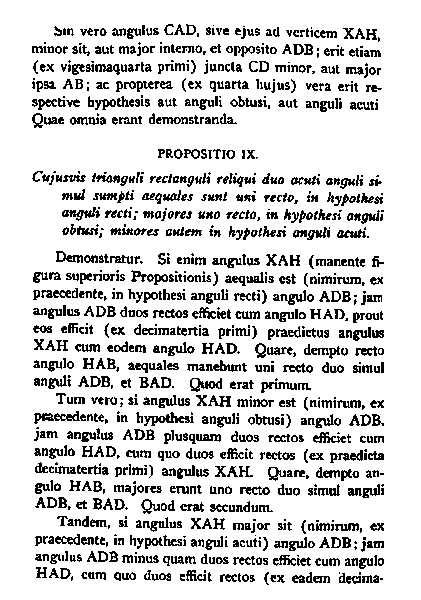
If the angle-sum in one triangle be equal to, greater than, or less than two right angles, so will it be in every triangle.
According as an angle inscribed in a semicircle is right, obtuse or acute, the hypothesis of right, obtuse or acute angle is true
With the hypothesis of the right angle, two distinct straight lines intersect, except in the one case in which a transversal cuts them under equal corresponding angles. With the hypothesis of the obtuse angle, two straight lines always intersect. With the hypothesis of the acute angle there are infinitely many straight lines through a given point not on the given straight line, which do not meet the given straight line.
Now eventually Saccheri convinced himself that he had the contradiction that he was looking for to rule out the case that in a triangle the sum of the angles are less than two right angles. He wrote, rather weakly, that:-
... the hypothesis of the acute angle is absolutely false; because it is repugnant to the nature of straight lines.
However, he was not satisfied with this second case as is evident by what he then wrote:-
It is well to consider here a notable difference between the foregoing refutations of the two hypotheses. For in regard to the hypothesis of the obtuse angle the thing is clearer than midday light. ... But on the contrary, I do not attain to proving the falsity of the other hypothesis, that of the acute angle, without previously proving that the line, all of whose points are equidistant from an assumed straight line lying in the same plane with it, is equal to this straight line.
In fact Euclides ab Omni Naevo Vindicatus Ⓣ is in two parts, the first part consisting of 39 propositions, contains the material we have just described. The second part of the work defends Euclid's treatment of proportion in Book V of The Elements. Of this second part, Halsted writes [11]:-
It shows again Saccheri's wisdom, penetration and modernity.
As we wrote above, after 1697 Saccheri worked in Pavia for the rest of his life. However, there were attempts to tempt him to chairs at other universities. In 1713 Victor Amadeus II, the Duke of Savoy, tried to bring him back to Turin by offering him the chair of mathematics there. Saccheri chose not to return. There is another story, which seems unlikely to be true, that Victor Amadeus II offered Saccheri a bishopric if he would return to Turin. This seems untrue but the story may well have arisen because Victor Amadeus II was so keen to again have Saccheri's assistance. What is certainly true is that Saccheri was offered the chair of mathematics at the University of Padua (the university of the Republic of Venice) that had been filled by Galileo almost a century earlier. This was a prestigious chair, but again Saccheri chose to remain in Pavia. However, he was a member of the Academia Claelia Vigilantium in Milan and went to Milan in university vacations to spend time at the Colleggio di Nobili.
Publication of Euclides ab Omni Naevo Vindicatus Ⓣ could only take place after approval by the Inquisition and it received this on 13 July 1733. The work then passed to the Provincial Company of Jesus on 16 August 1733 for their approval. Saccheri died in Milan two months later and only 170 years later was the significance of the work realised. It is fair to say that the discovery of non-Euclidean geometry by Nikolai Lobachevsky and János Bolyai was not due to this masterpiece by Saccheri. Neither seems to have ever heard of him.
正文里的方括号编号指向这里,悬停即可直接看到条目。书目保留原文——译了书名反而查不到文献。
原站列出的延伸阅读与外部数据库,照原样保留,目标多为英文页面。
关于Giovanni Girolamo Saccheri的其它页面:
关于Giovanni Girolamo Saccheri的其它网站:
原站的交叉引用。指向本站已镜像专题的留在站内,其余仍指回原站。