数学家传记
朱塞佩·皮亚诺是符号逻辑的创始人,他的兴趣集中在数学基础以及形式逻辑语言的发展上。
朱塞佩·皮亚诺的父母在农场工作,皮亚诺出生在距离库内奥约5公里的农舍“Tetto Galant”。他在Spinetta的村校上学,然后升入库内奥的学校,每天步行5公里往返。他的父母在库内奥买了一栋房子,但他的父亲在皮亚诺的一个兄弟和一个姐妹的帮助下继续在Tetto Galant的田地里劳作,而他的母亲则留在库内奥,与皮亚诺和他的哥哥在一起。
皮亚诺的母亲有一个兄弟,是都灵的一位神父兼律师。当他意识到皮亚诺是一个非常有天赋的孩子时,便在1870年带他到都灵接受中学教育,并为他进入大学学习做准备。皮亚诺于1873年在Ginnasio Cavour参加考试,随后成为Liceo Cavour的学生,并于1876年从那里毕业。同年,他进入了都灵大学。
皮亚诺在Turin大学第一年的老师是恩里科·多维迪奥,教他解析几何和代数。第二年,安吉洛·杰诺其教他微积分,Giuseppe Bruno教他画法几何。皮亚诺在第三年继续学习纯数学,并发现他是唯一这样做的人。其他人都在工程学院继续学业,而皮亚诺本人最初也打算这样做。在第三年,弗朗切斯科·法阿·迪布鲁诺教他分析,恩里科·多维迪奥教他几何。最后一年,他的老师中再次有恩里科·多维迪奥教授进一步的几何课程,以及Francesco Siacci教授力学课程。1880年9月29日,皮亚诺获得数学博士学位。
皮亚诺于1880年加入都灵大学教职,被任命为恩里科·多维迪奥的助手。他在1880年发表了他的第一篇数学论文,次年又发表了另外三篇论文。皮亚诺被任命为安吉洛·杰诺其1881-82年度的助手,正是在1882年,皮亚诺做出了一项将在此后多年成为其典型风格的发现,他发现了一个标准定义中的错误。
此时安吉洛·杰诺其已相当年迈,健康状况也较差,皮亚诺接替了他的一部分教学工作。皮亚诺正要给学生讲授曲面面积,这时他意识到约瑟夫·阿尔弗雷德·塞雷书中的定义——那是该课程的标准教材——是错误的。皮亚诺立即将自己的发现告诉了安吉洛·杰诺其,却被告知安吉洛·杰诺其早已知道此事。安吉洛·杰诺其在前一年已由赫尔曼·阿曼杜斯·施瓦茨告知,后者似乎是最早发现约瑟夫·阿尔弗雷德·塞雷这一错误的人。
1884年出版了一部基于安吉洛·杰诺其在都灵讲座的文本。这本书Course in Infinitesimal Calculus虽然基于安吉洛·杰诺其的讲座,却由皮亚诺编辑,而且其中确实有很多内容是皮亚诺本人撰写的。该书本身在扉页上写明它是:-
……由皮亚诺博士增补出版。
安吉洛·杰诺其似乎对这部作品以他的名义出版有些不满,因为他写道:-
……该卷包含重要的增补、一些修改以及各种注释,这些放在最前面。为了不把不属于我的东西归到我名下,我必须声明,我完全没有参与上述这本书的编纂,一切都归功于那位杰出的年轻人皮亚诺博士……
皮亚诺于1884年12月获得大学授课资格,并继续教授更多课程,其中一些是为安吉洛·杰诺其代课,因为后者的健康尚未完全恢复,无法返回大学。
1886年,皮亚诺证明了如果连续,则一阶微分方程有解。在关于的更强假设下解的存在性此前已由奥古斯丁·路易·柯西给出,随后又由鲁道夫·利普希茨给出。四年后,皮亚诺表明这些解并不唯一,并以微分方程为例,其中。
除了在都灵大学的教学工作外,皮亚诺于1886年开始在都灵军事学院授课。次年,他发现并发表了一种用逐次逼近法求解线性微分方程组的方法。然而埃米尔·皮卡独立发现了这一方法,并将首先发现该方法的功劳归于赫尔曼·阿曼杜斯·施瓦茨。1888年,皮亚诺出版了Geometrical Calculus一书,该书以一章数学逻辑开篇。这是他在此后数年中将在其研究中扮演重要角色的这一主题上的第一部作品,它以恩斯特·施勒德、乔治·布尔和查尔斯·桑德斯·皮尔士的工作为基础。该书一个更为重要的特点是,皮亚诺在其中极为清晰地阐述了赫尔曼·格拉斯曼的思想,而这些思想在赫尔曼·格拉斯曼本人那里确实是以相当晦涩的方式表述的。这本书包含了第一个以极其现代的记号与风格给出的向量空间定义,尽管当时并未得到许多人的赏识,但这无疑是皮亚诺一项相当了不起的成就。
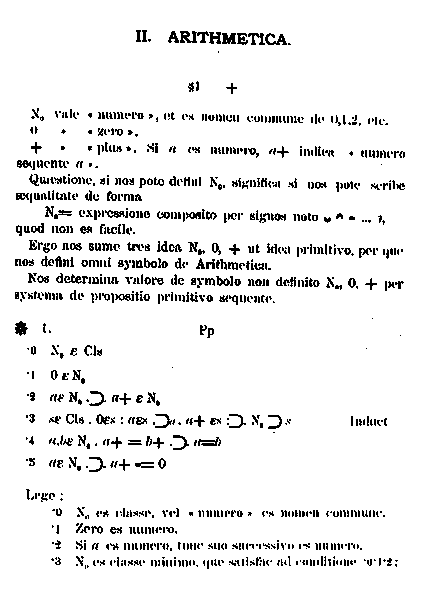
1889年,皮亚诺发表了他著名的公理,称为皮亚诺公理,这些公理用集合定义了自然数。它们发表在一本小册子Arithmetices principia, nova methodo expositaⓉ(《算术原理与新方法的解释》)中,据[5]称,这本小册子:-
……立刻成为数理逻辑和数学基础史上的一个里程碑。
这本小册子是用拉丁文写的,除了[5]之外,没有人能给出一个充分的理由:-
……这似乎是一种纯粹的浪漫主义行为,也许是他科学生涯中唯一的浪漫之举。
皮亚诺公理列于THIS LINK。
安吉洛·杰诺其于1889年去世,皮亚诺期望被任命填补他的讲席。他写信给Casorati,他相信后者是任命委员会的一员,只为获取信息,却发现由于难以找到足够的成员来组成委员会而出现了延迟。曾与Casorati接触过,但他的健康状况不允许他承担这项任务。在任命得以做出之前,皮亚诺发表了另一个惊人的结果。
他在1890年发明了“空间填充”曲线,这些是从[0,1]到单位正方形的连续满射映射。大卫·希尔伯特在1891年描述了类似的空间填充曲线。人们曾认为这样的曲线不可能存在。格奥尔格·康托尔已经证明区间[0,1]与单位正方形之间存在双射,但不久之后,欧根·尼托证明了这样的双射不可能是连续的。
你可以在THIS LINK看到这条曲线构造的一些阶段。
皮亚诺的连续空间填充曲线当然不可能是1-1的,否则就会与欧根·尼托的定理相矛盾。费利克斯·豪斯多夫在1914年的Grundzüge der Mengenlehre Ⓣ(一般集合论)中写到了皮亚诺的结果:-
这是集合论中最引人注目的事实之一。
1890年12月,经过通常的竞争,皮亚诺获得了职位,皮亚诺等待被任命为安吉洛·杰诺其讲席的时期结束了。1891年,皮亚诺创办了Rivista di matematica,一份主要致力于逻辑和数学基础的期刊。第一部分的第一篇论文是皮亚诺的一篇十页文章,总结了他到那时为止在数理逻辑方面的工作。
皮亚诺非常擅长通过找出例外来发现定理不正确。其他人并不那么乐意这些错误被指出,其中一位就是他的同事Corrado Segre。当Corrado Segre向Rivista di matematica提交一篇文章时,皮亚诺指出文章中的一些定理有例外。Segre不准备仅仅通过添加排除例外的条件来修正定理,而是为自己的工作辩护说,发现的时刻比严格的表述更重要。当然,这与皮亚诺对数学的严格方法如此相悖,以至于他强烈地争辩道:-
我相信,作者们在研究中明知故犯地使用已知有例外、或他们无法证明的命题,这在数学史上是新的……
不仅仅是Corrado Segre遭受了皮亚诺发现缺乏严谨性的杰出能力。当然,正是他思维的精确性,运用他数理逻辑的精确性,赋予了皮亚诺这种思想的清晰性。皮亚诺在1892年指出了Hermann Laurent证明中的一个错误,并在同一年评论了朱塞佩·韦罗内塞的一本书,以这样的评论结束了评论:-
我们可以继续长篇列举作者堆砌的荒谬之处。但这些错误,以及全书缺乏精确性和严谨性,使其毫无价值。
大约从1892年起,皮亚诺开始了一个新的、极其宏大的计划,即Formulario Mathematico。他在Rivista di matematica1892年3月的那部分中解释了他的想法:-
最有用的将是出版汇集所有目前已知的、涉及数学科学特定分支的定理的文集……这样的文集,用普通语言表述会冗长而困难,但使用数学逻辑的符号则明显容易得多……
在许多方面,这个宏大的想法标志着皮亚诺非凡创造性工作的终结。这是一个受到少数人热情欢迎、大多数人却兴趣寥寥的计划。皮亚诺开始试图让周围所有人相信这个计划的重要性,结果却惹恼了他们。然而,皮亚诺和他的亲密伙伴,包括他的助手乔瓦尼·瓦伊拉蒂、切萨雷·布拉利-福尔蒂、玛利欧·派埃利和基诺·法诺,很快就深入参与了这项工作。
在描述1896年新版Formulario Mathematico时,皮亚诺写道:-
每位教授都可以采用这部Formulario作为教科书,因为它应当包含所有定理和所有方法。他的教学将简化为展示如何阅读公式,并向学生指出他希望在本课程中讲解的定理。
当Formulario的微积分卷出版时,皮亚诺正如他所指出的那样,开始将其用于教学。这就是人们预料中的灾难。皮亚诺在开始教学生涯时是一位好老师,但他的教学风格却变得让他的学生和同事都无法接受。他的一位学生,实际上是皮亚诺的忠实崇拜者,写道:-
但我们学生知道,这种讲授超出了我们的理解能力。我们明白,这种对概念的微妙分析,对其他作者所用定义的细致批评,不适合初学者,尤其对工科学生没有用处。我们不喜欢把时间和精力花在那些以后可能永远不会用到的“符号”上。
军事学院于1901年终止了他在那里任教的合同,尽管他在大学的许多同事也希望停止他在那里的教学,但按照大学的体制,这是不可能的。教授在自己的学科领域内不受约束,当同事们试图鼓励皮亚诺回到他旧日的教学风格时,他不准备听取他们的意见。Formulario Mathematico项目于1908年完成,人们不得不钦佩皮亚诺所取得的成就,尽管这部著作包含了丰富的信息,却很少被使用。
然而,也许皮亚诺最大的胜利是在1900年。那一年在巴黎举行了两个大会。第一个是国际哲学大会,于8月1日在巴黎开幕。这对皮亚诺来说是一次胜利,出席大会的伯特兰·罗素在自传中写道:-
这次大会是我智力生活的转折点,因为在那里我遇到了皮亚诺。我已经知道他的名字,也看过他的一些工作,但没有费心去掌握他的符号。在大会的讨论中,我观察到他总是比任何人都更精确,而且他在所参与的任何争论中总是占上风。随着日子一天天过去,我断定这一定归功于他的数学逻辑。……我清楚地认识到,他的符号提供了一种逻辑分析工具,正是我多年来一直在寻找的……
哲学大会结束后的第二天,第二届国际数学家大会开幕。皮亚诺留在巴黎参加这次大会,并听取了大卫·希尔伯特的演讲,其中列出了他论文中23个问题中的10个,旨在给出下个世纪的议程。皮亚诺对第二个问题特别感兴趣,该问题问的是算术公理能否被证明是一致的。
甚至在Formulario Mathematico项目完成之前,皮亚诺就已经在着手安排他一生中的下一个重大项目。1903年,皮亚诺表示有兴趣寻找一种通用语言,即国际语言,并提出了一种人造语言“Latino sine flexione”,它以拉丁语为基础,但去掉了所有语法。他通过从英语、法语、德语和拉丁语中取词来编纂词汇。事实上,Formulario Mathematico的最终版本就是用Latino sine flexione写成的,这也是该著作如此少被使用的另一个原因。
因此,皮亚诺的生涯相当奇怪地分为两个时期。到1900年为止的时期,是他表现出巨大原创性和对数学发展中将会重要的主题具有非凡感觉的时期。他的成就是杰出的,而且他有一种在他自己的时代显得很不合时宜的现代风格。然而,这种对什么重要的感觉似乎离开了他,1900年之后,他以极大的热情从事两个极其困难的项目,这些项目是巨大的工程,却被证明在数学发展中相当不重要。
关于他的个性,Kennedy在5中写道:-
……我被他温和的个性、吸引终生追随者的能力、对人类弱点的宽容以及他持久的乐观精神所吸引。……皮亚诺不仅可被归类为19世纪的数学家和逻辑学家,而且由于他的独创性和影响力,必须被评判为该世纪伟大的科学家之一。
皮亚诺是数理逻辑的创始人,德国数学哲学家戈特洛布·弗雷格今天被认为是数理逻辑之父。
Giuseppe Peano's parents worked on a farm and Giuseppe was born in the farmhouse 'Tetto Galant' about 5 km from Cuneo. He attended the village school in Spinetta then he moved up to the school in Cuneo, making the 5km journey there and back on foot every day. His parents bought a house in Cuneo but his father continued to work the fields at Tetto Galant with the help of a brother and sister of Giuseppe, while his mother stayed in Cuneo with Giuseppe and his older brother.
Giuseppe's mother had a brother who was a priest and lawyer in Turin and, when he realised that Giuseppe was a very talented child, he took him to Turin in 1870 for his secondary schooling and to prepare him for university studies. Giuseppe took exams at Ginnasio Cavour in 1873 and then was a pupil at Liceo Cavour from where he graduated in 1876 and, in that year, he entered the University of Turin.
Among Peano's teachers in his first year at the University of Turin was D'Ovidio who taught him analytic geometry and algebra. In his second year he was taught calculus by Angelo Genocchi and descriptive geometry by Giuseppe Bruno. Peano continued to study pure mathematics in his third year and found that he was the only student to do so. The others had continued their studies at the Engineering School which Peano himself had originally intended to do. In his third year Francesco Faà di Bruno taught him analysis and D'Ovidio taught geometry. Among his teachers in his final year were again D'Ovidio with a further geometry course and Francesco Siacci with a mechanics course. On 29 September 1880 Peano graduated as doctor of mathematics.
Peano joined the staff at the University of Turin in 1880, being appointed as assistant to D'Ovidio. He published his first mathematical paper in 1880 and a further three papers the following year. Peano was appointed assistant to Genocchi for 1881-82 and it was in 1882 that Peano made a discovery that would be typical of his style for many years, he discovered an error in a standard definition.
Genocchi was by this time quite old and in relatively poor health and Peano took over some of his teaching. Peano was about to teach the students about the area of a curved surface when he realised that the definition in Serret's book, which was the standard text for the course, was incorrect. Peano immediately told Genocchi of his discovery to be told that Genocchi already knew. Genocchi had been informed the previous year by Schwarz who seems to have been the first to find Serret's error.
In 1884 there was published a text based on Genocchi's lectures at Turin. This book Course in Infinitesimal Calculus although based on Genocchi's lectures was edited by Peano and indeed it has much in it written by Peano himself. The book itself states on the title page that it is:-
... published with additions by Dr Giuseppe Peano.
Genocchi seemed somewhat unhappy that the work came out under his name for he wrote:-
... the volume contains important additions, some modifications, and various annotations, which are placed first. So that nothing will be attributed to me which is not mine, I must declare that I have had no part in the compilation of the aforementioned book and that everything is due to that outstanding young man Dr Giuseppe Peano ...
Peano received his qualification to be a university professor in December 1884 and he continued to teach further courses, some for Genocchi whose health had not recovered sufficiently to allow him to return to the University.
In 1886 Peano proved that if is continuous then the first order differential equation has a solution. The existence of solutions with stronger hypothesis on had been given earlier by Cauchy and then Lipschitz. Four years later Peano showed that the solutions were not unique, giving as an example the differential equation , with .
In addition to his teaching at the University of Turin, Peano began lecturing at the Military Academy in Turin in 1886. The following year he discovered, and published, a method for solving systems of linear differential equations using successive approximations. However Émile Picard had independently discovered this method and had credited Schwarz with discovering the method first. In 1888 Peano published the book Geometrical Calculus which begins with a chapter on mathematical logic. This was his first work on the topic that would play a major role in his research over the next few years and it was based on the work of Schröder, Boole and Charles Peirce. A more significant feature of the book is that in it Peano sets out with great clarity the ideas of Grassmann which certainly were set out in a rather obscure way by Grassmann himself. This book contains the first definition of a vector space given with a remarkably modern notation and style and, although it was not appreciated by many at the time, this is surely a quite remarkable achievement by Peano.
In 1889 Peano published his famous axioms, called Peano axioms, which defined the natural numbers in terms of sets. These were published in a pamphlet Arithmetices principia, nova methodo exposita Ⓣ which, according to [5] were:-
... at once a landmark in the history of mathematical logic and of the foundations of mathematics.
The pamphlet was written in Latin and nobody has been able to give a good reason for this, other than [5]:-
... it appears to be an act of sheer romanticism, perhaps the unique romantic act in his scientific career.
The Peano axioms are listed at THIS LINK.
Genocchi died in 1889 and Peano expected to be appointed to fill his chair. He wrote to Casorati, whom he believed to be part of the appointing committee, for information only to discover that there was a delay due to the difficulty of finding enough members to act on the committee. Casorati had been approached but his health was not up to the task. Before the appointment could be made Peano published another stunning result.
He invented 'space-filling' curves in 1890, these are continuous surjective mappings from [0,1] onto the unit square. Hilbert, in 1891, described similar space-filling curves. It had been thought that such curves could not exist. Cantor had shown that there is a bijection between the interval [0,1] and the unit square but, shortly after, Netto had proved that such a bijection cannot be continuous.
You can see some stages in the construction of this curve at THIS LINK.
Peano's continuous space-filling curves cannot be 1-1 of course, otherwise Netto's theorem would be contradicted. Hausdorff wrote of Peano's result in Grundzüge der Mengenlehre Ⓣ in 1914:-
This is one of the most remarkable facts of set theory.
In December 1890 Peano's wait to be appointed to Genocchi's chair was over when, after the usual competition, Peano was offered the post. In 1891 Peano founded Rivista di matematica, a journal devoted mainly to logic and the foundations of mathematics. The first paper in the first part is a ten page article by Peano summarising his work on mathematical logic up to that time.
Peano had a great skill in seeing that theorems were incorrect by spotting exceptions. Others were not so happy to have these errors pointed out and one such was his colleague Corrado Segre. When Corrado Segre submitted an article to Rivista di matematica Peano pointed out that some of the theorems in the article had exceptions.Segre was not prepared to just correct the theorems by adding conditions that ruled out the exceptions but defended his work saying that the moment of discovery was more important than a rigorous formulation. Of course this was so against Peano's rigorous approach to mathematics that he argued strongly:-
I believe it new in the history of mathematics that authors knowingly use in their research propositions for which exceptions are known, or for which they have no proof...
It was not only Corrado Segre who suffered from Peano's outstanding ability to spot lack of rigour. Of course it was the precision of his thinking, using the exactness of his mathematical logic, that gave Peano this clarity of thought. Peano pointed out an error in a proof by Hermann Laurent in 1892 and, in the same year, reviewed a book by Veronese ending the review with the comment:-
We could continue at length enumerating the absurdities that the author has piled up. But these errors, the lack of precision and rigour throughout the book take all value away from it.
From around 1892, Peano embarked on a new and extremely ambitious project, namely the Formulario Mathematico. He explained in the March 1892 part of Rivista di matematica his thinking:-
Of the greatest usefulness would be the publication of collections of all the theorems now known that refer to given branches of the mathematical sciences ... Such a collection, which would be long and difficult in ordinary language, is made noticeably easier by using the notation of mathematical logic ...
In many ways this grand idea marks the end of Peano's extraordinary creative work. It was a project that was greeted with enthusiasm by a few and with little interest by most. Peano began trying to convert all those around him to believe in the importance of this project and this had the effect of annoying them. However Peano and his close associates, including his assistants, Vailati, Burali-Forti, Pieri and Fano soon became deeply involved with the work.
When describing a new edition of the Formulario Mathematico in 1896 Peano writes:-
Each professor will be able to adopt this Formulario as a textbook, for it ought to contain all theorems and all methods. His teaching will be reduced to showing how to read the formulas, and to indicating to the students the theorems that he wishes to explain in his course.
When the calculus volume of the Formulario was published Peano, as he had indicated, began to use it for his teaching. This was the disaster that one would expect. Peano, who was a good teacher when he began his lecturing career, became unacceptable to both his students and his colleagues by the style of his teaching. One of his students, who was actually a great admirer of Peano, wrote:-
But we students knew that this instruction was above our heads. We understood that such a subtle analysis of concepts, such a minute criticism of the definitions used by other authors, was not adapted for beginners, and especially was not useful for engineering students. We disliked having to give time and effort to the "symbols" that in later years we might never use.
The Military Academy ended his contract to teach there in 1901 and although many of his colleagues at the university would have also liked to stop his teaching there, nothing was possible under the way that the university was set up. The professor was a law unto himself in his own subject and Peano was not prepared to listen to his colleagues when they tried to encourage him to return to his old style of teaching. The Formulario Mathematico project was completed in 1908 and one has to admire what Peano achieved but although the work contained a mine of information it was little used.
However, perhaps Peano's greatest triumph came in 1900. In that year there were two congresses held in Paris. The first was the International Congress of Philosophy which opened in Paris on 1 August. It was a triumph for Peano and Russell, who attended the Congress, wrote in his autobiography:-
The Congress was the turning point of my intellectual life, because there I met Peano. I already knew him by name and had seen some of his work, but had not taken the trouble to master his notation. In discussions at the Congress I observed that he was always more precise than anyone else, and that he invariably got the better of any argument on which he embarked. As the days went by, I decided that this must be owing to his mathematical logic. ... It became clear to me that his notation afforded an instrument of logical analysis such as I had been seeking for years ...
The day after the Philosophy Congress ended the Second International Congress of Mathematicians began. Peano remained in Paris for this Congress and listened to Hilbert's talk setting out ten of the 23 problems which appeared in his paper aimed at giving the agenda for the next century. Peano was particularly interested in the second problem which asked if the axioms of arithmetic could be proved consistent.
Even before the Formulario Mathematico project was completed Peano was putting in place the next major project of his life. In 1903 Peano expressed interest in finding a universal, or international, language and proposed an artificial language "Latino sine flexione" based on Latin but stripped of all grammar. He compiled the vocabulary by taking words from English, French, German and Latin. In fact the final edition of the Formulario Mathematico was written in Latino sine flexione which is another reason the work was so little used.
Peano's career was therefore rather strangely divided into two periods. The period up to 1900 is one where he showed great originality and a remarkable feel for topics which would be important in the development of mathematics. His achievements were outstanding and he had a modern style quite out of place in his own time. However this feel for what was important seemed to leave him and after 1900 he worked with great enthusiasm on two projects of great difficulty which were enormous undertakings but proved quite unimportant in the development of mathematics.
Of his personality Kennedy writes in [5]:-
... I am fascinated by his gentle personality, his ability to attract lifelong disciples, his tolerance of human weakness, his perennial optimism. ... Peano may not only be classified as a 19th century mathematician and logician, but because of his originality and influence, must be judged one of the great scientists of that century.
Although Peano is a founder of mathematical logic, the German mathematical philosopher Gottlob Frege is today considered the father of mathematical logic.
正文里的方括号编号指向这里,悬停即可直接看到条目。书目保留原文——译了书名反而查不到文献。
原站列出的延伸阅读与外部数据库,照原样保留,目标多为英文页面。
关于朱塞佩·皮亚诺的其它页面:
原站的交叉引用。指向本站已镜像专题的留在站内,其余仍指回原站。