数学家传记
乔治·布尔以一种新方法研究逻辑,将其简化为一种简单的代数,把逻辑纳入数学。他还研究微分方程、有限差分微积分以及概率论中的一般方法。
乔治·布尔的父母是Mary Ann Joyce和John Boole。弗瑞兹·约翰做鞋,但他对科学感兴趣,尤其是数学在科学仪器上的应用。Mary Ann是一名女仆,她于1806年9月14日与约翰结婚。他们搬到林肯,约翰在银街34号开了一家鞋匠铺。这个家庭并不富裕,部分原因是约翰对科学和数学的热爱意味着他没有像他本可以做到的那样投入精力发展自己的生意。他们的第一个孩子布尔是在Mary Ann和约翰结婚九年后出生的。在那之后,他们几乎放弃了生孩子的希望,所以这是一个值得大大欢庆的时刻。布尔在出生后的第二天接受了洗礼,这表明他是一个虚弱的孩子,父母担心他可能活不下来。他以约翰的父亲命名,后者已于1815年4月去世。在接下来的五年里,Mary Ann和约翰又有了三个孩子:Mary Ann、William和Charles。
如果说布尔出生时是一个虚弱的孩子,他当然很快就变得强壮健康了。布尔还不到两岁时,首先进入林肯一所由两位Clarke小姐为商人子弟开办的学校。一年后,他去了John Boole的朋友Gibson先生开办的一所商业学校,在那里一直待到七岁。然而,他早期的数学教育来自他的父亲,父亲还让布尔喜欢上了制作光学仪器。七岁时,布尔进入一所小学,由Reeves先生任教。他的兴趣转向了语言,父亲安排他从当地一位书商那里接受拉丁语教育。
从一位家庭教师那里学会拉丁语后,布尔又自学了希腊语。到14岁时,他的希腊语已经非常熟练,以至于引发了一场争论。他翻译了希腊诗人Meleager的一首诗,他的父亲为此非常自豪,便将其出版。然而,他的才华如此出众,以至于当地一位校长质疑任何14岁的孩子都能写出如此有深度的作品。此时,布尔正在林肯的Bainbridge商业学院就读,他于1828年9月10日入学。这所学校并未提供他希望接受的那种教育,但这已是他的父母所能负担的全部。不过,他能够自学法语和德语,自行研习商业学校不涵盖的学科。
布尔没有攻读学位,但从16岁起,他就在唐卡斯特的海厄姆学校担任助理教师。这多少是强加给他的,因为他父亲的生意倒闭了,他发现自己不得不经济上支持父母、兄弟和姐妹。他保持着对语言的兴趣,开始认真学习数学,并放弃了进入教会的想法。他读的第一本高等数学书是西尔维斯特·佛朗索瓦·拉克鲁瓦的Differential and integral calculus。他后来意识到,自己几乎浪费了五年时间试图自学这门学科,而不是有一位熟练的老师。1833年,他搬到利物浦的一个新教学职位,但只待了六个月就搬到了距林肯四英里的沃丁顿的霍尔学院。1834年,他在林肯开办了自己的学校,尽管他只有19岁。
1838年,罗伯特·霍尔(Robert Hall)去世,他曾在沃丁顿经营霍尔学院,布尔受邀接管这所学校,他接受了。他的父母、兄弟和姐妹搬到沃丁顿,一起经营这所既有寄宿生又有走读生的学校。此时,布尔正在研究皮埃尔·西蒙·拉普拉斯和约瑟夫·拉格朗日的著作,做笔记,这些笔记后来成为他第一篇数学论文的基础。然而,他确实得到了Duncan Gregory的鼓励,后者当时在剑桥,是最近创办的Cambridge Mathematical Journal的编辑。布尔无法接受Duncan Gregory的建议在剑桥学习课程,因为他需要学校的收入来照顾父母。1840年夏天,他在林肯开办了一所寄宿学校,全家人再次随他搬迁。他开始定期在Cambridge Mathematical Journal上发表文章,他的兴趣受到Duncan Gregory的影响,因为他开始研究代数。
布尔于1842年开始与奥古斯塔斯·德摩根通信,次年他写了一篇论文On a general method of analysis,将代数方法应用于微分方程的求解,他将其寄给奥古斯塔斯·德摩根征求意见。该论文由布尔于1844年在Transactions of the Royal Society上发表,为此他于1844年11月获得了该学会的皇家奖章。他的数学工作开始为他带来名声。
布尔于1849年被任命为科克女王学院数学讲席。事实上,他在1846年就申请了爱尔兰任何一所新女王学院的讲席,同年9月,奥古斯塔斯·德摩根、菲利普·凯兰、阿瑟·凯莱和开尔文都在支持他的推荐信撰写者之列。奥古斯塔斯·德摩根写道(例如见[7]):-
我可以自信地证明,他不仅精通数学的最高分支,而且拥有推动其发展的原创能力,这使他在当今英国数学研究者中享有非常可敬的地位。
菲利普·凯兰写道:-
从他的构想的原创性以及他知识的广度和准确性来看,我认为他在欧洲少有匹敌者……
布尔的父亲于1848年12月去世,当时关于爱尔兰讲席的决定尚未做出,但1849年8月宣布布尔将成为科克女王学院的第一位数学教授,他于11月就职。他在那里任教终生,赢得了杰出而敬业教师的声誉。然而,这个职位并非没有困难,因为学院卷入了宗教争端。布尔于1850年10月17日写信给奥古斯塔斯·德摩根(例如见[7]):-
……如果你听说英格兰有任何可能适合我的职位……请告诉我。我不会被此刻在我们这里肆虐的宗教偏执风暴所吓倒。我对自己的职责并不不满,而且我可以冒昧地说,我与同事和学生相处融洽。但我不禁有一种感觉……这所学院最近发生的事件已经在我们之间埋下了缺乏相互信任和信心的种子……
1851年5月,布尔当选为理学系主任,他尽职尽责地履行这一职责。此时他已经遇到了玛丽·埃佛勒斯·布尔(布尔 Everest爵士的侄女,那座山就是以他的名字命名的),她的叔叔是科克的希腊语教授,也是布尔的朋友。他们第一次见面是在1850年,当时玛丽·埃佛勒斯·布尔到科克拜访她的叔叔,第二次是在1852年7月,当时布尔到英格兰格洛斯特郡威克沃的Everest家拜访。布尔开始给玛丽·埃佛勒斯·布尔非正式地讲授微分学。当时他37岁,而玛丽·埃佛勒斯·布尔只有20岁。1855年,玛丽·埃佛勒斯·布尔的父亲去世,使她失去了生活来源,布尔于是求婚。他们于1855年9月11日在威克沃举行了一个小型仪式结婚。事实证明这是一段非常幸福的婚姻,育有五个女儿:Mary Ellen生于1856年,Margaret生于1858年,Alicia(后来成为艾丽西亚·布尔·斯托特)生于1860年,Lucy Everest生于1862年,Ethel Lilian生于1864年。MacHale写道[7]:-
他们年龄上的巨大差距似乎无关紧要,因为他们是志同道合的人,目标几乎完全一致。
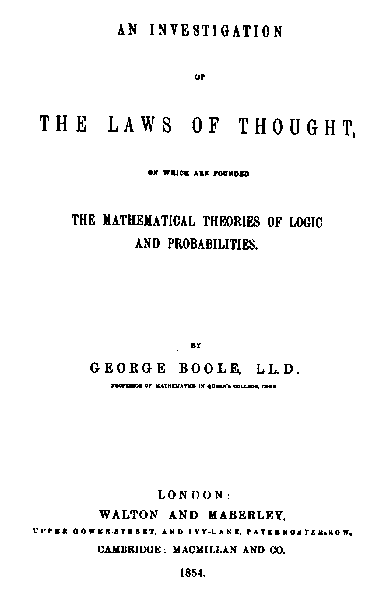
现在让我们来看看布尔最重要的著作。1854年,他出版了An investigation into the Laws of Thought, on Which are founded the Mathematical Theories of Logic and Probabilities。布尔以一种新的方式处理逻辑,将其简化为一种简单的代数,把逻辑纳入数学。他指出了代数符号与表示逻辑形式的符号之间的类比。这开创了被称为布尔代数的逻辑代数,如今在计算机结构、开关电路等方面得到应用。布尔本人理解这项工作的重要性。他在1851年1月2日写给开尔文的一封信中写道(例如见[7]):-
我现在正要认真着手准备付印一部关于我的逻辑与概率理论的著作,就其目前的状态而言,我认为这是我对科学所做或可能做出的最有价值的贡献,如果不是唯一有价值的贡献的话,也是我希望日后能被人记住的东西……
布尔还研究微分方程,有影响力的Treatise on Differential Equations于1859年问世,还研究有限差分法,Treatise on the Calculus of Finite Differences(1860年),以及probability中的一般方法。他发表了约50篇论文,是最早研究数的基本性质(如分配律)的人之一,这些性质构成了代数学科的基础。
由于他的工作才华得到认可,布尔获得了许多荣誉。他获得了都柏林大学和牛津大学的荣誉学位,并于1857年当选为皇家学会会士。然而,他的职业生涯起步较晚,却不幸过早地结束了,他在49岁时去世。Macfarlane在[18]中描述了当时的情况如下:-
1864年的一天,他从住所步行两英里到学院,途中遭遇倾盆大雨,穿着湿衣服讲课。结果他患上了寒热病,很快侵袭肺部,结束了他的职业生涯……
Macfarlane没有提到的是,玛丽·埃佛勒斯·布尔相信治疗方法应该与病因相似。她让布尔卧床,并向床上泼了几桶水,因为他的病是由淋湿引起的。
托马斯·阿彻·赫斯特这样描述布尔:-
……显然是一个真诚、能干同时又和蔼可亲的人。
他的工作受到奥古斯塔斯·德摩根的赞扬,他说:-
布尔的逻辑体系只是众多证明其天才与耐心兼备的证据之一。……代数符号运算本是为数值计算而发明的工具,竟然能够表达思维的每一个动作,并为一个无所不包的逻辑体系提供语法和词典,这在得到证明之前是无人会相信的。当托马斯·霍布斯……发表他的《计算或逻辑》时,他已隐约瞥见后来由布尔先生置于日光之下的某些要点。
布尔代数在现代计算机设计中有着广泛的应用。布尔的工作必须被视为当今计算机革命中的一个基础性步骤。
George Boole's parents were Mary Ann Joyce and John Boole. John made shoes but he was interested in science and in particular the application of mathematics to scientific instruments. Mary Ann was a lady's maid and she married John on 14 September 1806. They moved to Lincoln where John opened a cobbler's shop at 34 Silver Street. The family were not well off, partly because John's love of science and mathematics meant that he did not devote the energy to developing his business in the way he might have done. George, their first child, was born after Mary Ann and John had been married for nine years. They had almost given up hope of having children after this time so it was an occasion for great rejoicing. George was christened the day after he was born, an indication that he was a weak child that his parents feared might not live. He was named after John's father who had died in April 1815. Over the next five years Mary Ann and John had three further children, Mary Ann, William and Charles.
If George was a weak child after his birth, he certainly soon became strong and healthy. George first attended a school in Lincoln for children of tradesmen run by two Misses Clarke when he was less than two years old. After a year he went to a commercial school run by Mr Gibson, a friend of John Boole, where he remained until he was seven years old. His early instruction in mathematics, however, was from his father who also gave George a liking for constructing optical instruments. When he was seven George attended a primary school where he was taught by Mr Reeves. His interests turned to languages and his father arranged that he receive instruction in Latin from a local bookseller.
Having learnt Latin from a tutor, George went on to teach himself Greek. By the age of 14 he had become so skilled in Greek that it provoked an argument. He translated a poem by the Greek poet Meleager which his father was so proud of that he had it published. However the talent was such that a local schoolmaster disputed that any 14 year old could have written with such depth. By this time George was attending Bainbridge's Commercial Academy in Lincoln which he had entered on 10 September 1828. This school did not provide the type of education he would have wished but it was all his parents could afford. However he was able to teach himself French and German studying for himself academic subjects that a commercial school did not cover.
Boole did not study for an academic degree, but from the age of 16 he was an assistant school teacher at Heigham's School in Doncaster. This was rather forced on him since his father's business collapsed and he found himself having to support financially his parents, brothers and sister. He maintained his interest in languages, began to study mathematics seriously, and gave up ideas which he had to enter the Church. The first advanced mathematics book he read was Lacroix's Differential and integral calculus. He was later to realise that he had almost wasted five years in trying to teach himself the subject instead of having a skilled teacher. In 1833 he moved to a new teaching position in Liverpool but he only remained there for six months before moving to Hall's Academy in Waddington, four miles from Lincoln. In 1834 he opened his own school in Lincoln although he was only 19 years old.
In 1838 Robert Hall, who had run Hall's Academy in Waddington, died and Boole was invited to take over the school which he did. His parents, brothers and sister moved to Waddington and together they ran the school which had both boarding and day pupils. At this time Boole was studying the works of Laplace and Lagrange, making notes which would later be the basis for his first mathematics paper. However he did receive encouragement from Duncan Gregory who at this time was in Cambridge and the editor of the recently founded Cambridge Mathematical Journal. Boole was unable to take Duncan Gregory's advice and study courses at Cambridge as he required the income from his school to look after his parents. In the summer of 1840 he had opened a boarding school in Lincoln and again the whole family had moved with him. He began publishing regularly in the Cambridge Mathematical Journal and his interests were influenced by Duncan Gregory as he began to study algebra.
Boole had begun to correspond with De Morgan in 1842 and when in the following year he wrote a paper On a general method of analysis applying algebraic methods to the solution of differential equations he sent it to De Morgan for comments. It was published by Boole in the Transactions of the Royal Society in 1844 and for this work he received the Society's Royal Medal in November 1844. His mathematical work was beginning to bring him fame.
Boole was appointed to the chair of mathematics at Queens College, Cork in 1849. In fact he made an application for a chair in any of the new Queen's Colleges of Ireland in 1846 and in September of that year De Morgan, Kelland, Cayley, and Thomson were among those writing testimonials in support. De Morgan wrote (see for example [7]):-
I can speak confidently to the fact of his being not only well-versed in the highest branches of mathematics, but possessed of original power for their extension which gives him a very respectable rank among their English cultivators of this day.
Kelland wrote:-
From the originality of his conceptions and the extent and accuracy of his knowledge, I conceive he has few superiors in Europe ...
Boole's father died in December 1848 before the decision had been made concerning the Irish chairs but an announcement came in August 1849 that Boole was to become the first Professor of Mathematics at Queen's College, Cork, and he took up the position in November. He taught there for the rest of his life, gaining a reputation as an outstanding and dedicated teacher. However the position was not without difficulty as the College became embroiled in religious disputes. Boole wrote to De Morgan on 17 October 1850 (see for example [7]):-
... if you should hear of any situation in England that would be likely to suit me ... let me know of it. I am not terrified by the storm of religious bigotry which is at this moment raging round us here. I am not dissatisfied with my duties and I may venture to say that I am on good terms with my colleagues and with my pupils. But I cannot help entertaining a feeling ... that recent events in this College have laid the foundation of a lack of mutual trust and confidence among us ...
In May 1851 Boole was elected as Dean of Science, a role he carried out conscientiously. By this time he had already met Mary Everest (a niece of Sir George Everest, after whom the mountain is named) whose uncle was the professor of Greek at Cork and a friend of Boole. They met first in 1850 when Mary visited her uncle in Cork and again in July 1852 when Boole visited the Everest family in Wickwar, Gloucestershire, England. Boole began to give Mary informal mathematics lessons on the differential calculus. At this time he was 37 years old while Mary was only 20. In 1855 Mary's father died leaving her without means of support and Boole proposed marriage. They married on 11 September 1855 at a small ceremony in Wickwar. It proved a very happy marriage with five daughters: Mary Ellen born in 1856, Margaret born in 1858, Alicia (later Alicia Stott) born in 1860, Lucy Everest born in 1862, and Ethel Lilian born in 1864. MacHale writes [7]:-
The large gap in their ages seemed to count for nothing because they were kindred spirits with an almost complete unity of purpose.
Let us now look at Boole's most important work. In 1854 he published An investigation into the Laws of Thought, on Which are founded the Mathematical Theories of Logic and Probabilities. Boole approached logic in a new way reducing it to a simple algebra, incorporating logic into mathematics. He pointed out the analogy between algebraic symbols and those that represent logical forms. It began the algebra of logic called Boolean algebra which now finds application in computer construction, switching circuits etc. Boole himself understood the importance of the work. He wrote in a letter to Thomson dated 2 January 1851 (see for example [7]):-
I am now about to set seriously to work upon preparing for the press an account of my theory of Logic and Probabilities which in its present state I look upon as the most valuable if not the only valuable contribution that I have made or am likely to make to Science and the thing by which I would desire if at all to be remembered hereafter ...
Boole also worked on differential equations, the influential Treatise on Differential Equations appeared in 1859, the calculus of finite differences, Treatise on the Calculus of Finite Differences (1860), and general methods in probability. He published around 50 papers and was one of the first to investigate the basic properties of numbers, such as the distributive property, that underlie the subject of algebra.
Many honours were given to Boole as the genius in his work was recognised. He received honorary degrees from the universities of Dublin and Oxford and was elected a Fellow of the Royal Society (1857). However his career, which was started rather late, came to an unfortunately early end when he died at the age of 49. The circumstances are described by Macfarlane in [18] as follows:-
One day in 1864 he walked from his residence to the College, a distance of two miles, in the drenching rain, and lectured in wet clothes. The result was a feverish cold which soon fell upon his lungs and terminated his career ....
What Macfarlane fails to say is that Boole's wife believed that a remedy should resemble the cause. She put Boole to bed and threw buckets of water over the bed since his illness had been caused by getting wet.
Hirst described Boole as:-
... evidently an earnest able and at the same time a genial man.
His work was praised by De Morgan who said:-
Boole's system of logic is but one of many proofs of genius and patience combined. ... That the symbolic processes of algebra, invented as tools of numerical calculation, should be competent to express every act of thought, and to furnish the grammar and dictionary of an all-containing system of logic, would not have been believed until it was proved. When Hobbes ... published his "Computation or Logique" he had a remote glimpse of some of the points which are placed in the light of day by Mr Boole.
Boolean algebra has wide applications in the design of modern computers. Boole's work has to be seen as a fundamental step in today's computer revolution.
正文里的方括号编号指向这里,悬停即可直接看到条目。书目保留原文——译了书名反而查不到文献。
原站列出的延伸阅读与外部数据库,照原样保留,目标多为英文页面。
关于乔治·布尔的其它页面:
关于乔治·布尔的其它网站:
原站的交叉引用。指向本站已镜像专题的留在站内,其余仍指回原站。